Quick answer: Lived experience advocacy means young adults who have personally navigated homelessness, foster care, or housing instability use those experiences to shape the policies and programs that affect their peers. Across Tennessee — from Memphis to Knoxville, Nashville to Chattanooga — the Youth Action Board (YAAB) gives transition-age youth ages 17 to 25 a real seat at the table. When decision-makers hear directly from people who have lived through a system, policies get smarter, services get more useful, and fewer young people fall through the cracks.
What 'Lived Experience' Actually Means in Advocacy

Before we can talk about how lived experience strengthens advocacy, it helps to be clear about what the term actually means — and what it doesn’t. Lived experience is not a buzzword. It is a specific, recognized form of knowledge that comes from personally navigating systems like housing, child welfare, healthcare, and employment. In Tennessee’s youth homelessness space, it is the foundation of everything YAAB does.
More Than a Story — It's Expertise
A lot of people think lived experience just means telling your story. But in advocacy, lived experience is a form of expertise — one that no academic degree or policy manual can replicate. When you have personally slept in a shelter, aged out of foster care, or figured out how to keep your lights on while finishing high school, you understand the gaps in the system at a granular level that researchers and administrators simply cannot access from the outside.
In Tennessee’s Continuum of Care regions, that expertise is formally recognized. YAAB members don’t just share testimonials — they analyze data, review program designs, and give feedback on funding proposals. Their input is treated as essential, not optional.
The Difference Between Being Consulted and Having Power
There’s a big difference between being asked to share your story at a fundraiser and actually having a vote on how a program is structured. Genuine lived experience advocacy means young adults have decision-making power — not just a seat in the room, but a voice that changes outcomes.
YAAB members in Tennessee operate at both levels: they advise local Continuum of Care boards and connect directly with state legislators. That dual role — peer advocate and policy advisor — is what makes the model effective. According to the U.S. Interagency Council on Homelessness, programs co-designed with people who have lived experience of homelessness show measurably better engagement and retention rates among the populations they serve.
1. Lived Experience Exposes the Gaps Policymakers Miss

One of the most powerful things a lived experience advocate can do is point to something a spreadsheet cannot show. Policymakers work with data, reports, and program metrics — all of which are valuable, but all of which have blind spots. Young adults who have personally moved through Tennessee’s housing and social service systems can identify those blind spots in real time.
The 90-Day Rule Problem — A Real Tennessee Example
Here’s a concrete example of why lived experience matters in policy. Many rapid rehousing programs in Tennessee have historically required participants to maintain stable income within 90 days of receiving housing assistance. On paper, that sounds reasonable. In practice, a young adult who just aged out of foster care at 18, has no credit history, no rental history, and may be managing untreated trauma, often cannot meet that benchmark — and loses housing support just when they need it most.
YAAB members who had been through those programs flagged this gap directly to Continuum of Care coordinators. That feedback has contributed to ongoing conversations about extending eligibility windows and creating more flexible benchmarks for transition-age youth specifically — a change that would not have happened without insider knowledge.
Data Doesn't Always Tell the Full Story
Tennessee’s Point-in-Time (PIT) count — the annual census of people experiencing homelessness — consistently undercounts youth. Young people experiencing homelessness are more likely to be couch-surfing, staying in cars, or doubling up with friends than sleeping in a shelter where counters can find them. The 2023 Tennessee PIT count identified approximately 8,500 people experiencing homelessness statewide, but youth advocates and service providers widely agree the actual number of transition-age youth affected is significantly higher.
YAAB members help fill that data gap by sharing qualitative context — the lived reality behind the numbers — so that policymakers don’t make decisions based on incomplete pictures.
2. Peer Credibility Opens Doors That Outreach Workers Can't

There is a specific kind of trust that only comes from shared experience. When a young adult who has navigated homelessness tells a peer about a housing resource, that recommendation lands differently than the same information coming from a caseworker. This is not a criticism of caseworkers — it is a recognition that peer credibility is its own powerful tool, and one that lived experience advocates carry naturally.
Why Youth Trust Other Youth
Research consistently shows that transition-age youth experiencing homelessness are more likely to engage with services when the outreach comes from a peer — someone who has been in a similar situation — than from a professional outreach worker, no matter how skilled or well-intentioned that worker is. A 2020 study published in the American Journal of Public Health found that peer-delivered interventions for homeless youth increased service uptake by up to 34% compared to standard outreach models.
In Tennessee, YAAB members serve as that peer bridge. They show up at drop-in centers, transitional housing programs, and community events not as representatives of an institution, but as people who genuinely understand what it feels like to not know where you’re sleeping tonight.
Credibility in Both Directions
Peer credibility works in two directions. With other young people, YAAB members are trusted because they’ve been there. With policymakers and service providers, they are credible because they bring specific, verifiable knowledge about how programs actually function on the ground — not how they’re designed to function on paper.
That dual credibility is rare and valuable. It means a YAAB member can sit in a room with a county commissioner in the morning and connect a peer to a rapid rehousing referral in the afternoon. Across Tennessee’s seven Continuum of Care regions — including Memphis/Shelby County, Nashville/Davidson County, Knoxville/Knox County, Chattanooga/Hamilton County, Jackson/West Tennessee, Upper Cumberland, and Northeast Tennessee — local YAABs are doing exactly that.
3. YAAB Members Shape Real Policy — Here's How the Process Works

Advocacy without a clear pathway to influence is just venting. What makes YAAB’s model effective is that it connects young adults’ lived knowledge to actual decision-making structures — the Continuum of Care boards, state agencies, and legislative processes that determine how resources flow to transition-age youth across Tennessee.
From Local Boards to State Legislation
Tennessee’s Continuum of Care (CoC) system is the network of organizations, government agencies, and community groups that coordinate homeless services at the regional level. Each CoC region has a governing board that makes decisions about how federal HUD funding is allocated. YAAB members participate in those boards — not as guests, but as formal advisors with structured input into funding priorities and program standards.
At the state level, YAAB members have testified before Tennessee legislative committees, contributed to the development of the state’s strategic plan to end youth homelessness, and provided feedback on proposed rule changes affecting foster care and transitional housing programs. That is a direct line from lived experience to law.
The YAAB Feedback Loop
The process isn’t one-directional. YAAB members don’t just send feedback upward — they also bring information back to their communities. When a new housing program launches, or a policy changes, YAAB members help explain what that means in plain language to their peers. This feedback loop — from community to policymaker and back again — is what makes the model genuinely participatory rather than performative.
Members also track whether commitments made by policymakers are actually followed through. That accountability function is one of the most underappreciated aspects of lived experience advocacy. It’s easy for a board to say they value youth input; it’s harder to ignore a YAAB member who shows up six months later asking what happened to the recommendation they made.
4. The 7 Regions of Tennessee — and Why Local Matters

Statewide advocacy sets the direction, but local advocacy is where change actually happens in people’s daily lives. Tennessee’s seven Continuum of Care regions each have their own housing markets, service ecosystems, and political landscapes — and each needs young advocates who understand those local conditions from the inside.
One State, Seven Realities
Tennessee is not one homogeneous place. The experience of housing instability in Memphis looks different from the experience in rural Upper Cumberland or Northeast Tennessee. Urban areas like Nashville and Knoxville have larger shelter systems and more service providers, but also higher rents and longer waitlists. Rural regions often have fewer shelters but also fewer transportation options, making it harder to access services even when they exist.
That’s why YAAB operates through local boards in each of Tennessee’s seven Continuum of Care regions. Each local YAAB understands the specific landscape of their area — which shelters have beds, which landlords will work with young adults who have no rental history, which employers are actually hiring, and which local officials are open to conversation.
Regional Advocacy in Action
In Memphis/Shelby County (CoC TN-500), YAAB members have been involved in conversations about expanding low-barrier shelter access for youth. In Nashville/Davidson County (TN-501), the focus has included rapid rehousing expansion and youth-specific housing navigation. In Chattanooga/Hamilton County (TN-502) and Knoxville/Knox County (TN-503), members have worked on connecting youth to employment pipelines alongside housing stability.
In Jackson/West Tennessee (TN-504), Upper Cumberland (TN-506), and Northeast Tennessee (TN-507 and TN-509), YAAB members are often the only formal youth voice in regional CoC planning conversations — making their presence even more critical. To find your local YAAB and see what’s happening in your region, visit the local YAABs page.
5. What Lived Experience Advocacy Looks Like Day to Day

It’s worth demystifying what advocacy actually looks like in practice, because the word can sound intimidating or distant from everyday life. In reality, lived experience advocacy happens in meeting rooms, community centers, legislative hallways, and text message threads. It is both formal and informal, structured and spontaneous.
Meetings, Testimony, and Training
Day-to-day advocacy work is less dramatic than a single big speech and more like a steady accumulation of presence and input. YAAB members attend CoC planning meetings — sometimes monthly, sometimes more often — and review documents, ask questions, and provide written feedback on program proposals. They participate in training on topics like data literacy, public speaking, and policy analysis so that their advocacy is as informed and effective as possible.
When legislative sessions are active in Nashville, YAAB members may prepare written testimony, meet with legislative aides, or attend committee hearings. That kind of direct engagement with the legislative process is a skill that members build over time, and it is genuinely transferable — to careers in social work, public policy, law, community organizing, and beyond.
Peer Support and Community Connection
Advocacy also happens in informal spaces. A YAAB member who knows which shelter has a bed available tonight, or which workforce program has an open enrollment window, can share that information with a peer who needs it right now. That kind of real-time peer navigation is advocacy in its most immediate form — and it saves lives.
Members also organize community events, participate in outreach campaigns, and contribute to media and storytelling projects that shift public narratives about youth homelessness. Every op-ed written, every social media post that reframes the conversation, every panel appearance that replaces a stereotype with a real person’s experience — all of that is advocacy work.
6. The Skills You Build as a Lived Experience Advocate

Getting involved in lived experience advocacy is not just about changing policy — though it does that. It also builds a set of transferable skills and connections that can reshape your own trajectory. Young adults who join YAAB often come for the community and stay for the impact, but they leave with something they didn’t expect: a clearer sense of their own capability.
Leadership and Public Speaking
One of the most consistent things YAAB members report is that advocacy work builds confidence. Presenting to a Continuum of Care board, testifying before a legislative committee, or facilitating a community meeting are all experiences that develop public speaking, critical thinking, and leadership skills — the same skills that employers, colleges, and graduate programs value highly.
Many YAAB alumni have gone on to careers in social work, nonprofit management, public health, and policy — and they point to their YAAB experience as the foundation. The skills are real, the resume line is real, and the professional network built through YAAB is real.
Systems Knowledge and Policy Literacy
Understanding how HUD funding works, what a Coordinated Entry system is, how a CoC board makes decisions, and what rights transition-age youth have under the McKinney-Vento Act — this is systems knowledge that most people never acquire. YAAB members learn it through direct participation, and that knowledge is powerful both personally and professionally.
Policy literacy also means knowing when a proposed change is genuinely helpful versus when it is window dressing. That critical eye — the ability to read a policy proposal and identify who it actually helps and who it leaves behind — is a skill that takes time to develop and is enormously valuable in any field.
Community and Belonging
Perhaps the least-talked-about benefit of lived experience advocacy is the sense of community and belonging it creates. Homelessness and housing instability are profoundly isolating experiences. Being part of a group of peers who share similar histories, who take each other seriously, and who are working toward something meaningful together is itself a form of healing and stability.
YAAB members often describe the organization as the first place they felt genuinely heard and respected — not as a client or a case number, but as a person with knowledge and something to contribute. That matters enormously for young adults who have often experienced the opposite from institutions.
7. How to Get Involved with YAAB in Tennessee

If you’re a young adult in Tennessee who has experienced homelessness or housing instability, there is a place for you in this work. YAAB is not a program you receive services from — it is a community you join and help shape. Here’s how to take that first step.
To join YAAB Tennessee or learn more about membership, the process is straightforward and the welcome is genuine. You don’t have to have it all figured out — you just have to show up.
Who Can Join
YAAB membership is open to young adults ages 17 to 25 who have lived experience of homelessness or housing instability — including couch-surfing, doubling up, staying in shelters, living in cars, or aging out of foster care. You do not need to currently be experiencing homelessness to join. If you have been through it, your experience is relevant and your voice is needed.
You also don’t need any prior advocacy experience, policy knowledge, or public speaking skills. YAAB provides training, mentorship, and support. What you need to bring is your experience, your perspective, and a willingness to show up.
How to Connect with Your Local YAAB
Each of Tennessee’s seven CoC regions has its own local YAAB chapter. The best first step is to reach out directly through the YAAB Tennessee website. You can find contact information for your regional board, learn about upcoming meetings and events, and get connected with a member or coordinator who can walk you through what involvement looks like in your area.
If you’re a case manager, CoC partner, or service provider reading this — you can play a critical role by letting your clients and the young adults you work with know that YAAB exists and how to get involved. Warm referrals from trusted providers are one of the most effective ways young people find their way to advocacy spaces.
Lived Experience Advocacy vs. Traditional Top-Down Policy: A Side-by-Side Look
Understanding the difference between traditional policy development and lived experience advocacy helps clarify why YAAB's model produces better outcomes for transition-age youth in Tennessee.
Why Advocacy Rooted in Lived Experience Outperforms Top-Down Policy

Skeptics sometimes ask whether lived experience advocacy actually produces results, or whether it is simply a way for institutions to feel good about themselves while maintaining the status quo. The honest answer is: it depends entirely on whether institutions genuinely share power. When they do, the outcomes are measurably better. When they don’t, lived experience becomes tokenism. YAAB’s model is designed to demand the former.
The Evidence Base for Participatory Design
The case for lived experience advocacy is not just moral — it is practical and evidence-based. Participatory design research consistently shows that programs co-created with the people they serve have higher utilization rates, lower dropout rates, and better outcomes than programs designed without that input. A 2019 report from the National Alliance to End Homelessness found that youth-specific housing programs that incorporated lived experience feedback in their design were significantly more likely to achieve stable housing outcomes for participants.
In plain terms: when young people help design the programs meant to serve them, those programs actually work better. That is not a radical idea — it is basic good design. But it requires institutions to genuinely share power, not just perform inclusion.
Shifting the Narrative About Youth Homelessness
Beyond program design, lived experience advocacy shifts the public narrative. Tennessee, like most states, has a public conversation about homelessness that is often dominated by fear, stigma, and misunderstanding. Young adults who speak publicly about their experiences — on their own terms, in their own words — replace those narratives with something more accurate and more human.
That narrative shift matters for policy. Legislators who have met and listened to YAAB members vote differently on housing and social service budgets than legislators who have only encountered youth homelessness as an abstract statistic. Humanizing the issue is not soft work — it is strategic work with measurable political consequences.
Barriers Young Advocates Face — and How YAAB Addresses Them

It would be dishonest to talk about lived experience advocacy without acknowledging the real barriers that young adults face in accessing and sustaining that work. YAAB takes those barriers seriously — not as reasons to lower expectations, but as problems to solve so that more young people can participate fully and sustainably.
Practical Barriers: Transportation, Time, and Stipends
Advocacy work has real costs, and those costs fall disproportionately on people with the fewest resources. A young adult who is working two part-time jobs to keep an apartment cannot easily attend a 10 a.m. CoC board meeting without support. YAAB addresses this by advocating for — and in many cases providing — stipends for member participation, transportation assistance, and flexible meeting formats including virtual options.
Stipends are not charity — they are recognition that advocacy work has value and that young adults’ time deserves compensation, especially when the work directly benefits the institutions and communities that receive it. As of 2024, stipend practices vary by region, but YAAB continues to push for consistent compensation across all seven Tennessee CoC regions.
Emotional Barriers: Retraumatization and Burnout
Sharing your story repeatedly in professional settings — especially when that story involves trauma, loss, or instability — can be emotionally exhausting. Retraumatization is a real risk in advocacy spaces that are not thoughtfully structured. YAAB addresses this by training members on how to share their experiences strategically rather than exhaustively, by building in peer support structures, and by making clear that members are never required to share more than they choose to.
Burnout is also real. Young advocates who are simultaneously managing their own housing, employment, and educational needs cannot pour unlimited energy into advocacy without support. YAAB’s model recognizes this and works to ensure that membership is sustainable, not extractive.
Tennessee's Youth Homelessness Landscape: Key Numbers to Know

Understanding the scale of youth homelessness in Tennessee is essential context for advocacy work. Numbers give advocates credibility in policy rooms and help make the case for resources. Here are the key data points every Tennessee youth advocate should know — and the important caveats about what those numbers don’t capture.
What the Data Shows — and What It Misses
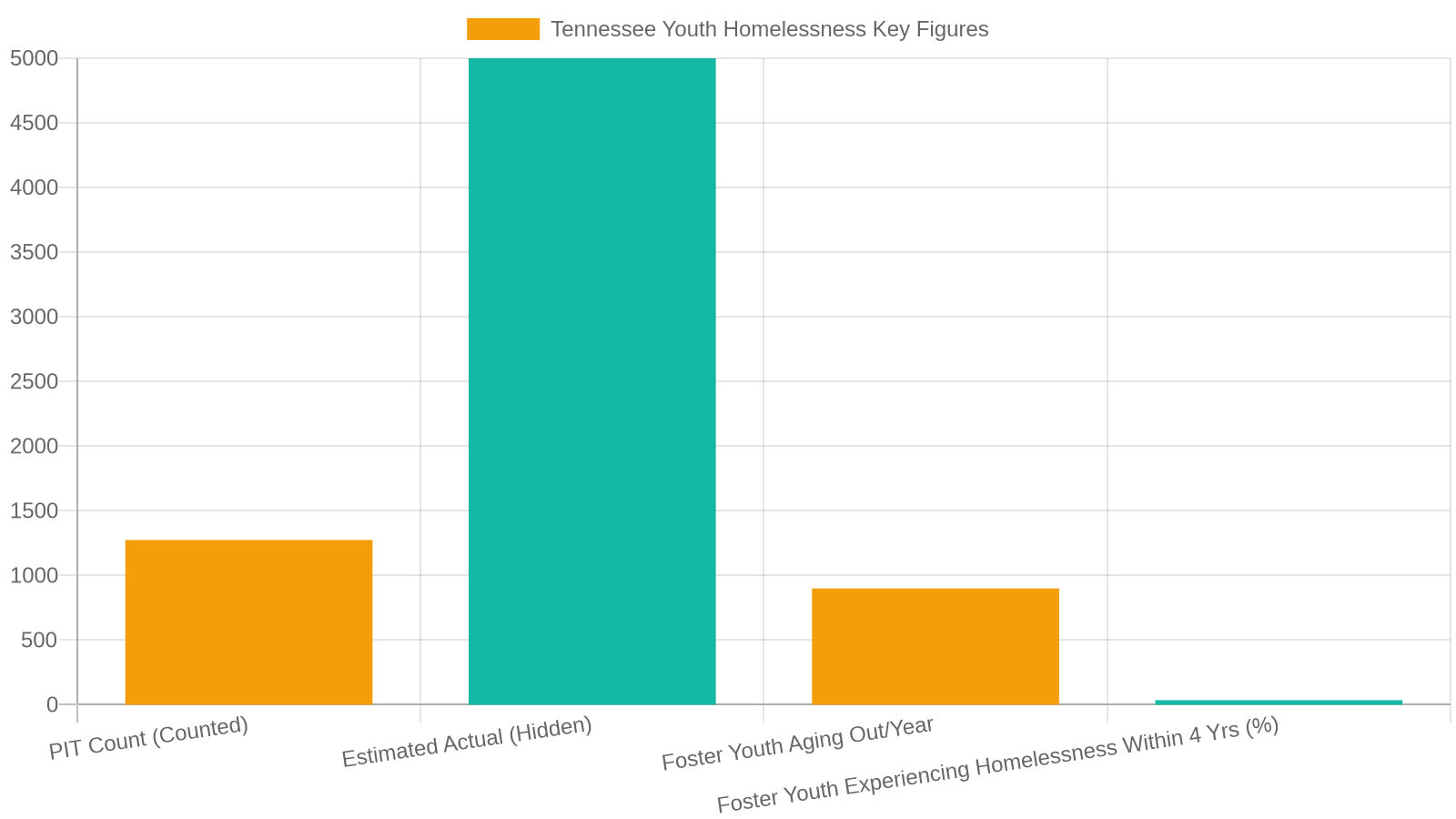
Tennessee’s 2023 Point-in-Time count identified approximately 8,500 people experiencing homelessness statewide on a single night in January. Of those, an estimated 12–15% were transition-age youth between 18 and 24 — roughly 1,000 to 1,275 individuals counted on that single night. But as noted earlier, youth homelessness is systematically undercounted because young people are more likely to be in hidden situations: couch-surfing, doubling up, or staying in places not easily found by PIT count volunteers.
The true number of Tennessee youth experiencing housing instability in any given year is likely three to five times higher than the PIT count suggests, according to estimates from youth service providers and national research on hidden homelessness among young adults.
Foster Care and the Aging-Out Pipeline
In Tennessee, approximately 800 to 1,000 young people age out of foster care each year without a permanent family connection. Nationally, research shows that within four years of aging out, approximately 36% of former foster youth experience homelessness. Tennessee’s numbers track closely with national trends.
Young people aging out of foster care are one of YAAB’s core constituencies — and one of the clearest examples of how policy failures create housing instability. When the state stops providing support at age 18 (or 21 for those in extended care), many young adults have no family safety net, no savings, no rental history, and no established credit. Advocacy for extended foster care support and stronger transitional housing programs is a central YAAB priority.
Stay Connected, Stay Informed — Your Next Move

You’ve read this far, which means you care about this work — whether you’re a young adult thinking about getting involved, a service provider looking to better support your clients, or a community member who wants to understand what lived experience advocacy actually looks like in Tennessee. Here’s where to go from here.
Resources, Stories, and Updates from Across Tennessee
Advocacy is not a one-time event — it’s an ongoing practice. Staying connected to what’s happening across Tennessee’s seven CoC regions, learning from other young advocates, and keeping up with policy changes are all part of sustaining effective advocacy over time. The YAAB Tennessee blog is one of the best places to do that — it features stories from members, updates on policy developments, resources for transition-age youth, and perspectives from across the state.
Whether you’re a young adult figuring out your first step, a case manager looking for resources to share with clients, or a CoC partner wanting to understand how to better incorporate lived experience into your work, the blog is a resource built for you.
Take the First Step Today
If you’re a young adult in Tennessee — in Memphis, Nashville, Knoxville, Chattanooga, Jackson, the Upper Cumberland, or Northeast Tennessee — and you have lived experience of homelessness or housing instability, your voice belongs in this work. You don’t have to have it all figured out. You just have to be willing to show up.
Explore the YAAB resources page for housing, employment, and education tools. Learn more about the organization’s mission and impact at About YAAB. And when you’re ready, reach out — because the strongest advocacy Tennessee has ever seen is being built right now, by young people just like you.
Frequently Asked Questions
What is lived experience advocacy and how is it different from regular advocacy?
Lived experience advocacy means that people who have personally navigated a system — like homelessness, foster care, or housing instability — use that firsthand knowledge to shape policies and programs. It's different from traditional advocacy because the knowledge comes from direct experience, not just research or professional training, which makes it harder to dismiss and more accurate about real-world gaps.
Who can join the Youth Action Board in Tennessee?
YAAB membership is open to young adults ages 17 to 25 who have lived experience of homelessness or housing instability, including couch-surfing, doubling up, staying in shelters, or aging out of foster care. You don't need prior advocacy experience — YAAB provides training and support.
Does YAAB operate in my city or region of Tennessee?
Yes. YAAB has local boards in all seven of Tennessee's Continuum of Care regions: Memphis/Shelby County, Nashville/Davidson County, Chattanooga/Hamilton County, Knoxville/Knox County, Jackson/West Tennessee, Upper Cumberland, and Northeast Tennessee. Visit the YAAB local YAABs page to find your regional chapter.
Do YAAB members get paid or compensated for their advocacy work?
Stipend practices vary by region, but YAAB actively advocates for consistent compensation across all seven Tennessee CoC regions. The principle is clear: young people's time and expertise have value, and participation should not require financial sacrifice.
How does youth homelessness in Tennessee compare to national trends?
Tennessee's 2023 Point-in-Time count identified approximately 8,500 people experiencing homelessness statewide, with an estimated 12–15% being transition-age youth. Like nationally, Tennessee significantly undercounts youth homelessness because young people are more likely to be in hidden situations like couch-surfing. Approximately 800–1,000 Tennessee youth age out of foster care annually, and roughly 36% experience homelessness within four years — consistent with national data.
I'm a case manager or service provider. How can I connect my clients to YAAB?
Warm referrals from trusted providers are one of the most effective ways young people find YAAB. You can direct clients to yaabtn.org, share information about local YAAB chapters in your region, and encourage eligible young adults to attend an introductory meeting. YAAB welcomes CoC partners who want to help build the pipeline of engaged youth advocates.