Quick answer: Central Tennessee YAAB members ages 17 to 25 can access job training and employment services in Nashville through a network of Workforce Essentials programs, Tennessee Career Centers, nonprofit workforce partners, paid apprenticeships, and peer-led advocacy pathways. Many programs are free, offer stipends, and are designed specifically for young adults with lived experience of homelessness or housing instability. Whether you want a trade certificate, a first paycheck, or a seat at the policy table, Nashville's CoC region (TN-503) has real, accessible options built for you.
Why Employment Is a Housing Issue for Transition-Age Youth

Before diving into specific programs, it helps to understand why employment services are built into Nashville’s homeless response system in the first place. For transition-age youth, housing and employment are not separate problems — they are the same problem viewed from different angles. Stable income unlocks stable housing; stable housing makes it possible to hold a job. Central Tennessee’s Continuum of Care (CoC) region, TN-503, has structured its youth services to address both simultaneously.
The Income-Housing Connection
For young adults ages 17 to 25 experiencing homelessness or housing instability in Tennessee, a job is rarely just a job — it is often the single fastest path to stable housing. Research from the National Alliance to End Homelessness consistently shows that income instability is the leading driver of youth homelessness, and that securing even part-time employment reduces the risk of returning to homelessness by more than 40%.
In Nashville’s Davidson County, the fair-market rent for a one-bedroom apartment sits at approximately $1,247 per month (HUD FY 2024 data). At Tennessee’s minimum wage of $7.25 per hour, a full-time worker earns roughly $1,160 per month before taxes — a gap that makes employment quality, not just employment itself, the real goal.
What YAAB Members Already Know
YAAB members bring lived expertise that most workforce programs overlook: navigating systems without a permanent address, managing ID barriers, and balancing survival needs while trying to build a future. That experience is not a deficit — it is a skill set. Programs that recognize this tend to produce better outcomes, which is exactly why Central Tennessee’s CoC region (TN-503) has invested in youth-specific employment pipelines that meet young adults where they are.
- Barrier-aware: The best Nashville programs waive ID requirements or help you get documents first.
- Stipend-supported: Many training programs pay you to participate, so you are not choosing between food and a future.
- Credential-focused: Short-term certificates (8–16 weeks) in trades, healthcare, and tech are prioritized over multi-year degrees.
1. Tennessee Career Centers: Your First Stop in Nashville

If you are in Nashville and need to start somewhere, Tennessee Career Centers are the front door to most publicly funded job training in the region. They are free, barrier-aware, and connected to the federal WIOA Youth funding that can pay for your training and provide supportive stipends while you learn. Here is what to expect and how to make the most of your first visit.
What Tennessee Career Centers Offer
Tennessee Career Centers (formerly called American Job Centers) are free, publicly funded workforce hubs operated through the Tennessee Department of Labor and Workforce Development. Nashville has two primary locations: the Donelson Career Center (2416 Murfreesboro Pike) and the Downtown Nashville Career Center (500 James Robertson Pkwy, Suite 1200). Both are open Monday through Friday, 8 a.m. to 4:30 p.m., and no appointment is required for walk-in services.
Services available at no cost include: résumé writing assistance, job search computers and printing, interview coaching, labor market data, and referrals to paid training programs. Staff can also connect you to WIOA Title I Youth funding — federal dollars specifically set aside for young adults ages 16 to 24 who face barriers to employment.
WIOA Youth Program: The Key to Paid Training
The Workforce Innovation and Opportunity Act (WIOA) Youth Program is the most important funding stream for transition-age youth in Nashville. Eligibility is straightforward: you must be ages 16 to 24, and you must face at least one defined barrier — homelessness or housing instability automatically qualifies you. Once enrolled, WIOA can cover:
- Tuition for short-term certificate programs at Tennessee College of Applied Technology (TCAT) Nashville
- Supportive service payments (up to $300/month in some cases) for transportation, work clothes, and tools
- Paid work experiences and on-the-job training stipends
- Follow-up services for 12 months after you complete the program
Ask specifically for the WIOA Youth Coordinator when you walk in — not every front-desk staffer will automatically route you to youth-specific funding.
2. TCAT Nashville: Short-Term Trade Certificates That Pay

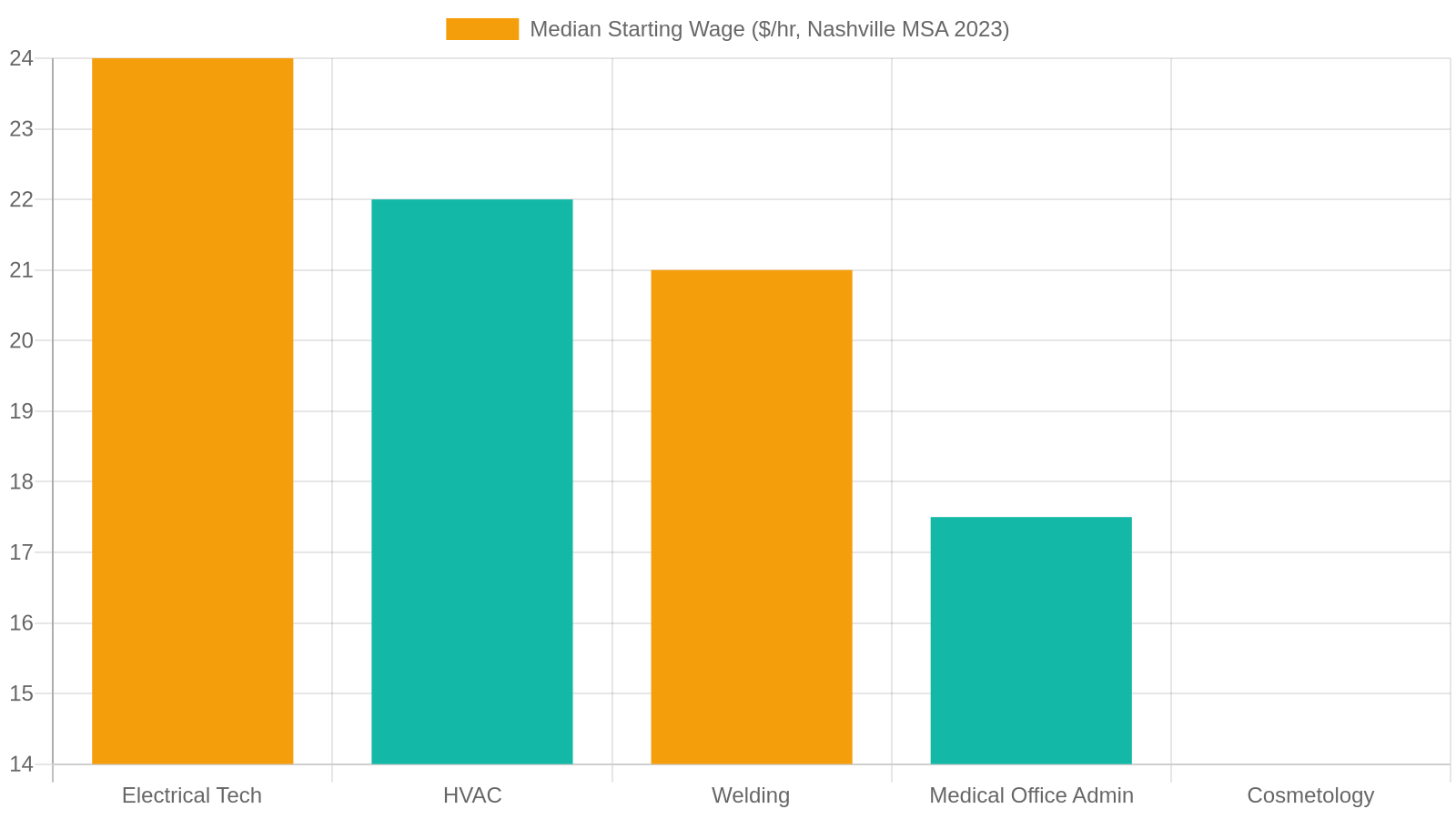
For young adults who want a credential and a paycheck within a year, TCAT Nashville is one of the most direct pathways available in Central Tennessee. Trade certificates in fields like electrical, HVAC, and welding open doors to careers where starting wages in Nashville significantly outpace minimum wage — and where demand for workers is consistently high regardless of economic conditions.
High-Demand Programs Under 12 Months
The Tennessee College of Applied Technology (TCAT) Nashville campus, located at 100 White Bridge Road, offers diploma and certificate programs in trades and technical fields that typically run 9 to 12 months. Many can be covered entirely by WIOA Youth funding or Tennessee Reconnect grants, meaning zero out-of-pocket cost for eligible students. High-demand programs include:
- Electrical Technology — median starting wage in Nashville: $22–$26/hr
- Heating, Ventilation, and Air Conditioning (HVAC) — median starting wage: $20–$24/hr
- Medical Office Administration — median starting wage: $16–$19/hr
- Welding Technology — median starting wage: $19–$23/hr
- Cosmetology — flexible scheduling, state-licensed credential
All wages reflect Tennessee Department of Labor occupational data for the Nashville-Davidson-Murfreesboro MSA, 2023.
How to Enroll Without a Permanent Address
One of the most common barriers YAAB members report is the assumption that you need a fixed address to enroll in school. TCAT Nashville works with students experiencing housing instability — you can use a shelter address, a case manager’s address, or a P.O. box for enrollment purposes. The admissions office (615-425-5500) has staff familiar with housing-unstable applicants. Bring whatever ID you have; if you lack documents, ask your WIOA Youth Coordinator to connect you to Tennessee’s ID Voucher Program before your enrollment appointment.
Financial aid processing takes 2 to 4 weeks, so apply early. In the meantime, your WIOA coordinator can issue a training authorization letter that allows TCAT to hold your seat while funding is confirmed.
3. Workforce Essentials and Youth Employment Programs

Workforce Essentials is the backbone of Nashville’s publicly funded youth employment system. If you have been told you have too many barriers to get a job, Workforce Essentials was literally designed for you. Their programs combine real paychecks with the support structures — transportation, tutoring, mentoring — that make it possible to succeed.
Workforce Essentials: Nashville's WIOA Operator
Workforce Essentials, Inc. is the primary WIOA service provider for the Nashville region and operates several youth-specific programs under contract with the Greater Nashville Regional Council. Their Youth Program serves ages 16 to 24 and is explicitly designed for young people facing barriers including homelessness, foster care aging-out, justice involvement, and disability. Services include:
- Individual career planning and goal-setting
- Paid work-based learning experiences (you earn while you learn, typically at or above minimum wage)
- Tutoring and help earning a high school equivalency (HiSET/GED)
- Driver’s license assistance and transportation support
- Leadership development and mentoring
Workforce Essentials can be reached at their Nashville office at (615) 771-6900. Walk-ins are welcome at Tennessee Career Centers, where Workforce Essentials staff are co-located.
Summer Youth Employment and Year-Round Opportunities
Each year, Metro Nashville and Workforce Essentials co-fund a Summer Youth Employment Program (SYEP) that places hundreds of young adults in paid positions with local employers and nonprofits. Participants ages 16 to 24 earn at least minimum wage for 6 to 8 weeks, with priority given to youth experiencing homelessness or housing instability. Applications typically open in March and April for summer placements — mark your calendar and ask your case manager or YAAB peer to help you apply early, as slots fill fast.
Year-round paid work experiences are also available through Workforce Essentials for young adults who cannot wait for summer. These placements run 3 to 6 months and are structured as on-the-job training, meaning the employer receives a wage subsidy and you receive a paycheck and a reference.
4. Nonprofit Workforce Partners Serving Nashville Youth

Government programs are not the only game in town. Nashville has a strong network of nonprofit workforce partners who serve transition-age youth with a whole-person approach — meaning they understand that you cannot focus on a job interview if you do not know where you are sleeping tonight. These organizations often have more flexibility than government programs and can move faster to connect you with resources.
Oasis Center: Holistic Youth Employment Support
Oasis Center (1221 16th Ave S, Nashville) is one of Tennessee’s most established youth-serving nonprofits and a key partner in the TN-503 Continuum of Care. Their workforce programs for transition-age youth include job readiness workshops, résumé coaching, employer connections, and transitional employment for young adults coming out of homelessness. Oasis also operates emergency shelter and housing programs, meaning staff can address housing and employment barriers in the same conversation — a huge advantage for youth juggling both crises simultaneously.
Oasis Center’s employment services are free and do not require a referral. Walk-in hours are available; call (615) 327-4455 to confirm current scheduling. Youth who are also connected to Oasis housing programs receive priority access to employment coaching.
Other Key Nonprofit Partners in Nashville
Nashville’s nonprofit ecosystem includes several other organizations offering employment pathways specifically relevant to transition-age youth:
- The Next Door — employment and life-skills programming for women ages 18+, including those with justice involvement
- Nashville GRAD — a city-funded initiative connecting disconnected youth to jobs and education, with a focus on ages 16 to 24
- Conexión Américas — bilingual workforce services for Latinx youth and young adults in Nashville
- Thistle Farms — social enterprise employment for survivors of trafficking and exploitation, ages 18+
- Goodwill Industries of Middle Tennessee — free job training, résumé help, and employer connections at multiple Nashville locations
Many of these organizations are formal CoC partners and can provide warm referrals to housing services if you need them alongside employment support.
5. Apprenticeships and Earn-While-You-Learn Pathways

Apprenticeships are one of the best-kept secrets in Nashville’s workforce system for young adults who want to earn real money without taking on student debt. You get paid from day one, you build skills, and you end up with a credential — all at the same time. For transition-age youth who cannot afford to go to school without income, this model is a game-changer.
Registered Apprenticeships in Middle Tennessee
A Registered Apprenticeship is a federally recognized earn-while-you-learn model: you work for an employer, earn a real wage from day one, and receive on-the-job training plus classroom instruction — all without paying tuition. In Middle Tennessee, registered apprenticeships are available in construction trades, healthcare, advanced manufacturing, and information technology. The Tennessee Department of Labor’s ApprenticeshipTN program (apprenticeshiptn.com) lists all active openings and allows you to apply directly.
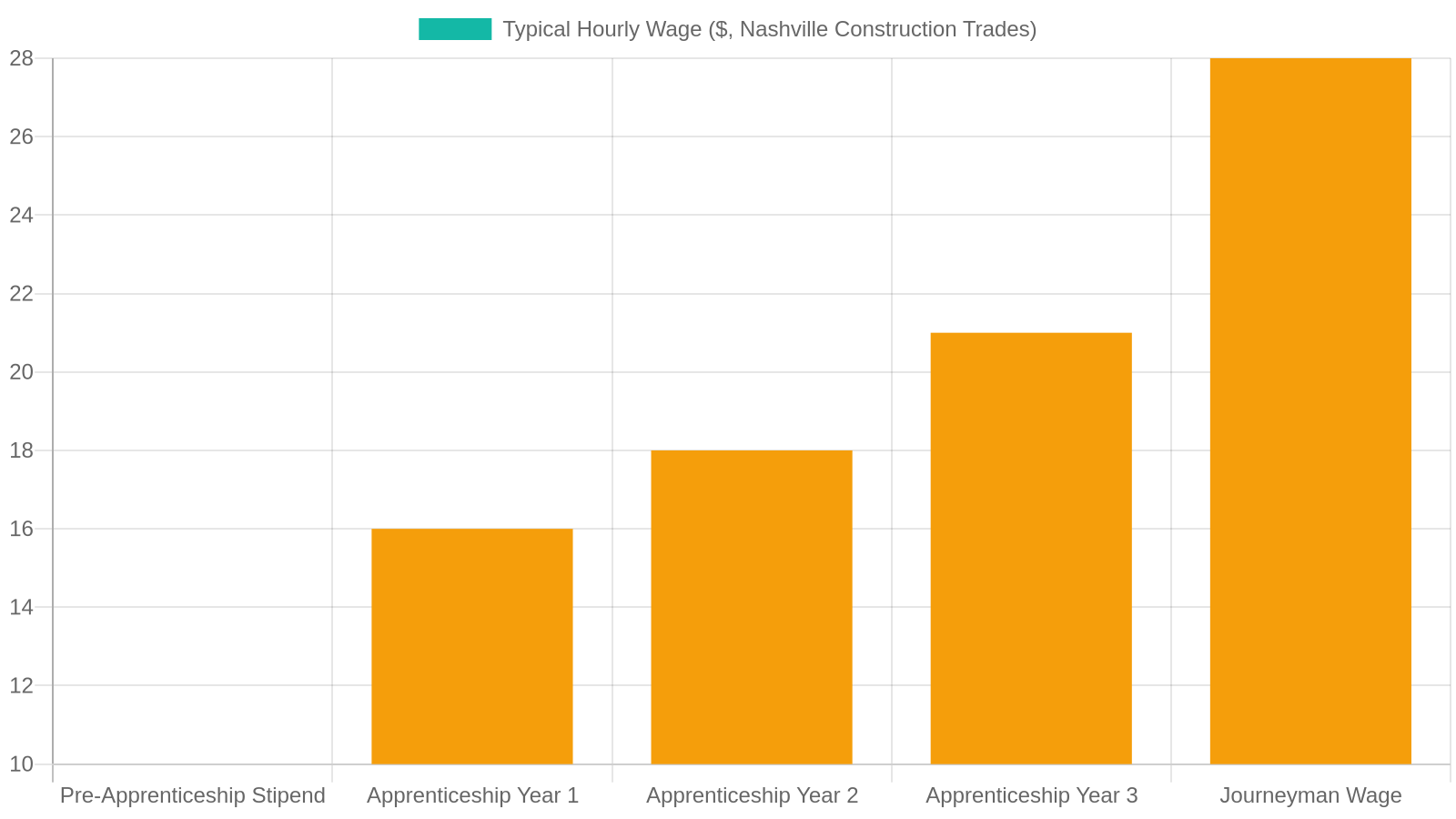
Starting wages for apprentices in Nashville typically range from $14 to $20 per hour, increasing as you advance through the program. Most apprenticeships run 1 to 4 years and end with a nationally portable credential recognized by employers across the country.
Pre-Apprenticeship Programs for Youth With Barriers
If you are not quite ready for a full apprenticeship, pre-apprenticeship programs bridge the gap. Nashville’s Building and Construction Trades Council partners with local nonprofits to offer pre-apprenticeship training specifically for young adults from underserved communities, including those with housing instability. These programs typically run 8 to 12 weeks, pay a training stipend, and provide a direct pathway into a union apprenticeship upon completion.
The Tennessee Pre-Apprenticeship Initiative, coordinated through the state Department of Labor, also funds slots specifically for WIOA-eligible youth — meaning your WIOA coordinator at a Tennessee Career Center can refer you and cover costs. Ask explicitly about pre-apprenticeship referrals; not all coordinators proactively offer this option.
6. Digital Skills and Tech Pathways for Nashville Youth

Nashville’s growing tech economy is not just for people who went to elite universities. Short-term digital credentials are opening doors to $40,000+ careers for young adults who are willing to invest a few months in focused training. And many of the best starting points are completely free — a fact that is not advertised nearly enough.
CodeTN and Free Tech Training
Tennessee’s CodeTN initiative and its successor programs offer free or heavily subsidized coding bootcamps and IT certificate pathways for residents ages 18 and older. Nashville’s tech sector has grown dramatically — the city added more than 12,000 tech jobs between 2018 and 2023 (Nashville Technology Council) — and entry-level IT support, cybersecurity, and data roles are accessible with short-term credentials rather than four-year degrees.
Specifically relevant for YAAB members: CompTIA A+ and Google IT Support certificates can be earned in as few as 3 to 6 months through self-paced online platforms like Coursera (free with Tennessee library card access) or through structured bootcamps at Nashville Software School and Vanderbilt’s coding programs. Starting salaries for IT support specialists in Nashville average $40,000 to $52,000 per year (BLS, 2023).
Digital Literacy as a Foundation
Before advanced tech training, some young adults need foundational digital literacy — basic computer skills, email, and Microsoft Office proficiency. Nashville Public Library’s Digital Literacy Lab (615 Church St, main branch) offers free classes and open computer lab hours seven days a week. No library card is required to attend classes. Library staff can also help you set up a professional email address and access free online learning platforms.
For young adults experiencing homelessness, the library is also a safe, climate-controlled space to job search, complete online applications, and charge devices. The Nashville Public Library has a formal partnership with the Metro Homelessness Commission and trains staff to connect patrons to housing resources without judgment.
Nashville Job Training Pathways: 6-Point Comparison
Every program has different strengths. Use this table to find the option that fits your situation right now — not where you hope to be, but where you actually are today.
7. Overcoming the Most Common Employment Barriers

Knowing that programs exist is only half the battle. The other half is getting through the doors when real-world barriers — missing documents, a criminal record, no transportation — stand in the way. Every one of these barriers has a workaround, and Nashville’s CoC system has resources specifically to help you navigate them. Here are the three most common ones and how to address each.
ID and Documentation Barriers
Lacking a state ID, Social Security card, or birth certificate is one of the most frequently cited barriers YAAB members face when trying to access employment. Tennessee law allows you to obtain a Tennessee Identification Card at any Driver Services Center. If you cannot afford the $8 fee, the Tennessee ID Voucher Program — administered through many CoC-partner nonprofits — covers it. Organizations like Oasis Center, Room in the Inn, and the Nashville Rescue Mission can issue vouchers or connect you to the process.
For a birth certificate, Tennessee Vital Records (615-741-1763) charges $15 for the first copy. Many CoC case managers have emergency funds to cover this cost — ask directly. Once you have a birth certificate and Social Security card, getting a state ID typically takes less than one business day.
Criminal Record and Background Check Barriers
A criminal record does not automatically disqualify you from employment in Nashville. Tennessee’s Ban the Box policy prohibits most public employers from asking about criminal history on initial job applications, and many private employers have adopted similar policies. For young adults with juvenile records, Tennessee law provides for automatic expungement of most juvenile offenses at age 18 — a fact that many youth are never told.
For adult records, Tennessee’s expungement process can clear many misdemeanors and some felonies. Legal Aid Society of Middle Tennessee (615-244-6610) provides free expungement clinics in Nashville. Getting a record cleared can dramatically expand your employment options and is worth pursuing even if it takes a few months.
Transportation Barriers
Nashville’s public transit system (WeGo Public Transit) covers much of Davidson County, with fares at $2 per ride or $65 per month for an unlimited pass. WIOA Youth supportive services can cover transit costs for enrolled participants. Several nonprofits also offer free bus passes for job seekers — ask your case manager or Tennessee Career Center coordinator. For young adults in outlying areas of the TN-503 region, some programs offer gas cards or rideshare credits as supportive services.
How YAAB Membership Itself Builds Your Résumé

Here is something that does not get said enough: being a YAAB member is work, and it counts as work experience. If you are already involved with your local YAAB — or considering joining — you are building a professional portfolio at the same time you are advocating for your peers. That combination is genuinely rare and genuinely valuable in today’s job market.
Leadership Experience That Employers Recognize
Participation in the Youth Action Board is not just advocacy — it is documented, transferable work experience. YAAB members regularly present to government bodies, facilitate community meetings, conduct peer outreach, analyze policy proposals, and collaborate with professional stakeholders across Tennessee’s Continuum of Care. These are skills that employers in nonprofit management, government, social services, healthcare, and community development actively recruit for.
On a résumé, YAAB participation can be listed as a volunteer leadership role with specific accomplishments: ‘Presented housing policy recommendations to the Davidson County CoC board,’ or ‘Facilitated peer focus groups informing statewide youth homelessness strategy.’ Ask your YAAB coordinator to provide a letter of participation that documents your contributions — this functions like a professional reference.
Stipends, Training, and Peer Networks
Many YAAB activities come with stipends for participation, recognizing that young adults’ time and expertise have real value. Beyond stipends, YAAB membership connects you to a peer network of young adults across Tennessee who are navigating the same systems — and who share job leads, program tips, and moral support. This peer network is one of the most underrated employment resources available to transition-age youth in the state.
YAAB also provides access to training in public speaking, policy analysis, and community organizing — skills that translate directly into careers in advocacy, social work, public administration, and community health. Several former YAAB members across Tennessee have gone on to paid positions with the very organizations they once navigated as clients.
Program Comparison: Nashville Job Training Options at a Glance

Choosing the right program depends on your goals, your timeline, and the barriers you are working through. The table below compares Nashville’s main job training pathways across the factors that matter most to transition-age youth: cost, time to completion, whether you get paid during training, and whether the program is specifically designed for youth with barriers.
Ready to Take Your Next Step in Nashville?

You have read through seven pathways, a full list of barrier solutions, and a comparison of every major program in Nashville. Now the most important step is the simplest one: pick one thing and do it today. Whether that is walking into a Tennessee Career Center, calling Oasis Center, or connecting with your Central Tennessee YAAB peers — momentum matters more than having a perfect plan.
Start With Your Local YAAB
If you are a young adult ages 17 to 25 in the Nashville or Davidson County area, your local YAAB is one of the best first calls you can make. YAAB members are peers — people who have been where you are and who know which programs actually deliver and which ones waste your time. The Central Tennessee YAAB (TN-503) is active across the Nashville region and connected to the full network of CoC partners, employment programs, and advocacy opportunities described in this article.
You can learn more and connect with the Central Tennessee YAAB at the TN-503 local YAAB page — find out about upcoming meetings, how to get involved, and what peer support looks like in your area. Joining is free, and you do not need to have your life figured out to show up.
Additional Resources and Next Steps
Beyond your local YAAB, here are concrete next steps you can take this week:
- Walk into a Tennessee Career Center and ask for the WIOA Youth Coordinator — bring whatever ID you have.
- Call Oasis Center at (615) 327-4455 to ask about employment coaching and whether you qualify for housing support at the same time.
- Visit Nashville Public Library’s Digital Literacy Lab to access free computers, job search tools, and digital skills classes.
- Check ApprenticeshipTN.com for current apprenticeship openings in Middle Tennessee.
- Explore the full range of statewide resources on the YAAB Tennessee resources page — including housing, education, and mental health supports alongside employment.
You do not have to navigate this alone. Tennessee’s CoC system, YAAB peer network, and nonprofit partners are all designed to support you — and the young adults who have come before you have helped shape those systems to be more responsive to your real needs. That is the power of youth-led advocacy, and it is ongoing work you can be part of.
Frequently Asked Questions
What job training programs in Nashville are free for young adults experiencing homelessness?
Several programs are completely free for young adults ages 16 to 24 who are experiencing homelessness or housing instability. These include WIOA Youth services at Tennessee Career Centers, TCAT Nashville certificate programs (covered by WIOA or Tennessee Reconnect), Workforce Essentials paid work experiences, and employment coaching at Oasis Center. Homelessness automatically qualifies you for WIOA Youth funding.
Can I enroll in job training in Nashville if I don't have a permanent address?
Yes. Programs like TCAT Nashville and Tennessee Career Centers accept shelter addresses, case manager addresses, or P.O. boxes for enrollment. If you lack a state ID, the Tennessee ID Voucher Program — available through many CoC-partner nonprofits — can cover the $8 fee. Bring whatever documentation you have and ask staff specifically about housing-unstable enrollment options.
How do I join the Central Tennessee YAAB in Nashville?
You can connect with the Central Tennessee YAAB (TN-503) through the YAAB Tennessee website at yaabtn.org/local-yaabs/tn-503/. YAAB is open to young adults ages 17 to 25 with lived experience of homelessness or housing instability. Joining is free, and you do not need to have stable housing or a job to participate.
Does a criminal record prevent me from getting job training or employment in Nashville?
Not necessarily. Tennessee's Ban the Box policy prevents most public employers from asking about criminal history on initial applications. Many private employers have similar policies. Juvenile records are often automatically expunged at age 18 in Tennessee. Legal Aid Society of Middle Tennessee (615-244-6610) offers free expungement clinics that can help clear eligible adult records.
What is the fastest way to start earning money through a Nashville job training program?
The fastest pathways to a paycheck are Workforce Essentials paid work experiences (which can place you in a paid position within weeks), Summer Youth Employment Program slots (which pay minimum wage or above for 6 to 8 weeks), and YAAB participation stipends. Apprenticeships also pay from day one, with starting wages of $14 to $20 per hour in many Nashville-area trades.
What is the WIOA Youth Program and how do I apply in Nashville?
The Workforce Innovation and Opportunity Act (WIOA) Youth Program is a federally funded program for ages 16 to 24 that covers job training costs, provides supportive stipends, and connects you to paid work experiences. In Nashville, it is administered through Tennessee Career Centers and Workforce Essentials. Walk into any Tennessee Career Center location and ask for the WIOA Youth Coordinator — homelessness or housing instability automatically qualifies you.