Quick answer: The Tennessee Youth Action Board (YAAB) is a statewide network of young adults ages 17 to 25 who have personally experienced homelessness or housing instability. YAAB's mission is to put those lived experiences at the center of policy decisions, program design, and resource allocation across Tennessee's Continuum of Care regions — covering Memphis, Nashville, Knoxville, Chattanooga, Jackson, Upper Cumberland, and Northeast Tennessee. Members advise local and state leaders, advocate for systemic change, and connect peers to housing, employment, education, and mental health services. The goal is simple: young people who've lived it should lead the solutions.
What Is the Tennessee Youth Action Board?

The Youth Action Board of Tennessee (YAAB) is a statewide peer-led network of young adults ages 17 to 25 who have experienced homelessness or housing instability firsthand. Founded to give transition-age youth a genuine seat at the table, YAAB operates across all of Tennessee’s Continuum of Care regions — from Memphis and Shelby County to Northeast Tennessee. The organization sits at the intersection of advocacy, policy, and peer support, and it is entirely driven by the people it represents.
A Network Built on Lived Experience
YAAB is not a program that serves young people from the outside — it is young people, leading from the inside. Every member has personally navigated homelessness, housing instability, aging out of foster care, or some combination of all three. That lived experience is not a footnote; it is the entire point. When a policymaker or service provider wants to understand what transition-age youth actually need, YAAB members are the authoritative voice in the room.
The network spans eight Continuum of Care (CoC) regions across Tennessee, meaning YAAB’s reach is genuinely statewide — not concentrated in one city. Whether you’re in Memphis or Mountain City, there is a regional YAAB chapter working on issues that affect your community.
Who Can Be a YAAB Member?
Membership is open to young adults ages 17 to 25 who have experienced homelessness or housing instability at some point in their lives. You do not need to be currently unhoused to join. YAAB specifically welcomes:
- Youth aging out of the foster care system
- Young adults who have stayed in shelters, transitional housing, or couch-surfed
- Peers who want to turn their experience into advocacy and leadership
- Young people connected to CoC partner agencies who want a bigger voice
There is no GPA requirement, no application essay, and no prior advocacy experience needed. If you’ve lived it, your perspective matters here.
The Core Mission: Centering Lived Experience in Policy

At its core, YAAB’s mission is to ensure that young adults with lived experience of homelessness and housing instability are central to — not peripheral to — every decision that affects transition-age youth in Tennessee. That means being present in the rooms where policy is written, budgets are set, and programs are designed. It means translating personal experience into systemic change.
Why 'Nothing About Us Without Us' Matters
For decades, housing and homelessness policy was designed for young people by adults who had never experienced what those young people were going through. The results were predictable: programs that didn’t fit real needs, shelters with rules that pushed people away, and services that expired the moment someone turned 18 or 21. YAAB exists to break that cycle.
The phrase ‘Nothing About Us Without Us’ is a guiding principle across disability and youth advocacy movements, and it applies directly here. Decisions about youth shelter beds, transitional housing funding, and CoC priorities should not happen without the input of people who have slept in those beds and navigated those systems. YAAB makes that input structural — not just a one-time focus group, but an ongoing advisory presence.
Shaping Policy at the Local and State Level
YAAB members do not just give feedback — they actively shape outcomes. Across Tennessee’s eight CoC regions, YAAB representatives participate in:
- Continuum of Care governance meetings, where funding priorities and program standards are set
- State-level policy conversations with Tennessee Housing Development Agency (THDA) and other agencies
- Local advisory boards for shelters, transitional housing programs, and youth service providers
- Legislative advocacy during Tennessee’s General Assembly session
This is real decision-making power, not symbolic participation. When YAAB members speak, they are changing how millions of dollars in housing resources get allocated.
YAAB's 8 Regional Chapters Across Tennessee
One of YAAB’s most important structural features is its regional presence across all eight of Tennessee’s Continuum of Care areas. Rather than operating as a single Nashville-based organization that speaks for the whole state, YAAB has local chapters rooted in each region — so the voices shaping policy are the voices of people who actually live there.
How the Continuum of Care Regions Work
Tennessee is divided into eight Continuum of Care (CoC) regions, each of which receives federal HUD funding to coordinate housing and homeless services in its geographic area. A CoC is essentially a local planning body made up of shelters, housing agencies, government offices, and community organizations that work together to address homelessness in their region.
YAAB has a chapter embedded in each CoC region, which means young people have a peer-led voice in every one of these planning bodies. The regional structure matters because homelessness looks different in Memphis than it does in Cookeville or Johnson City — local YAAB chapters can address those differences with specific, grounded knowledge.
The Eight YAAB Regions at a Glance
Here’s how Tennessee’s CoC regions map to YAAB’s local chapters:
- TN-500: Memphis / Shelby County
- TN-501: Nashville / Davidson County
- TN-502: Knoxville / Knox County
- TN-503: Chattanooga / Hamilton County
- TN-504: Jackson / West Tennessee
- TN-506: Upper Cumberland
- TN-507: Northeast Tennessee
- TN-509: Balance of State
Each chapter operates with regional autonomy while staying connected to the statewide YAAB network, sharing resources, strategies, and advocacy wins across all eight regions. You can find your local YAAB chapter and connect with peers in your area.
Goal 1 — Amplify Youth Voice in Housing Decisions

The first and most foundational goal of YAAB is straightforward: make sure young people’s voices are not just heard but structurally embedded in the decisions that shape their lives. This means more than attending a meeting — it means holding voting seats, shaping agendas, and ensuring that youth perspective is a non-negotiable part of every housing decision in Tennessee.
Participating in CoC Governance
Every Continuum of Care in Tennessee holds regular planning meetings where member organizations vote on funding priorities, program standards, and local homeless response strategies. These meetings have historically been dominated by adult service providers and government officials. YAAB changes that dynamic by placing young adults with lived experience directly on CoC committees and boards.
This is not just about having a seat — it’s about having a voice that is heard and acted upon. YAAB members receive training in CoC governance, HUD funding processes, and advocacy skills so they can participate as fully informed partners, not just token representatives.
Training Youth to Speak Policy Language
One barrier young people face in policy spaces is unfamiliar language — terms like ‘Point-in-Time Count,’ ‘Coordinated Entry,’ ‘Rapid Rehousing,’ and ‘Permanent Supportive Housing’ can feel like a foreign language. YAAB invests in peer education and leadership development so members can navigate these systems confidently.
Members learn how to:
- Read and respond to HUD Notices of Funding Opportunity (NOFOs)
- Give public comment at CoC meetings and legislative hearings
- Write policy briefs and advocacy letters
- Use data — including their own stories — to make compelling cases for change
Goal 2 — Drive Systemic Advocacy for Transition-Age Youth

Individual help matters, but YAAB’s second major goal is to change the rules of the game — the policies, funding formulas, and program designs that determine who gets help, how much, and when. Systemic advocacy is harder and slower than direct service, but it is the only way to create lasting change for every young person in Tennessee who comes after today’s YAAB members.
What 'Systemic' Advocacy Actually Means
Individual support — a shelter bed, a bus pass, a job referral — is important. But YAAB is focused on changing the systems that create the need for those individual supports in the first place. Systemic advocacy means pushing for policy changes that affect not just one young person but every young person in a similar situation.
Examples of systemic advocacy YAAB engages in include:
- Pushing for extended foster care support beyond age 18 in Tennessee
- Advocating for youth-specific shelter beds and transitional housing units in each CoC region
- Challenging age-restrictive shelter policies that turn away 17-year-olds
- Calling for trauma-informed, youth-centered practices at all CoC-funded programs
Connecting Local Stories to State and Federal Policy
One of YAAB’s most powerful tools is the ability to connect a young person’s real story to a policy number. When a YAAB member from Chattanooga testifies that she was turned away from a shelter because she was 17, that story can change how Hamilton County CoC writes its next funding application. When a member from Memphis describes how Coordinated Entry felt dehumanizing, that feedback can reshape how TN-500 trains its intake staff.
YAAB channels these stories upward — to the Tennessee Housing Development Agency, to HUD regional offices, and to state legislators — in ways that are strategic, evidence-based, and impossible to ignore. Learn more about YAAB’s ongoing advocacy work and campaigns across Tennessee.
Goal 3 — Connect Peers to Housing, Jobs, Education, and Support

YAAB’s third core goal is intensely practical: make sure young people can actually access the resources they need right now. Policy change takes time. In the meantime, YAAB members use their knowledge of local systems to help peers navigate housing programs, find jobs, continue their education, and access mental health support — all across Tennessee’s eight CoC regions.
Peer Navigation: Help From Someone Who Gets It
One of the most effective ways to connect a young person to resources is through a peer — someone who has been in a similar situation and knows the system from the inside. YAAB members serve as informal navigators, helping their peers understand:
- How to access Coordinated Entry and get assessed for housing programs
- What transitional housing options exist in their CoC region
- How to apply for Rapid Rehousing or Permanent Supportive Housing
- Where to find emergency shelter when there are no other options
This peer-to-peer model reduces the distrust that many young people feel toward formal systems, and it works. Research consistently shows that young adults are more likely to engage with services when they are introduced by a trusted peer rather than an institutional outreach worker.
Beyond Housing: Education, Employment, and Mental Health
Stable housing is the foundation, but YAAB knows that young people need more than four walls. The network actively connects members and their peers to:
- Education pathways: GED programs, community college enrollment, and scholarship opportunities for youth who have experienced homelessness
- Employment: job training programs, workforce development partnerships, and youth employment initiatives across Tennessee
- Mental health: trauma-informed counseling referrals and peer support resources
- Financial literacy: banking access, credit-building, and budgeting resources for young adults who may have never had financial stability
Explore the full range of resources available through YAAB for transition-age youth across Tennessee.
The Scale of Youth Homelessness YAAB Is Working to Address

To understand why YAAB exists and why its work is urgent, it helps to understand the scale of the problem it is addressing. Youth homelessness in Tennessee — and across the United States — is not a small or isolated issue. It is a systemic failure that touches hundreds of thousands of young lives every year, and the data makes clear that without intentional, youth-centered intervention, the numbers will not improve on their own.
What the Numbers Tell Us
Tennessee’s annual Point-in-Time (PIT) Count — a one-night snapshot of people experiencing homelessness — consistently undercounts youth because many young people avoid shelters and sleep in places that are harder to count: cars, friends’ couches, abandoned buildings, or with family members in overcrowded housing. The true number of youth experiencing homelessness in Tennessee is significantly higher than official counts suggest.
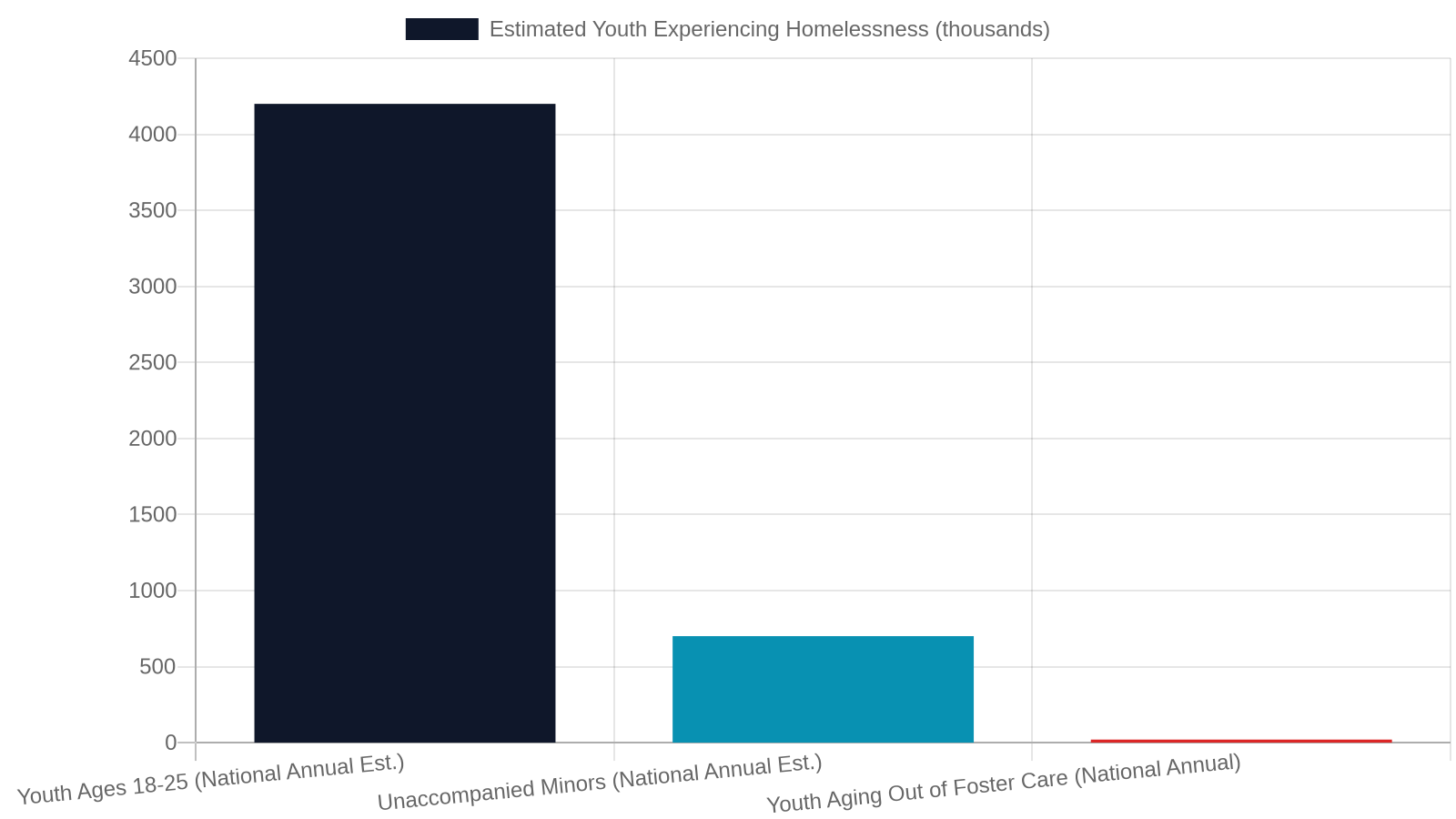
Nationally, studies estimate that approximately 4.2 million young adults ages 18 to 25 experience homelessness in a given year in the United States, with an additional 700,000 unaccompanied minors. Transition-age youth — those 17 to 25 — are among the fastest-growing segments of the homeless population. In Tennessee, LGBTQ+ youth, youth of color, and youth aging out of foster care are disproportionately represented.
Why Transition-Age Youth Face Unique Risks
The period between ages 17 and 25 is uniquely precarious. Young people in this age range are:
- Aging out of foster care with little to no financial safety net (approximately 20,000 youth age out of foster care nationally each year)
- Too old for many youth-specific programs but too young and under-resourced for adult systems
- Navigating homelessness while simultaneously trying to finish school, find work, and build adult lives
- At higher risk of exploitation, trafficking, and involvement in the criminal justice system when unhoused
YAAB’s work is urgent precisely because this window — 17 to 25 — is when the right support can change the entire trajectory of a person’s life.
How YAAB Compares to Traditional Youth Service Models

It is worth being clear about what makes YAAB structurally different from other youth-serving organizations in Tennessee. The distinction is not just philosophical — it has real consequences for how decisions get made and whether young people’s input actually changes anything.
The Difference Lived Experience Makes
Traditional youth service models — case management, shelter intake, outreach programs — are designed and operated primarily by adult professionals. These programs do vital work, and YAAB is not in opposition to them. But there is a structural gap: the people designing the programs are rarely the people who have used them.
YAAB fills that gap. When a YAAB member reviews a shelter’s intake process and says ‘this form asks questions that make youth feel judged and unsafe,’ that feedback carries a weight that no external consultant can replicate. It is specific, credible, and immediately actionable. Service providers who partner with YAAB consistently report that youth input leads to measurable improvements in program engagement and retention.
Advisory Boards vs. Action Boards
Many organizations have youth advisory boards — a group of young people who are consulted occasionally and whose input may or may not influence decisions. YAAB is deliberately called an Action Board, not just an advisory board. The distinction is intentional:
- Advisory boards are consulted. Action boards drive change.
- Advisory boards give input. Action boards hold seats and votes.
- Advisory boards are optional. Action boards are structurally embedded in CoC governance.
This is what makes YAAB different — and why it matters that young people join, stay engaged, and bring their full selves to the work.
YAAB vs. Traditional Youth Advisory Models: A Side-by-Side Look
Not all youth input structures are created equal. Here is how YAAB compares to more traditional models across key dimensions of power, participation, and impact.
Leadership Development: Building the Next Generation of Advocates

One of YAAB’s most tangible outcomes is the leadership growth of its members. Young adults who join YAAB often arrive with powerful lived experience but limited formal opportunity to use it. YAAB provides the training, platform, and support to turn that experience into lasting leadership — both for the benefit of Tennessee’s housing system and for each member’s own future.
Skills YAAB Members Gain
YAAB membership is not just about giving input — it is a genuine leadership development experience. Members build skills that serve them in every area of life, including:
- Public speaking and testimony: presenting at CoC meetings, legislative hearings, and community forums
- Policy analysis: reading and responding to housing policy proposals and funding applications
- Community organizing: mobilizing peers, building coalitions, and running campaigns
- Professional networking: connecting with housing professionals, government officials, and nonprofit leaders across Tennessee
- Resume and career development: YAAB experience is real, paid or stipended work that belongs on a resume
Stipends, Compensation, and Recognition
YAAB recognizes that asking young people — especially those navigating housing instability — to volunteer their time and expertise without compensation is not equitable. Across YAAB’s regional chapters, members may receive stipends, gift cards, transportation support, meals, and other forms of compensation for their participation in meetings, trainings, and advocacy activities.
The specifics vary by region and funding availability, but the principle is consistent: your time and expertise have value, and YAAB works to honor that. This approach also models the kind of equitable practice that YAAB advocates for in the broader homeless services system.
YAAB's Impact: What Has Changed Because of Youth-Led Advocacy

Advocacy is only meaningful if it produces real change. YAAB’s work is not just about process — it is about outcomes. Across Tennessee’s eight CoC regions, youth-led advocacy has contributed to measurable improvements in how the homeless services system treats, funds, and supports transition-age youth. Here is a look at what that impact looks like in practice.
Program and Policy Wins Driven by Youth Voice
While YAAB’s work is ongoing and systemic change is measured in years, youth-led advocacy across Tennessee’s CoC regions has contributed to real, documented improvements, including:
- Increased youth-specific beds and transitional housing units in multiple CoC regions
- Revised intake processes at shelters that are more trauma-informed and youth-friendly
- Greater youth representation on CoC boards and committees statewide
- Stronger youth-focused language in Tennessee’s Consolidated Plan for housing and community development
- Peer support roles created within CoC-funded agencies, providing employment opportunities for young adults with lived experience
The Ripple Effect: Members Who Go On to Lead
Perhaps YAAB’s most lasting impact is the trajectory of its members. Young adults who participate in YAAB go on to become case managers, housing advocates, nonprofit directors, and policy professionals. They carry the values of lived-experience leadership into every role they hold, creating a ripple effect that extends far beyond YAAB’s direct membership.
This is what it looks like when a system invests in young people rather than just serving them: the people who were once navigating homelessness become the people designing better systems for the next generation. That is the long game YAAB is playing — and it is working.
How YAAB Works With CoC Partners and Service Providers

YAAB does not operate in isolation. Its power comes from its relationships with the Continuum of Care partners, shelters, housing agencies, and service providers that make up Tennessee’s homeless response system. Understanding how YAAB works with these partners — and what it asks of them — is essential context for anyone working in this space.
A Resource for Case Managers and Providers
If you are a case manager, CoC coordinator, or service provider working with transition-age youth in Tennessee, YAAB is one of your most valuable partners. YAAB members can:
- Help you understand why certain young people are not engaging with your program
- Review your intake forms, program rules, and outreach materials for youth-friendliness
- Connect you with peer navigators who can build trust with youth who distrust formal systems
- Represent youth voice at your organization’s planning meetings and community forums
Partnering with YAAB is not about being told what you are doing wrong — it is about building something better together, with the people who know what ‘better’ actually looks and feels like.
Youth-Centered Practice: What Providers Can Learn
YAAB’s presence in CoC governance has pushed the entire Tennessee homeless services system toward more youth-centered practice. Key principles that YAAB advocates for in all CoC-funded programs include:
- Trauma-informed care: recognizing that most youth experiencing homelessness have experienced significant trauma
- Low-barrier access: removing ID, sobriety, and curfew requirements that disproportionately exclude young people
- Harm reduction: meeting young people where they are rather than requiring compliance before offering help
- Cultural humility: centering the identities and experiences of LGBTQ+ youth, youth of color, and other marginalized groups
Ready to Get Involved? Your Next Step With YAAB

YAAB’s mission is only as powerful as the people who show up to carry it forward. Whether you are a young adult ready to turn your lived experience into leadership, or a service provider ready to build something better with youth at the center — there is a role for you in this work. Tennessee’s eight CoC regions each have a local YAAB chapter ready to welcome new members and partners right now.
If You're a Young Adult in Tennessee
If you are between 17 and 25, have experienced homelessness or housing instability, and want to turn that experience into something powerful — YAAB is for you. You do not need to have it all figured out. You do not need a polished resume or a history of activism. You just need to show up and be willing to use your voice.
Here is how to get started:
- Visit the YAAB About page to learn more about the organization’s structure, values, and membership
- Find your local YAAB chapter and reach out to connect with peers in your CoC region
- Check the YAAB Join page to learn how to officially become a member
- Attend a regional meeting — most chapters hold regular gatherings that are open to new members
If You're a Provider, Partner, or Supporter
If you work in the homeless services system, a CoC agency, a school, a workforce program, or any organization that serves transition-age youth in Tennessee — YAAB wants to work with you. The most effective thing you can do is create space for young people with lived experience to lead, not just participate.
That means paying for their time, giving them real decision-making authority, and listening when their feedback challenges your assumptions. YAAB can help you build those practices into your organization. Reach out through the YAAB contact page to start a conversation about partnership. Together, we can build a Tennessee where no young person has to navigate homelessness alone — and where the people who have navigated it are leading the way forward.
Frequently Asked Questions
What is the Tennessee Youth Action Board (YAAB)?
The Tennessee Youth Action Board (YAAB) is a statewide network of young adults ages 17 to 25 who have experienced homelessness or housing instability. Members advise local and state leaders, advocate for policy change, and help connect peers to housing, employment, education, and support services across Tennessee's eight Continuum of Care regions.
Who is eligible to join YAAB in Tennessee?
Any young adult between the ages of 17 and 25 who has experienced homelessness or housing instability — including youth aging out of foster care — is eligible to join YAAB. No prior advocacy experience, specific GPA, or formal qualifications are required. Your lived experience is what matters.
How does YAAB actually influence housing policy in Tennessee?
YAAB members hold seats on Continuum of Care governance bodies, participate in state-level housing planning processes with agencies like THDA, give public testimony at legislative hearings, and provide direct feedback that shapes how CoC-funded programs are designed and operated. This is structural influence, not just symbolic input.
Does YAAB pay its members for their time?
Yes, YAAB recognizes that youth time and expertise have real value. Across regional chapters, members may receive stipends, gift cards, transportation support, meals, and other forms of compensation for participating in meetings, trainings, and advocacy activities. Specifics vary by region and available funding.
How do I find my local YAAB chapter in Tennessee?
YAAB has chapters in all eight of Tennessee's Continuum of Care regions, including Memphis/Shelby County (TN-500), Nashville/Davidson County (TN-501), Knoxville/Knox County (TN-502), Chattanooga/Hamilton County (TN-503), Jackson/West TN (TN-504), Upper Cumberland (TN-506), Northeast Tennessee (TN-507), and the Balance of State (TN-509). Visit yaabtn.org/local-yaabs to find the chapter nearest you.
How is YAAB different from other youth homelessness organizations in Tennessee?
Most youth-serving organizations provide services to young people. YAAB is led by young people with lived experience who shape the policies and programs that affect their peers. YAAB members are not just recipients of services — they are decision-makers, advocates, and leaders embedded in the governance structures that control how housing resources are allocated across Tennessee.