Quick answer: The Youth Action Board (YAAB) of Tennessee is a statewide network of young adults ages 17 to 25 who have personally experienced homelessness or housing instability. Operating across all of Tennessee's Continuum of Care regions — from Memphis to Northeast Tennessee — YAAB members advise local and state leaders, shape housing and support policies, and connect peers to real resources. If you're a transition-age youth in Tennessee and want your voice to matter, YAAB is how you turn lived experience into lasting change.
1. What the Youth Action Board of Tennessee Actually Is

Before you can decide whether YAAB is right for you, it helps to understand exactly what it is — and what it is not. The Youth Action Board of Tennessee is a statewide program that gives young adults with lived experience of homelessness a formal seat at the table where housing and support policies are made. It operates inside Tennessee’s Homeless Continuum of Care system, which is the federally recognized framework for coordinating homeless services across the state.
A Peer-Led, Statewide Network
YAAB is not a government agency, a shelter, or a service provider. It is a peer-led advisory network made up of young adults who have been through housing instability themselves. That distinction matters. When a YAAB member walks into a policy meeting, they are not reading from a textbook — they are speaking from real experience sleeping on a friend’s couch, navigating a shelter intake process, or aging out of foster care with nowhere to go.
The network spans all of Tennessee’s Continuum of Care (CoC) regions, meaning there are local YAAB chapters in Memphis/Shelby County, Nashville/Davidson County, Knoxville/Knox County, Chattanooga/Hamilton County, Jackson/West Tennessee, the Upper Cumberland, and Northeast Tennessee. Each local board is connected to the statewide YAAB structure, so a young person’s voice in Cookeville can influence decisions made in Nashville.
Why 'Lived Experience' Is the Whole Point
The phrase lived experience is not just a buzzword here — it is the formal qualification that makes YAAB members credible advisors. Research consistently shows that programs designed with the people they serve are more effective than programs designed for them. A 2021 report by the National Alliance to End Homelessness found that youth-led advisory structures improve service uptake and reduce repeat homelessness episodes among transition-age youth.
YAAB operationalizes that principle statewide. Members bring firsthand knowledge of what barriers actually look like: confusing intake paperwork, ID requirements that are impossible to meet without a permanent address, shelter rules that separate young couples, or employment programs that don’t account for trauma responses. That knowledge is irreplaceable, and YAAB puts it at the center of every conversation.
2. Who Can Join YAAB — and What the Eligibility Looks Like

One of the most common questions young adults ask about YAAB is simple: Am I even qualified? The answer, for most transition-age youth in Tennessee who have experienced any form of housing instability, is yes. Here is a clear breakdown of what eligibility actually looks like.
The Core Eligibility Window: Ages 17 to 25
YAAB is specifically designed for transition-age youth (TAY), defined as young adults between the ages of 17 and 25. This age range is not arbitrary. It reflects a recognized gap in the social safety net: young people who are too old for many child-serving systems but not yet established enough to navigate adult systems on their own. Federal housing programs, including HUD’s Continuum of Care grants, use this same 17–25 window when targeting TAY-specific resources.
If you are 17 and currently experiencing housing instability, you are eligible. If you are 24 and have been stably housed for two years but remember what it was like to sleep in your car at 19, you are still eligible — that lived experience does not expire.
Lived Experience of Homelessness or Housing Instability
You do not have to have slept outside to qualify. YAAB’s definition of housing instability is broad and realistic. It includes:
- Literal homelessness: sleeping outside, in a car, in a shelter, or in a place not meant for human habitation
- Couch surfing: staying temporarily with friends or family because you have no stable place of your own
- Housing insecurity: being at serious risk of losing your housing due to eviction, domestic violence, or inability to pay rent
- Aging out of foster care: leaving the foster care system without a stable permanent housing plan
If any of those descriptions fit your story — even if it was a few years ago — YAAB wants to hear from you. Your perspective is exactly what makes the board credible to policymakers.
No Degree, No Resume, No Prior Advocacy Experience Required
One of the most important things to know: YAAB does not require a GED, a college degree, or any prior advocacy experience. You do not need to know how to write a policy brief or give a speech. The board provides training, mentorship, and support so that members can grow into those skills over time. What you bring on day one — your story, your observations, your honesty — is already enough to start.
YAAB members have gone on to speak at state legislative hearings, present at national conferences, and lead local community initiatives. But none of them started there. They started exactly where you are right now.
3. Tennessee's 8 Continuum of Care Regions and Your Local YAAB

Tennessee is a geographically and demographically diverse state, and YAAB is built to reflect that. Rather than operating as a single centralized board in Nashville, YAAB is structured around Tennessee’s eight Homeless Continuum of Care regions — giving young adults in every corner of the state a local entry point into advocacy and leadership.
How the CoC Structure Shapes YAAB's Reach
Tennessee’s homeless services system is organized into eight Continuum of Care (CoC) regions, each of which receives federal HUD funding and coordinates local shelters, rapid rehousing programs, and permanent supportive housing. YAAB is embedded inside this structure, meaning each CoC region has — or is building — its own local Youth Action Board chapter that feeds into the statewide network.
This structure matters because housing challenges in Memphis look different from housing challenges in the Upper Cumberland or Northeast Tennessee. A young person in Shelby County may be navigating a large urban shelter system; a young person in rural Unicoi County may be dealing with a complete absence of shelter options. Having regional boards means local voices shape local solutions, while still connecting to statewide policy change.
Finding Your Regional YAAB Chapter
Here is a quick map of Tennessee’s CoC regions and their corresponding YAAB chapters:
- TN-500 — Memphis/Shelby County
- TN-501 — Nashville/Davidson County
- TN-502 — Knoxville/Knox County
- TN-503 — Chattanooga/Hamilton County
- TN-504 — Jackson/West Tennessee
- TN-506 — Upper Cumberland
- TN-507 — Northeast Tennessee
- TN-509 — Additional regional coverage
Each of these chapters has its own meeting schedule, local contacts, and specific advocacy priorities. You can find your local YAAB chapter and get connected to the right people in your region without having to navigate the full statewide system on your own.
4. What YAAB Members Actually Do Day to Day

Joining YAAB is not just about having a title or attending meetings. Members take on real, meaningful roles that directly influence how Tennessee’s housing and support systems work. Here is what that looks like in practice.
Advising Local and State Decision-Makers
YAAB members regularly participate in Continuum of Care board meetings, state-level housing workgroups, and legislative briefings. In practical terms, this means a YAAB member might review a proposed shelter policy and flag that a specific rule would make it harder for young parents to access services — then watch that feedback get incorporated into the final policy. That is real power, not symbolic participation.
At the state level, YAAB has contributed to conversations about how Tennessee allocates HUD Continuum of Care funding, how youth-specific housing programs are designed, and how data on youth homelessness is collected and reported. These are not small decisions — they affect how millions of dollars are spent and how thousands of young people are served.
Peer Outreach and Resource Connection
Beyond formal advisory roles, YAAB members serve as trusted messengers in their own communities. Because they have lived experience, they can connect with peers who might be skeptical of service providers or afraid to ask for help. A YAAB member at a community event can explain what rapid rehousing actually means, how to apply for emergency rental assistance, or where to get a free ID — in plain language, without judgment.
This peer outreach function is one of the most underrated parts of YAAB’s work. Research on peer support models in homeless services shows that young people are significantly more likely to engage with services when they are introduced by someone who has been through the same experience. YAAB members are that bridge.
Driving Advocacy Campaigns
YAAB members also lead and support advocacy campaigns aimed at changing the systems that create youth homelessness in the first place. This might mean testifying at a state legislative committee hearing, participating in a social media campaign to raise awareness about youth housing needs, or co-authoring a report on gaps in Tennessee’s TAY services. You can explore current and past campaigns on the YAAB advocacy page to get a sense of the issues the board is actively working on.
Advocacy work is not just for people who are comfortable public speaking. YAAB needs members who can write, design, organize, research, and connect with peers — every skill has a place in a well-rounded advocacy effort.
5. The Issues YAAB Focuses On Across Tennessee

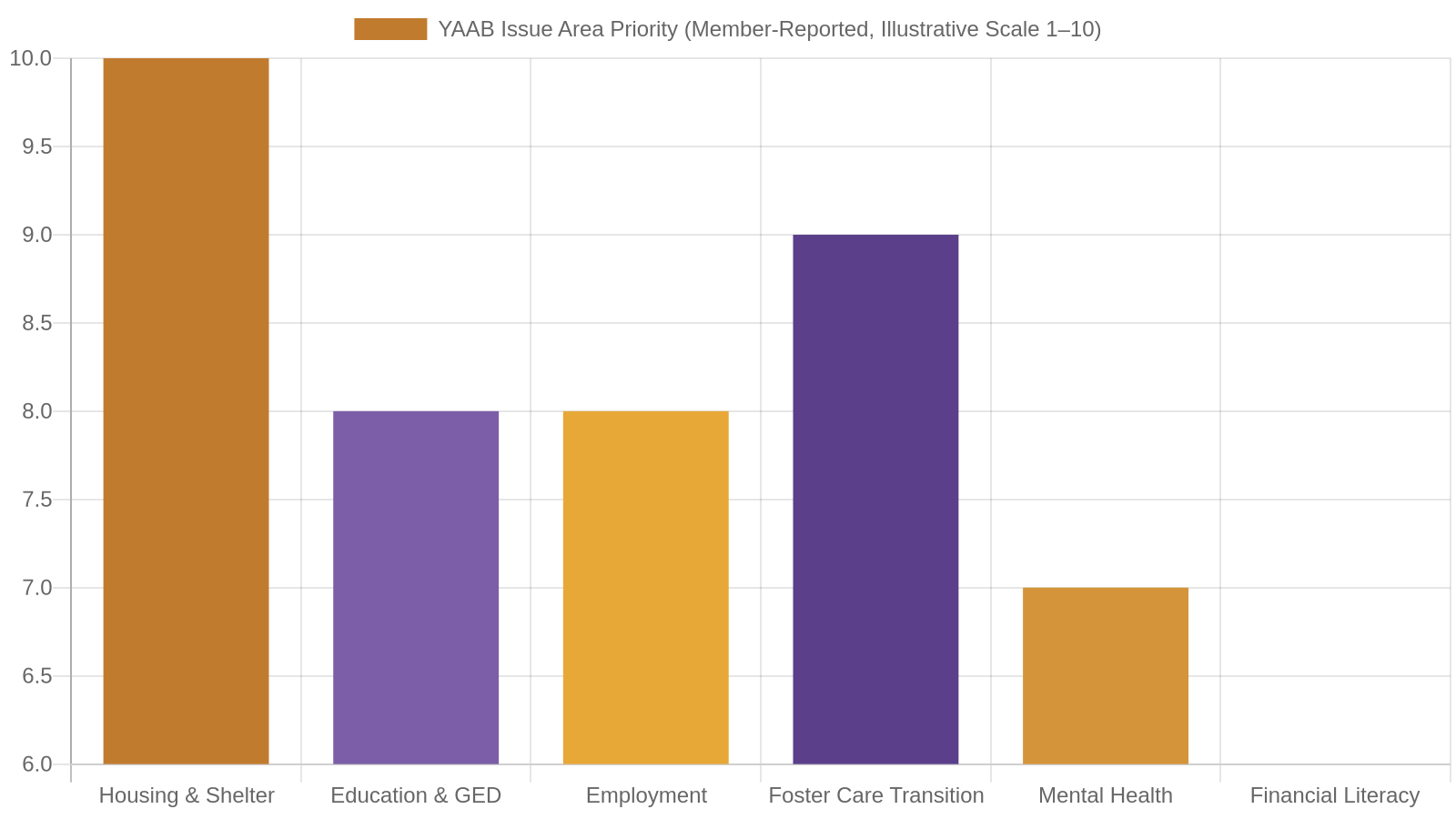
YAAB’s work is not limited to one issue. The challenges facing transition-age youth in Tennessee are interconnected — housing, education, employment, mental health, and foster care are all part of the same ecosystem. Here are the core issue areas where YAAB members focus their energy.
Housing and Shelter Access for Transition-Age Youth
Housing is the core issue. Tennessee, like most states, has a significant gap between the number of transition-age youth experiencing homelessness and the number of TAY-specific housing units available. According to HUD’s 2023 Annual Homeless Assessment Report, youth ages 18–24 make up approximately 10% of the total sheltered homeless population nationally, yet TAY-specific rapid rehousing and transitional housing programs remain underfunded in many Tennessee CoC regions.
YAAB members work to close that gap by advocating for more TAY-designated housing resources, more flexible shelter rules (such as allowing young couples or young parents to stay together), and faster pathways from emergency shelter to stable housing.
Education, Employment, and Economic Stability
Stable housing and economic stability are deeply connected. YAAB’s advocacy extends to education access, GED pathways, workforce development, and financial literacy — because a young person who cannot afford rent next month needs more than a shelter bed; they need a sustainable income. Tennessee has several workforce development programs specifically targeting TAY, including those administered through local workforce development boards and community colleges, but awareness of these programs among young people experiencing homelessness is often low.
YAAB members help bridge that gap by connecting peers to resources and by advocating for programs that are designed with TAY barriers in mind — like flexible scheduling, childcare support, and transportation assistance.
Aging Out of Foster Care
A disproportionate number of young people experiencing homelessness in Tennessee have aged out of the foster care system. Nationally, studies estimate that approximately 20% of youth who age out of foster care experience homelessness within two years of leaving care. Tennessee’s YAAB actively advocates for stronger transition planning, extended foster care support (Tennessee allows extended care up to age 21 under certain conditions), and better coordination between the child welfare system and the homeless services CoC.
If you aged out of foster care and are now experiencing housing instability, YAAB is one of the most relevant spaces you can enter — both to get connected to resources and to help change the system for the young people who come after you.
6. How YAAB Fits Inside Tennessee's Continuum of Care System

To understand why YAAB matters, it helps to understand the system it operates inside. Tennessee’s Continuum of Care structure is the backbone of homeless services in the state — and YAAB is formally embedded within it, not just adjacent to it.
What a Continuum of Care Actually Is
If you have heard the term Continuum of Care and are not sure what it means, here is a plain-language explanation. A Continuum of Care (CoC) is a regional planning body that coordinates housing and services for people experiencing homelessness. It is funded and overseen by the U.S. Department of Housing and Urban Development (HUD). Every CoC in Tennessee is responsible for conducting an annual Point-in-Time count of people experiencing homelessness, coordinating a Homeless Management Information System (HMIS) to track service usage, and applying for federal grants that fund local shelters, rapid rehousing programs, and permanent supportive housing.
In short, the CoC is where the money and the decisions are. And YAAB is embedded inside that structure — which means YAAB members are not just talking about the system from the outside. They are inside the room where it is governed.
YAAB's Formal Role in CoC Governance
Each local YAAB chapter is connected to its regional CoC board, and YAAB members may serve on CoC committees, participate in Coordinated Entry system reviews, and contribute to the annual CoC application process. The Coordinated Entry system is particularly important — it is the process by which people experiencing homelessness are assessed, prioritized, and matched to available housing resources. If that process has barriers that disproportionately affect young people, YAAB members are positioned to identify and address them.
At the statewide level, YAAB connects across all Tennessee CoC regions to identify systemic patterns and advocate for policy changes that no single regional board could achieve on its own. This statewide coordination is one of YAAB’s most distinctive features compared to youth advisory efforts in other states.
YAAB vs. Traditional Advisory Boards: How They Compare
Not all advisory boards are created equal. Here is how YAAB's lived-experience model compares to traditional advisory structures on the dimensions that matter most for transition-age youth.
7. What You Gain as a YAAB Member — Skills, Connections, and More

Joining YAAB is not just about giving back — it is also about what you gain. Membership comes with real, tangible benefits that can shape your future in meaningful ways.
Leadership and Advocacy Skills You Can Use Anywhere
YAAB provides members with training in advocacy, public speaking, policy analysis, and community organizing. These are not abstract skills — they are directly transferable to employment, higher education, and civic life. A young person who has testified before a state legislative committee, facilitated a community meeting, or co-authored a policy brief has a resume that stands out, regardless of their formal educational background.
Many YAAB alumni have gone on to careers in social work, public policy, nonprofit management, and community health — fields that actively value lived experience alongside formal credentials. Some have returned to higher education with a clearer sense of purpose and a portfolio of real advocacy work to show for it.
A Peer Network Across Tennessee
One of the less-talked-about benefits of YAAB membership is the peer network you build. When you join a local YAAB chapter, you are connecting with other young adults across your region and across the state who understand your experience without needing an explanation. That kind of community — people who get it — is genuinely rare and genuinely valuable.
That network also has practical benefits. YAAB members share information about job openings, housing resources, educational opportunities, and community events. They look out for each other. In a world where social capital (who you know and who knows you) plays a huge role in economic mobility, being part of a statewide network of motivated, connected young adults is a real asset.
Stipends, Recognition, and Tangible Support
YAAB recognizes that asking young adults with lived experience to volunteer their time and expertise without compensation is not equitable. Many YAAB chapters provide stipends, gift cards, transportation support, or other tangible recognition for members’ participation. The specific supports available vary by region and funding cycle, so it is worth asking your local chapter coordinator what is currently available.
Beyond financial support, YAAB members are recognized as advisors and leaders — not as clients or recipients of services. That shift in framing matters enormously for young people whose experience with systems has often been defined by being processed rather than heard.
8. How Tennessee Compares: Youth Homelessness by the Numbers

Context matters. Understanding the scale of youth homelessness in Tennessee helps explain why a statewide Youth Action Board is not just a nice idea — it is a necessary infrastructure. Here are some of the key numbers.
Tennessee's Youth Homelessness Landscape
According to HUD’s 2023 Annual Homeless Assessment Report, Tennessee counted approximately 8,700 people experiencing homelessness on a single night in January 2023 — a figure that is widely understood to undercount the true number, particularly for youth who are couch surfing or staying in unstable situations that do not show up in shelter counts. Transition-age youth (18–24) made up roughly 8–10% of that counted population, consistent with national patterns.
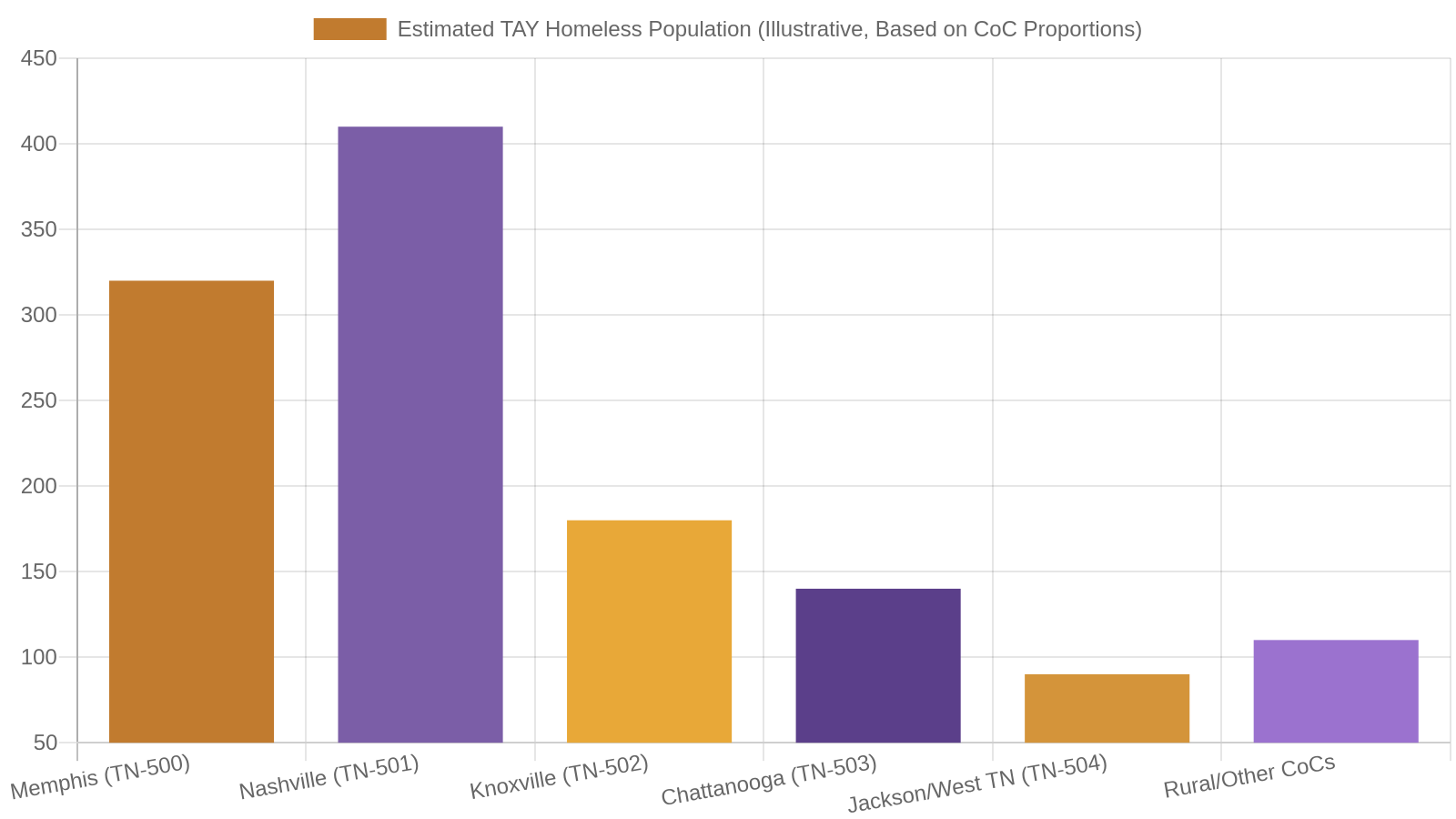
Tennessee’s urban CoC regions — Memphis (TN-500) and Nashville (TN-501) — account for the largest absolute numbers of youth experiencing homelessness, but rural regions often have fewer resources per capita and less visibility into the scope of the problem. YAAB’s regional structure is designed to ensure that rural youth homelessness is not invisible in statewide policy conversations.
The Foster Care to Homelessness Pipeline
Tennessee’s Department of Children’s Services reported that in recent years, approximately 800–1,000 young people age out of foster care in Tennessee annually. National research consistently shows that 20–30% of youth who age out of foster care experience homelessness within 2–4 years of leaving care. Applying that range to Tennessee’s numbers suggests that 160 to 300 Tennessee youth per year may be at high risk of homelessness directly as a result of aging out of foster care — a preventable outcome with the right policy interventions.
YAAB members who have aged out of foster care bring irreplaceable insight into what those interventions should look like. Their voices are not just valuable — they are essential to getting the policy right.
Ready to Join? Here Is Your Next Move in Tennessee
You have read about what YAAB is, who it serves, and what it does. Now the most important question is: what is your next step? Whether you are a young adult with lived experience ready to step into leadership, or a service provider looking to better connect the young people you work with, here is how to move forward in Tennessee.
How to Connect With Your Local YAAB Chapter
The fastest way to get involved is to reach out directly to the YAAB chapter in your CoC region. Each local board has its own contact, meeting schedule, and onboarding process. You do not need to have everything figured out before you reach out — showing up and expressing interest is the whole first step. You can start the process of joining YAAB here and get connected to the right regional contact for your area of Tennessee.
If you are a case manager, CoC partner, or service provider reading this, the best thing you can do is share this information with the young adults you work with — and advocate within your organization for YAAB members to have a genuine seat at your planning tables, not just a token presence.
Resources Available Through YAAB and Its Partners
YAAB is not just an advocacy body — it is also a gateway to resources. Members and their peers can access information about housing programs, emergency assistance, education and employment pathways, mental health support, and more through the YAAB network and its CoC partners. The YAAB resources page is a good starting point for finding what is available in your region of Tennessee.
Whether you are looking to get involved in advocacy, find housing support, or simply connect with peers who understand your experience, YAAB is built for exactly that. Your lived experience is not a liability — it is the most important qualification you bring to this work.
Learn More About the Full YAAB Mission
If you want to understand the full scope of what YAAB does — its history, structure, regional chapters, and statewide impact — the best place to start is the YAAB About page, which lays out the mission, values, and how the statewide network operates. From there, you can find your regional chapter, explore current projects, and figure out where your skills and interests fit best.
Tennessee’s transition-age youth deserve a system that was built with them, not just for them. YAAB is how that happens — and it starts with young adults across Memphis, Nashville, Knoxville, Chattanooga, Jackson, the Upper Cumberland, and Northeast Tennessee deciding that their voice matters enough to use it. It does. And YAAB is ready when you are.
Frequently Asked Questions
What is the Youth Action Board of Tennessee?
The Youth Action Board (YAAB) of Tennessee is a statewide network of young adults ages 17 to 25 with lived experience of homelessness or housing instability. Members advise local and state leaders, shape housing and support policies, and connect peers to resources across all of Tennessee's Continuum of Care regions.
Do I have to have been literally homeless to join YAAB?
No. YAAB's definition of lived experience includes couch surfing, staying in unstable housing, facing eviction, aging out of foster care, or any situation where you lacked a safe and stable place to live. You do not need to have slept outside or stayed in a shelter to qualify.
Is YAAB only in Nashville or Memphis, or does it cover all of Tennessee?
YAAB operates statewide across all eight of Tennessee's Continuum of Care regions, including Memphis, Nashville, Knoxville, Chattanooga, Jackson/West Tennessee, the Upper Cumberland, and Northeast Tennessee. Every region has or is building its own local YAAB chapter.
Do YAAB members get paid for their time?
Many YAAB chapters provide stipends, gift cards, transportation support, or other tangible compensation for members' participation. The specific supports available vary by region and current funding. Contact your local chapter coordinator to find out what is available in your area.
What if I aged out of foster care — is YAAB relevant to me?
Yes, absolutely. Young people who have aged out of foster care are among the most important voices in YAAB. Nationally, 20–30% of youth who age out of foster care experience homelessness within a few years of leaving care, and YAAB actively advocates for better transition planning and extended support for this group.
How do I actually join YAAB in Tennessee?
You can start by visiting yaabtn.org/join/ to connect with the YAAB team and get directed to the right regional chapter for your area of Tennessee. No prior advocacy experience, degree, or resume is required — just your interest and your story.