Quick answer: Any young adult in Tennessee between the ages of 17 and 25 who has experienced homelessness or housing instability can apply to join their regional Youth Action Board (YAAB). The process involves finding your local YAAB chapter — there are eight across Tennessee, from Memphis to Northeast TN — completing a short application, and attending an orientation. Members gain leadership training, a real voice in housing policy, peer connections, and in many regions a stipend for their time. No prior experience or perfect housing situation is required — your lived experience is exactly what YAAB needs.
What Is the Tennessee Youth Action Board (YAAB)?

Before you apply, it helps to understand exactly what you are signing up for — and why YAAB is different from most youth programs you may have encountered. YAAB is not a drop-in center or a case management service. It is a structured advocacy organization where young adults with lived experience hold real influence over Tennessee’s homeless-services ecosystem.
According to the U.S. Department of Housing and Urban Development (HUD), transition-age youth (ages 18–24) represent approximately 13% of the sheltered homeless population nationally, yet are often underrepresented in the policy conversations that shape their options. YAAB exists specifically to close that gap in Tennessee.
A Statewide Network Built by and for Young People
The Youth Action Board (YAAB) of Tennessee is a statewide network of young adults ages 17 to 25 who have lived through homelessness or housing instability. YAAB is not a service program — it is a leadership and advocacy body where members shape the policies, programs, and resources that affect transition-age youth (TAY) across Tennessee’s Continuum of Care (CoC) regions.
- Members advise local and state decision-makers on housing, shelter, and support services.
- YAAB works inside the official Homeless Management Information System (HMIS) structure, meaning your voice reaches real policy tables.
- The network spans all of Tennessee’s eight CoC regions, from Memphis/Shelby County to Northeast Tennessee.
Why Lived Experience Matters More Than a Résumé
YAAB operates on a core principle: the people closest to the problem are closest to the solution. You do not need a college degree, a stable address, or a polished résumé to join. What you need is firsthand knowledge of what it feels like to navigate the shelter system, couch-surf, age out of foster care, or search for affordable housing as a young person in Tennessee.
That experience is not a liability — it is your qualification. Decision-makers in housing policy rarely have it, which is exactly why YAAB exists: to make sure those voices are in the room.
Who Is Eligible to Join YAAB in Tennessee?

One of the most common questions young people ask is: “Do I actually qualify?” The answer is almost certainly yes if you are between 17 and 25 and have dealt with any form of housing instability. YAAB is intentionally designed to be accessible — the eligibility bar is about lived experience, not credentials.
Age and Experience Requirements
YAAB membership is open to young adults who meet both of the following criteria:
- Age: You are between 17 and 25 years old at the time of application. Some regional chapters allow members to continue participating up to age 26 if they joined before their 26th birthday — check with your local YAAB.
- Lived experience: You have personally experienced homelessness, housing instability, or housing insecurity at some point in your life. This includes sleeping in a shelter, staying with friends or family because you had nowhere else to go (couch-surfing), living in a car or other place not meant for sleeping, or aging out of foster care without stable housing.
You do not have to be currently homeless to apply. Many YAAB members are in transitional or permanent housing and use their past experience to advocate for others.
What Counts as 'Housing Instability'?
HUD’s definition of homelessness and housing instability is broader than most people realize. You likely qualify if you have experienced any of the following:
- Staying in an emergency shelter or transitional housing program
- Sleeping outside, in a car, in an abandoned building, or in any place not designed for regular sleeping
- Couch-surfing — temporarily staying with others because you lacked a stable place of your own
- Receiving a 30-day eviction notice or being doubled up in overcrowded housing
- Aging out of the Tennessee foster care system without a stable housing plan
- Fleeing domestic violence, sexual assault, or human trafficking situations that left you without safe housing
If you are unsure whether your experience qualifies, reach out to your local YAAB chapter — they will help you figure it out, no judgment.
No Prior Advocacy Experience Needed
YAAB provides all the training you need. You do not need to know what a Continuum of Care is, have attended a city council meeting, or have any public speaking experience. New members receive onboarding orientation, leadership development workshops, and peer mentorship from more experienced YAAB members. The only thing you bring on day one is your story and your willingness to show up.
Find Your Regional YAAB Chapter in Tennessee

Tennessee is a geographically diverse state, and YAAB reflects that. Whether you are in a major city like Memphis, Nashville, Knoxville, or Chattanooga, or in a smaller community in West Tennessee or the Upper Cumberland, there is a regional YAAB chapter close to you. Knowing which chapter to contact is the very first step in the application process.
Tennessee's Eight Continuum of Care Regions
Tennessee is divided into eight Continuum of Care (CoC) regions, and YAAB has a local chapter in each one. Your membership is tied to the region where you currently live or receive services — not necessarily where you grew up. The eight regional YAABs are:
- TN-500 — Memphis & Shelby County
- TN-501 — Nashville & Davidson County
- TN-502 — Knoxville & Knox County
- TN-503 — Chattanooga & Hamilton County
- TN-504 — Jackson & West Tennessee
- TN-506 — Upper Cumberland
- TN-507 — Northeast Tennessee
- TN-509 — Mid-South / Rural West Tennessee
How to Locate the Right Chapter for You
The fastest way to find your chapter is to visit the Local YAABs page on yaabtn.org, which lists contact information, meeting schedules, and region-specific details for each chapter. If you are unsure which region you fall into — especially if you are in a rural area or have recently moved — you can also contact the statewide YAAB network directly through the contact page and they will point you in the right direction.
Do not let geography be a barrier. Several regional chapters offer virtual meeting options for members who lack reliable transportation or live in rural parts of their CoC region.
What the YAAB Application Process Actually Looks Like

The YAAB application process is designed to be low-barrier and welcoming — not intimidating. There is no lengthy paperwork, no background check, and no requirement to disclose details about your housing situation beyond what you are comfortable sharing. Here is what to expect from start to finish.
Step 1 — Express Interest or Submit an Application
Most regional YAAB chapters use a short interest form or application that takes 15 to 30 minutes to complete. You will typically be asked to:
- Provide your name, age, and contact information (an email address or phone number is sufficient — a permanent mailing address is not required)
- Briefly describe your experience with housing instability in your own words
- Share why you want to get involved with YAAB
- Indicate your availability for meetings
Some chapters accept applications on a rolling basis year-round; others have cohort intake periods (often in the fall and spring). Check your regional chapter’s page for current timelines.
Step 2 — Informal Interview or Welcome Call
After submitting your application, most chapters will schedule a brief welcome conversation — usually a 20- to 30-minute phone or video call with a current YAAB member or regional coordinator. This is not a formal job interview. The purpose is to get to know you, answer your questions, and make sure YAAB is a good fit for what you are looking for right now. You will not be judged or evaluated on how you talk about your experience.
Step 3 — Orientation and Onboarding
New members attend an orientation session that covers:
- How the Continuum of Care system works in Tennessee and why it matters
- YAAB’s structure, values, and member expectations
- Your rights and responsibilities as a member
- Upcoming meetings, projects, and advocacy opportunities
Orientation is typically one to two hours and can be completed in person or virtually. After orientation, you are officially a YAAB member and can begin participating in meetings and projects right away.
What YAAB Members Actually Do Day to Day

Joining YAAB is not a passive commitment. Members are active participants in real advocacy work — but the workload is flexible and built around your life circumstances. Here is a realistic picture of what membership looks like week to week.
Attending Meetings and Shaping Policy
Most regional chapters hold monthly or bi-monthly meetings — typically one to two hours long. In these meetings, members:
- Review housing data and local shelter capacity reports
- Provide feedback on proposed policies and programs before they are adopted
- Plan advocacy campaigns and community outreach events
- Connect peers to resources like emergency shelter, food assistance, and employment programs
YAAB members are not just consulted — they sit on official CoC committees and working groups, meaning their input directly shapes how millions of dollars in federal housing funding are allocated across Tennessee.
Leadership Development and Training
YAAB invests in its members. Throughout the year, members have access to:
- Public speaking and testimony training — how to speak at city council meetings, state legislative hearings, and CoC board meetings
- Data literacy workshops — how to read and use housing and homelessness data to make arguments
- Financial literacy and workforce readiness sessions — practical skills that benefit members beyond their YAAB role
- Peer mentorship from more experienced YAAB members and alumni
Community Outreach and Peer Support
YAAB members also do direct peer outreach — connecting young people in their communities to housing resources, shelter referrals, and support services. This might look like tabling at a community event, distributing resource guides, or simply being a trusted peer who can say, “I’ve been there, and here’s what helped me.” Check the YAAB resources page for the tools members use in outreach.
Benefits of YAAB Membership: What You Get Out of It

Advocacy work should never be extracted from young people without giving something back. YAAB is built on the principle of reciprocity — members give their time, knowledge, and energy, and YAAB invests in them in return. Here is what you can realistically expect to gain from membership.
Stipends and Compensation for Your Time
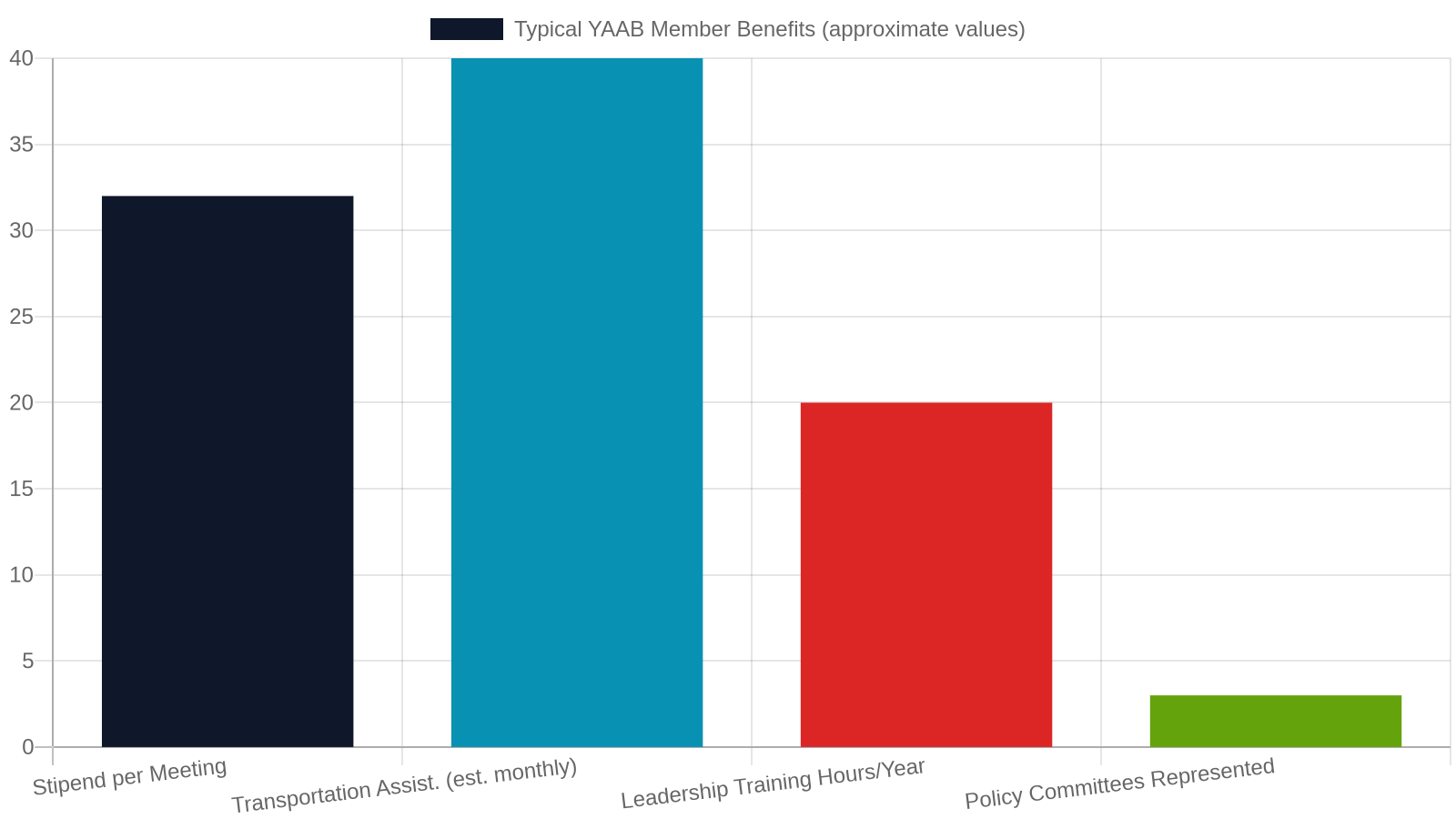
YAAB recognizes that your time has value. Many regional chapters offer stipends or gift cards to compensate members for attending meetings and participating in advocacy activities. Stipend amounts vary by region and available funding, but typically range from $15 to $50 per meeting session. Some chapters also provide transportation assistance — bus passes, gas cards, or rideshare credits — to remove barriers to participation. Ask your regional coordinator about current compensation structures when you apply.
Real Leadership Experience and Credentials
YAAB membership is a legitimate leadership credential. Members can list it on job applications, college applications, and scholarship essays. The skills you build — public speaking, policy analysis, community organizing, data literacy — are valued by employers, universities, and nonprofit organizations. Several YAAB alumni have gone on to careers in social work, public policy, housing advocacy, and community development, with YAAB experience as a key part of their story.
Community, Belonging, and Peer Connection
Perhaps the most powerful benefit is less tangible: you will be surrounded by peers who get it. YAAB members share similar backgrounds and understand the experience of navigating housing instability without judgment. Many members describe YAAB as the first place they felt truly heard and valued — not as a client or a case number, but as a leader. That sense of belonging has real mental health benefits, and research consistently shows that social connection is one of the strongest protective factors against the long-term effects of housing trauma.
Overcoming Common Barriers to Applying

We hear the same hesitations from young people all the time. Here are honest, direct answers to the most common concerns — because nothing should stand between you and a seat at the table.
"I Don't Have a Stable Address or Phone"
YAAB gets it. You do not need a permanent address to apply. A shelter address, a case manager’s contact information, or a Google Voice number all work fine. Many regional chapters also accept applications through a trusted service provider or case manager who can help you submit the form if internet access is a challenge. If you are currently in a shelter or transitional housing program, ask your case manager if they can connect you with the local YAAB — many providers have existing relationships with regional chapters.
"I'm Worried About What I'll Have to Share"
You are in control of your own story. YAAB never requires you to disclose specific details about your housing history, trauma, or personal circumstances beyond confirming that you have lived experience of housing instability. In meetings and public advocacy, you share only what you choose to share. YAAB has clear confidentiality norms — what is shared in member spaces stays there, and members are trained to respect each other’s privacy.
"I Have a Busy Schedule — Can I Still Participate?"
YAAB is designed for young adults who are juggling a lot — jobs, school, parenting, and the everyday work of stabilizing their lives. Most chapters meet once or twice a month, and many offer virtual participation options. There is no penalty for missing an occasional meeting, and members can scale their involvement up or down based on what their life allows at any given time. Showing up consistently matters, but YAAB understands that life is unpredictable when you are navigating housing instability.
YAAB Membership Across Tennessee's Eight Regions

Every region in Tennessee has unique housing challenges, and every regional YAAB chapter reflects those local realities. Here is a quick overview of what membership looks like across the state — so you know what to expect based on where you are.
Urban Chapters: Memphis, Nashville, Knoxville, Chattanooga
Tennessee’s four largest metro areas each have an active YAAB chapter with established meeting schedules, dedicated regional coordinators, and connections to large CoC systems. These chapters tend to have more frequent in-person meeting options, larger member cohorts, and more robust stipend programs due to greater CoC funding. If you are in Memphis (TN-500), Nashville (TN-501), Knoxville (TN-502), or Chattanooga (TN-503), you can expect a well-resourced chapter with multiple ways to get involved quickly.
Rural and Regional Chapters: West TN, Upper Cumberland, Northeast TN
Rural YAAB chapters — including Jackson/West Tennessee (TN-504), Upper Cumberland (TN-506), Northeast Tennessee (TN-507), and Mid-South/Rural West Tennessee (TN-509) — serve young adults across wide geographic areas. These chapters often prioritize virtual meeting access and may partner with regional service providers to reach members in smaller communities. If transportation is a major barrier, these chapters are particularly flexible about remote participation. Rural members often have an outsized impact because youth voices are even more underrepresented in smaller CoC systems.
YAAB Membership at a Glance: What to Expect by Region Type
Every regional YAAB chapter shares the same core mission and eligibility requirements, but the experience of membership can vary by region size and resources. Here is a general comparison to help you know what to expect.
How YAAB Connects to Broader Tennessee Housing Policy

Understanding why YAAB exists within the larger system helps you see the real impact your membership can have. This is not symbolic participation — it is structural influence over the programs and funding that shape young people’s lives across Tennessee.
The Continuum of Care System Explained
Tennessee’s homeless services are organized through the Continuum of Care (CoC) system — a federally mandated structure that coordinates housing and services for people experiencing homelessness at the local level. Each CoC receives funding from HUD and is responsible for planning, coordinating, and evaluating housing programs in its region. YAAB members participate directly in CoC governance, which means they influence how federal dollars — often millions per region per year — are spent on youth housing programs.
From Local Meetings to State Policy
YAAB’s influence does not stop at the local level. The statewide YAAB network aggregates member input and brings youth perspectives to Tennessee state-level housing and homelessness planning processes, including the Tennessee Interagency Council on Homelessness and state legislative hearings. Members who want to engage at the state level have pathways to do so through the statewide YAAB structure — learn more at yaabtn.org/advocacy.
Why Youth Voices Change Outcomes
Research from the National Alliance to End Homelessness and the True Colors United organization consistently shows that youth-informed programs have higher engagement rates and better housing outcomes than programs designed without youth input. When young people with lived experience help design shelter intake processes, transitional housing rules, or outreach strategies, those systems work better — for everyone. That is the evidence base behind YAAB’s existence, and it is why CoC leaders across Tennessee actively seek YAAB member participation.
Tips for a Strong YAAB Application
A strong YAAB application does not require perfect writing or a dramatic story. It requires honesty, a little reflection, and a genuine interest in making things better for young people in Tennessee. Here are a few practical tips to help you put your best application forward.
Be Honest and Specific About Your Experience
You do not need to write a polished essay. YAAB reviewers are looking for authenticity, not perfection. When describing your experience with housing instability, be as specific as you are comfortable being — the more concrete your description, the better the chapter can understand your background and match you with the right opportunities. Phrases like “I stayed in a shelter for three months when I was 19” or “I couch-surfed for most of my senior year of high school” are exactly the kind of detail that helps.
Say Why You Want to Make Things Better
The most compelling applications share not just what happened, but what you want to change. Did you encounter a shelter rule that made no sense? Did you struggle to find youth-specific housing resources in your city? Did you feel invisible in a system that was supposed to help you? That frustration is fuel for advocacy — and YAAB wants to know about it. One or two specific things you wish had been different is more powerful than a general statement about wanting to help.
Ask for Help If You Need It
If writing is difficult for you, or if English is not your first language, or if you simply feel stuck, ask for help. A trusted friend, a case manager, or a service provider can help you put your thoughts into words — the ideas and experiences need to be yours, but there is no rule that says you have to do it alone. Some regional chapters also accept verbal applications or phone interviews in place of written forms. When in doubt, call or text the regional coordinator and ask what options are available.
What Happens After You Join: Your First 90 Days

Knowing what to expect after you join helps you show up prepared and get the most out of your membership from day one. Here is a realistic timeline of your first three months as a YAAB member.
Month 1 — Orientation and Getting Your Bearings
Your first month is about listening, learning, and getting comfortable. You will attend orientation, meet your fellow members, and observe how meetings run. You are not expected to have all the answers or to speak up in every discussion right away. Most new members describe their first month as a period of absorbing information and building trust with the group. Take notes, ask questions, and let yourself settle in.
Month 2 — Finding Your Role
By your second month, you will have a clearer sense of where your interests and strengths fit within YAAB’s work. Some members gravitate toward policy and data work — reviewing CoC reports and providing written feedback. Others prefer outreach and peer support — tabling at events and connecting peers to resources. Still others find their voice in public testimony and storytelling — speaking at meetings or creating content that shares youth perspectives. There is no wrong lane.
Month 3 — Taking on a Project or Committee Role
By month three, most members are ready to take on a more active role — joining a subcommittee, co-leading an outreach event, or contributing to a policy brief. This is where the leadership development really accelerates. You will have built enough context and relationships to start making a real contribution, and your regional coordinator will help match you with opportunities that fit your schedule and interests.
Ready to Join? Here's Your Next Move

You have read this far, which tells us something: you are already thinking about what it would mean to get involved. Here is the simplest possible path from where you are right now to becoming a YAAB member in Tennessee.
Apply Today — Your Voice Is Needed Right Now
Tennessee’s CoC regions are actively seeking young adults with lived experience to join their YAAB chapters. There is no perfect time to apply — the right time is whenever you are ready. If you are between 17 and 25 and have experienced housing instability anywhere in Tennessee, apply for YAAB membership at yaabtn.org/join and take the first step toward turning your experience into leadership.
The application takes less than 30 minutes, no permanent address is required, and someone from your regional chapter will follow up with you personally. You have nothing to lose and a real seat at the table to gain.
Connect With Your Local Chapter First
If you want to learn more before you apply, start by exploring the local YAAB chapters page to find your region and see what is happening near you. You can also attend a meeting as a guest before committing — most chapters welcome visitors. The statewide YAAB network is here to answer your questions and make the process as easy as possible.
Young people across Memphis, Nashville, Knoxville, Chattanooga, Jackson, and every corner of Tennessee are already doing this work. They started exactly where you are right now. Your experience matters. Your voice belongs in the room. YAAB is ready when you are.
Frequently Asked Questions
Do I have to currently be homeless to join YAAB in Tennessee?
No. You do not have to be currently homeless. YAAB membership requires that you have lived experience of homelessness or housing instability at some point in your life — whether that was last month or several years ago. Many members are in stable or transitional housing when they join.
What is the age limit for joining YAAB?
YAAB membership is open to young adults ages 17 to 25. Some regional chapters allow members who joined before their 26th birthday to continue participating. Check with your local chapter for their specific policy.
Do YAAB members get paid?
Many regional YAAB chapters offer stipends — typically $15 to $50 per meeting session — to compensate members for their time. Some chapters also provide transportation assistance such as bus passes or gas cards. Compensation varies by region and available funding.
What if I don't have a stable address or reliable phone — can I still apply?
Yes. YAAB does not require a permanent address to apply. A shelter address, a case manager's contact information, or a free Google Voice number all work. If internet access is a barrier, a trusted service provider or case manager can help you submit your application.
How much time does YAAB membership require each month?
Most regional chapters meet once or twice a month for one to two hours. Additional time for outreach, projects, or committee work is optional and flexible. YAAB is designed to work around the realities of young people who are also managing jobs, school, and life.
Can I join YAAB if I live in a rural part of Tennessee?
Absolutely. Tennessee's eight CoC regions include rural areas across West Tennessee, the Upper Cumberland, and Northeast Tennessee, and those regional YAAB chapters prioritize virtual meeting access and flexible participation to reach members who lack reliable transportation.