Quick answer: Youth Action Board (YAAB) members across Tennessee — young adults ages 17 to 25 with real lived experience of homelessness — are showing up at the state legislature to testify on bills that directly affect where they sleep, how they access services, and whether they can build a stable future. From Memphis to Knoxville, YAAB members are preparing testimony, meeting with legislators, and pushing for concrete changes to Tennessee's youth housing laws. Their voices are not symbolic — they are shifting policy.
What Legislative Testimony Actually Means for Young Adults

Legislative testimony sounds formal and distant — but for YAAB members across Tennessee, it has become one of the most direct tools available to change the laws that shape their daily lives. Understanding what testimony is, how it works, and why it matters is the first step toward using it effectively.
Testimony Is a Legal, Public Record
When a YAAB member sits in front of a legislative committee and speaks, that testimony becomes part of the official public record of the Tennessee General Assembly. Legislators, their staff, lobbyists, and journalists all read it. It can be cited in future hearings, referenced in bill amendments, and quoted in news coverage. This is not a suggestion box — it is a formal mechanism of democracy, and young adults with lived experience of homelessness have every right to use it.
Tennessee’s General Assembly meets each year beginning in January, and committees hold public hearings on proposed bills throughout the session. Any Tennessee resident can sign up to testify. YAAB members have been learning this process and showing up — not as props for someone else’s narrative, but as the most credible voices in the room on youth housing.
Why Lived Experience Changes the Conversation
Policy experts, housing advocates, and nonprofit directors testify regularly. But there is a specific, irreplaceable weight that comes from a 20-year-old who slept in their car last winter explaining exactly what a proposed bill would have meant for them. Legislators hear statistics constantly. They hear a real person’s story far less often.
Research from the National Alliance to End Homelessness confirms that youth-led advocacy — where young people with direct experience drive the message — produces more durable policy outcomes than expert-only testimony. When YAAB members speak, they are not asking for sympathy. They are providing information that no consultant can replicate.
The Youth Housing Laws YAAB Members Are Targeting in Tennessee

YAAB members are not testifying in the abstract. They are targeting specific statutes, specific gaps, and specific funding lines. Here are the core areas where Tennessee youth have been pushing for legislative change — and why each one matters on the ground.
Minor Consent and Age-of-Access Barriers
One of the most persistent legal barriers for transition-age youth in Tennessee is the age threshold for accessing shelter and services without parental consent. Under current Tennessee law, many shelters and service providers require parental or guardian consent for anyone under 18, and some extend informal consent requirements to those under 21. For young people who are estranged from family, aging out of foster care, or fleeing unsafe home environments, this creates a direct barrier to safety.
YAAB members have testified that they were turned away from shelter — not because there was no bed, but because of paperwork requirements tied to age. Proposed legislative fixes include lowering or clarifying the consent threshold for emergency shelter access and aligning Tennessee statute with federal Runaway and Homeless Youth Act protections.
Extended Foster Care and the Cliff at 18
Tennessee’s extended foster care program, known as Tennessee Fostering Connections, allows eligible youth to remain in care until age 21. But enrollment is not automatic, awareness is uneven, and the supports available vary significantly by county. YAAB members who aged out of foster care — particularly those in rural regions like Upper Cumberland and Northeast Tennessee — report that they were not told about extended care options before they turned 18.
Legislative priorities have included requiring written notification of extended care options at least 90 days before a youth’s 18th birthday, standardizing transition planning requirements, and expanding the types of housing arrangements that qualify under the program. These are specific, achievable changes — and YAAB members have made them concrete by sharing what happened when those protections were absent.
Rapid Rehousing and Coordinated Entry Access
Tennessee’s Continuum of Care regions use a Coordinated Entry System (CES) to match people experiencing homelessness with available housing resources. But transition-age youth — ages 17 to 25 — often fall through gaps in CES because the system was originally designed around adult households and families with children. YAAB members have flagged specific problems: assessment tools that don’t reflect youth risk factors, referral timelines that exceed 90 days, and a lack of youth-specific rapid rehousing slots in several CoC regions.
Advocacy goals include requiring each Tennessee CoC to maintain a dedicated youth pathway within CES, setting maximum referral-to-housing timelines for youth, and funding youth-specific rapid rehousing through state appropriations — not just federal pass-through dollars.
How YAAB Members Prepare to Testify: The Real Process

Showing up to testify is only the visible part. The preparation that happens beforehand — understanding the legislation, crafting a focused message, and building the confidence to deliver it — is where YAAB members do some of their most important work.
Knowing the Bill Before You Walk In
Effective testimony starts weeks before the hearing. YAAB members work with regional coordinators and advocacy partners to identify which bills are moving through committee, what each bill actually says in legislative language, and what the likely opposition arguments will be. Tennessee’s General Assembly publishes all bill text and committee schedules at tn.gov/legislature — and YAAB members are trained to read and interpret that language, not just react to summaries.
Understanding a bill’s fiscal note — the state’s estimate of what it will cost — is especially important, because legislators often use cost as a reason to oppose youth-serving legislation. YAAB members learn to address fiscal concerns directly in their testimony, citing data on the long-term cost savings of stable housing versus emergency services.
Writing Testimony That Lands
A typical committee testimony slot is three to five minutes. That means every word counts. YAAB members are coached to open with a one-sentence statement of who they are and why they are qualified to speak — not credentials, but experience. ‘I am 22 years old, I grew up in foster care in Shelby County, and I aged out at 18 with nowhere to go’ is more powerful than any professional title.
The body of the testimony focuses on one specific ask — one bill, one amendment, one funding line — supported by a brief personal story and one or two concrete data points. Testimony that tries to cover everything covers nothing. Closing with a direct ask (‘We urge this committee to pass HB XXXX as amended’) gives legislators a clear action to take.
Practicing, Debriefing, and Supporting Each Other
Testifying in front of a legislative committee is intimidating for anyone. For young adults who may have experienced trauma, distrust of institutions, or previous negative encounters with government systems, it can feel especially high-stakes. YAAB builds in practice sessions — mock hearings where members give their testimony and receive feedback from peers and coordinators — before the real thing.
Equally important is the debrief afterward. YAAB members check in with each other after testimony, share what felt hard, celebrate what went well, and process any difficult questions from legislators. This peer support structure is what makes sustained advocacy possible — it is not a one-time performance, it is an ongoing practice.
Regional YAAB Voices: Stories From Across Tennessee

Tennessee’s YAAB network spans eight Continuum of Care regions, and the issues young people face — while connected by common themes — look different depending on where you live. Here is a snapshot of how regional YAAB members are showing up and what they are fighting for.
Memphis and Shelby County: Navigating Urban Barriers
In the Memphis area (Tennessee CoC region TN-500), transition-age youth face a combination of high housing cost burden, limited public transit, and a shelter system that historically prioritized adult households. YAAB members from the Memphis region have testified about the specific experience of being 19 or 20 years old, working a part-time job, and being unable to access shelter because of age-based intake restrictions — while also being ineligible for family shelter because they have no children.
Their advocacy has focused on creating a distinct youth shelter tier within Memphis’s Coordinated Entry System and expanding the number of transitional housing units specifically designated for ages 18 to 24.
Nashville and Davidson County: Policy at the Center of State Power
Nashville’s proximity to the state capitol makes it a natural hub for legislative advocacy. YAAB members in the Nashville/Davidson region (TN-502) have participated in lobby days, met directly with legislators’ offices, and testified in committee hearings within walking distance of their own neighborhoods. This geographic advantage comes with its own challenges: Nashville’s rapid gentrification has pushed low-income youth further from services, and the region’s high-profile growth narrative often drowns out conversations about housing instability.
Nashville YAAB members have been particularly vocal about the need for youth-specific rapid rehousing funding in the state budget — not just federal dollars, but a dedicated Tennessee state appropriation that does not disappear when federal priorities shift.
Knoxville, Chattanooga, and Beyond: Rural and Mid-Size City Realities
YAAB members in Knoxville (TN-503), Chattanooga/Hamilton County (TN-504), and smaller regions like Upper Cumberland and Northeast Tennessee face a different set of challenges: fewer shelter beds per capita, longer distances to services, and less legislative attention than the state’s two largest cities. Youth in these regions have testified that the assumption of ‘rural safety nets’ — extended family, church networks, community support — does not match their reality.
These members have pushed for state-level policy changes that do not rely solely on local CoC capacity, including a statewide youth housing fund that smaller regions can access without needing to compete against larger urban CoCs for the same dollars.
The Data Behind the Testimony: Youth Homelessness Numbers in Tennessee

Testimony is most powerful when personal story and concrete data work together. YAAB members are trained to bring both — and the numbers behind Tennessee’s youth homelessness crisis make a compelling case for legislative action.
Point-in-Time Count Limitations and What They Miss
Tennessee participates in the annual HUD Point-in-Time (PIT) count, a single-night census of people experiencing homelessness conducted each January. In the 2023 PIT count, Tennessee reported approximately 8,100 people experiencing homelessness statewide — but housing advocates and YAAB members consistently note that youth homelessness is dramatically undercounted by this method. Young people are more likely to be couch-surfing, staying in cars, or doubling up with friends rather than sleeping in shelters where counters can find them.
The true number of transition-age youth experiencing housing instability in Tennessee is estimated to be three to five times higher than PIT data suggests, based on school district McKinney-Vento enrollment figures and CoC intake data across the eight regions.
Cost of Inaction: What Stable Housing Saves
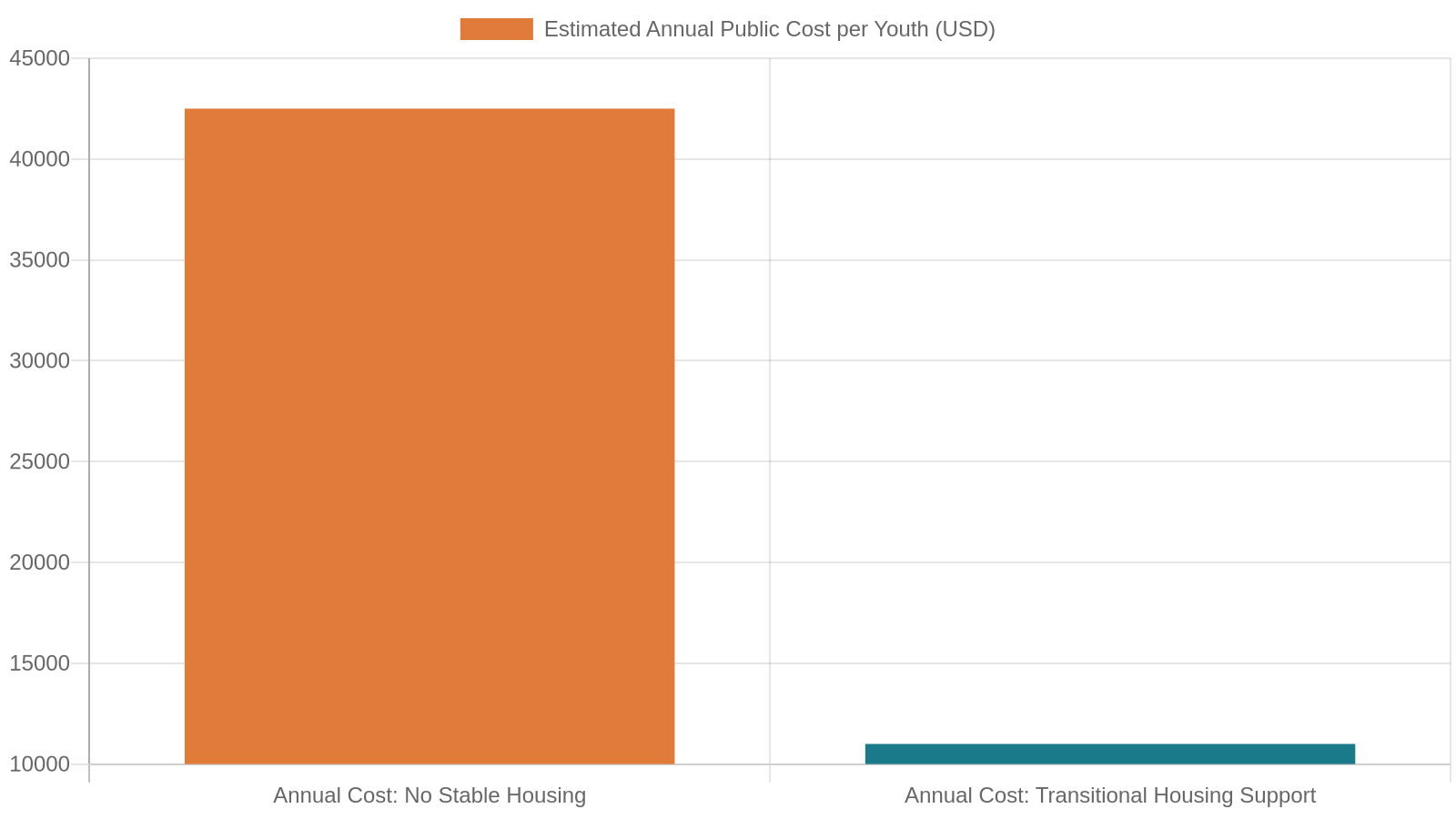
YAAB members cite economic data in their testimony because legislators respond to fiscal arguments. Research from the Urban Institute and the National Homelessness Law Center shows that each year a young adult spends without stable housing costs public systems an estimated $35,000 to $50,000 annually in emergency room visits, justice system involvement, and crisis services — compared to approximately $8,000 to $14,000 per year for a supported transitional housing placement.
In Tennessee, where the state legislature scrutinizes every new appropriation, framing youth housing investment as a cost-reduction strategy — not a charity — has proven more effective at moving votes. YAAB members have learned to lead with this framing without abandoning the human story at the center of their testimony.
What Legislators Actually Ask — and How YAAB Members Respond

Legislative hearings are not one-way speeches. Legislators ask questions — sometimes friendly, sometimes skeptical, sometimes designed to poke holes in an argument. YAAB members prepare for the hardest questions so they are not caught off guard when it matters most.
'Why Should the State Pay for This?'
This is the most common challenge YAAB members face in committee hearings. The response that has proven most effective is not defensive — it is economic. YAAB members walk through the cost comparison between crisis services and stable housing, cite Tennessee-specific data where available, and point to states like Virginia and Utah that have reduced youth homelessness by 30 to 40 percent over five years through targeted investment, generating documented savings in Medicaid, corrections, and emergency services spending.
The key is specificity: a general appeal to compassion is easy to dismiss. A specific dollar figure tied to a specific line item in the state budget is much harder to argue against.
'Aren't There Already Programs for This?'
Legislators sometimes assume that existing federal programs — HUD’s Emergency Solutions Grant, Runaway and Homeless Youth Act funding, or the McKinney-Vento Act — already cover the gaps YAAB members are describing. YAAB members are prepared to explain exactly why they do not: federal funding flows through CoCs and local agencies with significant discretion, youth-specific allocations are not mandated, and Tennessee has historically ranked in the bottom quartile of states for per-capita youth homelessness spending.
Naming the specific gaps — ‘There are currently zero youth-designated rapid rehousing units in the Upper Cumberland CoC region’ — is more persuasive than a general argument that more funding is needed.
'What Would You Change About the Bill as Written?'
This question is actually an opportunity, and YAAB members are trained to recognize it. When a legislator asks what changes would make a bill better, they are signaling openness to amendment — which is often more achievable than passing or defeating a bill outright. YAAB members come prepared with one or two specific amendment suggestions: a changed age threshold, an added reporting requirement, a funding floor for youth-specific services.
Having a concrete amendment ready — written out, not just conceptual — demonstrates preparation and good faith, and has led to several instances where YAAB input was directly incorporated into bill language before a final vote.
Wins So Far: Policy Changes Driven by Youth Testimony

Advocacy is a long game, and YAAB members have already notched real wins — even when those wins do not always look like headline-grabbing legislation. Here is what progress has looked like so far, and why it matters for what comes next.
Incremental Wins and Why They Matter
Legislative change rarely happens all at once. YAAB members have learned to celebrate and build on incremental wins — an amendment added, a funding line preserved, a study committee formed to examine youth housing data. These smaller victories are not consolation prizes; they are the building blocks of larger change. A study committee that includes YAAB members as stakeholders in 2024 can produce a report that drives a bill in 2025.
In Tennessee, YAAB members have contributed to outcomes including the preservation of state funding for transitional housing programs during budget negotiations, the inclusion of youth-specific language in CoC policy guidance issued by the Tennessee Housing Development Agency (THDA), and increased awareness among legislative staff about the distinct needs of transition-age youth versus adult households.
Building Long-Term Relationships With Legislative Offices
One of the most durable outcomes of YAAB’s legislative advocacy is not a single bill — it is the relationships that YAAB members have built with legislative staff and sympathetic legislators over multiple sessions. Staff turnover in legislative offices is lower than elected turnover, meaning that a relationship built with a committee staffer in 2023 can still be active and productive in 2027.
YAAB members who have testified once are often invited back for follow-up briefings, asked to review draft bill language, and included in stakeholder meetings that were previously closed to youth voices. This is how lived experience becomes institutionalized — not through a single dramatic moment, but through consistent, credible presence over time.
Tennessee Youth Advocacy Pathways: What Each Route Requires
Different advocacy pathways suit different situations. Use this table to find the entry point that works for where you are right now.
How the Tennessee Continuum of Care System Connects to State Law

To understand why state legislation matters for young people experiencing homelessness, it helps to understand how Tennessee’s housing system is structured — and where state law intersects with the local programs that YAAB members interact with every day.
What a CoC Is and Why State Law Shapes It
A Continuum of Care (CoC) is a regional planning body that coordinates housing and services for people experiencing homelessness. Tennessee has eight CoC regions, each receiving federal HUD funding that flows through local lead agencies. But federal funding comes with federal rules — and state law can either expand or restrict what CoCs can do with those dollars, who they can serve, and how they must operate.
When YAAB members testify about state legislation, they are often targeting the state-level rules that shape how CoCs function: who qualifies for services, what data must be collected, how youth must be prioritized in Coordinated Entry, and what the Tennessee Housing Development Agency (THDA) must require of CoC grantees. State law is the lever that moves the local system.
THDA's Role and How Youth Can Engage It
The Tennessee Housing Development Agency administers state housing funds and oversees CoC compliance. THDA holds public comment periods on its Consolidated Plan and Annual Action Plan — documents that determine how millions of dollars in housing funds are allocated across the state. YAAB members have learned to participate in these comment periods as another form of advocacy that runs parallel to legislative testimony.
Submitting written comments to THDA, attending THDA public hearings, and requesting meetings with THDA staff are all accessible forms of advocacy that do not require a trip to Nashville. For YAAB members in rural regions like Northeast Tennessee or West Tennessee, these channels can be more accessible than in-person legislative testimony.
Barriers Young Advocates Face — and How YAAB Addresses Them

Advocacy is not equally accessible to everyone, and YAAB is honest about that. Young adults who are actively experiencing housing instability face real barriers to participation — and addressing those barriers is part of YAAB’s work, not an afterthought.
Transportation, Time, and Basic Needs
Testifying before the Tennessee General Assembly in Nashville requires getting to Nashville — which is not simple or free for a 19-year-old in Knoxville or Jackson who is working a part-time job and couch-surfing. YAAB works to remove these barriers by coordinating transportation, covering travel costs, and scheduling advocacy trips around members’ work and school schedules. When in-person testimony is not possible, YAAB supports members in submitting written testimony, which carries legal weight equal to in-person testimony in most committee processes.
Food, housing stability, and basic safety are also prerequisites for advocacy. YAAB connects members to Tennessee-specific housing and support resources so that participation in advocacy is not contingent on having all your basic needs already solved — because for many members, those needs are exactly what they are advocating to address.
Trauma, Trust, and Institutional Skepticism
Many YAAB members have had negative experiences with government systems — child welfare, juvenile justice, public benefits — that make walking into a government building to testify feel unsafe or pointless. YAAB does not dismiss this skepticism. Instead, the organization builds trust through peer relationships, transparent communication about what advocacy can and cannot achieve, and by centering member wellbeing over any single policy outcome.
Members are never required to share more of their story than they choose to. Testimony preparation always includes a conversation about what feels safe to disclose and what does not — and members are reminded that their value to the advocacy effort is not measured by how much trauma they are willing to perform for legislators.
Tokenism and How to Avoid It
One of the most important lessons YAAB teaches is how to recognize and resist tokenism — being invited to testify not because your input will shape the outcome, but because having a young person present makes a policy process look more legitimate. Signs of tokenism include being given no preparation time, being asked to testify on a bill you have not read, being placed last on the agenda when legislators are leaving, or having your testimony ignored in the final vote without explanation.
YAAB members are coached to ask questions before agreeing to testify: What is the bill? What is the ask? Will our testimony be incorporated into the record? Who else is testifying and in what order? These questions are not rude — they are professional, and they signal that YAAB members are there as experts, not as props.
Comparing Advocacy Pathways: Which Route Fits Your Situation?

There is no single right way to advocate for youth housing policy in Tennessee. Different pathways suit different situations, skill sets, and levels of bandwidth. Here is how the main options compare — so you can find your entry point.
Choosing the Right Entry Point
Not every form of advocacy looks the same, and not every form requires the same level of time, energy, or access. YAAB members engage through multiple pathways — some highly visible, like in-person legislative testimony, and some quieter but equally important, like submitting written comments or sharing data with a case manager who then carries it into a policy meeting. The comparison table below outlines the main advocacy pathways available to Tennessee youth and what each one requires.
The right starting point is the one that fits your current situation. If you are in the middle of a housing crisis, written testimony or peer-to-peer outreach may be more sustainable than traveling to Nashville. If you have stability and want to go deeper, joining a regional YAAB and preparing for in-person testimony is a powerful next step.
Ready to Add Your Voice? How to Get Involved With YAAB

If anything in this article has resonated with you — if you have experienced housing instability, aged out of foster care, or just believe that young people should have a seat at the table when housing policy is made — YAAB is where that energy belongs. Here is how to take the next step, wherever you are in Tennessee.
Find Your Regional YAAB
Tennessee’s YAAB network is organized by Continuum of Care region, which means there is a local YAAB connected to your area — whether you are in Memphis, Nashville, Knoxville, Chattanooga, Jackson, or a more rural part of the state. Each regional YAAB has its own meeting schedule, focus areas, and ways to plug in. You do not need to have testified before, have a certain level of education, or have your housing situation fully resolved to join. You need to be between 17 and 25, live in Tennessee, and have some experience with housing instability — that is it.
Visit the local YAABs page to find the region closest to you and get connected with the people already doing this work in your community.
Start With Advocacy — Even Before You Testify
Joining YAAB does not mean your first act is testifying before a legislative committee. Most members start by attending regional meetings, learning about the issues, and building relationships with peers who have been involved longer. Advocacy takes many forms: sharing your story in a survey, reviewing a policy brief, attending a lobby day, or simply showing up consistently so that your perspective is part of the conversation when decisions get made.
When you are ready to go deeper, explore YAAB’s advocacy work and current priorities to see where your energy can make the most impact. The legislative session moves fast, and there is always a role for someone who is ready to step up — whether that means drafting testimony, making phone calls to legislative offices, or helping a peer prepare for their first time in front of a committee.
Your Story Is Already Enough
The most common thing YAAB members say before their first testimony is some version of: ‘I don’t know enough’ or ‘I’m not the right person.’ The truth is that your lived experience of housing instability in Tennessee is exactly the expertise that is missing from most policy conversations. You do not need a degree, a title, or a perfectly polished speech. You need your truth, a clear ask, and the support of a network of peers who have done this before and will do it alongside you.
Tennessee’s youth housing laws will change because young people who have lived through the gaps in those laws show up and say so — clearly, consistently, and on the record. That is what YAAB members are doing right now, across all eight CoC regions of this state. You can be part of it.
Frequently Asked Questions
How old do you have to be to testify before the Tennessee legislature?
There is no minimum age to testify before a Tennessee legislative committee. Any Tennessee resident can sign up to testify at a public hearing. YAAB members as young as 17 have testified, and the process is open to all transition-age youth ages 17 to 25.
Do I have to share personal details about my homelessness to testify?
No. You choose exactly what to share. YAAB coaches members to share only what feels safe and relevant. Your testimony can be effective without disclosing identifying details — what matters is the specific policy ask, not the amount of personal information you disclose.
What is the Youth Action Board of Tennessee and who can join?
The Youth Action Board (YAAB) of Tennessee is a statewide network of young adults ages 17 to 25 with lived experience of homelessness or housing instability. Members advise policymakers, drive advocacy, and connect peers to resources. If you are between 17 and 25, live in Tennessee, and have experienced housing instability, you are eligible to join your regional YAAB.
What Tennessee housing laws are YAAB members trying to change?
YAAB members are focused on several areas: lowering age-based barriers to emergency shelter access, strengthening extended foster care protections and notification requirements, creating youth-specific pathways within the Coordinated Entry System, and securing dedicated state funding for youth rapid rehousing programs that does not depend solely on federal pass-through dollars.
How does Tennessee's Continuum of Care system affect young people experiencing homelessness?
Tennessee's eight Continuum of Care (CoC) regions coordinate housing and services for people experiencing homelessness using federal HUD funding. The CoC's Coordinated Entry System (CES) is the main pathway to shelter and housing resources — but it was originally designed around adult households and often fails to account for the specific needs and risk factors of transition-age youth ages 17 to 25.
Can I advocate for youth housing policy if I am still experiencing homelessness myself?
Yes. YAAB is specifically designed to include members who are currently experiencing housing instability, not just those who have already achieved stability. YAAB works to remove barriers to participation — including transportation, scheduling, and basic needs support — so that advocacy is accessible to members regardless of where they are in their housing journey.