Quick answer: The Upper Cumberland YAAB (Tennessee Continuum of Care region TN-506) connects young adults ages 17 to 25 who have experienced homelessness or housing instability to mental health services, peer support networks, crisis resources, and advocacy opportunities across the Upper Cumberland region. Whether you need someone to talk to, a safe place to land, or a way to turn your experience into change, the Upper Cumberland YAAB and its community partners offer nine concrete pathways to support — all led by young people who have been where you are.
1. What the Upper Cumberland YAAB Actually Is

Before diving into specific services, it helps to understand what the Upper Cumberland YAAB is and why it exists. This is not a hotline or a shelter — it is a peer-led advisory body that shapes how mental health and support services are designed and delivered for transition-age youth across the Upper Cumberland region of Tennessee.
Understanding the structure helps you know exactly who to call, what to expect, and why the people helping you actually get it.
A Network Built by and for Young Adults
The Upper Cumberland Youth Action Board is not a program that happens to young people — it is a network run by young people. Members are ages 17 to 25 and bring lived experience of homelessness, housing instability, aging out of foster care, or other housing crises. That lived experience is treated as expertise, not a liability.
YAAB members in the Upper Cumberland region advise local Continuum of Care (CoC) leaders, help design services, and connect peers to resources across counties including Putnam, White, Overton, Pickett, Fentress, Cumberland, DeKalb, Smith, Macon, Clay, and Jackson County.
How the Upper Cumberland Fits Tennessee's Continuum of Care
Tennessee’s housing and homelessness response is organized into regional Continuums of Care (CoCs). The Upper Cumberland region is designated TN-506 and covers a largely rural swath of Middle Tennessee. The CoC coordinates funding, data, and services — and the YAAB is the youth voice inside that system.
Being part of the CoC means YAAB members have a seat at tables where real decisions get made: which shelters get funded, how outreach workers are trained, and what data gets collected about young people experiencing homelessness.
2. Peer Support: Why Talking to Someone Who Gets It Changes Everything

One of the most powerful things the Upper Cumberland YAAB offers is not a form or a referral — it is connection to someone who has lived it. Peer support is the foundation of everything the YAAB does, and it is also one of the most effective mental health interventions available for young adults ages 17 to 25.
What Peer Support Actually Looks Like
Peer support is not therapy, and it is not a lecture. It is a conversation with someone who has navigated similar experiences — housing instability, system involvement, mental health struggles — and come out the other side with tools and perspective to share.
In the Upper Cumberland, peer supporters connected through the YAAB network can help you figure out next steps, process what you are going through, and point you toward the right local resource without judgment. Sessions can happen in person, by phone, or through digital platforms depending on your county and comfort level.
The Research Behind Peer Support
Peer support is not just a feel-good idea. A 2019 study published in Psychiatric Services found that peer support specialists reduce psychiatric hospitalization rates by up to 35% among young adults with serious mental health challenges. SAMHSA (Substance Abuse and Mental Health Services Administration) recognizes peer support as an evidence-based practice.
For transition-age youth specifically, research from the National Alliance to End Homelessness shows that young adults are significantly more likely to engage with services when those services are delivered by peers rather than traditional providers. Trust is the first resource.
3. Mental Health Crisis Resources Available in the Upper Cumberland

Mental health crises do not wait for office hours, and the Upper Cumberland region — being largely rural — can feel especially isolated when you are struggling. Knowing exactly which numbers to call and which doors to walk through can be the difference between a bad night and a turning point. Here is a clear, no-jargon breakdown of what is available right now.
Immediate Crisis Lines You Can Use Right Now
If you are in crisis right now, these resources are available 24/7 and are free:
- 988 Suicide and Crisis Lifeline: Call or text 988 from anywhere in Tennessee. You can also chat at 988lifeline.org. Spanish-language support is available.
- Crisis Text Line: Text HOME to 741741 to connect with a trained crisis counselor via text.
- Tennessee Statewide Crisis Line: 1-855-CRISIS-1 (1-855-274-7471), available 24/7 for mental health and substance use crises.
- Trevor Project (LGBTQ+ youth): Call 1-866-488-7386 or text START to 678-678.
None of these lines require insurance, ID, or housing. You do not have to be in immediate danger to call — feeling overwhelmed counts.
Local Upper Cumberland Mental Health Centers
The Upper Cumberland Human Resource Agency (UCHRA) and Volunteer Behavioral Health Care System serve much of the TN-506 region and offer sliding-scale mental health services. Putnam County is served by Volunteer Behavioral Health, which has walk-in crisis services at its Cookeville location.
Many of these centers accept TennCare (Tennessee Medicaid) and offer services on a sliding fee scale if you are uninsured. If you are not sure whether you qualify for TennCare, YAAB peer navigators can help you figure that out — eligibility for young adults who have experienced homelessness is often broader than people realize.
4. Housing Instability and Mental Health: Understanding the Connection

Mental health and housing are not separate issues — they are the same issue wearing different clothes. The Upper Cumberland YAAB understands this deeply, which is why its peer support and advocacy work never treats mental wellness as something separate from having a safe place to sleep. This section explains the connection and what it means for how services are delivered in TN-506.
How Housing Stress Affects Your Mental Health
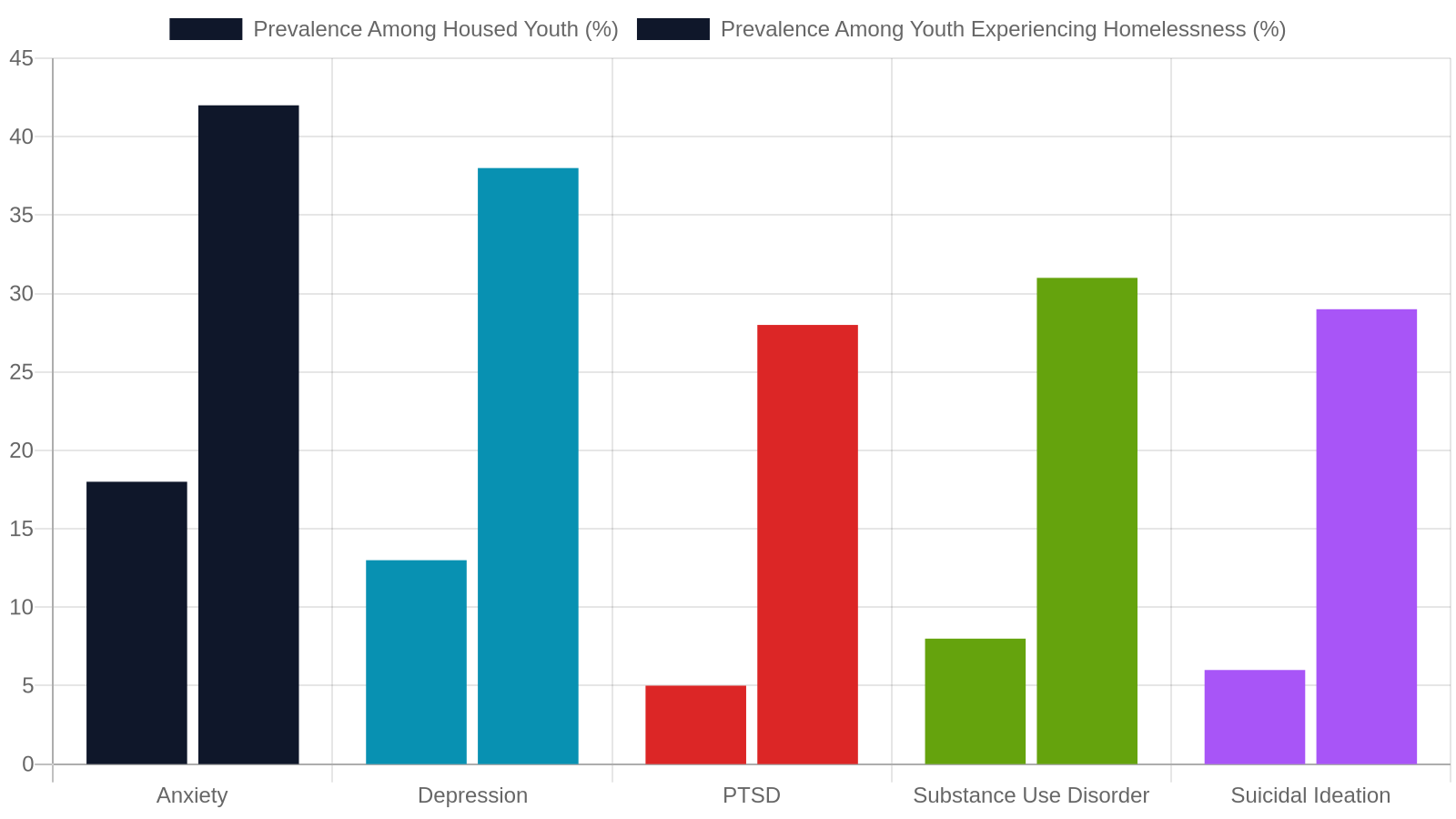
When you do not know where you will sleep tonight, your nervous system is in survival mode. Chronic stress from housing instability is linked to higher rates of anxiety, depression, PTSD, and substance use among transition-age youth. This is not a character flaw — it is a physiological response to an impossible situation.
A 2021 report from True Colors United found that approximately 4.2 million young adults experience homelessness in the United States each year, and LGBTQ+ youth are disproportionately represented, making up roughly 40% of youth experiencing homelessness despite being about 7% of the general youth population.
Why the YAAB Addresses Both at Once
The Upper Cumberland YAAB operates from a Housing First philosophy — the idea that stable housing is a prerequisite for mental health recovery, not a reward for it. YAAB members advocate for services that address housing and mental health simultaneously rather than requiring young people to be mentally stable before they can get housed.
This matters in practice: if a young adult in Cookeville or Crossville is connected to a peer supporter, that supporter can help them navigate both a mental health referral and an emergency housing application at the same time, without making them choose which crisis to address first.
5. How to Access Services If You Are Uninsured or Underinsured

One of the biggest barriers young adults in the Upper Cumberland face when seeking mental health support is the assumption that you need insurance, money, or a permanent address to get help. You do not. Here is a practical breakdown of the financial access points available in TN-506 right now.
TennCare and CoverKids: What You Likely Qualify For
Tennessee’s Medicaid program is called TennCare. If you are a young adult ages 17 to 25 with low or no income, you may qualify — especially if you have experienced homelessness, are aging out of foster care, or are pregnant. Former foster youth in Tennessee can remain on TennCare until age 26 through the Chafee Foster Care Independence Program.
Applying is free. You can apply online at tenncare.tn.gov, by phone at 1-800-342-3145, or in person at your local Department of Human Services office. YAAB peer navigators in the Upper Cumberland can walk you through the application if the process feels overwhelming.
Federally Qualified Health Centers in the Upper Cumberland
Federally Qualified Health Centers (FQHCs) are required by law to see patients regardless of ability to pay, using a sliding fee scale based on income. In the Upper Cumberland region, Plateau Mental Health Center and primary care FQHCs in Cookeville and surrounding counties offer mental health services on this basis.
You do not need insurance to walk in. You do not need a referral. You do not need a permanent address. You may need a form of ID, but if you do not have one, a YAAB peer navigator can help you obtain a Tennessee state ID — often at no cost for young adults who have experienced homelessness.
6. Substance Use Support: Harm Reduction Without Judgment

Substance use and mental health are deeply intertwined, and the Upper Cumberland YAAB approaches both with the same non-stigmatizing, peer-centered lens. If you or someone you know is struggling with substance use, there are options in TN-506 that do not require you to have everything figured out before you can get help.
What Harm Reduction Means in Practice
Harm reduction is a public health approach that meets people where they are — without requiring sobriety as a condition of receiving help. In the Upper Cumberland, harm reduction services may include access to naloxone (Narcan) kits, needle exchange programs, and counseling that does not require you to commit to abstinence before you can get support.
The YAAB does not shame young adults for substance use. Members understand that substance use is often a coping mechanism for trauma, housing stress, and untreated mental health conditions — and that punishing people for coping rarely helps anyone get better.
Substance Use Treatment Options in TN-506
Volunteer Behavioral Health Care System provides outpatient substance use treatment across several Upper Cumberland counties, including Putnam and White. Services include individual counseling, group therapy, and medication-assisted treatment (MAT) for opioid use disorder.
The Tennessee Department of Mental Health and Substance Abuse Services (TDMHSAS) maintains a statewide treatment locator at tn.gov/behavioral-health. You can filter by county and insurance type. If you are uninsured, many providers receive state grant funding that covers services at no cost to you. YAAB peer navigators can help you identify the right fit and make the first call if that feels like too much to do alone.
7. Advocacy as Mental Health: Why Having a Voice Matters

Getting mental health support is important. But so is having a say in how that support is designed. The Upper Cumberland YAAB treats advocacy itself as a form of healing — and the evidence backs that up. Here is why joining the advocacy side of YAAB is not just about changing systems, but about changing how you see yourself inside those systems.
The Healing Power of Being Heard
Research on trauma recovery consistently identifies agency — the sense that your choices and voice matter — as one of the most important factors in healing. For young adults who have experienced homelessness, systems involvement, or housing instability, that sense of agency is often stripped away repeatedly.
YAAB membership restores it. When you sit at a CoC meeting and your input changes how a shelter operates, or when your testimony helps shift a state policy, that is not just advocacy — that is a mental health intervention. Feeling like you matter, because you demonstrably do, is powerful medicine.
How Upper Cumberland YAAB Members Shape Policy
Upper Cumberland YAAB members participate in regional CoC planning meetings, provide input on Point-in-Time (PIT) count methodology, advise on how Coordinated Entry systems are designed for youth, and connect with statewide YAAB advocacy efforts in Nashville and beyond.
You do not need a degree, a clean record, or a permanent address to be a YAAB member. You need lived experience and a willingness to show up. Members receive training, stipends in some regions, and ongoing peer support to make participation sustainable — not just another thing that drains you.
Upper Cumberland Support Options at a Glance
Use this table to quickly match your current situation to the right type of support available in TN-506 and statewide Tennessee.
8. Navigating the System: What a Peer Navigator Can Do for You

Tennessee’s network of mental health, housing, and support services can feel like a maze — especially when you are already exhausted from surviving. Peer navigators in the Upper Cumberland YAAB network exist specifically to help you find the door that opens for you, not just the one that is theoretically available.
The Difference Between a Caseworker and a Peer Navigator
A caseworker is assigned to you by an agency and manages your case according to program rules. A peer navigator is a young adult with lived experience who walks alongside you — helping you understand your options, prepare for appointments, and advocate for yourself without doing it all for you.
Peer navigators connected through the Upper Cumberland YAAB network can help you: understand your rights in a shelter or transitional housing program, prepare for a mental health intake appointment, navigate TennCare enrollment, find transportation to services in rural counties, and identify emergency financial assistance for things like deposits or utility bills.
How to Connect with a Peer Navigator in TN-506
The best starting point is reaching out directly through the YAAB network. You can also connect through local CoC partners, outreach workers, and youth-serving organizations across the Upper Cumberland region. Many connections happen informally — through a friend, a shelter worker, or a community event.
If you are not sure where to start, the YAAB statewide resources page lists current contacts and partner organizations. You can also reach out through the YAAB contact page and someone will help route you to the right person in your area.
9. Comparing Your Support Options in the Upper Cumberland

Every young adult’s situation is different, and the Upper Cumberland has a range of support options — from immediate crisis lines to long-term peer advocacy. This section helps you match your current need to the right type of resource, and addresses the very real challenge of accessing services in a rural region.
Matching the Right Resource to Your Situation
Not every resource fits every situation, and that is okay. The comparison table below breaks down the main types of support available in TN-506 so you can quickly identify what fits your current need — whether that is an immediate crisis, ongoing mental health care, peer connection, or advocacy involvement.
Use this as a starting point, not a final answer. A peer navigator can help you go deeper on any of these options and figure out what is actually available in your specific county within the Upper Cumberland region.
Rural Access Challenges and How to Work Around Them
The Upper Cumberland is a largely rural region, and transportation is one of the biggest barriers to accessing services. Here are practical workarounds used by YAAB members and their peers:
- Telehealth: Most mental health providers in TN-506 now offer telehealth sessions. You need a phone or computer and a private space — libraries in Cookeville, Crossville, and other county seats offer free Wi-Fi and private study rooms.
- Mobile outreach: Some providers bring services to you. Ask your local CoC or YAAB contact whether mobile outreach is available in your county.
- Rideshare assistance: Some nonprofits and CoC partners offer gas cards or rideshare credits for medical and mental health appointments. Ask specifically — this is often not advertised.
10. LGBTQ+ Youth in the Upper Cumberland: Specific Resources and Protections

The Upper Cumberland YAAB is committed to being a fully affirming space for LGBTQ+ young adults — because the data is clear that LGBTQ+ youth face disproportionate risk of homelessness and mental health challenges, and because everyone deserves peer support that sees and respects who they are.
Why LGBTQ+ Youth Face Heightened Risk
LGBTQ+ young adults are overrepresented in the youth homelessness population nationally and in Tennessee. Family rejection following coming out is the leading driver of LGBTQ+ youth homelessness — accounting for an estimated 40% of youth experiencing homelessness despite LGBTQ+ youth representing roughly 7% of the general youth population, according to True Colors United.
In rural regions like the Upper Cumberland, LGBTQ+ young adults may face additional barriers: fewer affirming providers, greater social isolation, and less visibility of LGBTQ+-specific services. The Upper Cumberland YAAB actively works to make its peer support network affirming and accessible regardless of sexual orientation, gender identity, or expression.
Affirming Resources Available to You
Nationally, the Trevor Project (1-866-488-7386 or text START to 678-678) provides 24/7 crisis support specifically for LGBTQ+ youth. The Trans Lifeline (877-565-8860) is staffed by transgender people for transgender people in crisis.
Locally, ask your YAAB peer navigator specifically for affirming provider referrals — not all providers in rural Tennessee are equally prepared to serve LGBTQ+ youth, and a peer navigator who knows the landscape can steer you toward providers who will treat you with dignity. You have the right to affirming care, and you should not have to settle for less.
Ready to Connect with the Upper Cumberland YAAB?

You have made it through nine sections of real, concrete information about mental health and peer support in the Upper Cumberland. That means something. Now the most important step is the simplest one: reach out. The Upper Cumberland YAAB exists because young adults across TN-506 decided their experiences were worth something — and they were right. So are yours.
Your First Step Does Not Have to Be Big
You do not have to have your life together to reach out. You do not have to know exactly what you need. You do not have to be in a crisis. You can reach out because you are curious, because you want to meet people who get it, or because you want to turn your experience into something that helps others.
The Upper Cumberland YAAB is a network of young adults ages 17 to 25 across TN-506 who are doing exactly that — navigating their own paths while helping shape the systems around them. Whether you want peer support, a referral to mental health services, or a seat at the table where decisions get made, there is a place for you here.
How to Get Involved Across Tennessee
If you are in the Upper Cumberland region (TN-506), visit the Upper Cumberland YAAB page to learn about current members, upcoming events, and how to connect with peer navigators in your area. This is your starting point for everything from crisis referrals to advocacy involvement.
If you are in a different part of Tennessee, the full list of local YAABs covers every CoC region in the state — from Memphis/Shelby (TN-500) to Northeast Tennessee (TN-509). No matter where you are in Tennessee, there is a YAAB near you. You do not have to figure this out alone.
Frequently Asked Questions
How do I join the Upper Cumberland YAAB if I am between 17 and 25?
You can connect through the Upper Cumberland YAAB page at yaabtn.org/local-yaabs/tn-506/ or reach out through a local CoC partner or youth-serving organization in TN-506. You need lived experience of homelessness or housing instability — no degree, clean record, or permanent address required.
What mental health services are free for young adults in the Upper Cumberland?
The 988 Suicide and Crisis Lifeline, Crisis Text Line, and YAAB peer navigation are all free with no insurance required. Federally Qualified Health Centers use a sliding fee scale based on income, and many substance use treatment slots are covered by state grants at no cost to you.
Can I get mental health support in the Upper Cumberland if I do not have a permanent address?
Yes. Crisis lines, peer navigators, and Federally Qualified Health Centers do not require a permanent address. Some providers may ask for an ID — if you do not have one, a YAAB peer navigator can help you obtain a free Tennessee state ID.
What is the Upper Cumberland Continuum of Care and why does it matter for youth?
The Upper Cumberland Continuum of Care (CoC TN-506) is the regional network that coordinates housing and homelessness services across counties including Putnam, White, Cumberland, and surrounding areas. It determines which programs get funded and how services are designed — which is why YAAB youth voice inside the CoC directly shapes what help is available.
Are there LGBTQ+-affirming mental health services in the Upper Cumberland region?
Yes. The Trevor Project (1-866-488-7386) and Trans Lifeline (877-565-8860) are available 24/7 nationally. Locally, YAAB peer navigators can refer you to affirming providers in TN-506. Ask specifically for an affirming referral — you have the right to care that respects your identity.
What is the difference between a peer navigator and a caseworker?
A caseworker manages your case according to program rules set by an agency. A peer navigator is a young adult with lived experience who walks alongside you — helping you understand your options, prepare for appointments, and advocate for yourself. Peer navigators are not assigned to you; they work with you.