Quick answer: Nashville's Youth Action Board (YAAB) peer mentorship programs connect young adults ages 17–25 who have lived experience of homelessness with peers who are currently navigating housing instability. Through one-on-one mentoring, group workshops, advocacy training, and resource navigation, YAAB members in the Nashville/Davidson County Continuum of Care (TN-504) help each other find stable housing, access services, and build long-term skills — because the most powerful guide through a hard situation is someone who has already walked that road.
What Is the Nashville YAAB and Why Does Peer Mentorship Matter?

Before diving into the specific programs, it helps to understand what makes peer mentorship in the YAAB context different from other forms of support. The Nashville YAAB is not a hotline, a shelter, or a government office. It is a community of young adults with lived experience who are actively shaping the systems around them — and inviting their peers to do the same.
If you are between 17 and 25 and dealing with housing instability in the Nashville area, this is a network built by people who get it, because they have been there.
YAAB Is Run By and For Young Adults
The Youth Action Board of Tennessee (YAAB) is not a program run for young people by adults who have never experienced homelessness. It is a statewide network <em led by young adults ages 17–25 who have lived through housing instability themselves. The Nashville chapter operates within the TN-504 Continuum of Care, which covers Davidson County and the surrounding metro area.
YAAB members advise local service providers, sit on policy committees, and — critically — show up for their peers as mentors. When you are trying to find a place to sleep tonight and figure out tomorrow at the same time, advice from someone who has been in that exact spot carries weight that a pamphlet never can.
Why Peer Mentorship Works Better Than You Might Expect
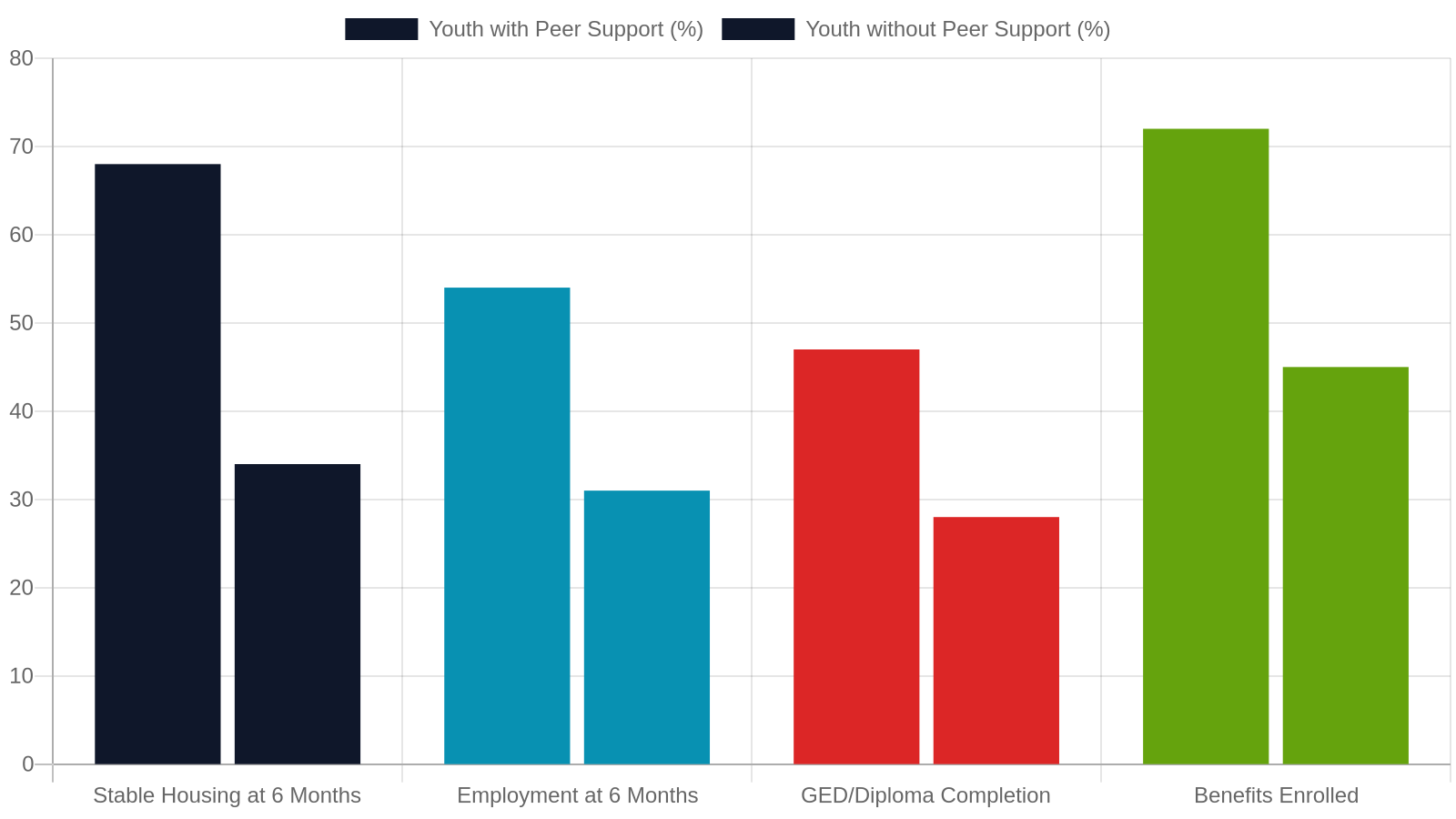
Research consistently backs what young adults already know intuitively. A 2022 study published in the Journal of Youth and Adolescence found that transition-age youth who received peer support during housing transitions were 34% more likely to maintain stable housing at the six-month mark compared to those who received only professional case management. Peers reduce shame, increase trust, and share hyper-local knowledge — like which shelter in Nashville has the shortest waitlist this week or which employment program actually calls you back.
Peer mentors also model possibility. Seeing someone your own age who has moved from couch-surfing to a lease to a leadership role in a statewide organization is a different kind of proof than a brochure full of statistics.
1. One-on-One Peer Mentoring: Your Personal Guide Through the System

The most foundational piece of Nashville YAAB’s peer support model is the one-on-one mentoring relationship. This is not a hotline call or a one-time appointment. It is an ongoing connection between a young adult navigating housing instability and a peer who has already found their footing — and wants to help someone else do the same.
What a One-on-One Peer Mentor Actually Does
A peer mentor in the Nashville YAAB is not a case manager with a caseload of 60 people. They are a young adult — often someone who aged out of foster care, experienced homelessness, or navigated the Continuum of Care themselves — who meets with you regularly to help you figure out your next steps. That might mean sitting with you while you fill out a rental application, walking you through what Rapid Rehousing actually covers, or just being a consistent person who picks up the phone.
Typical one-on-one mentoring touchpoints include: reviewing your housing plan with you, helping you prepare for landlord interviews, breaking down lease terms in plain language, and connecting you to specific resources in Davidson County like the Tennessee Homeless Solutions network or Metro Social Services.
How to Get Matched With a Peer Mentor in Nashville
Getting connected is simpler than most people expect. You do not need to be enrolled in a formal program or have a referral from a case manager. Young adults in the Nashville area can reach out directly through the YAAB network. Matching is based on shared experience — if you are aging out of foster care, you are more likely to be paired with a mentor who has navigated that specific transition. If your challenge is employment-related housing instability, your mentor will have relevant experience there.
Response times vary, but Nashville YAAB members aim to make initial contact within 72 hours of a request. The relationship is voluntary, confidential, and youth-driven — meaning you set the pace and the agenda.
2. Group Workshops: Learning Together, Not Alone

Not every form of support happens one-on-one. Some of the most powerful learning happens in a room full of people who are all figuring out the same things at the same time. Nashville YAAB’s group workshops create that space — structured enough to be useful, informal enough to feel safe.
Housing Navigation Workshops in Nashville
Nashville YAAB members facilitate group workshops specifically designed for young adults who are in the middle of a housing transition or trying to prevent one. These sessions cover practical ground: how to read a lease, what your rights are as a tenant in Tennessee, how to dispute an eviction notice, and how to build a rental history when you have none. Sessions are held in accessible locations across Davidson County — community centers, libraries, and partner organization spaces.
Workshops typically run 90 minutes and are kept small (under 20 participants) so there is real room for questions. Attendance is free, and no ID or proof of enrollment in any program is required to show up.
Financial Literacy and Benefits Navigation
One of the most requested workshop topics is financial literacy — specifically, how money works when you are young, have limited credit history, and are trying to get stable. Nashville YAAB workshops cover opening a bank account without a permanent address, understanding security deposit assistance programs, and navigating TennCare enrollment for healthcare coverage that does not disappear when you move.
Benefits navigation is woven into these sessions because housing stability and income support are inseparable. Participants learn how to apply for the Tennessee Low Income Home Energy Assistance Program (LIHEAP), how to access emergency rental assistance through Metro Nashville, and how to avoid common scams that target young adults in housing transitions.
Mental Health and Wellness Peer Circles
Housing instability is a trauma. The Nashville YAAB peer model acknowledges that directly. Peer-facilitated wellness circles give young adults a space to process what they are going through without clinical framing or judgment. These are not therapy sessions — they are structured conversations led by trained peer facilitators who have experienced similar stress and know how to hold space for it.
Topics rotate based on what participants bring: grief about losing a home, anxiety about aging out of foster care, burnout from navigating systems alone. Facilitators are trained in trauma-informed peer support principles and know when to refer someone to professional mental health services available through Nashville’s Continuum of Care partners.
3. Housing Navigation Support: Cutting Through the Red Tape

Finding housing in Nashville as a young adult without a rental history, without a co-signer, and potentially without ID is not just hard — it is a system designed for people who already have stability. Nashville YAAB peer mentors specialize in helping young adults navigate that system anyway, using every tool available and advocating loudly when tools are missing.
Understanding Nashville's Continuum of Care (TN-504)
Nashville’s Continuum of Care is officially designated TN-504 and covers Davidson County. It is a coordinated network of organizations — shelters, transitional housing programs, Rapid Rehousing providers, Permanent Supportive Housing programs — that are supposed to work together to move people from homelessness to stability. In theory, it is a pipeline. In practice, it can feel like a maze.
YAAB peer mentors who operate within TN-504 know the actual layout of that maze. They know which programs have the shortest waitlists, which ones prioritize transition-age youth, and which ones require documentation that can be waived or substituted. That insider knowledge — earned through personal experience — is not available in any official guide.
Coordinated Entry: What It Is and How to Navigate It
In Nashville, accessing most homeless services requires going through Coordinated Entry, the system that assesses need and matches people to available resources. For young adults, this process can feel intimidating or confusing — especially if it is your first time. Peer mentors can walk alongside you through every step: scheduling your assessment, understanding your score, and advocating for appropriate placement.
YAAB members have also worked directly with TN-504 leadership to improve how Coordinated Entry serves transition-age youth specifically — pushing for youth-specific assessment tools and dedicated youth housing slots. When you work with a peer mentor through YAAB, you are benefiting from years of collective advocacy, not just individual help.
4. Employment Support: Because Housing Requires Income

Stable housing and stable income are not separate goals — they are the same goal approached from two directions. Nashville YAAB peer mentors understand this, which is why employment support is woven into the peer mentorship model rather than treated as a separate track. You cannot pay rent without income, and you cannot focus on a job search when you do not know where you are sleeping tonight.
Peer-to-Peer Job Search Strategies That Actually Work
YAAB peer mentors in Nashville do not pretend that getting a job is simple when you do not have a stable address for your resume, a phone that stays on, or work clothes for an interview. They share strategies that work in the real world: using library addresses, accessing free phone plans through Lifeline, and identifying Nashville employers who participate in Fair Chance Hiring programs that do not automatically screen out applicants with records.
Peer mentors also share which temp agencies pay same-day or next-day, which Nashville employers offer on-the-job training with no prior experience required, and which workforce development programs — like those offered through Alignment Nashville or the Tennessee Department of Labor — have youth-specific tracks with wraparound support.
Education and GED Pathways as a Route to Housing Stability
For young adults who left school during a period of housing instability, returning to education can feel impossible — but it is one of the most reliable paths to long-term stability. Nashville YAAB peer mentors connect peers to free GED preparation programs through Nashville State Community College and the Tennessee Adult Education network, and help them understand how completing a GED opens doors to workforce programs with higher wages.
Mentors also share personal experience with navigating school re-enrollment while homeless or housing-insecure — including how to access McKinney-Vento protections that guarantee educational rights for students experiencing homelessness, even at the post-secondary level in some cases.
5. Advocacy Training: Turning Your Story Into Change

Peer mentorship in the Nashville YAAB is not just about surviving a housing crisis — it is about building the power to change the systems that create housing crises in the first place. Advocacy training is built into the YAAB model because young adults with lived experience are the most credible voices for reform, and because leadership is itself a pathway to stability.
How Nashville YAAB Members Become Advocates
One of the most distinctive things about the YAAB model is that peer support is not the end of the road — it is the beginning of a leadership journey. Nashville YAAB members who start as mentees often become mentors, and mentors often become advocates who testify before Metro Nashville committees, participate in statewide policy forums, and help design the programs that will serve the next generation of young adults.
Advocacy training through Nashville YAAB covers: how to tell your story effectively without re-traumatizing yourself, how local and state policy processes work, how to engage with elected officials, and how to use data alongside personal narrative for maximum impact. These are real, transferable skills that serve young adults in every area of life.
Youth Voice in the TN-504 Continuum of Care
Nashville’s Continuum of Care is required by HUD to include youth voice in planning and decision-making. YAAB members fill that role — not as token representatives, but as informed advocates who have studied the data, lived the experience, and built relationships with CoC leadership. Nashville YAAB members have contributed to changes in how TN-504 prioritizes youth in Coordinated Entry, how outreach workers are trained to engage young adults, and how Rapid Rehousing programs are structured for people under 25.
When you join Nashville YAAB, you are joining an organization with a documented track record of moving the needle on real policy — not just advising from the sidelines.
6. Foster Care Alumni Support: Navigating the Cliff at 18

For young adults aging out of foster care in Davidson County and across Tennessee, the transition to independent living is one of the most abrupt and under-supported moments in a young person’s life. Nashville YAAB peer mentors — many of whom have walked this exact road — provide specialized support for this population that goes beyond generic housing navigation.
Why Aging Out of Foster Care Creates a Housing Crisis
In Tennessee, young people in foster care can remain in care until age 21 under the Extended Foster Care program — but many still age out without a stable housing plan, a support network, or the practical skills to navigate adult life independently. Nationally, approximately 40% of former foster youth experience homelessness within 18 months of aging out. In Nashville, YAAB peer mentors who are themselves foster care alumni provide targeted support for this specific transition.
That support includes helping peers understand their rights under Extended Foster Care, connecting them to the Tennessee Department of Children’s Services (DCS) Transitional Services program, and walking them through the Chafee Education and Training Voucher (ETV) program, which provides up to $5,000 per year for post-secondary education or training for eligible youth.
Building a Support Network When You Don't Have Family
One of the most painful realities of aging out of foster care is that the systems that were supposed to support you disappear almost overnight — and you may not have family to fall back on. Nashville YAAB peer mentors who have been through this understand that rebuilding a support network is not just emotional work; it is practical work that directly affects housing stability.
Peer mentors help foster care alumni identify and connect with Transitional Living Programs (TLPs) in Nashville, which provide housing and life skills support for young adults 18–24. They also help peers build the kind of documented relationships — with employers, landlords, mentors — that substitute for family references on rental applications and job applications.
Nashville YAAB Peer Mentorship vs. Other Support Options: How They Compare
Not all support looks the same. Here is how Nashville YAAB peer mentorship compares to other common forms of support available to transition-age youth in Davidson County.
7. Knowing Your Rights: What Every Young Adult in Nashville Should Know

Knowledge is a form of protection. One of the most empowering things a peer mentor can do is help a young adult understand what the law actually says about their situation — because systems often count on people not knowing their rights. Nashville YAAB peer mentors are trained to share this information clearly and without judgment.
Tenant Rights for Young Adults in Tennessee
Tennessee has specific tenant protections that apply regardless of your age, but many young adults do not know them. Under the Tennessee Uniform Residential Landlord and Tenant Act, landlords in cities like Nashville are required to maintain habitable conditions, give proper notice before entry, and follow legal eviction procedures — they cannot simply lock you out or remove your belongings without a court order. Nashville YAAB peer mentors help young adults understand these rights and know when to contact Metro Nashville’s Office of Housing for assistance.
Key rights every young adult should know: you are entitled to a written receipt for cash rent payments, your security deposit must be returned within 30 days of move-out (with itemized deductions), and retaliation for complaining about habitability is illegal under Tennessee law.
Rights During Homelessness: What the Law Protects
Being homeless does not mean being without rights. Nashville YAAB peer mentors help young adults understand protections that apply even without a fixed address: the right to vote using a shelter address, the right to access public spaces, the right to refuse consent for searches, and the right to access emergency medical care regardless of ability to pay or insurance status.
For young adults who are parents, YAAB mentors also help navigate the intersection of housing instability and child welfare — a situation that requires careful, informed navigation. For young adults in school, McKinney-Vento Act protections guarantee the right to immediate enrollment and transportation, even without proof of residency.
8. How the Nashville YAAB Compares to Other Support Models

Understanding where peer mentorship fits in the larger landscape of support services helps young adults and the providers who work with them use every resource more effectively. Nashville YAAB is not trying to do everything — it is trying to do the things that only peers can do, and to do them exceptionally well.
Peer Support vs. Professional Case Management
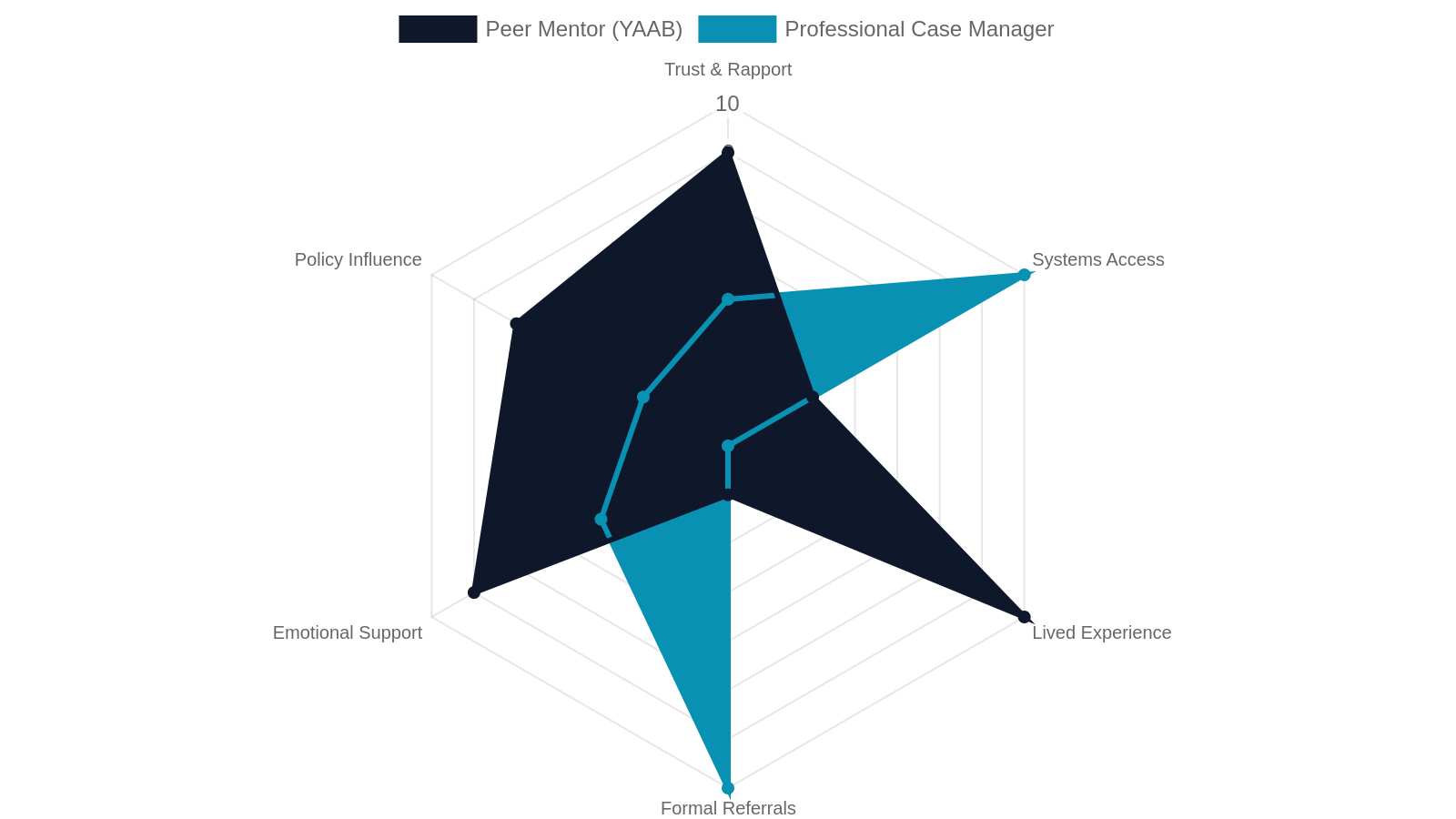
Professional case managers play an essential role in the Continuum of Care — they have access to systems, funding streams, and formal referral pathways that peer mentors do not. But they also carry large caseloads (often 30–60 clients per case manager), are bound by professional protocols, and may not have personal experience with housing instability. The peer mentor relationship is fundamentally different: it is based on shared experience, mutual respect, and a level of informality that makes it easier for young adults to ask questions they might be embarrassed to ask a professional.
The most effective support models combine both: professional case management for systems navigation and formal services, peer mentorship for trust-building, practical knowledge-sharing, and emotional support. Nashville YAAB is designed to complement, not replace, the professional services available through TN-504 partners.
How Nashville's YAAB Fits Into the Statewide Network
Nashville’s TN-504 YAAB is one of several regional YAABs across Tennessee. Each operates within its local Continuum of Care while connecting to the statewide YAAB network for shared learning, policy advocacy, and peer support. Other regional YAABs include those in Memphis (TN-500), Knoxville (TN-501), Chattanooga (TN-503), Jackson/West Tennessee (TN-506), and others. The statewide connection means Nashville YAAB members can connect peers who are relocating to other Tennessee cities with local support in their destination region — a critical service for young adults whose housing instability often involves moving between cities.
9. How to Get Involved With Nashville YAAB Right Now

Whether you are looking for support, ready to offer it, or somewhere in between — Nashville YAAB has a place for you. The steps to get involved are straightforward, and the community you will find is one built on honesty, shared experience, and genuine care for each other’s futures.
If You Need Support: How to Connect
If you are a young adult between 17 and 25 in the Nashville area who is experiencing housing instability or has in the past, you do not need to have everything figured out to reach out to YAAB. You do not need to be enrolled in a program, referred by a case manager, or ready to be a leader. You just need to show up. The Nashville YAAB (TN-504) welcomes young adults who are in the middle of their hardest moments — because that is exactly when peer connection matters most.
You can connect through the Nashville TN-504 YAAB page to find current meeting times, contact information, and information about upcoming events and workshops in Davidson County. Participation is free, voluntary, and confidential.
If You Want to Become a Peer Mentor
If you have lived experience of homelessness or housing instability and you want to use that experience to help others, becoming a Nashville YAAB peer mentor is one of the most meaningful things you can do — for your community and for yourself. Peer mentors receive training in trauma-informed support, advocacy skills, and resource navigation. Many YAAB members report that the mentoring relationship is as valuable for the mentor as it is for the mentee.
To learn more about joining the statewide YAAB network and what membership looks like, visit the YAAB join page or explore what YAAB is all about. You do not need a perfect story or a polished resume — you need lived experience and the willingness to show up for someone else.
If You Are a Service Provider or CoC Partner
Case managers, outreach workers, and Continuum of Care partners in Nashville can strengthen their work by connecting the young adults they serve to Nashville YAAB peer mentors. YAAB is not a competing service — it is a complementary layer of support that increases the likelihood that your clients will stay engaged, follow through on housing plans, and build the resilience to maintain stability long-term.
Partners can also support YAAB by advocating for youth voice in TN-504 planning processes, hosting workshops at their facilities, and connecting YAAB members to professional development opportunities. The relationship is genuinely reciprocal.
Frequently Asked Questions
How do I find a peer mentor through Nashville YAAB?
You can connect with Nashville YAAB (TN-504) directly through their page on the YAAB Tennessee website. No referral, enrollment, or prior program participation is required. You just need to be between 17 and 25 and have some connection to housing instability — past or present.
Do I have to be currently homeless to get help from Nashville YAAB?
No. Nashville YAAB supports young adults who are currently experiencing homelessness, those who are housing-insecure or at risk, and those who have experienced housing instability in the past and want to give back as peer mentors. You do not need to be in crisis to participate.
What is the TN-504 Continuum of Care and how does YAAB fit into it?
TN-504 is the official HUD designation for Nashville and Davidson County's Continuum of Care — the coordinated network of organizations that address homelessness locally. Nashville YAAB operates within TN-504, advising CoC leadership, participating in planning processes, and providing peer support that complements the formal services offered by CoC partner organizations.
Can I join Nashville YAAB if I aged out of foster care?
Absolutely. Foster care alumni are a core part of the YAAB community. Nashville YAAB has peer mentors with direct experience aging out of Tennessee's foster care system, and they provide targeted support for that specific transition — including help with Extended Foster Care rights, Chafee Education and Training Vouchers, and building a support network as an independent young adult.
Is Nashville YAAB only for people who live in Davidson County?
Nashville YAAB primarily serves young adults in Davidson County and the surrounding Nashville metro area. However, YAAB Tennessee is a statewide network with regional chapters across Tennessee, so if you are in another part of the state, there is likely a local YAAB near you — in Memphis, Knoxville, Chattanooga, Jackson, and other regions.
How is YAAB peer mentorship different from therapy or counseling?
Peer mentorship is not therapy and is not a replacement for professional mental health care. It is a relationship between two young adults based on shared experience, practical support, and mutual respect. Peer mentors are trained in trauma-informed principles and know when to refer someone to professional mental health services, but the mentoring relationship itself is informal, voluntary, and peer-driven.