Quick answer: Tennessee's Youth Action Board (YAAB) operates local chapters — called CoC regions — across the entire state, from Memphis and Nashville to Knoxville, Chattanooga, Jackson, the Upper Cumberland, and Northeast Tennessee. Each regional YAAB is made up of young adults ages 17 to 25 with lived experience of homelessness who advise local leaders and connect peers to housing, jobs, and education. To find your chapter, match your county to one of Tennessee's eight Continuum of Care regions and visit yaabtn.org/local-yaabs/ to connect directly.
What Is a YAAB Chapter and Why Does It Exist?

Before diving into the map, it helps to understand exactly what a YAAB chapter is and what it does for young people in your area. YAAB — the Youth Action Board of Tennessee — is a statewide network of regional chapters, each one anchored inside a specific geographic area called a Continuum of Care (CoC) region. Chapters are not just support groups; they are formal advisory bodies with real influence over the programs and policies that affect transition-age youth (TAY) across Tennessee.
Lived Experience at the Center of Policy
Most housing and social-service systems are designed by adults who have never experienced homelessness themselves. YAAB flips that script. Every chapter is led by young people, ages 17 to 25, who have actually lived through housing instability — couch-surfing, shelter stays, sleeping in cars, or aging out of foster care with nowhere to go. That firsthand knowledge is not a liability; it is the whole point.
When a YAAB member walks into a city council meeting or a Continuum of Care planning session, they bring something no consultant can buy: credibility built from real experience. Local chapters translate that credibility into concrete policy changes, program improvements, and peer-to-peer resource connections every single day.
How Chapters Fit Into Tennessee's Continuum of Care System
Tennessee’s homeless-services infrastructure is organized into geographic Continuums of Care (CoC) — regional networks of shelters, housing programs, government agencies, and nonprofits that coordinate services. The U.S. Department of Housing and Urban Development (HUD) funds and monitors each CoC. As of 2024, Tennessee has eight active CoC regions, and YAAB has a chapter embedded in each one.
Think of the CoC as the system and the YAAB chapter as the youth voice inside that system. Without a YAAB chapter, decisions about youth shelters, rapid-rehousing programs, and outreach services get made without the people those decisions most affect. With a chapter, young adults have a formal seat at the table — and the power to use it.
Tennessee's 8 Continuum of Care Regions at a Glance

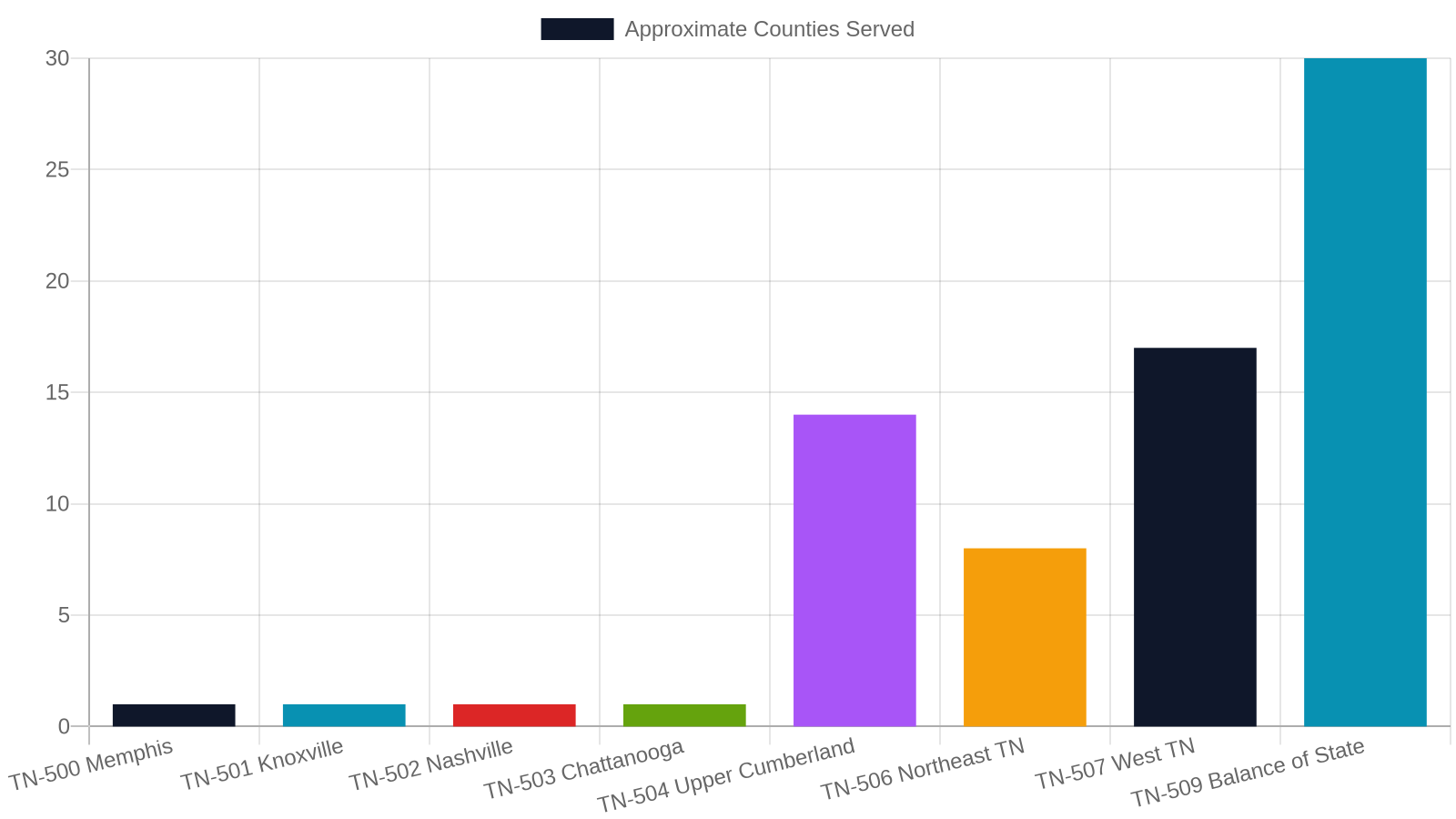
Tennessee is a long, narrow state with dramatically different communities from its western Mississippi River delta to its eastern Appalachian ridges. That geography shapes how services are organized. The table below gives you a bird’s-eye view of all eight active CoC regions, their HUD codes, and the major population centers they serve — so you can orient yourself before reading the detailed breakdowns.
Why Region Boundaries Matter for You
Your CoC region determines which local YAAB chapter serves your area, which shelter beds and rapid-rehousing slots are available to you, and which local planning meetings you can attend or testify at. Boundaries follow county lines, so knowing your county is the fastest way to find your chapter.
Tennessee’s eight CoC regions are identified by HUD codes: TN-500 through TN-509 (with some numbers retired or merged over the years). Each code corresponds to a geographic cluster of counties. The sections below walk through each active region, the counties it covers, and how to plug in.
A Quick-Reference County Lookup
Not sure which region you’re in? Here’s a fast rule of thumb: if you live in Shelby County, you’re in TN-500 (Memphis). Davidson County puts you in TN-502 (Nashville). Knox County is TN-501 (Knoxville). Hamilton County is TN-503 (Chattanooga). For everyone else — rural West Tennessee, the Upper Cumberland plateau, or the mountains of Northeast Tennessee — the regional breakdowns in the sections below will point you to the right chapter. When in doubt, the full local YAAB directory lists every county assignment so you never have to guess.
TN-500: Memphis and Shelby County YAAB

Memphis is the westernmost anchor of Tennessee’s YAAB network. The TN-500 region covers Shelby County exclusively, but that single county is home to roughly 935,000 residents — more than any other county in the state. For young adults navigating homelessness in one of Tennessee’s most resource-dense but also most inequitable cities, the Memphis YAAB chapter is a critical bridge to both services and power.
Who This Chapter Serves
The TN-500 chapter is anchored in Memphis and Shelby County, the largest city in Tennessee and one of the most populous metro areas in the mid-South. Memphis has a significant population of transition-age youth experiencing homelessness, with Shelby County consistently reporting some of the highest youth-homelessness counts in the state during HUD’s annual Point-in-Time (PIT) counts.
The Memphis YAAB chapter works alongside local CoC partners including Memphis and Shelby County’s coordinated-entry system, local shelters, and rapid-rehousing providers to make sure young adults have a voice in how those resources are allocated and who gets priority access.
How to Connect in Memphis
If you live in Shelby County — including the city of Memphis and surrounding municipalities like Bartlett, Germantown, Collierville, and Millington — the TN-500 chapter is your home base. You can learn more and reach out directly through the TN-500 YAAB page. Members meet regularly to discuss local policy, share resources, and support each other. You do not need to have your life “figured out” to join — showing up is enough.
TN-501: Knoxville and Knox County YAAB

East Tennessee’s largest city is also home to one of YAAB’s most active regional chapters. The TN-501 region centers on Knoxville and Knox County, a metro area of approximately 478,000 people. Young adults in this region face a unique mix of urban housing pressures and rural isolation — many come from surrounding Appalachian counties seeking services that simply don’t exist closer to home.
East Tennessee's Urban Hub
Knoxville sits at the foot of the Great Smoky Mountains and serves as East Tennessee’s economic and cultural center. The TN-501 CoC covers Knox County and coordinates with a network of shelters, transitional housing programs, and outreach teams that serve young adults across the area. The University of Tennessee’s presence means a large student population, but it also means a significant number of young people who are housing-insecure and may not identify as “homeless” even when they are.
The Knoxville YAAB chapter focuses on making sure transition-age youth — including those who are marginally housed, doubled-up, or couch-surfing near campus — know they qualify for services and have a voice in shaping them.
Getting Involved in Knoxville
If Knox County is your home, the TN-501 YAAB chapter page is your starting point. Chapter members participate in CoC planning meetings, advocate for youth-specific shelter beds, and connect peers to employment and education resources in the greater Knoxville area. Meetings are peer-led, meaning the agenda is set by young people — not service providers.
TN-502: Nashville and Davidson County YAAB

Nashville is where Tennessee’s statewide policy conversations happen, and the TN-502 YAAB chapter makes sure young adults are part of those conversations. The region covers Davidson County — a consolidated city-county government — and sits at the crossroads of local housing advocacy and statewide legislative action. For transition-age youth in Middle Tennessee’s urban core, this chapter is both a resource hub and a political platform.
The State Capital's Youth Voice
Nashville is Tennessee’s capital and fastest-growing city, with Davidson County’s population now exceeding 700,000. Rapid development has driven up rents dramatically — median rent in Nashville rose more than 40% between 2019 and 2024 — pushing more young adults into housing instability even as the city’s economy booms. The TN-502 YAAB chapter operates at the intersection of that tension, advocating for affordable housing policy, youth shelter capacity, and equitable access to Nashville’s booming job market.
Because Nashville is the seat of state government, the TN-502 chapter also plays a unique statewide advocacy role, engaging directly with Tennessee legislators and state agency staff on issues that affect all eight CoC regions.
Connecting in Nashville
Davidson County residents — whether you’re in downtown Nashville, Antioch, Madison, or any other neighborhood — can connect through the TN-502 chapter page. The Nashville chapter is one of the most active in the state, with regular advocacy events, peer-support sessions, and opportunities to testify before city and state bodies. If you want your voice heard where policy is actually made, this is the room to be in.
TN-503: Chattanooga and Hamilton County YAAB

Chattanooga anchors YAAB’s presence in Southeast Tennessee. The TN-503 region covers Hamilton County, home to roughly 380,000 residents and a rapidly changing economy that creates both opportunity and displacement for young adults. The chapter is embedded in Chattanooga’s Continuum of Care and plays an active role in shaping how the region’s housing resources are prioritized and distributed.
Southeast Tennessee's Chapter
Chattanooga has reinvented itself over the past two decades — from a struggling rust-belt city to a tech-forward, outdoor-recreation hub with one of the fastest municipal broadband networks in the country. But that reinvention has not reached everyone equally. Hamilton County’s transition-age youth still face significant barriers to stable housing, and the TN-503 YAAB chapter exists to make sure their experiences shape the city’s next chapter, not just its brochures.
The chapter works with Chattanooga’s CoC partners to advocate for youth-specific shelter beds, rapid-rehousing slots, and employment pathways in a local economy that is growing but not always accessible to young adults without stable housing or transportation.
Plugging In Around Chattanooga
If you live in Hamilton County — including Chattanooga, East Ridge, Red Bank, Soddy-Daisy, or Signal Mountain — the TN-503 chapter page is your entry point. Members meet regularly and have opportunities to engage with local government, CoC planning bodies, and peer-support networks. The chapter also connects members to education and workforce resources specific to the Chattanooga metro area.
TN-504, TN-506, TN-507, and TN-509: Rural and Multi-County Regions

Outside Tennessee’s four major urban centers, YAAB’s presence stretches across vast rural and semi-rural territories. These regions face distinct challenges: fewer shelter beds per capita, longer distances between services, and communities where talking openly about homelessness can carry more stigma. But they also have something powerful — tight-knit peer networks and young advocates who know exactly what their neighbors need.
TN-504: Upper Cumberland Region
The Upper Cumberland CoC covers approximately 14 counties on Tennessee’s central plateau, including Putnam, White, Overton, Fentress, Cumberland, DeKalb, Smith, Macon, Clay, Pickett, Jackson, Van Buren, Warren, and Cannon counties. The region’s largest city is Cookeville. Rural geography means young adults here often face transportation barriers on top of housing instability — services may be 30 to 60 miles away. The TN-504 YAAB chapter advocates for rural-specific solutions, including mobile outreach, remote case management, and transportation assistance.
TN-506: Northeast Tennessee
Northeast Tennessee’s CoC covers the mountain communities of the far eastern part of the state — including Johnson City, Kingsport, Bristol, and surrounding counties in the Tri-Cities area. This region has a strong Appalachian cultural identity and significant economic challenges tied to deindustrialization. The TN-506 chapter centers the voices of young adults navigating homelessness in communities where stigma around asking for help can be especially high. Members work to normalize peer support and advocacy in a region where those concepts are still taking root.
TN-507 and TN-509: West Tennessee and Balance of State
TN-507 covers rural West Tennessee — a broad swath of counties between Memphis and the Tennessee River, including Madison County (Jackson) and surrounding areas. Jackson is the region’s hub city, with a population of about 68,000. The TN-507 chapter serves young adults across a largely agricultural region where housing options are limited and shelter capacity is thin.
TN-509 is Tennessee’s Balance of State CoC — a catch-all region covering counties not assigned to any other CoC. It is one of the largest geographic CoCs in the country by land area, covering roughly 30 counties across Middle and East Tennessee. If you live in a rural county and aren’t sure which chapter serves you, start with the TN-509 page or the main local YAAB directory.
What Happens When You Join a Local Chapter?

Finding your chapter is step one. But what actually happens after you walk through the door — or log into the video call? Understanding what membership looks like day-to-day can help you decide whether YAAB is the right fit for you right now, and what you stand to gain from getting involved.
Your First Steps as a YAAB Member
Joining a YAAB chapter does not require a resume, a referral, or a perfect housing situation. The only real requirement is that you are between 17 and 25 years old and have some lived experience of homelessness or housing instability — whether that was last week or two years ago. You reach out, you show up, and you start talking. Everything else grows from there.
Most chapters hold regular meetings — monthly or bi-weekly — that combine peer support, skills-building, and advocacy planning. Some chapters offer stipends or gift cards for participation, recognizing that your time and expertise have real value. Check your regional chapter page for current meeting schedules and any compensation available in your area.
What You Can Influence as a Member
YAAB members have a documented track record of real impact. Across Tennessee, chapters have influenced decisions about how youth shelter beds are prioritized, which populations get fast-tracked through coordinated entry, how outreach workers are trained to approach young adults, and what language appears in local housing plans submitted to HUD. These are not symbolic wins — they are changes that affect who gets housed and how quickly.
Members also gain transferable skills: public speaking, policy analysis, data literacy, and coalition-building. Many former YAAB members have gone on to careers in social work, public policy, nonprofit management, and community organizing — with YAAB experience as a concrete credential on their resumes.
Tennessee YAAB Chapters at a Glance: All 8 CoC Regions
Use this table to quickly match your location to your regional YAAB chapter, understand the geographic scope of each CoC, and find the right page to connect.
Resources Available Through Your YAAB Chapter

YAAB chapters are advocacy bodies first — but they also serve as connective tissue between young adults and the broader network of housing, education, employment, and mental-health resources in each region. Here’s a breakdown of what you can typically access through or alongside your local chapter.
Housing and Shelter Navigation
Every YAAB chapter is embedded in its regional Continuum of Care, which means members have direct connections to local housing resources — emergency shelters, transitional housing, rapid-rehousing programs, and Permanent Supportive Housing (PSH). YAAB is not a housing provider itself, but chapter members and staff can help you navigate coordinated entry — the system that matches people to available housing resources — and advocate on your behalf if you’re not getting the help you need.
For a broader overview of how youth homelessness is defined and what resources exist statewide, the YAAB guide to understanding youth homelessness is a solid starting point before you connect with your local chapter.
Education, Employment, and Financial Literacy
Chapters connect members and peers to a range of wraparound supports beyond housing. Depending on your region, these may include:
- GED and HiSET prep programs — many CoC partners offer free or low-cost adult education
- Workforce development — job-readiness training, resume help, and connections to employers who actively recruit transition-age youth
- Financial literacy workshops — covering budgeting, banking, credit-building, and avoiding predatory financial products
- Benefits navigation — help understanding TennCare, SNAP, SSI/SSDI, and other public benefits you may be entitled to
Availability varies by region, so ask your local chapter coordinator what’s currently active in your area.
Mental Health and Peer Support
Housing instability takes a real toll on mental health, and YAAB chapters recognize that. Many chapters integrate peer-support models into their meetings, creating space for members to talk honestly about what they’re going through without judgment. Some chapters have formal partnerships with mental health providers who offer services specifically for transition-age youth. Others use a more informal peer-mentorship model where experienced members support newer ones. Either way, you are not expected to show up “okay” — showing up as you are is enough.
For Case Managers and CoC Partners: How to Refer Young Adults to YAAB

This guide is written for young adults — but service providers are reading it too, and that’s a good thing. Case managers and CoC partners who understand YAAB’s regional structure are far better equipped to make meaningful referrals. This section is for you.
Why Referrals to YAAB Matter
If you are a case manager, outreach worker, shelter staff member, or CoC partner reading this, you play a critical role in connecting young adults to YAAB. Many transition-age youth who would thrive in a chapter never hear about it because no one in their service network mentioned it. A warm referral — a personal introduction, not just a flyer — dramatically increases the likelihood that a young person will actually show up.
YAAB membership is not a treatment program or a service requirement. Frame it to young adults as an opportunity to be paid (where stipends are available) for expertise they already have, to build a professional network, and to have real influence over the systems they interact with every day. That framing resonates far better than “you should join this group.”
Connecting Your Clients to the Right Regional Chapter
To refer a young adult to their local chapter, start with the county they currently reside in (or the county where they are receiving services, if they are temporarily displaced). Match that county to the correct CoC region using the regional breakdowns in this guide, then direct them to the corresponding chapter page on the YAAB website. The full local YAAB directory is the most current source for contact information, meeting schedules, and chapter-specific details. You can also reach the statewide YAAB network through the main site for guidance on which chapter is the best fit for a specific young person’s situation.
How YAAB Chapters Influence Tennessee's Housing Policy

One of the most important things to understand about YAAB chapters is that they are not just support groups or peer-networking organizations — they are legitimate policy actors with documented influence over how Tennessee’s housing system works. Here’s how that influence operates at both the local and state level.
From Local CoC Tables to the State Capitol
Each regional YAAB chapter participates in its local CoC’s governance structure — attending planning meetings, reviewing data, and providing formal input on how federal HUD dollars are prioritized. That influence is real and documented: CoCs that include meaningful youth participation in their planning processes are required to demonstrate that participation in their HUD applications, which means YAAB members’ voices are literally part of the paperwork that determines how millions of dollars in housing funding get allocated across Tennessee.
At the state level, YAAB members have testified before Tennessee legislative committees, participated in state housing plan development, and contributed to the Tennessee Interagency Council on Homelessness (TICH). These are not token appearances — they are substantive contributions that have shaped state policy language and funding priorities.
Advocacy Tools and Campaigns
YAAB’s statewide advocacy work is coordinated across all eight chapters, allowing local members to plug into campaigns that have statewide reach. Recent focus areas have included expanding youth-specific shelter capacity, improving the coordinated-entry experience for transition-age youth, and advocating for “youth preference” policies that prioritize young adults in housing programs. To see current campaigns and how to get involved, visit the YAAB advocacy page — it’s updated regularly with action alerts, testimony opportunities, and campaign resources.
Ready to Find Your Chapter and Get Involved?

You’ve read the whole guide — now it’s time to take one concrete step. Finding your local YAAB chapter in Tennessee takes about two minutes, and it could open doors to advocacy experience, peer support, housing navigation, and a network of young people across the state who are working to make things better for everyone who comes after them. Here’s exactly how to do it.
Your Next Move, Right Now
You don’t need to wait until things are “stable” to get involved with YAAB. In fact, the whole point is that your current experience — whatever it looks like — is exactly what makes you valuable to the chapter. The system needs to hear from you now, not after you’ve figured everything out.
Here’s what to do today: find your county in the regional guide above, match it to your CoC region, and visit the local YAAB chapter directory to find your regional chapter’s contact information and meeting schedule. If you’re not sure which region covers your county, the directory has a full breakdown. You can also reach the statewide network through the YAAB join page and someone will connect you to the right local chapter.
Spread the Word in Your Community
If you know other young adults in Tennessee who are experiencing housing instability — friends, roommates, people you’ve met in a shelter or transitional housing program — share this guide with them. The more young people who know YAAB exists and what it does, the stronger every regional chapter becomes. You don’t have to be a member to make a referral. Just passing along the URL to the local chapter directory could be the thing that changes someone’s path.
Tennessee’s YAAB network is growing, and every region needs more voices. Whether you’re in Memphis, Nashville, Knoxville, Chattanooga, Jackson, the Upper Cumberland, Northeast Tennessee, or a rural county that most people couldn’t find on a map — there is a chapter for you, and that chapter needs exactly what you have to offer.
Frequently Asked Questions
How do I find my local YAAB chapter in Tennessee?
Match your county to one of Tennessee's eight Continuum of Care regions using the regional guide above, then visit yaabtn.org/local-yaabs/ for the full directory with contact information and meeting schedules for every chapter.
Do I have to currently be homeless to join a YAAB chapter?
No. YAAB membership is open to young adults ages 17 to 25 who have any lived experience of homelessness or housing instability — past or present. You do not need to be in a shelter or actively homeless right now to participate or to have your voice count.
What is a Continuum of Care and why does it matter for YAAB?
A Continuum of Care (CoC) is a regional network of shelters, housing programs, and government agencies that coordinates homeless services and receives federal HUD funding. Tennessee has eight CoCs, and each one has a YAAB chapter embedded in it so young adults have a formal voice in how those resources are used.
Which YAAB chapter covers rural Tennessee counties?
Rural counties that are not part of one of Tennessee's four major urban CoCs (Memphis, Knoxville, Nashville, Chattanooga) are typically served by TN-504 (Upper Cumberland), TN-506 (Northeast Tennessee), TN-507 (West Tennessee), or TN-509 (Balance of State). The full county-to-region breakdown is at yaabtn.org/local-yaabs/.
Can I get paid for being a YAAB member?
Some regional chapters offer stipends or gift cards to members for their participation, recognizing that young adults' time and expertise have real value. Availability varies by chapter and funding cycle — check your regional chapter page or ask a chapter coordinator for current details.
I'm a case manager. How do I refer a young person to their local YAAB chapter?
Identify the county where the young adult lives or receives services, match it to the correct CoC region using this guide, and direct them to the corresponding chapter page at yaabtn.org/local-yaabs/. A warm, personal introduction — framing YAAB as a paid leadership opportunity — works far better than simply handing over a flyer.