Quick answer: Any Tennessee resident — including young adults ages 17 to 25 — has the right to testify at a state legislative committee hearing. To do it effectively, you sign up in advance through the Tennessee General Assembly's witness registration system, prepare a short personal statement (usually 2–3 minutes), arrive early, state your name and where you're from, and speak clearly about how a housing bill affects your life. You don't need a lawyer, a fancy title, or permission from anyone. Your lived experience is exactly what lawmakers need to hear, and organizations like the Youth Action Board of Tennessee can help you prepare.
Why Your Voice Belongs in the Room

If you are a young adult in Tennessee between the ages of 17 and 25 who has experienced housing instability, you already hold something that professional lobbyists cannot buy: the truth of what it feels like to need a safe place to sleep. Legislative committee hearings are one of the most direct ways to put that truth in front of the people who write the laws — and in Tennessee, the door is open to you.
Lawmakers Hear Mostly from Lobbyists — Not Young People
Studies of state legislative testimony consistently show that the majority of witnesses at committee hearings represent industry groups, professional associations, or government agencies. Young adults — especially those with lived experience of homelessness — are almost never in the room. That gap is a problem, because the people most affected by housing policy are the ones least likely to be heard.
In Tennessee, bills that affect shelter funding, rental assistance, youth shelter capacity, and Continuum of Care grants move through committees like the Senate Commerce & Labor Committee and the House Government Operations Committee without a single young adult speaking to their real-world impact. Your two-minute testimony can be the only firsthand account a legislator hears all session.
Lived Experience Is Credible Evidence
Policy researchers call it experiential expertise — the knowledge that comes from living through a system rather than studying it from the outside. When you tell a committee member, “I aged out of foster care at 18 in Memphis and spent four months couch-surfing before I found a youth shelter,” you are providing evidence that no think-tank report can replicate.
Tennessee legislators have publicly stated that personal stories move them more than statistics alone. Your experience is not just valid — it is strategically powerful. Pairing your story with one or two concrete data points (like the fact that Tennessee has fewer than 500 dedicated transitional housing beds for youth) makes your testimony even harder to dismiss.
1. Understand How Tennessee's Legislative Process Works

Before you walk into a hearing room, it helps to know the basic path a bill travels. Tennessee’s process is more accessible than most people think — and knowing the map means you show up at the right moment, in the right room, ready to make an impact.
How a Bill Becomes a Law in Tennessee
Tennessee’s General Assembly meets in Nashville each year beginning in January. Both the House of Representatives (99 members) and the Senate (33 members) must pass identical versions of a bill before it goes to the Governor. Most bills are first reviewed in a subcommittee, then a full committee, and only then reach the floor for a vote.
Committee hearings are where testimony happens. This is the stage where members of the public — including you — can sign up to speak directly to the legislators who will vote on a bill. Once a bill passes committee and reaches the floor, public testimony is no longer an option. That means the committee stage is your window.
Which Committees Handle Housing and Youth Issues
Bills affecting youth homelessness, shelter funding, and Continuum of Care programs in Tennessee most commonly move through these committees:
- Senate Commerce & Labor Committee — often handles housing and workforce bills
- House Health Committee — covers mental health, substance use, and youth services
- House Finance, Ways & Means Committee — controls budget appropriations including shelter grants
- Joint Government Operations Committee — reviews rules and regulations affecting CoC programs
You can track which committee a specific bill is assigned to at capitol.tn.gov using the bill number. Sign up for free bill-tracking alerts so you know when a hearing is scheduled.
2. Find the Right Bill and Hearing to Target

Not every housing bill deserves your energy — some are technical amendments with little real-world impact. The goal is to identify the bills that could genuinely change the resources available to young adults like you in Tennessee, and then show up when those bills are in committee.
Searching for Housing and Youth Bills on capitol.tn.gov
Go to capitol.tn.gov and click “Bills & Resolutions.” You can search by keyword — try terms like “affordable housing,” “youth shelter,” “Continuum of Care,” “transitional housing,” “foster care,” or “rental assistance.” Each bill page shows its current status, which committee it is assigned to, and when the next hearing is scheduled.
You can also sign up for a free MyTN account to receive email alerts whenever a bill you are tracking moves to a new stage. Set alerts for any bill that could affect housing for young adults in your region — Memphis/Shelby County, Nashville/Davidson, Knoxville/Knox, Chattanooga/Hamilton, Jackson/West TN, Upper Cumberland, or Northeast Tennessee.
Getting Help Identifying the Right Bills
You do not have to do this research alone. The Youth Action Board of Tennessee tracks bills each session that directly affect transition-age youth. YAAB members and staff can point you toward the bills that matter most and tell you when hearings are coming up. Connecting with your local YAAB chapter is one of the fastest ways to stay informed about which hearings are worth your time and energy.
Advocacy organizations like the Tennessee Housing Development Agency (THDA), the Tennessee Coalition to End Homelessness, and local Continuum of Care leads also publish legislative alerts during session. Following them on social media or subscribing to their newsletters can surface hearing dates quickly.
3. Register as a Witness Before the Hearing

Registration is the step most people miss. Tennessee’s committee hearings do not operate on a first-come, first-served walk-in basis — you need to be on the list. The good news is that registering takes less than five minutes once you know where to go.
How Tennessee's Witness Registration System Works
Tennessee uses an online witness registration system available through the General Assembly’s website. You must register before the hearing begins — walk-in testimony is rare and not guaranteed. Here is the basic process:
- Go to capitol.tn.gov and navigate to the committee’s hearing page
- Click “Register as a Witness” for the specific bill you want to testify on
- Enter your name, city/county, organization (if any — “none” is fine), and whether you support, oppose, or are neutral on the bill
- Arrive at least 30 minutes early; the chair may close registration before the posted start time
If you are testifying with a group, each person registers individually. There is no fee to register.
What If You Can't Make It to Nashville?
If traveling to Nashville is not possible, you have a few options. First, some committees accept written testimony submitted by email to the committee clerk before the hearing. Second, Tennessee has occasionally held remote testimony options for certain committees — check the committee’s page or call the clerk’s office to ask. Third, you can submit a written statement for the record even if you cannot testify in person; it becomes part of the official hearing record that legislators and their staff review.
YAAB members in Memphis, Knoxville, Chattanooga, and other regions have coordinated group trips to Nashville for high-priority hearings. Reach out to your regional YAAB to see if transportation support is available.
4. Write Your Testimony: a Simple 3-Part Framework

You do not need to be a professional writer or a public speaker to give powerful testimony. The most effective statements follow a simple three-part structure that any young adult can use. Aim for a total of 2 to 3 minutes when read aloud — that is roughly 300 to 400 words on paper.
Part 1 — Who You Are and Why You're Here (30 seconds)
Start with your name, where you are from in Tennessee, and one sentence about your connection to the issue. You do not need to share every detail of your story. A simple opener might sound like: “My name is Jordan, I’m 21 years old, I’m from Knoxville, and I spent eight months without stable housing after aging out of foster care.”
This opening does three things: it establishes you as a real person and a constituent, it signals your lived expertise, and it gets the committee’s attention immediately. Keep it to two or three sentences maximum.
Part 2 — The Specific Impact (60–90 seconds)
This is the heart of your testimony. Describe how the bill — or the problem it addresses — has affected your life or the lives of people you know. Be specific. Specific details are memorable; vague statements are forgettable.
For example: “When I was couch-surfing, I lost my job because I had no address to put on the application. I missed two GED classes because I had nowhere safe to study. This bill would fund 50 new transitional housing beds in Knox County — that is 50 young people who won’t have to make the same impossible choices I did.”
If you have a relevant statistic, include one. One number, stated clearly, lands better than a list of five. Try to connect the bill’s specific provisions to a real outcome.
Part 3 — Your Ask (20–30 seconds)
End with a clear, direct request. Do you want the committee to vote yes? To amend a specific provision? To hold a follow-up hearing with youth witnesses? State it plainly: “I am asking this committee to pass HB 1234 out of committee and send it to the floor for a full vote.”
A clear ask makes your testimony actionable. Legislators and their staff will remember a witness who made a specific request far longer than one who simply shared a story without a direction. Keep your entire testimony to 2–3 minutes — most committees enforce strict time limits, and finishing early is better than being cut off.
5. Practice, Prepare, and Protect Your Comfort

Nerves are normal — even experienced advocates get them. The difference between a nervous testimony and a powerful one is almost always preparation. A few simple steps before the day of the hearing will make you feel ready and in control.
How to Practice Without Feeling Silly
Read your testimony aloud — not in your head, but out loud — at least three times before the hearing. Time yourself. Record yourself on your phone and watch it back once. You will notice filler words (“um,” “like,” “you know”) and places where you rush. Both are easy to fix with one more practice round.
Ask a trusted friend, a case manager, or a YAAB peer to listen and give you feedback. Practicing in front of another person is the single most effective way to reduce nerves on the day. If your YAAB chapter is organizing a group trip to a hearing, ask about a group practice session beforehand.
You Get to Choose What You Share
This is important: you are never required to disclose more than you want to. You can testify about housing policy without revealing your current living situation, your mental health history, your immigration status, or any other personal detail. You can say “I have experienced housing instability” without explaining every circumstance. Your story belongs to you.
If a committee member asks a follow-up question that feels too personal, it is completely acceptable to say, “I’d prefer not to go into that detail, but I’m happy to answer questions about the bill itself.” You are a witness, not a subject under investigation.
What to Bring and What to Wear
Bring a printed copy of your testimony — technology fails, and having paper means you will never lose your place. Bring a photo ID; some hearing rooms require it for entry. Bring water. Wear whatever makes you feel confident and comfortable. There is no dress code for public testimony, though business casual is common. What matters is that you feel like yourself.
Arrive at the Legislative Plaza or the committee room at least 30 minutes before the posted start time. Security screening can take 10–15 minutes, and you want time to find the right room, confirm your registration, and settle in before the gavel drops.
6. Know What to Expect Inside the Hearing Room
Walking into a state legislative hearing room for the first time can feel intimidating. Knowing what the room looks like, how the process flows, and what is expected of you removes most of the uncertainty — and uncertainty is usually what makes people nervous, not the speaking itself.
The Physical Setup and the Order of Business
Tennessee committee hearing rooms are typically arranged with the committee members seated at an elevated curved or straight bench at the front, facing rows of chairs for the public. A witness table or podium with a microphone sits between the public seating and the committee bench. When your name is called, you walk to the microphone, state your name and city, and begin your testimony.
Hearings usually begin with the bill’s sponsor presenting the legislation, followed by invited witnesses (often agency officials or bill supporters), and then public witnesses — that is you. Depending on how many bills are on the agenda, you may wait 30 minutes to two hours before your name is called. Bring something to do while you wait, and stay in the room so you don’t miss your turn.
How to Handle Questions from Committee Members
After you testify, a committee member may ask you a question. This is a good sign — it means they were listening. Answer as directly as you can. If you don’t know the answer, say so: “I don’t have that data in front of me, but I’d be happy to follow up in writing.” That is a completely professional response.
Committee members may also push back on your position. Stay calm, stay respectful, and stick to your statement. You do not have to win an argument — you just have to plant a seed. Sometimes the most powerful thing you can do is simply remain composed when challenged.
7. Follow Up After You Testify

Your testimony does not end when you step away from the microphone. What you do in the 48 hours after a hearing can be just as important as the testimony itself — and it takes less than 15 minutes.
Send a Thank-You and Your Written Statement
Within 48 hours of testifying, send a brief email to the committee chair and your own state representative and senator. Thank them for the opportunity to testify, attach your written statement as a PDF, and restate your ask in one sentence. This follow-up keeps your name and your issue in front of their staff, who read and track constituent correspondence throughout the session.
You can find every legislator’s contact information at capitol.tn.gov/legislators. Look up your representative and senator by your home address or the last stable address you have used. Even if you are currently unhoused, you have the right to contact your elected officials.
Track the Bill and Stay Engaged
Set a bill-tracking alert so you know when the committee votes, when the bill moves to the floor, or when it is tabled. If the bill advances, consider showing up for the floor vote day — your presence in the gallery sends a message even when you are not at a microphone. If the bill stalls, connect with YAAB and allied organizations to understand the next strategy.
Advocacy is rarely a single event. The young adults who create lasting change in Tennessee’s housing policy are the ones who show up once, learn the process, and then keep coming back — as witnesses, as organizers, and eventually as the people in the room who shape the agenda.
Testimony Methods at a Glance: Which Option Works for You?
Not everyone can travel to Nashville for every hearing. Here is a side-by-side look at the four main ways Tennessee young adults can make their voices heard on housing legislation, so you can choose the option that fits your situation.
Tennessee's Continuum of Care Regions: Where to Plug In Locally

Tennessee is a geographically and politically diverse state. Housing challenges in Memphis look different from those in Johnson City or Cookeville — and the legislators who represent those communities need to hear from young adults in their own backyards. Understanding your region makes your testimony more targeted and more persuasive.
The 8 CoC Regions and Their Legislative Districts
Tennessee’s Continuum of Care system is organized into eight regional CoCs, each covering a set of counties and served by specific state House and Senate districts. Knowing your CoC region helps you identify which local legislators sit on committees that affect your community’s housing funding:
- TN-500 — Memphis/Shelby County
- TN-501 — Nashville/Davidson County
- TN-502 — Knoxville/Knox County
- TN-503 — Chattanooga/Hamilton County
- TN-504 — Northeast Tennessee
- TN-506 — Upper Cumberland
- TN-507 — Jackson/West Tennessee
- TN-509 — Balance of State
Each of these regions has a local YAAB chapter working on housing advocacy. Find yours at yaabtn.org/local-yaabs.
Why Regional Testimony Is Especially Powerful
Tennessee legislators respond strongly to constituents from their own districts. A young adult from Chattanooga testifying about the impact of a housing bill on Hamilton County’s shelter system is speaking directly to the lived reality of a legislator’s own voters. That specificity — naming your city, your county, your CoC region — transforms your testimony from a general statement into a constituent demand.
When multiple young adults from different Tennessee regions testify on the same bill in the same session, it signals to the committee that this is a statewide issue, not a single-city concern. Coordinated regional testimony is one of YAAB Tennessee’s most effective advocacy strategies.
What Tennessee Youth Advocates Have Already Changed

It can be hard to believe that two minutes at a microphone can change anything. But the history of housing policy in Tennessee — and across the country — is full of moments where a single young adult’s testimony shifted the conversation in a committee room. Here is some of what has already happened.
Real Wins Driven by Youth Testimony
Youth advocates across Tennessee have already demonstrated that showing up works. In recent years, young adults with lived experience of homelessness have testified before state committees in support of increased funding for the Tennessee Housing Development Agency’s Emergency Solutions Grant program, which funds emergency shelter and rapid rehousing for youth. Their testimony has helped sustain and grow funding streams that directly support CoC programs statewide.
In Nashville, Memphis, and Knoxville, young adults who testified about the gap between aging out of foster care at 18 and accessing adult housing services helped push local CoC leads to extend youth-specific housing programs to age 25 — a change that affects hundreds of young people each year.
The Data Behind the Need
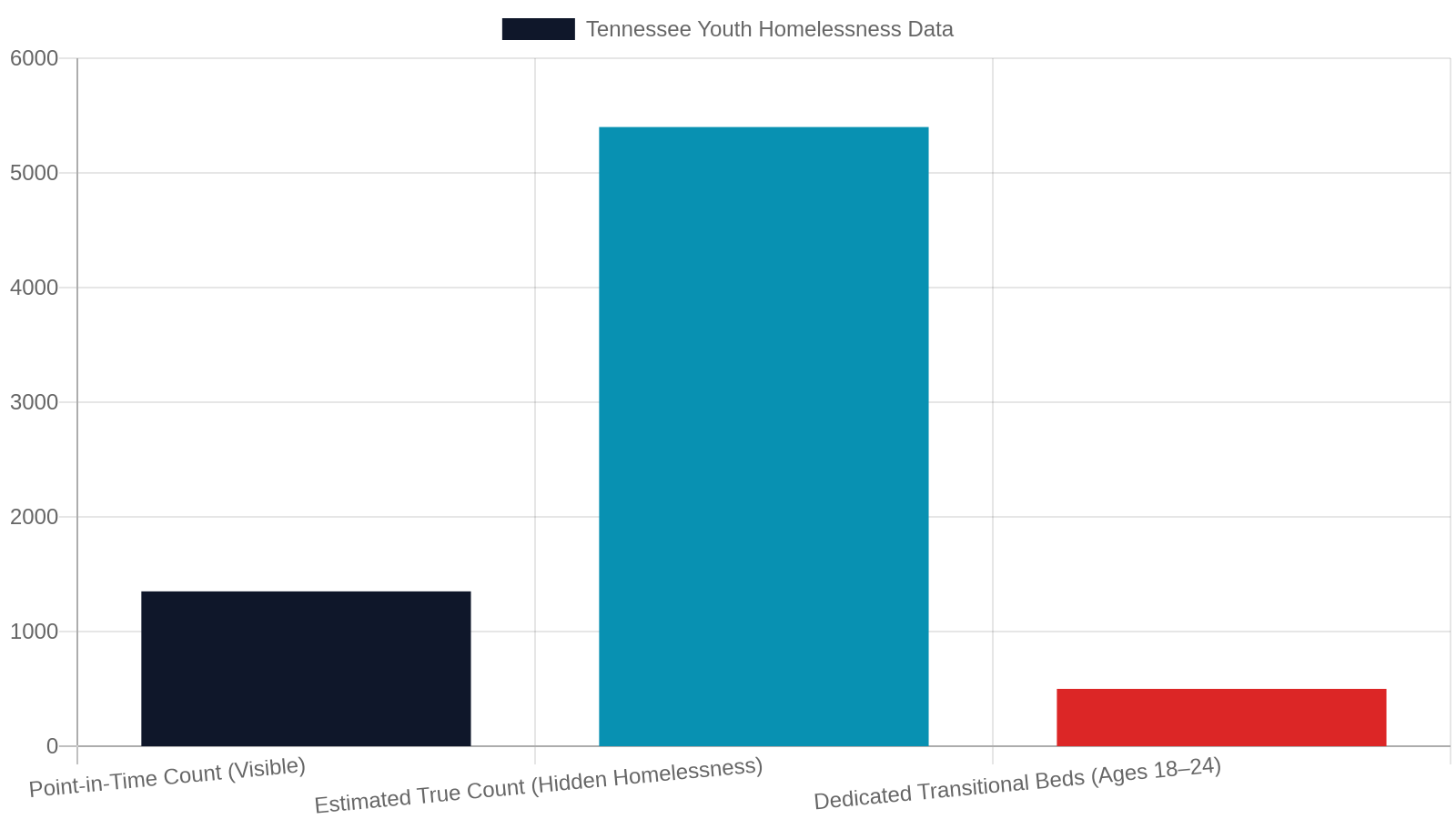
Tennessee’s own data underscores why youth testimony matters. According to the most recent Point-in-Time count data available for Tennessee:
- Approximately 1,200 to 1,500 unaccompanied youth are counted as homeless on a single January night statewide — and researchers estimate the true number is 3 to 5 times higher due to hidden homelessness (couch-surfing, doubled-up households)
- Youth who age out of Tennessee’s foster care system without a permanent connection to family or housing face a 30–40% likelihood of experiencing homelessness within two years of aging out
- Tennessee has fewer than 500 dedicated transitional housing beds for young adults ages 18–24 across all eight CoC regions combined
These numbers are not just statistics — they are the reason your voice in a committee room carries weight that no professional lobbyist can replicate.
Common Fears About Testifying — and the Real Answers

Almost every young adult who has testified for the first time admits they almost didn’t go. The fears are real — but so are the answers. Here are the most common concerns we hear from YAAB members, and the honest truth about each one.
"I'm Not Old Enough" or "I Don't Have the Right"
Any Tennessee resident can testify at a public legislative committee hearing. There is no minimum age requirement for public witnesses. If you are 17 and a Tennessee resident, you have the same right to testify as a 50-year-old attorney. You do not need to be a registered voter, a homeowner, or affiliated with any organization. You just need to register as a witness and show up.
If you are worried about being dismissed because of your age, lean into it. Your age is part of your credibility. You are the exact demographic the bill affects — and the committee needs to hear that directly.
"What If I Get Emotional?"
Getting emotional during testimony is not a weakness — it is human. Legislators and their staff are moved by genuine emotion. If you feel tears coming, pause, take a breath, and continue. You do not need to apologize. Many of the most memorable and effective testimonies in Tennessee’s legislative history have included moments of raw honesty.
That said, if you are worried about becoming overwhelmed, practice your testimony enough times that the words feel familiar and automatic. Familiarity reduces the emotional charge of difficult material. You can also ask a YAAB peer or staff member to sit in the room with you for support — their presence can be grounding.
"What If They Don't Listen?"
Sometimes a committee votes the wrong way. Sometimes your bill dies in subcommittee. That is a real possibility, and it is okay to feel frustrated when it happens. But testimony is never wasted. It is entered into the official record. It is read by legislative staff. It is sometimes quoted in news coverage. And it builds a pattern — the more sessions in which young adults show up and speak, the harder it becomes for legislators to ignore youth housing as a priority issue.
Change in public policy is almost always slow and cumulative. Every time a young adult from Tennessee stands at that microphone, they make it a little easier for the next one.
Ready to Speak Up? Here's How YAAB Tennessee Can Help

You have read the steps. You know your rights. Now the question is: what’s your next move? The Youth Action Board of Tennessee is here to walk alongside you — from finding the right bill to standing at the microphone to following up after the hearing. Here is how to plug in right now, wherever you are in Tennessee.
Testimony Prep Support Through YAAB
The Youth Action Board of Tennessee exists specifically to support young adults like you in becoming effective advocates. YAAB members and staff can help you identify upcoming hearings, review your written testimony, practice with you before the day, and coordinate group travel to Nashville for high-priority committee hearings. You do not have to walk into that hearing room alone.
YAAB also connects you with a statewide network of peers who have already testified — young adults from Memphis, Knoxville, Chattanooga, Jackson, and across Tennessee who can share what the experience was actually like and what they wish they had known. That peer knowledge is something no guide can fully replace. Explore the full range of YAAB Tennessee’s advocacy work and resources to see how you can get involved this session.
Join a Local YAAB and Start Building Your Voice
If you are between 17 and 25 and have lived experience of housing instability anywhere in Tennessee, you are eligible to join your regional Youth Action Board. YAAB members receive training in advocacy, public speaking, policy analysis, and leadership — all skills that make you more effective not just at hearings, but in every area of your life.
Membership is free and open to young adults across all eight Tennessee CoC regions. Whether you are in Memphis, Nashville, Knoxville, Chattanooga, Johnson City, Cookeville, Jackson, or anywhere in between, there is a YAAB chapter near you. Visit yaabtn.org/join to get started, or reach out through the YAAB contact page if you have questions. Your lived experience is not a liability — it is exactly the credential Tennessee’s housing policy needs in the room.
Frequently Asked Questions
Do I have to be 18 to testify at a Tennessee legislative committee hearing?
No. There is no minimum age requirement for public witnesses at Tennessee General Assembly committee hearings. Any Tennessee resident, including 17-year-olds, can register as a witness and testify. Your age does not limit your right to speak.
How do I find out when a housing bill is being heard in committee in Tennessee?
Go to capitol.tn.gov, search for the bill by keyword or number, and check its committee assignment and scheduled hearing date. You can also create a free MyTN account to receive email alerts when a bill you are tracking moves to a new stage.
What if I am currently experiencing homelessness — can I still testify?
Yes, absolutely. You do not need a permanent address to testify. You can use a shelter address, a case manager's address, or simply state the city or county you are in. Your current housing situation does not affect your right to participate in the legislative process.
How long should my testimony be at a Tennessee committee hearing?
Most Tennessee committees allow public witnesses 2 to 3 minutes. Write your testimony to fit within that window — roughly 300 to 400 words when read aloud at a normal pace. Finishing slightly early is better than being cut off by the chair.
What is the Youth Action Board of Tennessee and how can it help me testify?
YAAB Tennessee is a statewide network of young adults ages 17 to 25 with lived experience of homelessness who advise policymakers and drive housing advocacy across Tennessee's eight Continuum of Care regions. YAAB can help you identify hearings, prepare your testimony, practice before the day, and connect you with peers who have already testified.
Do I have to disclose personal details about my housing situation when I testify?
No. You choose exactly what you share. You can testify about housing policy by saying you have experienced housing instability without providing any specific details about your current situation, mental health, or personal history. Your story belongs to you, and you are never required to disclose more than you are comfortable sharing.