Quick answer: Young adults ages 17 to 25 in Nashville and across Central Tennessee face some of the steepest housing barriers in the state — from landlords who reject applicants with no rental history to policies that screen out youth with prior justice involvement. Central Tennessee YAAB members (TN-503) are pushing back through policy advocacy, direct peer support, and coalition-building with Continuum of Care partners. This article breaks down exactly what housing discrimination looks like for transition-age youth, what rights you have under Tennessee and federal law, and how YAAB is turning lived experience into lasting change in Davidson County and beyond.
What Housing Discrimination Actually Looks Like for Young Adults in Nashville

Housing discrimination rarely looks like a landlord saying ‘we don’t rent to young people.’ More often it’s buried in application requirements, screening policies, and informal practices that make it nearly impossible for transition-age youth to compete in Nashville’s rental market. Understanding what discrimination actually looks like is the first step toward fighting it — and Central Tennessee YAAB members have spent years mapping exactly where these barriers show up.
The 'No Rental History' Trap
One of the most common barriers young adults hit in Nashville’s rental market is the no rental history requirement. Most landlords in Davidson County ask for 12 to 24 months of verifiable rental history before approving an application. If you’ve been couch-surfing, staying in a shelter, or aging out of foster care, you simply don’t have that record — through no fault of your own.
This isn’t just an inconvenience. It’s a structural barrier that disproportionately locks out transition-age youth (ages 17–25) who are trying to get stable for the first time. YAAB members have documented this pattern across Nashville’s rental market and brought it directly to Continuum of Care planning meetings as a systemic equity issue.
Criminal History Screening and Youth Justice Involvement
Tennessee law does not ban landlords from running criminal background checks, and Nashville’s private rental market uses them aggressively. For young adults who have any prior justice involvement — even arrests that didn’t lead to convictions — this can mean automatic rejection from dozens of properties.
The U.S. Department of Housing and Urban Development (HUD) issued guidance in 2016 clarifying that blanket criminal history bans may violate the Fair Housing Act when they have a disparate impact on protected classes. YAAB members have used this guidance in conversations with local housing authorities and property managers to push for individualized assessments rather than automatic disqualifications.
Source-of-Income Discrimination
Tennessee is one of the majority of states that does not have a statewide source-of-income protection law. That means landlords in Nashville can legally refuse to accept Housing Choice Vouchers (Section 8), Rapid Rehousing subsidies, or other forms of rental assistance. For youth who finally secure a voucher after months on a waitlist, this can make the voucher nearly useless in a tight market.
Nashville’s rental vacancy rate hovered around 6.2% in 2023, and median rent for a one-bedroom apartment exceeded $1,450 per month — well above what most transition-age youth can afford without subsidy. When landlords refuse vouchers, the gap becomes impossible to bridge.
By the Numbers: Nashville's Housing Crisis and Transition-Age Youth

Numbers matter in advocacy. When YAAB members walk into a room with policymakers, they come prepared with data — because concrete figures make it harder to dismiss the reality that young adults face every day. Here’s what the data says about housing instability and discrimination in Nashville and Davidson County.
Point-in-Time Count Data for Davidson County
Tennessee’s annual Point-in-Time (PIT) Count — conducted every January — gives a snapshot of people experiencing homelessness on a single night. In Davidson County’s 2023 count, approximately 18% of people counted were between the ages of 18 and 24, making transition-age youth one of the most over-represented groups relative to their share of the general population.
These numbers almost certainly undercount the true scale of youth homelessness, because the PIT Count misses young people who are doubled up in overcrowded apartments, staying temporarily with friends, or sleeping in cars — all situations that YAAB members know intimately from their own experience.
The Affordable Housing Gap in Nashville
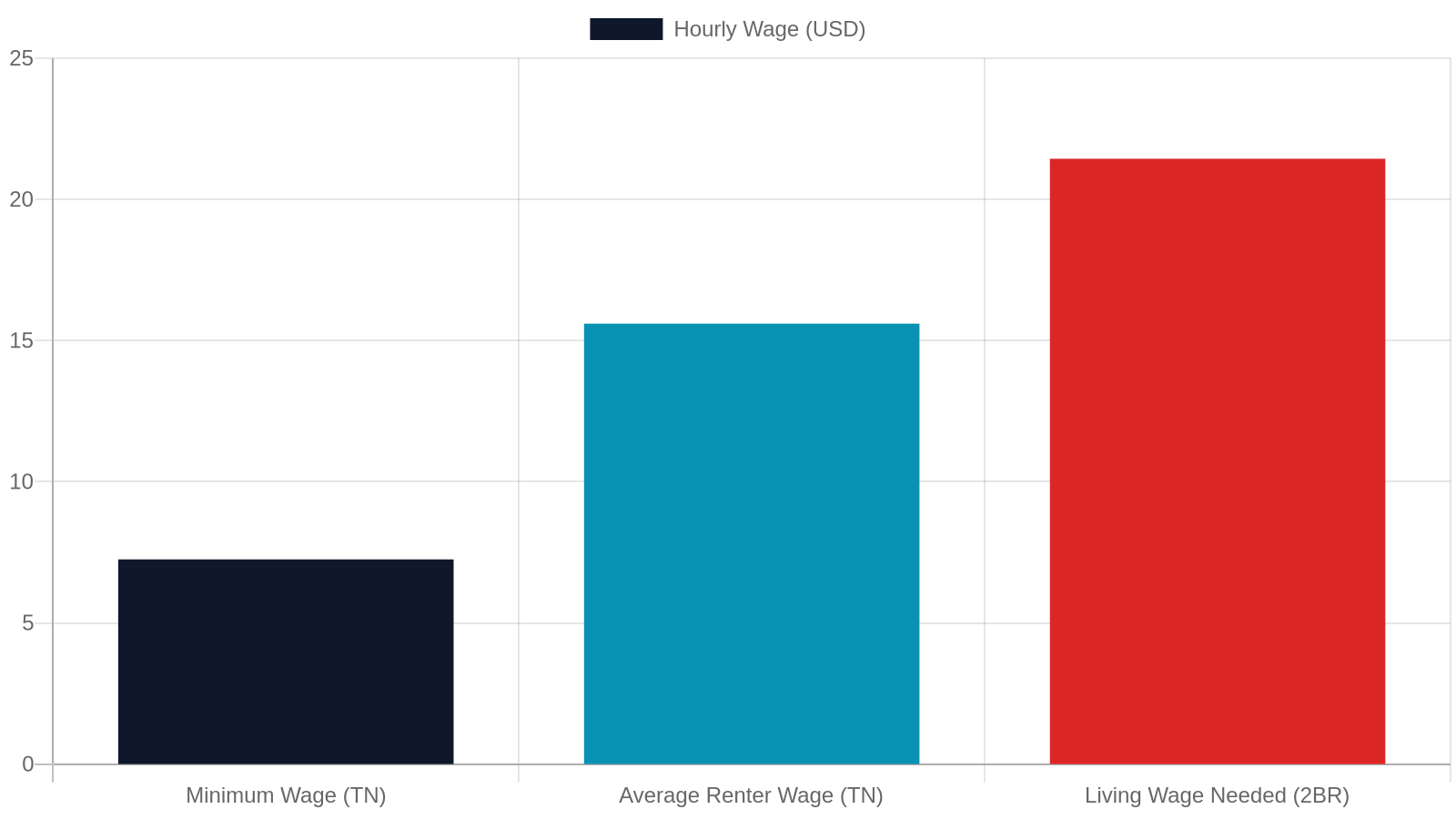
According to the National Low Income Housing Coalition’s 2023 ‘Out of Reach’ report, a Tennessee renter needs to earn at least $21.44 per hour to afford a modest two-bedroom apartment without spending more than 30% of their income on rent. The average renter wage in Tennessee is approximately $15.60 per hour. For a young adult working an entry-level job at minimum wage ($7.25 in Tennessee as of 2024), the gap is staggering.
Nashville’s rapid growth has accelerated this problem. The city added more than 100 new residents per day at its peak growth period between 2018 and 2022, driving up housing costs faster than wages could follow — especially for young adults just entering the workforce.
Your Rights Under the Fair Housing Act as a Young Adult

Knowledge is power, especially when you’re navigating a system that wasn’t designed with young adults in mind. Understanding your legal rights under the Fair Housing Act and Tennessee state law can make the difference between accepting an illegal rejection and pushing back. YAAB members across Central Tennessee have made ‘know your rights’ education a cornerstone of their peer-to-peer advocacy work.
Protected Classes and What They Cover
The federal Fair Housing Act (FHA) prohibits discrimination in housing based on race, color, national origin, religion, sex, familial status, and disability. Tennessee state law mirrors these protections. It’s important to know that ‘familial status’ protections cover families with children — but they do not specifically protect young adults as a class based on age alone.
However, many forms of discrimination that young adults experience do intersect with protected classes. For example, discriminatory practices that disproportionately affect Black youth, youth with disabilities (including mental health conditions), or youth who are pregnant or parenting may all trigger Fair Housing Act protections even if the landlord claims age is the reason for rejection.
How to File a Fair Housing Complaint in Tennessee
If you believe you’ve experienced housing discrimination, you have options. You can file a complaint with:
- HUD’s Office of Fair Housing and Equal Opportunity (FHEO) — online at hud.gov or by calling 1-800-669-9777. You have one year from the discriminatory act to file.
- Tennessee Human Rights Commission (THRC) — the state agency that enforces fair housing law. File online or call (615) 741-5825.
- Legal Aid Society of Middle Tennessee and the Cumberlands — provides free legal help for income-eligible residents, including housing discrimination cases.
YAAB members have worked alongside these organizations to help peers navigate complaint processes that can feel overwhelming, especially when you’re already in a housing crisis.
Reasonable Accommodation Requests for Youth with Disabilities
If you have a physical or mental health disability — including conditions like PTSD, depression, or anxiety that are common among youth who have experienced homelessness — you have the right to request a reasonable accommodation from a landlord. This might mean requesting an exception to a ‘no pets’ policy for an emotional support animal, or asking for a modified application process.
Landlords are legally required to engage in an ‘interactive process’ when you make a reasonable accommodation request. They cannot simply ignore it or deny it without explanation. Knowing this right exists — and knowing how to assert it — is something YAAB members actively share with their peers across Nashville and Davidson County.
How Central Tennessee YAAB Is Organized to Fight Back

The Central Tennessee Youth Action Board — operating within the TN-503 Continuum of Care region — is one of the most active YAAB chapters in the state. Its members have built a model of advocacy that combines formal policy engagement with grassroots peer support, and their work on housing discrimination has become a blueprint for other regions across Tennessee.
What TN-503 Means and Who It Covers
Tennessee’s Continuum of Care system is divided into geographic regions, each identified by a CoC number. TN-503 is the Continuum of Care region covering Nashville and Davidson County, coordinated through the Metro Homelessness Commission. This is the regional planning body responsible for allocating HUD funding, setting local housing policy, and coordinating the network of shelters, rapid rehousing programs, and permanent supportive housing across the area.
Central Tennessee YAAB members are embedded in this system — not as observers, but as voting participants and advisors who bring youth perspective to decisions that directly affect their peers. That presence at the table is hard-won and ongoing.
YAAB's Role in CoC Planning and Policy
YAAB members in the TN-503 region participate in CoC planning meetings, review funding applications, and advocate for youth-specific priorities in Nashville’s housing system. Specific areas where YAAB has pushed for change include:
- Lowering or eliminating minimum age requirements at certain emergency shelters
- Advocating for youth-specific Rapid Rehousing funding streams that don’t require rental history
- Pushing for trauma-informed screening practices that don’t penalize youth for circumstances beyond their control
- Calling for increased funding for Transitional Housing programs that serve the 17–25 age range
These aren’t abstract policy positions — they come directly from what YAAB members have experienced themselves and heard from their peers across Davidson County.
Peer-to-Peer Outreach and Street Engagement
Beyond formal policy work, Central Tennessee YAAB members do direct peer outreach — meeting young adults where they are, whether that’s at drop-in centers, outside shelters, on social media, or through word of mouth. Peer outreach is effective precisely because it doesn’t feel like a service provider interaction. When someone who has been through similar experiences tells you about a resource or a right you didn’t know you had, it lands differently.
YAAB members have distributed ‘know your rights’ materials at Nashville-area drop-in centers, connected peers to Legal Aid, and helped young adults prepare documentation for housing applications — small acts that add up to real change in individual lives while the larger policy work continues.
5 Specific Wins YAAB Members Have Helped Achieve in Nashville

Advocacy work can feel slow and invisible, but Central Tennessee YAAB members have notched real, concrete wins in Nashville’s housing system. These aren’t hypothetical victories — they’re documented changes in policy and practice that have made the system more accessible for young adults experiencing homelessness and housing instability in Davidson County.
Pushing for Youth-Inclusive Language in CoC Policies
One of YAAB’s earliest and most consistent advocacy goals has been making sure that CoC planning documents, funding priorities, and program eligibility rules actually name transition-age youth explicitly — not just as a subcategory of ‘adults’ or ‘families.’ When youth are invisible in policy language, they become invisible in funding decisions.
Central Tennessee YAAB members have reviewed and provided feedback on CoC Consolidated Plans and local housing strategies, pushing for language that explicitly identifies 17–25 year olds as a priority population with distinct needs. This kind of policy-level work may not make headlines, but it shapes how millions of dollars in HUD funding gets allocated every year.
Advocating for Lowered Barriers at Emergency Shelters
Many Nashville-area emergency shelters historically required government-issued ID, sobriety, and other documentation that many young adults — especially those fresh out of foster care or fleeing unsafe situations — simply don’t have. YAAB members raised these barriers directly with shelter operators and CoC leadership, resulting in several Nashville-area shelters adopting low-barrier intake policies that prioritize getting people inside first and addressing documentation later.
Low-barrier shelter access is now a HUD best practice, and YAAB’s advocacy helped accelerate local adoption of these standards in the TN-503 region.
Amplifying Youth Voice in Nashville's Housing Needs Assessment
Every few years, the CoC conducts a Community Needs Assessment that shapes long-term housing strategy. YAAB members in Central Tennessee have participated in these assessments as both respondents and co-designers — helping to craft survey questions that actually capture youth experience, and ensuring that young adults are actively recruited as survey participants rather than overlooked.
When youth data is present in needs assessments, it creates a documented case for youth-specific funding. That’s a direct line from YAAB member participation to dollars flowing toward programs that serve transition-age youth in Nashville and Davidson County.
Comparing Housing Options for Transition-Age Youth in Nashville

Not every housing option is right for every young adult, and understanding the differences between emergency shelter, transitional housing, rapid rehousing, and permanent supportive housing can help you or someone you’re supporting make a more informed decision. YAAB members know these systems from the inside — and they can help peers navigate them.
Emergency Shelter: First Stop, Not Final Destination
Emergency shelters provide immediate, short-term safety — typically 30 to 90 days — while a longer-term housing plan is developed. In Nashville, youth-specific emergency shelter options include facilities operated through the Metro Homelessness Commission’s network. Capacity is limited, and demand consistently exceeds available beds, which is why YAAB has pushed for both expanded capacity and lower-barrier access policies.
Emergency shelter is a critical first step, but it’s not designed to be a long-term solution. The goal is always to move as quickly as possible toward more stable housing options — and YAAB members are often the ones helping peers understand what comes next.
Rapid Rehousing vs. Transitional Housing
Rapid Rehousing (RRH) provides short-term rental assistance and services to help people move quickly from homelessness into their own apartment. It’s designed to be fast — often placing people in housing within 30 days — but the rental assistance is time-limited, typically 3 to 24 months. For youth without rental history or income, RRH can be transformative, but it requires landlords willing to accept the subsidy.
Transitional Housing (TH) offers a longer runway — usually 12 to 24 months — in a structured setting with wraparound services like case management, life skills training, and employment support. It’s a better fit for young adults who need more time to build stability before moving to independent housing. YAAB members have advocated for both tracks to remain funded and accessible in the TN-503 region.
Intersecting Barriers: Race, Foster Care, and LGBTQ+ Youth in Nashville

Housing discrimination in Nashville doesn’t affect all young adults equally. Race, foster care history, and LGBTQ+ identity each create additional layers of vulnerability that compound the baseline barriers every transition-age youth faces. Central Tennessee YAAB members have been deliberate about centering these intersecting identities in their advocacy — because solutions that don’t address disparity will always leave the most marginalized young adults behind.
Black Youth Are Disproportionately Affected
Research consistently shows that Black youth are dramatically over-represented among young people experiencing homelessness nationwide. In Tennessee, this disparity is compounded by historical patterns of residential segregation in Nashville, discriminatory lending and rental practices that have concentrated poverty in specific neighborhoods, and disparities in the child welfare and justice systems that feed into youth homelessness.
YAAB members have named racial equity as a core lens for housing advocacy in Central Tennessee — pushing for disaggregated data in CoC reporting so that racial disparities are visible and can be addressed in funding and program design, not just acknowledged in mission statements.
Youth Aging Out of Foster Care Face a Cliff
In Tennessee, youth in foster care can remain in care until age 21 under the state’s extended foster care program (Tennessee’s ‘Fostering Success’ initiative). But many youth exit care earlier, and even those who stay until 21 face an abrupt transition with limited housing options. Studies estimate that approximately 30% of youth who age out of foster care experience homelessness within 2 to 4 years of leaving the system.
YAAB members who have aged out of foster care bring this experience directly into advocacy spaces — pushing for better transition planning, extended eligibility for housing programs, and stronger connections between the child welfare system and CoC housing resources in Davidson County and across Tennessee.
LGBTQ+ Youth and Family Rejection
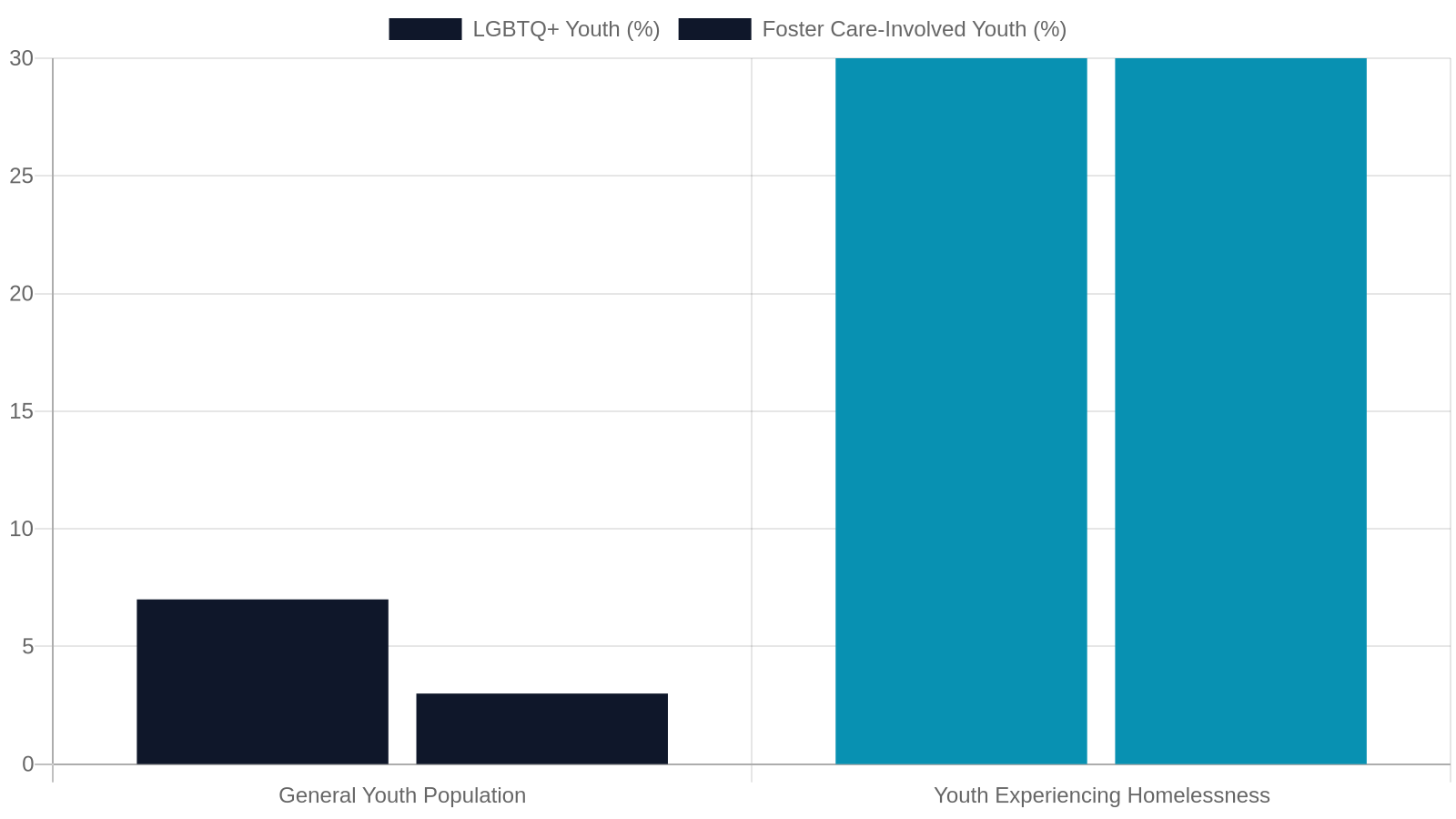
LGBTQ+ youth are estimated to make up 20 to 40% of the youth homeless population nationally, despite being only about 7% of the general youth population. Family rejection following coming out is a leading driver of LGBTQ+ youth homelessness. In Nashville, where both affirming and non-affirming shelter environments exist, YAAB members have advocated for explicitly LGBTQ+-affirming policies at youth shelters and housing programs — including protections against discrimination based on gender identity and sexual orientation.
Tennessee does not have statewide LGBTQ+ protections in housing, making local policy advocacy at the CoC level even more critical for this population.
Nashville Housing Options for Transition-Age Youth at a Glance
Understanding the differences between housing program types helps young adults and their support networks identify the right fit. Here's how the main options compare across key factors.
What Case Managers and CoC Partners Can Do Differently

Fighting housing discrimination isn’t only the work of young adults — it requires service providers, case managers, and Continuum of Care partners to examine and change their own practices. YAAB members in Central Tennessee have been direct and specific about what they need from the professionals and organizations that are supposed to support them. Here’s what that looks like in practice.
Adopt Trauma-Informed Screening Practices
Many housing programs still use intake processes that feel interrogative, stigmatizing, or designed for an older adult population. YAAB members have consistently flagged intake forms that ask about criminal history upfront, require extensive documentation before any assistance is offered, or use language that feels clinical or judgmental.
Trauma-informed practice means understanding that the behaviors and histories that show up in a young person’s application — gaps in employment, eviction records, criminal history — are often the direct result of the instability they’ve experienced, not evidence of untrustworthiness. Programs that lead with relationship and meet young adults where they are see better engagement and housing retention outcomes.
Engage YAAB Members as Paid Consultants, Not Just Advisors
One of YAAB’s clearest messages to service providers and CoC partners is this: lived experience expertise has value, and it should be compensated. When organizations invite young adults with lived experience to review programs, sit on panels, or participate in planning processes, they should pay for that time — not ask for it as a volunteer contribution from people who are often still in financial instability themselves.
Several Nashville-area organizations have moved toward stipend models for YAAB member participation, and YAAB has advocated for this practice to become standard across the TN-503 CoC. Compensating lived experience expertise is both an equity issue and a practical one — it ensures sustained, meaningful participation rather than one-time tokenism.
Use Data to Drive Accountability
YAAB members have pushed CoC partners to collect and report disaggregated data — broken down by age, race, gender identity, and housing pathway — so that disparities are visible and can be addressed. When data is aggregated, youth-specific patterns disappear into averages. When it’s disaggregated, the system becomes accountable for outcomes for every subpopulation it serves.
Providers and CoC partners who want to be genuine allies to YAAB’s advocacy work can start by committing to data transparency: sharing outcomes data with YAAB members, inviting analysis, and being willing to change practices when the data shows disparate outcomes.
Resources for Young Adults Facing Housing Discrimination in Nashville

Knowing your rights is important — but having a list of concrete resources you can actually use is what gets people housed. Here’s a practical rundown of the most relevant resources for young adults in Nashville and Davidson County who are dealing with housing discrimination, instability, or crisis. You can also explore the full YAAB Tennessee resources page for statewide tools and links organized by region and topic.
Emergency and Immediate Housing Help
If you’re in a housing crisis right now in Nashville or Davidson County, these are your first contacts:
- Metro Homelessness Commission Coordinated Entry — Nashville’s front door to the housing system. Call 2-1-1 (Tennessee’s statewide helpline) to get connected.
- Oasis Center — Nashville’s primary youth-serving organization, offering emergency shelter, transitional housing, and drop-in services for young adults up to age 24.
- Campus for Human Development — provides shelter and services for adults experiencing homelessness in Nashville, including young adults 18 and older.
If you’re under 18, you have additional protections and options — a 2-1-1 call can connect you with youth-specific resources regardless of your age.
Legal Help and Know-Your-Rights Resources
If you’ve experienced housing discrimination or an illegal eviction, free legal help is available:
- Legal Aid Society of Middle Tennessee and the Cumberlands — free civil legal services for income-eligible residents. Apply online at las.org or call (615) 244-6610.
- Tennessee Human Rights Commission — file a housing discrimination complaint at tn.gov/humanrights or call (615) 741-5825.
- HUD Fair Housing Hotline — 1-800-669-9777. Available in multiple languages.
YAAB members can also help you understand your options and connect you with the right resource — peer navigation is one of the most powerful tools in the network.
Financial Assistance and Rental Support
Several programs in Nashville offer direct financial assistance for young adults facing housing instability:
- Tennessee Emergency Solutions Grant (ESG) — funds emergency shelter, rapid rehousing, and homelessness prevention. Access through Coordinated Entry via 2-1-1.
- Metro Social Services — Davidson County’s local safety net, offering emergency rental assistance for eligible residents.
- Rapid Rehousing programs through Oasis Center and other CoC-funded providers — short-term rental assistance with case management support.
Eligibility requirements vary, and some programs have waitlists. Getting connected to Coordinated Entry through 2-1-1 is the most efficient way to find out what you qualify for right now.
How to Get Involved with Central Tennessee YAAB

Reading about advocacy is one thing. Being part of it is another. If you’re a young adult in Nashville or anywhere in Tennessee who has experienced homelessness or housing instability, you already have something powerful: a perspective that policymakers need to hear. Central Tennessee YAAB is how you turn that perspective into change — for yourself and for the thousands of young adults who come after you.
Who Can Join and What Membership Looks Like
YAAB membership is open to young adults ages 17 to 25 who have lived experience of homelessness or housing instability in Tennessee. You don’t need a perfect story, a certain level of stability, or any prior advocacy experience. What YAAB is looking for is your perspective — because the people closest to the problem are closest to the solution.
Membership looks different for different people. Some members participate in weekly meetings, serve on CoC committees, and travel to state-level advocacy events. Others contribute by sharing their story at a community forum, reviewing a program’s materials, or connecting a peer to a resource. There’s a role for everyone, and YAAB meets members where they are.
What You Gain as a YAAB Member
Being part of YAAB isn’t just about giving — it’s about growing. Members gain:
- Leadership skills — public speaking, policy analysis, facilitation, and coalition-building
- Professional connections — relationships with housing advocates, CoC staff, and community leaders across Tennessee
- Stipends and compensation — YAAB advocates for paid participation and works to ensure members are compensated for their time and expertise
- Community — a peer network of young adults across the state who understand what you’ve been through and are working toward the same goals
Many YAAB members have gone on to careers in social work, policy, nonprofit management, and community organizing — with YAAB as the launching pad.
Connect with the Central Tennessee Chapter
The Central Tennessee YAAB chapter operates within the TN-503 Continuum of Care region covering Nashville and Davidson County. If you’re a young adult in the area — or a service provider who wants to connect a client — the best first step is to reach out directly. You can learn more about upcoming meetings, current advocacy campaigns, and how to get plugged in by visiting the Central Tennessee YAAB page for TN-503. You can also explore all Tennessee YAAB chapters to find the chapter closest to you if you’re outside the Nashville area.
Your voice matters. Your experience matters. And there’s a seat at the table waiting for you.
Ready to Turn Your Experience Into Change?

Housing discrimination in Nashville is real, it’s documented, and it disproportionately affects young adults ages 17 to 25 who are already navigating some of the hardest circumstances imaginable. But it’s not inevitable — and Central Tennessee YAAB members are proving that every day. The work is happening right now, in CoC meetings, in shelters, in courtrooms, and in conversations between peers. You can be part of it.
Start Where You Are
You don’t have to have everything figured out to get involved. YAAB members across Tennessee started exactly where you are — navigating housing instability, figuring out next steps, wondering if their voice would make a difference. It does. The Central Tennessee YAAB chapter in Nashville has been a place where young adults not only find community but build the skills and connections to create lasting change in the systems that shape their lives.
Whether you’re currently in a shelter, in transitional housing, recently housed, or just trying to understand your options — there is a place for you in this work. Advocacy doesn’t require stability. It requires honesty, commitment, and the willingness to show up.
Take the Next Step Today
Here’s what you can do right now:
- Learn more about housing discrimination and your rights at the YAAB Tennessee youth homelessness resource page.
- Find your local YAAB chapter — if you’re in Nashville, visit the Central Tennessee YAAB (TN-503) page to connect with members and find out about upcoming meetings and events.
- Share this article with a peer, a case manager, or a service provider who needs to understand what housing discrimination looks like for young adults in Tennessee.
- Show up — to a meeting, a community forum, a CoC planning session. Your presence changes the room.
Central Tennessee YAAB is fighting housing discrimination in Nashville — and the fight is stronger with you in it. You belong here.
Frequently Asked Questions
Can a landlord in Nashville legally refuse to rent to me because I'm young or have no rental history?
Age alone is not a protected class under the federal Fair Housing Act or Tennessee state law, so landlords can legally require rental history. However, if a policy disproportionately affects a protected class — such as race or disability — it may still be illegal. YAAB members and Legal Aid Society of Middle Tennessee can help you evaluate your specific situation.
What is the Central Tennessee YAAB and how do I join?
The Central Tennessee Youth Action Board (YAAB) is a chapter of the statewide YAAB network for young adults ages 17 to 25 with lived experience of homelessness or housing instability. It operates within the TN-503 Continuum of Care region covering Nashville and Davidson County. Visit yaabtn.org/local-yaabs/tn-503/ to learn how to connect with the chapter and get involved.
What should I do if I think I was illegally discriminated against by a Nashville landlord?
You can file a complaint with the Tennessee Human Rights Commission at (615) 741-5825 or online at tn.gov/humanrights, or with HUD's Fair Housing hotline at 1-800-669-9777. The Legal Aid Society of Middle Tennessee offers free legal help for eligible residents. You have one year from the discriminatory act to file a federal complaint.
Does Nashville have any protections for renters who use housing vouchers?
Tennessee does not have a statewide source-of-income protection law, which means Nashville landlords can legally refuse to accept Housing Choice Vouchers or other rental subsidies. This is a key advocacy issue for YAAB members in the TN-503 region, who are pushing for policy changes at the local and state level.
What housing resources are available for young adults aging out of foster care in Nashville?
Tennessee's extended foster care program allows youth to remain in care until age 21. After exiting, young adults can access Rapid Rehousing and Transitional Housing programs through the Metro Homelessness Commission's Coordinated Entry system. Call 2-1-1 to get connected, or reach out to Oasis Center, Nashville's primary youth-serving housing organization.
How does YAAB work with Nashville's Continuum of Care to change housing policy?
Central Tennessee YAAB members participate directly in TN-503 CoC planning meetings, review funding applications, and advocate for youth-specific priorities including low-barrier shelter access, youth-focused Rapid Rehousing funding, and trauma-informed screening practices. YAAB members have voting and advisory roles in CoC governance, ensuring youth lived experience shapes how HUD dollars are spent.