Quick answer: Nashville YAAB (Youth Action Board) members — young adults ages 17 to 25 with lived experience of homelessness — advocate for affordable housing policy in Davidson County by attending Metro Council meetings, testifying before planning commissions, co-designing programs with Continuum of Care partners, and pushing for policy changes like expanded rapid rehousing funds and youth-specific shelter beds. Their peer-driven advocacy is directly shaping how Nashville spends housing dollars and designs services for transition-age youth across Tennessee's CoC region TN-504.
What Is the Nashville YAAB and Why Does It Exist?

The Nashville Youth Action Board (YAAB) exists because young people experiencing homelessness in Davidson County have historically been left out of the rooms where decisions about their lives are made. Founded as part of Tennessee’s statewide YAAB network, the Nashville chapter — rooted in CoC region TN-504 — gives transition-age youth a formal seat at the table where housing policy is debated, funded, and implemented. Understanding who YAAB members are and how the organization is structured is the first step to understanding why their advocacy is so effective.
Lived Experience as a Credential
Most housing policy in America is written by people who have never slept in a shelter or couch-surfed for months. The Nashville Youth Action Board flips that script. YAAB members are young adults — ages 17 to 25 — who have personally navigated housing instability, foster care aging-out, or homelessness in Davidson County and the surrounding region. That lived experience is not a liability; it is the credential that makes their advocacy credible and irreplaceable.
When a YAAB member walks into a Metro Council chamber or sits across from a housing authority director, they carry data that no consultant can manufacture: first-hand knowledge of what it feels like to be turned away from a shelter because you are 17, or to lose stable housing the day you age out of foster care at 18.
The TN-504 Continuum of Care Connection
Nashville’s YAAB operates within CoC region TN-504, which covers Davidson County. The Continuum of Care (CoC) is the federally mandated planning body that coordinates homeless services and allocates HUD funding across a defined geographic area. In Davidson County, that means coordinating shelters, rapid rehousing programs, permanent supportive housing, and outreach teams.
YAAB members hold formal advisory roles within TN-504, meaning their voices are embedded in the annual funding application process, the Coordinated Entry System design, and the community planning meetings that decide who gets resources and how. This is not symbolic participation — it is structural influence.
The Scale of Youth Homelessness in Davidson County

Before you can change a policy, you have to understand the problem it is supposed to solve. Nashville YAAB members ground their advocacy in real data about youth homelessness in Davidson County — and the numbers make a compelling case for urgent action. Here is what the evidence shows about the scale and specific nature of housing instability among transition-age youth in the Nashville region.
Point-in-Time Count Data for Nashville
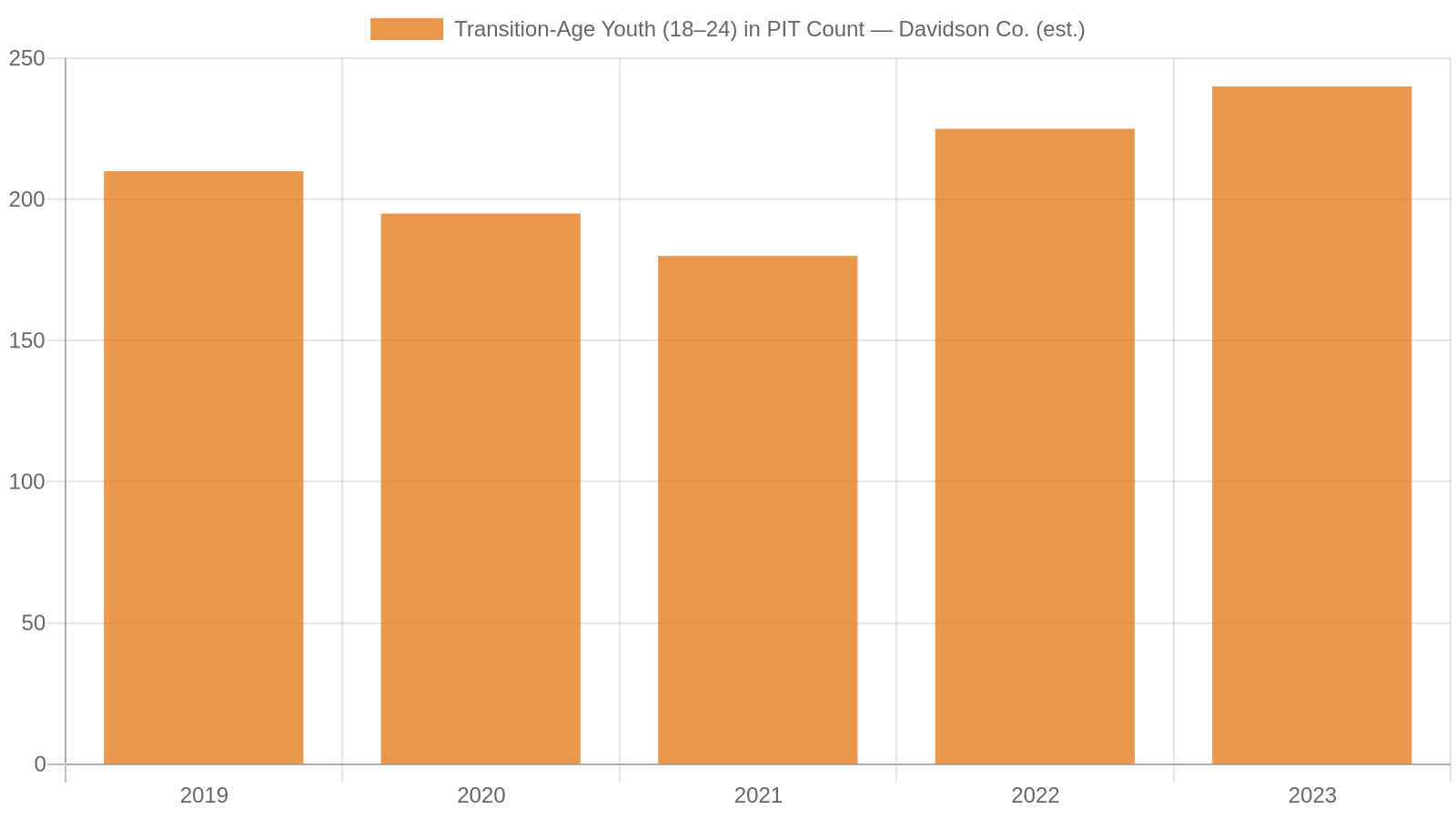
Every January, CoC regions across the country conduct a Point-in-Time (PIT) Count — a single-night census of people experiencing homelessness. In Davidson County’s most recent counts, transition-age youth (ages 18–24) have consistently represented roughly 15–20% of the unsheltered population, despite making up a much smaller share of the general population. Youth under 18 who are unaccompanied add additional numbers that are often undercounted because young people hide their homelessness to avoid involvement with child welfare systems.
These numbers matter because HUD uses PIT data to allocate funding. Undercounting youth means underfunding youth services — which is exactly why YAAB members advocate for better youth-specific counting methodologies every year.
Why Transition-Age Youth Face Unique Barriers in Nashville
Nashville’s housing market has experienced dramatic rent increases over the past decade. Between 2015 and 2024, median rent in Davidson County rose by more than 60%, while wages for entry-level workers grew far more slowly. For a 20-year-old working a minimum-wage job in Nashville, affording a one-bedroom apartment at the standard 30%-of-income threshold would require earning roughly $22–$25 per hour — well above Tennessee’s $7.25 minimum wage.
Add in barriers like no rental history, no credit score, prior evictions, or aging out of foster care with no family safety net, and the math becomes nearly impossible. YAAB members live this math. Their advocacy is grounded in it.
How Nashville YAAB Members Actually Influence Policy

Advocacy is not just marching with signs — though that matters too. Nashville YAAB members use a range of concrete, structural tools to influence how housing policy is written and funded in Davidson County. These are not symbolic gestures; they are real mechanisms for change embedded in the systems that govern housing in Nashville.
Testifying at Metro Council and Planning Meetings
One of the most direct advocacy tools YAAB members use is public testimony. Nashville’s Metro Council holds regular meetings where residents can speak on budget priorities, zoning changes, and housing ordinances. YAAB members show up — sometimes in groups, sometimes alone — and deliver two-to-three-minute testimonies that put a human face on housing data.
Effective testimony is not about being emotional for its own sake. YAAB members are trained to open with a specific policy ask, back it up with data, and close with a personal story that illustrates why the policy matters. This structure — ask, evidence, story — is the same framework used by professional lobbyists, and it works.
Participating in the Coordinated Entry System Design
Nashville’s Coordinated Entry System (CES) is the front door to all homeless services in Davidson County. When someone seeks help, CES determines their eligibility, prioritizes their needs, and connects them to available resources. The design of CES — its assessment tools, its eligibility criteria, its referral pathways — has an enormous impact on whether young people actually get housed.
YAAB members have participated in working groups that review and redesign CES tools to be more youth-friendly. For example, they have pushed back on assessment questions that assume adults have rental history or a credit score, and advocated for trauma-informed intake processes that do not re-traumatize young people who have already been through difficult experiences.
Influencing the Annual HUD CoC Funding Application
Every year, TN-504 submits a competitive application to HUD for Continuum of Care funding. The priorities in that application — which programs get funded, at what levels, serving which populations — are shaped by community input. YAAB members participate in the ranking process, advocate for youth-specific programs to receive priority, and review draft applications to ensure youth needs are accurately represented.
In practical terms, this means YAAB members have helped secure funding for rapid rehousing programs specifically designed for transition-age youth, and have pushed for the creation of dedicated youth shelter beds in Davidson County — a gap that has been documented in Nashville’s housing system for years.
Key Affordable Housing Policies YAAB Has Pushed For in Nashville

YAAB members do not just show up to meetings — they come with specific policy asks. Over the years, Nashville’s YAAB chapter has focused its advocacy energy on a set of concrete housing policy priorities that directly affect transition-age youth in Davidson County. Here are the key issues they have been pushing on.
Expanding Rapid Rehousing for Youth Ages 17–25
Rapid Rehousing (RRH) is an evidence-based intervention that provides short-term rental assistance and case management to help people move quickly from homelessness into stable housing. For transition-age youth, RRH is often more effective than shelter-based approaches because it places young people in real apartments, building the life skills and rental history they need for long-term stability.
Nashville YAAB members have consistently advocated for more RRH slots dedicated specifically to youth ages 17–25, arguing that programs designed for adults often have eligibility rules, curfews, or case management styles that do not fit the needs of young people. Their advocacy has contributed to conversations about creating youth-specific RRH tracks within Davidson County’s housing system.
Host Home and Transitional Housing Models
Not every young person experiencing homelessness needs a full apartment. Some need a safe, stable place to stay for 60–90 days while they get on their feet. Host Home programs — where vetted community members open their homes to youth — and transitional housing — longer-term supported living for up to 24 months — are both models that YAAB members have championed in Nashville.
These models are particularly important for youth who are not yet ready for independent living, including those who are still in school, dealing with mental health challenges, or just aging out of foster care. YAAB members have shared their own experiences with these models — both positive and negative — to help providers and policymakers design better programs.
Zoning and Affordable Unit Advocacy
Nashville’s rapid growth has put enormous pressure on its housing stock. YAAB members have engaged with broader affordable housing campaigns in Davidson County, including advocacy for inclusionary zoning policies that would require new developments to include a percentage of affordable units, and for the preservation of existing affordable housing stock that is at risk of being converted to market-rate use.
While these are complex, long-term policy fights, YAAB members bring a critical perspective: they are the people who will be most affected if Nashville’s affordable housing supply continues to shrink. Their presence in these conversations ensures that youth voices are part of the city’s long-term housing planning.
The Tools and Skills YAAB Members Build as Advocates

Joining YAAB is not just about showing up — it is about growing into a skilled, confident advocate. The Nashville chapter invests in building real competencies in its members, competencies that serve them in advocacy and in life. Here is what that development looks like in practice.
Policy Literacy: Understanding How Housing Systems Work
You cannot change a system you do not understand. One of the most valuable things YAAB membership offers is policy literacy training — learning how HUD funding flows, how CoC governance works, what a Consolidated Plan is, and how Metro Council budget decisions get made. Many YAAB members come in knowing their lived experience deeply but not knowing the bureaucratic language that surrounds it. YAAB bridges that gap.
This training is practical and peer-driven. Experienced YAAB members teach newer ones. Guest speakers from housing authorities, legal aid organizations, and advocacy groups share expertise. The goal is to turn young people with powerful stories into young people with powerful stories and the policy knowledge to back them up.
Public Speaking and Testimony Skills
Standing up in a Metro Council chamber and speaking into a microphone is intimidating for anyone. YAAB provides members with public speaking coaching and testimony preparation, including mock hearings, feedback sessions, and guidance on how to structure a two-minute statement for maximum impact.
Members learn to lead with the policy ask, not the personal story — a counterintuitive approach that actually works better in policy settings, where decision-makers need to know what you want before they can be moved by why you want it. This skill transfers beyond YAAB: members use it in job interviews, college applications, and community organizing.
Coalition Building and Peer Outreach
Effective advocacy rarely happens alone. Nashville YAAB members build relationships with other advocacy organizations, legal aid clinics, housing nonprofits, and faith communities working on affordable housing in Davidson County. They also do peer outreach — connecting with other young people experiencing homelessness and bringing their voices and needs back into the policy conversation.
This coalition-building work means YAAB’s advocacy carries more weight than any single organization could generate alone. When YAAB members show up to a Metro Council meeting alongside representatives from housing nonprofits, legal aid, and faith communities, the message is amplified and harder to ignore.
What a Typical YAAB Advocacy Cycle Looks Like in Nashville

Advocacy is not a one-time event — it is a cycle that follows the rhythms of government planning, budget seasons, and community organizing. Understanding Nashville YAAB’s annual advocacy calendar helps you see how consistent, strategic engagement produces real policy change over time.
Fall: CoC Planning Season and Priority Setting
Each fall, TN-504 enters its annual CoC planning cycle — the period when the community sets priorities for the coming year’s HUD funding application. YAAB members attend community planning meetings, participate in needs assessments, and advocate for youth-specific priorities to be included in the CoC’s annual application. This is a high-stakes period because the decisions made here determine which programs get funded for the next 12 months.
YAAB members prepare by reviewing the previous year’s data, identifying gaps in youth services, and developing specific policy recommendations they want to see reflected in the application. It is detailed, sometimes tedious work — and it is exactly the kind of work that changes systems.
Winter and Spring: Budget Season and Metro Council Engagement
Nashville’s Metro Council budget process runs from late winter through spring, culminating in a budget vote in June. This is when YAAB members engage most intensively with local government, attending budget hearings, meeting with council members, and submitting written testimony on housing budget priorities.
Key asks during budget season have included increased funding for the Metro Homelessness Commission, support for youth-specific shelter capacity, and investment in affordable housing trust funds that can be used for rapid rehousing and transitional housing programs serving transition-age youth.
Summer: Reflection, Training, and Peer Outreach
Summer is when Nashville YAAB invests in its own members — running training sessions, attending statewide YAAB convenings, and doing peer outreach to recruit new members who are currently experiencing housing instability. It is also a time for reflection: reviewing what advocacy wins were achieved, what did not work, and what the priorities should be for the coming cycle.
New members who join during summer get onboarded through peer mentorship, learning from experienced YAAB advocates who have already been through multiple policy cycles. By the time fall arrives, they are ready to step into the CoC planning process with confidence.
Real Impact: What Nashville YAAB Advocacy Has Helped Achieve

Advocacy work can feel slow and incremental — and honestly, sometimes it is. But Nashville YAAB members have contributed to real, documented changes in how Davidson County’s housing system serves transition-age youth. Here are some of the most meaningful outcomes their work has helped produce.
Youth-Informed Changes to Coordinated Entry
One of the most concrete outcomes of Nashville YAAB’s advocacy has been the incorporation of youth feedback into Davidson County’s Coordinated Entry System. After YAAB members documented barriers young people faced in the intake process — including assessment tools that assumed adult life circumstances and intake locations that felt unsafe — TN-504 partners worked to revise protocols and create more youth-accessible entry points.
These changes are not dramatic headlines, but they are the kind of systemic improvements that make a real difference in whether a 19-year-old who has been sleeping in their car can actually access help. Process improvements driven by youth voice are a signature YAAB contribution.
Increased Visibility for Youth Homelessness in Nashville Policy Conversations
Before YAAB members began showing up consistently at Metro Council meetings and CoC planning sessions, youth homelessness in Davidson County was often treated as a footnote in broader homelessness policy discussions. YAAB’s sustained presence has changed that. Youth-specific data is now regularly included in Nashville’s homelessness reporting, and youth voices are increasingly expected — not just welcomed — at policy tables.
This shift in visibility is itself a policy outcome. When decision-makers expect to hear from young people, they design programs and budgets with young people in mind. YAAB has helped create that expectation in Nashville.
How Nashville YAAB Compares to Other Tennessee CoC Regions

Nashville YAAB does not operate in isolation — it is part of a statewide network of youth advocates working across Tennessee’s Continuum of Care regions. Understanding how Nashville’s chapter fits into that broader landscape helps clarify both its unique strengths and the opportunities for cross-regional learning and solidarity.
Statewide YAAB Network: Shared Goals, Regional Differences
Tennessee’s YAAB network spans multiple CoC regions — from Memphis/Shelby County (TN-500) to Chattanooga/Hamilton County (TN-503), Knoxville/Knox County (TN-501), and rural regions like the Upper Cumberland and Northeast Tennessee. Each regional YAAB operates with the same core mission — centering youth lived experience in housing policy — but faces different local conditions.
Nashville’s TN-504 region is unique in having a large, rapidly growing urban housing market with significant private development activity. This creates both challenges (rising rents, displacement) and opportunities (more stakeholders to engage, more media attention on housing issues). Other regions face different challenges, like limited shelter capacity in rural areas or smaller CoC budgets with fewer youth-specific programs.
Learning Across Regions: What Nashville Can Share and Learn
One of the strengths of Tennessee’s statewide YAAB structure is that regional chapters share strategies, successes, and lessons learned. Nashville YAAB members have shared testimony training approaches with other regions, while learning from Memphis YAAB’s work on youth-specific shelter models and Knoxville YAAB’s peer outreach strategies.
This cross-regional learning is formalized through statewide YAAB convenings and informal peer networks. It means that a policy win in one Tennessee city can inform advocacy strategy in another — multiplying the impact of every member’s work across the state.
Nashville YAAB Advocacy Methods at a Glance
Nashville YAAB members use multiple advocacy tools across the policy cycle. Here is how the key methods compare in terms of target audience, timing, and impact level.
Barriers YAAB Members Face in Advocacy — and How They Overcome Them

Advocacy is powerful work, but it is not easy — especially for young people who are navigating their own housing instability at the same time. Nashville YAAB members face real barriers in their advocacy work, and being honest about those barriers is part of what makes the organization trustworthy and effective. Here is how those challenges show up and how YAAB works to address them.
Navigating Systems While Still in Survival Mode
One of the most honest things to acknowledge about youth advocacy is that it is hard to show up for policy meetings when you are also trying to figure out where you are sleeping tonight. Many YAAB members are doing advocacy work while simultaneously managing their own housing instability, employment challenges, or mental health needs. This is not a weakness — it is a testament to their commitment — but it is a real barrier that organizations must actively address.
Nashville YAAB works to reduce these barriers by providing transportation support, flexible meeting times, stipends for member participation, and connections to housing and support services for members who need them. The goal is to make advocacy accessible to the people who have the most at stake.
Being Taken Seriously in Professional Policy Spaces
Young people — especially young people with histories of homelessness — are not always taken seriously in professional policy environments. YAAB members sometimes encounter skepticism, tokenism, or outright dismissal from adult stakeholders who see youth participation as a checkbox rather than a genuine contribution.
YAAB addresses this by preparing members thoroughly, building relationships with CoC partners who champion youth voice, and documenting the concrete outcomes of youth-informed policy changes. Over time, demonstrated impact builds credibility. YAAB members who have been through the process once come back the next year with receipts — evidence of what their advocacy has actually changed.
How to Get Involved With Nashville YAAB as a Young Adult

Reading about YAAB’s advocacy work is one thing. Being part of it is another. If you are a young adult in Nashville or Davidson County who wants to turn your lived experience into real policy change — or if you just want to connect with peers who get it — here is how to get involved with the Nashville YAAB chapter.
You can learn more about the Nashville TN-504 YAAB chapter, including how to connect with local members and find out about upcoming meetings and events. If you are in another part of Tennessee, check out the full list of regional YAAB chapters to find the one closest to you.
Who Can Join and What Membership Looks Like
If you are between 17 and 25 years old and have lived experience of homelessness or housing instability in Davidson County or anywhere in Tennessee, you are exactly who Nashville YAAB is built for. Membership is open to young people at all stages — whether you have been housed for years and want to give back, or you are currently in a shelter and looking for community and purpose.
There is no application fee, no requirement to have your life perfectly together, and no expectation that you share your full story publicly. You can participate at whatever level feels right — attending meetings, joining a working group, or eventually stepping into a leadership role. YAAB meets you where you are.
What You Get Out of YAAB Membership
YAAB membership is not just about giving — it is about growing. Members gain access to policy training, public speaking coaching, professional networking opportunities, and connections to housing, employment, and education resources. Many YAAB members have used their advocacy experience to strengthen college applications, build resumes, and develop leadership skills that employers and educators recognize and value.
Perhaps most importantly, YAAB offers community — a group of peers who understand your experience, take your perspective seriously, and are working toward the same goals. For young people who have often felt invisible in systems designed for them, that sense of belonging and purpose is itself transformative.
Resources for Transition-Age Youth in Davidson County

Advocacy and direct services go hand in hand. Nashville YAAB members are not just policy advocates — they are also connectors, helping peers navigate the resources that exist right now in Davidson County and across Tennessee. Here is a quick overview of what is available and how to access it.
Emergency Shelter and Rapid Rehousing Options in Nashville
If you are a young adult in Nashville who needs housing help right now, the first step is to contact Davidson County’s Coordinated Entry System. In Nashville, you can access CES through the Metro Homelessness Commission’s outreach teams or by calling 211, Tennessee’s statewide social services helpline. From there, you will be connected to available shelter, rapid rehousing, or other housing programs based on your needs and eligibility.
Key Nashville providers serving transition-age youth include Oasis Center, which offers youth shelter and transitional housing, and Conexión Américas and other community organizations that serve specific populations. YAAB members can often help connect peers to these resources directly — peer navigation is one of the most valuable services YAAB provides.
Education, Employment, and Support Services
Stable housing is the foundation, but it is not the whole picture. Nashville YAAB connects members and peers to a range of support services beyond housing, including GED and workforce training programs, mental health services, legal aid for issues like record expungement, and financial literacy resources. Tennessee’s TennCare program provides health coverage for eligible young adults, and the Tennessee College of Applied Technology (TCAT) network offers affordable workforce training across the state.
For a broader look at resources available to transition-age youth across Tennessee, visit the YAAB Tennessee resources page, which is regularly updated with housing, employment, education, and mental health information relevant to young adults statewide.
Your Next Move: Join the Advocacy for Affordable Housing in Nashville

Nashville’s affordable housing crisis is real, urgent, and deeply personal for thousands of young adults in Davidson County. But it is not hopeless — because young people with lived experience are already in the fight, already at the tables where decisions are made, and already changing the systems that shape their lives. The Nashville YAAB chapter is proof that transition-age youth are not just the people housing policy is about — they are the people who can change it.
Why Your Voice Matters More Than You Think
Housing policy in Nashville is made by people in rooms. The question is which people. For too long, the young adults most affected by housing instability have been the subject of policy conversations rather than participants in them. Nashville YAAB exists to change that — and every new member who joins makes the collective voice louder and harder to ignore.
You do not need a degree in public policy. You do not need a perfect housing situation. You do not need to have all the answers. You need your experience, your perspective, and the willingness to show up. YAAB will help you with the rest. The young people already in the room are waiting for you to join them.
Take the First Step Today
Whether you are currently experiencing housing instability, recently housed, or just passionate about making Nashville more equitable for young people, there is a place for you in YAAB. Start by connecting with the Nashville TN-504 chapter, attending a meeting, or reaching out to learn more about what membership looks like in practice.
You can also explore the broader YAAB Tennessee mission and structure to understand how the statewide network operates and how regional chapters like Nashville’s fit into the bigger picture of youth housing advocacy across Tennessee. The movement for affordable housing for young adults in Davidson County and beyond needs your voice — and YAAB is the place to use it.
Frequently Asked Questions
What is the Nashville YAAB and who can join?
The Nashville Youth Action Board (YAAB) is a chapter of Tennessee's statewide YAAB network, operating within CoC region TN-504 (Davidson County). It is open to young adults ages 17 to 25 who have lived experience of homelessness or housing instability. There is no fee to join and no requirement to share your full story publicly.
How does YAAB actually influence housing policy in Nashville?
YAAB members influence housing policy by testifying at Metro Council meetings, participating in the TN-504 Continuum of Care planning process, reviewing the annual HUD funding application, and engaging in the design of Nashville's Coordinated Entry System. These are formal, structural roles — not just symbolic participation.
What is the Continuum of Care and why does it matter for young people in Nashville?
The Continuum of Care (CoC) is a federally mandated planning body that coordinates homeless services and allocates HUD funding in a defined geographic area. Nashville's CoC is TN-504, covering Davidson County. It determines which programs get funded — shelters, rapid rehousing, permanent supportive housing — which directly affects what services are available to young adults experiencing homelessness.
I am currently experiencing homelessness in Nashville. Can I still join YAAB?
Yes — YAAB is specifically designed for young people who are currently or recently experiencing housing instability. The organization provides transportation support, flexible meeting options, and stipends for participation, and can also connect you to housing and support services while you are involved in advocacy.
How does Nashville YAAB's advocacy compare to other Tennessee regions?
Nashville's TN-504 YAAB chapter focuses on Davidson County's rapidly growing urban housing market, engaging with Metro Council, the Metro Homelessness Commission, and a large network of nonprofit partners. Other Tennessee YAAB chapters — in Memphis, Knoxville, Chattanooga, and rural regions — face different local conditions but share the same core mission and collaborate through statewide convenings.
What affordable housing policies has Nashville YAAB advocated for?
Nashville YAAB members have advocated for expanded rapid rehousing programs specifically for youth ages 17–25, youth-specific shelter beds, host home and transitional housing models, youth-friendly changes to the Coordinated Entry System, and increased Metro funding for the Homelessness Commission. They have also engaged with broader inclusionary zoning discussions in Davidson County.