Quick answer: The Youth Action Board (YAAB) of Tennessee is a statewide network of young adults ages 17 to 25 with lived experience of homelessness who directly shape the policies, programs, and resources that affect transition-age youth. Operating across all seven Continuum of Care regions — from Memphis to Northeast Tennessee — YAAB members advise local and state leaders, push for systemic change, and connect peers to housing, employment, education, and mental health services. Their lived-experience perspective makes Tennessee's youth-serving systems more effective, equitable, and responsive.
What Is YAAB Tennessee and Who Does It Serve?

Before you can understand what YAAB does, you need to understand who it is. YAAB Tennessee is a statewide network of young adults with lived experience of homelessness and housing instability — and that lived experience is the entire point. This section breaks down the organization’s identity, the population it centers, and why that peer-driven model produces real results for transition-age youth across Tennessee.
A Network Built on Lived Experience
YAAB — the Youth Action Board of Tennessee — is not a traditional advisory committee made up of professionals talking about young people. It is a network <em of young people, ages 17 to 25, who have personally navigated homelessness, housing instability, foster care, or related crises. That distinction matters enormously. When a young adult who has slept in a car or aged out of foster care sits at the table where policy decisions are made, the conversation changes. Blind spots get named. Jargon gets challenged. Real solutions get built.
YAAB members are not token voices — they are trained advocates, researchers, and community leaders who bring data alongside their stories.
The Population YAAB Centers: Transition-Age Youth
Transition-age youth (TAY) refers to young adults between the ages of 17 and 25 who are navigating the gap between childhood systems — like foster care or juvenile services — and adult independence. According to the U.S. Department of Housing and Urban Development (HUD), youth ages 18 to 24 represent approximately 20% of the total unhoused population nationally, yet they are often underserved by systems designed for either children or older adults.
In Tennessee specifically, young adults aging out of foster care face a stark transition: on their 18th birthday, many lose housing, health coverage, and case management support simultaneously. YAAB exists to close that gap — not by replacing services, but by making existing services work better for the people who need them most.
Why Peer Voices Drive Better Outcomes
Research consistently shows that programs co-designed with the people they serve produce better engagement and outcomes. A 2021 report from the National Alliance to End Homelessness found that youth-informed program design reduced barriers to shelter entry by as much as 30% in pilot cities. YAAB Tennessee operationalizes this principle statewide — embedding youth voice not just in one city, but across every major region of the state, from Memphis/Shelby County to the Upper Cumberland and Northeast Tennessee.
How Tennessee's 7 Continuum of Care Regions Shape YAAB's Work

Tennessee’s approach to ending homelessness is organized through seven regional Continuum of Care bodies. YAAB’s power comes from having a seat at the table in all seven of those regions simultaneously. Here’s what that structure looks like in practice — and why it matters for young adults across the state.
What Is a Continuum of Care (CoC)?
A Continuum of Care (CoC) is a regional planning body funded and overseen by HUD that coordinates housing and services for people experiencing homelessness. Each CoC brings together nonprofits, government agencies, healthcare providers, and community members to allocate federal funding and set local priorities. Tennessee has seven CoC regions, each with its own geography, demographics, and service landscape.
- TN-500: Memphis/Shelby County
- TN-501: Nashville/Davidson County
- TN-502: Knoxville/Knox County
- TN-503: Chattanooga/Hamilton County
- TN-504: Jackson/West Tennessee
- TN-506: Upper Cumberland
- TN-509: Northeast Tennessee
YAAB has a local chapter embedded in each of these regions, meaning youth voices are present at every CoC planning table across the state.
How Local YAABs Plug Into Regional Decision-Making
Each local YAAB chapter participates in its region’s CoC governance — attending meetings, reviewing funding applications, and providing feedback on program design. This is not ceremonial participation. YAAB members in Nashville, for example, have contributed to shaping the criteria used to prioritize youth for Rapid Rehousing programs. In Memphis, YAAB members have helped identify gaps in outreach to LGBTQ+ youth, a population that is 120% more likely to experience homelessness than their peers, according to the Trevor Project.
The regional structure also means YAAB can surface issues that are unique to rural or smaller communities — like the transportation barriers that make shelter access nearly impossible in the Upper Cumberland — rather than applying a one-size-fits-all urban model to every part of Tennessee.
Shaping Housing Policy from the Inside

Housing is the foundation. Without stable housing, education, employment, and mental health all become harder to maintain. YAAB Tennessee works inside the systems that control housing access — not just to get individual young adults housed, but to change the rules so the system works better for everyone who comes after them.
Youth-Specific Housing Priorities YAAB Has Influenced
One of YAAB’s most concrete contributions is pushing CoC regions to adopt youth-specific housing priorities within their coordinated entry systems. Coordinated entry is the process by which people experiencing homelessness are assessed and matched to available housing resources. Without intentional design, these systems can deprioritize young adults — especially those who are couch-surfing or staying in unstable situations that don’t look like “classic” homelessness on paper.
YAAB members have advocated for assessment tools that recognize the specific vulnerabilities of transition-age youth, including trauma history, lack of rental history, and the absence of a co-signer. In several Tennessee CoC regions, this advocacy has contributed to the creation of dedicated youth beds in Rapid Rehousing and Transitional Housing programs.
Challenging Policies That Harm Young Adults
YAAB members don’t just suggest additions — they also push back on policies that create harm. Rules that prohibit guests in housing programs, for instance, can isolate young adults from their support networks and increase dropout rates. Curfews in transitional housing that conflict with work schedules can force youth to choose between a job and a bed. YAAB has brought these real-world conflicts to the attention of program administrators and CoC leadership across Tennessee, resulting in policy reviews and, in some cases, rule changes.
This kind of insider advocacy — grounded in direct experience — is something no consultant or researcher can replicate. It is the core value YAAB brings to the system.
State-Level Advocacy and Legislative Engagement
Beyond regional CoC work, YAAB Tennessee engages at the state level — providing testimony, meeting with legislators, and contributing to Tennessee’s annual Consolidated Plan, which guides how federal Community Development Block Grant and HOME Investment Partnership funds are spent. Young adults who have experienced homelessness testifying before state committees shifts the political calculus around youth housing funding in ways that data reports alone cannot.
Connecting Peers to Employment and Economic Opportunity

Getting housed is step one. Staying housed requires income. YAAB Tennessee works at the intersection of housing and employment — advocating for systems that recognize the real barriers young adults face, and connecting peers to the workforce programs and economic opportunities that can change their trajectory.
Why Employment Is a Housing Issue for Transition-Age Youth
Stable income is one of the two most common barriers to housing stability for young adults — the other being rental history. For a 19-year-old with no credit score, no co-signer, and a gap in their work history, landing an apartment is genuinely difficult even when they have income. YAAB addresses this by advocating for landlord incentive programs and flexible screening criteria, while also connecting peers to employment pathways that build the income and work history they need.
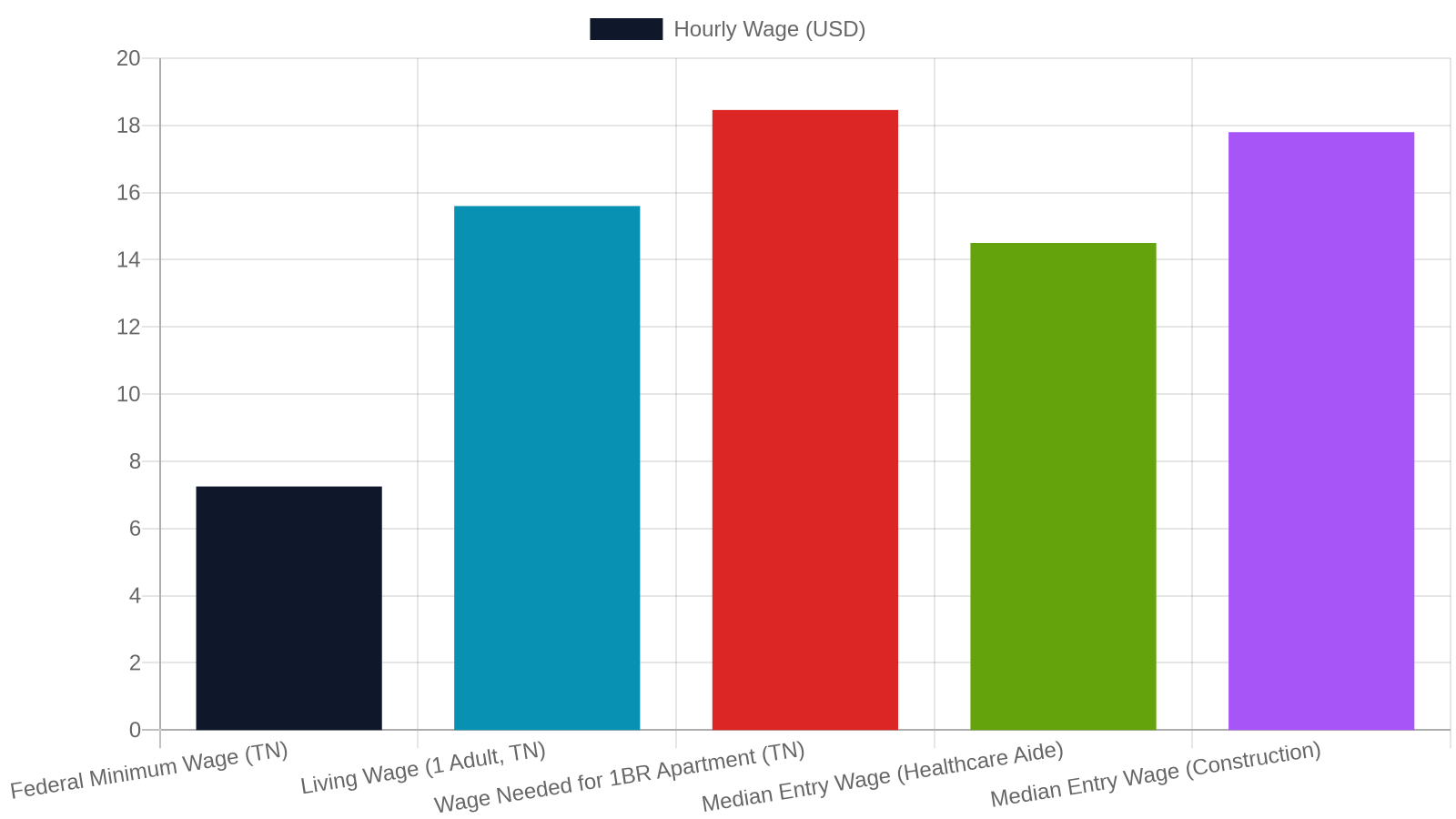
Tennessee’s minimum wage remains at the federal floor of $7.25 per hour as of 2024, making it nearly impossible for a young adult working full-time to afford a one-bedroom apartment — which requires an estimated $18.46/hour in Tennessee to afford at HUD’s 30% income standard. YAAB members understand this math personally, and they bring it into policy conversations.
Workforce Programs YAAB Members Navigate and Recommend
YAAB connects peers to workforce programs including Tennessee’s American Job Centers, which offer free job search assistance, resume help, and skills training. The state’s Tennessee Reconnect program provides free community college for adults without a degree — a pathway YAAB actively promotes to peers who left school during a housing crisis. Additionally, programs like YouthBuild and local workforce development boards in Memphis, Nashville, and Knoxville offer paid training in construction, healthcare, and IT trades.
Because YAAB members have used these programs themselves, their peer referrals carry credibility that a flyer on a bulletin board cannot match. Warm handoffs — one young adult personally connecting another to a resource — dramatically increase follow-through rates.
Supporting Education and GED Pathways Across Tennessee

Education is one of the most powerful tools for long-term stability — and one of the first things disrupted by housing instability. YAAB Tennessee works to make sure young adults across the state know their educational rights, understand their options, and have the peer support to pursue them.
The Education-Homelessness Cycle and How to Break It
Housing instability and educational disruption feed each other. When a young adult loses stable housing, school attendance drops. When school attendance drops, the path to a diploma or GED gets longer. The longer that path, the harder it is to access jobs that pay enough to afford housing. YAAB works to interrupt this cycle by advocating for educational systems that accommodate the realities of housing instability — flexible enrollment, credit recovery, and access to McKinney-Vento protections for youth up to age 21.
The McKinney-Vento Homeless Assistance Act guarantees certain educational rights to students experiencing homelessness, including immediate enrollment and transportation support. YAAB members help peers understand and assert these rights, which are frequently unknown even to the young adults who are entitled to them.
GED and Adult Education Resources YAAB Promotes
For young adults who left high school before graduating, Tennessee’s Adult Education program — operated through the Tennessee Department of Labor and Workforce Development — offers free GED preparation classes at more than 100 sites statewide. YAAB actively promotes these pathways because a GED is often the credential that unlocks access to community college, apprenticeships, and better-paying jobs.
Tennessee Reconnect, mentioned earlier, covers tuition at Tennessee College of Applied Technology (TCAT) programs and community colleges for adults 22 and older without a degree. For those 21 and under, the Tennessee Promise scholarship covers two years of community college. YAAB members help peers understand which program applies to them and how to apply — cutting through the confusion that causes many eligible young adults to miss out.
Advocating for Campus-Based Housing Support
YAAB has also engaged with Tennessee’s higher education institutions to advocate for campus homeless liaisons, emergency housing funds, and food pantries at community colleges — resources that help housing-unstable students stay enrolled. Several Tennessee community colleges now have formal supports in place partly as a result of advocacy from young adults who experienced housing insecurity while trying to complete their education.
Addressing Mental Health and Trauma-Informed Care

You can’t talk about housing stability without talking about mental health. YAAB Tennessee centers trauma-informed care in its advocacy — pushing for programs that meet young adults where they are emotionally, not just physically. Here’s how that shows up in the work.
Why Mental Health Support Is Non-Negotiable for TAY
Homelessness is not just a housing problem — it is a trauma. Young adults who have experienced housing instability, family rejection, foster care, or street homelessness carry significant trauma histories. According to the Substance Abuse and Mental Health Services Administration (SAMHSA), more than 50% of youth experiencing homelessness report a diagnosable mental health condition, and many have experienced physical or sexual abuse. Without trauma-informed support, even excellent housing programs can fail to keep young adults stably housed.
YAAB advocates for trauma-informed care standards across Tennessee’s CoC-funded programs — meaning staff are trained to understand how trauma affects behavior, and programs are designed to avoid re-traumatizing the people they serve.
Peer Support as a Mental Health Strategy
One of the most evidence-backed mental health interventions for transition-age youth is peer support — connection with someone who has shared experience and has found a path forward. YAAB members function as peer supporters by definition: they are young adults who have been through it, who are still working through it, and who show up for each other. This is not a clinical intervention, but it is a powerful one.
Research from the National Institute of Mental Health suggests that peer support programs reduce hospitalization rates and improve medication adherence among young adults with serious mental illness. YAAB’s model embeds this principle into every aspect of its work — from one-on-one peer connections to group advocacy spaces where young adults process shared experiences together.
Pushing for Better Mental Health Resources in CoC Programs
YAAB members have consistently raised the shortage of mental health providers who accept TennCare (Tennessee’s Medicaid program) and who have experience working with transition-age youth. In CoC planning processes, YAAB has advocated for mental health co-location — placing counselors inside housing programs rather than requiring young adults to navigate a separate system. Several programs in Nashville and Memphis have adopted this model, reducing the number of steps between a young adult and mental health support.
Supporting Youth Aging Out of Foster Care

Aging out of foster care is one of the most common pathways into youth homelessness in Tennessee. YAAB members — many of whom have lived this experience — are uniquely positioned to both support peers navigating this transition and advocate for the systemic changes that would make it less dangerous.
The Foster Care Cliff and What It Means in Tennessee
In Tennessee, young adults who have been in foster care typically lose their placement and many associated supports at age 18. This is sometimes called the “foster care cliff” — a sudden drop in support at exactly the moment when young adults need the most help building independence. Nationally, one in five youth who age out of foster care will experience homelessness within two years of leaving the system, according to the Annie E. Casey Foundation.
Tennessee’s Extended Foster Care program, known as TN Fostering Connections, allows young adults to remain in foster care voluntarily up to age 21 if they are in school, working, or participating in a program designed to remove barriers to employment. YAAB actively informs peers about this option, which many eligible young adults do not know exists.
Chafee Funds and Independent Living Programs
The federal John H. Chafee Foster Care Program for Successful Transition to Adulthood provides funding to states to support youth aging out of foster care. Tennessee uses these funds for independent living programs, education and training vouchers (ETVs), and room-and-board assistance. ETVs can provide up to $5,000 per year for education and training for eligible youth up to age 23. YAAB helps peers navigate the application process for these funds, which require documentation and deadlines that can be hard to manage during a housing crisis.
YAAB's Role in Reforming Foster Care Transitions
Beyond connecting individuals to existing resources, YAAB members advocate for systemic reform of how Tennessee handles foster care transitions. This includes pushing for earlier transition planning (starting at age 14 rather than 17), stronger connections to adult housing programs before a young adult exits care, and better data sharing between the Department of Children’s Services and CoC housing providers so that young adults don’t fall through the cracks between systems.
How YAAB Collects and Uses Data to Drive Change

Advocacy without data is just opinion. YAAB Tennessee trains its members to be researchers — collecting evidence, analyzing trends, and presenting findings to the people who control funding and policy. This section explains how YAAB turns lived experience into actionable data.
Youth Participatory Action Research (YPAR)
Youth Participatory Action Research (YPAR) is a methodology in which young people are not just research subjects — they are the researchers. YAAB members are trained to design surveys, conduct interviews, analyze findings, and present results to policymakers. This approach produces data that is both rigorous and deeply credible, because it comes from people with direct knowledge of the issue.
YAAB has used YPAR to document barriers to shelter access, gaps in mental health services, and the specific challenges facing LGBTQ+ youth and youth of color in Tennessee’s housing system. These findings have been presented to CoC leadership and state officials, contributing to funding decisions and program redesigns.
Point-in-Time Count Participation and Limitations
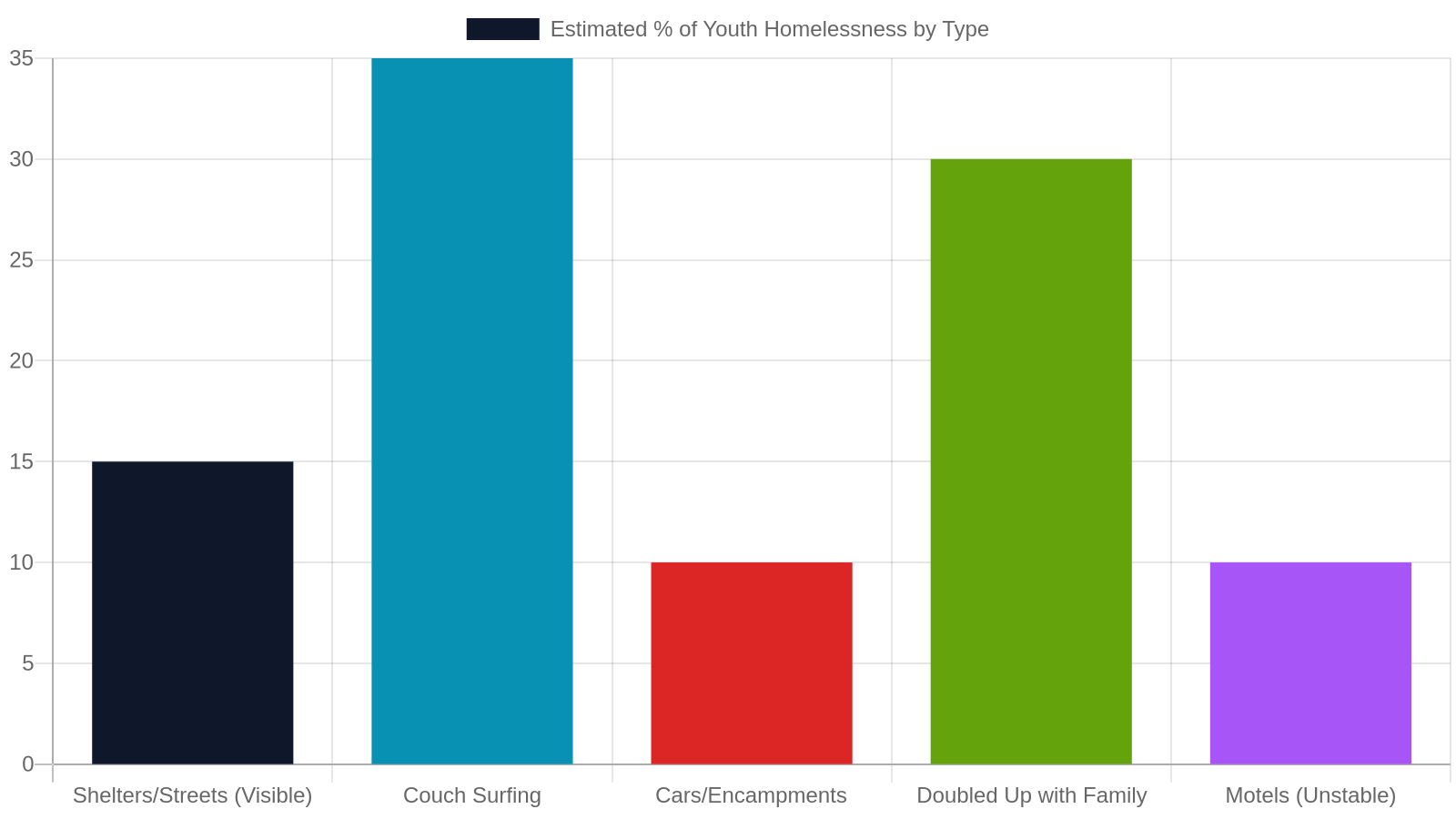
The annual Point-in-Time (PIT) Count is a HUD-required census of people experiencing homelessness on a single night in January. YAAB members participate in PIT counts across Tennessee’s CoC regions — but they also advocate for understanding the count’s limitations. Youth homelessness is significantly undercounted in PIT data because many young adults are couch-surfing, staying in cars, or doubling up with family rather than sleeping in shelters or on the street. YAAB pushes for supplemental youth-specific counts and better data collection methods that capture the full scope of the problem.
Using Data to Secure Funding for Youth Programs
Data collected and presented by YAAB members has directly supported funding applications for youth-specific programs in Tennessee’s CoC regions. When a funding application can cite youth-generated research alongside HUD data, it tells a more complete story — and a more compelling one. YAAB’s data work is not just academic; it translates directly into dollars for programs that serve young adults across the state.
YAAB Tennessee: 7 CoC Regions at a Glance
YAAB has a local chapter embedded in each of Tennessee's seven Continuum of Care regions. Here's how they compare by geography, key challenges, and YAAB focus areas.
YAAB's Impact Across Tennessee's Regions: A Snapshot

YAAB’s statewide reach means its impact looks different in different places — because the challenges facing young adults in Memphis are not identical to those in rural Northeast Tennessee. This section offers a regional snapshot of where YAAB is making a difference and how.
Memphis/Shelby County (TN-500) and West Tennessee
In the Memphis metro area, YAAB members have engaged with the Continuum of Care to address the high rates of youth homelessness among young adults of color and LGBTQ+ youth. Memphis has one of the highest youth poverty rates of any major U.S. city, making YAAB’s work there particularly urgent. Local YAAB members have participated in coordinated entry redesign and have advocated for culturally responsive services that reflect the demographics of the youth population being served. The Jackson/West Tennessee CoC (TN-504) covers a large rural geography where transportation is a primary barrier — YAAB members from this region have raised this issue in state-level conversations about resource allocation.
Middle Tennessee: Nashville/Davidson (TN-501)
Nashville’s rapid growth has made housing affordability a crisis for everyone — but especially for young adults without rental history or co-signers. YAAB members in the Nashville CoC have engaged with the Metro Homelessness Commission and local service providers to advocate for landlord incentive programs and lower-barrier housing options. Nashville’s YAAB chapter has also been active in pushing for better data collection on youth homelessness in a city where the official count has historically undercounted transition-age youth.
East Tennessee: Knoxville, Chattanooga, and Beyond
In Knoxville (TN-502) and Chattanooga (TN-503), YAAB members have worked alongside local CoC partners to expand youth-specific shelter capacity and advocate for trauma-informed staff training. The Upper Cumberland (TN-506) and Northeast Tennessee (TN-509) regions present unique rural challenges — fewer services, greater distances, and less visibility for young adults experiencing homelessness. YAAB members from these regions ensure that rural youth are not an afterthought in statewide planning conversations.
How Young Adults Can Get Involved with YAAB

YAAB is not just an organization you read about — it is one you can be part of. Whether you are a young adult who wants to turn your experience into advocacy, or a service provider looking to connect clients to peer support and leadership opportunities, there is a place for you in YAAB Tennessee.
Who Can Join a Local YAAB Chapter
If you are between 17 and 25 years old and have lived experience of homelessness or housing instability — including couch surfing, staying in a shelter, living in a car, or doubling up with family — you are exactly who YAAB is built for. You don’t need a resume, a degree, or a polished story. You need your experience and your willingness to show up. YAAB chapters across Tennessee welcome young adults who want to turn their experience into change.
Membership is open to young adults in all seven CoC regions. Each local chapter has its own meeting schedule and activities — from attending CoC meetings to participating in advocacy campaigns and research projects. You can explore all local YAAB chapters across Tennessee to find the one closest to you.
What Membership Looks Like in Practice
Being a YAAB member is not a second job — it is a community. Members participate at whatever level works for their life. Some attend monthly meetings and CoC planning sessions. Others take on leadership roles, presenting at conferences or testifying before state committees. Many start by simply connecting with peers and gradually take on more as their confidence and capacity grow.
YAAB provides training in advocacy, research methods, public speaking, and policy analysis — skills that are genuinely useful beyond YAAB itself. Members have gone on to careers in social work, public policy, nonprofit management, and community organizing. The skills you build here are yours to keep.
For Case Managers and Service Providers: How to Connect Your Clients
If you are a case manager, CoC partner, or service provider reading this — YAAB is a resource for your clients. Connecting a young adult to their local YAAB chapter is a warm referral to a peer community that can provide support, connection, and a sense of purpose. YAAB members are not a replacement for services; they are a complement to them. Reach out through the YAAB contact page to learn how your organization can partner with or refer to your regional chapter.
Resources and Rights Every Tennessee TAY Should Know

You cannot advocate for yourself without knowing what you are entitled to. This section gathers the most important rights and resources for transition-age youth in Tennessee — the kind of information YAAB members share with each other every day.
Know Your Rights: Housing, Education, and Healthcare
Young adults experiencing homelessness in Tennessee have legal rights that are frequently unknown and underutilized. Under the McKinney-Vento Act, students experiencing homelessness have the right to immediate school enrollment, transportation, and services — up to age 21. Under TennCare, young adults who aged out of foster care at age 18 are eligible for Medicaid coverage until age 26 at no cost. Under the Fair Housing Act, housing providers cannot discriminate based on race, sex, national origin, disability, or familial status — and many local ordinances add additional protections.
Knowing these rights is the first step to asserting them. YAAB members help peers understand what they are entitled to — because systems do not always volunteer that information.
Key Tennessee Resources for Transition-Age Youth
A few essential resources every Tennessee TAY should have on their radar:
- 2-1-1 Tennessee: Dial 2-1-1 or text your zip code to 898-211 for local housing, food, and service referrals 24/7.
- Tennessee’s Coordinated Entry System: Contact your local CoC to access housing assessments and referrals.
- TN Fostering Connections: Extended foster care up to age 21 for eligible youth.
- Education Training Vouchers (ETVs): Up to $5,000/year for education for foster care alumni up to age 23.
- Tennessee Reconnect: Free community college for adults without a degree (age 22+).
- Tennessee Promise: Two years free community college for recent high school graduates (under 22).
For a more complete list of resources organized by region, visit the YAAB Tennessee resources page.
Ready to Shape the Future of Youth Services in Tennessee?

YAAB Tennessee is built on a simple belief: the people closest to the problem are closest to the solution. Across all seven Continuum of Care regions — from Memphis and Nashville to Knoxville, Chattanooga, Jackson, the Upper Cumberland, and Northeast Tennessee — young adults with lived experience are changing the systems that shape their lives. Here is how you can be part of that.
Your Experience Is Your Credential
If you have navigated housing instability, foster care, or homelessness as a young adult in Tennessee, you already have something that no degree or training can give you: the knowledge of what it actually feels like to move through these systems. That knowledge is exactly what makes YAAB powerful — and it is exactly what Tennessee’s CoC regions need at their planning tables.
You do not have to have it all figured out to get involved. YAAB meets you where you are. The only requirement is that you are between 17 and 25, you have lived experience of housing instability, and you are willing to show up.
Take the Next Step with YAAB Tennessee
Whether you want to join a local chapter, learn more about what YAAB does, or connect your organization to the network, the best next step is to explore YAAB Tennessee’s current projects and initiatives to see the work in action. You can also visit the YAAB join page to get started with membership in your region.
Young adults across Tennessee — from Memphis to Kingsport, from Nashville to the Upper Cumberland — are already shaping the systems that affect their lives. The table has room for you. YAAB Tennessee is proof that when young adults with lived experience lead, the whole system gets better — not just for them, but for every young person who comes after.
Frequently Asked Questions
What is the Youth Action Board (YAAB) of Tennessee?
YAAB Tennessee is a statewide network of young adults ages 17 to 25 with lived experience of homelessness or housing instability. Members advise local and state leaders, participate in Continuum of Care planning, and connect peers to housing, employment, education, and mental health resources across all seven of Tennessee's CoC regions.
How do I join YAAB Tennessee if I've experienced homelessness?
If you are between 17 and 25 and have lived experience of homelessness or housing instability — including couch surfing, shelter stays, or doubling up — you are eligible to join. Visit yaabtn.org/join or find your local chapter at yaabtn.org/local-yaabs to get started. No resume or formal credentials are required.
What is a Continuum of Care and how does YAAB fit into it?
A Continuum of Care (CoC) is a HUD-funded regional body that coordinates housing and services for people experiencing homelessness. Tennessee has seven CoC regions. YAAB has a chapter in each region, giving young adults with lived experience a direct seat at the table where funding decisions and program policies are made.
What resources are available for young adults aging out of foster care in Tennessee?
Tennessee's TN Fostering Connections program allows eligible youth to remain in extended foster care up to age 21. Education Training Vouchers (ETVs) provide up to $5,000 per year for education for foster care alumni up to age 23. TennCare Medicaid coverage is also available at no cost for foster care alumni up to age 26. YAAB helps peers navigate all of these programs.
How does YAAB use data to improve services for transition-age youth?
YAAB members are trained in Youth Participatory Action Research (YPAR), conducting surveys and interviews to document barriers and gaps in Tennessee's youth-serving systems. This data is presented to CoC leadership and state officials to inform funding decisions and program redesigns. YAAB also advocates for better Point-in-Time count methods that capture hidden forms of youth homelessness like couch surfing.
Is YAAB only for young adults in big cities like Memphis and Nashville?
No. YAAB Tennessee has chapters in all seven CoC regions, including rural areas like the Upper Cumberland (TN-506) and Northeast Tennessee (TN-509). YAAB specifically advocates for rural young adults who are often overlooked in statewide planning, and members from rural regions participate in state-level conversations to ensure their communities are not left behind.