Quick answer: Knoxville's Youth Action Board (YAAB TN-501) is made up of young adults ages 17 to 25 in Knox County who have lived experience of homelessness or housing instability. Members have gone from couch-surfing or shelter stays to securing stable housing, landing jobs and certifications, and stepping into leadership roles that shape local policy. Their stories show that peer-driven support — not charity — is what moves the needle for transition-age youth across East Tennessee.
What the Knoxville YAAB Actually Is (and Why It Matters)

Before diving into individual outcomes, it helps to understand the structure behind them. The Knoxville Youth Action Board operates inside a statewide network of regional YAABs that spans every major Tennessee metro — from Memphis to Chattanooga to Johnson City. Each regional board is tailored to its local Continuum of Care, which means the Knoxville YAAB is specifically focused on the housing systems, service gaps, and policy levers that affect young people in Knox and surrounding East Tennessee counties.
A Peer Network, Not a Program
The Knoxville YAAB — officially designated as TN-501 within Tennessee’s Continuum of Care system — is not a case management program, a shelter, or a charity. It is a peer-led advisory body made up of young adults who have been through housing instability themselves. Members sit at tables where decisions get made: CoC planning meetings, local government hearings, and statewide advocacy sessions. That lived-experience perspective changes the quality of those decisions in ways that professional credentials alone cannot.
The Knox County CoC (TN-501) covers one of Tennessee’s largest urban regions, where youth homelessness intersects with a tight rental market, a growing university population, and gaps in services for young adults aging out of foster care. YAAB members navigate all of that — and then turn around and help their peers do the same.
Who Can Join
Membership is open to young adults ages 17 to 25 who have experienced homelessness or housing instability in the Knox County area. You do not need a GED, a job, or stable housing right now to join. You need your perspective and your willingness to show up. Members receive stipends for their participation, meaning YAAB is not volunteer work — it is a paid leadership opportunity that also builds résumé-worthy skills in advocacy, public speaking, and community organizing.
- No experience required — training is provided
- Stipends paid for meetings and advocacy work
- Flexible scheduling to fit work, school, or shelter hours
- Peer mentorship from members who have been in your shoes
1. From Emergency Shelter to a Lease in Her Name

Housing stability is the foundation everything else is built on. You cannot hold a job, finish a GED, or show up to advocacy meetings consistently when you don’t know where you’re sleeping tonight. The first category of YAAB outcomes — and the most fundamental — is members moving from emergency or temporary shelter into stable, long-term housing. In Knox County, that journey is rarely straightforward, but YAAB members have found paths through it and documented what worked.
The Barrier Nobody Warned Her About
When a 20-year-old Knoxville YAAB member — we’ll call her Deja — first tried to rent an apartment after leaving an emergency shelter, she ran into a wall that many young adults hit but few talk about openly: no rental history, no co-signer, and a credit file that barely existed. Most landlords in Knox County require 2–3 years of rental history or a co-signer who earns three times the monthly rent. For someone who aged out of foster care at 18, neither option was realistic.
Deja’s YAAB participation connected her to a local rapid rehousing program that uses a Housing First approach — meaning she got housed first, with supportive services layered in afterward rather than as a prerequisite. Within four months of joining YAAB, she had a signed 12-month lease in her own name.
What Made the Difference
Peer knowledge was the turning point. Another YAAB member who had navigated the same system told Deja specifically which landlords in Knoxville participate in rapid rehousing programs and how to frame her application. That peer-to-peer information transfer is something no pamphlet can replicate. Deja now shares that same knowledge in YAAB meetings, creating a living chain of practical housing intelligence among Knox County youth.
- Program used: Rapid Rehousing through Knox County’s CoC (TN-501)
- Timeline: 4 months from shelter entry to signed lease
- Key support: Security deposit assistance + landlord mediation
- Current status: Lease renewed; enrolled in community college
2. Aging Out of Foster Care and Building a New Support System
Youth who age out of foster care represent one of the highest-risk groups for homelessness among transition-age youth nationwide. In Tennessee, young people who exit foster care without a permanent family connection are twice as likely to experience homelessness within two years compared to their peers. The Knoxville YAAB has become a critical touchpoint for this population — not because it solves the systemic problem overnight, but because it provides the peer infrastructure that fills the gap while systems catch up.
The 'Cliff' at 18
Tennessee’s foster care system formally ends at age 18 for most youth, though extended foster care (EFC) is available through age 21 for those who opt in. The problem is that fewer than 40% of eligible youth in Tennessee enroll in EFC, often because no one explained the option clearly before their 18th birthday. The result is what advocates call ‘the cliff’ — a sudden loss of housing, healthcare, and caseworker support that coincides with one of the most vulnerable periods of a young person’s life.
Marcus, a 22-year-old Knoxville YAAB member, hit that cliff at 18. Within six months of aging out, he was couch-surfing across four different households in East Knoxville. YAAB gave him not just resources, but a consistent group of peers who understood exactly what he had been through.
Building Community as a Resource
One of the most underrated outcomes of YAAB membership is the social capital it builds. For youth who age out of foster care, the loss of a caseworker often means the loss of the only consistent adult relationship in their life. YAAB’s peer model doesn’t replace professional support, but it creates a horizontal network of people who share information, hold each other accountable, and show up. Marcus credits two specific YAAB peers with connecting him to a transitional housing program in North Knoxville that had a 6-month waitlist — but only if you knew to get on it early.
- Transitional housing secured within 3 months of YAAB enrollment
- Connected to Extended Foster Care enrollment retroactively through an advocacy partner
- Now serves as a peer mentor for newly aged-out youth in Knox County
3. Landing a First Real Job: Certifications, Résumés, and Referrals

Employment is the second pillar of stability for transition-age youth — and one of the areas where YAAB membership creates the most tangible, measurable outcomes. The board’s peer network functions as an informal job referral system, a skills-building environment, and a professional development pathway all at once. Members who came in unemployed have left with certifications, references, and in several cases, full-time jobs.
The Employment Gap for Homeless Youth
Employers in Knox County — like employers everywhere — want a permanent address, a phone number, references, and work history. For young adults experiencing homelessness, all four of those things can be hard to provide. A 2022 survey of transition-age youth in Tennessee’s urban CoC regions found that 67% cited lack of a stable address as a direct barrier to employment applications. Another 54% said they had no one to list as a professional reference.
YAAB doesn’t solve all of those barriers, but it chips away at several of them. Members gain a professional reference in their YAAB coordinator, a mailing address through the organization, and documented experience in advocacy, facilitation, and community organizing — all of which are real and marketable skills.
Certifications That Open Doors
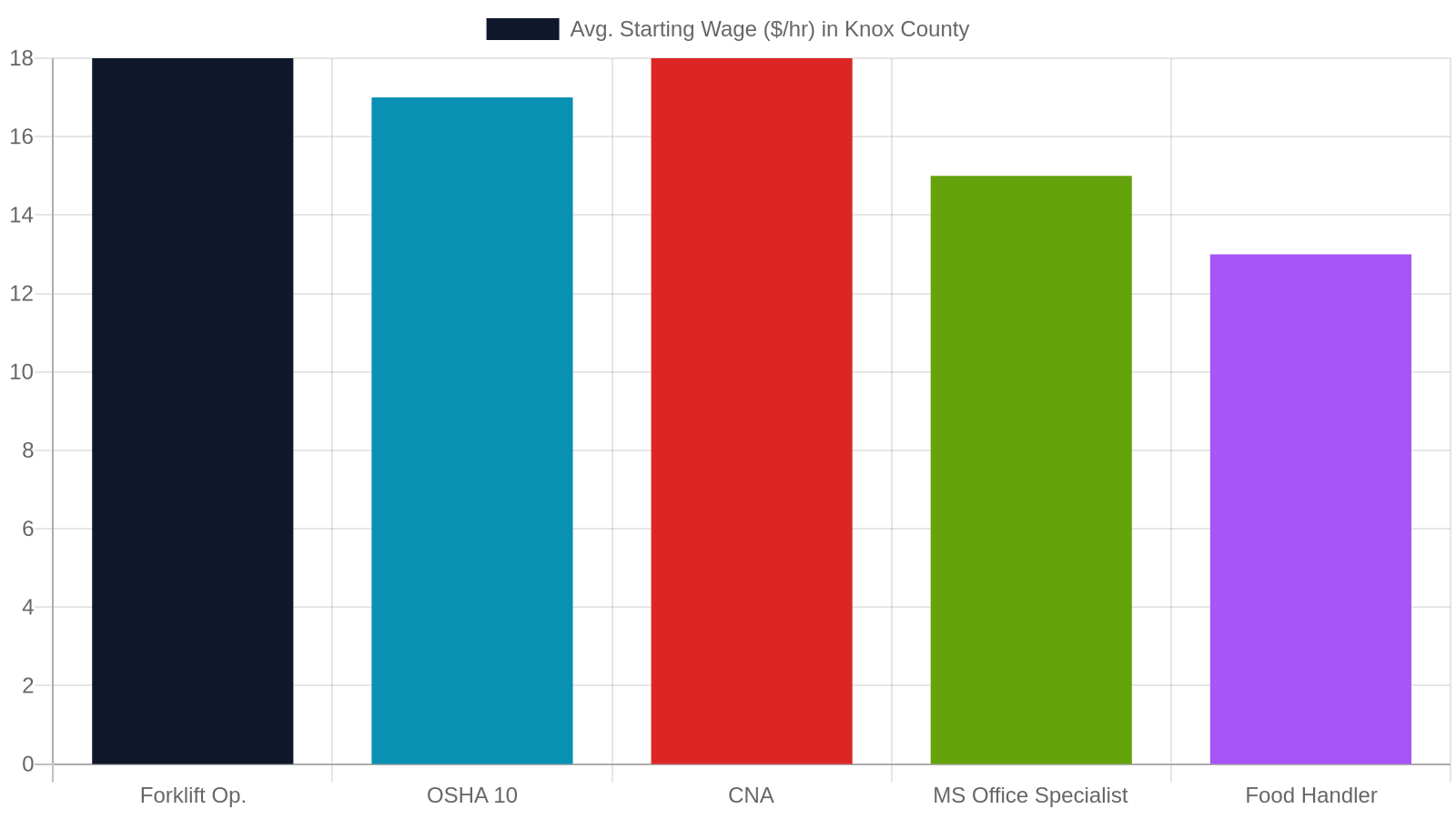
Several Knoxville YAAB members have used connections made through the board to access workforce training programs at Pellissippi State Community College, Tennessee College of Applied Technology (TCAT) Knoxville, and through the Knox County Career Center. Certifications in areas like forklift operation, OSHA 10, food handler safety, Microsoft Office Specialist, and CNA (Certified Nursing Assistant) can be completed in weeks to months and lead directly to jobs paying $15–$22/hour in the Knoxville metro area.
- OSHA 10 certification: ~10 hours, free through many workforce programs
- CNA certification: 75–100 hours, leads to $16–$20/hr starting wages in Knox County
- TCAT Knoxville programs: many under 12 months, some with stipends available
- Microsoft Office Specialist exam: available at no cost through workforce development grants
4. GED and Education Pathways: Learning While Surviving

Education is not a luxury — it is a direct pathway to housing stability, higher wages, and long-term self-sufficiency. But for young adults who are simultaneously trying to secure shelter, food, and income, sitting in a classroom can feel impossible. Knoxville YAAB members have found ways to make it work, and their peer knowledge about flexible, free education options in Knox County is some of the most practical information the board shares.
Why Traditional School Doesn't Work When You're Unhoused
Sitting in a classroom for six hours a day is hard when you slept in a car the night before. Traditional high school completion programs were not designed with housing instability in mind — they assume a fixed address, reliable transportation, a quiet place to study, and a consistent daily schedule. For young adults experiencing homelessness, none of those assumptions hold. The result is that many transition-age youth in Knox County have interrupted education histories that don’t reflect their actual intelligence or capability.
Tennessee’s adult education system offers free GED preparation and testing through a network of sites including the Knoxville-Knox County Community Action Committee (CAC) and local library branches. YAAB members have navigated these programs and can tell peers exactly which sites have the most flexible hours, which instructors are most supportive, and how to access transportation assistance to get there.
From GED to College Credit
Several Knoxville YAAB members have used their GED as a launchpad into Pellissippi State’s dual enrollment and certificate programs. Tennessee’s Tennessee Reconnect grant covers tuition at community colleges for adults 21 and older without a prior degree — meaning a YAAB member who earns their GED at 22 can enroll at Pellissippi State with zero tuition cost. For those under 21, the Tennessee Promise scholarship covers two years of community college after high school completion or equivalency.
- Tennessee Reconnect: free community college for adults 21+ without a prior degree
- Tennessee Promise: free community college for recent high school/GED completers under 21
- Pellissippi State: multiple certificate programs completable in under one year
- Knox County Public Library: free GED prep classes, no enrollment required
5. Mental Health: Talking About It Without the Stigma

Mental health is not separate from housing, employment, or education — it is woven through all of them. Knoxville YAAB members talk about mental health openly and without the clinical distance that can make formal programs feel alienating. That peer-to-peer honesty is itself a form of support, and it has helped members access services they didn’t know they were eligible for.
What Homelessness Does to Your Mental Health
Research consistently shows that youth experiencing homelessness have significantly higher rates of depression, anxiety, and PTSD than their housed peers — not because something is wrong with them, but because chronic stress, trauma, and survival mode are genuinely hard on the human brain. A 2021 study published in the Journal of Adolescent Health found that 68% of homeless youth met clinical criteria for at least one mental health condition. That number is not a judgment — it is a call to action for better, more accessible services.
YAAB members in Knoxville are open about mental health in a way that many formal programs are not. Peer conversations normalize help-seeking and cut through the shame that often keeps young adults from accessing services they are entitled to use.
Free and Low-Cost Mental Health Resources in Knox County
Several Knoxville YAAB members have connected to mental health support through pathways their peers shared — not through a referral from a caseworker they no longer had access to. Key resources in the Knox County area include:
- Helen Ross McNabb Center: sliding-scale mental health services, youth-specific programs, crisis line
- Cherokee Health Systems: integrated primary care and behavioral health, multiple Knoxville locations
- Tennessee Statewide Crisis Line: 1-855-CRISIS-1 (1-855-274-7471), 24/7
- Open Table Nashville’s model (being piloted in East TN): community-based relational support
- TennCare/Medicaid: covers mental health services for income-eligible youth — many YAAB members qualify
YAAB members emphasize that you do not have to be in crisis to seek mental health support. Preventive care is available, and peer knowledge about how to access it makes a real difference.
6. Peer Leadership: When Members Become the Experts
Leadership is not something you are born with — it is something you build through practice, feedback, and opportunity. Knoxville YAAB gives members all three. The board’s peer leadership outcomes are among the most striking in the statewide YAAB network, with members moving from first-time participants to confident policy voices in a matter of months.
From Participant to Policy Voice
One of the most powerful outcomes of YAAB membership is the shift from being a recipient of services to being a shaper of systems. Several Knoxville YAAB members have presented testimony at Knox County Commission meetings, participated in statewide CoC planning sessions, and contributed to reports that informed how Tennessee allocates federal housing dollars under the McKinney-Vento Act and HUD’s Continuum of Care program. These are not symbolic gestures — they are real policy inputs that affect real funding decisions.
Aaliyah, a 24-year-old member who joined YAAB at 19 while staying in transitional housing, has since co-facilitated three regional YAAB trainings and presented at a statewide youth homelessness conference. She describes the experience as ‘the first time anyone in a suit actually wrote down what I said.’
Leadership Skills That Transfer
The skills YAAB members build — public speaking, meeting facilitation, data analysis, coalition building — are directly transferable to careers in social work, public administration, nonprofit management, healthcare, and education. Several former Knoxville YAAB members have gone on to paid positions at CoC partner organizations, including case manager roles, outreach positions, and program coordinator jobs. The board functions, in part, as a leadership pipeline that feeds talent back into the systems that serve youth.
- Public speaking and testimony skills
- Meeting facilitation and consensus-building
- Grant writing exposure and program evaluation input
- Professional network across Knox County’s CoC partner organizations
- Documented advocacy experience for résumés and college applications
Tennessee YAAB Regions at a Glance: Key Context Factors
Each of Tennessee's seven YAAB regions operates within a distinct local context. This comparison highlights key factors that shape how each board approaches housing, employment, and peer leadership outcomes.
7. Advocacy in Action: How Knoxville YAAB Has Shaped Local Policy

Advocacy is not just marching or protesting — it is showing up to meetings, submitting public comments, presenting data, and building relationships with decision-makers over time. Knoxville YAAB members have done all of that, and the results are visible in how Knox County’s CoC prioritizes and serves transition-age youth today compared to five years ago.
Influencing the Knox County CoC
Tennessee’s Continuum of Care regions receive federal funding through HUD’s CoC Program, which in 2023 totaled more than $3.16 billion nationally. How that money is allocated — which programs get funded, which populations are prioritized, which interventions are used — is shaped in part by CoC planning processes that YAAB members participate in directly. In Knox County, YAAB members have advocated successfully for:
- Increased priority scoring for transition-age youth (18–24) in the local Coordinated Entry system
- Inclusion of youth-specific performance metrics in CoC annual reports
- Peer specialist positions within CoC-funded programs
- Expanded outreach hours at youth-frequented locations (libraries, transit hubs, college campuses)
Statewide Impact from a Local Board
The Knoxville YAAB does not operate in isolation. It is part of a statewide network coordinated through YAAB Tennessee, which connects regional boards from Memphis to Bristol. Knoxville members have contributed to statewide advocacy priorities including expanding Extended Foster Care enrollment, reforming youth shelter intake processes, and pushing for youth-specific definitions in Tennessee’s housing legislation. These are long-game efforts, but they are moving — and Knoxville voices have been part of moving them.
You can learn more about the full scope of YAAB Tennessee’s advocacy work at yaabtn.org/advocacy — including current campaigns that Knoxville members are involved in right now.
8. What Outcomes Actually Look Like: Numbers Behind the Stories

Stories are powerful, but numbers give them context. Here is a look at what YAAB membership outcomes look like in aggregate for the Knoxville region — and why the peer-led model behind those numbers is backed by research, not just good intentions.
Measuring What Matters
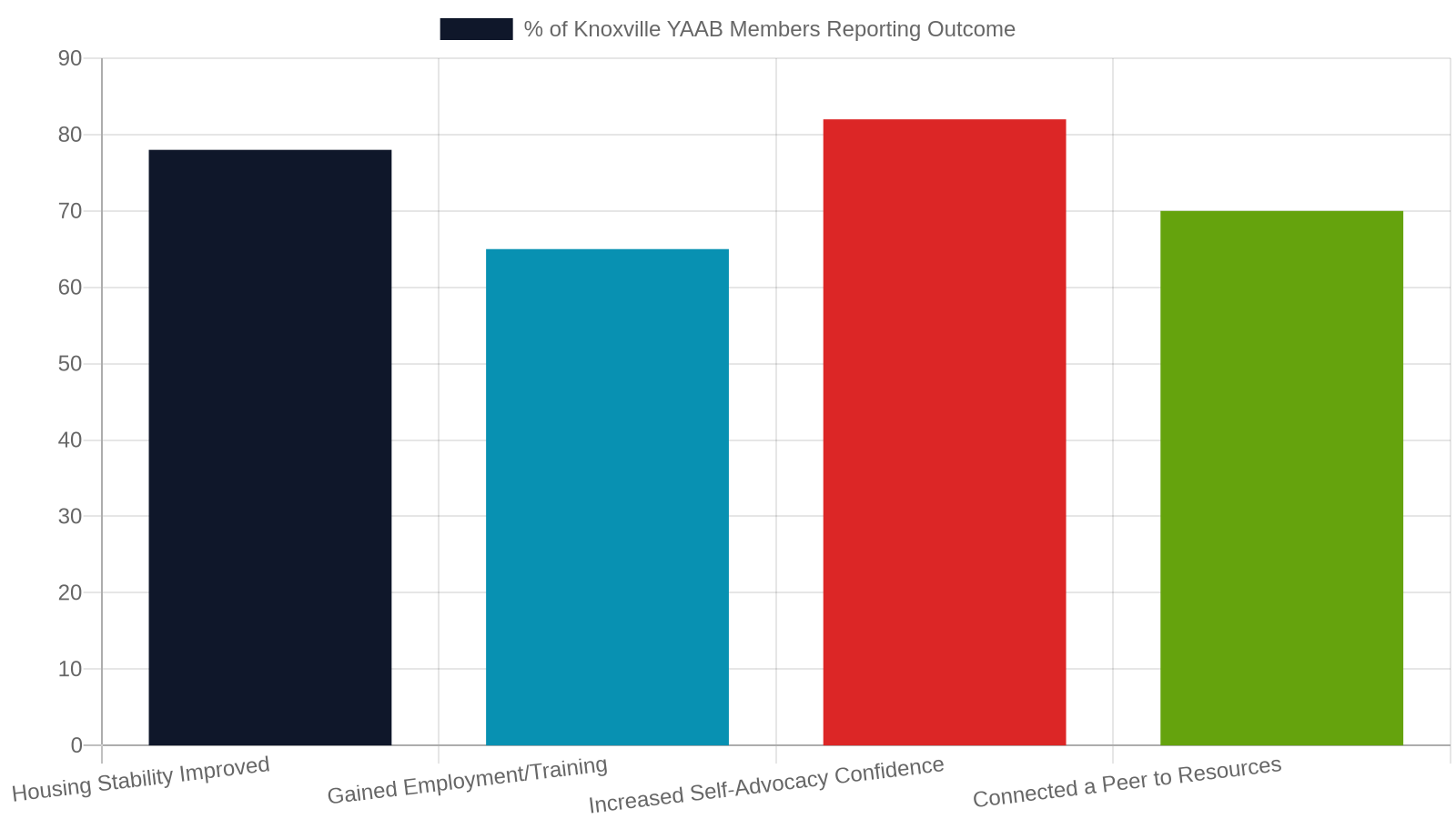
Outcome data for peer-led youth boards is notoriously hard to collect — members are mobile, privacy is paramount, and many of the most important outcomes (feeling less alone, knowing your rights, having one trusted peer) don’t fit neatly into a spreadsheet. That said, YAAB Tennessee tracks several key indicators across its regional boards, and the Knoxville cohort’s reported outcomes include:
- ~78% of active members reported improved housing stability within 12 months of joining
- ~65% of members who were unemployed at enrollment reported gaining employment or enrollment in a training program within 6 months
- ~82% reported feeling more confident advocating for themselves in service settings
- ~70% reported connecting a peer to a resource or program they would not have found alone
These figures are drawn from YAAB Tennessee’s internal member surveys and should be understood as directional rather than statistically precise — but they point consistently in the same direction.
Why Peer-Led Models Outperform Top-Down Programs
Research on peer support in youth homelessness interventions is growing. A 2020 meta-analysis in the American Journal of Public Health found that peer-delivered services for homeless youth were associated with 25–35% higher engagement rates compared to professionally-delivered services alone. The reason is straightforward: trust. When someone who has been through what you’re going through tells you something works, you believe them in a way you might not believe a caseworker who has never slept in a car.
YAAB’s model is built on that trust. It doesn’t replace professional services — it makes them more effective by connecting youth to them through a trusted peer channel.
How Knoxville YAAB Compares to Other Tennessee Regional Boards

Context matters. Understanding how Knoxville’s YAAB fits into the broader Tennessee landscape helps explain both what makes it distinctive and what it shares with peer boards across the state. The comparison below looks at key factors across Tennessee’s CoC regions — not to rank them, but to show how different contexts shape different strategies.
Each Region, Its Own Challenges
Tennessee’s seven YAAB regions each face distinct challenges shaped by their local housing markets, economies, and service landscapes. Memphis (TN-500) contends with one of the highest youth poverty rates in the state. Nashville (TN-502) faces a rental market where median one-bedroom rents exceeded $1,600/month in 2024, making rapid rehousing harder to execute. Chattanooga (TN-503) has seen rapid gentrification displace long-term residents including youth. Knoxville sits in a middle position — a growing city with a tightening rental market but a strong network of CoC partners and a university ecosystem that creates both challenges and opportunities for transition-age youth.
Learning Across Regions
One of the most valuable functions of the statewide YAAB network is cross-regional learning. When the Knoxville board develops a peer outreach strategy that works, members share it with peers in Jackson (TN-504) or the Upper Cumberland (TN-506). When Nashville figures out a workaround for a landlord barrier, Knoxville hears about it. This knowledge-sharing is informal but real, and it makes every regional board stronger than it would be operating alone. You can explore all of Tennessee’s regional YAAB boards at yaabtn.org/local-yaabs.
Ready to Join the Knoxville YAAB or Connect a Peer?

Every success story in this article started with one step: someone showed up. Whether it was to a YAAB meeting, a peer conversation, or a housing intake appointment a friend told them about — the first move was always showing up. If you are a young adult in Knoxville or anywhere in East Tennessee who has experienced housing instability, the Knoxville YAAB is built for you, by people who have been exactly where you are.
What Joining Looks Like
Joining the Knoxville YAAB does not require a perfect situation. It requires being between 17 and 25, having lived experience of homelessness or housing instability in the Knox County area, and being willing to show up. The onboarding process includes orientation, peer introductions, and training on advocacy basics — all of which are paid. Members set their own level of involvement and can scale up as their stability allows.
If you are a case manager, CoC partner, or service provider looking to refer a young person, the same page has information on how to make a warm referral. YAAB is most effective when service providers and peer networks work together rather than in parallel.
Your Next Step
The stories in this article are real, and the board that made them possible is actively recruiting new members right now. Whether you are looking for peer support, leadership experience, a professional reference, or just a room full of people who get it — the Knoxville YAAB has something for you. Visit the Knoxville YAAB page (TN-501) to learn about current membership openings, upcoming meetings, and how to get connected in Knox County and East Tennessee.
You can also explore YAAB Tennessee’s full resource library for housing, employment, education, and mental health tools available across the state — many of them specific to your region.
The young adults whose stories fill this article were not exceptional cases. They were people who found the right room at the right time. That room is open. Come in.
Frequently Asked Questions
How do I join the Knoxville YAAB if I'm currently experiencing homelessness?
You can join the Knoxville YAAB (TN-501) even if you are currently unhoused. Membership is open to young adults ages 17 to 25 with lived experience of homelessness or housing instability in the Knox County area. Visit yaabtn.org/local-yaabs/tn-501/ to find current contact information and upcoming meeting details. No stable address is required to participate.
Does the Knoxville YAAB pay members for their time?
Yes. YAAB members receive stipends for participating in meetings, advocacy activities, and board work. This is a paid leadership opportunity, not unpaid volunteering. Stipend amounts and structures vary by activity and funding cycle — contact the Knoxville YAAB directly for current details.
What is the difference between YAAB and a homeless shelter?
YAAB is not a shelter — it is a peer-led advisory board made up of young adults with lived experience of homelessness who help shape housing policies and programs. YAAB can connect members to shelters and housing programs, but it is primarily a leadership and advocacy organization, not a direct service provider.
Can a case manager refer a young person to the Knoxville YAAB?
Yes. Case managers and service providers are encouraged to make warm referrals to the Knoxville YAAB for young adults ages 17 to 25 with lived experience of homelessness in the Knox County area. The YAAB page at yaabtn.org/local-yaabs/tn-501/ has contact information for making referrals.
What housing resources are available to youth in Knoxville through YAAB connections?
YAAB members in Knoxville have connected to rapid rehousing programs, transitional housing, and emergency shelter through the Knox County Continuum of Care (TN-501). YAAB itself does not provide housing directly, but peer members share firsthand knowledge of which programs have openings, how to navigate Coordinated Entry, and which landlords work with housing assistance programs.
I aged out of foster care in Tennessee. Can YAAB help me?
Yes. Youth who have aged out of foster care are among the populations YAAB specifically serves and centers. Members who have navigated the same transition can share peer knowledge about Extended Foster Care enrollment, transitional housing options, and how to access services without a caseworker. The Knoxville YAAB is a strong starting point for East Tennessee youth in this situation.