Quick answer: Tennessee young adults ages 17 to 25 who have experienced homelessness or housing instability have real power to advocate for better mental health services inside housing programs. You can share your story with Continuum of Care leaders, push for trauma-informed care standards, join a local Youth Action Board (YAAB), and use policy tools like public comment periods and CoC planning meetings. Across Tennessee — from Memphis to Knoxville — advocacy by young people with lived experience is already changing how programs are designed and funded. This guide walks you through exactly how to do it.
Why Mental Health and Housing Are Impossible to Separate

Mental health and stable housing are not two separate problems — they’re two sides of the same coin. For young adults ages 17 to 25 across Tennessee, the connection between where you sleep and how you feel is not abstract. It is lived every single day. Understanding this link is the first step toward advocating for programs that actually work.
The Cycle That Keeps Too Many Young People Stuck
When you’re sleeping somewhere unsafe or bouncing between couches, your mental health takes a hit. And when your mental health is struggling, holding down a job, keeping an apartment, or navigating paperwork feels impossible. This isn’t a personal failure — it’s a documented cycle. Research from the Substance Abuse and Mental Health Services Administration (SAMHSA) shows that approximately 30% of transition-age youth experiencing homelessness also live with a serious mental health condition, compared to roughly 5% of the general youth population.
But here’s the thing: housing programs in Tennessee aren’t always built with that reality in mind. Some programs focus almost entirely on getting a roof overhead without asking what mental health supports someone needs to stay housed. That’s the gap advocates — including you — can help close.
What 'Mental Health Services in Housing' Actually Means
Mental health services in housing programs can look like a lot of different things. At the most basic level, it means a case manager who is trained to recognize signs of trauma, anxiety, or depression — not just check boxes on a lease application. It can also mean:
- On-site or co-located therapy and counseling
- Connections to community mental health centers
- Peer support specialists with lived experience
- Crisis intervention that doesn’t automatically involve police
- Trauma-informed care training for all staff
In Tennessee, programs funded through the Continuum of Care (CoC) are required to follow certain federal guidelines, but the quality and availability of mental health integration varies enormously from region to region. That’s where advocacy makes a measurable difference.
Know Your Rights: What Tennessee Housing Programs Are Supposed to Provide

Before you can advocate for change, it helps to know what the rules already say — because sometimes the problem isn’t that protections don’t exist, it’s that programs aren’t following them. Understanding your federal and state-level rights gives you a real foundation to stand on when you speak up.
Federal Protections That Apply to You Right Now
If you’re accessing a housing program that receives federal funding — which includes most CoC-funded programs in Tennessee — you have rights. The Fair Housing Act prohibits discrimination based on disability, which includes mental health conditions. The Americans with Disabilities Act (ADA) requires reasonable accommodations, meaning a program must adjust its rules or services to meet your needs if you have a documented mental health condition.
What does that look like in practice? If a program has a strict curfew that conflicts with your outpatient therapy schedule, you can request a reasonable accommodation in writing. If a program refuses to provide you access to mental health resources it offers other residents, that may be a civil rights violation. You don’t have to accept a ‘no’ as a final answer.
Tennessee-Specific Standards and the CoC Framework
Tennessee’s eight Continuum of Care regions — including Memphis/Shelby County (TN-500), Nashville/Davidson County (TN-502), Knoxville/Knox County (TN-507), and Chattanooga/Hamilton County (TN-503) — each receive federal HUD funding and are required to submit annual plans that address the needs of transition-age youth. These plans must include strategies for connecting youth to mental health services.
The Tennessee Department of Mental Health and Substance Abuse Services (TDMHSAS) also sets standards for community mental health centers across the state. Young adults are entitled to access these services regardless of insurance status — sliding-scale fees and TennCare enrollment assistance are available. Knowing these frameworks exist gives you a foundation for asking hard questions when programs fall short.
How to Find and Join a Local YAAB in Tennessee

One of the most powerful things you can do as a young adult in Tennessee is join a group of peers who are already at the table. The Youth Action Board gives you that seat — and it’s specifically designed for people with your experience. Here’s how to find your regional chapter and what to expect when you get involved.
What the Youth Action Board Actually Does
The Youth Action Board (YAAB) of Tennessee is a statewide network of young adults ages 17 to 25 who have lived experience of homelessness or housing instability. YAAB members don’t just receive services — they shape them. Members advise local CoC leaders, provide input on funding decisions, and advocate directly to state legislators and program directors. When a housing program in Nashville adds a peer support specialist or a shelter in Knoxville changes its intake process to be more trauma-informed, there’s a good chance a YAAB member pushed for that.
YAAB is organized regionally, so there’s a local board near you no matter where in Tennessee you live. Members receive leadership training, stipends for their time, and connections to a statewide community of peers who get it.
Finding Your Regional YAAB
Tennessee’s YAAB network spans all eight CoC regions. Here’s a quick map of where local YAABs operate:
- Memphis/Shelby County (TN-500): Serving the greater Memphis area and surrounding counties
- Nashville/Davidson County (TN-502): Serving Middle Tennessee’s urban core
- Chattanooga/Hamilton County (TN-503): Serving Southeast Tennessee
- Knoxville/Knox County (TN-507): Serving East Tennessee
- Jackson/West Tennessee (TN-501), Upper Cumberland (TN-504), Northeast TN (TN-506, TN-509): Serving rural and smaller-city communities
You can explore all local YAAB chapters and find the one closest to you by visiting the local YAABs page on the YAAB Tennessee website. Joining is free, and your lived experience is exactly the qualification that matters most.
Using Your Story as an Advocacy Tool (Without Giving Up Your Privacy)

Your experience of navigating housing instability and mental health challenges is not just your personal history — it is evidence. It is data. And in the right setting, it can move decision-makers in ways that reports and statistics alone cannot. This section is about how to use your story strategically and safely.
Why Lived Experience Is the Most Powerful Evidence
Policy makers and program directors respond to data — but they remember stories. When a young adult stands up at a CoC planning meeting and describes what it felt like to be turned away from a shelter because of a mental health crisis, that moment changes the room in a way a spreadsheet never can. Research from the National Alliance to End Homelessness confirms that youth-led advocacy that centers lived experience is among the most effective drivers of policy change in housing programs.
Your story doesn’t have to be dramatic or complete. You don’t have to share everything. The goal is to connect your experience to a specific gap in services — and then name what would have helped. That’s advocacy. That’s evidence.
How to Share Your Story Safely
Sharing personal experience in public settings requires some preparation. Here are practical steps to protect yourself while still making an impact:
- Decide what’s yours to share. You control your narrative. You can describe a system failure without disclosing a diagnosis or specific trauma.
- Use ‘I’ statements tied to policy. Instead of ‘I was traumatized,’ try ‘I was in a program that didn’t have any mental health support, and I want to talk about what that gap cost me.’
- Know your audience. A city council meeting, a CoC planning session, and a media interview each call for a slightly different approach. YAAB members get coaching on all of these.
- Debrief afterward. Sharing hard experiences can be emotionally draining. Have a trusted person or peer support contact ready before you speak.
5 Concrete Advocacy Actions You Can Take This Month

Advocacy doesn’t have to mean marching or making headlines. Some of the most effective advocacy happens in meetings, comment boxes, and one-on-one conversations. Here are five actions — ranging from immediate to longer-term — that any young adult in Tennessee can take to push for better mental health services in housing programs.
Actions That Work at the Local Level
1. Attend a CoC Planning Meeting. Every Continuum of Care in Tennessee holds public meetings where funding priorities and program standards are discussed. These meetings are open to the public, and your voice belongs there. Contact your local CoC lead agency to find out the schedule — many now offer virtual options, making it easier to participate from anywhere in the state.
2. Submit a Public Comment. When HUD or Tennessee state agencies open comment periods on housing plans, those comments are read and counted. A two-paragraph personal statement about what mental health services are missing from programs you’ve used carries real weight. YAAB can help you draft and submit comments effectively.
3. Request a Meeting with Your Case Manager’s Supervisor. If you’re currently in a housing program and mental health services are inadequate, you have the right to escalate. Ask for a meeting with program leadership and come with specific requests — not just complaints, but solutions.
Actions That Build Long-Term Power
4. Connect with a State Legislator’s Office. Tennessee legislators on the Health and Human Services committees make decisions that directly affect mental health funding in housing programs. You can request a meeting, send a written testimony, or show up during a committee hearing. YAAB’s statewide advocacy team can connect you with the right contacts and help you prepare.
5. Build Peer-to-Peer Networks. Sometimes the most powerful advocacy starts not in a government building but in a group chat. Connecting with other young adults who have similar experiences — through YAAB, through a shelter, through social media — builds the collective voice that makes individual stories into a movement. Peer networks also help identify patterns: if five people in the same program all report the same gap in mental health services, that’s a systemic issue, not a personal one.
What Trauma-Informed Care Looks Like — and How to Ask for It

Trauma-informed care is one of the most important — and most frequently missing — elements in housing programs for young adults. Understanding what it means, what it looks like in practice, and how to ask for it by name gives you a concrete advocacy target that is both achievable and measurable.
Defining Trauma-Informed Care in Plain Language
Trauma-informed care (TIC) is an approach that recognizes how widespread trauma is — and builds services around that reality instead of ignoring it. In a housing program, trauma-informed care means staff don’t respond to a young person’s anger or withdrawal with punishment, but with curiosity and support. It means intake processes don’t require you to re-tell your worst experiences to five different people. It means physical spaces feel safe, not institutional.
SAMHSA identifies six core principles of trauma-informed care: safety, trustworthiness, peer support, collaboration, empowerment, and cultural sensitivity. These aren’t aspirational — they’re a framework you can use to evaluate any program you’re in or advocating about. Ask directly: ‘How does your program apply trauma-informed care principles?’ A good program will have a real answer.
How to Push for TIC Standards in Your Local Programs
If a housing program you’re connected to isn’t using trauma-informed practices, here’s how to advocate for change:
- Name the gap specifically. ‘Staff don’t have trauma-informed training’ is more actionable than ‘the staff are mean.’
- Reference federal guidance. HUD’s CoC program regulations encourage trauma-informed approaches, and SAMHSA provides free training resources for providers. You can literally hand a program director a link to free staff training.
- Ask for a policy review. Request that the program’s written policies be reviewed against TIC standards — this is a reasonable ask that puts the issue on record.
- Bring in YAAB. YAAB members have experience raising these issues with CoC leaders and can help amplify your request through official channels.
Mental Health Resources Available to Tennessee Young Adults Right Now

Advocacy is a long game — but your mental health needs support right now. Here is a practical snapshot of the resources available to young adults across Tennessee, from crisis lines to peer support programs to insurance enrollment help. Knowing what exists is the first step to accessing it and advocating for others to have the same access.
Statewide Crisis and Counseling Resources
You don’t have to wait for a program to change before you get support. These resources are available to young adults across Tennessee right now:
- 988 Suicide and Crisis Lifeline: Call or text 988 — available 24/7, free, and confidential. Tennessee has dedicated crisis centers in multiple regions.
- Tennessee Crisis Services: The state operates mobile crisis teams in many counties that can come to you — no police involvement required in most cases. Call 855-274-7471.
- TennCare: If you’re uninsured and under 26, you may qualify for TennCare, which covers mental health services. Enrollment assistance is available through community health centers statewide.
- TDMHSAS Community Mental Health Centers: Sliding-scale fee counseling available in all 95 Tennessee counties. Find your nearest center at tn.gov/behavioral-health.
Peer Support and Youth-Specific Programs
Peer support — getting help from someone who has been through similar experiences — is one of the most effective mental health interventions for transition-age youth. In Tennessee, several programs specifically serve young adults:
- Youth Villages: Offers transitional living and mental health support for young adults aging out of foster care across Tennessee.
- Oasis Center (Nashville): Provides mental health counseling, crisis support, and housing services for youth ages 14 to 25 in Middle Tennessee.
- YAAB Peer Networks: YAAB members themselves serve as informal peer supporters — connecting young adults to resources and providing the kind of ‘I’ve been there’ understanding that professional services sometimes can’t.
For a broader list of housing and mental health resources organized by region, visit the YAAB Tennessee resources page.
How Tennessee's CoC Regions Compare on Youth Mental Health Integration

Understanding how different parts of Tennessee are doing — and where the biggest gaps are — helps advocates prioritize their energy and make the case for targeted investment. Here’s a look at the landscape across Tennessee’s CoC regions.
Reading the Landscape Across Eight Regions
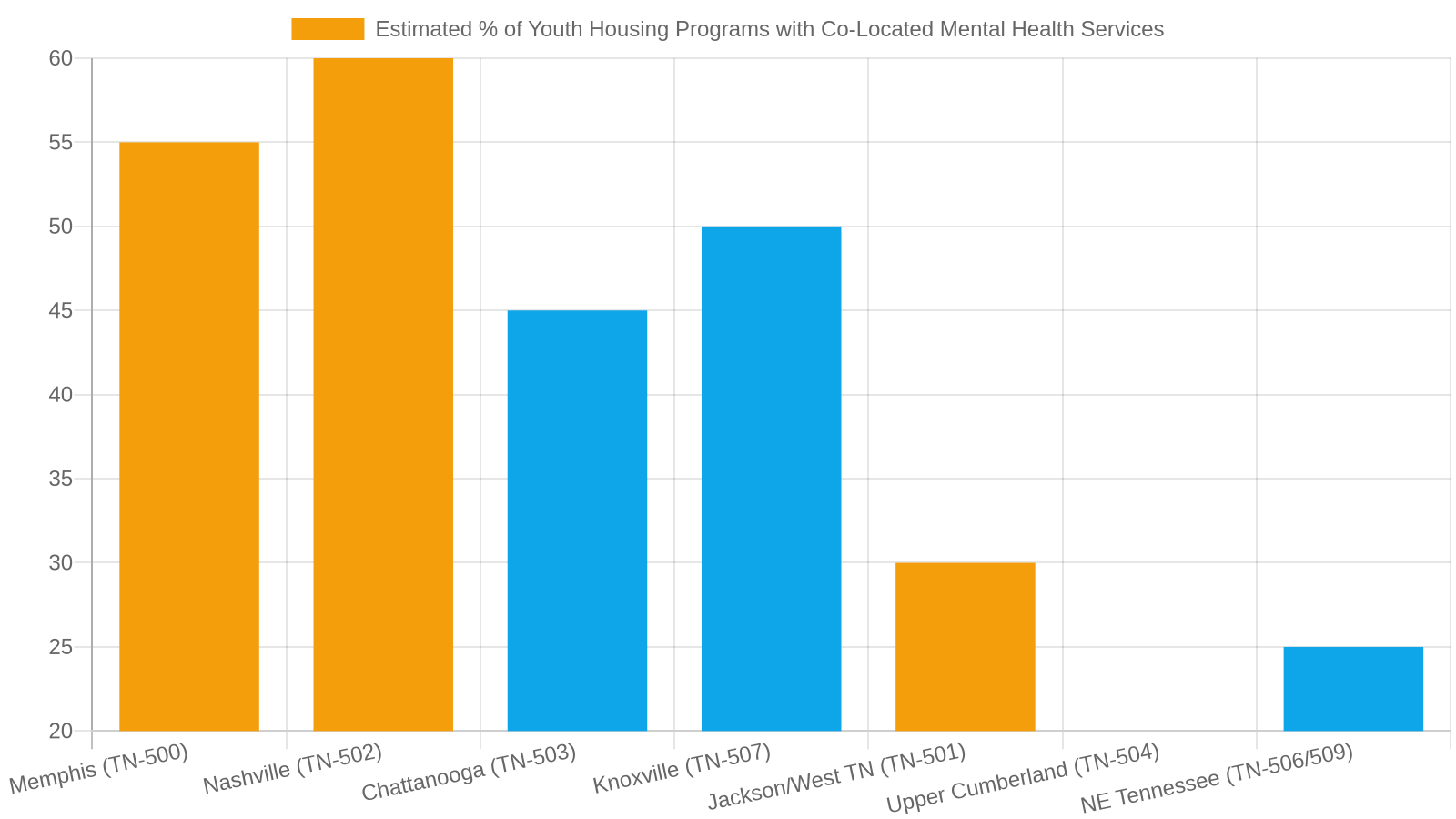
Tennessee’s eight CoC regions vary significantly in how well they integrate mental health services into youth housing programs. Urban regions like Memphis (TN-500) and Nashville (TN-502) generally have more dedicated youth-specific programs and co-located mental health services, partly because of greater funding density and the presence of large anchor institutions like Vanderbilt University Medical Center and Le Bonheur Community Health. Rural regions — including Upper Cumberland (TN-504) and Northeast Tennessee (TN-506, TN-509) — often face provider shortages, with some counties having zero licensed mental health providers accepting TennCare.
This disparity is not inevitable. It’s a policy choice — and it’s one that youth advocates, including YAAB members, are actively challenging through statewide coordination and HUD funding advocacy.
What the Data Tells Us About Youth Homelessness and Mental Health in Tennessee
According to Tennessee’s most recent Point-in-Time (PIT) count data, approximately 1,200 to 1,500 transition-age youth (ages 18 to 24) experience homelessness on any given night in Tennessee — and this figure is widely understood to undercount the true number, since many young people are in hidden homelessness situations (couch surfing, staying in cars, or doubling up). Of those counted, studies suggest up to 40% have an unmet mental health need at the time of their housing crisis. Closing that gap requires both more resources and better integration of the resources that already exist.
Advocacy Approaches Compared: Which Strategy Fits Your Situation?
Not every advocacy approach works for every person or every moment. This table compares the most common strategies for pushing for better mental health services in housing programs, so you can choose the one that fits where you are right now.
How to Navigate Advocacy When You're Also Dealing with Your Own Stuff

Advocacy is important work — but it’s also work, and it can be hard. This section is about how to show up for the cause without burning yourself out, and how to make sure your own mental health stays part of the equation even as you fight for others to have better access to support.
You Don't Have to Be 'Healed' to Advocate
One of the biggest myths about advocacy is that you have to have your life fully together before you can speak up for others. That’s not true — and it’s especially not true in the world of youth homelessness and mental health. Some of the most effective advocates in Tennessee’s YAAB network are young adults who are still navigating housing instability, still in therapy, still figuring things out. Your current experience is not a disqualifier. It’s your credential.
That said, advocacy can be emotionally demanding. Sharing your story, sitting in rooms with people who have power over your life, and fighting for change that feels urgent — all of that takes a toll. It’s important to pace yourself and build in recovery time.
Building Your Own Support System While You Advocate
Sustainable advocacy requires a support system. Here are practical ways to build one:
- Connect with a peer advocate or mentor inside YAAB who has navigated similar challenges and can offer guidance without judgment.
- Set boundaries on what you share and when. You are not obligated to tell your full story every time you show up. Advocacy can be as simple as asking a question at a meeting.
- Use YAAB’s built-in support structures. Regional YAAB chapters provide debriefing spaces, peer check-ins, and connections to mental health resources specifically for members who are doing advocacy work.
- Celebrate small wins. A program adding a peer support specialist, a CoC updating its intake process, a legislator agreeing to a meeting — these are real victories. Mark them.
What Case Managers and CoC Partners Can Do to Support Youth Advocates

Changing systems requires people inside those systems to be willing to change. This section is for the case managers, CoC partners, and service providers who work alongside young adults — because youth advocacy is most powerful when the institutions around it are ready to respond.
Creating Conditions Where Youth Voice Is Real, Not Performative
For service providers, CoC staff, and case managers reading this: youth advocacy only works if the systems around it are set up to actually listen. That means more than inviting a young person to sit on a committee. It means paying young advocates for their time (stipends are standard practice in effective YAAB partnerships), providing transportation or virtual access, giving advance notice of agendas so participants can prepare, and following up when young people’s input is — or isn’t — incorporated into decisions.
The National Alliance to End Homelessness recommends that CoC boards include at least one seat reserved for a person with lived experience of homelessness — and that this person receive full voting rights, not just advisory status. Tennessee CoCs that have implemented this model report stronger youth engagement and more responsive program design.
Practical Steps for Providers Who Want to Do Better
If you’re a case manager or program director who wants to strengthen mental health integration and youth advocacy in your organization, here are concrete starting points:
- Complete SAMHSA’s free Trauma-Informed Care online training (available at samhsa.gov)
- Partner formally with your regional YAAB chapter — reach out through the YAAB Tennessee about page to start a conversation
- Conduct an annual youth satisfaction survey with questions specifically about mental health service access
- Review your program’s grievance policy to ensure it is accessible to young adults with varying literacy levels and mental health challenges
- Advocate within your own organization for a dedicated peer support specialist role, funded through CoC or state grants
Measuring Progress: How to Know If Your Advocacy Is Working

Effective advocacy isn’t just about showing up — it’s about being able to show that things changed because you showed up. Learning to set measurable goals and track progress turns individual actions into a documented record of impact, which is exactly what funders, legislators, and program directors respond to.
Setting Specific, Trackable Goals
Advocacy without measurement is just noise. If you want to know whether your efforts are making a difference, you need to define what ‘better’ looks like before you start pushing for it. In the context of mental health services in housing programs, trackable goals might include:
- A specific program adds a licensed counselor or peer support specialist within 12 months
- A CoC updates its written standards to include trauma-informed care requirements by the next annual plan submission
- Wait times for mental health referrals in a housing program drop from 6 weeks to 2 weeks
- A shelter’s written grievance policy is revised to include a mental health accommodation request process
These are concrete, verifiable outcomes. When you achieve one, document it. That documentation becomes evidence for the next ask.
Using Data to Sustain the Momentum
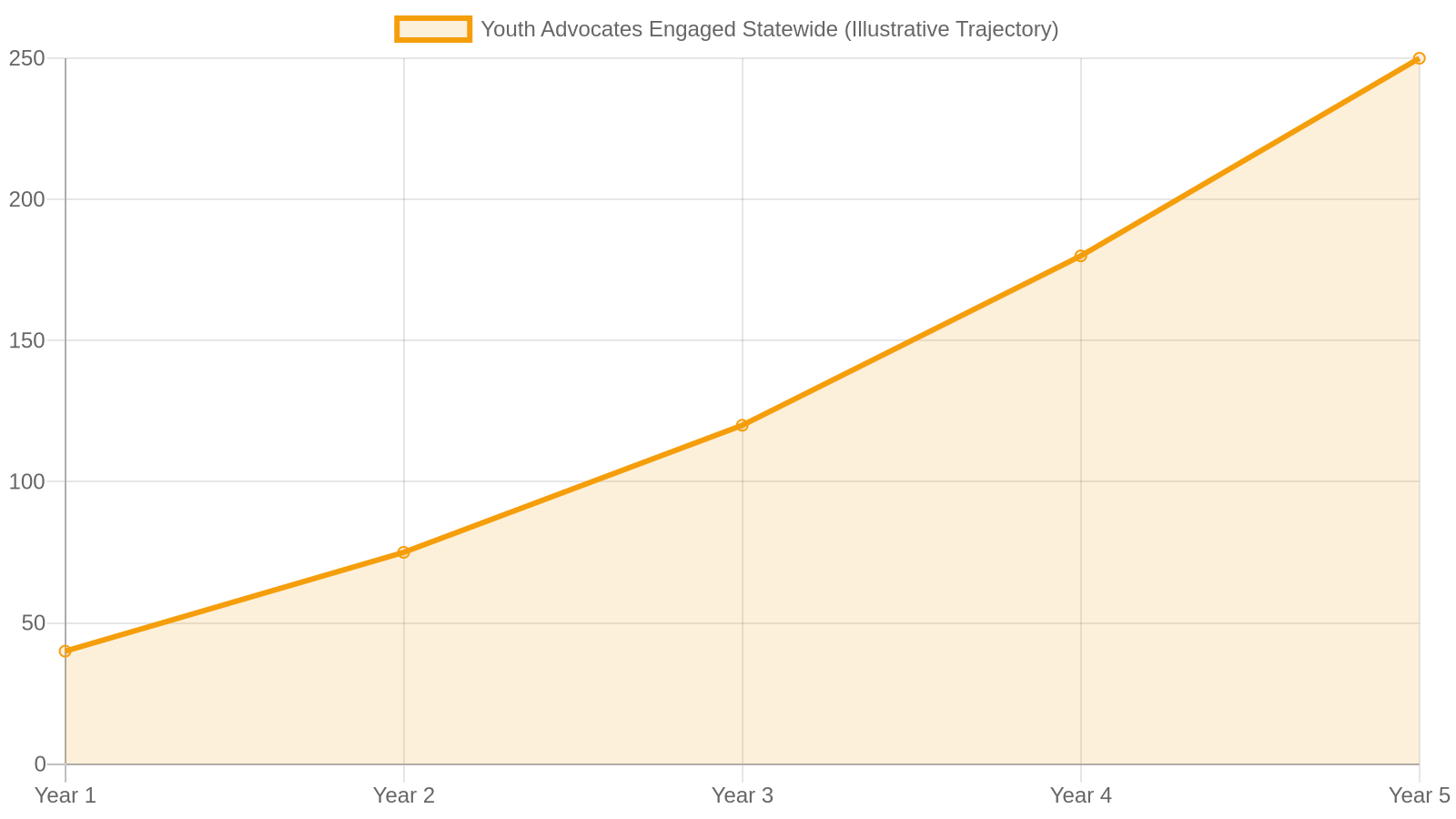
Once you’ve established baseline data — how many programs offer co-located mental health services, what the average wait time for a referral is, how many young adults in a given program have accessed mental health support in the past year — you can track change over time. YAAB members across Tennessee are building this kind of data infrastructure through their regional advocacy work.
You can also use publicly available data: HUD’s annual CoC competition results show which programs are funded and at what level. Tennessee’s TDMHSAS publishes annual reports on mental health service utilization. The Point-in-Time count data, released each spring, gives a snapshot of who is experiencing homelessness and what their needs are. Learning to read these documents — and to point out what they reveal about gaps — is a powerful advocacy skill.
Ready to Get Involved? Your Next Step Starts Here

Everything in this guide points toward one thing: action. And action is most effective when it’s collective. Here’s how to take your first step — or your next one — toward making Tennessee’s housing programs work better for every young adult who needs mental health support.
You Already Have What It Takes
You don’t need a degree, a title, or a perfect story to be an advocate. You need your experience, your voice, and a willingness to show up. Tennessee’s housing and mental health systems are not fixed — they are shaped by the people who engage with them. And right now, the most important voices missing from too many planning tables are the young adults who actually use these programs.
Whether you’re currently in a housing program, recently stabilized, or supporting a friend who is navigating the system, you have something to contribute. YAAB exists to channel that contribution into real change — at the program level, the CoC level, and the state policy level.
Connect with YAAB Tennessee Today
The single most powerful step you can take right now is to connect with the Youth Action Board. YAAB is built by and for young adults like you — people who have navigated housing instability and mental health challenges and who refuse to let those experiences be the end of their story. Members across Tennessee are already shaping the policies and programs that will affect the next generation of young adults who need support.
Visit YAAB Tennessee’s homepage to learn more about who we are and what we do. When you’re ready to take the next step, head to the join YAAB page to find out how to get involved in your region. From Memphis to Knoxville, from Chattanooga to the Upper Cumberland, there is a seat at the table waiting for you — and the mental health services that Tennessee’s young adults deserve are worth fighting for together.
Frequently Asked Questions
How do I join the Youth Action Board in Tennessee?
Visit yaabtn.org/join to find out how to connect with your regional YAAB chapter. YAAB is open to young adults ages 17 to 25 who have lived experience of homelessness or housing instability. No prior advocacy experience is required — your experience is the qualification.
What mental health services am I entitled to in a Tennessee housing program?
If you're in a federally funded housing program, the Fair Housing Act and ADA entitle you to reasonable accommodations for mental health conditions. You may also be eligible for TennCare, which covers mental health services, and can access sliding-scale counseling through TDMHSAS community mental health centers in all 95 Tennessee counties.
What is trauma-informed care and how do I ask for it?
Trauma-informed care means a program recognizes how trauma affects behavior and builds services around safety, trust, and empowerment rather than punishment. You can ask a program directly: 'What trauma-informed care practices does your staff use?' and request that staff complete SAMHSA's free trauma-informed care training if they haven't.
Can I advocate for better mental health services even if I'm still dealing with my own housing instability?
Absolutely. You don't need to have your situation fully resolved to advocate. Many of the most effective YAAB members are young adults who are still navigating challenges. Your current experience is exactly what makes your voice credible and important in policy conversations.
What is a Continuum of Care and why does it matter for mental health services?
A Continuum of Care (CoC) is a regional planning body that coordinates housing and homeless services and applies for federal HUD funding. Tennessee has eight CoC regions. CoC planning meetings are where funding priorities — including mental health service integration — are decided, making them a key advocacy target for young adults.
Where can I find mental health crisis support in Tennessee right now?
Call or text 988 for the Suicide and Crisis Lifeline, available 24/7 and free. For mobile crisis support without police involvement, call Tennessee Crisis Services at 855-274-7471. TennCare enrollment assistance is available through community health centers if you need insurance to access ongoing counseling.