Quick answer: If you're a young adult ages 17 to 25 in Tennessee dealing with housing instability, food insecurity is a real and common challenge — but you have more options than you might think. You can apply for SNAP benefits even without a fixed address, access free meals at food banks across Memphis, Nashville, Knoxville, Chattanooga, and beyond, and tap into campus pantries, community fridges, and youth-specific programs. This guide walks through nine concrete ways to get food on your plate right now, plus how to connect with peers and advocates through YAAB Tennessee who can help you navigate every step.
Why Food Insecurity and Housing Instability Go Hand in Hand for Tennessee Youth
Before diving into specific resources, it helps to understand why food insecurity hits transition-age youth in Tennessee so hard — and why the usual advice often doesn’t apply to your situation. Housing instability doesn’t just mean you don’t have a place to sleep; it means your entire daily routine is disrupted, including how, when, and where you eat.
The Numbers Behind the Crisis
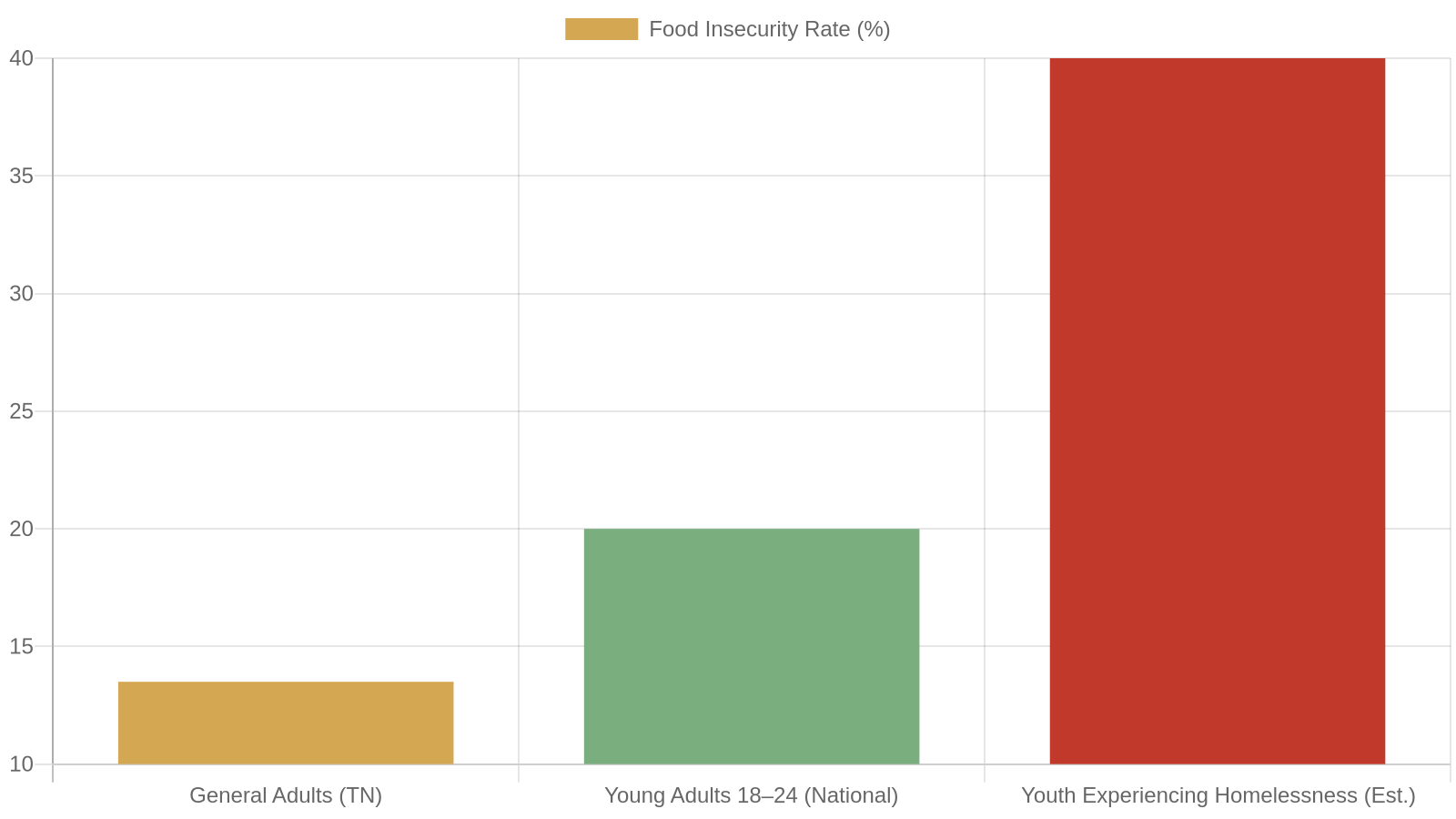
Food insecurity and housing instability are not separate problems — they feed each other. When you’re spending every dollar on a motel room, a couch, or a bus ticket to somewhere safer, groceries become a luxury. A 2023 report by Feeding America found that 1 in 5 young adults ages 18 to 24 experienced food insecurity in the previous year, a rate significantly higher than the general adult population.
In Tennessee specifically, the USDA Economic Research Service estimated that roughly 13.5% of Tennessee households were food insecure as of 2022 — and that figure climbs sharply when you isolate households with no stable housing. Youth experiencing homelessness are estimated to face food insecurity at rates two to three times higher than housed peers of the same age.
Why Standard Solutions Often Miss Transition-Age Youth
Most public food assistance programs were designed with families or elderly adults in mind. Transition-age youth — people ages 17 to 25 — often fall through the cracks because they don’t fit neatly into either category. You might be too old for a youth shelter’s meal program but not yet connected to adult services. You might not know you can apply for SNAP without a permanent address. You might be aging out of foster care with zero knowledge of what benefits you’re entitled to.
That gap is real, and it’s exactly why peer-led networks like the Youth Action Board (YAAB) of Tennessee exist — to make sure young people know their options and can advocate for better systems. Understanding the landscape of food resources is the first step.
1. Apply for SNAP — Even Without a Permanent Address
SNAP is the single largest food assistance program available to you, and it’s almost certainly the most underutilized by transition-age youth in Tennessee. Here’s what you actually need to know to apply — and why the barriers you think exist probably don’t.
You Don't Need a Fixed Address to Qualify
One of the biggest myths about SNAP (Supplemental Nutrition Assistance Program) is that you need a home address to apply. You do not. Tennessee’s Department of Human Services (TDHS) allows applicants experiencing homelessness to use a shelter address, a case manager’s address, or even a P.O. Box as their mailing address on an application. If you’re staying somewhere temporarily — a friend’s couch, a motel, a transitional housing unit — that counts.
In Tennessee, a single adult with no income can receive up to $291 per month in SNAP benefits (as of 2024 federal guidelines). That’s real money for food. The application takes about 30 minutes online at tdhs.tn.gov, and most applicants receive a decision within 30 days — or as few as 7 days if you qualify for expedited processing due to extremely low income.
Special Rules for Youth Ages 17 to 21
If you are between 17 and 21 and were in foster care in Tennessee at age 18 or older, you may be categorically eligible for SNAP without meeting the standard work requirements. Tennessee participates in the Extended Foster Care program, and youth who aged out of care have additional protections under federal law.
For youth ages 18 to 49 who are not in school full-time, the standard SNAP work requirement (80 hours per month of work, training, or school) applies — but there are exemptions for people experiencing homelessness or enrolled in workforce training programs. Ask your caseworker or a TDHS representative specifically about the homeless exemption when you apply. Don’t assume you’re ineligible before you ask.
2. Find a Food Bank in Your Tennessee Region
Tennessee’s food bank network is extensive, and most of it is free, no-questions-asked, and available in every major metro area where YAAB operates. Here’s how to plug in based on where you are in the state.
Regional Food Bank Networks Across Tennessee
Tennessee is served by several major food bank networks, each covering specific regions of the state. You do not need to prove residency or show ID at most food pantry distributions — just show up during distribution hours.
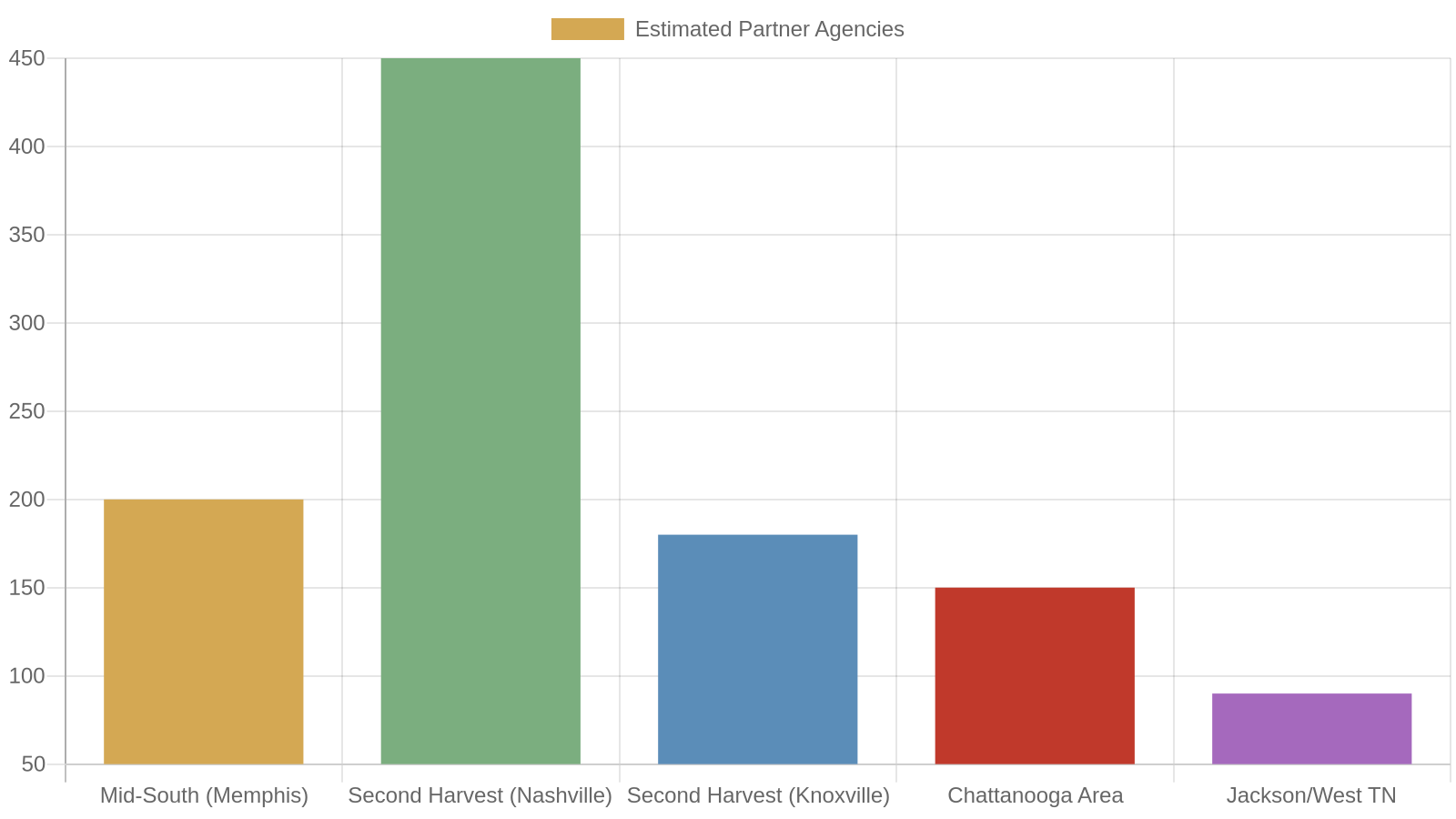
- Mid-South Food Bank — serves Memphis and Shelby County, plus parts of West Tennessee. Over 200 partner agencies. Visit midsouthfoodbank.org for a pantry locator.
- Second Harvest Food Bank of Middle Tennessee — covers Nashville/Davidson and surrounding counties. Operates mobile pantries and a direct-service center on Murfreesboro Road.
- Second Harvest Food Bank of East Tennessee — serves Knoxville/Knox County and the surrounding region. Offers a mobile pantry schedule at secondharvestknox.org.
- Chattanooga Area Food Bank — covers Hamilton County and Southeast Tennessee. Distributes through 150+ partner agencies.
- Regional Food Bank of Jackson/West Tennessee — serves the Jackson metro and surrounding rural counties.
How to Find Same-Day Food Near You
If you need food today, two tools work fast: 211.org (call or text 211) connects you to the nearest open food pantry in real time, anywhere in Tennessee. The Feeding America food bank locator at feedingamerica.org/find-your-local-foodbank also maps the closest distribution to your zip code.
Most food pantries are open to anyone regardless of documentation. Some youth-specific distributions — like those run through YAAB partner organizations — actively welcome transition-age youth and don’t require ID, proof of address, or income verification. If a pantry asks for documentation you don’t have, ask specifically if they have a no-barrier distribution option or can refer you to one nearby.
3. Use Community Fridges and Free Meal Programs

Beyond formal programs, Tennessee’s mutual aid networks have built grassroots food infrastructure that’s specifically designed to be barrier-free. These options are especially useful when you need food outside of standard pantry hours or don’t have documentation on hand.
What Is a Community Fridge?
Community fridges — sometimes called mutual aid fridges — are publicly accessible refrigerators stocked by neighbors, local businesses, and volunteers. They operate on a simple principle: take what you need, leave what you can. No sign-up, no ID, no questions. In Tennessee, community fridges have grown significantly since 2020, with active fridges in Memphis, Nashville, and Knoxville.
To find the nearest community fridge, search “community fridge [your city]” on Instagram or Facebook — most are managed by local mutual aid groups who post updates on stocking times. The website mutualaidhub.org also maintains a national map that includes Tennessee locations.
Free Meal Programs at Shelters and Drop-In Centers
Many youth shelters and drop-in centers in Tennessee serve free meals daily, even if you’re not staying overnight. These include:
- Covenant House Tennessee (Nashville) — serves meals and snacks at their drop-in center for youth ages 18 to 24, no overnight stay required.
- Memphis Youth Villages and partner drop-in sites — offer food support alongside other services.
- KARM (Knox Area Rescue Ministries) in Knoxville — serves thousands of free meals per week and welcomes walk-ins.
- Room in the Inn (Nashville) — operates a day shelter with meal service.
Call ahead or check each organization’s website for current hours, as meal schedules can shift seasonally. The 211 network can also confirm same-day availability.
4. Tap Into Campus Food Pantries If You're in School

Being enrolled in school — even at a community college — opens up a whole additional layer of food support that most students don’t know about. Tennessee’s college campuses have invested heavily in student basic needs programs since 2020, and transition-age youth are exactly who these programs are designed to serve.
Tennessee Colleges With Active Food Pantries
If you’re enrolled — even part-time — at a Tennessee college, university, or community college, there’s a good chance your campus has a free food pantry. These pantries are specifically designed for students experiencing food insecurity and typically require only a student ID.
- University of Tennessee (Knoxville) — Vol Pantry, open to all enrolled students.
- Tennessee State University (Nashville) — Tiger Food Pantry, no income verification required.
- University of Memphis — Tiger Pantry, serves students with same-day pickup.
- Chattanooga State Community College — Campus pantry available to enrolled students.
- Nashville State Community College — food pantry and emergency meal swipe program.
If your campus isn’t listed, check with your student services office — many Tennessee community colleges added pantries between 2020 and 2023, and new ones continue to open.
Emergency Meal Swipes and Dining Hall Access
Some Tennessee campuses offer emergency meal swipe programs — a pool of donated dining hall swipes that any student can request confidentially through the Dean of Students office or a campus food pantry coordinator. This is especially useful if you live on or near campus but have run out of meal plan funds mid-semester.
You typically don’t need to explain your full situation to access emergency swipes — a brief form or email is usually enough. Ask specifically for the emergency meal assistance or student basic needs program by name. These programs exist because campus administrators know food insecurity is real among students, and using them is not something to be ashamed of — it’s exactly what they’re there for.
5. Know Your Rights: WIC, Free School Meals, and Other Federal Programs

Federal nutrition programs exist specifically because lawmakers recognized that food is a basic right. As a transition-age youth in Tennessee, several of these programs apply directly to you — and some you’re automatically entitled to. Here’s what you should know.
WIC for Young Adults Who Are Pregnant or Parenting
If you are pregnant, recently gave birth, or are breastfeeding and between ages 17 and 25, you may qualify for WIC (Women, Infants, and Children) — a federal nutrition program that provides monthly food benefits specifically for nutritious foods like fruits, vegetables, whole grains, dairy, and infant formula. In Tennessee, WIC is administered through the Tennessee Department of Health.
WIC benefits are separate from SNAP and can be used simultaneously. Monthly benefit amounts vary by eligibility category but typically range from $25 to $50 per month in food vouchers plus access to WIC-approved grocery items. To apply, call 1-800-342-3145 or visit tn.gov/health/wic to find your nearest WIC clinic.
Free and Reduced Lunch If You're Still in High School
If you are 17 to 18 and still enrolled in a Tennessee public high school, you are entitled to apply for free or reduced-price school meals through the National School Lunch Program. Income eligibility thresholds for free meals are set at or below 130% of the federal poverty level — for a single-person household, that’s approximately $19,578 per year as of 2024.
Youth experiencing homelessness are automatically eligible for free school meals under the McKinney-Vento Homeless Assistance Act — you do not need to fill out an income form. Simply notify your school’s homeless liaison (every Tennessee public school is required to have one) and your eligibility will be certified immediately. This is a right, not a favor.
6. Access Emergency Food Assistance Through Tennessee's 211 Network

When you don’t know where to start, 211 is the fastest bridge between you and food. It’s not just a hotline — it’s a real-time directory of every food resource in your county, operated by people who know the local landscape.
How 211 Works and What to Ask For
211 is Tennessee’s statewide information and referral service, available 24 hours a day, 7 days a week. You can reach it by calling or texting 211 from any phone — including a borrowed phone or a phone with no active plan (as long as it can make emergency calls). Operators are trained to connect callers with the nearest available food resources, including pantries, meal programs, and emergency food boxes.
When you call, be specific about what you need: say “I need food assistance today” or “I’m looking for a food pantry open right now near [your zip code].” You can also ask about same-day meal programs, community fridges, and whether any youth-specific food resources are available in your area. The 211 database is updated regularly and includes resources that don’t always appear in a Google search.
Emergency Food Boxes Through TDHS
Tennessee’s Department of Human Services administers the Emergency Food Assistance Program (TEFAP), which distributes USDA commodity foods — canned goods, grains, proteins, and sometimes fresh produce — through local partner agencies. These boxes are available to households with incomes at or below 185% of the federal poverty level, which for a single adult is approximately $26,973 per year as of 2024.
TEFAP boxes are distributed at food banks, community centers, and faith organizations across all seven of Tennessee’s Continuum of Care regions. You typically need to provide a name and address (a shelter or transitional housing address qualifies) and sign a brief self-declaration of income. The boxes are free and can be picked up monthly at most distribution sites.
Tennessee Food Security Resources at a Glance
Use this table to quickly compare the main food assistance options available to transition-age youth in Tennessee — including eligibility, documentation required, and how fast you can access benefits.
7. Explore Youth-Specific Meal Programs at Drop-In Centers

Drop-in centers are often the most youth-friendly food access points in Tennessee because they’re built around the reality of your life — not the assumption that you have a stable schedule, a fixed address, or a case manager already in your corner.
What Drop-In Centers Offer Beyond Shelter
Drop-in centers for transition-age youth are designed to be low-barrier spaces where you can access services without committing to a shelter stay or a case management relationship. Many of them serve food — sometimes full meals, sometimes snacks and hygiene items — as a way to build trust and keep young people connected to support.
In Tennessee, drop-in centers with food programming include:
- Oasis Center (Nashville) — serves youth ages 14 to 24 with drop-in services including food, showers, and laundry.
- Memphis Leadership Foundation partner sites — provide food and basic needs support in the Memphis area.
- YWCA Knoxville — offers food support alongside housing and employment services for young women and gender-nonconforming youth.
- Partnership for Families, Children and Adults (Chattanooga) — serves transition-age youth with food and wraparound services.
How to Find the Right Drop-In Center for You
Not every drop-in center serves the same population or offers the same services. Before making a trip, it’s worth calling ahead to confirm hours, age eligibility, and whether food is available that day. Most centers welcome walk-ins during operating hours, but some require a brief intake process on your first visit.
Your local YAAB chapter is one of the best sources for up-to-date information on which drop-in centers are youth-friendly, barrier-free, and actually serving food right now. Peer navigators — young adults with lived experience — know which spaces feel safe and which ones have changed their policies. That kind of peer knowledge is something a Google search can’t always give you.
8. Leverage Mutual Aid Networks and Peer Support
Not all food access runs through official programs. Mutual aid networks and peer-to-peer support are fast, flexible, and often the most culturally responsive options available — especially for young people who have had negative experiences with formal systems.
What Mutual Aid Looks Like in Tennessee
Mutual aid is neighbors helping neighbors — no bureaucracy, no income verification, no waiting list. In Tennessee, mutual aid networks have grown significantly since 2020 and now operate in Memphis, Nashville, Knoxville, Chattanooga, and several rural counties. These networks often distribute food, hygiene supplies, and household goods through pop-up events, community fridges, and social media-coordinated drops.
To find a mutual aid network near you, search “[your city] mutual aid” on Facebook, Instagram, or Nextdoor. Many networks post weekly or monthly distribution schedules. Some are specifically organized around youth, LGBTQ+ communities, or communities of color — so you may find a space that feels like it was built for you specifically.
How Peer Advocates Can Help You Navigate Food Resources
One of the most underrated food security tools is a peer who has already figured out the system. YAAB members across Tennessee’s Continuum of Care regions are trained to help their peers navigate housing, food, employment, and benefits — not as social workers, but as people who’ve been in similar situations and know what actually works.
If you’re struggling to figure out which food programs you qualify for, how to apply for SNAP without an address, or where the nearest no-barrier pantry is, connecting with a YAAB peer navigator can save you hours of frustration. Peer support isn’t charity — it’s collective knowledge, and it’s one of the most powerful tools available to transition-age youth in Tennessee. Learn more about YAAB’s resources and peer connections to find support in your region.
9. Understand How Housing Programs Can Include Food Support

Housing and food security are deeply connected — and the programs designed to stabilize your housing situation often have food support built in or available through the same case management relationship. Here’s how to make sure you’re accessing everything you’re entitled to.
Transitional Housing Programs With Meal Components
Some transitional housing programs in Tennessee include food as part of their service model — meaning that if you’re placed in a transitional housing unit, you may have access to a shared kitchen, a stocked pantry, or meal vouchers as part of your housing plan. Programs like Rapid Rehousing and Transitional Housing funded through the Continuum of Care may include case management support that connects you to food benefits as part of your overall stability plan.
When you’re working with a housing case manager, explicitly ask: “What food support is included in this program, and what can you help me apply for?” Many case managers can assist with SNAP applications, connect you to food pantries, and help you access WIC or TEFAP if you qualify. Don’t assume food support isn’t available just because it wasn’t mentioned upfront.
Using Your Housing Stability Plan to Address Food Needs
If you’re working with a Continuum of Care case manager in any of Tennessee’s seven CoC regions — Memphis/Shelby, Nashville/Davidson, Knoxville/Knox, Chattanooga/Hamilton, Jackson/West TN, Upper Cumberland, or Northeast TN — your housing stability plan should address your basic needs holistically, including food. Federal HUD guidance explicitly supports case managers helping clients access nutrition benefits as part of a comprehensive stability plan.
If your current plan doesn’t mention food, bring it up. You have the right to advocate for your own needs within any program you’re enrolled in. YAAB members across Tennessee have done exactly that — pushed programs to take food insecurity seriously as part of housing stability, not as a separate afterthought. Check out YAAB’s overview of youth homelessness in Tennessee to understand how these systems connect.
Your Next Move: Connect With YAAB Tennessee and Get Support

You’ve read through nine concrete ways to access food while navigating housing instability in Tennessee. Now the most important step is taking action — and you don’t have to do it alone. YAAB Tennessee exists specifically to make sure young adults ages 17 to 25 across this state have the peer support, information, and advocacy they need to not just survive, but build something stable.
How YAAB Can Help You Find Food Resources in Your Region
The Youth Action Board of Tennessee has members and partner organizations in every major region of the state — Memphis/Shelby, Nashville/Davidson, Knoxville/Knox, Chattanooga/Hamilton, Jackson/West TN, Upper Cumberland, and Northeast TN. YAAB isn’t just an advocacy organization — it’s a peer network of young adults ages 17 to 25 who have navigated the exact systems this article describes, and who can point you toward what actually works in your specific community.
Whether you need help figuring out SNAP eligibility, finding a food pantry near your current location, or connecting with a drop-in center that serves transition-age youth, YAAB members and regional coordinators can help. Visit the YAAB Tennessee homepage to find your regional chapter and get connected to peer support today.
Get Involved: Turn Your Experience Into Advocacy
If you’ve navigated food insecurity while experiencing housing instability, your experience is valuable — not just to you, but to the systems that need to change. YAAB members across Tennessee use their lived experience to advise Continuum of Care leaders, shape program design, and advocate for policies that actually work for transition-age youth.
Getting involved with a local YAAB chapter means joining a community of peers who understand where you’ve been and where you’re trying to go. It means having a voice in the decisions that affect young people like you across Tennessee. And it means turning what you’ve survived into something that helps the next person. Join YAAB Tennessee and find out how your story can drive real change.
Frequently Asked Questions
Can I apply for SNAP in Tennessee if I don't have a permanent address?
Yes. Tennessee's Department of Human Services allows you to use a shelter address, a transitional housing address, a case manager's address, or a P.O. Box when applying for SNAP. You do not need a permanent home address to qualify or receive benefits.
What food resources are available in Tennessee for youth aging out of foster care?
Youth who aged out of Tennessee foster care at age 18 or older may be categorically eligible for SNAP without standard work requirements. You may also qualify for WIC if pregnant or parenting, and can access food banks, drop-in center meal programs, and campus pantries if enrolled in school. Your Extended Foster Care case manager can help you apply for multiple programs at once.
How do I find a food pantry open today near me in Tennessee?
Call or text 211 from any phone — operators are available 24/7 and can tell you the nearest open food pantry in real time. You can also use the Feeding America pantry locator at feedingamerica.org or search for a community fridge in your city on Instagram or Facebook.
Do I need an ID to get food from a Tennessee food bank?
Most food bank partner agencies in Tennessee do not require a photo ID for food distribution. Some may ask for a name and zip code for tracking purposes, but no-barrier distributions are widely available. If a site asks for documentation you don't have, ask specifically about their no-barrier option or call 211 for a referral to a site that doesn't require ID.
What is YAAB Tennessee and how can it help me access food resources?
YAAB (Youth Action Board) Tennessee is a statewide network of young adults ages 17 to 25 with lived experience of homelessness and housing instability. YAAB members can connect you with peer navigators who know the local food and housing resource landscape in your region — from Memphis to Knoxville to Chattanooga. Visit yaabtn.org to find your regional chapter.
Are there food resources specifically for LGBTQ+ young adults experiencing homelessness in Tennessee?
Some mutual aid networks and drop-in centers in Tennessee specifically serve or prioritize LGBTQ+ youth. Searching for LGBTQ+ mutual aid groups in your city on social media is a good starting point. YAAB Tennessee can also connect you with peer navigators who know which local spaces are affirming and barrier-free for LGBTQ+ transition-age youth.