Quick answer: The Youth Action Board (YAAB) of Tennessee was built by and for young adults ages 17 to 25 who have personally experienced homelessness or housing instability. Organized through Tennessee's regional Continuum of Care system, YAAB gives transition-age youth a formal seat at the table — advising policymakers, shaping local programs, and connecting peers to housing, jobs, education, and support services across all seven CoC regions statewide. Their mission is simple but powerful: nothing about us without us.
What Is the Youth Action Board of Tennessee?

Before diving into founding history and mission, it helps to understand exactly what the Youth Action Board of Tennessee is — because it is unlike most organizations you may have encountered. YAAB is a youth-led advisory and advocacy network that operates inside Tennessee’s homeless services infrastructure, known as the Continuum of Care (CoC). Rather than being a charity that serves young people from the outside, YAAB puts young people inside the decision-making rooms where housing policy, funding priorities, and program design are determined.
A Statewide Network, Not a Single Office
YAAB Tennessee is not a single building or a single staff team — it is a statewide network of regional boards, each embedded inside one of Tennessee’s seven Continuum of Care (CoC) regions. Those regions cover Memphis/Shelby County, Nashville/Davidson County, Knoxville/Knox County, Chattanooga/Hamilton County, Jackson and West Tennessee, the Upper Cumberland, and Northeast Tennessee. Every regional YAAB operates with its own local members, its own priorities, and its own relationships with local service providers — but all share the same core identity and mission.
This distributed structure is intentional. Youth homelessness looks different in rural Upper Cumberland than it does in downtown Memphis, and the people closest to those differences are the young adults living them. By anchoring each board locally while connecting them statewide, YAAB can push for both community-level solutions and big-picture policy change at the same time.
Who Can Join and Who Already Has
Membership is open to young adults ages 17 to 25 who have lived experience of homelessness or housing instability — including those who have aged out of foster care, couch-surfed, stayed in shelters, or faced eviction. You do not need a degree, a résumé, or any prior advocacy experience. Your story and your perspective are the qualification.
Members come from every corner of Tennessee. Some are still navigating their own housing situations while they serve. Others have found stable footing and want to give back. What they share is a firsthand understanding of what it feels like when systems work — and when they don’t.
The Origins: How YAAB Tennessee Came to Be

Understanding YAAB’s founding means understanding the landscape it was born into — a Tennessee homeless services system that, like most systems nationwide, was designed primarily by and for adults, often leaving transition-age youth without appropriate resources, representation, or recognition. The creation of YAAB was an act of deliberate correction: building a formal structure that put young adults with lived experience at the center of the work, not at the margins of it.
The National Context That Made YAAB Possible
YAAB Tennessee did not emerge in a vacuum. Across the United States, a growing movement in the 2010s pushed homeless services systems to adopt youth-specific approaches after research consistently showed that traditional adult-focused shelters and programs failed transition-age youth. National bodies like the United States Interagency Council on Homelessness (USICH) and the federal Home, Together plan explicitly called for youth input in CoC planning. Funders began requiring evidence of youth engagement as a condition of grants, creating structural incentives for CoCs to build formal youth advisory bodies.
Tennessee’s CoC regions responded to that national momentum by establishing local Youth Action Boards — boards that would satisfy federal expectations but, more importantly, would genuinely reflect the voices of young Tennesseans who had experienced homelessness firsthand.
Built From Lived Experience, Not a Blueprint
The founding energy behind YAAB Tennessee came from young people themselves — often in partnership with CoC leads, service providers, and advocates who understood that top-down program design consistently missed the mark. Early members helped define what the boards would look like, how decisions would be made, and what issues would take priority. This co-creation process is part of what makes YAAB structurally different from a typical advisory committee where youth are invited to speak but rarely invited to lead.
The result is an organization whose founding philosophy — nothing about us without us — is baked into its DNA, not just stated in a mission statement. Every policy recommendation, every resource guide, and every public comment YAAB produces is shaped by people who have personally navigated the systems being discussed.
The Mission: Nothing About Us Without Us

YAAB’s mission can be stated simply: to ensure that young adults with lived experience of homelessness have a genuine, ongoing voice in the policies and programs that affect their lives. That mission unfolds across three interconnected areas of work — advising decision-makers, connecting peers to resources, and driving advocacy for systemic change. Each area reinforces the others, and together they add up to something more than any one of them could achieve alone.
Advising Leaders Who Make the Decisions
One of YAAB’s core functions is formal advisory participation in CoC governance. In practical terms, this means YAAB members attend CoC board meetings, review funding applications, weigh in on local homeless system performance data, and provide feedback on how programs are designed and delivered. This is not symbolic participation — CoC funding from the U.S. Department of Housing and Urban Development (HUD) is increasingly tied to demonstrated youth engagement, which means YAAB’s voice carries real institutional weight.
Members have testified before local government bodies, contributed to state-level planning documents, and participated in national convenings where Tennessee’s youth perspective shapes federal policy conversations. The advisory role scales from the neighborhood level all the way to Washington, D.C.
Connecting Peers to Resources
Beyond policy work, YAAB members serve as peer connectors — trusted messengers who help other young adults find housing, employment, education, and mental health support. Research consistently shows that young people experiencing homelessness are more likely to engage with services when they are introduced by someone who has shared their experience. YAAB members are that bridge.
Whether it’s pointing a peer toward a rapid rehousing program, explaining how to access a GED pathway, or simply sitting with someone who feels overwhelmed by the system, this peer-to-peer work is as central to YAAB’s mission as any policy memo. The YAAB resources page is one place where that connection work is made accessible statewide.
Driving Advocacy for Systemic Change
YAAB members do not just describe problems — they advocate for specific solutions. This includes pushing for lower barriers to shelter entry, better transition supports for youth aging out of foster care, expanded mental health services, and stronger legal protections for young adults facing eviction or discrimination. Advocacy happens through public comment periods, legislative visits, coalition work, and media engagement. You can explore the full scope of this work on the YAAB advocacy page.
Tennessee's 7 CoC Regions and the Local YAABs
One of the most important structural features of YAAB Tennessee is that it is not a single centralized organization — it is a network of seven regional boards, each rooted in its own Continuum of Care region. This design reflects a core belief: that the young adults best positioned to advise on solutions in Memphis are the ones living in Memphis, and the same is true for every other region across the state.
Why the Regional Structure Matters
Tennessee’s Continuum of Care system is divided into seven federally recognized regions, each responsible for coordinating homeless services in its geographic area. Each region has its own funding, its own governance structure, and its own set of local providers. Because youth homelessness is shaped by local factors — job markets, transit access, shelter capacity, school district policies — a statewide YAAB that ignored regional differences would quickly lose relevance.
The regional structure ensures that each local YAAB reflects its own community. A member in Chattanooga is not expected to speak for Memphis, and vice versa. But through the statewide YAAB network, regional boards can share strategies, amplify each other’s advocacy, and present a unified front when engaging state-level decision-makers.
Finding Your Local YAAB
Each of Tennessee’s seven CoC regions has its own YAAB chapter. The regions and their CoC identifiers are:
- TN-500 — Memphis/Shelby County
- TN-501 — Nashville/Davidson County
- TN-502 — Knoxville/Knox County
- TN-503 — Upper Cumberland
- TN-504 — Northeast Tennessee
- TN-506 — Chattanooga/Hamilton County
- TN-507 — Jackson/West Tennessee
- TN-509 — Balance of State
You can find contact information and details for each chapter on the local YAABs page. If you are not sure which region you fall into, that page can help you figure it out based on where you live or stay.
Youth Homelessness in Tennessee: The Scale of the Problem YAAB Is Addressing

To understand why YAAB exists and why its mission matters, it helps to look honestly at the scale of youth homelessness in Tennessee and across the United States. The numbers are significant — but they also systematically undercount the real scope of the problem, because most young people experiencing homelessness are hidden from official data.
What the Numbers Tell Us
On a single night in January 2023, the U.S. Department of Housing and Urban Development’s Point-in-Time Count identified approximately 4,600 unaccompanied youth experiencing homelessness across the country — and those numbers are widely understood to be significant undercounts, since many young people experiencing homelessness are invisible to official counts. They are couch-surfing, staying in cars, or doubling up with friends and family in ways that don’t show up in shelter data.
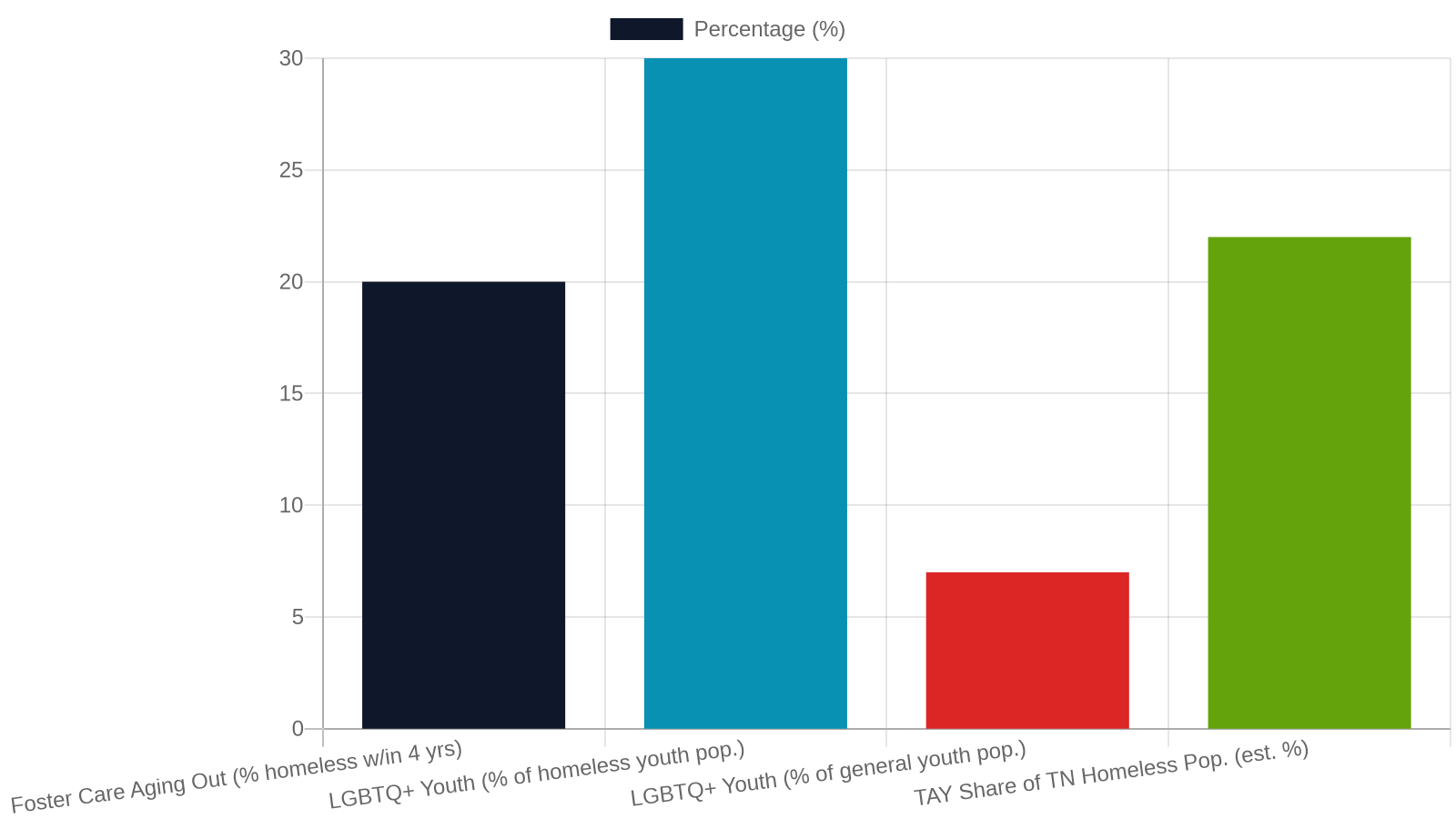
In Tennessee specifically, transition-age youth (ages 18–24) consistently represent a disproportionate share of the homeless population relative to their share of the general population. Youth aging out of foster care face particularly acute risk: studies show that approximately 20% of youth who age out of foster care experience homelessness within two to four years of leaving care. Tennessee has roughly 800–1,000 youth aging out of the foster care system each year, making this a significant and ongoing pipeline into housing instability.
Why Young Adults Need Youth-Specific Solutions
Adult homeless services were not designed with 19-year-olds in mind. Shelter rules, curfews, and program structures that work for middle-aged adults can feel unsafe, irrelevant, or actively harmful to young people — particularly LGBTQ+ youth, who are estimated to make up 20–40% of the youth homeless population despite being roughly 7% of the general youth population. Young adults also face distinct legal barriers: many cannot sign leases without a co-signer, may lack identification documents, and are not yet eligible for certain adult benefits.
YAAB’s existence is, in part, a direct response to this mismatch. By centering youth voice in program design, YAAB helps ensure that services are actually usable by the people they are meant to serve — not just theoretically available to them.
Core Values That Guide Everything YAAB Does

Organizations are only as strong as the values they actually live by — not just the ones they post on a website. YAAB Tennessee’s work is grounded in a set of core values that show up in how members are recruited, how decisions are made, and how the organization engages with partners and policymakers. These values are worth naming explicitly, because they explain why YAAB operates the way it does.
Lived Experience as Expertise
In most policy spaces, expertise is defined by credentials — degrees, job titles, years of professional experience. YAAB operates from a different premise: that the person who has navigated a broken system has knowledge that no degree can replicate. A young adult who has slept in a shelter, fought for a spot in a transitional housing program, or been turned away from services because of a rule that made no practical sense carries expertise that is essential to designing better systems.
This is not just a feel-good philosophy. Research in participatory design and community-based program evaluation consistently shows that programs co-designed with their intended users have higher uptake, better outcomes, and lower dropout rates. YAAB’s insistence on centering lived experience is evidence-based, not just values-based.
Equity and Inclusion Without Exception
YAAB explicitly centers the experiences of young people who face compounded barriers: LGBTQ+ youth, youth of color, youth with disabilities, youth involved in the justice system, and youth aging out of foster care. These groups are overrepresented in the homeless youth population and underrepresented in the rooms where decisions get made. YAAB works to flip that imbalance — not by treating these identities as deficits, but by recognizing the strength, resilience, and insight they bring to the work.
Transparency and Accountability
YAAB members are not rubber stamps. Part of their role is to hold systems accountable — to ask hard questions when data shows that programs are not reaching young people, to push back when policies create unnecessary barriers, and to make their findings public so that communities can see how their homeless services systems are performing. This accountability function is only possible because YAAB members have the credibility that comes from lived experience and the structural access that comes from formal CoC participation.
What YAAB Members Actually Do Day to Day

It is one thing to describe YAAB’s mission in abstract terms — it is another to understand what membership actually looks like in practice. What does a YAAB member do on a Tuesday afternoon? What does participation require, and what does it give back? The answers vary by region and by individual, but there are consistent patterns worth knowing.
Meetings, Trainings, and Leadership Development
YAAB is not a passive membership. Active members attend regular regional board meetings, participate in trainings on topics like housing policy, public speaking, data literacy, and advocacy strategy, and take on specific roles within their regional board. Many members report that their time with YAAB is among the most significant leadership development experiences of their lives — giving them skills and confidence that translate directly into employment, education, and civic engagement.
Trainings are designed to meet members where they are. You don’t need to know what a CoC is before you join — you’ll learn. You don’t need to have testified before a city council — YAAB will help you get there if that’s where you want to go.
Projects, Campaigns, and Public Work
Beyond meetings, YAAB members contribute to concrete projects: producing resource guides for peers, running social media campaigns, participating in community needs assessments, creating public art and storytelling projects, and engaging with media. These projects are visible, tangible, and often directly useful to other young Tennesseans navigating housing instability. You can see examples of current and past projects on the YAAB projects page.
Members also participate in advocacy campaigns — from local budget hearings to statewide legislative sessions — where their firsthand accounts carry weight that statistics alone cannot.
How YAAB Fits Into Tennessee's Broader Homeless Services System

YAAB does not exist in isolation — it is woven into Tennessee’s existing homeless services infrastructure in ways that give it real institutional leverage. Understanding that infrastructure helps explain why YAAB’s advisory role is more than symbolic, and why the organization’s founding represented a meaningful structural shift in how Tennessee approaches youth homelessness.
The Continuum of Care: A Quick Explainer
The Continuum of Care (CoC) is a federally mandated planning and funding structure that coordinates homeless services in a defined geographic area. Each CoC receives HUD funding to support a range of services — emergency shelter, transitional housing, rapid rehousing, and permanent supportive housing — and is responsible for ensuring those services are coordinated, data-driven, and accessible. Tennessee has seven CoC regions, each governed by a local CoC board that includes service providers, government agencies, and — increasingly, thanks to YAAB — people with lived experience of homelessness.
For more background on how youth homelessness is defined and measured within this system, the understanding youth homelessness page is a great starting point.
YAAB's Formal Role in CoC Governance
YAAB is not an outside advocacy group lobbying the CoC from the outside — it is embedded within CoC governance structures. This means YAAB members have formal seats at CoC planning tables, access to system performance data, and the ability to shape how federal dollars are allocated and how programs are designed. This inside position is rare and powerful. It means that when YAAB raises a concern, it is not just a complaint — it is a formal input into a federally accountable planning process.
HUD’s CoC program regulations increasingly require CoCs to demonstrate meaningful youth engagement as a condition of funding. YAAB’s existence helps Tennessee’s CoC regions meet that standard — but more importantly, it ensures that the engagement is genuine, not performative.
YAAB vs. Other Youth-Serving Approaches: How They Compare
Not all youth-serving organizations are structured the same way. Here is how YAAB compares to other common approaches across key dimensions.
YAAB vs. Other Youth-Serving Organizations: What Makes It Different

It is worth being clear about what makes YAAB distinct from other organizations working on youth homelessness in Tennessee — not to diminish those organizations, but because understanding the difference helps explain why YAAB’s founding filled a specific and important gap in the ecosystem.
Led By Youth, Not Just For Youth
Many organizations serve young people experiencing homelessness — shelters, case management agencies, drop-in centers, transitional housing programs. These are essential, and YAAB works alongside them. But most of these organizations are led by adults, designed by adults, and evaluated by adults. Young people are the recipients of services, not the architects of them.
YAAB flips that dynamic. While adult allies and CoC staff play supporting roles, the agenda, the priorities, and the public voice of YAAB are driven by young adults with lived experience. This is not a youth program run by a nonprofit — it is a youth-led body that operates within a formal governance structure.
Advocacy and Services, Not One or the Other
Some organizations focus exclusively on direct services — getting young people housed, fed, and connected to employment. Others focus exclusively on policy advocacy — lobbying for better laws and more funding. YAAB does both, simultaneously. Members connect peers to resources and push for the systemic changes that would make those resources more accessible and more effective. This dual role makes YAAB uniquely positioned to bridge the gap between what young people need right now and what the system needs to look like long-term.
Impact: What YAAB Has Helped Change

Founding stories and mission statements matter — but so does impact. What has YAAB actually changed since its establishment? While a full accounting of every policy win and program improvement would fill its own article, it is worth highlighting the kinds of impact YAAB has had across Tennessee’s CoC regions, both at the systems level and at the individual member level.
Policy Wins Driven by Youth Voice
Across Tennessee’s CoC regions, YAAB members have contributed to tangible policy and program changes. These include advocating for lower-barrier shelter entry policies that remove ID requirements as a precondition for emergency shelter access, pushing for youth-specific housing programs within regional CoC funding allocations, and contributing to statewide planning documents that shape how Tennessee’s homeless services system is organized and evaluated.
While the specific wins vary by region and year, the pattern is consistent: when young adults with lived experience are in the room, the decisions that come out of that room are better calibrated to what actually works for young people.
Leadership Development That Lasts
Perhaps the most durable impact of YAAB is the leadership development it provides to members themselves. Former YAAB members have gone on to careers in social work, public policy, nonprofit management, and community organizing. Others have used skills gained through YAAB — public speaking, data analysis, coalition building — to advance in education and employment. The organization does not just advocate for better futures for young people; it actively builds them, one member at a time.
This is not incidental to the mission — it is central to it. An organization that burns out its members or treats their participation as purely instrumental is not truly centering youth. YAAB’s commitment to member development reflects its understanding that the young people doing this work deserve to benefit from it directly.
How to Get Involved With YAAB Tennessee

Knowing YAAB’s history and mission is one thing — knowing how to connect with it is another. Whether you are a young adult who wants to get involved or a professional who wants to support the work, there are clear entry points. YAAB Tennessee is actively growing its membership across all seven regions, and the need for engaged, passionate young adults has never been greater.
If You Are a Young Adult Ages 17 to 25
If you are between 17 and 25 and have experienced homelessness or housing instability — including couch-surfing, staying in shelters, aging out of foster care, or facing eviction — YAAB was built for you. You do not need prior experience, a stable living situation, or any particular credentials. You need your story, your perspective, and a willingness to show up.
The best first step is to find your regional YAAB and reach out. Each regional board has its own contact information and meeting schedule. You can also visit the YAAB join page to express interest and get connected to the right regional board for where you are in Tennessee.
If You Are a Case Manager, Provider, or CoC Partner
If you work in homeless services or youth-serving systems in Tennessee, YAAB is a partner, not a competitor. You can support YAAB by actively referring eligible young adults to their regional board, by advocating within your CoC for meaningful youth representation in governance, and by creating organizational cultures that treat youth voice as an asset rather than a checkbox. YAAB members are not just advisors — they are potential colleagues, future staff, and long-term community leaders. Investing in their participation is investing in the future of your field.
Ready to Be Part of the Change?

YAAB Tennessee was not founded by a single visionary leader or a major institution — it was built by a movement of young people who refused to accept that their experiences were liabilities rather than assets. Across Memphis, Nashville, Knoxville, Chattanooga, Jackson, the Upper Cumberland, and Northeast Tennessee, that movement is still growing. Every new member who joins a regional YAAB makes the whole network stronger — and makes Tennessee’s homeless services system a little more accountable to the people it is supposed to serve.
Your Experience Is the Qualification
If you have read this far, you already know more about YAAB than most people in Tennessee. More importantly, if you have lived experience of homelessness or housing instability, you carry knowledge that this work genuinely needs. YAAB exists because systems built without youth input consistently fail young people. The solution is not more studies or more reports — it is more young adults with lived experience in the rooms where decisions get made.
That room has a seat with your name on it. The only question is whether you are ready to take it.
Learn More and Connect
The best place to start is the YAAB About page, where you can learn more about the organization’s structure, values, and regional boards. From there, you can find your local YAAB, explore current projects, and figure out how to get involved in a way that fits your life right now. Tennessee’s young adults built this — and Tennessee’s young adults are the ones who will keep pushing it forward, one region, one policy, and one peer connection at a time.
Frequently Asked Questions
Who founded the Youth Action Board of Tennessee?
YAAB Tennessee was not founded by a single individual but emerged from a collaborative effort involving young adults with lived experience of homelessness, Continuum of Care leads, and service providers across Tennessee's seven CoC regions. It was built in response to both national momentum for youth-inclusive homeless services planning and local recognition that transition-age youth needed a formal voice in the systems that affect them.
What is the mission of the Youth Action Board of Tennessee?
YAAB Tennessee's mission is to ensure that young adults ages 17 to 25 with lived experience of homelessness have a genuine, ongoing voice in the policies, programs, and resources that shape their lives. This mission is carried out through formal advisory participation in CoC governance, peer-to-peer resource connection, and advocacy for systemic change across all seven of Tennessee's Continuum of Care regions.
How do I join a YAAB in Tennessee?
If you are between 17 and 25 and have lived experience of homelessness or housing instability — including couch-surfing, shelter stays, or aging out of foster care — you can join your regional YAAB. Visit yaabtn.org/join to express interest and get connected to the right regional board for your area of Tennessee. No prior experience or credentials are required.
What is a Continuum of Care and how does YAAB fit into it?
A Continuum of Care (CoC) is a federally mandated structure that coordinates homeless services in a defined geographic area and distributes HUD funding for shelter, housing, and support services. YAAB Tennessee is embedded within each of Tennessee's seven CoC regions, giving young adults with lived experience formal seats at CoC planning tables where funding and program decisions are made.
Does YAAB Tennessee serve young people who are still experiencing homelessness?
Yes. YAAB membership is open to young adults ages 17 to 25 who are currently experiencing or have previously experienced homelessness or housing instability. You do not need to have stable housing to participate — in fact, many members are navigating their own housing situations while doing this work.
What regions of Tennessee does YAAB cover?
YAAB Tennessee has regional boards in all seven Continuum of Care regions: Memphis/Shelby County (TN-500), Nashville/Davidson County (TN-501), Knoxville/Knox County (TN-502), Upper Cumberland (TN-503), Northeast Tennessee (TN-504), Chattanooga/Hamilton County (TN-506), and Jackson/West Tennessee (TN-507). Each regional board operates independently while being part of the statewide YAAB network.