Quick answer: The Youth Action Board (YAAB) of Tennessee operates in all eight Continuum of Care (CoC) regions across the state — from Memphis/Shelby County in the west to Northeast Tennessee in the east. Each local YAAB is made up of young adults ages 17 to 25 with lived experience of homelessness or housing instability. Members advise CoC leaders, shape local policy, and connect peers to housing, employment, education, and mental health resources. If you're a young adult in Tennessee who has experienced housing instability, you can find and join the YAAB closest to you.
What Is the Youth Action Board of Tennessee?

Before diving into the specific regions, it helps to understand what the Youth Action Board actually is and why it exists. YAAB is not a case management program or a shelter — it is a leadership and advocacy network run by young people, for young people. Understanding its structure makes it easier to find the right local chapter and know what to expect when you get involved.
A Statewide Network Built on Lived Experience
The Youth Action Board (YAAB) of Tennessee is a statewide network of young adults — ages 17 to 25 — who have personally experienced homelessness or housing instability. That lived experience is not a footnote; it is the entire point. YAAB members bring firsthand knowledge to the tables where decisions get made about the services, shelters, and systems that affect transition-age youth across Tennessee.
Founded to ensure that young people have a real voice in the Continuum of Care (CoC) process, YAAB operates as both an advisory body and a peer-support community. Members attend CoC meetings, review policies, give feedback on programs, and advocate for changes that actually reflect what young people need — not just what adults assume they need.
Who Can Join a Local YAAB?
Any young adult between the ages of 17 and 25 who has lived experience of homelessness, housing instability, or housing insecurity in Tennessee is eligible to participate. That includes young people who have:
- Experienced unsheltered homelessness or couch-surfing
- Stayed in an emergency shelter, transitional housing, or rapid rehousing program
- Aged out of the foster care system
- Faced eviction, doubled up with family, or been unstably housed
You do not need to be currently homeless to join. Many YAAB members are in stable housing now and use their experience to help others navigate the same systems they once faced.
Understanding Tennessee's 8 Continuum of Care Regions

Tennessee’s eight CoC regions cover every corner of the state — from the Mississippi River delta communities in the west to the Appalachian highlands in the east. Each region has unique demographics, service landscapes, and housing markets. Here’s a quick orientation before we walk through each one.
What Is a Continuum of Care?
A Continuum of Care (CoC) is a regional planning body funded and overseen by the U.S. Department of Housing and Urban Development (HUD). Each CoC is responsible for coordinating housing and services for people experiencing homelessness in its geographic area — from street outreach and emergency shelter all the way to permanent supportive housing.
Tennessee is divided into eight CoC regions, each with its own lead agency, service providers, and local priorities. HUD assigns each CoC a numerical code (e.g., TN-500, TN-501) that you’ll see referenced throughout YAAB’s regional pages. These codes help identify which region a specific program or funding stream belongs to.
Why Does Each Region Have Its Own YAAB?
Housing challenges in Memphis look very different from those in rural Northeast Tennessee. Urban CoCs deal with large shelter systems and high housing costs; rural CoCs face long distances to services, fewer shelter beds, and limited public transportation. Having a local YAAB in each region means that the young adults advising that CoC understand the specific barriers in their community.
Each local YAAB feeds into the statewide YAAB network, so regional insights can also influence state-level policy conversations. It’s a two-way channel: local problems get local solutions, and statewide patterns get statewide advocacy.
TN-500: Memphis and Shelby County YAAB

Memphis is home to Tennessee’s largest urban CoC and one of its most active local YAABs. Young adults in this region face some of the steepest housing affordability gaps in the state — the fair market rent for a one-bedroom apartment in Memphis is approximately $900/month, while many transition-age youth earn at or below minimum wage ($7.25/hour in Tennessee as of 2024). The Memphis YAAB is a critical space where those economic realities get translated into policy demands.
Who This Region Serves
The TN-500 CoC covers Memphis and Shelby County, Tennessee’s largest city and most populous county with over 900,000 residents. Memphis has one of the highest youth homelessness rates in the state, driven by poverty concentration, limited affordable housing stock, and systemic inequities that disproportionately affect Black youth — who make up the majority of the city’s transition-age youth population experiencing homelessness.
The Memphis YAAB works alongside major service providers including Memphis Area Legal Services, Hospitality Hub, and Youth Villages to ensure that young people’s voices are embedded in the local CoC’s decision-making.
Getting Involved in TN-500
If you’re a young adult in Memphis or Shelby County with lived experience of housing instability, the TN-500 local YAAB page has current contact information, meeting schedules, and details on how to join. Members participate in monthly CoC meetings, peer outreach events, and regional advocacy campaigns. Some members also receive stipends or other support for their participation — because your time and expertise have real value.
TN-501: Nashville and Davidson County YAAB

Nashville’s rapid growth has made it one of the most challenging cities in the South for young adults trying to secure stable housing. The TN-501 YAAB sits at the intersection of that crisis and the policy conversations happening inside the Davidson County CoC. If you’re a young adult in Nashville who has navigated the shelter system, couch-surfed, or struggled to afford rent, your experience is exactly what this YAAB needs.
Nashville's Housing Crisis and Young Adults
Nashville has experienced one of the fastest rent increases of any major U.S. city over the past decade. Between 2019 and 2024, median rents in Davidson County rose by more than 40%, pushing thousands of low-income young adults into housing instability. The TN-501 CoC — which covers Nashville and Davidson County — is the state’s second-largest urban CoC and coordinates services through dozens of partner agencies.
For transition-age youth in Nashville, the YAAB is a way to connect with peers, access resources, and have a say in how the CoC allocates its HUD funding each year. Youth-specific programs like rapid rehousing and transitional housing are directly shaped by YAAB feedback.
What Nashville YAAB Members Do
Nashville YAAB members have participated in Point-in-Time (PIT) Count planning, provided testimony at Metro Council hearings, and contributed to the development of Nashville’s youth homelessness action plan. Members also connect peers to resources like the Oasis Center, Conexión Américas, and the Nashville YWCA — all of which serve transition-age youth in the region.
Visit the TN-501 YAAB page for meeting details and how to sign up.
TN-502: Knoxville and Knox County YAAB

Knoxville sits at the crossroads of Appalachian culture and a rapidly modernizing economy. For young adults in Knox County, housing instability often intersects with limited public transit, gaps in behavioral health services, and the particular vulnerabilities that come with aging out of foster care in a mid-sized city. The TN-502 YAAB brings those lived realities directly into CoC planning conversations.
East Tennessee's Hub for Youth Services
Knoxville and Knox County form the TN-502 CoC, which serves as the primary urban anchor for East Tennessee. The region is home to the University of Tennessee, which creates a complex housing market where student demand drives up rents even as a significant population of transition-age youth — many of whom are not students — struggles to find affordable options.
Key service partners in the TN-502 region include Volunteer Ministry Center, KARM (Knox Area Rescue Ministries), and Helen Ross McNabb Center, all of which work with young adults experiencing homelessness or housing instability.
YAAB's Role in Knoxville's CoC
The Knoxville YAAB has been active in shaping how the TN-502 CoC thinks about youth-specific housing pathways — including the push for more transitional housing units dedicated to young adults ages 18 to 24. Members have also worked on outreach strategies to reach LGBTQ+ youth, who are 40% more likely to experience homelessness than their non-LGBTQ+ peers according to national research by True Colors United.
Find meeting times and contact info on the TN-502 YAAB page.
TN-503: Chattanooga and Hamilton County YAAB

Chattanooga is one of Tennessee’s fastest-growing cities, and with that growth comes pressure on an already tight housing market. The TN-503 YAAB is a space where young adults in Hamilton County can turn their personal experiences navigating that pressure into concrete advocacy — and connect with peers who get it.
Chattanooga's Growing Economy and Housing Gap
Chattanooga has reinvented itself over the past two decades as a tech and outdoor recreation destination, but that economic growth has not reached all young adults equally. Hamilton County’s TN-503 CoC coordinates services for a population that includes young adults displaced by gentrification, those aging out of foster care through the Tennessee Department of Children’s Services (DCS), and youth fleeing unsafe home environments.
The Chattanooga Area Food Bank, Chambliss Center for Children, and Signal Centers are among the regional partners working alongside the TN-503 CoC to serve transition-age youth.
Advocacy Wins from the Chattanooga YAAB
YAAB members in Chattanooga have contributed to local discussions about coordinated entry — the system that determines how people get matched to available housing resources. Youth advocates have pushed for a youth-specific coordinated entry pathway that accounts for the unique barriers young adults face, such as lack of rental history, no co-signer, and limited credit. These are not small asks; they represent systemic changes that affect hundreds of young people each year.
Learn more and connect at the TN-503 YAAB page.
TN-504: Jackson and West Tennessee YAAB

West Tennessee outside of Memphis is often overlooked in statewide conversations about homelessness, but the need is real and the distances are vast. The TN-504 YAAB gives young adults in Jackson and surrounding counties a platform to make sure their region’s specific challenges — from rural isolation to limited shelter capacity — are heard at every level of the CoC system.
Serving a Sprawling Rural and Small-City Region
The TN-504 CoC covers Jackson and the surrounding West Tennessee counties — a region that blends small-city services with deeply rural communities. Jackson, with a population of roughly 67,000, is the largest city in West Tennessee outside of Memphis, and it serves as the service hub for young adults across a wide geographic area. Distance is a real barrier here: a young adult in a rural county may be 45 minutes from the nearest shelter or drop-in center.
West Tennessee YAAB members have been vocal about the need for mobile outreach, transportation assistance, and remote service options that can reach young people who don’t have reliable access to a car or public transit.
Resources and Connections in TN-504
The West Tennessee YAAB connects young adults to regional resources including the Carl Perkins Center, Salvation Army Jackson, and local Community Action Agencies. Members also engage with the TN-504 CoC’s annual planning process to ensure that rural youth — who are often undercounted in Point-in-Time surveys — are represented in funding decisions.
Check the TN-504 YAAB page for current meeting schedules and how to get plugged in.
TN-506: Upper Cumberland YAAB

The Upper Cumberland is one of Tennessee’s most beautiful and most underserved regions when it comes to youth housing resources. The TN-506 YAAB is building something important here: a peer network that makes young adults in rural communities feel less alone and more powerful in shaping the systems around them.
A Region Defined by Rural Resilience
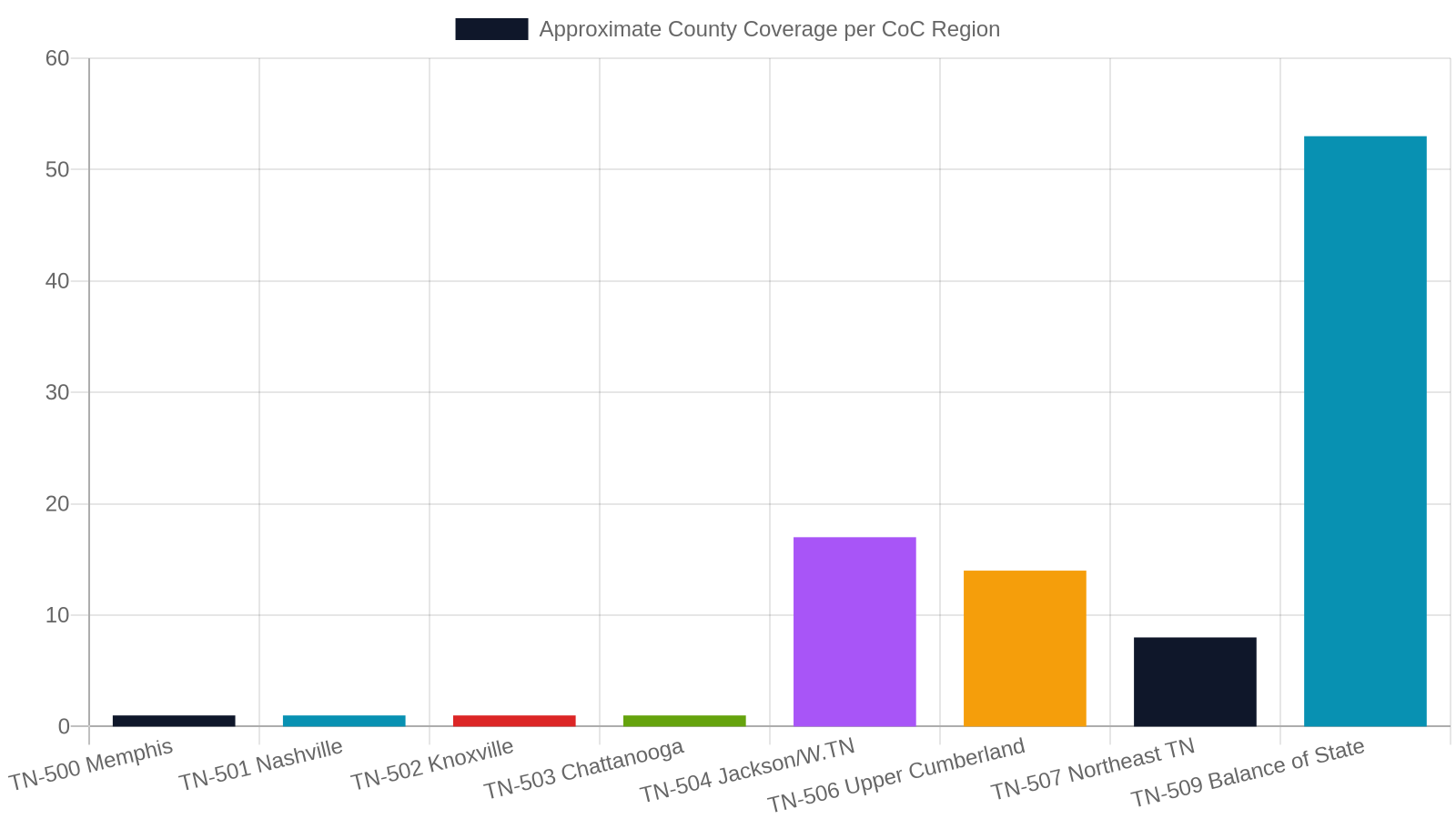
The Upper Cumberland region — covered by the TN-506 CoC — spans approximately 14 counties in North-Central Tennessee, including Putnam, White, Overton, Fentress, and Cumberland counties. Cookeville serves as the region’s urban center, home to Tennessee Tech University and a growing healthcare sector, but much of the CoC’s geography is rural and mountainous.
Youth homelessness in the Upper Cumberland often looks different from urban homelessness: it’s more likely to involve couch-surfing, staying with extended family in overcrowded conditions, or living in substandard housing rather than sleeping unsheltered. These forms of hidden homelessness are harder to count and harder to fund — which is exactly why YAAB advocacy in this region matters.
Getting Connected in TN-506
The Upper Cumberland YAAB works with partners like the Cookeville Regional Medical Center social work team, local Community Action Agencies, and the Upper Cumberland Human Resource Agency (UCHRA) to identify and support transition-age youth. YAAB members in this region have been particularly active in pushing for youth-specific outreach strategies that account for the rural geography and the stigma that can prevent young people in small communities from seeking help.
Visit the TN-506 YAAB page for regional contact details.
Tennessee's 8 YAAB Regions at a Glance
Use this table to quickly identify your CoC region, its geographic scope, and the primary urban center served by each local YAAB.
TN-507: Northeast Tennessee YAAB

Northeast Tennessee’s Appalachian communities have a deep tradition of resilience and mutual aid — and the TN-507 YAAB builds on that tradition by creating a space where young adults can support each other and advocate for the resources their communities need. If you’re a young adult in the Tri-Cities area or surrounding counties, this YAAB is your regional home base.
Appalachian Youth and Housing Instability
Northeast Tennessee — covered by the TN-507 CoC — includes approximately eight counties in the Tri-Cities area: Sullivan, Washington, Carter, Unicoi, Johnson, Hawkins, Greene, and Hancock. The Tri-Cities metro (Johnson City, Kingsport, Bristol) is the region’s population center, but the CoC also serves deeply rural Appalachian communities where poverty rates are among the highest in the state.
Young adults in Northeast Tennessee face a combination of limited employment opportunities, opioid epidemic impacts on family stability, and a shortage of transitional housing options. The TN-507 YAAB amplifies these realities in CoC planning and connects young people to resources they might not know exist.
YAAB in the Tri-Cities Area
Key partners in the TN-507 region include Frontier Health, HOPE Sullivan, and Appalachian Agency for Senior Citizens (which also serves transition-age youth in some programs). YAAB members in Northeast Tennessee have advocated for better coordination between the behavioral health system and the housing system — because for many young adults in this region, mental health and substance use challenges are inseparable from housing instability.
Connect with the Northeast Tennessee YAAB at the TN-507 YAAB page.
TN-509: Balance of State YAAB

The Balance of State CoC is proof that youth advocacy can’t stop at city limits. Fifty-three counties means fifty-three sets of local needs, local resources, and local gaps — and the TN-509 YAAB works to make sure none of those communities are invisible in state-level conversations about youth homelessness funding and policy.
What Does 'Balance of State' Mean?
The TN-509 CoC is Tennessee’s Balance of State Continuum of Care — a single CoC that covers all Tennessee counties not included in one of the seven urban or regional CoCs. That means TN-509 spans approximately 53 counties, making it one of the largest geographic CoCs in the southeastern United States by land area.
The Balance of State CoC is administered by the Tennessee Housing Development Agency (THDA), which coordinates with local service providers, Community Action Agencies, and regional coalitions across this enormous territory. For transition-age youth in these counties, the TN-509 YAAB is often the only formal youth advocacy structure in their area.
Advocacy Across 53 Counties
Because TN-509 is so geographically diverse, the Balance of State YAAB has developed creative approaches to engagement — including virtual meetings, regional sub-groups, and partnerships with local libraries and community centers that can serve as meeting hubs. Members have advocated for increased CoC funding for rural counties, better data collection on hidden homelessness, and more flexible program rules that account for rural realities.
If you’re in a county not covered by one of the seven other CoCs, the TN-509 YAAB page is your starting point.
What YAAB Members Actually Do: Roles and Responsibilities

Understanding what YAAB members actually do day-to-day helps you decide whether it’s the right fit — and helps service providers understand how to support YAAB engagement. Here’s a breakdown of the core roles and activities across all eight Tennessee regions.
Advising the Continuum of Care
Every local YAAB has a formal advisory relationship with its CoC. That means YAAB members attend CoC meetings, review funding applications, give feedback on program designs, and sometimes vote on CoC decisions. This is not symbolic participation — HUD increasingly requires CoCs to demonstrate meaningful youth engagement as a condition of funding. Your voice has real leverage.
Common advisory activities include reviewing Coordinated Entry policies, providing input on the annual Point-in-Time Count methodology, and evaluating whether existing programs are actually youth-friendly (spoiler: many aren’t, until YAAB members push for changes).
Peer Outreach and Community Connection
YAAB members also do peer outreach — connecting with other young adults who may not know what resources are available or who may distrust systems because of past negative experiences. Peer outreach works because it’s delivered by someone who has been there. A young adult who has navigated the shelter system, applied for rapid rehousing, or aged out of foster care can explain those processes in a way that a caseworker never quite can.
Many YAAB members also help with local events, resource fairs, and social media outreach that makes information about housing, employment, and mental health services more accessible to peers. Learn more about YAAB’s broader advocacy work at the YAAB Tennessee advocacy page.
Leadership Development and Stipends
Participation in YAAB is not just about giving back — it’s also about building skills. Members develop public speaking, policy analysis, meeting facilitation, and community organizing skills that are directly transferable to careers in social work, public policy, healthcare, and nonprofit management. Many YAAB members go on to work in the very systems they once navigated as clients.
Importantly, most YAAB chapters offer stipends or other compensation for member participation, because YAAB recognizes that your time is valuable and that asking young adults with limited resources to volunteer indefinitely is not equitable. Compensation structures vary by region, so check with your local YAAB for details.
Ready to Find Your Local YAAB and Get Involved?

You’ve now got a full picture of all eight Youth Action Board locations across Tennessee’s Continuum of Care regions. Whether you’re a young adult ready to get involved, a peer looking for resources, or a service provider wanting to strengthen youth engagement in your CoC, the next step is simple: connect with your regional YAAB. Here’s how to make that happen.
Your First Step: Connect With the Right Region
The easiest way to get started is to find your local YAAB on the Tennessee YAAB regional directory. Each regional page lists current contact information, meeting schedules, and a brief overview of what that YAAB is working on. You don’t need to have everything figured out before you reach out — just show up and see what it’s about.
If you’re not sure which CoC region you’re in, use your county as a reference point. The eight regions map roughly to: Memphis/Shelby (TN-500), Nashville/Davidson (TN-501), Knoxville/Knox (TN-502), Chattanooga/Hamilton (TN-503), Jackson/West TN (TN-504), Upper Cumberland (TN-506), Northeast TN (TN-507), and all other counties (TN-509).
For Service Providers and CoC Partners
If you’re a case manager, CoC coordinator, or service provider reading this: YAAB is one of the most effective tools available for making your programs more responsive to the young adults you serve. Connecting your clients to their local YAAB — and making space for YAAB members at your CoC table — is a concrete step toward the youth-centered systems change that HUD and state funders are increasingly prioritizing.
You can learn more about how YAAB works and how to partner with the network at the YAAB Tennessee about page, or explore current projects and initiatives at the YAAB projects page.
Tennessee's Young Adults Are Leading the Way
Across all eight CoC regions — from Memphis to the mountains of Northeast Tennessee — young adults with lived experience are showing up, speaking out, and changing systems. The Youth Action Board of Tennessee is proof that the people closest to a problem are also closest to its solution. Whether you’re in Nashville, Cookeville, Jackson, or a small county in the Balance of State, there is a YAAB community waiting for you.
Your story matters. Your experience is expertise. And Tennessee’s CoC system is better because you’re in it.
Frequently Asked Questions
How do I find my local Youth Action Board in Tennessee?
Visit yaabtn.org/local-yaabs/ and look for the CoC region that matches your county. Tennessee has eight regional YAABs covering every county in the state, from Memphis (TN-500) to the Balance of State (TN-509). Each regional page has current contact info and meeting details.
Do I have to be currently homeless to join a YAAB in Tennessee?
No. You need lived experience of homelessness or housing instability at some point between ages 17 and 25, but you do not have to be currently homeless. Many YAAB members are in stable housing and use their past experience to advocate for others navigating the same systems.
What is a Continuum of Care and how does it relate to YAAB?
A Continuum of Care (CoC) is a HUD-funded regional body that coordinates housing and homeless services in a geographic area. Tennessee has eight CoCs. Each local YAAB advises its CoC, ensuring that young adults with lived experience have a voice in how funding and programs are designed and delivered.
Do YAAB members get paid for their participation?
Most YAAB chapters offer stipends or other compensation for member participation, because YAAB recognizes that young adults' time and expertise have real value. Compensation structures vary by region, so contact your local YAAB for specifics.
What is the TN-509 Balance of State CoC?
TN-509 is the CoC that covers all Tennessee counties not included in one of the seven other regional CoCs — approximately 53 counties in total. It is administered by the Tennessee Housing Development Agency (THDA). If you live outside Memphis, Nashville, Knoxville, Chattanooga, the Jackson area, Upper Cumberland, or Northeast Tennessee, TN-509 is your CoC.
How does YAAB help young adults aging out of foster care in Tennessee?
YAAB members who have aged out of Tennessee's foster care system bring that specific experience into CoC planning conversations, pushing for housing programs that account for the unique barriers foster youth face — such as no rental history, no co-signer, and abrupt loss of DCS support at age 18 or 21. YAAB also connects foster-care alumni to peer support and regional resources.