Quick answer: Across Tennessee's eight Continuum of Care regions — from Memphis and Nashville to Knoxville, Chattanooga, and rural Northeast TN — dozens of federally and state-funded initiatives are working right now to reduce youth homelessness for young adults ages 17 to 25. These programs include rapid rehousing, transitional housing, street outreach, HOST grants, and youth-specific Emergency Solutions Grants. The Youth Action Board (YAAB) of Tennessee plays a direct role in shaping many of these efforts, making sure young people with lived experience have a real seat at the table.
Why Tennessee Funds Youth-Specific Homelessness Programs

Tennessee doesn’t treat youth homelessness as a footnote inside its broader housing crisis response — it funds dedicated programs, staffs youth-specific outreach teams, and requires Continuum of Care regions to track young adults separately. Understanding why that funding exists helps young people and their advocates know what to ask for and where to push for more.
Transition-Age Youth Are a Distinct Population
Young adults ages 17 to 25 — often called transition-age youth (TAY) — face homelessness differently than older adults. Many are aging out of foster care, fleeing unsafe home environments, or navigating adulthood without a family safety net. Tennessee’s Continuum of Care (CoC) system recognizes this, and HUD requires CoC applicants to demonstrate how they specifically address unaccompanied youth in their Point-in-Time (PIT) counts and funding applications.
In Tennessee’s most recent statewide PIT count data, young adults under 25 represented approximately 18–22% of all people experiencing homelessness on a single night — a share that advocates argue is undercounted because youth are more likely to couch-surf or stay in hidden locations rather than emergency shelters.
Federal Funding Streams That Flow Into Tennessee
Most youth homelessness funding in Tennessee originates from three federal sources:
- HUD Continuum of Care (CoC) Program — competitive grants awarded annually to local CoC lead agencies
- Emergency Solutions Grants (ESG) — formula grants administered by the Tennessee Department of Human Services (TDHS) and passed to local providers
- SAMHSA Grants for the Benefit of Homeless Individuals (GBHI) — fund co-occurring mental health and substance use services for unhoused young adults
Tennessee also leverages state-level dollars through the Tennessee Housing Development Agency (THDA) and periodic federal appropriations like the American Rescue Plan Act (ARPA), which sent hundreds of millions in emergency rental assistance through Tennessee between 2021 and 2023.
1. Rapid Rehousing for Youth — Statewide CoC Investments

Rapid Rehousing is the workhorse of Tennessee’s youth homelessness response. It’s fast, it puts young adults in real housing, and it’s backed by strong evidence. Here’s how it’s funded and where it operates across the state.
What Rapid Rehousing Actually Means for You
Rapid Rehousing (RRH) is one of the most widely funded interventions in Tennessee’s CoC portfolio. The model moves young adults out of shelters or unsafe situations and into their own housing as quickly as possible, then provides short-term rental assistance (typically 3 to 12 months) plus case management while the person stabilizes. Unlike transitional housing, RRH places youth directly in market-rate apartments — the lease is in your name from day one.
HUD data show that youth-specific RRH programs achieve housing placement in a median of 30 to 45 days from program enrollment, compared to 90+ days in traditional shelter-to-housing pipelines. Tennessee CoC regions collectively received over $4.2 million in RRH funding in the most recent HUD CoC award cycle, a portion of which is earmarked for youth.
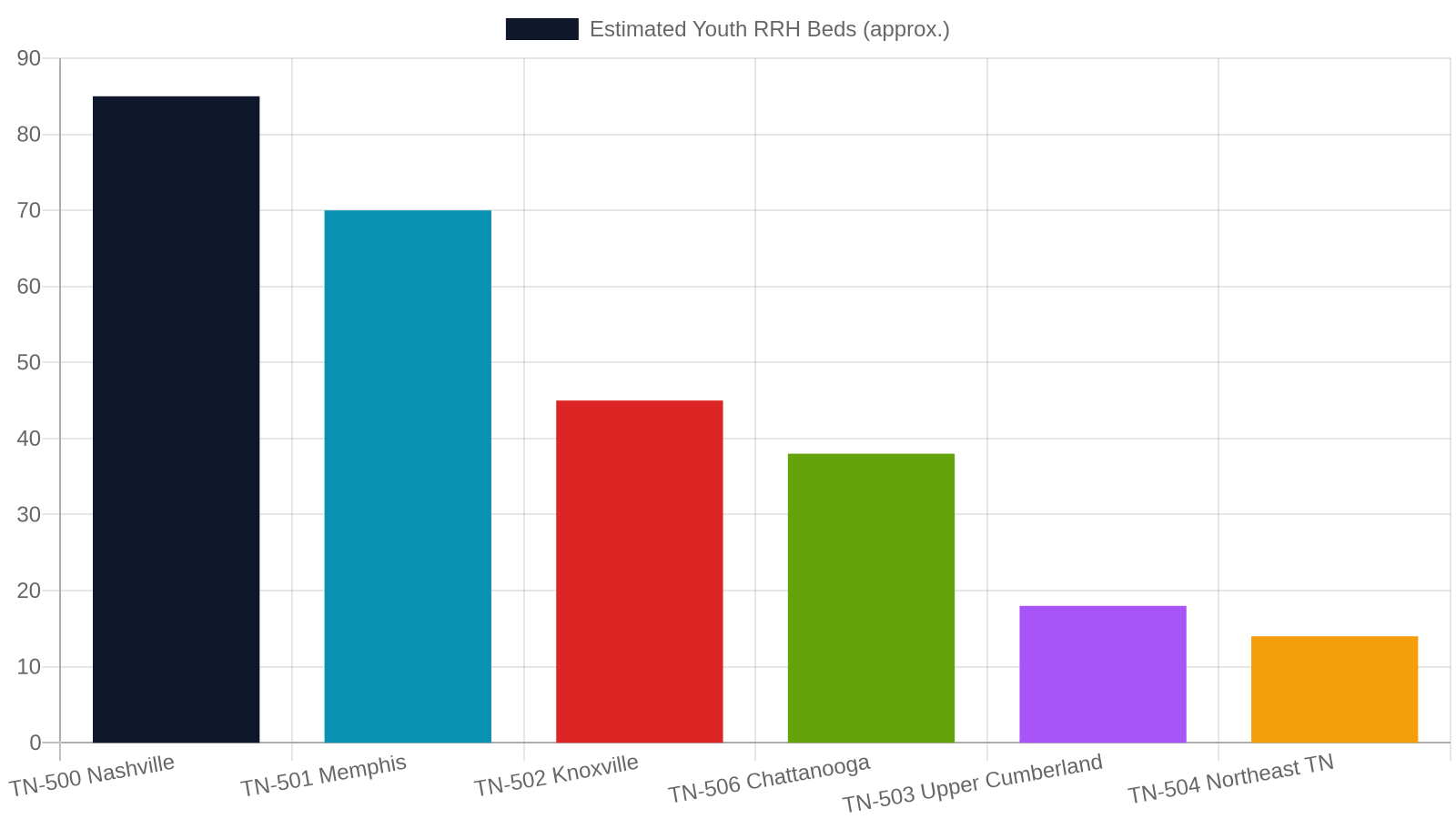
Which Tennessee CoCs Run Youth RRH Programs
Several Tennessee CoC regions operate dedicated youth RRH tracks:
- TN-500 (Nashville/Davidson County) — Centerstone, Oasis Center, and Campus for Human Development all operate youth RRH beds funded through the Nashville CoC.
- TN-501 (Memphis/Shelby County) — Memphis MIFA and Youth Villages coordinate RRH slots specifically for 17–24-year-olds exiting the shelter system.
- TN-502 (Knoxville/Knox County) — Volunteer Ministry Center and KARM partner on youth-track RRH funded through the Knoxville-Knox County CoC.
- TN-506 (Chattanooga/Hamilton County) — Chattanooga Room in the Inn and CADAS provide RRH services for TAY in the Hamilton County CoC.
If you’re in a smaller region, ask your local CoC lead agency whether youth RRH slots exist — they may be embedded inside adult programs.
2. Transitional Housing Programs for Young Adults
Not every young adult is ready to jump straight into an independent apartment — and that’s okay. Transitional housing gives you time, structure, and support while you figure out your next move. Tennessee funds these programs in every major region.
How Transitional Housing Differs From RRH
While Rapid Rehousing moves youth directly into independent apartments, Transitional Housing (TH) programs provide a structured, time-limited living environment — usually 6 to 24 months — where young adults can build skills, save money, and work toward permanent housing at their own pace. TH programs often include life-skills workshops, employment coaching, mental health support, and peer mentoring built into the program model.
HUD funds Transitional Housing through the CoC Program, and Tennessee has maintained a significant TH portfolio even as national policy has shifted emphasis toward RRH. As of the most recent CoC award cycle, Tennessee’s CoC regions collectively hold approximately $2.8 million in active TH grants, with several programs specifically designed for youth aging out of foster care.
Notable Transitional Housing Programs Across Tennessee
Across the state, several transitional housing programs stand out for their youth focus:
- Oasis Center (Nashville) — Operates transitional housing units for youth 18–24, with a focus on LGBTQ+ young adults who face disproportionate rates of family rejection and homelessness.
- Youth Villages LifeSet (Statewide) — Provides intensive case management and transitional support for young adults aging out of foster care across multiple Tennessee regions.
- Restoration House (Knoxville) — Offers transitional housing for young women 18–24 with trauma-informed, community-based support.
- Room in the Inn (Chattanooga) — Runs a transitional program for TAY alongside its emergency shelter, funded through TN-506 CoC grants.
Program availability changes — always check with your local CoC or YAAB’s statewide resource list for current openings.
3. Street Outreach and Drop-In Centers Funded Across Tennessee

Before someone can access housing, they need to be found, trusted, and connected. Street outreach and drop-in centers are the first link in that chain — and Tennessee funds them in every major region through ESG and CoC grants.
Why Street Outreach Is the Front Door
Many young adults experiencing homelessness never walk into a shelter — they sleep in cars, stay with friends, or camp out of sight. Street outreach teams funded through ESG and CoC grants go to where young people actually are: parks, encampments, fast-food restaurants, bus stations, and online platforms. Outreach workers build trust over time, connect youth to ID documents, benefits enrollment, and housing programs, and help them navigate a system that can feel overwhelming or even hostile.
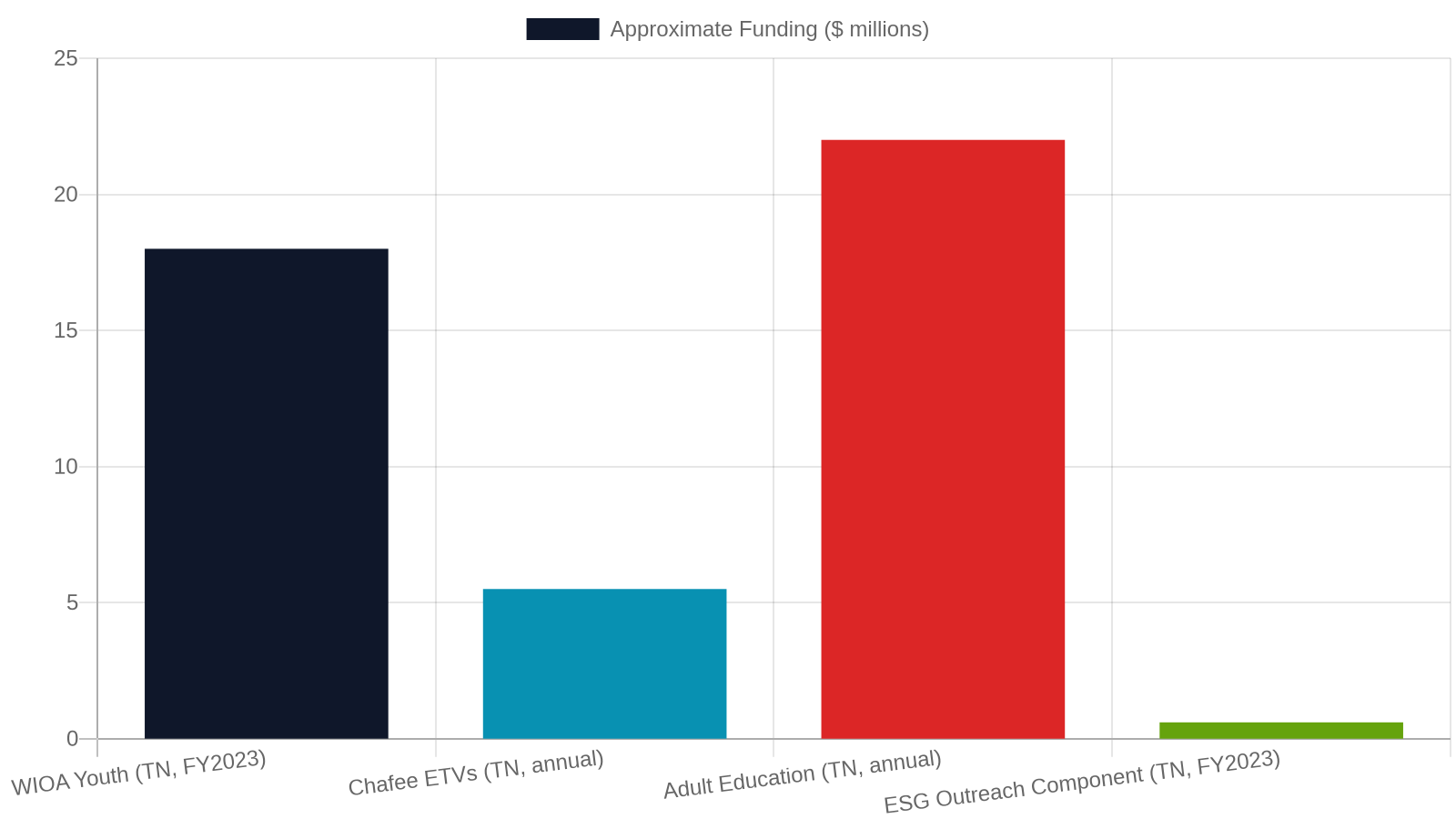
Tennessee’s Emergency Solutions Grant allocates a dedicated outreach component to each region. In FY2023, Tennessee TDHS distributed approximately $3.1 million in ESG funds statewide, with outreach activities accounting for roughly 15–20% of total ESG expenditures.
Drop-In Centers: A Safe Space Without Requirements
Drop-in centers are low-barrier spaces where young adults can access showers, meals, laundry, Wi-Fi, phone charging, and basic services without needing to be enrolled in a program or meet sobriety requirements. Several Tennessee cities operate youth-focused drop-in centers:
- Oasis Center Drop-In (Nashville) — Open weekdays, serves youth 14–24 with meals, hygiene supplies, and case management referrals.
- Door of Hope (Memphis) — Provides drop-in services for youth and young adults in the Memphis metro area.
- KARM Day Services (Knoxville) — Offers daytime access to showers, laundry, and meals for people experiencing homelessness, including young adults.
Drop-in centers are often the first point of contact between a young person and the formal service system — and they’re funded because they work.
4. HOST Grants and Youth-Specific HUD Initiatives
Beyond the standard CoC and ESG streams, several targeted federal programs have sent significant new dollars into Tennessee specifically for youth homelessness. Knowing these programs by name helps you advocate for them — and hold systems accountable for using them well.
What the HOME-ARP and HOST Programs Fund
In 2021, Congress created the HOME Investment Partnerships Program – American Rescue Plan (HOME-ARP), which sent Tennessee approximately $80 million in flexible housing dollars. Unlike standard CoC grants, HOME-ARP funds can be used for a wide range of activities: building or rehabilitating affordable housing units, funding supportive services, and providing rental assistance. HUD required that HOME-ARP prioritize qualifying populations, which explicitly include unaccompanied youth and young adults experiencing homelessness.
Tennessee’s THDA administered HOME-ARP funds and distributed sub-grants to local governments and nonprofits. Several of those sub-grants went directly to organizations serving transition-age youth in Nashville, Memphis, and Knoxville.
Youth Homelessness Demonstration Program (YHDP)
HUD’s Youth Homelessness Demonstration Program (YHDP) is a competitive grant that funds communities to build a coordinated community plan specifically for youth homelessness. While Tennessee CoC regions have not all received YHDP designation, Nashville’s TN-500 CoC has participated in YHDP planning efforts, and advocates continue to push for YHDP investment in Memphis and Knoxville.
YHDP communities receive both funding and technical assistance to build youth-specific coordinated entry systems — meaning young adults get assessed and connected to housing faster, through a process designed with their needs in mind rather than adapted from adult systems. YAAB members in Tennessee have been involved in advocating for YHDP expansion statewide.
5. Foster Care Aging-Out Programs and Funded Supports

For young adults aging out of foster care, the risk of homelessness is real and well-documented. But so are the programs designed to prevent it — if you know they exist and how to access them.
The Pipeline From Foster Care to Homelessness
Research consistently shows that young adults who age out of foster care are at dramatically elevated risk of homelessness. Nationally, studies estimate that 25–40% of youth who age out of foster care experience homelessness within 2 to 4 years of leaving the system. Tennessee has approximately 800–1,000 young people aging out of foster care each year, making this one of the most critical pipelines to address.
Tennessee’s Department of Children’s Services (DCS) is required to provide Independent Living services to youth in foster care beginning at age 14, and extended foster care (called Voluntary Extension of Foster Care in Tennessee) allows young adults to remain in care up to age 21. However, not all eligible youth participate, and the transition cliff at 21 remains steep.
Chafee Funds and What They Cover in Tennessee
The John H. Chafee Foster Care Program for Successful Transition to Adulthood provides Tennessee with approximately $5–6 million annually in federal dollars for independent living services. In Tennessee, Chafee funds support:
- Life-skills training (budgeting, cooking, renting an apartment)
- Educational and vocational support
- Mentoring and peer support programs
- Room and board assistance for youth ages 18–21
- Education and Training Vouchers (ETVs) — up to $5,000 per year for eligible youth to use toward college, vocational training, or GED programs
ETVs are underutilized — many eligible young adults don’t know they exist. If you aged out of foster care in Tennessee, you may qualify even if you’re no longer in DCS custody.
6. Mental Health and Substance Use Funding Tied to Youth Housing

Mental health and housing are deeply connected — and Tennessee’s funding landscape reflects that. Behavioral health dollars are increasingly braided with housing dollars to create more holistic support for young adults.
Why Behavioral Health Funding Is a Housing Issue
You can’t talk about youth homelessness without talking about mental health. Nationally, approximately 50% of young adults experiencing homelessness report a mental health condition, and rates of trauma exposure are even higher. Tennessee funds behavioral health services for unhoused young adults through several streams that are explicitly linked to housing stability:
- SAMHSA GBHI grants — fund co-occurring disorder treatment for people experiencing homelessness, including youth
- PATH Program (Projects for Assistance in Transition from Homelessness) — funds outreach and mental health services for people with serious mental illness who are homeless or at risk
- Tennessee Department of Mental Health and Substance Abuse Services (TDMHSAS) — administers state-funded crisis services and peer support programs that serve unhoused TAY
Peer Support Specialists: A Funded Role for Young Adults With Lived Experience
One of the most meaningful investments Tennessee has made is funding Certified Peer Recovery Specialists (CPRS) and peer support roles within homeless service organizations. These are paid positions — often held by young adults who have their own lived experience of homelessness or behavioral health challenges — who provide support, navigation, and mentorship to their peers.
The CPRS certification is offered through TDMHSAS and takes approximately 40 hours of training plus a supervised experience requirement. For young adults looking to turn their lived experience into a career in the helping field, this is a real, funded pathway. Several Tennessee CoC regions have embedded peer support roles inside their youth outreach and housing programs.
Tennessee Youth Homelessness Programs at a Glance
This table compares the main program types funded across Tennessee's CoC regions — what they offer, who they're for, and how long they typically last.
7. Employment and Education Initiatives Linked to Housing Stability

A stable job and a pathway to education are two of the most powerful tools for ending homelessness long-term. Tennessee funds both — and young adults experiencing housing instability are specifically prioritized in several of these programs.
Workforce Development Funding That Reaches Unhoused Youth
Housing stability and income are inseparable. Tennessee taps into federal Workforce Innovation and Opportunity Act (WIOA) dollars to fund youth workforce programs, and WIOA explicitly prioritizes out-of-school youth ages 16–24 who face barriers including homelessness. In Tennessee, WIOA Youth funds flow through local Workforce Development Boards and support:
- Paid work experiences and internships
- Occupational skills training (certifications, trade programs)
- GED and basic skills instruction
- Mentoring and financial literacy
- Supportive services including transportation assistance
Tennessee received approximately $18 million in WIOA Youth formula funds in FY2023, distributed across the state’s 10 Local Workforce Development Areas.
GED Pathways and Adult Education Funding
The Tennessee Adult Education program, funded through the federal Adult Education and Family Literacy Act (AEFLA), provides free GED preparation and adult basic education classes at community colleges and adult education centers across every county in Tennessee. For young adults who left school during a period of housing instability, this is a no-cost, no-judgment pathway back to a credential.
Several Tennessee cities also have dropout recovery programs specifically designed for 17–21-year-olds, including Tennessee Reconnect and local school district re-engagement programs. These are funded through a combination of state education dollars and federal grants, and they connect young adults to both credentials and supportive services.
8. Regional Spotlight — Initiatives by Tennessee CoC Area

Tennessee’s eight Continuum of Care regions are not equal in size, funding, or provider capacity — but every region has funded initiatives working to reduce youth homelessness. Here’s a snapshot of what’s happening across the state.
West Tennessee: Memphis, Jackson, and Rural CoCs
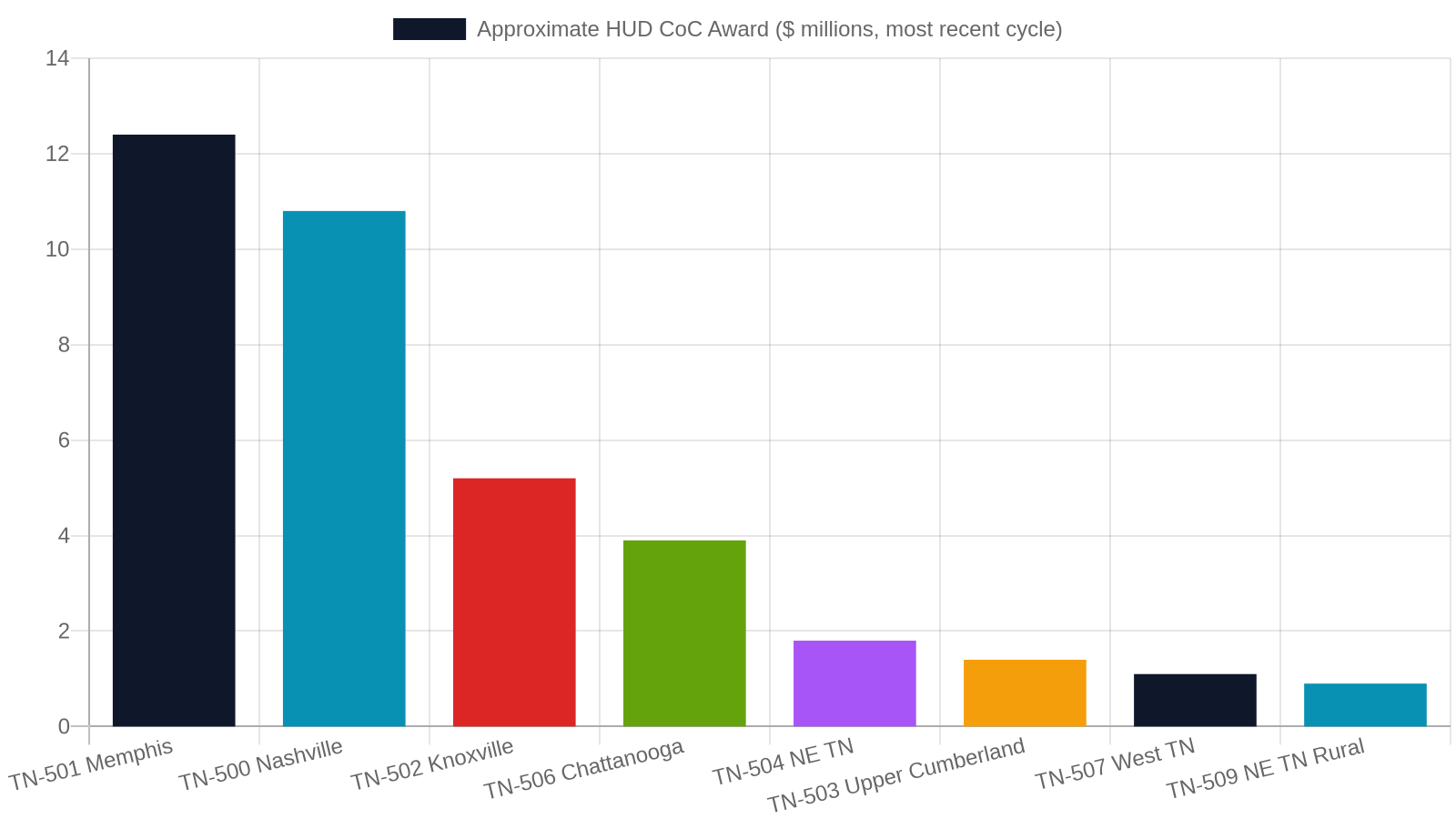
TN-501 (Memphis/Shelby County) is Tennessee’s largest CoC by population and receives the state’s largest share of HUD CoC funding — over $12 million in the most recent award cycle. Memphis has invested heavily in Coordinated Entry for youth, with Youth Villages and Memphis MIFA operating the youth track. TN-500 (Nashville/Davidson) receives the second-largest allocation and has the most developed youth-specific infrastructure, including YHDP-aligned planning and multiple youth-only RRH and TH programs.
TN-507 (Western Tennessee/Jackson area) covers a large rural swath and faces unique challenges: fewer shelter beds, longer travel distances to services, and a smaller provider ecosystem. ESG outreach dollars in this region are critical because many youth are hidden in rural homelessness — staying in cars, motels, or with extended family in overcrowded conditions.
East Tennessee: Knoxville, Chattanooga, and Northeast TN
TN-502 (Knoxville/Knox County) has a robust provider network including KARM, Volunteer Ministry Center, and Restoration House, funded through a combination of CoC, ESG, and local government dollars. Knoxville’s CoC has prioritized youth in its most recent strategic plan, adding youth-specific beds and a dedicated youth coordinated entry track.
TN-506 (Chattanooga/Hamilton County) has seen significant growth in youth-focused services, with CADAS and Chattanooga Room in the Inn expanding TAY programming. TN-509 (Northeast Tennessee) and TN-503 (Upper Cumberland) are smaller CoCs where every funded bed matters — these regions have successfully leveraged state ESG pass-through dollars to maintain outreach capacity even in years when federal CoC awards were flat.
9. How YAAB Tennessee Shapes These Initiatives From the Inside

Funding is only as good as the people who shape how it’s used. YAAB Tennessee exists to make sure young adults with lived experience are in the room — not as tokens, but as real decision-makers who influence where millions of dollars go and how programs are designed.
Youth Voice Is Built Into the Funding Process
It’s not enough to have programs — those programs need to actually work for the young adults they’re supposed to serve. That’s where the Youth Action Board (YAAB) of Tennessee comes in. YAAB members — young adults ages 17 to 25 with lived experience of homelessness — sit at the table when CoC regions make decisions about how to use their HUD funding. They provide feedback on program design, flag gaps in services, and advocate for policy changes at the local and state level.
HUD’s CoC Program regulations encourage — and in some cases require — meaningful youth participation in CoC governance. YAAB’s presence in Tennessee’s CoC regions helps ensure that requirement is more than a checkbox. Young people who’ve actually experienced the system are the most credible voices for improving it.
YAAB's Advocacy Work and Policy Impact
Beyond program-level feedback, YAAB members in Tennessee have engaged in state-level advocacy on issues including:
- Expanding Medicaid coverage for young adults aging out of foster care
- Increasing the age of extended foster care eligibility
- Pushing for more youth-specific beds in CoC funding competitions
- Advocating for low-barrier shelter policies that don’t exclude young adults with criminal records or substance use histories
This advocacy is funded through YAAB’s organizational infrastructure and supported by national partners. When you join a local YAAB, you’re not just getting support — you’re joining a movement that is actively changing the policies and programs that affect young adults across Tennessee. Learn more about YAAB’s advocacy work and how you can get involved.
Ready to Get Involved? Here's Your Next Move

You’ve just read about millions of dollars in funded programs, dozens of organizations, and eight regional CoC systems — all working to reduce youth homelessness across Tennessee. That’s real. But the most powerful thing in this whole ecosystem is you — a young adult who knows what it’s actually like and who can help make these systems better for everyone who comes after you.
Find Your Local YAAB and Connect to Resources
If you’re a young adult in Tennessee ages 17 to 25 — whether you’re currently experiencing housing instability, have in the past, or just want to use your experience to help others — there’s a place for you in YAAB. Local YAABs operate in every major CoC region, and membership is open to young adults who want to shape the systems that affect their lives.
Start by visiting the local YAABs page to find the chapter in your region. From Memphis to Northeast Tennessee, there are young adults just like you already doing this work — and they want you at the table.
See What YAAB Is Working on Right Now
YAAB Tennessee is always running new projects — from policy advocacy campaigns to peer support initiatives to community events. The best way to stay connected and see what’s happening is to explore YAAB’s current projects and initiatives, where you can see exactly what young adults across Tennessee are working on and how you can plug in.
Whether you’re in Memphis, Nashville, Knoxville, Chattanooga, Jackson, or a rural corner of the state, the resources, the community, and the movement are here. You don’t have to navigate any of this alone — and your voice matters more than you might think.
Frequently Asked Questions
What programs help young adults experiencing homelessness in Tennessee?
Tennessee funds several programs specifically for young adults ages 17–25, including Rapid Rehousing, Transitional Housing, street outreach, drop-in centers, and Permanent Supportive Housing through its eight Continuum of Care regions. Federal programs like WIOA Youth and Chafee Education and Training Vouchers also provide employment and education support for youth experiencing or at risk of homelessness.
How do I find a shelter or housing program for youth in Tennessee?
Contact your local Continuum of Care's Coordinated Entry system — this is the official front door to most funded housing programs. You can also call 211 (Tennessee's social services helpline), visit a local drop-in center, or check YAAB Tennessee's resource page at yaabtn.org/resources/ for region-specific referrals.
What is the Youth Action Board (YAAB) of Tennessee?
YAAB Tennessee is a statewide network of young adults ages 17 to 25 with lived experience of homelessness who advise local and state leaders, drive policy advocacy, and connect peers to housing and support services. YAAB has chapters in every major Tennessee CoC region and is open to young adults who want to get involved.
Can I get help with housing if I aged out of foster care in Tennessee?
Yes. Tennessee offers Voluntary Extension of Foster Care up to age 21, Chafee Independent Living services, and Education and Training Vouchers (up to $5,000/year) for eligible youth who aged out of foster care. Several CoC-funded transitional housing programs also specifically prioritize youth aging out of care.
What is a Continuum of Care (CoC) and how does it affect me as a young adult in Tennessee?
A Continuum of Care is a regional planning body that coordinates homeless services and applies for HUD funding on behalf of local providers. Tennessee has eight CoC regions. The CoC in your area decides which programs get funded, how Coordinated Entry works, and what housing options are available — which is why YAAB's involvement in CoC governance directly affects young adults.
Are there paid jobs or career pathways in youth homelessness services for young adults with lived experience?
Yes. Tennessee funds Certified Peer Recovery Specialist (CPRS) roles inside many CoC-funded organizations — these are paid positions for people with lived experience of homelessness or behavioral health challenges. The CPRS certification requires about 40 hours of training through TDMHSAS and is a real career pathway in the helping field.