10 Best Jobs and Career Resources for Tennessee Young Adults Ages 18–25
Quick answer: Tennessee offers a strong network of free and low-cost career resources built specifically for young adults ages 18–25 — including workforce development centers, registered apprenticeships, community college job-training programs, and peer-led advocacy groups like YAAB. Whether you’re searching for your first job, building a trade skill, or recovering from a period of housing instability, programs like Tennessee Reconnect, Jobs for Tennessee Graduates, and local American Job Centers can connect you to paid training, résumé help, and real employment in every region of the state.
1. Why Career Resources Matter for Transition-Age Youth in Tennessee
Landing a steady job is one of the most powerful steps any young adult can take toward stable housing and long-term independence. For young people in Tennessee who have experienced homelessness or housing instability, the path to employment can feel especially steep — but it doesn’t have to be. Across the state, from Memphis and Nashville to Knoxville, Chattanooga, Jackson, and the Upper Cumberland, there are programs built specifically to meet you where you are and move you forward.
The Employment Gap for Youth Experiencing Homelessness
Research from the National Alliance to End Homelessness shows that roughly 4.2 million young adults ages 18–25 experience homelessness each year in the United States. In Tennessee, the Continuum of Care regions — from Memphis/Shelby County to Northeast TN — consistently identify unemployment and underemployment as top drivers of youth housing instability. Without a stable income, holding onto housing is nearly impossible.
The good news: Tennessee has invested heavily in workforce programs designed for exactly this population. Knowing where to look is the first step.
What 'Transition-Age Youth' Means for Employers and Programs
Transition-age youth (TAY) refers to young adults roughly ages 16–25 who are moving from youth systems — like foster care or juvenile justice — into adult independence. Many workforce programs use this definition to set eligibility, meaning you may qualify for extra support that older adults cannot access. Programs often cover paid work experience, transportation stipends, childcare assistance, and mentorship on top of job placement.
2. Tennessee American Job Centers — Your Free Statewide Starting Point
The single most accessible career resource in Tennessee is the American Job Center (AJC) network — and it costs you nothing to walk in. These federally funded centers exist in every major Tennessee region and are specifically designed to help job seekers at all experience levels, including young adults who are just starting out or rebuilding after a tough stretch.
What Services Are Free at an American Job Center?
American Job Centers (AJCs), operated through the Tennessee Department of Labor and Workforce Development, offer no-cost services including résumé writing workshops, mock interviews, job-search computers, career assessments, and connections to training funds. There are over 70 AJC locations across Tennessee, with major hubs in Memphis, Nashville, Knoxville, Chattanooga, and Jackson.
Career counseling — one-on-one sessions with a workforce specialist
Workforce Innovation and Opportunity Act (WIOA) funding — can pay for certified training programs if you qualify
On-the-job training (OJT) — employers get reimbursed for training you while you earn a paycheck
Registered apprenticeship referrals — connect to earn-and-learn programs in trades and tech
How to Qualify for WIOA Youth Services (Ages 18–24)
WIOA Title I Youth funding is specifically reserved for young adults ages 14–24 who face barriers to employment. If you are homeless, in foster care, or lack a high school diploma, you are likely eligible. To apply, visit your nearest AJC and ask for a WIOA Youth intake. Staff will walk you through a barrier assessment. If approved, you can access paid work experiences, occupational skills training, financial literacy workshops, and leadership development — all covered by the program.
Find your nearest center at TNWorkReady.com or call 1-800-255-5872.
3. Tennessee Reconnect — Free Community College for Adults 18+
You don’t need a four-year university to build a career that pays well and offers stability. Tennessee has invested more than $1 billion in Tennessee Promise and Tennessee Reconnect since 2015, making it one of the most accessible free-college states in the country. For young adults who need a fast, affordable path to a credential, this is one of the most powerful tools available.
What Tennessee Reconnect Covers
Tennessee Reconnect is a last-dollar scholarship that covers tuition and mandatory fees at Tennessee’s 13 community colleges and 27 Tennessee College of Applied Technology (TCAT) campuses for adults 21 and older who don’t already have a college degree. Adults ages 18–20 may qualify through the related Tennessee Promise program. Together, these two programs make short-term workforce certificates and two-year associate degrees essentially free for most Tennessee young adults.
Eligible programs include healthcare, IT, skilled trades, business, and early childhood education
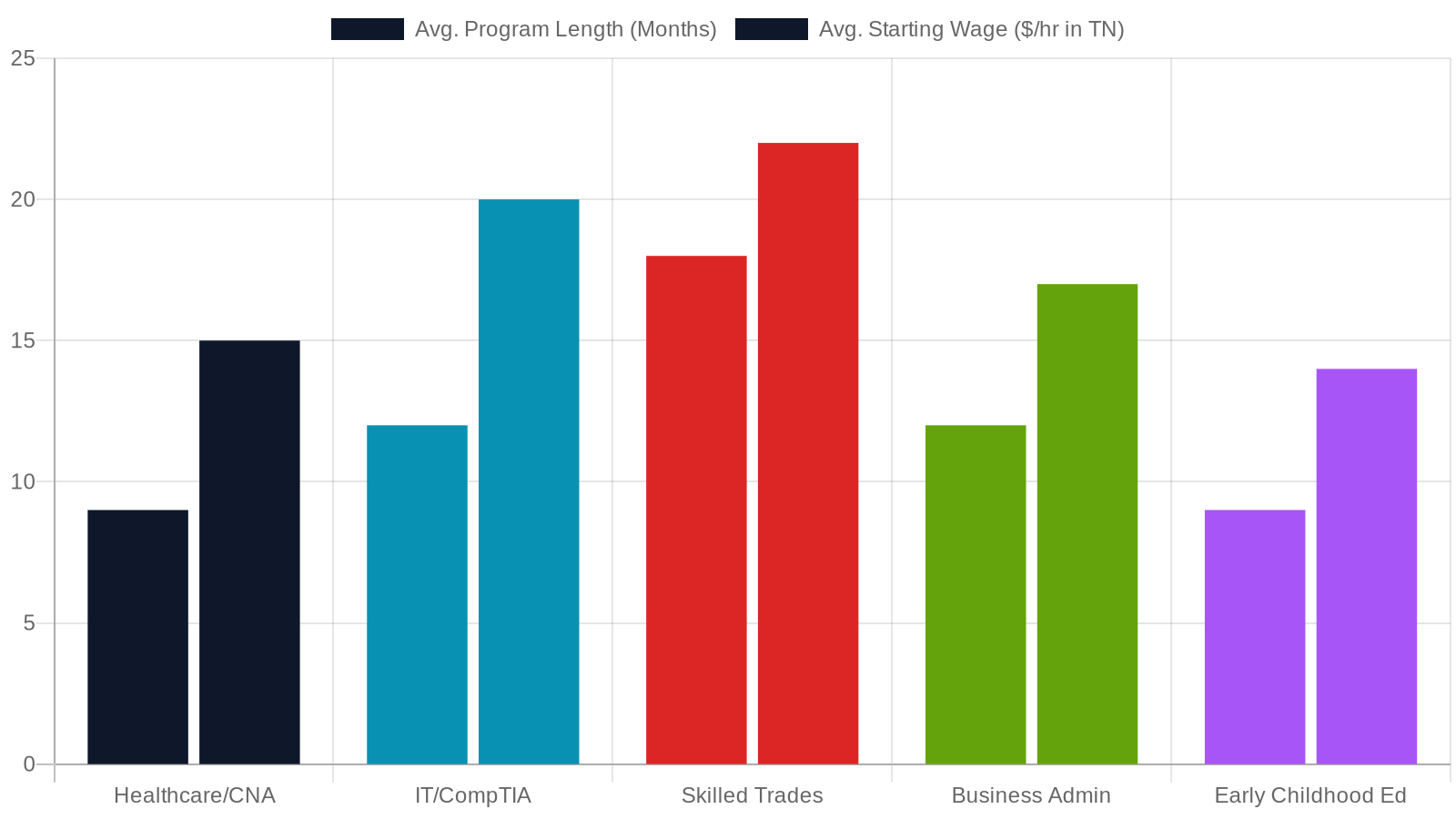
Average TCAT certificate programs run 9–18 months
Many programs lead directly to industry-recognized credentials like CompTIA, OSHA 30, and Certified Nursing Assistant (CNA)
How to Apply and What to Expect
To apply for Tennessee Reconnect, complete the Free Application for Federal Student Aid (FAFSA) and then submit the Tennessee Reconnect application at TNReconnect.gov. The process takes about 20 minutes. Once approved, choose a community college or TCAT campus near you. Advisors at every campus are trained to work with adult learners who may have gaps in their education history — you will not be judged for starting over.
Many campuses also offer emergency funds, food pantries, and childcare referrals to help you stay enrolled once you start.
Approximate program lengths and average Tennessee starting wages for common TCAT certificate tracks. Source: Tennessee Department of Labor and TN Board of Regents wage data.
4. Jobs for Tennessee Graduates (JTG) — Staying Connected After High School
For young adults who are 18–21 and recently out of high school — or who left school without finishing — Jobs for Tennessee Graduates is one of the most proven pathways to stable employment in the state. The program blends career skills training with real employer connections and ongoing coaching, making it more than just a résumé workshop.
What JTG Offers Young Adults
Jobs for Tennessee Graduates (JTG) is a school-to-career program operating in more than 70 Tennessee high schools and alternative education settings. But its reach doesn’t stop at graduation — JTG specialists provide 12 months of follow-up support after a student leaves the program, helping young adults ages 18–21 find and keep employment. Services include job-readiness training, career exploration, and direct employer connections.
JTG has served more than 200,000 Tennessee youth since its founding in 1979
The program reports a 90%+ positive outcome rate (employment, military, or further education) among completers
Alternative-school and GED-track students are actively recruited — you don’t need a traditional diploma to participate
How to Connect with JTG as a Young Adult
If you didn’t go through JTG in high school, you can still connect through your local American Job Center or by contacting JTG directly at jtg.org. Case managers and workforce specialists across Tennessee’s Continuum of Care regions often refer transition-age youth to JTG as a bridge to employment. The program is especially strong in Memphis, Nashville, Knoxville, and Chattanooga — the four largest metro regions in the state.
5. Registered Apprenticeships — Get Paid While You Train
Apprenticeships are one of the best-kept secrets in career development for young adults — you earn a real paycheck from day one, graduate with zero student debt, and hold a credential that employers across the country recognize. Tennessee has been expanding its registered apprenticeship network significantly, with over 7,000 active apprentices statewide as of 2023.
How Apprenticeships Work in Tennessee
A registered apprenticeship is a formal earn-and-learn program where you work for an employer, get paid a real wage, and receive structured on-the-job training alongside classroom instruction. The U.S. Department of Labor registers these programs, meaning your credential is nationally recognized. In Tennessee, apprenticeships are available in over 30 occupations, including electrical, plumbing, HVAC, construction, IT, healthcare, and advanced manufacturing.
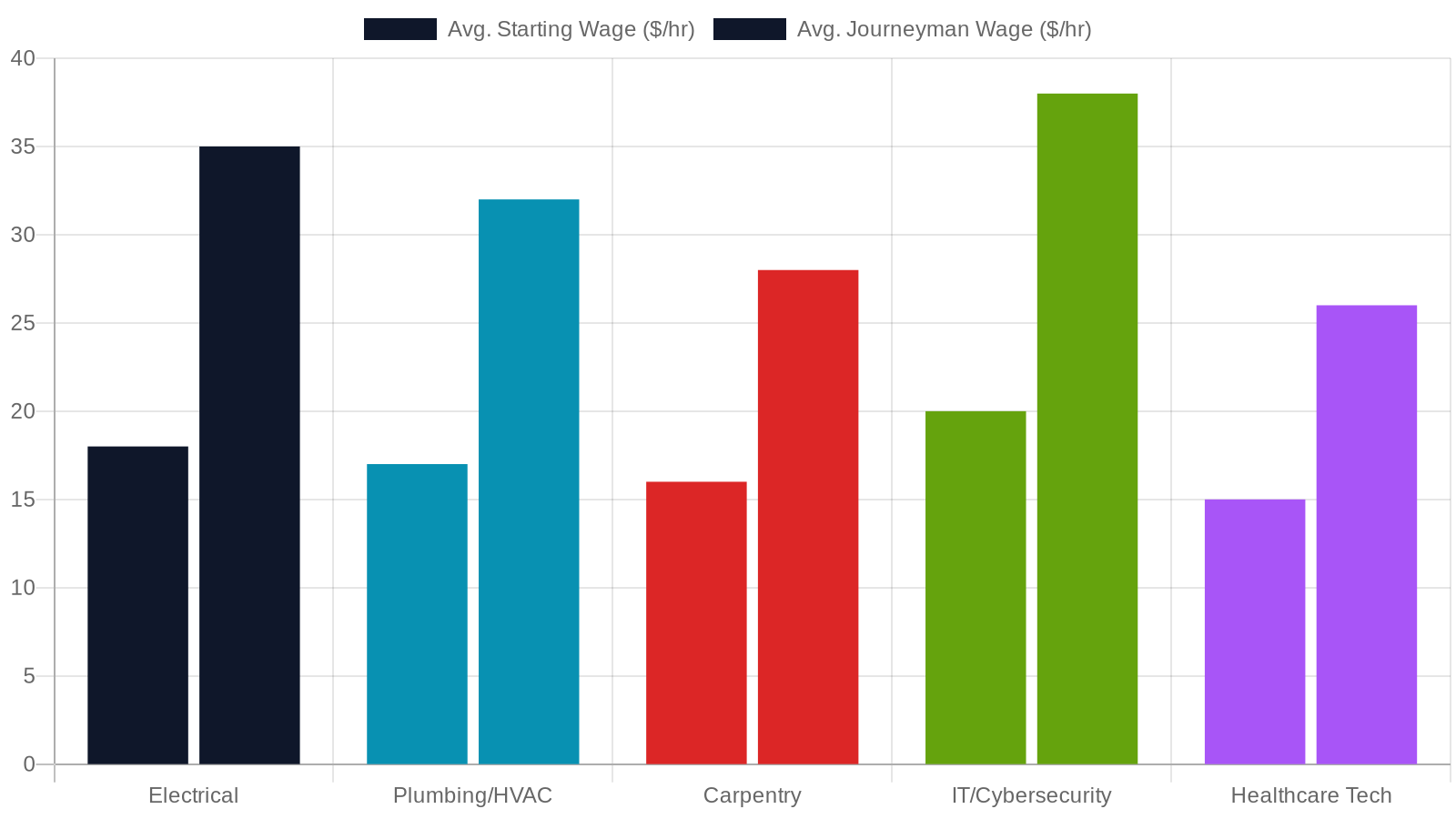
Starting wages typically range from $15–$22/hr, rising as you advance through the program
Programs last 1–5 years depending on the trade
Apprentices earn industry-recognized journeyman credentials upon completion — no student debt required
Finding Apprenticeships in Your Tennessee Region
The Tennessee Department of Labor and Workforce Development maintains an apprenticeship portal at tn.gov/workforce/apprenticeship. You can also search apprenticeship.gov and filter by Tennessee zip code. Local union halls — including IBEW (electrical), UA (plumbing), and Carpenters Union chapters in Memphis, Nashville, and Knoxville — accept applications year-round. Your nearest American Job Center can also match you with registered apprenticeship sponsors actively hiring in your area.
Approximate Tennessee wage ranges for registered apprenticeship trades. Journeyman wages reflect completion of full program. Source: U.S. DOL Apprenticeship.gov and TN Labor wage data.
6. GED and High School Equivalency Pathways That Connect to Jobs
A high school diploma or equivalency credential unlocks doors to employment, training programs, and higher education. If you left school before graduating, getting your HiSET (Tennessee’s high school equivalency credential) is one of the highest-return moves you can make — and Tennessee makes it free. Across all seven Continuum of Care regions, adult education centers are specifically set up to serve young adults who are working, parenting, or navigating housing instability at the same time.
Free GED Prep in Tennessee
Not having a high school diploma is one of the most common barriers young adults face when applying for jobs or training programs — but it’s also one of the most fixable. Tennessee offers free adult education classes through the Tennessee Department of Labor and Workforce Development at more than 100 locations statewide. These classes prepare you for the HiSET exam, Tennessee’s high school equivalency test (similar to the GED). Classes are free, and testing fees can be waived for low-income applicants.
Classes are available in-person and online
Average time to complete: 3–6 months with consistent attendance
Many sites offer evening and weekend hours to work around jobs or childcare
Stacking a Diploma with a Career Credential
Tennessee’s adult education system is designed to stack credentials — meaning you can earn your HiSET and a workforce certificate at the same time through co-enrollment at a TCAT campus. This approach cuts your total time to employment significantly. Programs like Integrated Education and Training (IET) combine basic skills instruction with occupational training in fields like welding, logistics, and healthcare. Ask your adult education center about IET options in your region.
7. Regional Workforce Programs Across Tennessee's 7 CoC Areas
Tennessee’s workforce resources are not one-size-fits-all — each of the state’s seven Continuum of Care regions has its own mix of employers, training programs, and local organizations. Knowing what’s available in your specific region is key to finding the fastest path to employment. Below is a regional breakdown of standout programs across the state.
Memphis/Shelby and West Tennessee
Memphis is home to several strong youth employment programs. SRVS Works, Memphis Goodwill Industries, and the Memphis Urban League Young Professionals all offer job training and placement for young adults. The Shelby County Mayor’s Youth Employment Program hires young adults ages 16–24 for paid summer and year-round positions. In Jackson and West Tennessee, the West Tennessee Workforce Board administers WIOA youth funding through local AJCs in Jackson, Dyersburg, and Union City.
Nashville/Davidson and Middle Tennessee
Nashville’s booming economy means high demand for workers in healthcare, hospitality, logistics, and construction. Key resources include Nashville Career Advancement Center (NCAC), Conexión Américas (bilingual workforce services), and The Next Door (employment for women with barriers). The Upper Cumberland Development District serves Cookeville, Crossville, and surrounding counties with WIOA youth services and adult education co-enrollment programs.
Knoxville/Knox, Chattanooga/Hamilton, and Northeast Tennessee
In Knoxville, Workforce Connections and the Helen Ross McNabb Center both support transition-age youth with employment and housing services. Chattanooga has invested heavily in tech workforce development through Chattanooga State’s workforce division and the Company Lab (Co.Lab) entrepreneurship hub. In Northeast Tennessee (Johnson City, Kingsport, Bristol — the Tri-Cities), the Northeast Tennessee Workforce Board funds youth employment programs through local AJCs and community colleges.
Tennessee Career Resources at a Glance — 10-Point Comparison
Use this table to quickly compare the top career and workforce resources available to Tennessee young adults ages 18–25 by eligibility, cost, and what you get.
Resource
Age Range
Cost to You
Key Benefit
Where to Start
American Job Centers (AJC/WIOA)
18–24 (youth services)
Free
Paid work experience, training funds, job placement
8. Building Your Résumé and Interview Skills — Free Tools That Work
Even the best workforce program can’t get you hired if your résumé doesn’t open doors or your interview skills aren’t sharp. The good news: both are learnable, and Tennessee offers free tools to help you build both from scratch — no prior experience required. Young adults who invest even a few hours in these skills dramatically improve their hiring outcomes.
Free Online Résumé Builders for Young Adults
You don’t need to pay anyone to write your résumé. Several free tools are built specifically for people with limited work history:
MyTNSkills.com — Tennessee’s official career planning portal includes a résumé builder tied to your job history and skills assessments
Canva.com — free, visually polished résumé templates that work well for creative and service-industry roles
LinkedIn.com — free profile that doubles as a living résumé; many Tennessee employers search LinkedIn directly
Google Docs Résumé Templates — clean, ATS-friendly formats that most employers’ applicant tracking systems can read correctly
Pro tip: tailor your résumé to each job description by mirroring the exact words the employer uses. Applicant tracking systems often filter out résumés that don’t match keywords.
Mock Interview Practice Resources
Interviewing is a skill you can practice and improve. American Job Centers across Tennessee offer free mock interview sessions with workforce specialists. The Big Interview platform (free through many public libraries) uses AI to simulate real interview questions and give feedback on your answers. Tennessee public library cardholders also get free access to LinkedIn Learning, which includes dozens of interview prep courses. Practice answering the most common questions: Tell me about yourself, Why do you want this job?, and What’s your greatest strength? — out loud, not just in your head.
9. Financial Literacy and Benefits Navigation — Making Your Income Work
Landing a job is a huge win — but financial stability requires more than a paycheck. Understanding how to manage money, avoid predatory lenders, build credit, and navigate benefits is just as important as the job itself. Tennessee has several free resources to help young adults build financial confidence alongside their career momentum. You can also find a curated list of financial literacy tools at the YAAB Tennessee resources page.
Opening a Bank Account and Building Credit
Getting paid is only step one — keeping and growing your money is the next challenge. If you don’t have a bank account, start with a Bank On certified account: these are low-fee or no-fee checking accounts available at banks and credit unions across Tennessee that don’t require a minimum balance or a credit check. Search joinbankon.org to find certified accounts near you.
To start building credit, consider a secured credit card (you deposit $200–$500 as collateral) or a credit-builder loan from a local credit union. Using either responsibly for 6–12 months can establish a credit score that helps you rent an apartment, finance a car, or eventually buy a home.
Benefits That Don't Penalize You for Working
Many young adults worry that getting a job will cause them to lose benefits like Medicaid or food assistance (SNAP). In Tennessee, Medicaid (TennCare) has an income threshold — but earning a moderate income doesn’t automatically cut you off immediately. SNAP also has a graduated phase-out. The key is to report income changes promptly and ask your case manager about the benefits cliff — the point at which earning more could reduce your net income. Programs like Benefits.gov and Tennessee’s 211 helpline can model how a new job affects your benefits before you accept an offer.
10. YAAB Tennessee — Turning Lived Experience Into Leadership and Career Skills
Every resource on this list is more powerful when you have a community behind you. The Youth Action Board of Tennessee connects young adults across the state who are building careers, advocating for better systems, and supporting each other through the process. YAAB is peer-led, statewide, and built on the belief that young people with lived experience are the experts on what transition-age youth actually need.
How YAAB Builds Career-Ready Skills
The Youth Action Board (YAAB) of Tennessee isn’t just an advocacy organization — it’s also a real-world career development experience. YAAB members develop public speaking, policy research, data analysis, community organizing, and leadership skills that employers in the nonprofit, government, healthcare, and education sectors actively seek. Participating in YAAB gives you concrete résumé entries: advisory board member, community advocate, policy researcher, peer educator.
These are not small credentials. Many YAAB alumni have gone on to careers in social work, public health, housing policy, and community development — fields that are growing rapidly across Tennessee.
Finding Your Local YAAB and Getting Involved
YAAB operates across all seven of Tennessee’s Continuum of Care regions, including Memphis/Shelby, Nashville/Davidson, Knoxville/Knox, Chattanooga/Hamilton, Jackson/West TN, Upper Cumberland, and Northeast TN. Each regional YAAB meets regularly, connects members to local resources, and feeds into statewide advocacy efforts. If you’re a young adult ages 17–25 with lived experience of homelessness or housing instability, you belong here.
To find your regional YAAB and learn how to join, visit the local YAABs page or head to Get Involved to take the first step. Your experience is not a liability — it’s exactly what makes YAAB powerful.
Your Next Move — Start With One Step Today
You don’t have to figure out your career path alone, and you don’t have to do everything at once. Tennessee has invested real money and real programs into making sure young adults ages 18–25 have a path forward — whether you’re looking for your first job, finishing your education, learning a trade, or building leadership skills through advocacy. The resources are here. The community is here. Start with one step today.
Make a 48-Hour Action Plan
The biggest barrier to using career resources is often just not knowing where to start. Here’s a simple 48-hour plan:
Today: Visit TNWorkReady.com or call 1-800-255-5872 to find your nearest American Job Center and schedule an appointment
Today: Check your eligibility for Tennessee Reconnect at TNReconnect.gov — it takes 10 minutes
Tomorrow: Create a free account on MyTNSkills.com and start your career profile
This week: Text or call 211 to connect with local housing, food, and employment resources in your Tennessee region
This week: Explore joining YAAB Tennessee and connect with peers who are on the same journey
You Already Have What It Takes
Navigating housing instability, aging out of foster care, or starting over takes resilience, problem-solving, and courage — skills that every employer values, even if they don’t always know how to ask for them. The resources in this guide exist because Tennessee has recognized that transition-age youth deserve real support, not just sympathy. Use them. Share them with a friend. And if you want to help shape the programs that serve young adults across Tennessee, get involved in YAAB’s advocacy work — your voice matters more than you know.
Frequently Asked Questions
What jobs are available for 18-year-olds with no experience in Tennessee?
Tennessee has strong entry-level hiring in retail, food service, warehousing, and healthcare support roles like CNA and patient transport. American Job Centers can connect you to employers actively hiring young adults with no prior experience, and WIOA youth funding can pay for short-term training to boost your qualifications quickly.
Can I get free job training in Tennessee if I'm homeless or unstable housing?
Yes. WIOA Title I Youth funding specifically prioritizes young adults who are homeless or in unstable housing. Visit your nearest American Job Center and ask for a WIOA Youth intake — if you qualify, training, work experience, and support services are covered at no cost to you.
Does Tennessee Reconnect cover job training programs or just college degrees?
Tennessee Reconnect covers both. It applies to short-term workforce certificates at Tennessee Colleges of Applied Technology (TCATs) — programs as short as 9 months in fields like welding, healthcare, and IT — as well as two-year associate degrees at community colleges.
What is YAAB Tennessee and how can it help my career?
YAAB (Youth Action Board) Tennessee is a statewide network of young adults ages 17–25 with lived experience of homelessness who advise policymakers and advocate for better youth services. Membership builds real career skills — public speaking, policy research, community organizing — and provides a peer community across all seven Tennessee regions.
Will getting a job cause me to lose my TennCare or SNAP benefits in Tennessee?
Not immediately. Both TennCare and SNAP have income thresholds with gradual phase-outs rather than abrupt cutoffs. Before accepting a job offer, call 211 or ask your case manager to walk you through how your specific benefits will be affected at different income levels.
How do I find apprenticeship programs near me in Tennessee?
Search apprenticeship.gov and filter by your Tennessee zip code, or visit your nearest American Job Center and ask about registered apprenticeship sponsors actively hiring in your area. The Tennessee Department of Labor also maintains a statewide apprenticeship portal at tn.gov/workforce/apprenticeship.