Quick answer: The Youth Action Board (YAAB) of Tennessee is a statewide network of young adults ages 17 to 25 who have lived experience with homelessness or housing instability. YAAB members advise local governments, shape housing policy, and connect peers to real resources across eight Continuum of Care regions — from Memphis to Northeast Tennessee. Getting involved means your voice drives decisions that affect thousands of young people like you, while you build leadership skills, earn stipends, and access a powerful support network.
1. What YAAB Actually Is (and What It Isn't)

Before you can decide whether YAAB is right for you, you need a clear picture of what it actually is. The Youth Action Board of Tennessee is a statewide network of young adults ages 17 to 25 who have lived experience of homelessness or housing instability. YAAB members don’t just receive services — they shape the systems that deliver those services. That’s the core idea, and it changes everything about how the organization operates.
A Peer-Led Network, Not a Service Program
YAAB is not a shelter, a case management program, or a charity handing out resources — it is a peer-led advocacy network. That distinction matters. Every member is a young adult between 17 and 25 who has personally experienced homelessness or housing instability. Members are the experts in the room, not the recipients of someone else’s expertise.
- Members advise Continuum of Care (CoC) boards and local government leaders.
- They review and influence policies before those policies are finalized.
- They connect peers to housing, employment, education, and mental health resources.
Think of YAAB as the place where people who know what it’s like get a real seat at the table — and use it.
The Continuum of Care Connection
Tennessee is divided into eight Continuum of Care (CoC) regions, each responsible for coordinating homeless services in its area. YAAB has a local chapter — called a local YAAB — embedded in each of these regions. That means whether you’re in Memphis/Shelby County, Nashville/Davidson, Knoxville/Knox, Chattanooga/Hamilton, Jackson/West Tennessee, Upper Cumberland, or Northeast Tennessee, there is a YAAB chapter near you.
Each local YAAB feeds into the statewide network, so the lived experience gathered at the community level actually reaches state-level decision makers. It’s a bottom-up pipeline for youth voice that most states simply don’t have.
2. The 8 Regions Where YAAB Operates

One of YAAB’s greatest strengths is that it isn’t a single office in Nashville making decisions for the whole state. It’s a network of eight regional chapters, each rooted in its own community. Understanding which chapter covers your area is the first step toward getting plugged in — and toward making sure your local issues get heard at every level of government.
Finding Your Local Chapter
Each of Tennessee’s eight CoC regions has its own local YAAB chapter, identified by a CoC code. Here’s a quick breakdown of where each chapter operates:
- TN-500: Memphis/Shelby County
- TN-501: Nashville/Davidson County
- TN-502: Knoxville/Knox County
- TN-503: Chattanooga/Hamilton County
- TN-504: Jackson/West Tennessee
- TN-506: Upper Cumberland
- TN-507: Northeast Tennessee
- TN-509: Balance of State
Each chapter holds its own meetings, sets its own local advocacy priorities, and connects members to region-specific resources. Your local YAAB is your starting point.
Why Regional Structure Matters for You
A single statewide board could easily lose sight of what’s happening on the ground in rural Northeast Tennessee versus urban Memphis. The regional structure ensures that local problems get local attention. If your CoC region is struggling with a shortage of transitional housing beds, your local YAAB can raise that issue directly with the CoC board — and escalate it to the state level if needed.
Regional chapters also mean you’re building relationships with people in your own community — peers, service providers, and local officials who actually control resources in your area. That local network has real, immediate value for your own stability and career.
3. Who Can Join YAAB

YAAB is designed to be accessible. There are no complicated application portals, no GPA requirements, and no income thresholds to clear. The question YAAB asks is simple: Have you lived it? If housing instability has been part of your story as a young adult in Tennessee, you already have what it takes to be a YAAB member.
The Core Eligibility: Lived Experience
The primary requirement for YAAB membership is lived experience of homelessness or housing instability between the ages of 17 and 25. This includes:
- Experiencing literal homelessness (sleeping outside, in a shelter, in a car)
- Couch surfing or staying in unsafe or overcrowded housing
- Aging out of foster care without stable housing
- Being at imminent risk of losing housing
You don’t need a résumé. You don’t need a college degree. You need your own story — and the willingness to use it to help others navigate the same systems you’ve faced.
Youth Aging Out of Foster Care
Tennessee’s foster care system transitions young people out at age 18 (with some extended support to 21 under the state’s Extended Foster Care program). Research from the National Alliance to End Homelessness shows that former foster youth are 2 to 3 times more likely to experience homelessness than their peers. YAAB specifically welcomes young adults who have aged out of foster care, because their experience with multiple systems — child welfare, housing, education — gives them a uniquely powerful perspective for advocacy.
If you’ve aged out of foster care in Tennessee and are navigating housing instability, YAAB is one of the most direct pathways to both peer support and systemic change.
Allies, Case Managers, and CoC Partners
While YAAB membership is centered on young adults with lived experience, case managers, CoC partners, and service providers play an important supporting role. They can attend YAAB meetings as allies, learn directly from members about what’s working and what isn’t, and help amplify YAAB’s policy recommendations within their own organizations. If you work with transition-age youth in Tennessee, engaging with your local YAAB chapter is one of the most effective ways to ensure your services actually meet young people’s needs.
4. What YAAB Members Actually Do Day to Day

Joining YAAB isn’t just about attending meetings. Members take on real responsibilities with real impact — from shaping multi-million-dollar funding decisions to helping a peer find a safe place to sleep tonight. Here’s what that looks like in practice across a typical month.
Advising CoC Boards and Local Leaders
YAAB members attend Continuum of Care board meetings and present youth perspectives on housing policy, resource allocation, and program design. This isn’t symbolic — CoC boards in Tennessee are required to incorporate youth voice into their planning processes under federal HUD guidelines. When a CoC is deciding how to allocate millions of dollars in Emergency Solutions Grants or Continuum of Care Program funds, YAAB members are in the room helping shape those decisions.
Members may also testify before city councils, county commissions, and state legislative committees. In 2023, YAAB members provided direct testimony that influenced housing policy discussions at the Tennessee General Assembly level.
Peer Outreach and Resource Connection
Beyond formal policy work, YAAB members do on-the-ground peer outreach. They connect other young adults to:
- Emergency shelter and transitional housing programs
- Rapid Rehousing assistance through local CoC providers
- GED and workforce training programs
- Mental health and substance use support services
- Benefits navigation — Medicaid, SNAP, TennCare
Because YAAB members have navigated these systems themselves, they know how to explain them in plain language — and they know which programs actually deliver. That peer credibility is something no professional case manager can fully replicate.
Driving Advocacy Campaigns
YAAB members don’t just respond to policy — they initiate it. Local and statewide YAAB chapters identify priority issues, develop advocacy platforms, and run campaigns to push for change. Past focus areas have included expanding affordable housing stock for transition-age youth, improving discharge planning from hospitals and correctional facilities, and increasing access to mental health services for young adults experiencing homelessness. Members learn how to write policy briefs, organize community meetings, and use social media to amplify their message.
5. The Real Benefits of YAAB Membership

Getting involved with YAAB isn’t just about giving back — it’s also about investing in yourself. Members gain tangible benefits that support their stability, build their résumé, and grow their network. Here’s what you can realistically expect when you join.
Stipends and Financial Support
YAAB members are compensated for their time and expertise. Stipends are provided for participation in meetings, trainings, and advocacy activities — recognizing that young adults with lived experience of housing instability cannot be expected to volunteer their labor for free. The specific stipend amounts vary by region and available funding, but the principle is consistent: your knowledge and time have value, and YAAB treats them that way.
Some members also access travel reimbursement for attending statewide convenings, and certain leadership roles come with additional compensation. Check with your local YAAB chapter for current stipend structures.
Leadership and Professional Development
YAAB is one of the most intensive leadership development experiences available to transition-age youth in Tennessee. Members gain hands-on experience in:
- Public speaking and testimony
- Policy analysis and brief writing
- Community organizing and outreach
- Meeting facilitation and group decision-making
- Data literacy — understanding how CoC point-in-time counts and HMIS data shape funding decisions
These are skills that translate directly into careers in social work, public policy, nonprofit management, community health, and beyond. Many former YAAB members have gone on to paid positions with CoC partner agencies, state government offices, and national advocacy organizations.
Community, Belonging, and Peer Support
Perhaps the most underrated benefit of YAAB is the community. Housing instability is isolating. YAAB puts you in a room — virtual or in-person — with other young adults who get it, who’ve been there, and who are choosing to do something about it. That sense of belonging and mutual accountability is something that’s hard to quantify but impossible to overstate. Members consistently report that the relationships they build through YAAB are among the most meaningful of their young adult lives.
6. Youth Homelessness in Tennessee: the Numbers Behind the Mission
Understanding the scale of youth homelessness in Tennessee isn’t about dwelling on hard numbers — it’s about knowing why YAAB’s work is urgent. Every statistic below represents a real young adult whose life could be changed by the policies YAAB members help shape.
What the Point-in-Time Count Tells Us
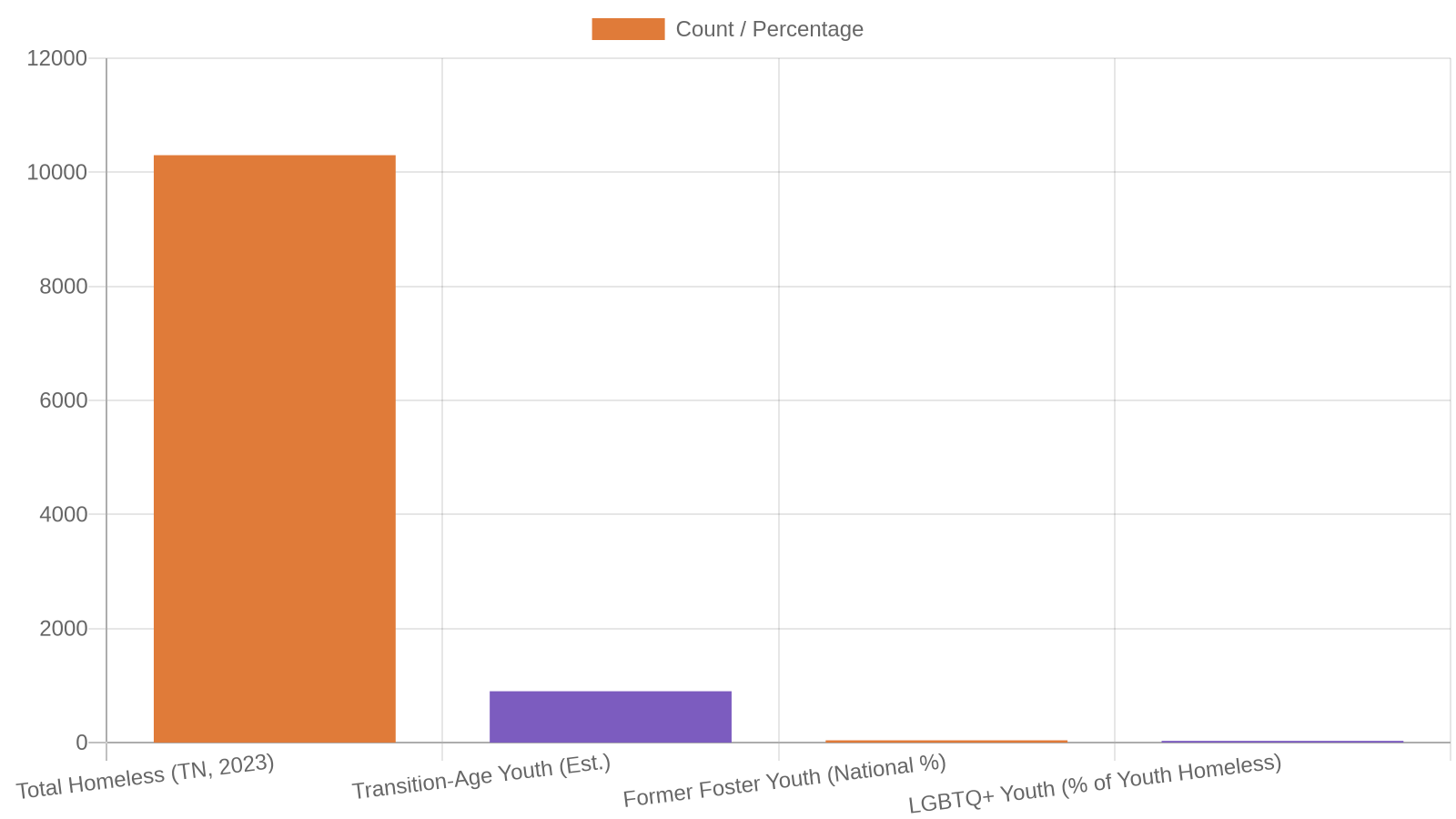
Every January, CoC regions across Tennessee conduct a Point-in-Time (PIT) count — a one-night snapshot of people experiencing homelessness. According to HUD’s 2023 Annual Homeless Assessment Report, Tennessee counted approximately 10,300 individuals experiencing homelessness on a single night, with transition-age youth (ages 18–24) representing roughly 8 to 10 percent of that total. That’s 800 to 1,000 young adults on any given January night — and PIT counts are widely understood to be significant undercounts of the true population.
Unaccompanied youth and young adults are especially likely to be missed because they often avoid shelters and stay in hidden locations — couch surfing, in cars, or in abandoned buildings.
The Specific Risks Facing Transition-Age Youth
Transition-age youth face a unique combination of risk factors that make homelessness both more likely and more dangerous:
- Aging out of foster care: An estimated 20,000 young people age out of foster care nationally each year; within 2–4 years, up to 40% experience homelessness.
- LGBTQ+ youth overrepresentation: National research consistently finds that LGBTQ+ young adults make up 20–40% of youth experiencing homelessness despite being roughly 7% of the general youth population.
- Lack of family support: Many transition-age youth cannot return to family homes due to conflict, abuse, or family homelessness itself.
- Employment barriers: Without stable housing, maintaining a job becomes exponentially harder — and without a job, stable housing remains out of reach.
7. How YAAB Shapes Policy: From Local to Statewide

YAAB doesn’t just talk about change — it creates pathways for young adults to directly influence the decisions that affect their lives. Understanding how that influence flows from the neighborhood level to the state capitol helps you see why your participation matters so much.
The CoC Governance Pipeline
Tennessee’s eight CoC regions each have a governance board that makes decisions about how federal homeless assistance funds are allocated. Under HUD’s CoC Program regulations (24 CFR Part 578), CoC boards are required to be inclusive of people with lived experience of homelessness. YAAB fills that requirement with substance — not just a token seat, but trained, prepared young advocates who show up with data, personal testimony, and specific policy recommendations.
When a CoC board in Memphis or Nashville decides which programs to fund, YAAB members have already reviewed the options, identified gaps, and drafted recommendations. That preparation is what separates meaningful participation from performative inclusion.
State-Level Advocacy and the Tennessee General Assembly
YAAB’s statewide structure allows it to aggregate local experiences into a coherent state-level policy agenda. Members have engaged with Tennessee state legislators on issues including:
- Expanding the Extended Foster Care program beyond age 21
- Increasing state investment in Rapid Rehousing for young adults
- Improving discharge planning from state facilities (hospitals, juvenile justice, corrections) to prevent homelessness at exit
- Strengthening tenant protections for young adults in private rental markets
State-level advocacy requires young adults who can speak to both personal experience and policy mechanics — and YAAB’s training programs build exactly that dual fluency.
Influencing Program Design at the Provider Level
Beyond government, YAAB members work directly with service providers — shelters, transitional housing programs, workforce development agencies — to improve how programs are designed and delivered. Members conduct focus groups, review intake processes, and provide feedback on whether programs are actually youth-friendly. This provider-level influence is often where change happens fastest, because program managers can adjust practices without waiting for legislation.
8. Resources YAAB Connects You To

One of the most immediate and practical reasons to connect with YAAB is access to a curated, peer-vetted network of resources. Members know which programs actually work, which ones have waitlists, and which ones are genuinely youth-friendly. Here’s a snapshot of what YAAB can help you navigate.
Housing and Shelter Pathways
YAAB members are trained to connect peers to the full range of housing resources available through Tennessee’s CoC system, including:
- Emergency Shelter: Short-term, safe places to sleep while longer-term options are arranged.
- Transitional Housing: Programs providing 6–24 months of supported housing with services like case management, life skills, and employment support.
- Rapid Rehousing (RRH): Short-term rental assistance and services to quickly move young adults from homelessness into permanent housing — the model with the strongest evidence base for transition-age youth.
- Permanent Supportive Housing (PSH): Long-term housing with wraparound services for young adults with disabilities or complex needs.
Education, Employment, and Financial Literacy
Stable housing is only one piece of the puzzle. YAAB connects members and peers to:
- GED and HiSET programs available through Tennessee’s Adult Education network — free for qualifying individuals.
- Tennessee Promise and Tennessee Reconnect — free community college pathways for eligible young adults.
- Workforce development programs including YouthBuild, Job Corps, and local American Job Centers.
- Financial literacy workshops covering budgeting, banking, credit building, and avoiding predatory lending — critical skills for young adults establishing financial independence for the first time.
Mental Health and Wellbeing
Housing instability takes a serious toll on mental health. YAAB acknowledges this openly and connects young adults to:
- Tennessee’s Crisis Services — call or text 988 (Suicide and Crisis Lifeline) for immediate support.
- Community mental health centers in each CoC region offering sliding-scale or no-cost counseling.
- Peer support specialists — trained individuals with their own lived experience who provide one-on-one support.
- Trauma-informed care programs specifically designed for young adults who have experienced housing instability, family conflict, or system involvement.
Explore the full YAAB Tennessee resources directory for region-specific listings updated by local chapter members.
YAAB vs. Other Youth Support Options: How They Compare
Not all youth programs are built the same. Here's how YAAB stacks up against other common options available to transition-age youth in Tennessee across five key dimensions.
9. YAAB vs. Other Youth Programs: How It Compares

If you’re weighing your options for how to spend your time and energy as a young adult in Tennessee, it helps to understand how YAAB fits into the broader landscape of youth programs and services. The comparison below lays out the key differences — and why YAAB offers something genuinely unique.
Why the Peer-Led Model Is Different
Most programs serving transition-age youth are delivered to young adults — case managers assess needs, providers deliver services, and young people receive them. YAAB flips this model. Members are co-designers and decision-makers, not recipients. Research on youth-led advocacy models consistently shows that peer-led approaches produce higher engagement, better outcomes, and more durable policy change than top-down service delivery alone.
A 2021 study by the True Colors United and Chapin Hall found that youth-led advocacy organizations were significantly more effective at influencing CoC policy than traditional service provider advocacy — precisely because decision-makers respond differently to lived testimony than to professional lobbying.
Complementary, Not Competing
It’s important to understand that YAAB is not in competition with shelters, case management programs, or transitional housing providers. It complements them. A young adult can be receiving services from a CoC provider and be an active YAAB member at the same time. In fact, many YAAB members first connected with the network through a service provider who referred them. The two roles — service recipient and policy advocate — are not mutually exclusive, and holding both simultaneously is a sign of strength, not conflict.
10. How to Join Your Local YAAB Chapter

Ready to get involved? The process is designed to be low-barrier and welcoming. Here’s exactly how to go from curious to active member in three steps — no complicated paperwork, no gatekeeping.
Step 1 — Find Your Region
Start by identifying which of Tennessee’s eight CoC regions covers your area. The eight regions are Memphis/Shelby (TN-500), Nashville/Davidson (TN-501), Knoxville/Knox (TN-502), Chattanooga/Hamilton (TN-503), Jackson/West TN (TN-504), Upper Cumberland (TN-506), Northeast TN (TN-507), and Balance of State (TN-509). Each has its own local YAAB chapter with its own meeting schedule, leadership team, and contact information. Visit the local YAABs directory to find the chapter nearest you.
Step 2 — Reach Out and Show Up
Joining is straightforward: reach out to your local chapter and attend a meeting. There’s no lengthy application process designed to screen people out — YAAB is designed to be accessible from day one. Many members describe their first meeting as the moment they realized their experience had value and their voice could matter. You don’t need to have your story perfectly packaged. You just need to show up.
If you’re not sure how to reach your local chapter, the YAAB contact page can connect you with the right people quickly.
Step 3 — Get Trained and Get Active
Once you’re connected, YAAB provides onboarding and training so you understand how CoC governance works, what your rights are as a member, and how to make your voice heard effectively. Training topics typically include:
- How the Continuum of Care system works and how funding decisions are made
- Public speaking and testimony skills
- Trauma-informed communication for peer outreach
- Data literacy: reading PIT count data and HMIS reports
- Self-advocacy and knowing your rights as a tenant and as a young adult
The goal is to make sure every member walks into every room feeling prepared and confident — not just present.
11. Stories of Impact: What YAAB Has Already Changed

It’s one thing to describe what YAAB does in theory. It’s another to see what it has actually changed in Tennessee’s housing and policy landscape. Here’s a look at real-world impact — the kind of change that happens when young adults with lived experience are genuinely empowered to lead.
Policy Wins Driven by Youth Voice
While individual member stories are kept confidential to protect privacy, YAAB as a network has contributed to measurable policy outcomes across Tennessee, including:
- Influencing CoC funding priorities to increase the share of resources directed toward Rapid Rehousing for transition-age youth in multiple regions.
- Providing testimony that shaped discussions around discharge planning reform — ensuring that young adults leaving state facilities aren’t released directly into homelessness.
- Advocating successfully for youth-specific shelter options in regions where young adults were previously mixed into adult shelter populations without appropriate safeguards.
- Contributing to statewide conversations about extending foster care support and improving transition planning for youth aging out of the system.
What Members Say About the Experience
Across YAAB chapters in Tennessee, members consistently describe the same transformation: arriving feeling like their experience was a liability, and leaving — sometimes after just a few meetings — understanding that their experience is their greatest asset. The shift from surviving a broken system to actively working to fix it is profound, and it’s one that no amount of case management or service delivery can fully replicate.
Members also report concrete personal gains: improved confidence in professional settings, stronger communication skills, new employment opportunities that emerged directly from YAAB connections, and — perhaps most importantly — a sense of purpose that sustains them through ongoing challenges.
Ready to Make Your Voice Matter? Here's Your Next Move

You’ve read the full picture of what the Youth Action Board of Tennessee is, who it’s for, and what it can do for you and your community. Now the question is simple: what’s your next move? Whether you’re a young adult ready to join, a peer who wants to spread the word, or a service provider looking to better support the young adults you work with — YAAB has a place for you in Tennessee’s statewide movement for housing justice and youth leadership.
Start with the YAAB Website
The best first step is to learn more about the network and find your local chapter. The YAAB Tennessee About page gives you a full overview of the organization’s mission, structure, and how to connect — it’s the clearest single resource for anyone who wants to understand what YAAB is and whether it’s right for them.
From there, you can navigate to your regional chapter, browse the resources directory, and find upcoming events and meetings in your area. Everything is designed to make it as easy as possible to take that first step.
Spread the Word to Peers Who Need It
Even if you’re not ready to join yourself right now, you can make a difference by telling other young adults in Tennessee about YAAB. If you know someone who is couch surfing, aging out of foster care, or struggling with housing instability, let them know that there’s a network of peers who get it — and that their experience has value and power.
Peer referrals are one of the most effective ways YAAB grows its membership and extends its reach to the young adults who need it most. You don’t have to be a member to be part of the solution.
For Service Providers and CoC Partners
If you’re a case manager, CoC partner, or service provider working with transition-age youth anywhere in Tennessee, connecting your clients to YAAB is one of the most empowering referrals you can make. YAAB gives young adults a pathway from service recipient to community leader — and that trajectory has lasting positive effects on stability, employment, and wellbeing. Explore the YAAB advocacy page to understand how you can support and amplify youth-led policy work in your region.
Frequently Asked Questions
What is the Youth Action Board of Tennessee?
The Youth Action Board (YAAB) of Tennessee is a statewide network of young adults ages 17 to 25 who have lived experience of homelessness or housing instability. Members advise Continuum of Care boards, shape housing policy, and connect peers to resources across eight regions of Tennessee.
How do I join YAAB in Tennessee?
Find your local YAAB chapter based on your CoC region (Memphis, Nashville, Knoxville, Chattanooga, Jackson, Upper Cumberland, Northeast TN, or Balance of State), then reach out and attend a meeting. The process is low-barrier — you need lived experience of housing instability, not a formal application. Visit yaabtn.org/local-yaabs/ to find your chapter.
Do YAAB members get paid?
Yes. YAAB members receive stipends for their participation in meetings, trainings, and advocacy activities. The specific amounts vary by region and available funding. YAAB recognizes that young adults' time and expertise have real value and compensates members accordingly.
Can I join YAAB if I'm still experiencing homelessness?
Yes. You do not need to be housed to participate in YAAB. The network is designed to be accessible to young adults at all stages of housing stability. In fact, your current experience makes your perspective especially valuable for shaping policies and programs in real time.
What is a Continuum of Care and how does YAAB relate to it?
A Continuum of Care (CoC) is a regional planning body that coordinates homeless services and allocates federal HUD funding in a geographic area. Tennessee has eight CoC regions. YAAB has a local chapter in each region that ensures young adults with lived experience have a voice in CoC governance and funding decisions.
Is YAAB only for young adults who have experienced homelessness, or can case managers and providers get involved too?
YAAB membership is centered on young adults with lived experience of homelessness or housing instability. However, case managers, CoC partners, and service providers are welcome to attend meetings as allies and supporters. Their engagement helps ensure that professional services better reflect what young adults actually need.