Quick answer: The Youth Action Board (YAAB) of Tennessee is a statewide network of young adults ages 17 to 25 with lived experience of homelessness or housing instability. YAAB has local chapters — called regional boards — in eight Continuum of Care areas across Tennessee, including Memphis/Shelby County, Nashville/Davidson County, Knoxville/Knox County, Chattanooga/Hamilton County, Jackson/West Tennessee, Upper Cumberland, Northeast Tennessee, and more. To connect, visit yaabtn.org/local-yaabs, identify your region, and reach out directly. Membership is open to young adults who want to turn their experience into leadership and advocacy.
What Is YAAB and Why Does It Exist?

Before you can find your local YAAB chapter, it helps to understand what YAAB actually is and why it was built the way it was. YAAB is not a drop-in center, a shelter, or a government agency. It is a peer-led advisory network — meaning young adults with lived experience guide its direction. Across Tennessee, YAAB members advise local Continuums of Care, connect peers to resources, and advocate for systemic change. In 2023 alone, YAAB members participated in more than 40 regional and statewide policy conversations affecting transition-age youth housing.
A Network Built by Young Adults, for Young Adults
YAAB — the Youth Action Board of Tennessee — was created on a simple but powerful idea: the people most affected by a problem are the most qualified to help solve it. Young adults between the ages of 17 and 25 who have experienced homelessness, housing instability, or aging out of foster care bring knowledge that no policy manual can replicate. YAAB channels that knowledge into real advisory work, shaping programs and policies across Tennessee’s Continuum of Care (CoC) regions.
Unlike traditional youth programs where adults make decisions about young people, YAAB is a space where young adults make decisions with and for each other. Members sit at tables with local government officials, housing agencies, and service providers — and their voices carry weight.
What the Continuum of Care Has to Do With You
Tennessee’s housing and homelessness system is organized into regional Continuums of Care (CoC). Each CoC coordinates local shelters, housing programs, outreach teams, and funding. There are eight active CoC regions in Tennessee, and YAAB has a presence in each one. Understanding your CoC region is the first step to finding your local YAAB chapter, because each chapter is tied to its regional CoC. If you’ve ever worked with a case manager, stayed in a shelter, or applied for rapid rehousing, you’ve already interacted with your local CoC — even if you didn’t know it by that name.
The 8 YAAB Regions Across Tennessee

Tennessee is a long, diverse state — what works in Memphis doesn’t always translate to the mountains of Northeast Tennessee, and what young adults need in Nashville may look very different from what peers in rural Upper Cumberland are navigating. That’s exactly why YAAB is organized regionally. Each of the eight CoC-aligned chapters focuses on the specific challenges, resources, and power structures in its area. Here’s a breakdown of every region so you can find exactly where you fit.
West Tennessee: Memphis/Shelby and Jackson
West Tennessee is home to two distinct YAAB regions. The Memphis/Shelby County CoC (TN-500) covers one of the state’s largest urban areas, where youth homelessness intersects with concentrated poverty, limited affordable housing, and a high rate of young adults aging out of foster care. The Jackson/West Tennessee CoC (TN-506) covers a broader rural and small-city area where resources are more spread out and transportation can be a major barrier. Both chapters are actively recruiting members who want to shape local housing and support systems.
Middle Tennessee: Nashville/Davidson and Beyond
The Nashville/Davidson County CoC (TN-504) operates in one of the fastest-growing cities in the country — a city where rising rents have pushed more young adults into housing instability even as the economy booms. Nashville’s YAAB chapter works closely with Metro Social Services, local shelters, and statewide advocacy coalitions. Middle Tennessee also includes the Upper Cumberland CoC (TN-507), a largely rural region spanning counties like Putnam, White, and Cumberland, where YAAB members often focus on transportation access, employment pathways, and rural-specific housing challenges.
East Tennessee: Knoxville, Chattanooga, and Northeast TN
East Tennessee has three active YAAB regions. The Knoxville/Knox County CoC (TN-503) is anchored by a strong university presence and a growing nonprofit ecosystem. The Chattanooga/Hamilton County CoC (TN-502) serves a mid-size city with active youth advocacy organizations and a strong connection to regional workforce development. The Northeast Tennessee CoC (TN-501) covers a mountainous, largely rural corridor — including Johnson City, Kingsport, and Bristol — where YAAB members often bridge gaps between scattered rural communities and centralized services. There is also the TN-509 region rounding out statewide coverage.
How to Identify Which YAAB Region You Belong To

One of the most common questions young adults have is: which chapter is actually mine? Tennessee’s CoC boundaries don’t always match city limits or what feels intuitive. But the process of figuring it out is simpler than it sounds, and YAAB makes it easy to get oriented — whether you’ve lived in the same place your whole life or you’ve moved around a lot.
Use Your County as Your Starting Point
Tennessee has 95 counties, and each one falls within a specific Continuum of Care region. Your county is the fastest way to figure out which YAAB chapter is yours. For example: if you live in Shelby County, you’re in TN-500 (Memphis). If you’re in Knox County, you’re in TN-503 (Knoxville). If you’re in Hamilton County, that’s TN-502 (Chattanooga). Davidson County residents belong to TN-504 (Nashville). For rural counties, it can be less obvious — that’s where the YAAB website’s regional directory becomes especially useful.
What If You're Between Regions or Frequently Moving?
Housing instability often means moving — sometimes across county lines or even across regions. If you’re unsure which chapter fits your situation, don’t let that stop you from reaching out. YAAB’s statewide network is designed to be flexible. You can connect with the chapter closest to where you’re currently staying, or reach out to the statewide YAAB team who can help you figure out the best fit. Young adults who move between regions sometimes end up contributing to multiple chapters, which only strengthens the network. There is no wrong door.
What Happens When You Join a Local YAAB Chapter

Joining YAAB isn’t just about attending meetings — it’s about stepping into a role where your perspective actively shapes systems. Here’s what the experience actually looks like once you connect with your regional chapter, from your very first meeting to longer-term leadership opportunities.
Your First Meeting: What to Expect
Walking into any new group for the first time can feel intimidating. YAAB chapters work hard to make that first experience welcoming. Most regional chapters hold regular meetings — monthly or bi-weekly — that combine peer connection, skill-building, and actual advisory work. You don’t need to have a polished speech or a perfect story. You just need to show up. Members often describe their first YAAB meeting as the first time they felt like their experience was treated as an asset rather than a problem to be fixed.
Meetings typically include updates on local housing policy, open discussion about what’s working and what isn’t in local services, and opportunities to weigh in on decisions that affect your peers.
Leadership Roles and Real Responsibilities
YAAB is not a passive membership. As you get more comfortable, you can take on real leadership roles: chapter co-chair, regional representative, statewide delegate, or project lead. These aren’t honorary titles — they come with actual responsibilities like presenting at CoC meetings, co-designing surveys about youth needs, reviewing grant applications, and speaking at public hearings. Members who step into leadership roles often report that YAAB gave them their first experience of being taken seriously as an expert — not just a recipient of services.
Many YAAB alumni have gone on to careers in social work, policy, housing advocacy, and nonprofit management, crediting their YAAB experience as the foundation.
Stipends, Training, and Tangible Support
YAAB recognizes that your time has value. Many regional chapters offer stipends for participation, particularly for attending CoC meetings or completing specific advisory tasks. Chapters also provide training in areas like public speaking, systems navigation, financial literacy, and trauma-informed communication. Some chapters offer transportation support or gift cards to remove barriers to attendance. These aren’t perks — they’re part of YAAB’s commitment to making sure that economic barriers don’t prevent the most affected young adults from having a seat at the table.
Who Is Eligible to Join YAAB?

YAAB has clear eligibility guidelines, but they’re designed to be inclusive, not restrictive. If you’ve ever wondered whether your experience qualifies or whether YAAB is really for someone like you, the short answer is almost certainly yes. Here’s what you need to know about who can join and how different backgrounds fit into the network.
The Core Eligibility Criteria
YAAB membership is open to young adults who meet the following criteria: ages 17 to 25 at the time of joining, and lived experience of homelessness or housing instability. This includes young adults who have stayed in shelters, couch-surfed, lived in motels or cars, experienced domestic violence that caused them to leave home, or aged out of foster care into unstable housing. You do not need to currently be homeless to join — many YAAB members are in stable housing now and use that stability as a platform to advocate for peers who aren’t yet.
A Note on Foster Care and Aging Out
Young adults who have aged out of Tennessee’s foster care system are especially encouraged to connect with YAAB. Research consistently shows that youth who age out of foster care face dramatically elevated risk of homelessness — one in five youth who age out of foster care will experience homelessness within four years (National Alliance to End Homelessness, 2022). YAAB chapters across Tennessee actively work on policy issues specific to foster care transition, including extended foster care, housing vouchers for former foster youth, and coordination between the Department of Children’s Services and CoC providers.
What If You're a Case Manager or Service Provider?
If you work with transition-age youth as a case manager, outreach worker, or CoC partner, YAAB wants to work with you — not replace you. Service providers can support YAAB by connecting eligible young adults to their regional chapter, attending CoC meetings where YAAB presents, and incorporating YAAB’s feedback into program design. The most effective CoC partnerships treat YAAB members as genuine co-designers of services, not just focus group participants. Reach out through the YAAB contact page to learn how your organization can build a meaningful partnership.
A Region-by-Region Look at Youth Homelessness in Tennessee

Understanding the scale and shape of youth homelessness across Tennessee helps explain why YAAB’s regional structure matters so much. The numbers tell part of the story — but YAAB members know that behind every statistic is a real person navigating a system that wasn’t always designed with them in mind.
Point-in-Time Count Data and What It Tells Us
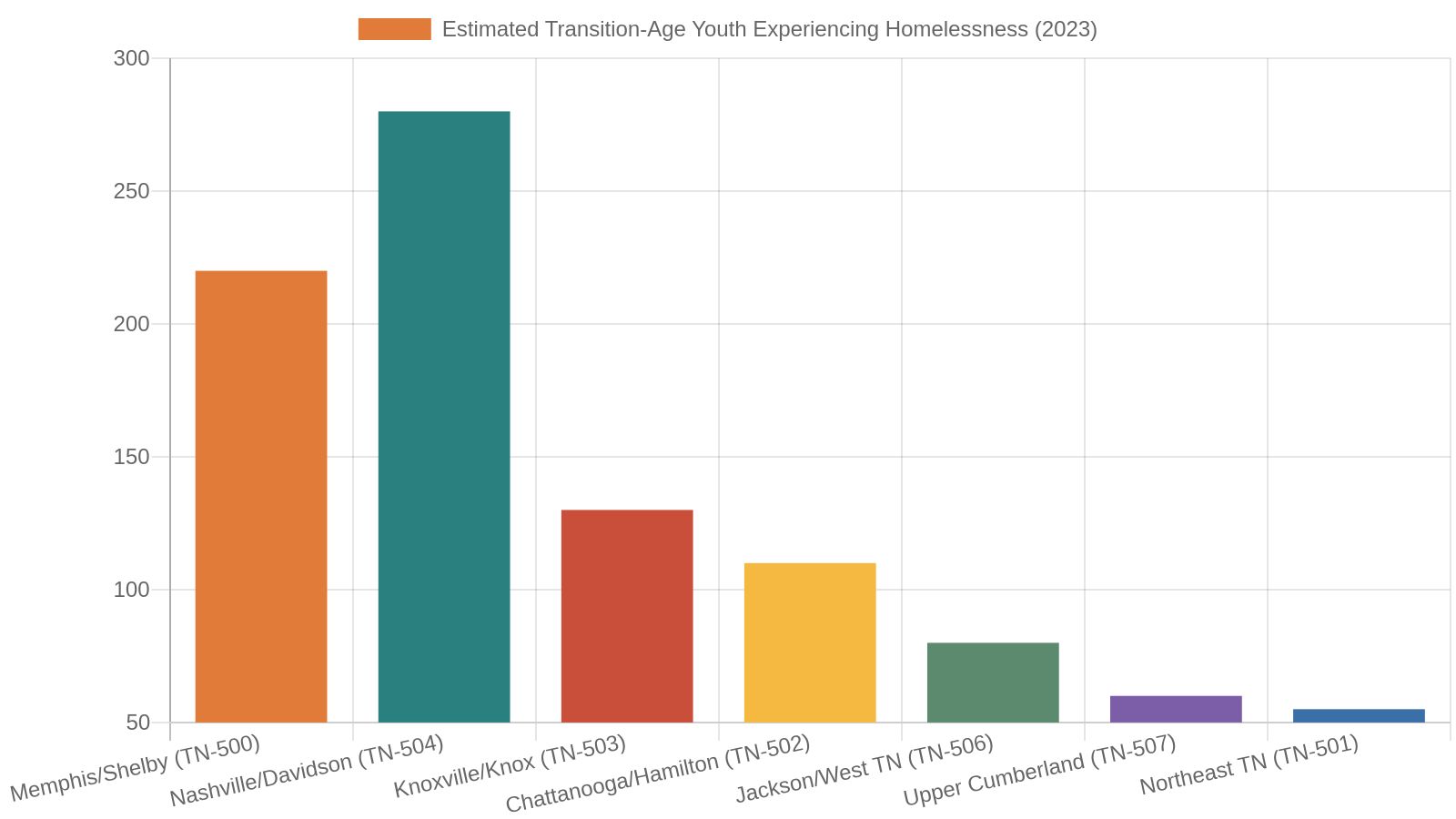
Each year, Tennessee’s CoC regions participate in the national Point-in-Time (PIT) Count — a single-night count of people experiencing homelessness. The 2023 Tennessee PIT Count identified approximately 8,500 individuals experiencing homelessness statewide, with transition-age youth (18–24) representing roughly 11% of that total — or about 935 young adults counted on a single night. Because PIT counts are known to undercount youth (who are more likely to be couch-surfing or hidden from street outreach), the actual number is significantly higher. Some estimates suggest the true figure is 2 to 4 times the PIT count for this age group.
Regional Variation: Urban vs. Rural Challenges
Youth homelessness looks very different depending on where you are in Tennessee. In Memphis and Nashville, the challenge is often high housing costs, limited shelter beds for youth, and long waitlists for rapid rehousing programs. In rural regions like Northeast Tennessee and Upper Cumberland, the challenge is more often geographic isolation, lack of public transportation, and fewer specialized youth services. YAAB’s regional structure means each chapter can focus on the specific barriers its members face, rather than applying a one-size-fits-all approach.
How YAAB Members Shape Real Policy Decisions

One of the most important things to understand about YAAB is that membership isn’t ceremonial. Young adults who join YAAB aren’t invited to observe policy conversations — they’re invited to lead them. Here are some of the concrete ways YAAB members across Tennessee have shaped real decisions.
Advising Continuums of Care
Every Tennessee CoC is required by the U.S. Department of Housing and Urban Development (HUD) to have meaningful youth input in its planning process. YAAB fulfills that requirement — but goes well beyond a checkbox. YAAB members regularly attend CoC board meetings, present findings from peer surveys, and provide formal recommendations on how federal funding should be allocated. In several Tennessee regions, YAAB members have successfully advocated for lowering barriers to shelter entry (such as removing ID requirements for initial intake), extending service hours, and adding youth-specific housing programs to local funding priorities.
Statewide Advocacy and Legislative Engagement
YAAB’s influence extends beyond local CoC meetings. Members have testified before Tennessee legislative committees, participated in statewide homeless coalition convenings, and contributed to reports that shape how Tennessee allocates state and federal housing dollars. In 2022, YAAB members helped inform recommendations around Tennessee’s use of Emergency Housing Vouchers — a federal program that prioritized transition-age youth among other vulnerable populations. Advocacy is not something YAAB does occasionally — it is the core of what YAAB is. Learn more about the advocacy work driving change at yaabtn.org/advocacy.
Resources YAAB Connects You To Beyond Advocacy

YAAB is primarily an advocacy and advisory network — but being part of YAAB also connects you to a wide range of practical resources. Members and their peers gain access to information, referrals, and support that can make a real difference in day-to-day life. Here’s what the network can open up for you.
Housing, Shelter, and Rapid Rehousing
YAAB members are often the best-informed people in a region about what housing resources actually exist and how to access them. Through their CoC connections, YAAB chapters can point peers toward youth-specific shelter beds, transitional housing programs, rapid rehousing assistance, and permanent supportive housing waitlists. In Tennessee, programs like the Coordinated Entry system are the official pathway to most CoC-funded housing — and YAAB members can help you understand how to navigate that system, what to expect, and how to advocate for yourself within it.
Education, Employment, and Financial Literacy
Housing stability is connected to everything else — and YAAB knows it. Regional chapters regularly connect members and peers to GED and high school equivalency programs, workforce development initiatives, job training, and financial literacy workshops. Tennessee’s community college system offers free tuition for eligible residents through the Tennessee Promise and Tennessee Reconnect programs. YAAB members often serve as informal navigators, helping peers understand what they’re eligible for and how to apply. Many chapters also partner with local employers who are committed to hiring young adults with housing instability histories.
Mental Health and Peer Support
Experiencing homelessness or housing instability takes a real toll on mental health — and YAAB doesn’t pretend otherwise. Many regional chapters have connections to low-barrier mental health services, peer support specialists, and crisis intervention resources. The peer-to-peer model of YAAB itself is a form of support: being in a room with other young adults who’ve been through similar experiences, and who are now leading and thriving, is genuinely powerful. YAAB also maintains a statewide resources directory where you can find region-specific services for housing, mental health, employment, and more.
Tennessee YAAB Regions at a Glance
Each of Tennessee's eight Continuum of Care regions has its own YAAB chapter with a distinct geographic focus and set of local priorities. Use this table to quickly identify your region and understand its context.
What Current YAAB Members Say About the Experience

Data and policy matter — but so do stories. The young adults who make up YAAB across Tennessee’s eight regions bring perspectives that no report can fully capture. Here’s a glimpse into what the YAAB experience has meant for members, in their own words and experiences.
From Surviving to Leading
Across Tennessee, YAAB members describe a common turning point: the moment they realized their experience wasn’t a liability — it was expertise. One member from the Knoxville region described it this way: “I spent years thinking I had to hide what I’d been through. YAAB was the first place where what I’d been through was actually the reason they wanted me at the table.” This shift — from seeing yourself as someone who needs help to someone who can help shape systems — is something YAAB members across every region talk about. It’s not just a feel-good outcome. It’s a measurable change in confidence, civic engagement, and long-term stability.
Building Community Across Tennessee
One of the unexpected benefits of YAAB membership is the statewide community it creates. Regional chapters connect through statewide convenings, shared training sessions, and collaborative projects. A young adult in Jackson, West Tennessee, might find themselves collaborating with peers in Chattanooga on a survey about shelter barriers — and building a friendship in the process. In a population that often experiences profound isolation, the peer community YAAB builds is not a side benefit. For many members, it is the most important thing YAAB provides. You are not navigating this alone.
Common Barriers to Joining — and How YAAB Addresses Them

It’s worth being honest: joining something new when you’re navigating housing instability, work, school, or other pressures is not always easy. YAAB chapters across Tennessee have heard every concern, and they’ve worked to build structures that make participation as accessible as possible. Here are the most common barriers — and how YAAB addresses each one.
Transportation and Scheduling
Getting to meetings is one of the most cited barriers for young adults in both urban and rural Tennessee. YAAB chapters address this in several ways: transportation stipends or bus passes for in-person meetings, virtual meeting options via video call for members who can’t travel, and flexible scheduling that accounts for work shifts and other responsibilities. If transportation is a concern for you, mention it when you first reach out — chapters are used to problem-solving this together.
Trust and Past Experiences With Systems
Many young adults who’ve experienced homelessness have also had difficult experiences with systems — child welfare, criminal justice, healthcare, or housing agencies. It makes complete sense to be cautious about joining another institution. YAAB’s peer-led model is designed specifically to address this. You’re not walking into a room run by adults who’ve never experienced what you have. You’re walking into a room run by people who have. YAAB has no mandatory reporting requirements tied to membership, and participation is entirely voluntary. Your story is yours to share on your own terms and timeline.
Not Knowing Where to Start
Sometimes the biggest barrier is simply not knowing what the first step is. That’s completely normal. The easiest starting point is visiting yaabtn.org/local-yaabs to find your regional chapter’s contact information. From there, you can send a message, attend a single meeting with no commitment, or ask questions before deciding anything. There is no application essay, no interview, and no requirement to have your life figured out. YAAB meets you where you are — because that’s where change actually starts.
How Case Managers and CoC Partners Can Support YAAB Engagement

YAAB’s peer-led model works best when the broader service system supports and amplifies it. Case managers, outreach workers, and CoC partners play a critical role in connecting eligible young adults to their regional chapter — and in making sure YAAB’s voice is genuinely heard in program and policy decisions.
Making Warm Referrals, Not Just Handoffs
If you work with transition-age youth as a case manager, outreach worker, or program coordinator, one of the most impactful things you can do is make a warm referral to your regional YAAB chapter. A warm referral means more than handing someone a flyer — it means personally connecting a young adult with a YAAB member or chapter contact, explaining what YAAB is in your own words, and following up to see if they connected. Research on peer support programs consistently shows that warm referrals dramatically increase follow-through compared to passive information-sharing.
Incorporating YAAB Feedback Into Program Design
YAAB’s value to the CoC system is maximized when service providers treat member feedback as actionable intelligence, not just consultation. This means reviewing YAAB survey results before designing new programs, inviting YAAB members to co-facilitate training for staff, and reporting back to YAAB on what changed as a result of their input. CoCs and providers that build genuine feedback loops with YAAB chapters consistently report better program outcomes and higher trust from the young adults they serve. Learn more about YAAB’s current projects and how providers can get involved at yaabtn.org/projects.
Ready to Find Your Chapter and Get Connected?

You’ve read this far — which means you’re already thinking about what it would look like to get connected. That instinct is worth following. Whether you’re currently in a shelter, couch-surfing, in transitional housing, or finally in a stable place and ready to give back, YAAB has a chapter in your corner of Tennessee that wants to hear from you. Here’s exactly how to take that first step.
Your First Step: Visit the Local YAABs Directory
The fastest way to find your regional chapter is to visit the YAAB Local Chapters directory at yaabtn.org/local-yaabs. There you’ll find contact information, meeting schedules, and details for all eight Tennessee CoC regions — including Memphis/Shelby (TN-500), Nashville/Davidson (TN-504), Knoxville/Knox (TN-503), Chattanooga/Hamilton (TN-502), Jackson/West Tennessee (TN-506), Upper Cumberland (TN-507), Northeast Tennessee (TN-501), and TN-509. Click your region, reach out, and take it one step at a time.
Learn More About YAAB Before You Commit
If you want to learn more before reaching out, the About YAAB page gives a full picture of the organization’s mission, structure, and values. You can also browse the Understanding Youth Homelessness section to see how YAAB frames the issues it works on — and to find language that might help you explain your own experience to others. There’s no pressure and no timeline. YAAB will be here when you’re ready.
You Belong at This Table
If you are a young adult between 17 and 25 in Tennessee who has experienced homelessness, housing instability, or aging out of foster care — your experience is not something to move past. It is something to build from. YAAB exists because young people like you have something to say that the system needs to hear. Across Memphis, Nashville, Knoxville, Chattanooga, Jackson, and every corner of this state, YAAB members are turning their lived experience into lasting change. You can too. Start by finding your chapter today — because the table is already set, and there’s a seat with your name on it.
Frequently Asked Questions
How do I join my local YAAB chapter in Tennessee?
Visit yaabtn.org/local-yaabs to find your regional chapter based on where you live. Each chapter listing includes contact information and meeting details. You can reach out by email or phone, and most chapters welcome you to attend a meeting before making any commitment.
Do I have to currently be homeless to join YAAB?
No. YAAB is open to young adults ages 17 to 25 who have lived experience of homelessness or housing instability — including those who are now in stable housing. Many YAAB members joined after finding stability and wanted to use their experience to help others and shape better systems.
What is a Continuum of Care and how does it relate to YAAB?
A Continuum of Care (CoC) is a regional network of organizations that coordinate housing and homelessness services, funded largely through HUD. Tennessee has eight CoC regions. Each YAAB chapter is aligned with one CoC region and advises that region's planning and funding decisions on behalf of transition-age youth.
Does YAAB pay members for their time?
Many regional YAAB chapters offer stipends for participation in CoC meetings and specific advisory tasks, as well as transportation support and other assistance. Stipend amounts and structures vary by region. Ask your local chapter contact about compensation when you first reach out.
I aged out of foster care in Tennessee. Is YAAB relevant for me?
Absolutely. Young adults who have aged out of Tennessee's foster care system are among the populations YAAB most actively works to support and include. YAAB chapters work on policy issues directly related to foster care transitions, including housing vouchers for former foster youth and coordination between DCS and CoC providers.
What if I live in a rural part of Tennessee and can't get to meetings?
YAAB chapters are aware that transportation is a major barrier in rural regions like Upper Cumberland and Northeast Tennessee. Most chapters offer virtual meeting options via video call, and some provide transportation stipends for in-person attendance. Contact your regional chapter to discuss what accommodations are available.