Quick answer: Any Tennessee organization, school, Continuum of Care partner, or community group can request a Youth Action Board (YAAB) speaker or advocate by submitting a request through yaabtn.org/contact-yaab/. YAAB members — young adults ages 17 to 25 with lived experience of homelessness — bring authentic peer perspective to panels, trainings, policy meetings, and public events. Requests are typically reviewed within 5 to 10 business days. The more lead time you give (at least 3 to 4 weeks), the better the match between your event's goals and the right YAAB member or regional chapter.
What Is the Youth Action Board and Why Does Lived Experience Matter?

Before you submit a speaker request, it helps to understand exactly who you’re inviting into the room. The Youth Action Board (YAAB) of Tennessee is a statewide network of young adults with lived experience of homelessness and housing instability. YAAB members advise local and state leaders, drive policy advocacy, and connect peers to housing, education, employment, and support services — all across Tennessee’s Continuum of Care regions. Learn more on the YAAB About page.
Who YAAB Members Are
YAAB members are young adults between the ages of 17 and 25 who have personally navigated homelessness, housing instability, aging out of foster care, or related challenges across Tennessee. They are not spokespersons hired to perform a story — they are peers who have turned their own experience into expertise. That distinction matters enormously when you bring one of them into your space.
- Statewide reach: YAAB operates across all of Tennessee’s Continuum of Care (CoC) regions, including Memphis/Shelby County, Nashville/Davidson County, Knoxville/Knox County, Chattanooga/Hamilton County, Jackson/West Tennessee, the Upper Cumberland, and Northeast Tennessee.
- Trained advocates: Members receive advocacy and leadership training before representing YAAB publicly.
- Peer-to-peer credibility: Young people in your audience — or on your caseload — are more likely to engage with someone who has walked the same road.
Why Lived Experience Changes the Conversation
Research consistently shows that policies and programs designed with the people they serve — not just for them — produce better outcomes. A 2021 report from the National Alliance to End Homelessness found that youth-informed program design reduced service gaps by as much as 30% compared to programs developed without youth input. When a YAAB member speaks at your event, they are not a data point; they are the expert in the room on what it actually feels like to navigate Tennessee’s housing system at age 19 or 22.
For case managers, CoC partners, and service providers, that perspective is irreplaceable. It challenges assumptions, humanizes statistics, and often surfaces practical gaps that no needs assessment ever captured.
What Types of Events and Engagements YAAB Speakers Support

YAAB speakers and advocates are flexible — they show up in a wide range of settings depending on your organization’s needs. Whether you’re running a staff training, a public awareness event, a policy meeting, or a university lecture, there’s likely a format that works. Here’s a breakdown of the most common engagement types and what to expect from each.
Public Events and Community Forums
YAAB members are well-suited to community town halls, public forums on housing policy, awareness events for Homeless Youth Awareness Month (November), and advocacy days at the Tennessee State Capitol. They can speak on panels, deliver brief keynote remarks, or participate in moderated Q&A sessions. If your event draws a broad public audience, a YAAB speaker adds authenticity that no policy brief can replicate.
- Community town halls on affordable housing
- Homeless Youth Awareness Month events
- Tennessee General Assembly advocacy days
- Nonprofit awareness fundraisers and galas
Professional Trainings and CoC Partner Meetings
Continuum of Care partners, case managers, social workers, and housing navigators regularly benefit from hearing directly from the young adults they serve. YAAB members can join staff trainings, CoC planning meetings, Point-in-Time (PIT) count briefings, and Housing Inventory Chart (HIC) reviews to offer a youth perspective on data, service gaps, and program design. This is especially valuable for organizations completing their annual CoC applications, where HUD now strongly encourages documented youth input.
- Staff and volunteer trainings at shelters or drop-in centers
- CoC Continuum planning and HMIS data review sessions
- Point-in-Time count volunteer orientations
- Grant-writing stakeholder interviews
School, College, and University Settings
High schools, community colleges, and universities across Tennessee — from UT Knoxville to Southwest Tennessee Community College — increasingly integrate social justice and housing equity topics into curricula. A YAAB speaker can guest-lecture in sociology, social work, public policy, or education courses. They can also participate in student-led panels or club events focused on youth homelessness, foster care, or housing rights. These engagements often spark new YAAB membership inquiries from students who want to get involved.
Before You Submit: 5 Things to Prepare

A well-prepared request gets a faster, better response. YAAB members are volunteers and emerging advocates — not a speaker’s bureau with a full-time booking staff. The more clearly you communicate your needs upfront, the smoother the coordination process will be for everyone involved. Here are five things to nail down before you hit submit.
1. Define Your Event's Purpose and Audience
Be specific about what you want a YAAB speaker to accomplish. Are you trying to educate staff who have never worked with transition-age youth? Inspire young people in your program to consider advocacy? Satisfy a funder’s requirement for community voice? The clearer your goal, the better YAAB can match you with a member whose experience and communication style fits your context. Write down one sentence: “After this speaker, my audience will understand/feel/be able to _____.”
2. Know Your Logistics
Have the following details ready before you fill out the request form:
- Date and time (including time zone — Tennessee spans Central and Eastern)
- Location (city, venue name, address, and whether it’s in-person, virtual, or hybrid)
- Expected audience size (10 people vs. 500 people changes the format significantly)
- Session length (a 15-minute panel slot vs. a 45-minute keynote are very different asks)
- Accessibility needs (ASL interpretation, captioning, transportation support)
If your event is virtual, confirm your platform (Zoom, Teams, Google Meet) and whether you can provide a stable internet connection and tech support for the speaker.
3. Consider Compensation and Honoraria
YAAB members are young adults, many of whom are navigating their own financial instability. Asking someone to share vulnerable lived experience — often to benefit your organization’s credibility or grant compliance — without any compensation is worth examining critically. While YAAB does not set a universal honorarium rate, organizations are strongly encouraged to offer:
- A speaker honorarium (even $50–$150 for a short engagement is meaningful)
- Mileage reimbursement or a gas card for travel within Tennessee
- Meal coverage if the event spans a mealtime
- Parking validation or a rideshare credit
If your organization genuinely cannot offer compensation, be transparent about that in your request and ask what is possible. Equity in speaker treatment matters.
How to Submit Your YAAB Speaker Request: Step by Step

The actual process of requesting a YAAB speaker is straightforward — but doing it well takes a few intentional steps. Here’s exactly how to move from “I want a YAAB speaker” to a confirmed advocate showing up at your event ready to make an impact.
Step 1 — Visit the Contact Page
Head to yaabtn.org/contact-yaab to find the official YAAB contact and speaker request form. This is the primary intake channel for all speaker, advocate, and partnership inquiries. Avoid reaching out to individual YAAB members directly on social media — routing through the official form ensures your request is logged, reviewed by the appropriate regional coordinator, and responded to equitably.
Step 2 — Complete the Form With Specific Details
The form will ask for your organization name, contact information, event details, and the nature of your request. In the message or description field, include:
- The specific topic or question you want the speaker to address
- Your audience’s background (e.g., “social work students with no prior exposure to youth homelessness” vs. “experienced CoC case managers”)
- Any content boundaries or trauma-informed considerations you want to flag
- Whether you are open to a virtual engagement if in-person isn’t feasible
- Your compensation offer (or an honest note that you’re working within a limited budget)
Step 3 — Allow Adequate Lead Time
Plan to submit your request at least 3 to 4 weeks before your event date — ideally 6 to 8 weeks for large conferences or events requiring travel across Tennessee. YAAB members are young adults balancing work, school, and their own housing stability alongside their advocacy work. Last-minute requests (under 2 weeks) significantly reduce the likelihood of a confirmed match and may result in a virtual option only. For events tied to grant deliverables or legislative sessions, build even more buffer time into your planning calendar.
Timeline: What to Expect After You Submit

Understanding the typical timeline helps you plan your event calendar realistically and sets fair expectations for everyone involved. Here’s a general breakdown of what happens between your submission and the day of the event.
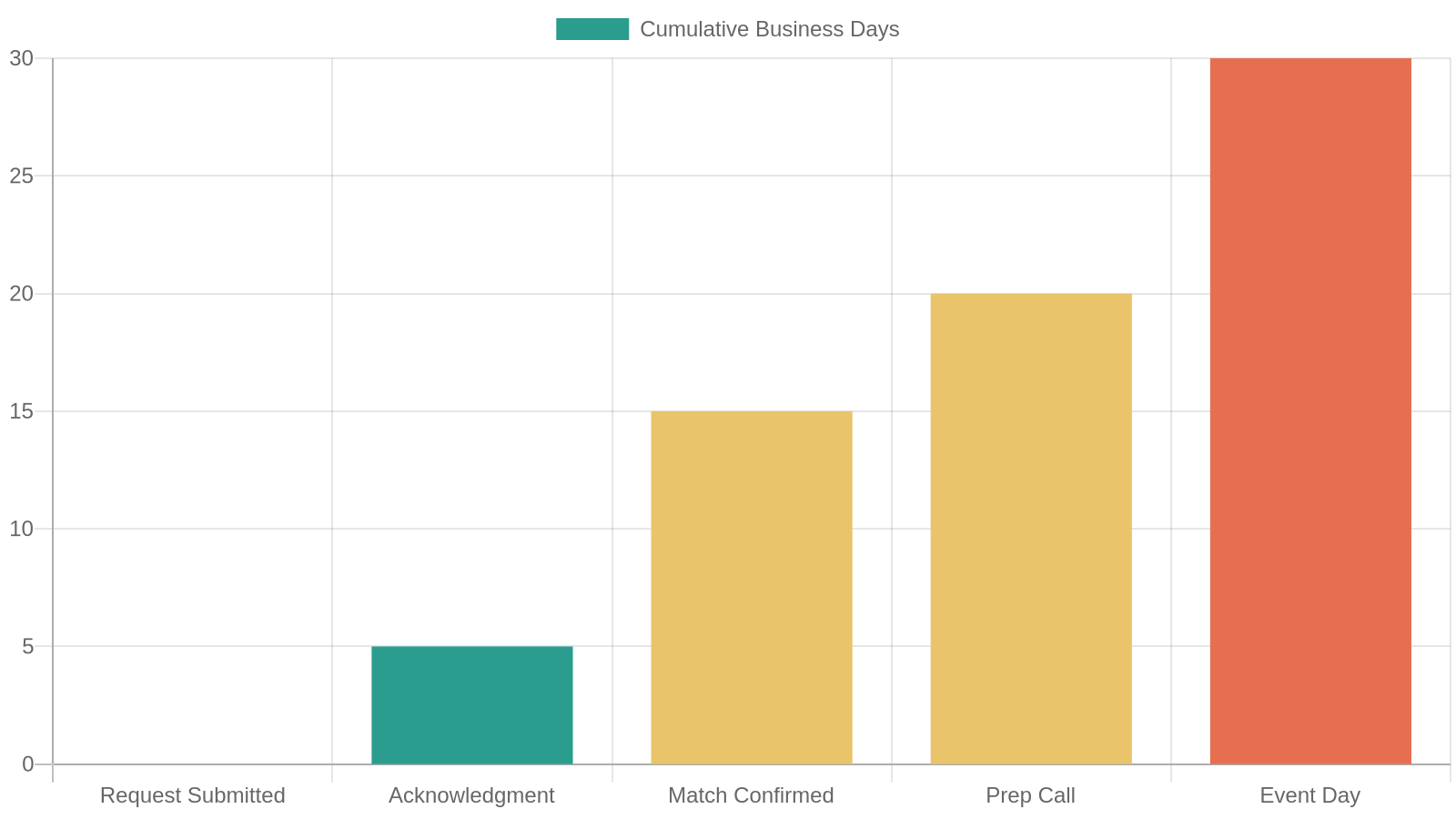
Days 1–5: Initial Review
After you submit your request, YAAB staff or regional coordinators will review the details to assess fit, feasibility, and which regional chapter or individual member is best positioned to respond. You should receive an acknowledgment email within 5 business days. If you don’t, check your spam folder and follow up through the contact page.
Days 6–15: Matching and Confirmation
During this window, YAAB will identify the right member or members for your event, confirm their availability, and reach out to you with a proposed match. You may be asked to schedule a brief 15–20 minute prep call with the speaker to align on content, format, and any Q&A logistics. This call is important — it protects the speaker from being put in an uncomfortable position and helps you get the most out of the engagement.
Days 16–30: Preparation and Logistics
In the final weeks before your event, confirm logistics directly with your YAAB contact: travel arrangements, technology setup for virtual events, run-of-show timing, and any promotional materials (bios, headshots, social media graphics). Ask the speaker how they’d like to be introduced — their preferred name, pronouns, and how much of their personal story (if any) they want shared in the introduction. Never summarize a speaker’s lived experience in your introduction without their explicit review and approval.
How to Be a Good Host: Making the Engagement Work for Everyone

Booking a YAAB speaker is only half the job. How you host them — before, during, and after the event — determines whether the engagement is genuinely empowering or inadvertently extractive. Here’s how to be the kind of organization YAAB members are glad they said yes to.
Create a Trauma-Informed Environment
YAAB members may share experiences involving housing loss, family separation, system involvement, or other challenging life events. Your audience — whether it’s a room of social workers or a group of college students — needs to be prepared to receive those stories with respect. Consider:
- Issuing a brief content note at the start of the session (e.g., “Today’s speaker may discuss experiences with housing instability and system involvement”)
- Ensuring tissues and water are available
- Designating a quiet space where the speaker can decompress after an emotional session
- Briefing your audience on respectful listening norms before the speaker begins
Don't Reduce the Speaker to Their Trauma
One of the most common mistakes hosts make is framing a YAAB speaker purely as a “story of struggle.” YAAB members are advocates, leaders, and experts — not cautionary tales. Structure your introduction and Q&A to highlight their expertise and insight, not just their hardship. Avoid questions like “What was your lowest point?” in favor of “What do you wish service providers understood?” or “What policy change would have made the biggest difference for you?”
After the event, send a genuine thank-you note — and follow through on any commitments you made (honorarium payment, feedback sharing, follow-up connections).
Amplify, Don't Extract
If your event is recorded or photographed, confirm in advance what the speaker consents to. Get written permission before posting video clips, quotes, or photos to your organization’s social media or website. Share the final recording or materials with the speaker so they can use them in their own advocacy portfolio if they choose. The goal is a relationship of mutual benefit — not extraction of a compelling story for your organization’s marketing.
Regional YAAB Chapters Across Tennessee: Finding the Right Fit

Tennessee is a geographically diverse state, and YAAB reflects that diversity. From the Mississippi River delta culture of Memphis to the Appalachian communities of Northeast Tennessee, each region has its own housing landscape, service ecosystem, and youth experience. Knowing which regional chapter to connect with — or whether a statewide virtual panel makes more sense — helps you make the most of your engagement.
Matching Your Event Location to the Right CoC Region
Tennessee has eight Continuum of Care regions, and YAAB has local chapters embedded in each. Whenever possible, requesting a speaker from the same region as your event reduces travel burden, increases local relevance, and strengthens regional CoC relationships. Here’s a quick map of YAAB’s regional presence:
- TN-500 (Chattanooga/Hamilton County): TN-500 YAAB
- TN-501 (Memphis/Shelby County): TN-501 YAAB
- TN-502 (Nashville/Davidson County): YAAB Nashville chapter
- TN-503 (Knox County/Knoxville): YAAB Knoxville chapter
- TN-504, TN-506, TN-507, TN-509: West Tennessee, Upper Cumberland, Northeast TN, and additional regions
If your event is statewide or virtual, a cross-regional panel of two or three YAAB members can represent multiple Tennessee perspectives simultaneously.
Virtual Engagements Expand Access Statewide
One of the silver linings of the shift toward hybrid events post-2020 is that a YAAB member in Memphis can now speak to an audience in Kingsport without a six-hour round trip. Virtual engagements are a legitimate and often preferred option for:
- Statewide webinars and online trainings
- University courses with students across multiple campuses
- Legislative briefings with participants in multiple cities
- Organizations with limited travel reimbursement budgets
When requesting a virtual engagement, specify your platform, confirm that the speaker has reliable internet access (or offer a data stipend if needed), and do a tech check at least 48 hours before the event.
Common Engagement Formats Compared: Panels, Keynotes, Trainings, and More

The format of your engagement shapes everything — how the speaker prepares, how your audience participates, and what outcomes you can realistically expect. Here’s a side-by-side look at the most common YAAB engagement formats to help you choose the right one.
Choosing the Right Format for Your Goals
Not every engagement needs to be a keynote speech. In fact, for many professional audiences — case managers, CoC coordinators, grant reviewers — a structured conversation or panel discussion is more effective than a one-way presentation. Think about what format will generate the most genuine dialogue and learning for your specific audience.
- Keynote (20–45 min): Best for large conferences, awareness events, or fundraisers. One speaker, prepared remarks, optional Q&A.
- Panel (60–90 min): Best for nuanced topics. Two to four YAAB members alongside subject-matter experts. Moderated Q&A.
- Staff training (60–120 min): Interactive, small-group. YAAB member shares perspective and responds to scenario-based questions from staff.
- Policy briefing (30–60 min): YAAB member presents youth-informed recommendations to legislators, funders, or CoC leadership.
- Classroom guest lecture (45–75 min): Conversational, curriculum-aligned. Works well with a faculty moderator.
YAAB Engagement Formats at a Glance
Use this table to quickly compare the most common YAAB speaker and advocate engagement formats by duration, audience size, format type, and best use case.
For Young Adults: How to Become a YAAB Speaker Yourself

This section is for you — the young person reading this who’s thinking, “Wait, I could do that.” Yes, you could. YAAB isn’t just looking for speakers to book; it’s building a generation of advocates who know Tennessee’s housing system from the inside out. If you’ve lived it, you’re qualified to help change it.
You Don't Have to Have It All Figured Out
If you’re a young adult between 17 and 25 in Tennessee who has experienced housing instability — even if you’re still navigating it — you have something valuable to contribute. YAAB doesn’t require you to have a polished story, a stable address, or a five-year plan. What matters is your willingness to show up, share your perspective, and grow alongside other young people doing the same work.
Many YAAB members started out just looking for resources and ended up becoming the resource for someone else. That transformation is exactly what YAAB is designed to support. Check out the YAAB youth homelessness resource page to understand more about the landscape you’ve been navigating — and why your experience matters in shaping it.
What YAAB Membership Looks Like in Practice
As a YAAB member, you might:
- Attend monthly regional meetings (in-person or virtual) to discuss local housing issues
- Participate in advocacy trainings that teach you how to speak to policymakers effectively
- Represent youth voice at CoC planning meetings or grant review panels
- Speak at community events, school presentations, or staff trainings
- Connect peers to housing, employment, and education resources
- Co-design programs and policies with service providers who want to do better
You set your own level of involvement. Some members are deeply active; others participate when they have capacity. YAAB meets you where you are.
How to Join
The simplest first step is to visit the YAAB Join page or reach out through the contact form. You can also connect with your local YAAB chapter directly — find yours at yaabtn.org/local-yaabs. There’s no application fee, no minimum GPA, and no requirement to have your housing situation fully resolved. The only requirement is that you’re between 17 and 25 and have lived experience of housing instability in Tennessee.
For Organizations: 8 Ways to Make the Most of a YAAB Partnership

Organizations that treat YAAB engagements as transactional — book a speaker, check a box, move on — miss the deeper opportunity. The most effective CoC partners and nonprofits in Tennessee build ongoing, reciprocal relationships with YAAB that shape their programs year-round. Here are eight concrete ways to move from a one-time booking to a genuine partnership.
Go Beyond the One-Time Speaking Slot
A single speaking engagement is a starting point, not a partnership. Organizations that get the most value from YAAB relationships treat young adults as ongoing consultants, not one-time guests. Consider:
- Inviting YAAB members to serve on advisory boards or program design committees
- Building a recurring youth voice component into your annual staff training calendar
- Citing YAAB input in your CoC application or grant narrative (with permission)
- Sharing your organization’s data and program outcomes with YAAB so members can give informed feedback
Compensate Fairly and Consistently
If your organization pays external consultants or keynote speakers, apply the same standard to YAAB members. Inconsistent or zero compensation for lived-experience speakers — while paying credentialed professionals on the same panel — is an equity issue. Budget for honoraria from the start of your event planning process, not as an afterthought. Even small amounts signal that you value the expertise being offered.
Share Outcomes and Follow Through
After your event, close the loop with YAAB. Share attendance numbers, participant feedback, and any policy or program changes that resulted from the engagement. This kind of feedback helps YAAB members see the tangible impact of their advocacy — and it builds the kind of trust that makes long-term partnerships possible. If you promised to advocate for a specific policy change after hearing a YAAB member’s testimony, follow up and report back on what happened.
Frequently Asked Questions About YAAB Speaker Requests

Still have questions? Here are the answers to the most common things organizations and young adults ask before reaching out to YAAB about a speaking engagement or advocacy partnership.
Ready to Request a YAAB Speaker for Your Tennessee Event?

Tennessee’s young adults who have experienced homelessness aren’t a problem to be solved — they’re leaders in waiting. YAAB exists to make sure their voices shape the systems that affect them, and every speaking engagement, every training, every policy briefing is one more step toward a Tennessee where no young person has to navigate housing instability alone. Here’s how to take your next step — whether you’re an organization looking to book a speaker or a young adult ready to become one.
Your Next Step Is Simple
Whether you’re a nonprofit in Memphis, a community college in Knoxville, a CoC coordinator in Chattanooga, or a state agency in Nashville, the process starts in the same place: submit your request through the YAAB contact page. Fill out the form with as much detail as possible, give yourself at least 3 to 4 weeks of lead time, and be ready to have a genuine conversation about what a mutually beneficial engagement looks like.
YAAB members across Tennessee are ready to bring their expertise, their lived experience, and their vision for a better system into your space. The question is whether your organization is ready to truly listen — and then act on what you hear.
If You're a Young Adult in Tennessee
If you’re between 17 and 25 and you’ve experienced housing instability anywhere in Tennessee — from the Tri-Cities to the Mississippi Delta — YAAB wants to hear from you. Your story isn’t just something that happened to you; it’s a lens that can change how this state thinks about and responds to youth homelessness. Explore YAAB’s advocacy work to see what members are already doing, and then take the step to join them. The movement is built by people exactly like you.
Frequently Asked Questions
How far in advance do I need to request a YAAB speaker?
Plan to submit your request at least 3 to 4 weeks before your event, and ideally 6 to 8 weeks for large conferences or events requiring travel across Tennessee. Last-minute requests under 2 weeks significantly reduce the chance of a confirmed match.
Does YAAB charge a fee for speakers?
YAAB does not set a universal speaker fee, but organizations are strongly encouraged to offer an honorarium, mileage reimbursement, and meal coverage. Compensating lived-experience speakers is an equity issue — treat YAAB members the same way you would any other expert you invite to your event.
Can I request a YAAB speaker for a virtual event?
Yes. Virtual and hybrid engagements are fully supported and often preferred for statewide webinars, university courses, and organizations with limited travel budgets. Specify your platform (Zoom, Teams, etc.) in your request and offer a data stipend if the speaker may need one.
What if I want a speaker from a specific Tennessee region?
You can indicate your preferred region in your request, and YAAB will do its best to match you with a member from that Continuum of Care area. YAAB has local chapters across all of Tennessee's CoC regions, from Memphis/Shelby County to Northeast Tennessee.
I'm a young adult who has experienced homelessness. Can I become a YAAB speaker?
Absolutely. If you're between 17 and 25 and have lived experience of housing instability in Tennessee, YAAB wants to hear from you. Visit yaabtn.org/join or reach out through the contact page to connect with your regional chapter and learn about getting involved.
Can YAAB members testify at government hearings or legislative sessions?
Yes. YAAB members regularly participate in policy briefings, CoC planning meetings, and advocacy days at the Tennessee State Capitol. If you're organizing a legislative engagement or government hearing and want youth voice included, note that specifically in your speaker request.