Quick answer: Northeast Tennessee YAAB members — young adults ages 17 to 25 with lived experience of homelessness — are actively shaping housing policy and youth services across the Tri-Cities region (Johnson City, Kingsport, and Bristol). Working through the TN-509 Continuum of Care, they advise local leaders, push for youth-specific shelter beds, advocate for tenant rights, and connect peers to housing, employment, and education resources. Their work proves that young people with lived experience are the most powerful voices in the fight for youth housing justice in Northeast Tennessee.
1. Who the Northeast Tennessee YAAB Is and Why It Exists

To understand the advocacy happening in the Tri-Cities, you first need to understand who the Northeast Tennessee YAAB members are, what the TN-509 Continuum of Care region looks like, and why a peer-led model is uniquely powerful for addressing youth housing instability in this part of the state.
A Peer-Led Network Built on Lived Experience
The Northeast Tennessee Youth Action Board is part of the statewide YAAB Tennessee network — a coalition of young adults ages 17 to 25 who have personally experienced homelessness or housing instability. The NE Tennessee chapter operates within the TN-509 Continuum of Care, which covers the Tri-Cities metro area: Johnson City, Kingsport, and Bristol, plus surrounding counties including Carter, Sullivan, Washington, Unicoi, and Greene.
What makes YAAB different from a traditional advisory board is simple: every member has lived it. These aren’t researchers or bureaucrats studying youth homelessness from the outside. They are young people who have slept in cars, couch-surfed, aged out of foster care with nowhere to go, or navigated a system that wasn’t designed with them in mind. That lived experience is the credential — and it’s the most valuable one in the room.
The Scale of Youth Homelessness in Northeast Tennessee
According to the 2023 Point-in-Time (PIT) Count, Northeast Tennessee consistently identifies dozens of unsheltered and sheltered youth on any given night — and advocates note that youth homelessness is chronically undercounted because young people are more likely to be hidden: staying with friends, in motels, or in vehicles rather than in visible encampments. Nationally, studies from Chapin Hall at the University of Chicago estimate that 1 in 10 young adults ages 18–25 experience homelessness in a given year. In rural and semi-rural regions like the Tri-Cities, limited public transit, fewer shelter beds designated for youth, and geographic isolation compound the challenge significantly.
YAAB members in Northeast Tennessee understand these statistics not as abstract data points but as descriptions of their own lives and their neighbors’ lives — and that understanding drives their advocacy with urgency and precision.
2. The Housing Landscape Young Adults Face in the Tri-Cities

Before diving into what YAAB members are doing, it’s worth grounding the conversation in the real housing conditions that young adults in Johnson City, Kingsport, and Bristol are navigating every day. The numbers tell part of the story — but YAAB members live the rest of it.
Rental Costs vs. Entry-Level Wages: A Growing Gap
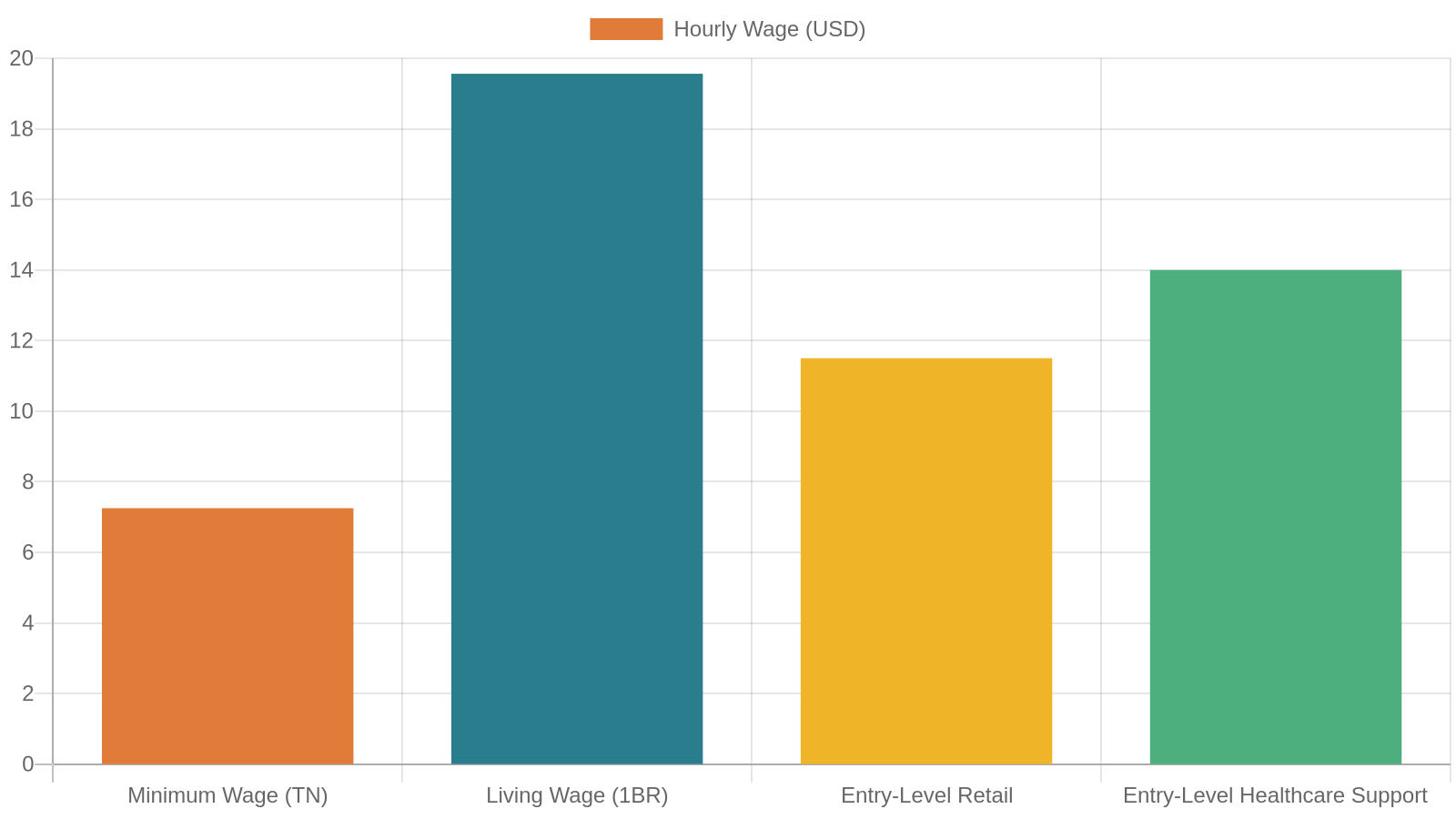
The Tri-Cities region has historically been considered affordable compared to Nashville or Memphis — but affordability is relative when you’re 19 years old with no rental history, no co-signer, and an entry-level wage. According to the National Low Income Housing Coalition’s 2023 Out of Reach report, a worker in Tennessee must earn approximately $19.56 per hour to afford a modest one-bedroom apartment at fair market rent without spending more than 30% of their income. The minimum wage in Tennessee remains the federal floor of $7.25 per hour — a gap of more than $12 per hour that falls hardest on transition-age youth.
In Washington County (Johnson City), fair market rent for a one-bedroom unit was approximately $750–$850 per month in 2023, while Sullivan County (Kingsport/Bristol) ran similarly. For a 20-year-old working 30 hours a week at minimum wage — earning roughly $870 per month before taxes — that math simply doesn’t work.
Barriers Unique to Transition-Age Youth
Beyond raw rent costs, young adults in the Tri-Cities face a specific set of barriers that older adults don’t:
- No rental history: Most landlords require 1–2 years of rental history. At 18 or 19, that’s impossible to have.
- No co-signer: Youth aging out of foster care or estranged from family have no one to co-sign a lease.
- Credit invisibility: Many young adults have no credit score at all, which disqualifies them from standard applications.
- Criminal record barriers: Even minor juvenile records can trigger automatic rejections from housing applications.
- Age discrimination in shelters: Many adult shelters in the region have minimum age requirements of 18 or even 21, leaving 17-year-olds in a dangerous gap.
YAAB members have documented these barriers firsthand and bring them directly into conversations with CoC leadership and local housing authorities.
3. How YAAB Members Are Shaping TN-509 CoC Policy

Advocacy isn’t just marching and rallying — though those matter too. For Northeast Tennessee YAAB members, some of the most impactful work happens inside meeting rooms, on policy documents, and in conversations with CoC administrators who control how housing resources are distributed across the Tri-Cities region.
Seats at the Table: Formal CoC Participation
One of the most concrete ways Northeast Tennessee YAAB members advocate for youth housing rights is by holding formal seats within the TN-509 Continuum of Care governance structure. The U.S. Department of Housing and Urban Development (HUD) requires CoCs to include people with lived experience of homelessness in their planning and decision-making processes — and YAAB members fulfill that requirement with expertise and credibility.
In practice, this means YAAB members attend CoC board meetings, review funding applications from local service providers, and weigh in on how federal dollars — including Emergency Solutions Grants (ESG) and CoC Program grants — are allocated across the region. When a new shelter program applies for funding, YAAB members can ask: Does this program serve youth? Does it have a minimum age requirement that excludes 17-year-olds? Does it require sobriety as a condition of entry? Those questions, asked by people who have been turned away from programs themselves, carry real weight.
Pushing for Youth-Specific Shelter Beds and Housing Programs
Northeast Tennessee has historically had very limited shelter infrastructure specifically designated for transition-age youth. Adult shelters often can’t serve 17-year-olds, and family shelters aren’t appropriate for young adults living independently. YAAB members have been vocal advocates for dedicated youth shelter beds and Rapid Rehousing programs designed around the specific needs of 17–25-year-olds.
Advocacy priorities have included:
- Expanding the number of youth-designated beds in the TN-509 region’s annual HUD application
- Advocating for low-barrier entry criteria — meaning shelters that don’t require sobriety, ID, or employment as conditions of entry
- Pushing for Transitional Housing programs that allow youth to stay for 18–24 months while building skills and savings
- Supporting Host Home models, where vetted community members provide short-term housing to youth in crisis
Each of these priorities came directly from YAAB members describing what they needed — and didn’t have — when they were in crisis.
4. Tenant Rights Education as a Form of Advocacy

Knowing your rights as a renter is a form of power — and YAAB members in Northeast Tennessee are making sure their peers have that power. From understanding what a landlord legally can and can’t do, to navigating eviction court, tenant rights education is a frontline advocacy tool.
What Young Adults in Tennessee Have the Right to Know
Many young adults in Northeast Tennessee don’t know their basic tenant rights — and landlords know it. YAAB members have taken on tenant rights education as a core part of their peer advocacy work, sharing information in plain language that empowers their peers to push back against illegal practices.
Key rights that Tennessee law provides to renters include:
- Right to a habitable unit: Landlords must maintain heating, plumbing, and structural safety under the Tennessee Uniform Residential Landlord and Tenant Act (URLTA), which applies in counties with populations over 75,000 — including Sullivan and Washington counties.
- Right to written notice before eviction: In most cases, landlords must provide at least 14 days’ written notice for nonpayment of rent before filing for eviction.
- Right to a security deposit return: Landlords must return your deposit within 30 days of move-out, with an itemized list of any deductions.
- Right to be free from retaliation: A landlord cannot evict you for reporting code violations or organizing with other tenants.
YAAB members share this information peer-to-peer — at drop-in centers, through social media, and at community events — because knowing your rights is the first step to exercising them.
Navigating Eviction Proceedings as a Young Adult
Eviction is one of the fastest paths back into homelessness for young adults who have just secured housing. In Tennessee, an eviction on your record can follow you for 7 years and make it nearly impossible to rent again. YAAB members in the Tri-Cities have worked to connect peers with legal aid resources before an eviction filing becomes a judgment.
Northeast Tennessee Legal Aid (NTLA) provides free civil legal services to low-income residents in the region, including eviction defense. YAAB members actively refer peers to NTLA and have advocated for right-to-counsel programs that would guarantee legal representation to low-income tenants in eviction court — a policy proven in cities like New York to reduce eviction rates by up to 77%.
The peer-to-peer referral model matters: a young adult is far more likely to call a legal aid number when a friend who has used the service hands them the number directly and says, “They actually helped me.”
5. Connecting Youth to Housing Resources Across the Tri-Cities

Advocacy shapes the future — but young adults in the Tri-Cities need housing resources right now. YAAB members bridge both: pushing for systemic change while also serving as peer navigators who help their community access what’s already available in Johnson City, Kingsport, Bristol, and surrounding areas.
Key Programs and Pathways in the TN-509 Region
YAAB members don’t just advocate for better systems — they also help peers navigate the systems that exist right now. In Northeast Tennessee, key housing resources for young adults include:
- Frontier Health: Provides behavioral health services and has connections to housing support for youth in crisis across the region.
- Johnson City Community Center (JCCC): Offers drop-in services, showers, laundry, and connections to shelter for individuals experiencing homelessness.
- Salvation Army (Johnson City and Kingsport): Operates emergency shelter beds, though availability and age requirements vary.
- HUD-VASH and CoC Rapid Rehousing: For eligible youth (including young veterans), these programs can provide rental assistance and case management to help secure and maintain housing.
- Tennessee’s 211 Helpline: Calling or texting 211 connects young adults to local housing, food, and crisis resources 24/7.
YAAB members serve as informal navigators — helping peers understand which door to knock on first and what to say when they get there.
The Role of Coordinated Entry in Getting Housed
In the TN-509 region, as in all HUD-funded CoCs, access to most housing programs runs through a Coordinated Entry System (CES). This is a standardized process where a young adult is assessed for their housing needs and then matched to the most appropriate program — whether that’s emergency shelter, Rapid Rehousing, or Permanent Supportive Housing.
For young adults, the CES process can feel intimidating or bureaucratic. YAAB members have advocated for youth-friendly Coordinated Entry access points — meaning places where young adults can get assessed without having to walk into an adult-dominated shelter environment. This includes mobile outreach, school-based access, and drop-in center partnerships.
Understanding that Coordinated Entry is the front door to most housing resources — and knowing where the youth-friendly access points are — can make the difference between getting housed and staying stuck. YAAB members share this knowledge constantly within their peer networks.
6. Education and Employment as Housing Stability Tools

Housing advocacy in Northeast Tennessee doesn’t stop at the front door of a shelter. YAAB members push for a broader vision of stability that includes access to education, job training, and fair employment — because sustainable housing requires sustainable income.
Why YAAB Connects Housing Advocacy to Education Pathways
Stable housing and education are deeply linked — it’s nearly impossible to stay in school when you don’t know where you’ll sleep, and it’s hard to maintain housing without the income that education can unlock. Northeast Tennessee YAAB members understand this connection viscerally, and they advocate for education access as part of their housing rights platform.
Key education resources in the Tri-Cities region include:
- Northeast State Community College (Blountville): Offers affordable associate degrees and workforce certificates, with financial aid available to students experiencing homelessness.
- GED programs through Tennessee College of Applied Technology (TCAT) campuses in Elizabethton and Morristown serve youth who didn’t complete high school.
- McKinney-Vento Act protections: Young adults who are still enrolled in K–12 and experiencing homelessness have federal rights to school stability, transportation, and immediate enrollment — YAAB members help peers know and use these rights.
- Tennessee Promise and Tennessee Reconnect: Free community college programs that can dramatically reduce the cost of post-secondary education for eligible youth.
Employment Programs That Meet Youth Where They Are
Entry-level employment is often the first step toward housing stability — but young adults with gaps in their history, no references, or a record face real barriers to getting hired. YAAB members in Northeast Tennessee connect peers to workforce programs designed for transition-age youth:
- American Job Centers (Workforce Solutions): Located in Johnson City and Kingsport, these centers offer free job search support, résumé help, and connections to training programs.
- YouthBuild programs: Provide job training in construction and other trades while participants work toward their GED — and often include a housing component.
- Tennessee Department of Labor & Workforce Development: Offers apprenticeship programs and on-the-job training subsidies that can help young adults get hired in higher-wage careers.
YAAB members advocate for employers in the Tri-Cities to adopt fair chance hiring practices — meaning they don’t automatically disqualify applicants based on criminal history — because housing stability is impossible without income stability.
7. Mental Health and Trauma-Informed Advocacy
You can’t separate housing stability from mental health — they are deeply intertwined. Northeast Tennessee YAAB members advocate for services that recognize this connection and push back against programs that treat mental health challenges as reasons to exclude young adults from housing rather than reasons to provide more support.
Why Trauma-Informed Care Matters in Housing Programs
Youth homelessness is almost always accompanied by trauma — whether from family instability, abuse, foster care, community violence, or the experience of homelessness itself. YAAB members in Northeast Tennessee advocate for housing programs and services that are trauma-informed, meaning they are designed with an understanding of how trauma affects behavior, decision-making, and the ability to engage with services.
In practical terms, trauma-informed housing programs:
- Don’t punish residents for behaviors that are trauma responses (like missing appointments or difficulty with rules)
- Offer voluntary mental health and counseling supports rather than requiring participation as a condition of housing
- Train staff to respond to conflict and crisis with de-escalation rather than immediate program exit
- Create physical spaces that feel safe, private, and dignified
YAAB members have used their platform to push CoC-funded programs in the Tri-Cities toward these standards — and to call out programs that fall short.
Mental Health Resources in the Northeast Tennessee Region
Access to mental health care is a housing stability issue. Young adults who are managing untreated depression, anxiety, PTSD, or substance use challenges are at higher risk of losing housing. YAAB members connect peers to mental health resources in the region, including:
- Frontier Health: The primary community mental health center for the Northeast Tennessee region, offering sliding-scale counseling, crisis services, and substance use treatment.
- SAMHSA’s 988 Suicide and Crisis Lifeline: Call or text 988 for immediate mental health crisis support, available 24/7.
- TennCare (Tennessee Medicaid): Many young adults ages 19–25 qualify for TennCare, which covers mental health services — YAAB members help peers understand and apply for this coverage.
- Peer support specialists: Individuals with their own lived experience of mental health challenges who provide support and navigation — a model YAAB members themselves embody.
8. Aging Out of Foster Care in Northeast Tennessee

Young adults aging out of foster care are among the most vulnerable to homelessness in Northeast Tennessee — and among the most underserved by existing systems. YAAB members with foster care experience are driving advocacy to close the gaps that put their peers at risk the moment they turn 18.
The Foster Care Cliff: What Happens at 18
In Tennessee, young people in foster care can remain in the system until age 21 under the state’s Extended Foster Care program — but many don’t know this, and others choose to leave at 18 without fully understanding the risks. Those who do age out without a stable support network face some of the highest rates of homelessness of any youth population: nationally, 1 in 3 young adults who age out of foster care experience homelessness within two years of leaving the system, according to the National Foster Youth Institute.
In Northeast Tennessee, young adults aging out of foster care often land in the Tri-Cities with limited connections, no family safety net, and a 30-day notice that their placement is ending. YAAB members who have aged out of foster care themselves are among the most powerful advocates in the room — because they know exactly what that cliff feels like.
Tennessee's Chafee and ETV Programs: What Youth Are Owed
Tennessee administers several federally funded programs specifically for youth aging out of foster care, and YAAB members work to make sure their peers know these resources exist:
- Independent Living (Chafee) Program: Provides life skills training, housing assistance, and support services to youth ages 14–21 who are in or aging out of foster care.
- Education and Training Vouchers (ETV): Up to $5,000 per year in funding for post-secondary education or vocational training for eligible current and former foster youth.
- Fostering Futures (Tennessee): Allows young adults who aged out of foster care to re-enter the system for services up to age 21.
- Tennessee’s 1811 program: Provides extended Medicaid coverage to former foster youth up to age 26 — critically important for mental and physical health access.
YAAB members advocate loudly for these programs to be better publicized within the foster care system itself — because too many young people age out without ever being told these resources exist.
Northeast Tennessee vs. Other Tennessee CoC Regions: Youth Housing Context at a Glance
Each of Tennessee's Continuum of Care regions faces distinct challenges for transition-age youth. This comparison highlights key differences in context, infrastructure, and advocacy focus across five major regions.
9. How Northeast Tennessee YAAB Compares to Other Regional YAABs

Northeast Tennessee’s YAAB doesn’t operate in isolation. It’s part of a statewide network of young adult advocates who share strategies, amplify each other’s wins, and build collective power across Tennessee’s Continuum of Care regions. Understanding how TN-509 fits into the bigger picture reveals both the unique challenges of the Tri-Cities and the strength of being connected.
Shared Goals, Different Contexts
Tennessee’s statewide YAAB network includes chapters across multiple Continuum of Care regions — from Memphis/Shelby County (TN-500) to Nashville/Davidson (TN-502) to Knoxville/Knox (TN-501) and beyond. Each regional YAAB operates within its own CoC context, with different funding levels, different shelter infrastructure, and different local policy landscapes.
Northeast Tennessee’s TN-509 YAAB faces challenges that are distinct from urban chapters: geographic spread across rural counties, limited public transportation, fewer dedicated youth shelter beds per capita, and a smaller pool of CoC-funded housing programs overall. At the same time, the Tri-Cities region has a strong community college system, active legal aid organizations, and a growing awareness among local leaders of the youth homelessness issue — creating real opportunities for advocacy wins.
Learning Across the Statewide Network
One of the most powerful aspects of the YAAB Tennessee model is that regional chapters learn from each other. When Nashville’s YAAB wins a policy change around Coordinated Entry, Northeast Tennessee members can bring that model to their CoC. When Knoxville develops a successful peer navigator program, Tri-Cities members can adapt it for their context.
Statewide convenings, shared training resources, and cross-regional communication mean that a young person in Johnson City benefits from the advocacy wins of a peer in Memphis — and vice versa. This network effect multiplies the power of every local win. You can explore all Tennessee regional YAAB chapters to see how the network spans the state and find the chapter closest to you.
10. Statewide Policy Wins Driven by YAAB Advocacy

The work of Northeast Tennessee YAAB members doesn’t stay in the Tri-Cities. Their advocacy feeds into statewide conversations that shape how Tennessee allocates housing resources, designs shelter programs, and protects the rights of young renters across all seven CoC regions.
From Local Advocacy to State-Level Change
YAAB members across Tennessee — including those in the Northeast — have contributed to meaningful policy conversations at the state level. Youth advocates have testified before Tennessee legislative committees, participated in state Consolidated Plan processes, and provided input to the Tennessee Housing Development Agency (THDA) on how housing programs can better serve transition-age youth.
Key advocacy themes that YAAB members have elevated at the state level include:
- The need for youth-specific set-asides in CoC Program funding competitions
- Expanding low-barrier shelter standards statewide so youth aren’t turned away for lacking ID or sobriety
- Strengthening tenant protections for young renters, including notice requirements and security deposit rules
- Increasing awareness of and access to Extended Foster Care and ETV programs among youth who are aging out
The Power of Testimony: Youth Voices in Policy Rooms
There is a documented difference between policy makers hearing statistics about youth homelessness and hearing a 21-year-old describe what it felt like to sleep in a car in January in Johnson City because every shelter had a minimum age of 18 and they were 17 years and 11 months old. That is what YAAB members bring to policy rooms — and it changes conversations.
Research on participatory policy-making consistently shows that programs designed with the people they serve are more effective than programs designed for them. YAAB’s model — centering lived experience in every advocacy space — is not just morally right. It produces better policy outcomes. And the Northeast Tennessee chapter is building a track record of exactly that kind of impact in the Tri-Cities.
11. How to Get Involved With Northeast Tennessee YAAB

The most powerful thing about YAAB is that it’s not just an organization you read about — it’s one you can be part of. Whether you’re a young adult with lived experience looking for community and purpose, or a service provider looking to deepen your connection to the youth you serve, there’s a place for you in the Northeast Tennessee YAAB.
Who Can Join and What Membership Looks Like
If you’re a young adult ages 17 to 25 in the Tri-Cities area — or anywhere in Northeast Tennessee — and you have lived experience of homelessness or housing instability, YAAB wants to hear from you. Membership isn’t about having the right credentials or a perfect story. It’s about having a perspective that comes from living through something the system needs to understand better.
YAAB members participate in a range of ways depending on their capacity and interest:
- Attending CoC meetings and providing input on housing program decisions
- Participating in peer education and outreach events
- Contributing to advocacy campaigns — locally, statewide, or nationally
- Sharing their story (on their own terms) with policymakers, funders, or media
- Connecting peers to housing, employment, and education resources
There is no single way to be a YAAB member. The board meets you where you are. Learn how to join YAAB Tennessee and find out what membership looks like in your region.
For Case Managers and Service Providers: How to Partner
If you’re a case manager, CoC partner, or service provider working with transition-age youth in Northeast Tennessee, YAAB is a resource and a partner — not just a client population. Connecting the young adults you serve to YAAB can provide them with:
- Peer community and connection to others who understand their experience
- Leadership development and advocacy skills that build long-term resilience
- A sense of agency and purpose that is itself a protective factor against homelessness
And YAAB members can provide your organization with honest, direct feedback about what’s working and what isn’t in your programs — the kind of feedback that’s hard to get through formal surveys. Reach out through the YAAB contact page to explore partnership opportunities in the TN-509 region.
Ready to Learn More and Take Action in Northeast Tennessee?

The fight for youth housing rights in Northeast Tennessee is real, ongoing, and winnable — and it’s being led by young adults who know what’s at stake because they’ve lived it. Here’s how to stay connected, get involved, and keep the momentum going in the Tri-Cities and across the state.
Stay Connected and Keep Building Power
Advocacy is a long game — and it’s one that Northeast Tennessee YAAB members are playing with skill, persistence, and deep knowledge of what’s at stake. Every policy win, every peer connected to housing, every young adult who knows their tenant rights because a YAAB member told them — that’s the work adding up.
If you want to stay connected to what’s happening in the Tri-Cities and across Tennessee, the YAAB Tennessee blog is the best place to follow updates on advocacy campaigns, policy changes, new resources, and stories from YAAB members across the state. It’s written by and for young adults — and it reflects the same peer-to-peer, empowering voice that drives everything YAAB does.
You can also explore the full range of youth housing and support resources on the YAAB Tennessee site, including region-specific information for the Tri-Cities and beyond. And if you’re ready to get involved, don’t wait — the Northeast Tennessee YAAB needs your voice, your experience, and your energy. The system changes when the people most affected by it demand something better. That’s exactly what YAAB members in Johnson City, Kingsport, Bristol, and across Northeast Tennessee are doing every day.
Frequently Asked Questions
What is the Northeast Tennessee YAAB and who can join?
The Northeast Tennessee Youth Action Board (YAAB) is a peer-led group of young adults ages 17 to 25 with lived experience of homelessness or housing instability who advocate for better housing policies and services in the Tri-Cities region (TN-509 CoC). Any young adult in that age range with relevant lived experience can join — no formal credentials required.
What housing resources are available for young adults in the Tri-Cities area of Tennessee?
Young adults in Johnson City, Kingsport, and Bristol can access resources including the Johnson City Community Center, Salvation Army shelters, Frontier Health (mental health and housing connections), Tennessee's 211 helpline (call or text 211), and CoC-funded Rapid Rehousing programs through the TN-509 Continuum of Care. YAAB members can help navigate these options peer-to-peer.
What are my rights as a young renter in Tennessee?
In Tennessee counties with populations over 75,000 (including Sullivan and Washington counties), the Uniform Residential Landlord and Tenant Act gives renters the right to a habitable unit, at least 14 days' written notice before eviction for nonpayment, and return of their security deposit within 30 days of move-out with an itemized deduction list. Landlords cannot legally retaliate against you for reporting code violations.
What happens to foster youth in Tennessee when they turn 18?
Tennessee's Extended Foster Care program allows young people to remain in the system until age 21, but many don't know this option exists. Youth who age out also have access to the Chafee Independent Living Program, Education and Training Vouchers (up to $5,000/year for school), and extended Medicaid coverage through age 26 under Tennessee's 1811 program. YAAB members advocate for these resources to be better communicated to youth before they age out.
How does the Coordinated Entry System work for youth in Northeast Tennessee?
Coordinated Entry is the front door to most HUD-funded housing programs in the TN-509 region. A young adult is assessed for their housing needs and matched to the most appropriate program — emergency shelter, Rapid Rehousing, or Permanent Supportive Housing. YAAB members advocate for youth-friendly access points like mobile outreach and drop-in centers so young adults don't have to navigate adult-dominated shelter environments to get assessed.
How can service providers and case managers partner with Northeast Tennessee YAAB?
Service providers can partner with Northeast Tennessee YAAB by connecting the youth they serve to YAAB membership opportunities and by inviting YAAB members to provide feedback on their programs. YAAB members offer direct, lived-experience perspectives that formal surveys rarely capture. Reach out through the YAAB Tennessee contact page to explore partnership opportunities in the TN-509 region.