Quick answer: Young adults ages 17 to 25 in Knoxville who have experienced homelessness or housing instability are using their lived expertise to directly shape Knox County's youth housing policies through the local Youth Action Board (YAAB). As part of Tennessee's Continuum of Care network, Knoxville YAAB members advise service providers, advocate at city and county levels, and help design programs that actually work for transition-age youth. Their voices are not just welcome — they are the engine driving more effective, youth-centered solutions across the region.
What the Knoxville YAAB Actually Is — and Why It Exists

The Knoxville Youth Action Board (YAAB) is the local chapter of a statewide network of young adults in Tennessee who use their lived experience of homelessness and housing instability to shape the policies and programs that affect their peers. In Knox County, the YAAB operates as a recognized voice within the TN-501 Continuum of Care — the regional system that coordinates housing and homeless services. Understanding what the YAAB is and why it was built this way is the first step to understanding why it works.
Lived Experience as a Policy Tool
Most housing policy is written by people who have never slept in a shelter, couch-surfed for months, or aged out of foster care with nowhere to go. The Knoxville Youth Action Board flips that script. YAAB members — young adults between 17 and 25 who have personally navigated homelessness or housing instability — sit at the table where decisions get made. Their first-hand knowledge is treated as expertise, because it is.
Research consistently shows that programs co-designed with the people they serve are more effective. A 2021 report from the National Alliance to End Homelessness found that youth-informed service models reduced barriers to housing entry by up to 40% compared to programs designed without youth input. Knoxville’s YAAB exists precisely to close that gap.
The Continuum of Care Connection
Knox County operates within Tennessee’s TN-501 Continuum of Care (CoC) region — a federally recognized network of organizations, government agencies, and community partners working together to prevent and end homelessness. The CoC receives millions in HUD funding each year and is responsible for coordinating shelter, rapid rehousing, and permanent supportive housing resources across the region.
The Knoxville YAAB is embedded directly in this system. Members participate in CoC planning meetings, review funding applications, and provide feedback on how programs are actually experienced by young people on the ground. This is not a token advisory role — YAAB members have a formal seat in the process, giving transition-age youth a real mechanism to influence where dollars go and how services are delivered.
The Scale of Youth Homelessness in Knox County

Before you can change a policy, you have to understand the problem it needs to solve. Knoxville YAAB members are deeply familiar with the data on youth homelessness in Knox County — not just because they’ve read the reports, but because many of them have lived inside those statistics. Here’s what the numbers show, and what they don’t.
Point-in-Time Count Data and What It Misses
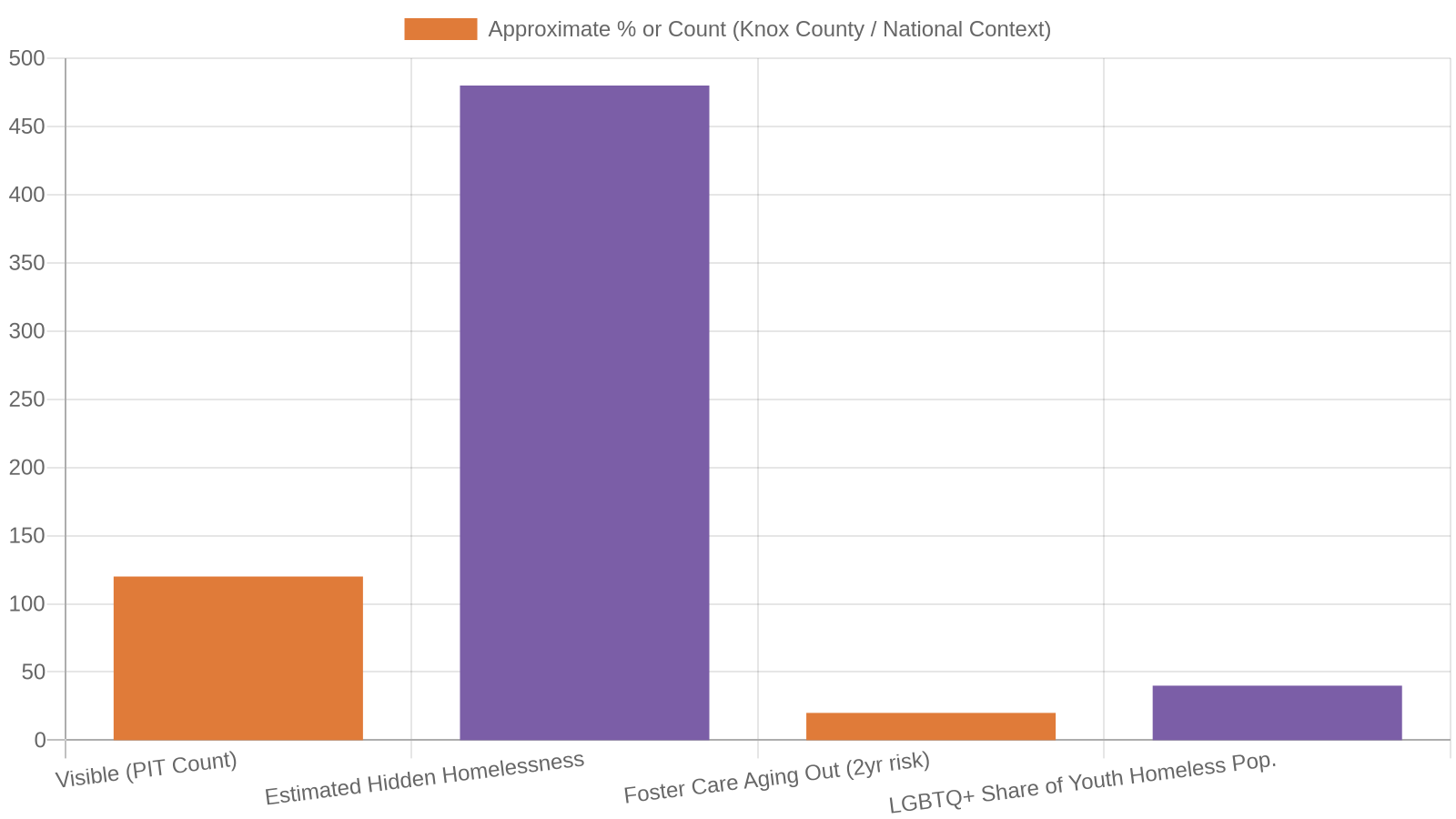
Each January, communities across the country conduct a Point-in-Time (PIT) Count — a single-night census of people experiencing homelessness. In recent years, Knox County’s PIT Count has identified between 600 and 800 individuals experiencing homelessness on any given night, with transition-age youth (ages 18–24) representing roughly 10–15% of that total. That means approximately 60 to 120 young adults are visibly homeless on any given night in Knox County alone.
But YAAB members know the PIT Count is just the tip of the iceberg. It misses young people who are couch-surfing, staying in unsafe situations to avoid the streets, or doubling up with family in overcrowded housing. When hidden homelessness is factored in, the true number of housing-unstable youth in Knox County is estimated to be 3 to 5 times higher than what the count captures.
Who Is Most Affected in Knoxville
Youth homelessness in Knox County is not random — it follows patterns shaped by systemic inequity. Young adults aging out of Tennessee’s foster care system are among the most vulnerable: nationally, 1 in 5 youth who age out of foster care experience homelessness within 2 years. LGBTQ+ youth are also disproportionately represented, making up an estimated 40% of the youth homeless population despite being a much smaller share of the general population.
Young adults of color, those with justice system involvement, and those without a high school diploma or GED face compounding barriers to stable housing. Knoxville YAAB members understand these intersections personally — and that understanding directly informs the policy recommendations they bring to CoC planning tables.
How YAAB Members Influence Policy: The Real Mechanisms

Saying that young people have a ‘seat at the table’ is easy. What makes Knoxville’s YAAB different is that the seat comes with real mechanisms for influence — not just symbolic inclusion. Here are the concrete ways YAAB members shape housing policy in Knox County.
CoC Committee Participation
Knoxville YAAB members don’t just submit comments from the sidelines — they participate directly in Continuum of Care committees. This includes attending CoC planning meetings, reviewing applications for HUD-funded programs, and providing formal feedback on whether proposed services actually meet the needs of transition-age youth. In practical terms, this means a 20-year-old with lived experience of shelter life has a voice in deciding whether a new rapid rehousing program gets funded.
This kind of structural inclusion is relatively rare nationally. Many CoCs still treat youth input as optional or supplementary. Knoxville’s model — embedding YAAB members in the process itself — reflects a growing evidence base showing that participatory governance leads to better outcomes and more efficient use of limited housing dollars.
Direct Advocacy with Local and State Leaders
Beyond the CoC, Knoxville YAAB members engage in direct advocacy. This includes meeting with Knox County commissioners, testifying before city council, and participating in statewide advocacy days in Nashville alongside members from other Tennessee YAAB regions. These interactions give elected officials something they rarely get: unfiltered, first-person accounts of what it’s like to navigate the housing system as a young adult in their district.
Advocacy training is a core part of YAAB membership. Members learn how to tell their story effectively, how to translate personal experience into policy language, and how to hold officials accountable. This skill-building is not just good for advocacy — it’s a transferable asset that members carry into their careers, education, and community leadership long after their YAAB tenure.
Program Design and Feedback Loops
Service providers in Knox County increasingly bring YAAB members into the design phase of new programs — not just to evaluate existing ones. When a shelter is considering a new intake process, or a rapid rehousing program is revising its eligibility criteria, YAAB members can flag barriers that staff might never notice: a form that requires a permanent address to apply for housing, a curfew that conflicts with second-shift work schedules, or a requirement for a government ID that youth experiencing homelessness often don’t have.
These are the kinds of details that can make or break a program’s effectiveness. YAAB members catch them because they’ve lived them — and that’s exactly why their involvement in program design produces measurably better services.
Key Policy Wins Driven by Youth Voice in Knox County

Advocacy is only meaningful if it produces results. Knoxville YAAB members have been part of real, tangible changes to how Knox County’s housing system works for young adults. While the work is ongoing and the system still has significant gaps, these wins show what youth-led advocacy can accomplish.
Lowering Barriers to Shelter and Housing Programs
One of the most consistent advocacy priorities for Knoxville YAAB members has been reducing the documentation and eligibility barriers that prevent young adults from accessing shelter and housing programs. Historically, many programs required photo ID, proof of income, or a referral from a specific agency — requirements that disproportionately screen out the young adults who need help most urgently.
Through sustained advocacy and direct engagement with service providers, YAAB members have helped push for more flexible intake processes that allow youth to begin accessing services while they gather required documents, rather than being turned away at the door. This shift — sometimes called a ‘low-barrier’ or ‘Housing First’ approach — is supported by a strong evidence base and has been adopted more broadly across Knox County’s CoC system in part because of YAAB advocacy.
Youth-Specific Housing Resources and Set-Asides
Transition-age youth have distinct needs that general adult homeless programs are not always designed to meet. YAAB members have advocated for dedicated youth beds, youth-specific rapid rehousing slots, and age-appropriate supportive services within Knox County’s CoC system. These are not small asks — they require CoC members to prioritize youth in their funding applications and to make the case to HUD that youth-specific resources are a necessary investment.
The Knoxville YAAB’s ongoing presence in CoC planning has helped keep transition-age youth visible in these conversations, ensuring that youth needs don’t get absorbed into broader adult homeless system priorities. The result is a more intentional, youth-responsive local system than would exist without YAAB participation.
What It's Like to Be a Knoxville YAAB Member

If you’re a young adult in Knoxville between 17 and 25 with lived experience of housing instability, YAAB membership is built for you. Here’s what it actually looks like to be part of the Knoxville chapter — and what you get out of it beyond the advocacy work itself.
Who Can Join and What Membership Looks Like
Knoxville YAAB membership is open to young adults ages 17 to 25 who have lived experience of homelessness or housing instability — including couch-surfing, staying in a shelter, aging out of foster care, or living in any situation that wasn’t safe or stable. You don’t need a resume, a college degree, or any prior advocacy experience. Your experience is the qualification.
Members participate in regular meetings, trainings, and advocacy activities. The time commitment is flexible and designed to work around school, work, and other responsibilities. YAAB membership is compensated — members receive stipends for their participation, recognizing that their time and expertise have real value. This is a meaningful distinction from volunteer advisory roles that ask young adults to give their labor for free.
Skills You Build as a YAAB Member
Being a Knoxville YAAB member is a leadership development experience, not just an advisory role. Members build skills in public speaking, policy analysis, community organizing, and professional communication. Many members describe YAAB as the first place where they felt their voice was taken seriously — and where they developed the confidence to use it in other settings.
YAAB also connects members to a peer network across Tennessee’s seven CoC regions, creating relationships and mentorship opportunities that extend well beyond Knox County. Alumni of the program have gone on to careers in social work, public policy, nonprofit management, and community organizing — often citing YAAB as the experience that opened those doors.
Stipends, Support, and Practical Benefits
YAAB membership comes with practical support designed to remove barriers to participation. In addition to stipends for meeting attendance and advocacy activities, members may have access to transportation assistance, connections to housing and employment resources, and support navigating other systems. The goal is to make sure that participation is genuinely accessible — not just theoretically open — to young adults who are still working to stabilize their own situations.
This support structure reflects a core YAAB value: you don’t have to have everything figured out to contribute. In fact, being in the middle of navigating the system often makes members more effective advocates, because their experience is current and specific.
How Knoxville YAAB Compares to Other Tennessee Regions

The Knoxville YAAB doesn’t operate in isolation — it’s part of a statewide network of seven regional chapters, each rooted in its own community while connected to a larger movement. Understanding how Knoxville fits into that picture helps explain both the local impact and the broader power of Tennessee’s youth-led advocacy model.
A Statewide Network, Locally Rooted
Tennessee’s YAAB network spans seven Continuum of Care regions, from Memphis in the west to the Upper Cumberland and Northeast Tennessee in the east. Each regional YAAB operates with local autonomy — addressing the specific housing landscape, service gaps, and policy priorities of its own community — while also connecting to the statewide network for shared learning, joint advocacy, and collective power.
Knoxville’s TN-501 CoC region has some distinctive characteristics that shape its YAAB’s work. Knox County is a mid-sized urban area with a significant university population, a growing economy, and a rental market that has tightened considerably in recent years. Median rent in Knoxville increased by approximately 28% between 2020 and 2024, putting additional pressure on young adults with limited incomes. The Knoxville YAAB’s advocacy reflects these local realities.
Cross-Regional Collaboration and Shared Wins
One of the most powerful aspects of Tennessee’s YAAB structure is the ability for regional chapters to collaborate on statewide advocacy. When Knoxville YAAB members travel to Nashville for advocacy days alongside peers from Memphis, Chattanooga, Jackson, and other regions, they present a unified youth voice to state legislators and agency officials — one that is harder to dismiss than any single local chapter could be on its own.
Cross-regional collaboration has also produced shared resources, training curricula, and policy recommendations that individual chapters can adapt for their local contexts. This means Knoxville YAAB members benefit from the learning and wins of their peers across Tennessee, and vice versa.
The Role of Case Managers and Service Providers in Supporting YAAB

YAAB’s impact in Knox County depends not just on the young adults who join, but on the ecosystem of providers, case managers, and institutional partners who support and engage with the board. Here’s how the professional community around transition-age youth can strengthen — and benefit from — YAAB’s work.
How Providers Can Amplify Youth Voice
Case managers, housing navigators, and service providers in Knox County play a critical role in making YAAB participation accessible to the young adults they serve. The most direct way to support the YAAB is to tell young people it exists — many eligible members first learn about YAAB through a case manager or shelter staff member who mentioned it during a service interaction.
Providers can also support YAAB participation by helping young adults address practical barriers: transportation to meetings, documentation for stipend payments, or simply encouraging a young person who doesn’t yet see themselves as a leader. The message that ‘your experience qualifies you’ is often most powerful when it comes from a trusted adult in a young person’s life.
Institutional Partners and CoC Responsibilities
For CoC member organizations in Knox County, supporting the YAAB is not just a nice-to-have — it’s increasingly a best practice expectation from HUD and from the broader homeless services field. HUD’s Youth Homelessness Demonstration Program (YHDP) and related federal initiatives explicitly require meaningful youth engagement in planning and governance as a condition of funding. Organizations that invest in genuine YAAB partnership are better positioned for federal funding opportunities.
Beyond funding, institutional partners benefit from YAAB engagement in practical ways: programs that incorporate youth feedback have lower drop-out rates, higher client satisfaction, and better housing stability outcomes. The return on investment for genuine youth engagement is well-documented — and Knoxville’s CoC partners are increasingly recognizing it.
Barriers YAAB Members Are Still Fighting to Remove

The Knoxville YAAB has achieved real wins — but the work is far from done. Here are the most pressing barriers that YAAB members are still actively fighting to dismantle in Knox County and across Tennessee.
The Rental Market and Affordability Crisis
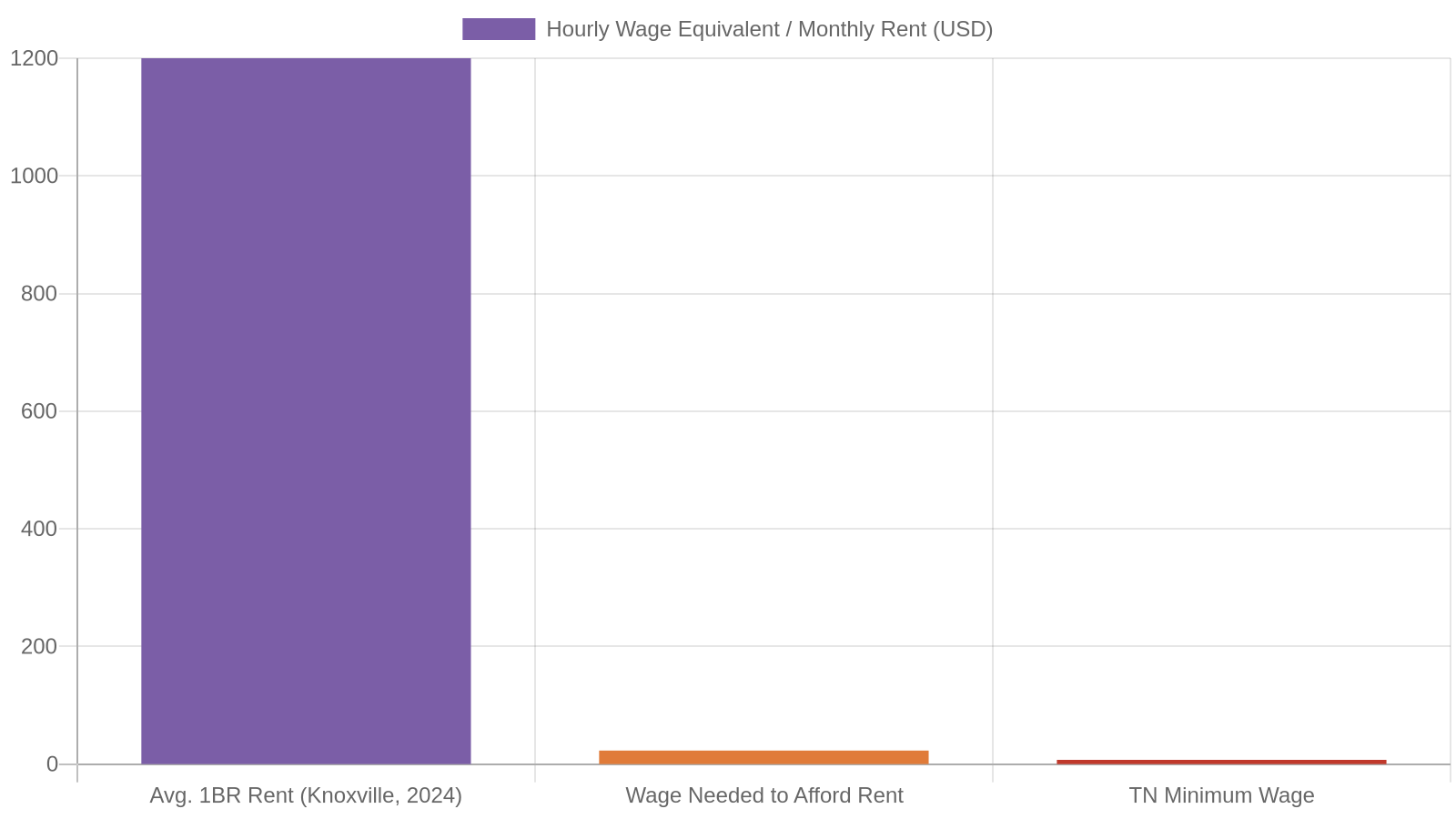
Knoxville’s rental market has become significantly less affordable for young adults with low or no income. The average one-bedroom apartment in Knoxville rented for approximately $1,100–$1,300 per month in 2024 — a price point that requires an hourly wage of roughly $21–$25 to afford without being cost-burdened (spending more than 30% of income on housing). Tennessee’s minimum wage remains at the federal floor of $7.25 per hour, creating a gap that is nearly impossible to bridge without housing assistance.
YAAB members in Knoxville are actively advocating for increased housing vouchers for transition-age youth, expanded rapid rehousing funding, and local policies that protect renters — including young adults who may lack rental history or credit scores that landlords typically require.
Systemic Gaps for Youth Aging Out of Foster Care
Tennessee extends foster care eligibility to age 21 under its Extended Foster Care program, but uptake is inconsistent and many young adults still exit care without stable housing, employment, or a support network. Nationally, youth who age out of foster care without support are twice as likely to experience homelessness within the first year of independence compared to peers who had extended care or family support.
Knoxville YAAB members who have aged out of foster care are among the most vocal advocates for stronger transition planning, better coordination between the child welfare system and the CoC, and more youth-specific housing options that don’t require a co-signer, rental history, or credit score. These are systemic changes that require sustained advocacy — exactly the kind of long-game work the YAAB is built for.
Mental Health and Trauma-Informed Services
Housing instability and homelessness are deeply connected to mental health challenges — both as causes and consequences. Young adults experiencing homelessness in Knox County frequently report difficulty accessing mental health services due to cost, lack of insurance, transportation barriers, and services that don’t feel culturally safe or relevant. YAAB members have consistently advocated for trauma-informed approaches across the CoC system — not just in mental health programs, but in shelter intake, housing applications, and case management practices.
Trauma-informed care is not a luxury add-on. It’s a prerequisite for effective service delivery with a population that has often experienced significant harm at the hands of institutions. YAAB members bring this message directly to providers and policymakers who may not have considered how standard practices can re-traumatize the young adults they’re trying to help.
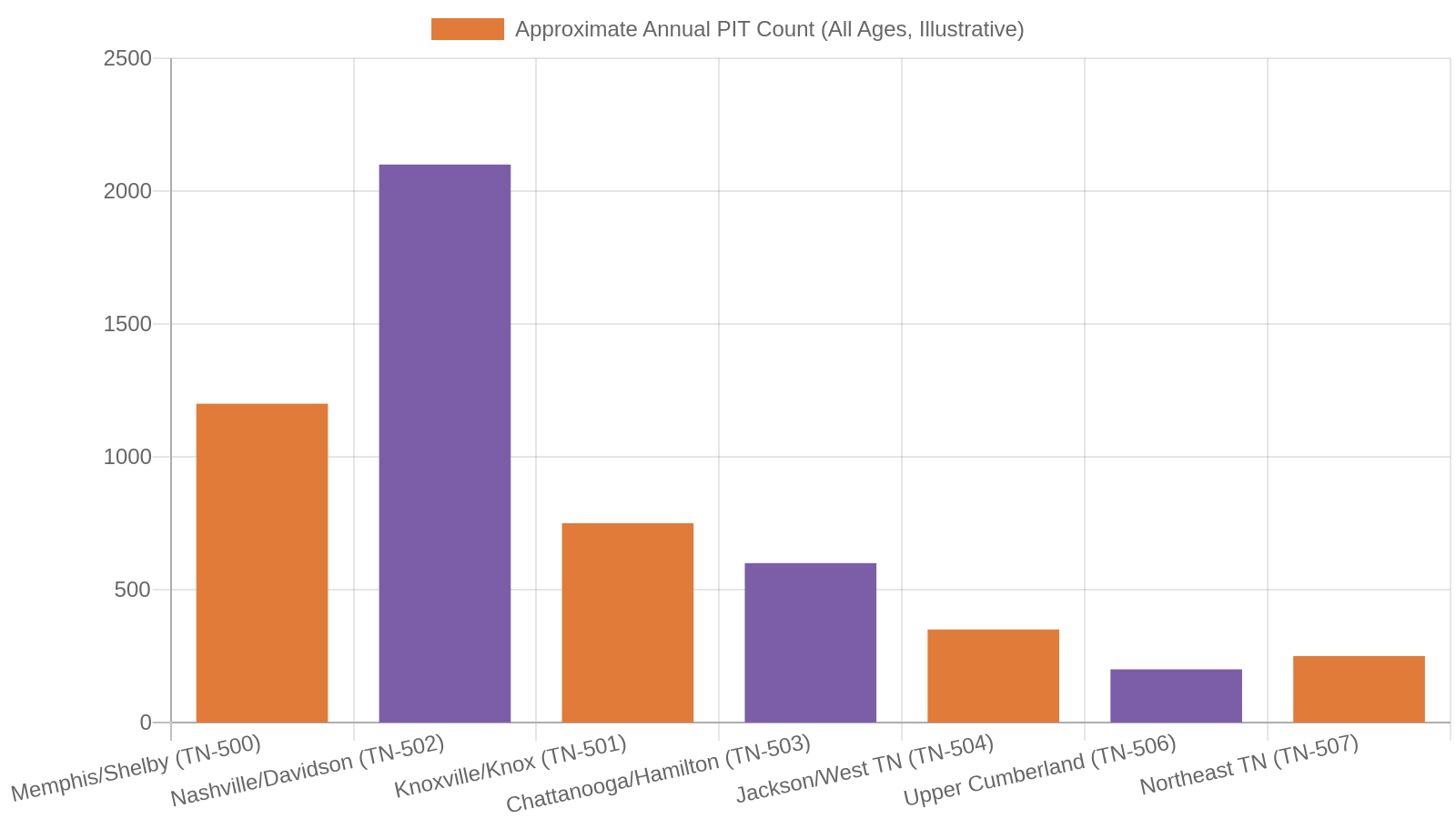
Tennessee YAAB Regions at a Glance: What Each Chapter Covers
Tennessee's YAAB network spans seven Continuum of Care regions, each with its own local chapter and focus areas. Here's how they compare across key dimensions.
Education, Employment, and Housing: How They Connect for Knoxville Youth

Housing policy doesn’t exist in a vacuum. For young adults in Knoxville, stable housing is directly connected to their ability to pursue education and employment — and YAAB members are increasingly pushing the system to recognize and respond to that reality.
Why Stable Housing Is the Foundation
It’s nearly impossible to hold a job or stay enrolled in school without a stable place to sleep. Research from the Urban Institute shows that young adults experiencing homelessness are 3 times more likely to drop out of school and 50% less likely to maintain steady employment compared to housed peers. These aren’t failures of individual motivation — they’re predictable outcomes of an unstable foundation.
Knoxville YAAB members understand this connection viscerally. Many have experienced the cycle firsthand: losing a job because of no transportation from a shelter, dropping a class because there was nowhere to study, or missing a housing appointment because of a work shift conflict. Their advocacy consistently pushes for integrated approaches that address housing, education, and employment together — not as separate silos.
GED Pathways and Workforce Connections in Knox County
Knox County has several pathways for young adults who need to complete their education or build workforce skills. Pellissippi State Community College offers GED preparation and adult education programs, and Tennessee’s Drive to 55 initiative has expanded access to workforce credentials across the state. The Tennessee Reconnect Grant provides tuition-free community college for adults without a degree — a resource that YAAB members frequently help their peers navigate.
YAAB’s role in this space is often connective: helping young adults learn that these resources exist, understand how to apply, and navigate the bureaucratic steps that can feel overwhelming when you’re also managing housing instability. Peer-to-peer navigation — one young adult helping another find and use a resource — is one of the most effective forms of support, and it’s something YAAB members do naturally.
Resources Available to Housing-Unstable Youth in Knox County

If you’re a young adult in Knox County who is currently experiencing housing instability, knowing what resources exist is the first step. YAAB members are often the best guides to this landscape — but here’s an overview of what’s available and how the system works. You can also explore the YAAB Tennessee resources page for a broader statewide directory.
Emergency Shelter and Transitional Housing Options
Knox County has several emergency shelter options for young adults, including Young-Williams Animal Center (which operates a separate youth-focused program), Volunteer Ministry Center, and the YWCA. Transitional housing programs — which provide a bridge between emergency shelter and permanent housing — are available through organizations like Restoration House and Emerald Youth Foundation. Availability fluctuates, and YAAB members can often help peers navigate current options more effectively than a static resource list.
It’s worth noting that shelter capacity in Knox County does not meet demand. On high-need nights, young adults may be turned away or placed on waiting lists — a reality that YAAB members regularly bring to CoC planning conversations as evidence for expanding capacity and funding.
Rapid Rehousing and Rental Assistance Programs
Rapid rehousing programs help young adults move quickly from homelessness into their own housing, with short-term rental assistance and case management support. In Knox County, rapid rehousing slots are coordinated through the CoC’s Coordinated Entry system — the standardized process for assessing and prioritizing people for housing resources. YAAB members have been involved in shaping how Coordinated Entry works for transition-age youth, including advocating for youth-specific assessment tools that better capture the nuances of youth homelessness.
Additional rental assistance may be available through Tennessee’s Emergency Solutions Grant (ESG) program, local community action agencies, and faith-based organizations. Navigating these options can be complex — another area where peer support from YAAB members adds real value.
Understanding Youth Homelessness Beyond the Stereotype

One of the most important things the Knoxville YAAB does is change the story — not just the policy. How youth homelessness is understood and talked about in Knox County directly affects what solutions get funded and who gets helped. YAAB members are active participants in reshaping that narrative.
Redefining What Homelessness Looks Like for Young Adults
When most people picture homelessness, they picture an adult sleeping on a sidewalk. Youth homelessness in Knoxville — and across Tennessee — looks very different. The majority of housing-unstable young adults are what researchers call ‘hidden homeless’: staying with friends or relatives in overcrowded conditions, sleeping in cars, or moving between temporary situations without a stable base. This invisibility makes it harder to count, harder to fund, and harder to address.
YAAB members are powerful messengers for reframing this picture. When a 19-year-old explains that they’ve been couch-surfing for six months while working a part-time job and trying to stay enrolled in community college, it challenges the narrative that homelessness is a choice or a character flaw. It’s a structural problem that requires structural solutions — and YAAB is one of those solutions.
Language, Stigma, and Why It Matters for Policy
The words used to describe young people experiencing homelessness shape how policymakers, funders, and the public respond to the issue. Terms like ‘homeless youth’ can carry stigma that makes it easier to dismiss or criminalize rather than support. YAAB members consistently advocate for person-first, non-stigmatizing language — ‘young adults experiencing homelessness’ rather than ‘homeless youth’ — and for narratives that center resilience and systemic causes rather than individual failure.
This isn’t just semantics. Language shapes policy. When young adults are described as resilient people navigating a broken system, the policy response looks like investment and support. When they’re described through a deficit lens, the response looks like surveillance and restriction. YAAB members understand this dynamic and work actively to shift the narrative in Knox County and beyond. Learn more at the YAAB Tennessee understanding youth homelessness page.
Ready to Join or Connect with the Knoxville YAAB?

The Knoxville YAAB is growing — and there’s a place in it for you, whether you’re a young adult ready to turn your experience into advocacy, or a professional who wants to build a more youth-centered system in Knox County. Here’s how to take the next step.
For Young Adults: How to Get Involved
If you’re between 17 and 25, live in or around Knox County, and have experience with housing instability — whether that’s a shelter stay, couch-surfing, aging out of foster care, or anything in between — the Knoxville YAAB wants to hear from you. You don’t need experience in advocacy, policy, or public speaking. You need your story and the willingness to use it to make things better for your peers.
The best first step is to connect directly with the Knoxville YAAB chapter (TN-501) to learn about current meeting schedules, how to apply for membership, and what participation looks like right now. You can also visit the YAAB Tennessee join page to start the process online. Membership comes with stipends, leadership training, peer connections, and the knowledge that your voice is shaping real policy in Knox County and across Tennessee.
For Providers and Partners: How to Engage
If you’re a case manager, CoC partner, or service provider in Knox County, the most impactful thing you can do is refer eligible young adults to the YAAB and show up as a genuine partner — not just a referral source. That means attending CoC meetings where YAAB members present, taking their recommendations seriously, and advocating within your own organization for youth-informed program design.
The Knoxville YAAB is part of a statewide network with chapters across Tennessee — from Memphis to Chattanooga to Northeast Tennessee. If you work across regions, explore the full YAAB Tennessee local chapters page to find the right connection for each community you serve. Together, providers and YAAB members can build a Knox County housing system that actually works for young adults — one that reflects their needs, respects their expertise, and delivers real results.
Frequently Asked Questions
What is the Knoxville YAAB and who can join?
The Knoxville Youth Action Board (YAAB) is a chapter of Tennessee's statewide YAAB network, open to young adults ages 17 to 25 who have lived experience of homelessness or housing instability in Knox County. No prior advocacy experience is required — your lived experience is the qualification.
Do YAAB members get paid for their time?
Yes. YAAB members receive stipends for their participation in meetings, trainings, and advocacy activities. This recognizes that their time and expertise have real value and helps remove financial barriers to involvement.
How does the Knoxville YAAB actually influence housing policy?
Knoxville YAAB members participate directly in TN-501 Continuum of Care planning meetings, review funding applications, provide feedback on program design, and engage in direct advocacy with Knox County commissioners, city council, and state legislators in Nashville.
What resources are available for young adults experiencing homelessness in Knox County?
Knox County has emergency shelters, transitional housing programs, rapid rehousing slots through the CoC's Coordinated Entry system, and rental assistance through programs like Tennessee's Emergency Solutions Grant. YAAB members can help peers navigate current availability, and the YAAB Tennessee resources page has a broader statewide directory.
How does the Knoxville YAAB connect to other Tennessee regions?
The Knoxville YAAB (TN-501) is part of a statewide network with six other regional chapters covering Memphis, Nashville, Chattanooga, Jackson, Upper Cumberland, and Northeast Tennessee. Chapters collaborate on statewide advocacy days and share training and policy resources across regions.
I'm a case manager in Knox County — how can I refer a young adult to the YAAB?
The most direct step is to share the Knoxville YAAB chapter page (yaabtn.org/local-yaabs/tn-501/) with eligible young adults ages 17–25 who have lived experience of housing instability. You can also encourage them to visit the YAAB join page at yaabtn.org/join/ to start the membership process.