Quick answer: The Youth Action Board (YAAB) of Tennessee is a statewide network of young adults ages 17 to 25 who have experienced homelessness or housing instability and want to shape the policies that affect their peers. To get involved, you can reach YAAB staff directly through the contact form at yaabtn.org/contact-yaab, then connect with the regional chapter that covers your county — from Memphis and Nashville to Knoxville, Chattanooga, Jackson, the Upper Cumberland, and Northeast Tennessee. No experience or degree required; your lived experience is the qualification.
1. What YAAB Is — and Why It Exists for You

Before you reach out to YAAB staff or show up to a regional chapter meeting, it helps to understand exactly what you’re walking into — and why this organization was built specifically for young adults like you. YAAB is statewide, youth-led, and grounded in the belief that your experience is expertise.
A Network Built on Lived Experience
YAAB — the Youth Action Board of Tennessee — was created on a simple premise: the people closest to a problem are the best equipped to solve it. Every YAAB member is a young adult between 17 and 25 who has personally navigated homelessness, housing instability, foster care, or the gaps that fall in between. That lived experience isn’t a liability — it’s the whole point.
YAAB members don’t just receive services; they advise the decision-makers who design those services. That means sitting at tables with Continuum of Care leaders, state agencies, and local governments to make sure youth voices are centered before policies are finalized.
What YAAB Is Not
YAAB is not a shelter, a case-management program, or a charity. It’s a leadership and advocacy organization. Think of it as the bridge between young people with real-world knowledge and the institutions that need that knowledge to do their jobs better. If you’re looking for emergency housing tonight, YAAB’s resources page can point you toward the right services — but YAAB’s core work is about changing the systems so fewer young people end up in crisis in the first place.
2. Who Can Join — the Eligibility Basics

One of the most common questions YAAB gets is: Am I even eligible? The short answer is: if you’re a young adult in Tennessee between 17 and 25 with any experience of housing instability, the answer is almost certainly yes. Here’s what you need to know before you reach out.
Age and Experience Requirements
To become a YAAB member, you generally need to be between 17 and 25 years old and have some lived experience with homelessness or housing instability. That includes couch-surfing, staying in a shelter, living in a car, aging out of foster care, or any period when you didn’t have a stable, safe place to call home. You don’t need to be currently unhoused — past experience counts.
There is no GPA requirement, no job history requirement, and no criminal-record disqualifier. YAAB actively works to remove barriers that keep young people out of leadership spaces.
What 'Lived Experience' Actually Means
The term lived experience can feel vague, so here’s a plain-language version: if you have personally gone through housing instability at any point in your life — even briefly — that qualifies. You might have bounced between relatives’ homes (sometimes called doubled up), slept in a car, stayed in transitional housing, or aged out of the foster care system without a stable landing place. According to the U.S. Department of Housing and Urban Development (HUD), approximately 4.2 million young adults ages 18 to 25 experience homelessness in the United States each year, and Tennessee’s Continuum of Care regions document thousands of those experiences annually. You are far from alone, and your story gives YAAB its power.
3. How to Contact YAAB Staff Directly

Reaching YAAB staff is intentionally straightforward — no gatekeepers, no long applications, no waiting lists. The organization is designed to be accessible to young adults who may have had negative experiences with bureaucratic systems. Here are the main ways to make contact.
The Contact Form: Fastest Way In
The quickest way to reach the statewide YAAB team is through the YAAB contact page. The form takes about two minutes to fill out. You can use it to introduce yourself, ask questions about membership, request a connection to your regional chapter, or just say you’re interested and want to learn more. Staff typically respond within a few business days.
You don’t need to have a perfectly polished message. A simple note — “I’m 21, I’m in Nashville, I’ve experienced housing instability, and I want to get involved” — is enough to get the conversation started.
What to Include in Your First Message
To help staff connect you to the right regional chapter and the right opportunities, try to include a few basic details in your first message:
- Your first name (last name optional)
- Your county or city in Tennessee
- Your age (just to confirm eligibility)
- What you’re looking for — joining a chapter, learning about advocacy, connecting to resources, or something else
- Your preferred contact method — email, phone, or text
That’s it. No essay, no resume, no references required.
Other Ways to Stay Connected
Beyond the contact form, YAAB maintains a public calendar of events, chapter meetings, and advocacy actions at yaabtn.org/calendar-events. Following that page is a great way to find an upcoming meeting near you before you even send a message. YAAB also shares updates through its media channels and blog, so checking those regularly keeps you in the loop on statewide campaigns and regional news.
4. Tennessee's 8 Regional YAAB Chapters — Find Yours

YAAB’s statewide reach is made real through eight regional chapters, each tied to a Continuum of Care (CoC) region. Whether you’re in Memphis, Knoxville, a rural Upper Cumberland county, or anywhere in between, there’s a local chapter where your voice can be heard and your leadership can grow.
How the Continuum of Care Regions Work
Tennessee is divided into Continuum of Care (CoC) regions — federally recognized geographic areas that coordinate homeless services and funding. Each CoC has its own YAAB chapter, which means the advocacy and leadership work is local and specific to your community’s needs. The eight CoC regions in Tennessee each carry a numeric code (TN-500 through TN-509, with some numbers retired or consolidated), and YAAB has an active chapter in each.
Your county determines your region. If you’re not sure which CoC covers where you live, the YAAB staff can tell you in about 30 seconds — just mention your city or county in your contact message.
Regional Chapter Directory
Here’s a quick-reference guide to Tennessee’s active YAAB regional chapters and the major areas they serve:
- TN-500 (Memphis / Shelby County): yaabtn.org/local-yaabs/tn-500
- TN-501 (Nashville / Davidson County): yaabtn.org/local-yaabs/tn-501
- TN-502 (Knoxville / Knox County): yaabtn.org/local-yaabs/tn-502
- TN-503 (Chattanooga / Hamilton County): yaabtn.org/local-yaabs/tn-503
- TN-504 (Jackson / West Tennessee): yaabtn.org/local-yaabs/tn-504
- TN-506 (Upper Cumberland): yaabtn.org/local-yaabs/tn-506
- TN-507 (Northeast Tennessee): yaabtn.org/local-yaabs/tn-507
- TN-509 (Balance of State): yaabtn.org/local-yaabs/tn-509
5. What Regional Chapter Membership Actually Looks Like

Joining a regional chapter isn’t signing up for a second job. YAAB is built around the reality of young adult life — unpredictable schedules, competing priorities, and the need for genuine support. Here’s what day-to-day membership actually involves.
Meetings, Frequency, and Format
Regional YAAB chapters typically meet once or twice a month, with some chapters offering virtual options alongside in-person gatherings. Meeting formats vary by region but usually include a mix of peer check-ins, policy discussions, skill-building activities, and planning for upcoming advocacy actions. Meetings are designed to be welcoming, not formal — you won’t be quizzed or put on the spot when you show up for the first time.
Some chapters also participate in statewide convenings, where members from all eight regions come together to align on shared priorities and present recommendations to state-level decision-makers.
Time Commitment and Flexibility
YAAB understands that young adults ages 17 to 25 are managing a lot — jobs, school, housing searches, family responsibilities. There’s no rigid attendance policy that kicks you out for missing a meeting. The expectation is that you show up when you can, contribute your perspective, and grow at your own pace. Many members start by attending a single meeting and gradually take on more as they get comfortable.
For members who want to go deeper, there are opportunities to serve on leadership committees, represent your region at statewide meetings, and participate in advocacy days at the Tennessee State Capitol in Nashville — typically held in the spring legislative session.
Stipends and Supports
YAAB recognizes that asking young people to volunteer their time without any support is inequitable. Many chapters offer stipends or honoraria for members who participate in advocacy activities, attend convenings, or take on leadership roles. Transportation assistance and meal support are also common at in-person events. The specifics vary by chapter and available funding — ask your regional coordinator when you connect for the most current details.
6. Leadership Roles You Can Step Into

YAAB isn’t just a place to attend meetings — it’s a place to build real leadership skills and hold real influence. From facilitating your regional chapter to advising state-level policy, the roles available to members span a wide range of experience levels and interests.
Chapter-Level Leadership Positions
Within each regional chapter, there are formal and informal leadership roles available to members who want more responsibility. Common positions include Chapter Chair or Co-Chair, who facilitates meetings and represents the chapter in statewide communications; Secretary or Recorder, who keeps notes and tracks action items; and Outreach Coordinator, who connects with peers in the community and recruits new members. These roles are filled by members, not staff — which means the chapter’s direction is genuinely youth-led.
Statewide and Policy-Level Roles
Beyond the regional level, YAAB members can step into statewide roles that carry real policy influence. This includes serving as a youth representative to a local Continuum of Care board, participating in HUD-required Point-in-Time count planning, advising state agencies on youth-specific housing programs, and contributing to YAAB’s published advocacy positions and reports. These aren’t symbolic seats — CoC boards make decisions about how millions of dollars in federal homeless-assistance funding are allocated in Tennessee each year.
YAAB’s advocacy page outlines current campaigns and how members are shaping them.
Training and Skill-Building
YAAB invests in building the skills members need to lead effectively. Training topics have included public speaking, policy analysis, trauma-informed communication, budgeting and financial literacy, and how to navigate government meetings. Many of these trainings are offered at no cost to members and count as professional development you can list on a resume or use in a job interview. Leadership in YAAB is also a credential — one that employers, colleges, and community organizations recognize as meaningful.
7. How YAAB Compares to Other Youth Programs in Tennessee

If you’ve interacted with other youth-serving programs in Tennessee, you might wonder how YAAB fits in — or whether it’s just another version of something you’ve already tried. Here’s how YAAB is distinct, and why that distinction matters for young adults who want more than services.
Why YAAB Is Different
Tennessee has a number of programs that serve transition-age youth, including transitional housing programs, workforce development initiatives, and peer support networks. What sets YAAB apart is its explicit focus on policy influence and systems change rather than direct service delivery. Most programs serve young people; YAAB is run by young people to change the programs that serve them. That’s a meaningful distinction.
YAAB also operates across all eight CoC regions simultaneously, giving it a statewide reach that most local nonprofits don’t have. A policy recommendation developed in Memphis can be amplified by members in Knoxville and Chattanooga, creating a unified youth voice that carries more weight with state legislators and federal agencies.
Complementary, Not Competing
YAAB membership doesn’t replace other programs — it works alongside them. You can be enrolled in a transitional housing program, working with a case manager, pursuing a GED, and be a YAAB member at the same time. In fact, many YAAB members say that the leadership and advocacy work gives them a sense of purpose and community that accelerates their own stability. The two tracks reinforce each other.
If you’re a case manager or service provider reading this, YAAB welcomes your referrals. Connecting a young person you work with to their regional chapter is one of the most empowering referrals you can make — visit yaabtn.org/about-yaab to learn how YAAB fits into the broader CoC ecosystem.
8. What Happens After You Make Contact

Sending that first message can feel like a big step — especially if you’ve had experiences where institutions let you down. Here’s exactly what you can expect after you make contact, so there are no surprises.
The Onboarding Process
After you reach out through the contact form or connect with a regional chapter, the next step is typically a brief welcome conversation — a phone call, video chat, or in-person meeting with a YAAB staff member or chapter leader. This isn’t an interview; it’s more of a mutual introduction. You’ll learn what the chapter is currently working on, and the staff member will learn what you’re hoping to get out of membership. From there, you’ll be invited to an upcoming meeting.
Most members say the first meeting feels like walking into a room where people actually get it — because everyone in the room has navigated similar experiences.
Your First 90 Days
There’s no formal probationary period or evaluation. Your first few months are about getting comfortable, building relationships with other members, and figuring out where your energy and interests fit best. Some new members jump into outreach right away; others spend the first few meetings listening and learning. Both approaches are completely valid.
By the end of your first 90 days, most members have attended at least two or three chapter meetings, connected with a peer mentor or chapter leader, and identified one area of YAAB’s work they want to contribute to — whether that’s policy research, peer outreach, social media, event planning, or public speaking.
YAAB Membership at a Glance: What to Expect by Region
Each of Tennessee's eight YAAB regional chapters serves a distinct Continuum of Care area. Use this table to quickly compare what each chapter covers and how to connect.
9. Resources YAAB Connects You To

Joining YAAB opens doors beyond advocacy. Because YAAB is embedded in the Continuum of Care ecosystem across all of Tennessee, members gain access to a network of resources that can support stability in every area of life — not just housing.
Housing, Shelter, and Rapid Rehousing
While YAAB is an advocacy organization, its members and staff are deeply connected to the service landscape in each region. Through YAAB, you can get warm referrals to emergency shelter, rapid rehousing programs, transitional housing, and Permanent Supportive Housing options specific to your county. YAAB’s knowledge of the local CoC means referrals come with context — staff know which programs have capacity, which are youth-friendly, and which have the shortest wait times.
Education, Employment, and Financial Literacy
YAAB connects members to GED and high school equivalency programs, workforce development opportunities, and financial literacy workshops. Many of these are available through CoC partner organizations in each region. YAAB members have also helped design some of these programs — so the content is more likely to reflect what young adults actually need rather than what adults assume they need.
Tennessee’s statewide Tennessee Promise and Tennessee Reconnect scholarship programs are also frequently discussed in YAAB meetings, as they offer tuition-free pathways to community college for eligible young adults. YAAB’s resources page aggregates many of these opportunities in one place.
Mental Health and Peer Support
Housing instability takes a toll on mental health — and YAAB doesn’t ignore that reality. Members have access to peer support within the chapter community, and YAAB staff can connect you to mental health resources through CoC partner organizations in your region. The peer-to-peer model of YAAB itself functions as a form of community care: being in a room with people who understand your experience, who don’t require you to explain or justify yourself, has real mental health value that formal services sometimes can’t replicate.
10. For Case Managers and CoC Partners: How to Refer Young Adults to YAAB

This section is specifically for the case managers, housing navigators, CoC staff, and service providers who support transition-age youth across Tennessee. YAAB is a powerful tool in your referral toolkit — here’s how to use it effectively.
Why Referrals from Trusted Adults Matter
Many young adults who would thrive in YAAB first hear about it from a case manager, housing navigator, school counselor, or other trusted adult in their life. If you work with transition-age youth in Tennessee, you’re in a unique position to make a warm introduction. A referral from someone a young person already trusts dramatically increases the likelihood they’ll follow through on reaching out.
The best referral is a simple one: “There’s a group of young people your age who are working to change the systems that affect housing. They meet regularly, they pay stipends, and they’d love to have you. Want me to help you reach out?”
Partnership Opportunities for Organizations
Beyond individual referrals, CoC partner organizations can engage with YAAB at the organizational level — hosting chapter meetings, co-designing programs with YAAB input, or inviting YAAB members to serve on advisory committees. This kind of partnership strengthens both organizations and, more importantly, produces better outcomes for young adults because the people most affected are helping shape the response.
To explore partnership or make a referral, the YAAB contact page is the right starting point for organizations as well as individuals.
11. YAAB's Impact by the Numbers

Advocacy is most powerful when it’s grounded in data. Here are the numbers that frame YAAB’s work — and that make the case for why youth-led organizing in Tennessee isn’t optional; it’s essential.
Youth Homelessness in Tennessee: The Scale of the Problem
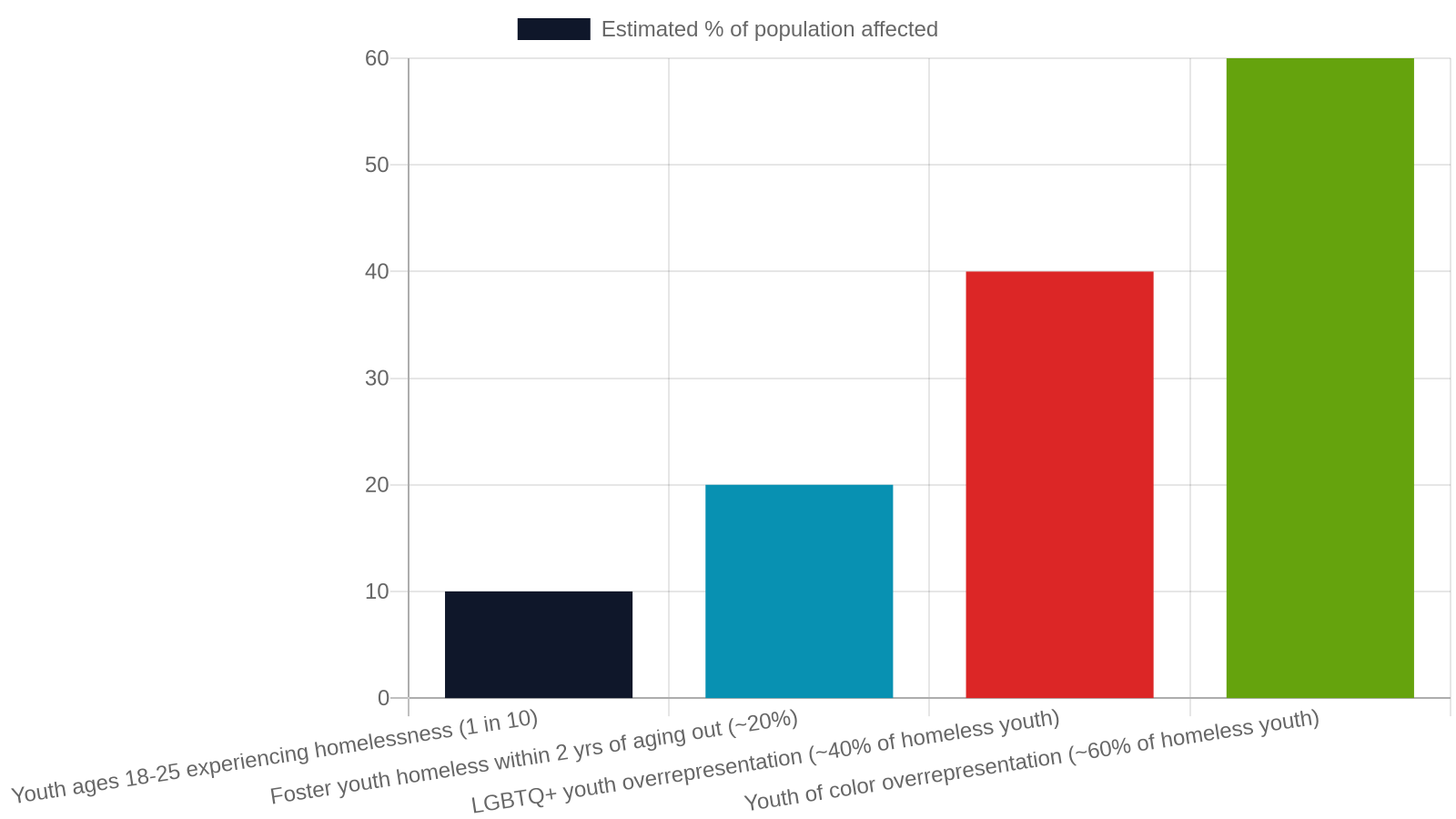
To understand why YAAB’s work matters, it helps to see the scale of what it’s responding to. Tennessee’s annual Point-in-Time count — a HUD-required single-night census of people experiencing homelessness — consistently documents thousands of individuals across the state, with transition-age youth (18 to 24) representing a significant and often undercounted segment. National research from True Colors United estimates that 1 in 10 young adults ages 18 to 25 in the U.S. experiences some form of homelessness each year, with LGBTQ+ youth and youth of color facing disproportionately higher rates.
In Tennessee, youth aging out of foster care face particularly acute risk: studies show that approximately 20% of foster youth experience homelessness within two years of aging out of the system — a gap that YAAB’s advocacy directly targets.
What Youth-Led Advocacy Achieves
Research consistently shows that programs designed with meaningful youth input produce better outcomes than those designed without it. A 2022 report from the National Alliance to End Homelessness found that CoC regions with active youth advisory structures were more likely to adopt low-barrier shelter policies, youth-specific rapid rehousing programs, and trauma-informed intake processes — all changes that reduce the time young people spend without stable housing. YAAB’s presence across all eight Tennessee CoC regions positions it to drive exactly these kinds of systemic improvements.
Ready to Join? Your Next Step Starts Here

You’ve read this far — which means something about YAAB resonates with you. Whether you’re 17 and just starting to figure things out, or 25 and ready to turn years of hard experience into real advocacy, there’s a place for you in Tennessee’s Youth Action Board network. Here’s exactly how to take the next step.
One Message Is All It Takes
You don’t need to have everything figured out before you reach out. You don’t need a plan, a polished story, or any certainty about what role you want to play. All you need is a willingness to show up. The YAAB team across Tennessee — from Memphis to Northeast TN — is made up of young adults who were once exactly where you are, wondering if this was the right move.
It is. Reach out to YAAB staff today and take the first step toward turning your experience into leadership that changes things for the next young person who comes after you.
Find Your Regional Chapter
If you already know your region, go directly to your chapter’s page and introduce yourself. If you’re not sure which region covers your county, the statewide team at yaabtn.org/local-yaabs can point you in the right direction in minutes. Every chapter in Tennessee — TN-500 through TN-509 — is actively welcoming new members right now.
Your lived experience is not a burden. It’s the credential that gets you in the door. YAAB exists because young people like you decided that surviving wasn’t enough — that they wanted to build something better. That work continues, and there’s a seat at the table with your name on it.
Frequently Asked Questions
How do I join the Youth Action Board in Tennessee?
You can join by reaching out through the contact form at yaabtn.org/contact-yaab. Share your name, city or county, age, and what you're interested in. A YAAB staff member will connect you to your regional chapter and invite you to an upcoming meeting.
Do I have to currently be homeless to join YAAB?
No. You need to be between 17 and 25 years old and have some lived experience of homelessness or housing instability at any point in your life — including past experiences like couch-surfing, staying in a shelter, or aging out of foster care. You do not have to be currently unhoused.
What is a Continuum of Care and why does it matter for YAAB?
A Continuum of Care (CoC) is a federally recognized regional network that coordinates homeless services and HUD funding. Tennessee has eight CoC regions, and each has its own YAAB chapter. CoC boards make real decisions about housing funding, which is why having YAAB youth representatives at those tables matters.
Does YAAB pay members or offer any financial support?
Many YAAB chapters offer stipends or honoraria for members who participate in advocacy activities, attend convenings, or take on leadership roles. Transportation assistance and meals are also common at in-person events. Specifics vary by chapter and available funding — ask your regional coordinator for current details.
I'm aging out of foster care in Tennessee. Can YAAB help me?
Yes. Youth aging out of foster care are among the populations YAAB most actively works to support and include. YAAB can connect you to your regional chapter, provide warm referrals to housing and support services, and give you a leadership community of peers who understand the foster care experience.
I'm a case manager. How do I refer a young person to YAAB?
The easiest way is to visit yaabtn.org/contact-yaab and either make the referral yourself or help the young person send a message. A warm introduction — where you let the young person know what YAAB is and why you think it's a good fit — significantly increases the chance they'll follow through.