Quick answer: Tennessee young adults ages 17 to 25 who have experienced homelessness or housing instability have real power to change housing policy — and you don't need a law degree or political connections to do it. By understanding how state and local government works, connecting with your regional Youth Action Board (YAAB), sharing your story strategically, and showing up at the right moments in the legislative calendar, you can directly influence the decisions that shape housing programs, shelter funding, and tenant protections across Tennessee. This guide walks you through every step.
1. Why Your Voice Actually Matters in Tennessee Housing Policy

Advocacy can feel intimidating — especially when you’re young, you’ve been through hard times, and the people making decisions seem far away and powerful. But here’s the truth: Tennessee legislators need to hear from you. They represent you. And the housing crisis affecting young adults across Memphis, Nashville, Knoxville, Chattanooga, Jackson, and every other corner of this state will not change unless people who have lived it speak up.
Lived Experience Is a Policy Superpower
Legislators, agency directors, and Continuum of Care coordinators make decisions every year that affect where young people sleep, whether shelters stay funded, and what rights renters have. But most of them have never experienced housing instability themselves. That gap between decision-maker and lived reality is exactly where your voice becomes irreplaceable.
Research from the National Alliance to End Homelessness consistently shows that policy changes are more likely to be sustained when people with lived experience are involved in designing them. In Tennessee, the Continuum of Care system — which coordinates homeless services across eight regional areas — is explicitly required by HUD to include people with lived experience on planning bodies. That requirement exists because your perspective changes the outcome.
Tennessee's Housing Crisis by the Numbers
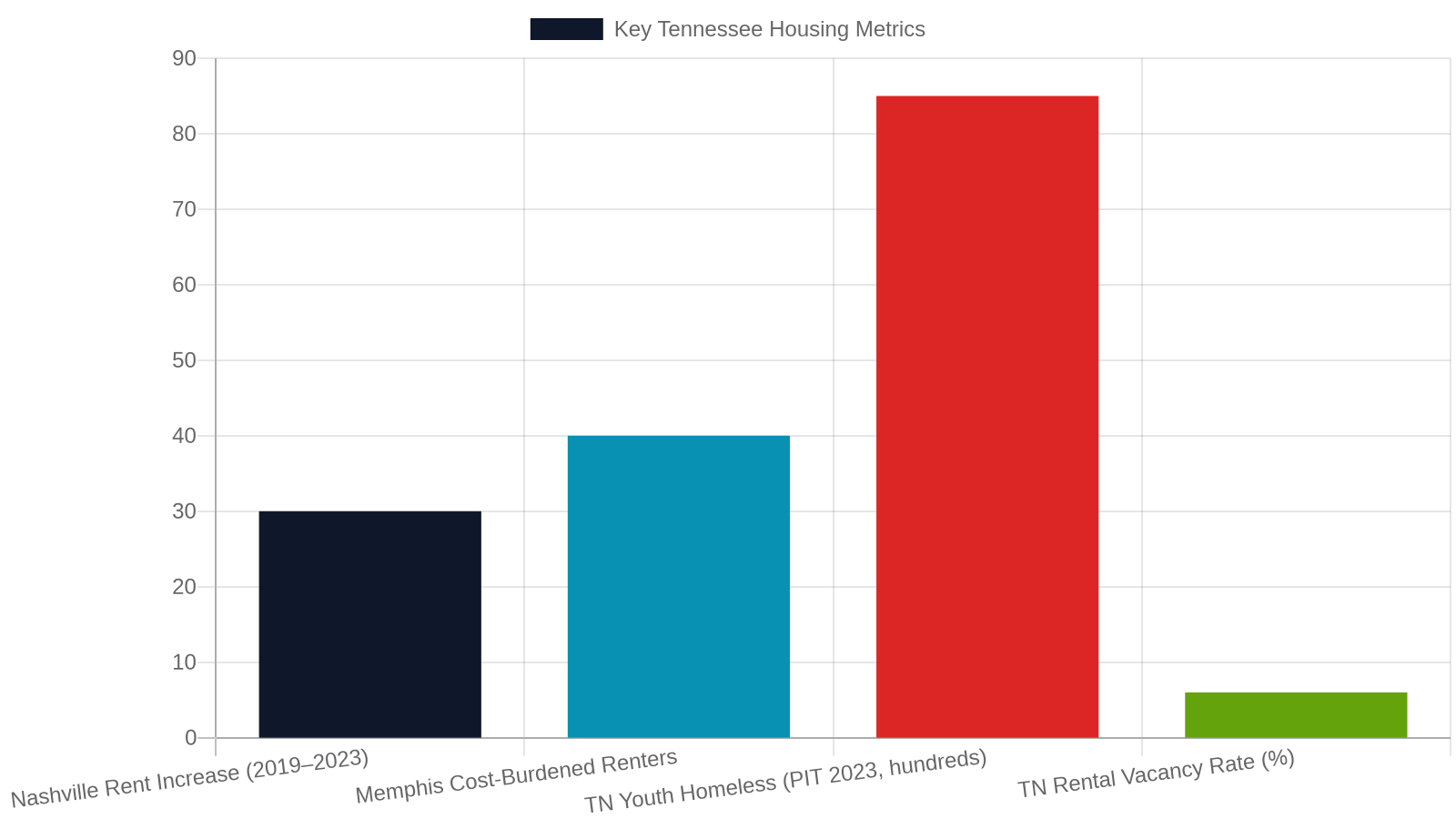
Understanding the scale of the problem helps you make a stronger case. According to the 2023 Tennessee Point-in-Time Count, approximately 8,500 people experienced homelessness on a single night in January — and young adults ages 18 to 24 represented one of the fastest-growing segments. Tennessee’s statewide rental vacancy rate hovered near 6% in 2023, while median rent in Nashville rose more than 30% between 2019 and 2023. In Memphis and Shelby County, over 40% of renters are cost-burdened, meaning they spend more than 30% of their income on housing.
These numbers are not just statistics — they are the backdrop to your story, and they give legislators context for why individual experiences reflect a systemic problem that requires a policy solution.
2. Understanding How Tennessee's Legislative Process Works

Before you walk into a legislator’s office or write a letter, it helps to understand the terrain. Tennessee’s legislative process has specific moments when outside voices carry the most weight — and knowing those moments is the difference between an email that gets filed away and a conversation that actually moves a bill.
The Tennessee General Assembly: A Quick Breakdown
Tennessee’s legislature is called the General Assembly. It has two chambers: the Senate (33 members) and the House of Representatives (99 members). Every Tennessee resident is represented by one state senator and one state representative. You can find yours in about 60 seconds by entering your address at tnsos.gov or the Tennessee General Assembly’s website at legislature.state.tn.us.
The General Assembly meets in regular session starting in January each year, typically running through April or May. Bills related to housing, shelter funding, tenant rights, and youth services are introduced during this window. Committee hearings — where advocates can testify — usually happen between January and March. That means your best window to influence legislation is October through March, when bills are being drafted and committee schedules are being set.
How a Housing Bill Becomes Law in Tennessee
A bill starts when a legislator files it with the clerk’s office. It’s then assigned to one or more committees — small groups of legislators who review it, hear testimony, and vote on whether to send it to the full chamber. If it passes both the House and Senate, it goes to the Governor, who signs or vetoes it. Most housing-related bills pass through the Commerce and Labor Committee or the State and Local Government Committee in the Senate, and similar committees in the House.
Key takeaway: committees are where bills live or die. A well-timed phone call or in-person visit to a committee member before a hearing can genuinely shift a vote. This is not theory — Tennessee advocates have seen it happen on issues ranging from rental assistance to foster care transition services.
Local Government Matters Too
State law sets the framework, but city councils and county commissions control a lot of the money and zoning decisions that affect housing on the ground. Memphis City Council, Nashville Metro Council, Knoxville City Council, Chattanooga City Council, and county commissions across Tennessee all vote on local budgets, affordable housing trust funds, and land-use rules. Many of these meetings are open to the public, happen monthly, and include a public comment period where anyone can speak for two to three minutes. You don’t need an appointment.
3. Knowing Your Rights as a Young Adult Renter in Tennessee

Effective advocacy is grounded in knowledge — of your own experience and of the legal landscape. When you walk into a meeting with a legislator or testify at a committee hearing, knowing your rights and the rights of your peers makes your message more powerful and harder to dismiss. Here’s what every Tennessee young adult should know.
Tennessee Landlord-Tenant Law Basics
Tennessee’s Uniform Residential Landlord and Tenant Act (URLTA) applies in counties with populations over 75,000 — which covers Shelby, Davidson, Knox, Hamilton, and several other counties. Under URLTA, landlords must maintain habitable conditions, give at least 14 days’ written notice before filing for eviction for nonpayment, and return security deposits within 30 days of move-out. In counties not covered by URLTA, the rules are less protective, which is itself a policy issue worth advocating on.
If you’re 18 or older, you can sign a lease in Tennessee. If you’re 17 and legally emancipated, you can also enter contracts. Knowing these basics means you can advocate not just from personal experience but from legal knowledge — which makes you a more credible voice in any legislative conversation.
Rights for Youth Aging Out of Foster Care
Young adults aging out of Tennessee’s foster care system have specific legal protections and entitlements. Under the Fostering Connections Act and Tennessee’s own Extended Foster Care program, young adults can remain in foster care — and continue receiving services — until age 21, as long as they meet participation requirements like attending school, working, or completing a GED. Tennessee’s Independent Living program also provides housing assistance, life skills training, and educational support to eligible youth.
Despite these protections, many young people age out without knowing they exist. Advocating for better outreach, clearer enrollment processes, and extended eligibility is a concrete policy goal that legislators can act on — and one where your lived experience is direct evidence of the gap.
4. Finding and Joining Your Regional YAAB Chapter

You don’t have to advocate alone. The most effective way to influence housing policy in Tennessee is to connect with other young people who are already doing it — and to plug into a structure that gives your voice institutional weight. That’s exactly what the Youth Action Board of Tennessee is built to do.
What the Youth Action Board Does
The Youth Action Board (YAAB) of Tennessee is a statewide network of young adults ages 17 to 25 with lived experience of homelessness and housing instability. YAAB members don’t just receive services — they shape them. Members advise local Continuum of Care bodies, review funding applications, testify at legislative hearings, and connect peers to housing, employment, education, and mental health resources. Being part of YAAB means having a seat at the table where real decisions get made.
YAAB operates across Tennessee’s eight Continuum of Care regions. Each region has its own local chapter with its own leadership, meeting schedule, and focus areas. Whether you’re in Memphis, Nashville, Knoxville, Chattanooga, Jackson, the Upper Cumberland, or Northeast Tennessee, there’s a chapter near you — or one being built that needs your energy.
How to Connect With Your Local Chapter
Getting involved is straightforward. You can find your regional chapter and contact information at yaabtn.org/local-yaabs. Tennessee’s Continuum of Care regions include:
- TN-500 — Chattanooga/Hamilton County
- TN-501 — Memphis/Shelby County
- TN-502 — Nashville/Davidson County
- TN-503 — Knox County/Knoxville
- TN-504 — Northeast Tennessee
- TN-506 — Upper Cumberland
- TN-507 — Jackson/West Tennessee
- TN-509 — Balance of State
Each chapter meets regularly — most monthly or biweekly — and welcomes new members at any point. You don’t need to have all the answers or a polished story. You just need to show up.
5. Crafting Your Story for Maximum Policy Impact

Policy advocacy is fundamentally about communication — and your lived experience is the most compelling communication tool you have. But there’s a difference between telling your story and telling it strategically. This section will help you shape your narrative so it lands with the people who have the power to change things.
The Three-Part Advocacy Narrative
When you’re speaking to a legislator, testifying at a committee, or writing a letter, your story is most powerful when it follows a simple three-part structure: (1) What happened to me, (2) What the system did or didn’t do, and (3) What I’m asking you to change.
This structure works because it moves from personal to systemic to actionable. A legislator hearing only a personal story may feel sympathy but not know what to do. A legislator hearing a personal story connected to a specific policy gap and a specific ask has a clear path forward. Practice your narrative until you can deliver it in 90 seconds or less — that’s roughly the length of a hallway conversation or a public comment slot.
Protecting Yourself While Sharing Your Story
You get to decide how much you share, with whom, and when. You never owe anyone your trauma. Before sharing personal details in a public setting — a legislative hearing, a community meeting, a media interview — think through what you’re comfortable disclosing and what you’d prefer to keep private. It’s completely legitimate to say, ‘I’ve experienced housing instability, and that experience taught me that our current system has a gap in X area,’ without sharing every detail of what that instability looked like.
YAAB chapters can help you prepare your narrative in a way that feels safe and strategic. Many members work with chapter coordinators to practice their stories, identify what details are most relevant to specific policy asks, and debrief after high-stakes advocacy moments. You’re not alone in this process.
Pairing Your Story With Data
Legislators respond to both emotion and evidence. Pairing your personal narrative with a relevant statistic — ‘I’m not alone: Tennessee’s 2023 Point-in-Time Count found that young adults are one of the fastest-growing segments of the homeless population’ — signals that you’ve done your homework and that your experience reflects a pattern, not an isolated incident. Use data from sources legislators recognize: HUD reports, Tennessee Housing Development Agency (THDA) publications, and the Tennessee Commission on Children and Youth all carry credibility in Nashville.
6. Practical Ways to Reach Your State Legislators

Knowing what you want to say is only half the equation. The other half is knowing how to get in front of the right people. Here are the most effective channels for reaching Tennessee state legislators — ranked by impact and with specific, actionable steps for each.
Phone Calls: Still the Most Effective Tool
Legislative staffers consistently report that phone calls carry more weight than emails — and far more than online petitions. A two-minute call to your legislator’s district office or Nashville office, delivered by a constituent with a specific ask, is logged, tracked, and reported to the legislator. You don’t need to be an expert. You need to say: ‘My name is [name], I live in [city], and I’m calling to ask Representative/Senator [name] to support [specific bill or issue]. Here’s why it matters to me personally.’
Find your legislators’ phone numbers at legislature.state.tn.us. Call during business hours — 9 a.m. to 4 p.m. on weekdays — and ask to leave a message if they’re unavailable. Volume matters: if 20 young people from a district all call in one week, that gets noticed.
Scheduling In-Person Meetings
Meeting face-to-face with your legislator or their staff is the gold standard of constituent advocacy. During session (January–May), legislators are in Nashville most weekdays. You can request a meeting through their official website or by calling their office. Many legislators also hold district office hours in their home communities — which means you may be able to meet them in Memphis, Knoxville, Chattanooga, or wherever you live without traveling to Nashville.
Bring a one-page fact sheet summarizing your ask, the relevant data, and your contact information. Keep the meeting to 15–20 minutes, be specific about what you’re asking for, and always follow up with a thank-you email that restates your ask. YAAB chapters often organize group legislative visits during session — a coordinated visit from five young adults is significantly more memorable than five individual visits.
Testifying at Committee Hearings
Committee hearings are open to the public, and most allow public testimony. Check the Tennessee General Assembly’s website for committee schedules — they’re posted weekly during session. Testimony slots are typically two to three minutes, so your 90-second narrative is perfectly sized. Arrive early, sign up to speak, and bring copies of any written testimony to leave with committee members. Testifying puts your words in the official legislative record, which means they can be cited in future policy discussions long after the hearing ends.
7. Writing Effective Advocacy Letters and Emails

Not every advocacy moment happens in person. A well-crafted letter or email — sent at the right moment in the legislative calendar — can be just as influential as a face-to-face meeting. Here’s how to write one that actually gets read and remembered.
The One-Page Rule
Legislative staff read dozens of emails and letters every day. The ones that get attention are short, specific, and personal. Aim for one page or fewer — roughly 250 to 350 words. Start with who you are and where you live (establishing that you’re a constituent is essential), state your specific ask in the first paragraph, share a brief personal connection in the second, and close with a clear call to action: ‘I’m asking you to vote yes on SB [number]’ or ‘I’d welcome a meeting to discuss this further.’
Avoid form letters if at all possible. Legislators and their staff can tell when a letter is copied from a template, and personalized letters carry significantly more weight. Even two or three sentences of personal context make a form letter substantially more effective.
Sample Letter Framework
Use this framework as a starting point:
- Opening: ‘My name is [name]. I am a [age]-year-old resident of [city/county] and a constituent in your district.’
- The ask: ‘I’m writing to urge you to support [specific bill, funding item, or policy position].’
- Your connection: ‘As someone who has experienced [brief, general description of housing instability], I know firsthand that [specific gap or problem].’
- The data: ‘Tennessee’s [relevant statistic] shows that this is not an isolated issue.’
- The close: ‘I’d welcome the opportunity to speak with you or your staff about this issue. Thank you for your service to our community.’
Sign with your full name, city, and a contact email or phone number. A letter without contact information signals that you don’t expect a response — and often, you won’t get one.
8. Using Social Media and Digital Tools Strategically

Digital tools won’t replace in-person advocacy, but they can amplify it significantly — especially when you’re coordinating with other young people across Tennessee’s regions. Here’s how to use social media and online platforms in ways that actually move the needle.
Tagging, Timing, and Tone
Tennessee legislators are on social media — most are active on Facebook, and many are on X (formerly Twitter) and Instagram. Tagging your legislator in a post about a housing issue they’re voting on creates public accountability and can generate constituent pressure quickly. Post when bills are in committee or coming to a floor vote — that’s when public attention is most likely to translate into legislative action.
Keep your tone firm but respectful. Posts that are angry or accusatory are easy to dismiss; posts that are specific, factual, and personal are harder to ignore. ‘Senator [name] is voting on SB [number] this week. This bill would [specific impact]. Here’s what that means for young people in [city]’ is more effective than a general expression of frustration.
Amplifying Through YAAB Networks
Individual social media posts reach your personal network. Coordinated posts across a YAAB chapter’s membership reach a much larger audience — and signal to legislators that a community is paying attention, not just one person. YAAB chapters can coordinate social media days of action, where members across a region all post about the same issue on the same day, tag the same legislators, and use the same hashtag. This kind of coordinated digital advocacy has been used effectively by youth organizations across the country to move legislative votes.
Ask your local YAAB chapter coordinator about upcoming digital advocacy campaigns, or propose one if you see a bill moving through the General Assembly that affects young people’s housing.
Advocacy Methods Compared: Impact, Effort, and Best Timing
Not all advocacy actions carry the same weight or require the same investment. Use this table to choose the right approach for where you are right now — and where you want to go.
9. Navigating the Tennessee Continuum of Care System

State legislators aren’t the only decision-makers who shape housing outcomes for young people in Tennessee. The Continuum of Care system operates at the regional level and controls significant federal funding — and it’s a space where young adults with lived experience have a formal, recognized role to play.
What the CoC Is and Why It Matters for Advocacy
Tennessee’s Continuum of Care (CoC) system is the federally mandated framework for coordinating homeless services at the regional level. Each of Tennessee’s eight CoC regions receives HUD funding — which it distributes to local shelters, rapid rehousing programs, permanent supportive housing, and outreach services. The CoC is governed by a board that includes service providers, government agencies, and — critically — people with lived experience of homelessness.
HUD requires that people with lived experience have meaningful participation in CoC governance. That means there are real, formal seats at the table for young adults like you. YAAB chapters are often the primary mechanism through which young people fill those seats in Tennessee. Participating in CoC governance isn’t just symbolic — it means voting on how millions of dollars in federal funding get allocated.
How to Participate in CoC Meetings
CoC meetings are generally open to the public and are held monthly or quarterly depending on the region. Agendas are typically posted in advance on the CoC’s website or through the lead agency for your region. You can attend as an observer, sign up to speak during public comment, or — through your YAAB chapter — apply for a formal seat on a committee or working group.
If you’re not sure how to find your regional CoC meeting schedule, your local YAAB chapter coordinator can connect you. You can also find regional information at yaabtn.org/understanding-youth-homelessness, which explains how the CoC system works and how young people fit into it.
10. Building Coalitions and Sustaining Your Advocacy

The most powerful advocacy is collective. When young people across Tennessee’s regions coordinate their voices, share strategies, and build relationships with allied organizations, they become a force that legislators and CoC boards cannot ignore. Here’s how to build that coalition — and how to keep showing up over time.
Who Your Allies Are
Effective advocacy rarely happens in isolation. In Tennessee, young adults advocating for housing policy can build coalitions with:
- Tennessee Housing Development Agency (THDA) — the state agency that administers federal housing programs and publishes annual housing data
- Tennessee Coalition to End Domestic and Sexual Violence — a key partner on housing for survivors
- Tennessee Justice Center — legal advocacy organization that works on housing and benefits issues
- Local Legal Aid offices — Tennessee’s legal aid organizations (Memphis Area Legal Services, Legal Aid Society of Middle Tennessee, etc.) provide free legal help and often partner with advocates on policy campaigns
- University and community college student governments — students facing housing insecurity are natural allies
Building relationships with these organizations means your advocacy is backed by a broader coalition — which carries more weight with legislators than any single voice.
Avoiding Burnout and Sustaining Your Engagement
Advocacy is a long game. Housing policy doesn’t change after one meeting or one legislative session. It changes through sustained, consistent pressure over months and years. That means protecting your own energy is part of the work. Set boundaries around how much you share publicly. Take breaks from advocacy when you need to. Celebrate small wins — a bill that advances in committee, a legislator who agrees to meet, a CoC policy that gets updated — because those wins are real, even when the bigger goal is still ahead.
YAAB chapters are built to support this kind of sustained engagement. Members look out for each other, share responsibilities, and create community around the work. You’re not expected to carry it alone.
11. Specific Housing Policy Issues Worth Advocating for in Tennessee Right Now

Knowing how to advocate is important. Knowing what to advocate for is equally critical. Here are three specific Tennessee housing policy areas where young adults’ voices are most needed right now — and where incremental progress is genuinely achievable in the near term.
Expanding Youth-Specific Housing Programs
Tennessee currently has a limited number of transitional housing units specifically designated for young adults ages 18 to 24. Advocating for increased state funding for youth-specific transitional housing — through the THDA budget or through CoC competitive grants — is a concrete, achievable policy goal. Young adults in transitional housing have better long-term housing stability outcomes than those placed in adult shelters, and that data is available to cite in your advocacy.
Strengthening Tenant Protections Statewide
Tennessee’s URLTA currently applies only in counties over 75,000 in population, leaving renters in smaller counties with fewer protections. Advocating for statewide application of URLTA — or for stronger notice requirements before eviction — is a policy change that would benefit young renters across all of Tennessee’s regions, not just urban areas. Tennessee also has no statewide rent stabilization law, and eviction filing rates remain among the highest in the nation in Memphis and Nashville.
Improving Aging-Out-of-Foster-Care Supports
Tennessee’s Extended Foster Care program allows young adults to remain in care until 21, but enrollment and retention rates remain lower than they should be. Advocating for better outreach to youth approaching 18, simplified enrollment processes, and expanded eligibility criteria is a policy goal with strong bipartisan support — because it saves the state money in the long run by reducing homelessness, incarceration, and emergency service use among young adults who age out without support.
Ready to Make Your Voice Heard? Here's Your First Step

You’ve made it through the full picture — from understanding Tennessee’s legislative process to crafting your story, reaching your legislators, and building coalitions. Now it’s time to take the first real step. Here’s how to move from reading to doing, starting today.
Start With Your Regional YAAB Chapter
The single most effective first step you can take is connecting with the YAAB chapter in your region. Chapters meet regularly, welcome new members at any point, and will help you understand the local policy landscape, practice your advocacy narrative, and find your place in the work. You can find your regional chapter and get connected at yaabtn.org/local-yaabs. If you’re not sure which region you’re in, the contact page can help you figure it out.
YAAB is also always looking for young people who want to take on leadership roles — as chapter officers, CoC representatives, or statewide spokespersons. If you’re ready to step up, say so when you connect.
Dive Into the Advocacy Work
Once you’re connected with your local chapter, explore the full range of advocacy opportunities available through YAAB statewide. From testifying at the General Assembly to participating in CoC governance to driving digital campaigns, there’s a role for every level of experience and every comfort level. Visit yaabtn.org/advocacy to see current campaigns, learn about upcoming legislative opportunities, and find out how YAAB members across Tennessee are already shaping the policies that affect your life.
Housing instability is not a personal failure — it’s a policy failure. And policy failures can be fixed. Young adults across Memphis, Nashville, Knoxville, Chattanooga, Jackson, and every other corner of Tennessee are already doing this work. The table has a seat for you.
Frequently Asked Questions
Do I have to be 18 to advocate for housing policy in Tennessee?
No. YAAB accepts members ages 17 to 25, and 17-year-olds can participate in advocacy activities including attending meetings, testifying at public hearings, and contacting legislators. Some formal CoC governance roles may have age requirements, but most advocacy activities are open to anyone 17 and older.
How do I find my state representative and senator in Tennessee?
Go to legislature.state.tn.us and use the 'Find My Legislator' tool — just enter your home address. You'll get the names, phone numbers, and email addresses for both your state representative and your state senator within seconds.
What is the Youth Action Board of Tennessee and how do I join?
YAAB Tennessee is a statewide network of young adults ages 17 to 25 with lived experience of homelessness or housing instability who advise policymakers and advocate for change. You can join by connecting with your regional chapter at yaabtn.org/local-yaabs or by visiting yaabtn.org/join.
When is the best time of year to contact Tennessee legislators about housing issues?
The most impactful window is October through March. Bills are drafted in the fall, filed in January, and move through committees between January and March. Contacting your legislator before a committee vote — not after — is when constituent input carries the most weight.
Can I advocate for housing policy if I'm currently experiencing homelessness?
Absolutely. Your current experience is exactly what makes your voice credible and necessary. YAAB chapters can also help connect you to housing resources, employment support, and other services at the same time you're getting involved in advocacy — you don't have to have your situation fully resolved before you can participate.
What is the Continuum of Care and how does it affect young people in Tennessee?
The Continuum of Care (CoC) is a federally mandated regional system for coordinating homeless services. Tennessee has eight CoC regions, each of which receives HUD funding distributed to local shelters, housing programs, and outreach services. Young adults with lived experience are required by HUD to have meaningful participation in CoC governance, and YAAB chapters are the primary way young people fill those roles in Tennessee.