Quick answer: The Youth Action Board (YAAB) of Tennessee is a statewide network of young adults ages 17 to 25 with lived experience of homelessness who shape housing policy and connect peers to real resources. Across eight Continuum of Care regions — including Memphis, Nashville, Knoxville, Chattanooga, Jackson, Upper Cumberland, and Northeast Tennessee — YAAB links transition-age youth to emergency shelter, rapid rehousing, rental assistance, employment support, education pathways, mental health services, and peer advocacy. This guide breaks down what's available, where to find it, and how to get involved.
1. What Is the Tennessee YAAB and Why Does It Exist?

Before diving into specific resources, it helps to understand the organization behind them. The Youth Action Board of Tennessee is not a government agency and not a traditional nonprofit service provider — it is a peer-led advisory and advocacy network embedded inside Tennessee’s housing system. That positioning gives YAAB unique power: members can influence the policies that determine who gets housed and how quickly.
Youth-Led, Youth-Centered
YAAB — the Youth Action Board of Tennessee — is not a program run for young people by adults. It is a network run by young adults, ages 17 to 25, who have personally experienced homelessness or housing instability. That distinction matters. Every recommendation YAAB makes to state and local leaders comes from someone who has actually navigated the system — slept in a shelter, couch-surfed, aged out of foster care, or struggled to pay rent on a part-time wage.
YAAB members sit at policy tables, advise Continuum of Care (CoC) boards, and push for changes that make services more accessible, less stigmatizing, and more effective for transition-age youth (TAY) across Tennessee.
The Continuum of Care Framework
Tennessee’s housing and homeless-services system is organized into regional Continuums of Care (CoC) — federally recognized planning bodies that coordinate shelter, housing, and support services. Each CoC receives HUD funding and is responsible for connecting people to the right resources at the right time. YAAB operates within all of Tennessee’s CoC regions, ensuring that young adult voices are part of every regional plan.
Understanding the CoC framework helps you know who is responsible for services in your area and how to access them. YAAB bridges the gap between complicated systems and the young people who need them most.
Who YAAB Serves
YAAB focuses specifically on transition-age youth (TAY) — a term used across housing and social-service systems to describe young adults between 17 and 25. This age group faces unique barriers: they are too old for many child-focused services but often lack the credit history, rental history, or income documentation required for adult housing programs. YAAB advocates for systems that close that gap. Whether you are currently unhoused, recently housed, aging out of foster care, or just trying to stay stable — YAAB’s network is built for you.
2. Tennessee's 8 CoC Regions and Your Local YAAB

Tennessee has eight active Continuum of Care regions, each with its own housing inventory, service providers, and local YAAB presence. Knowing which region you’re in is the first step to finding the right resources — because funding, shelter capacity, and program eligibility can vary significantly from one CoC to the next.
Memphis and Shelby County (TN-500)
Memphis is Tennessee’s largest city and home to one of the state’s most active CoC regions. The TN-500 CoC covers Shelby County and coordinates shelter, rapid rehousing, and permanent supportive housing for thousands of individuals each year. The local YAAB chapter here works directly with Memphis-area service providers to advocate for youth-specific housing units and lower barriers to entry — like removing requirements for ID documents that many young adults don’t have.
Nashville and Davidson County (TN-501) and Knoxville/Knox County (TN-502)
TN-501 covers Nashville and Davidson County, one of the fastest-growing metros in the South. Rising rents have hit transition-age youth especially hard here — the average one-bedroom apartment in Nashville exceeded $1,500/month in 2024, making rapid rehousing subsidies critical. The Nashville YAAB chapter engages Metro Nashville’s CoC and advocates for youth set-aside units in new affordable housing developments.
TN-502 serves Knoxville and Knox County, where YAAB members work alongside Continuums of Care to expand youth-specific shelter beds and push for more flexible rental assistance programs that don’t require 12-month lease commitments — a common barrier for young adults in unstable situations.
Chattanooga, Jackson, and Beyond (TN-503 through TN-509)
The remaining CoC regions cover Chattanooga/Hamilton County (TN-503), Jackson/West Tennessee (TN-504), Upper Cumberland (TN-506), Northeast Tennessee (TN-507), and additional rural and multi-county regions through TN-509. Rural CoCs face different challenges than urban ones: fewer shelter beds, longer distances to services, and less public transit. YAAB chapters in these regions often focus on mobile outreach, peer navigation, and connecting young adults to virtual or phone-based services when in-person options are limited. Find your local YAAB chapter to connect with peers in your region.
3. Emergency Shelter: What to Do Tonight

If you need a place to stay right now, this section is for you. Emergency shelter is not a permanent solution, but it is a safe starting point — and knowing how to access it quickly can make all the difference. Tennessee’s shelter system has specific pathways for young adults, and YAAB has worked to make those pathways more accessible.
How Emergency Shelter Works in Tennessee
Emergency shelters are the first line of response when you have nowhere safe to sleep. In Tennessee, most emergency shelters are accessed through a Coordinated Entry System (CES) — a standardized process where you are assessed, prioritized, and connected to the most appropriate housing intervention. Coordinated Entry is designed to reduce the number of times you have to tell your story and to match you with resources faster.
To access Coordinated Entry in most Tennessee CoC regions, you can call 211 — Tennessee’s free, 24/7 health and human services helpline. Dial or text 211 from anywhere in the state to be connected to local resources including shelter referrals, food assistance, and crisis support.
Youth-Specific Shelter Options
Not all shelters are the same. Many general adult shelters are not safe or appropriate for young adults ages 17 to 25 — particularly for young women, LGBTQ+ youth, or those with trauma histories. Tennessee has a growing number of youth-specific shelters and drop-in centers that offer lower-barrier access, trauma-informed staff, and peer support. Examples include Oasis Center in Nashville, Youth Villages’ transitional living programs, and various faith-based youth shelters in Memphis and Knoxville.
YAAB members have advocated for — and in some cases helped design — intake processes at these shelters that don’t require ID, don’t turn away youth with criminal records for minor offenses, and allow same-day access rather than waiting lists that can stretch weeks.
What to Bring and What to Expect
If you’re heading to a shelter for the first time, here’s what to know: bring any ID you have (even a school ID or birth certificate helps, though many shelters won’t turn you away without one), bring any medications you need, and be ready to answer questions about your housing history and safety needs. Most youth shelters offer meals, laundry, case management, and connections to next-step housing. Length of stay varies — emergency shelters typically allow 30 to 90 days, with extensions possible while you work toward a longer-term solution.
4. Rapid Rehousing and Rental Assistance Programs

Getting off the streets or out of a shelter is one step — staying housed is another. Rapid Rehousing and rental assistance programs are the bridge between emergency shelter and long-term stability for most transition-age youth in Tennessee. Here’s how they work and how to access them.
What Is Rapid Rehousing?
Rapid Rehousing (RRH) is a HUD-funded intervention designed to move people out of homelessness and into stable housing as quickly as possible. For transition-age youth, RRH typically includes three components: housing search assistance (a case manager helps you find a landlord willing to rent to you), short-term rental subsidies (the program pays part or all of your rent for a defined period, usually 3 to 24 months), and supportive services (ongoing case management to help you stay housed).
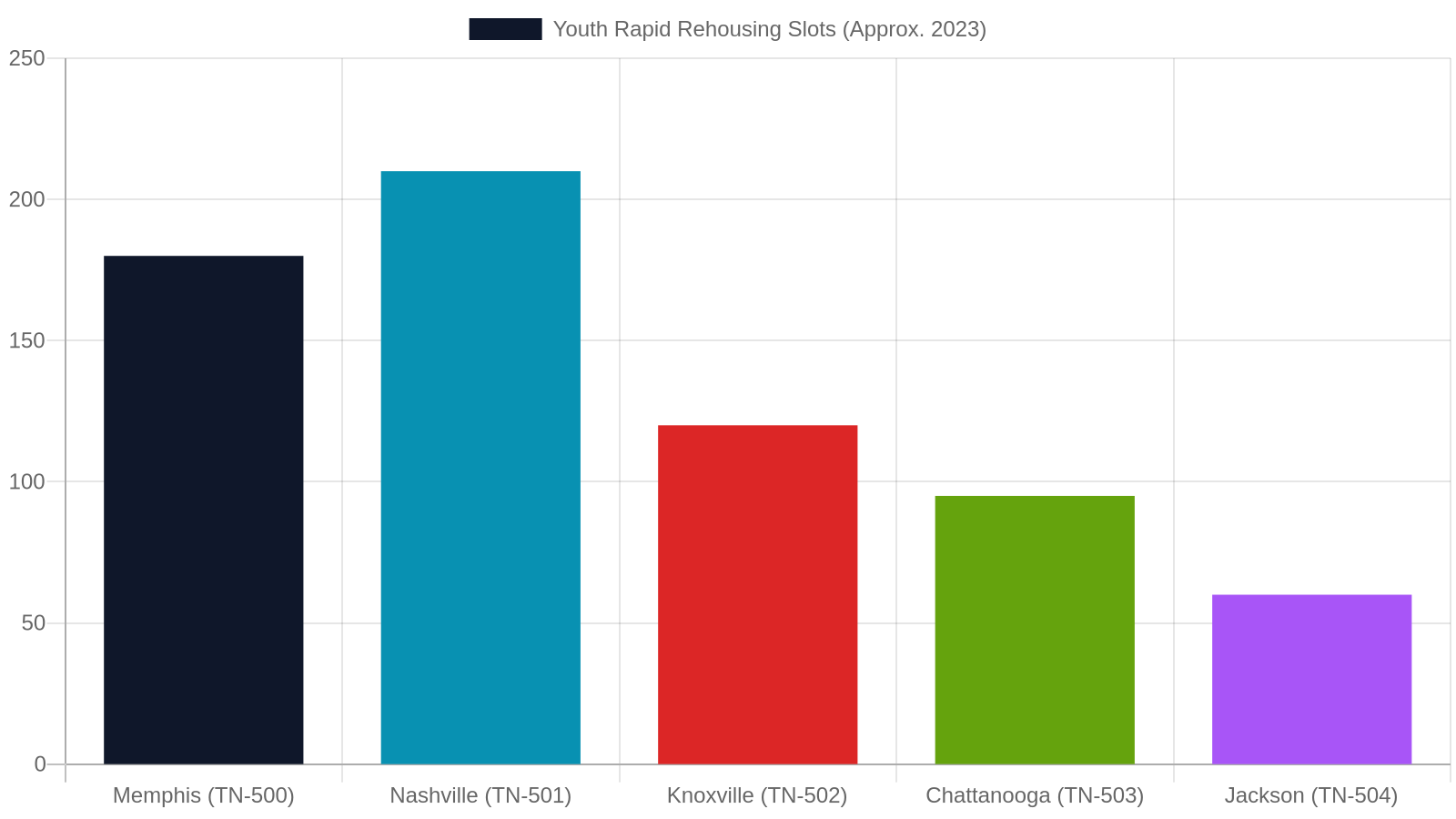
In Tennessee, RRH programs for youth exist in every CoC region, though capacity varies. Nashville’s CoC, for example, had over 200 rapid rehousing slots designated for youth in 2023.
Rental Assistance and Emergency Funds
Beyond formal RRH programs, Tennessee has several sources of emergency rental assistance that young adults can access:
- Tennessee Housing Development Agency (THDA) administers state-level rental assistance programs and can be reached at thda.org.
- Community Action Agencies in each county often have one-time emergency rental funds — call 211 to find your local agency.
- Faith-based organizations like Catholic Charities, Jewish Family Services, and local churches frequently offer small emergency grants with minimal paperwork.
- Utility assistance through LIHEAP (Low Income Home Energy Assistance Program) can free up cash for rent — apply through your local Community Action Agency.
Barriers YAAB Is Working to Remove
Standard rental assistance programs were not designed with 19-year-olds in mind. Common barriers include requirements for 12-month lease history, credit checks, co-signers, and proof of income at 2.5x rent — all things that most young adults experiencing homelessness simply cannot provide. YAAB advocates at the CoC level to create youth-specific RRH programs with modified eligibility criteria, and to train landlords on working with young adult renters who are rebuilding their stability.
5. Employment Support: Building Income While Rebuilding Stability

Stable housing and stable income are deeply connected. Most rapid rehousing programs expect participants to work toward self-sufficiency — which means finding employment or increasing income during the subsidy period. Tennessee has real resources to help, and YAAB has pushed to make them more accessible to young adults who face the most barriers.
Tennessee's Workforce Development Programs for Youth
You can’t pay rent without income — which is why employment support is inseparable from housing stability. Tennessee’s American Job Centers (AJCs), funded through the Workforce Innovation and Opportunity Act (WIOA), offer free job search assistance, résumé help, interview coaching, and occupational skills training to young adults ages 16 to 24. There are AJC locations in every major Tennessee city, and many offer services specifically for youth and young adults who face barriers to employment.
WIOA Youth Program participants can also receive supportive services like transportation assistance, work clothing stipends, and help with childcare — removing some of the practical barriers that make job-searching while unhoused so difficult.
Paid Training and Apprenticeship Pathways
Several Tennessee programs offer paid training so you earn money while building skills:
- Tennessee Reconnect covers tuition for adults pursuing a certificate or associate degree at a Tennessee College of Applied Technology (TCAT) — and many TCAT programs take less than a year to complete.
- Registered Apprenticeships in trades like electrical, plumbing, HVAC, and construction allow you to earn a wage (often $15–$22/hour starting) while training on the job.
- YouthBuild Tennessee programs combine construction skills training with GED preparation and leadership development — and participants receive a stipend during training.
YAAB's Role in Employment Advocacy
YAAB members have consistently identified employment as one of the top needs for transition-age youth experiencing homelessness. YAAB advocates for ban-the-box policies (removing criminal history questions from job applications), for employers to accept alternative ID documents, and for workforce programs to remove documentation requirements that exclude youth without Social Security cards or state IDs. If you’ve been turned away from a job or training program because of paperwork barriers, YAAB wants to hear your story — it’s exactly the kind of lived experience that drives policy change.
6. Education Pathways: GED, College, and Beyond

Education is one of the most powerful tools for long-term housing stability — and Tennessee has made significant investments in making it accessible and affordable. Whether you’re working toward your HiSET, starting community college, or exploring a trade certification, there are real pathways available to you right now.
Getting Your High School Equivalency in Tennessee
Tennessee offers the HiSET exam as its high school equivalency test (replacing the GED in the state). Preparation classes are free through Tennessee’s Adult Education program, offered at community colleges, libraries, and adult education centers across all 95 counties. Many sites offer flexible scheduling — including evenings and online options — designed for people who are working or navigating housing instability at the same time.
Passing the HiSET opens doors to college enrollment, better-paying jobs, and eligibility for programs like Tennessee Reconnect. If you left high school before graduating, this is one of the highest-return investments you can make in your own stability.
Tennessee Promise and Tennessee Reconnect
Tennessee Promise provides last-dollar scholarship funding for recent high school graduates to attend a Tennessee community college or TCAT tuition-free. Tennessee Reconnect does the same for adults who did not complete a postsecondary credential — meaning if you have a HiSET or high school diploma and haven’t earned a college degree or certificate, you may qualify for free community college.
Both programs require FAFSA completion. For youth who have experienced homelessness or aged out of foster care, the FAFSA includes a special unaccompanied homeless youth status that allows you to file independently — without a parent’s tax information — which can significantly increase your financial aid eligibility.
Education Supports Specific to Youth Experiencing Homelessness
The McKinney-Vento Homeless Assistance Act guarantees educational rights to students experiencing homelessness, including the right to immediate school enrollment, transportation, and free meals. For young adults in postsecondary settings, many Tennessee community colleges have Basic Needs programs that offer emergency food, emergency housing funds, and case management for students facing housing instability. Ask your college’s Dean of Students office about what’s available — these programs are often underutilized because students don’t know they exist.
7. Mental Health and Wellness Resources for Transition-Age Youth

Your mental and emotional wellbeing matters — not just as a side issue, but as a central part of your ability to find and keep stable housing. This section covers the mental health resources available to transition-age youth across Tennessee, and how YAAB’s peer-support model fits into the bigger picture.
Why Mental Health Is a Housing Issue
Housing instability and mental health are deeply intertwined. Research consistently shows that young adults experiencing homelessness have significantly higher rates of depression, anxiety, PTSD, and trauma-related conditions — not because of personal failings, but because of the stress, danger, and uncertainty that comes with not having a stable place to live. Addressing mental health is not separate from housing work — it is part of it.
Tennessee’s CoC-funded programs increasingly recognize this. Many rapid rehousing and transitional housing programs include access to mental health case managers or can refer you to community mental health centers that offer sliding-scale or no-cost therapy.
Tennessee's Mental Health Resources
Key mental health resources available to transition-age youth across Tennessee include:
- Tennessee’s Crisis Line: Call or text 988 (Suicide and Crisis Lifeline) — available 24/7, free, and confidential.
- Community Mental Health Centers: Every Tennessee county is served by a publicly funded community mental health center. Services are available on a sliding-scale fee based on income — many young adults pay $0.
- Behavioral Health Safety Net (BHSN): For uninsured Tennesseans, BHSN provides access to mental health and substance use treatment at reduced or no cost.
- TennCare (Medicaid): If you are uninsured and meet income requirements, TennCare covers mental health services including therapy and psychiatric medication management. Young adults ages 19–25 who were in foster care may qualify for extended foster care TennCare regardless of income.
Peer Support and Trauma-Informed Care
One of YAAB’s core values is peer support — the idea that lived experience is a form of expertise, and that connecting with someone who has been through similar experiences can be as powerful as professional therapy. Many YAAB members serve as informal peer navigators, helping peers access services without judgment. If you are looking for connection with someone who gets it, reaching out to your local YAAB chapter is a real option — not just for advocacy, but for community.
8. Aging Out of Foster Care: What Tennessee Offers

Aging out of foster care is one of the leading pathways into youth homelessness in Tennessee. But it doesn’t have to be. Tennessee has programs specifically designed to support young adults through this transition — and YAAB has been a consistent voice for making those programs more accessible, more flexible, and more responsive to what young people actually need.
The Cliff Edge: What Happens at 18
In Tennessee, young people in foster care can remain in the system until age 21 through the Extended Foster Care program — but many still exit at 18 without stable housing, employment, or a support network. Research from the National Homelessness Youth Alliance estimates that 1 in 5 young people who age out of foster care experience homelessness within two years of leaving care. Tennessee’s YAAB has made foster care transition a central advocacy priority.
Tennessee's Extended Foster Care and Transitional Living
Key programs for youth aging out of foster care in Tennessee include:
- Extended Foster Care (EFC): Young adults ages 18–21 can voluntarily remain in or re-enter foster care to receive housing, case management, and support. Contact the Tennessee Department of Children’s Services (DCS) to learn more.
- Transitional Living Programs (TLPs): Structured living arrangements that provide housing, life skills training, and case management for youth ages 16–24. Several TLPs operate across Tennessee’s CoC regions.
- Independent Living Skills Programs: DCS-funded programs that teach budgeting, cooking, job readiness, and other skills before and after youth exit care.
- Chafee Education and Training Vouchers (ETVs): Up to $5,000 per year for education and training expenses for current and former foster youth up to age 26.
Know Your Rights as a Former Foster Youth
Former foster youth in Tennessee have specific legal protections and entitlements that many young adults don’t know about. These include priority access to certain housing programs, independent FAFSA filing status (no parental information required), and potential eligibility for TennCare through age 26 regardless of income. YAAB members who have aged out of foster care are among the most powerful advocates in the network — because they know firsthand what the system gets right and what it fails to deliver. Learn more about youth homelessness and the foster care connection on the YAAB website.
Tennessee Youth Housing Interventions at a Glance
Use this table to compare the main housing options available to transition-age youth (ages 17–25) across Tennessee's Continuum of Care regions. Eligibility and availability vary by CoC — always confirm current openings through 211 or your local CoC.
9. Financial Literacy and Benefits Navigation

Financial stability and housing stability are inseparable. Understanding what benefits you qualify for, how to build credit, and how to navigate the paperwork requirements of housing programs can make the difference between staying housed and falling back into crisis. This section covers the financial tools and benefits most relevant to transition-age youth in Tennessee.
Building a Financial Foundation
Financial literacy isn’t about being good with money — it’s about having the knowledge to navigate systems that weren’t designed to be easy. For young adults rebuilding stability, the basics matter most: opening a bank account (many banks offer second-chance accounts for people with ChexSystems flags), understanding credit (a secured credit card with a $200 limit, used responsibly, can build a credit score within 6 months), and creating a simple budget using the 50/30/20 rule as a starting framework.
Many CoC-funded case managers can connect you with free financial counseling through local nonprofits — ask your case manager or call 211 to find a HUD-approved housing counselor near you.
Public Benefits You May Qualify For
Transition-age youth experiencing housing instability often qualify for multiple public benefits that can significantly increase their monthly resources:
- SNAP (food stamps): Single adults ages 18–49 without dependents face work requirements, but exemptions exist for those experiencing homelessness or in job training.
- TennCare (Medicaid): Free health insurance for qualifying low-income Tennesseans — apply at tenncare.tn.gov.
- SSI/SSDI: If you have a disability, you may qualify for Supplemental Security Income — a YAAB case manager or benefits navigator can help you apply.
- EITC (Earned Income Tax Credit): If you work, even part-time, you may qualify for a significant tax refund through the EITC — free tax prep is available through VITA sites statewide.
Getting Your Documents in Order
Many benefits and housing programs require identification documents — and for young adults who have been unhoused, those documents are often lost, stolen, or never obtained. Tennessee offers pathways to get documents at low or no cost:
- Birth certificate: Order through the Tennessee Office of Vital Records for $15; many shelters and nonprofits can cover this cost.
- State ID or Driver’s License: Tennessee’s Real ID-compliant state ID requires a birth certificate and proof of Social Security number. Some CoC programs can help cover the $8–$10 fee.
- Social Security card: Free to replace at your local Social Security Administration office — no fee, no appointment needed in most locations.
10. How to Get Involved with YAAB and Drive Change

Resources matter — but so does power. YAAB exists not just to connect young adults to services, but to put young adults in the rooms where decisions get made. If you want to turn your experience into influence, here’s how YAAB membership works and what it can lead to.
What YAAB Membership Looks Like
YAAB is not a one-time event or a checkbox program — it’s an ongoing community of young adults who show up for each other and for systemic change. Members participate in regional meetings, provide input on CoC planning documents, present at community forums, and sometimes testify before state legislative committees. Some members are paid stipends for their participation, recognizing that their lived experience is labor that has real value.
You don’t need a résumé, a college degree, or any particular background to join. You need to be between 17 and 25, to have experience with housing instability, and to want to use that experience to make things better for others. Learn how to join YAAB and find out what membership looks like in your region.
Advocacy Wins That Started with YAAB
YAAB members have contributed to real, documented policy changes across Tennessee. These include:
- Securing youth-specific set-asides in CoC funding competitions, ensuring that a portion of rapid rehousing and transitional housing funds are reserved for transition-age youth.
- Influencing shelter intake policies to reduce documentation barriers and improve safety for LGBTQ+ youth.
- Providing testimony that shaped Tennessee’s approach to Extended Foster Care program outreach.
- Developing peer-reviewed recommendations for CoC Boards on how to measure and improve youth housing outcomes.
These wins happened because young people with lived experience showed up and spoke up. Your voice has the same power.
Advocacy Beyond YAAB
YAAB is one avenue for advocacy — but not the only one. Tennessee has a growing ecosystem of youth-led and youth-serving advocacy organizations. You can also engage with your state legislators directly (every Tennessean has a state House and Senate representative who holds constituent meetings), participate in public comment periods on HUD funding plans, and connect with national networks like the National Homelessness Youth Alliance (NHYA) and True Colors United. YAAB can help you find the right entry point. Explore YAAB’s advocacy work to see what’s currently in motion.
11. A Side-by-Side Look at Tennessee's Key Youth Housing Interventions

Not every housing program is the right fit for every situation. The table below compares Tennessee’s main housing interventions for transition-age youth — including who they serve, how long they last, and what they require — so you can quickly identify which option makes the most sense for where you are right now. Use this as a starting point, then connect with a case manager or call 211 for current availability in your CoC region.
12. Your Next Move: Access Resources and Connect with YAAB

You’ve made it through a lot of information — and hopefully found something useful for where you are right now. Whether you need a place to sleep tonight, help finding a job, a path back to school, or a community of peers who get it, Tennessee has resources and so does YAAB. Here’s how to take the next step.
Start Here, Right Now
If you are in Tennessee and need housing help today, start with 211 — call or text from anywhere in the state, 24 hours a day, 7 days a week. A trained specialist will connect you to shelter referrals, rental assistance, food, and other resources in your area. It’s free, confidential, and available in multiple languages.
If you’re not in immediate crisis but want to explore what’s available to you, the YAAB Tennessee resources page is the best single starting point — it’s organized by region and updated regularly with housing, employment, education, and mental health resources specifically for transition-age youth across the state.
Connect with Your Regional YAAB
Whether you want services, community, or a way to turn your experience into change — your regional YAAB chapter is the place to start. YAAB operates in Memphis/Shelby, Nashville/Davidson, Knoxville/Knox, Chattanooga/Hamilton, Jackson/West Tennessee, Upper Cumberland, and Northeast Tennessee. Each chapter has its own meeting schedule, peer navigators, and connections to local service providers.
Reaching out to YAAB doesn’t commit you to anything — it connects you to a community of peers who understand what you’ve been through and want to help you move forward. Visit YAAB’s contact page to reach the team directly, or find your local chapter and introduce yourself. You belong here.
Frequently Asked Questions
How do I find housing help as a young adult in Tennessee?
Call or text 211 from anywhere in Tennessee — it's free, available 24/7, and will connect you to shelter referrals, rental assistance, and other resources in your area. You can also visit the YAAB Tennessee resources page at yaabtn.org/resources for a curated list of youth-specific housing programs by region.
What is the Youth Action Board (YAAB) of Tennessee?
YAAB is a statewide network of young adults ages 17 to 25 with lived experience of homelessness who advise local and state leaders, advocate for better policies, and connect peers to housing, employment, education, and mental health resources across Tennessee's Continuum of Care regions.
Can I get housing help in Tennessee if I don't have an ID?
Many youth-specific shelters and rapid rehousing programs in Tennessee accept young adults without ID. YAAB has actively advocated to reduce documentation barriers at shelter intake. If you need help getting a birth certificate, state ID, or Social Security card, ask your case manager or call 211 — many nonprofits can cover the fees.
What happens to young people who age out of foster care in Tennessee?
Tennessee allows young adults to voluntarily remain in or re-enter foster care until age 21 through the Extended Foster Care program. Former foster youth also qualify for TennCare through age 26, Chafee Education and Training Vouchers up to $5,000/year, and independent FAFSA filing status for college financial aid.
How do I join the Youth Action Board in Tennessee?
YAAB is open to young adults ages 17 to 25 with lived experience of homelessness or housing instability. No résumé or prior experience required. Visit yaabtn.org/join to learn about membership, or find your local YAAB chapter at yaabtn.org/local-yaabs to connect with peers in your region.
What is Coordinated Entry and how does it work for youth in Tennessee?
Coordinated Entry is a standardized process used by Tennessee's Continuum of Care regions to assess your housing needs, prioritize you based on vulnerability, and match you to the most appropriate program — whether that's emergency shelter, rapid rehousing, or transitional housing. Access it by calling 211 or contacting a youth-serving agency in your area.