Quick answer: Aging out of foster care in Tennessee at 18 — or up to 21 under extended care — can feel like stepping off a cliff with no safety net. Central Tennessee's Youth Action Board (TN-503), covering Nashville and Davidson County, connects young adults ages 17 to 25 to peer mentors, housing resources, employment pathways, education support, and advocacy opportunities. Unlike top-down programs, YAAB is led by young people with lived experience who know the system from the inside and use that knowledge to help peers navigate it — and change it.
What 'Aging Out' Actually Means — and Why It's So Hard

For thousands of young adults across Tennessee, turning 18 in foster care is less a celebration and more a countdown. The system that housed, fed, and — however imperfectly — supported them for years suddenly steps back. Understanding what that transition actually looks like, and what legal protections and programs exist, is the first step toward navigating it successfully.
The Cliff at 18 (and What Extended Care Offers)
In Tennessee, young people in foster care traditionally “age out” at 18 — meaning the state’s legal obligation to provide placement and support ends on their birthday. Since 2016, Tennessee’s Extended Foster Care (EFC) program, sometimes called Tennessee Fostering Connections, has allowed eligible youth to remain in care voluntarily until age 21 if they meet certain conditions: enrolled in school, working at least 80 hours per month, completing a GED program, or participating in an approved activity to remove barriers to employment. Despite this option, fewer than 40% of eligible Tennessee youth opt into extended care, often because they don’t know it exists or don’t have someone to walk them through the paperwork.
The Numbers Behind the Challenge
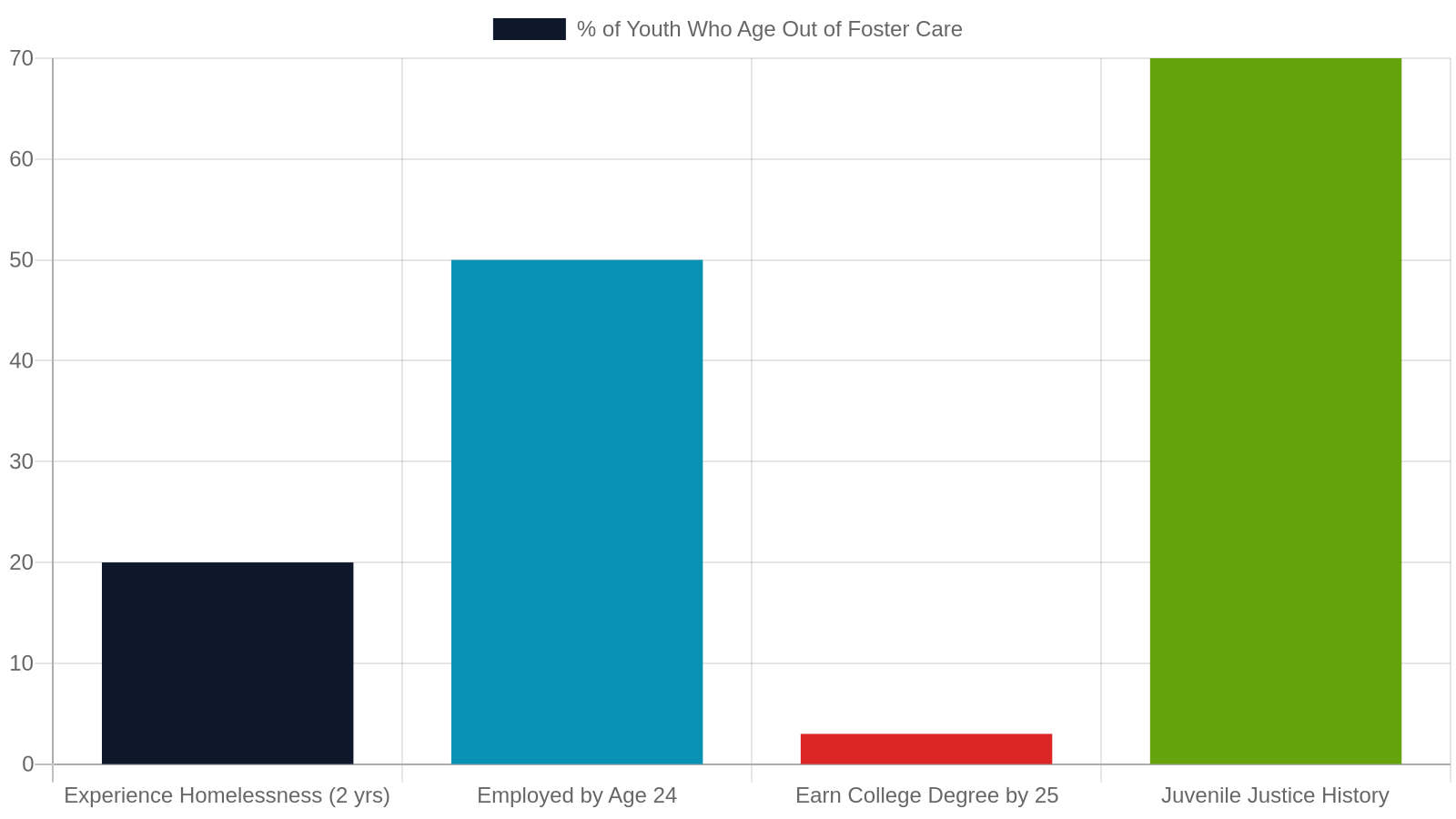
The stakes are real and the data is sobering. Nationally, within two years of aging out:
- 1 in 5 young adults who aged out of foster care experience homelessness
- Only 50% are employed by age 24
- Fewer than 3% earn a college degree by age 25
- More than 70% of youth in the juvenile justice system have a foster care history
In Tennessee, the Department of Children’s Services (DCS) serves roughly 8,000 young people in foster care at any given time, with several hundred aging out each year statewide. Nashville and Davidson County — the heart of the TN-503 Continuum of Care region — see a significant share of those transitions. These aren’t just statistics. They represent real people who deserved more preparation and more support.
Why Peer Support Changes the Equation
Research consistently shows that peer-to-peer connection is one of the strongest predictors of positive outcomes for transition-age youth. When someone who has lived through the same system tells you what resources exist and how to actually access them — not in bureaucratic language but in plain, honest terms — you’re far more likely to act on that information. This is the core philosophy behind YAAB: young people with lived experience are not just beneficiaries of services, they are experts, advocates, and leaders.
What Is the Central Tennessee YAAB (TN-503)?

Before diving into the specific ways YAAB supports young adults aging out of foster care, it helps to understand exactly what the Central Tennessee YAAB is, how it fits into the broader statewide network, and why its structure makes it uniquely effective for transition-age youth in the Nashville area.
The TN-503 Continuum of Care Region
Tennessee is divided into nine Continuum of Care (CoC) regions, each responsible for coordinating homeless services and housing resources for their area. TN-503 covers Nashville and Davidson County — one of the state’s largest and most resource-rich regions, but also one where housing costs have surged dramatically. The median rent for a one-bedroom apartment in Nashville crossed $1,400/month in 2024, making it one of the least affordable mid-sized cities in the Southeast for young adults earning entry-level wages.
YAAB's Role Within TN-503
The Youth Action Board embedded in TN-503 is a peer-led advisory body made up of young adults ages 17 to 25 who have personally experienced homelessness or housing instability — including those who have aged out of foster care. YAAB members don’t just receive services; they shape the policies and programs that determine what services exist. They sit at tables with CoC leadership, provide input on funding priorities, review service gaps, and advocate directly to local and state decision-makers.
This is a fundamental shift from traditional youth services: instead of adults deciding what young people need, young people with lived experience are in the room making those calls.
Who Can Join and What Membership Looks Like
Any young adult in the TN-503 region (Nashville/Davidson County) between ages 17 and 25 who has experienced homelessness or housing instability — including foster care transitions — is eligible to join the local YAAB. Membership is flexible and designed around real life: meetings are held at accessible times, transportation support may be available, and members are often compensated for their time through stipends or gift cards, recognizing that their expertise has real value. You don’t need a resume or references. Your experience is your qualification.
Housing Support: Finding Stability After Foster Care

Housing is the foundation everything else is built on. Without a stable place to sleep, it’s nearly impossible to hold a job, finish school, or take care of your mental health. Central Tennessee YAAB members — many of whom have navigated Nashville’s housing landscape themselves — are some of the best guides you’ll find for understanding what’s available, what you qualify for, and how to actually get it.
Rapid Rehousing and Transitional Housing Options in TN-503
Within the TN-503 CoC, several housing programs specifically target transition-age youth (TAY), including those aging out of foster care. Rapid Rehousing (RRH) programs provide short-term rental assistance — typically 3 to 12 months — plus case management to help young adults stabilize quickly. Transitional Housing (TH) programs offer longer-term supported living, often 12 to 24 months, with structured programming around life skills, employment, and education. YAAB members can help peers understand which program is the right fit and how to get referred through the Coordinated Entry system.
Coordinated Entry: The Gateway to Housing Resources
In Tennessee, accessing most federally funded housing programs requires going through Coordinated Entry (CE) — a standardized assessment process that prioritizes people based on need and vulnerability. For young adults aging out of foster care, this can feel intimidating. YAAB peers can walk you through what to expect: the VI-SPDAT or youth-specific assessment tool, what questions will be asked, how scores are used, and what happens after you’re assessed. Knowing the process in advance reduces anxiety and increases the chance you’ll follow through. In Nashville, the Coordinated Entry access point for youth is operated through the Metro Social Services and partner agencies — YAAB can connect you directly.
Tennessee's DCS Housing Programs for Former Foster Youth
Tennessee DCS offers several housing-related supports specifically for young adults who were in foster care:
- Transitional Living Program (TLP): Supervised living for youth ages 16-21 with life skills training
- Independent Living Stipends: Financial assistance for youth in Extended Foster Care
- Housing Vouchers (HUD-VASH equivalent for foster youth): Some CoC regions have dedicated vouchers for former foster youth — availability varies by year and funding cycle
- Fostering Futures Scholarship: Covers tuition at Tennessee public colleges and universities for former foster youth — which can free up income for housing costs
YAAB members help peers identify which of these programs they may qualify for and connect them with the right case managers or DCS liaisons.
Employment Pathways: Getting Paid and Building a Career

Finding and keeping a job is one of the biggest challenges for young adults leaving foster care — especially in a city like Nashville where the cost of living has outpaced entry-level wages. YAAB peers can help you cut through the noise and find programs that are actually designed for people in your situation.
Workforce Programs Specifically for Transition-Age Youth in Nashville
Nashville has a robust workforce development ecosystem, but knowing which programs are actually youth-friendly — and which ones have long waitlists or complicated eligibility rules — takes insider knowledge. Key programs YAAB peers can help you navigate include:
- Tennessee Promise and Tennessee Reconnect: Free community college pathways that also open doors to workforce credentials
- Nashville Career Advancement Center (NCAC): Free job training, resume help, and placement services
- YouthBuild Nashville: Paid job training in construction trades combined with GED/diploma completion for ages 16-24
- Workforce Innovation and Opportunity Act (WIOA) Youth Programs: Federally funded, income-eligible job training and paid work experience for ages 14-24
Your Rights as a Young Worker in Tennessee
Many young adults aging out of foster care don’t know their workplace rights — and some employers take advantage of that. Key things to know in Tennessee:
- Tennessee’s minimum wage follows the federal floor of $7.25/hour (as of 2024), but many Nashville employers pay more due to competition
- You cannot be discriminated against in hiring based on your housing status in many federally funded programs
- If you’re in Extended Foster Care, working does not automatically disqualify you — you may be able to count work hours toward your EFC eligibility requirement
- YAAB advocates push for Ban the Box policies that remove criminal history questions from initial job applications — know that some Nashville employers have already adopted these voluntarily
How YAAB Advocacy Shapes Employment Policy
YAAB members don’t just connect peers to existing jobs — they work to change the systems that create barriers to employment for young adults with foster care histories. This includes advocating for paid internships within CoC partner organizations, pushing for stipends for YAAB participation itself (so advocacy work is recognized as real work), and providing input to local workforce boards about what young adults actually need from job training programs. If you want to be part of that advocacy work, learn more about YAAB’s statewide advocacy efforts and how you can add your voice.
Education and GED Pathways: Finishing What You Started

Education is one of the most reliable pathways out of poverty — and Tennessee has created real financial supports specifically for young adults who experienced foster care. The challenge is knowing they exist and knowing how to access them. YAAB peers have navigated these systems themselves and can help you do the same.
The Fostering Futures Scholarship — Free College for Former Foster Youth
One of the most powerful and underutilized resources available to young adults who were in Tennessee foster care is the Fostering Futures Scholarship. This program covers tuition and mandatory fees at any Tennessee public college or university for eligible former foster youth up to age 23 (with some extensions). Eligibility generally requires that you were in Tennessee DCS custody at age 14 or older and aged out or were adopted/placed in guardianship after age 14. The scholarship can be combined with Tennessee Promise (free community college for recent high school graduates) or Tennessee Reconnect (for adults returning to college). YAAB peers can help you understand how to apply and what documentation DCS needs to verify your eligibility.
GED and HiSET Options in the Nashville Area
If you didn’t finish high school — which is common for young people who experienced placement instability — a high school equivalency credential opens doors to employment and college. In Nashville and Davidson County, free or low-cost GED/HiSET preparation is available through:
- Nashville Adult Literacy Council: Free tutoring and prep classes
- Tennessee College of Applied Technology (TCAT) Nashville: Offers adult education programs
- Metro Nashville Public Schools Adult Education: Free GED prep classes at multiple locations
- YouthBuild Nashville: Integrates GED completion with paid job training
The HiSET exam costs approximately $10.75 per subtest in Tennessee, and fee waivers are available for income-eligible individuals — YAAB peers can help you access those waivers.
Staying Enrolled When Life Gets Complicated
One of the hardest parts of pursuing education while housing-unstable is staying enrolled when a crisis hits. YAAB members understand this from personal experience. Strategies that have worked for peers include: using campus emergency funds (most Tennessee colleges have them), connecting with campus foster youth liaison programs (required at Tennessee public universities under state law), applying for Priority Registration as a foster youth, and accessing campus food pantries and housing assistance programs. You don’t have to choose between stability and education — YAAB can help you find ways to pursue both at the same time.
Mental Health and Wellness: Taking Care of Yourself First

Aging out of foster care is one of the most stressful life transitions a young person can face — and the mental health toll is real. YAAB centers wellness not as a luxury but as a foundation. Taking care of your mental health isn’t separate from finding housing or a job; it makes all of those things more possible.
Why Mental Health Support Matters for Foster Care Alumni
Research from the National Survey of Child and Adolescent Well-Being found that more than 50% of youth aging out of foster care meet diagnostic criteria for at least one mental health condition — most commonly depression, anxiety, and PTSD related to trauma experienced before or during placement. This isn’t a character flaw; it’s a predictable response to genuinely hard experiences. The problem is that mental health support often disappears at the same moment everything else does — at 18. Tennessee Medicaid (TennCare) covers former foster youth until age 26 regardless of income, which means you have a legal right to mental health services through your mid-twenties even if you have no income.
Finding Mental Health Resources in Nashville
Knowing you have TennCare coverage is one thing; finding a provider who takes it and who actually understands trauma and housing instability is another. In the Nashville area, YAAB peers can help connect you to:
- Centerstone: Large community mental health provider with sliding-scale and TennCare-covered services
- Matthew Walker Comprehensive Health Center: Federally Qualified Health Center (FQHC) with integrated behavioral health
- Vanderbilt Psychiatric Hospital outpatient programs: Accepts TennCare for eligible youth
- Crisis Text Line: Text HOME to 741741 — free, 24/7, no insurance needed
YAAB members are not therapists, but they are peers who have found these resources and can help you navigate the process of getting an appointment without it feeling overwhelming.
Peer Support as a Wellness Tool
Beyond formal mental health services, peer connection itself is a wellness intervention. YAAB meetings, events, and advocacy work create community — which is something many young adults leaving foster care have never had in a stable, consistent way. Belonging to a group of people who understand your experience without judgment, who celebrate your wins and show up when things are hard, is genuinely healing. Multiple YAAB members across Tennessee have described their involvement as one of the most important factors in their own stability and recovery.
Knowing Your Rights: What Tennessee Law Guarantees You

One of the most empowering things you can do as a young adult navigating these systems is know your rights — not in a confrontational way, but in a confident, informed way. Tennessee law and federal policy provide real protections for young adults who have experienced foster care, and YAAB members can help you understand and use them.
Extended Foster Care Rights (Ages 18-21)
If you are currently in Tennessee foster care and approaching 18, or if you aged out recently, you have the right to voluntarily re-enter Extended Foster Care until age 21 if you meet one of the participation requirements. DCS is legally required to inform you of this option — if they didn’t, that’s a problem you can raise. Key rights under EFC include: the right to a Transitional Living Plan updated at least annually, the right to participate in decisions about your own case, the right to request a different placement or caseworker, and the right to have an advocate present at meetings. YAAB members can attend case planning meetings with you as a peer support person.
TennCare Coverage Until Age 26
This is one of the most important rights former foster youth in Tennessee have and one of the least known: under federal law (the Affordable Care Act’s foster care provision), any young adult who was in foster care in Tennessee at age 18 or older is entitled to TennCare (Medicaid) coverage until age 26 — with no income test and no application fee. This covers medical, dental, vision, mental health, and substance use treatment. If you were in foster care in another state, you may still qualify for Tennessee TennCare if you now live here. Contact TennCare Connect at 1-855-259-0701 to enroll or verify your eligibility.
Fair Housing Rights and Tenant Protections
As a renter in Tennessee, you have legal rights even if you’re young, even if you’ve experienced homelessness, and even if your rental history is thin. Key protections include:
- Landlords cannot discriminate based on source of income in some Nashville-area programs (check local ordinances)
- You are entitled to a written lease and must receive proper notice before eviction
- Security deposits in Tennessee are capped at one month’s rent for most residential leases
- If you receive a housing voucher (like HCV/Section 8), landlords in federally funded housing cannot refuse it
YAAB advocates push for stronger tenant protections for young adults and can connect you to free legal aid resources in Nashville if you’re facing an eviction or landlord dispute.
Key Support Programs for Foster Youth Aging Out in Tennessee: At a Glance
Navigating the landscape of programs available to young adults aging out of foster care in Tennessee can be overwhelming. This table breaks down the most important options by eligibility, what they provide, and how to access them.
How YAAB Compares to Other Youth Support Models

Understanding how YAAB fits into the broader landscape of youth support services helps you make the most of every resource available to you. YAAB isn’t trying to replace other programs — it’s filling gaps that other models weren’t designed to fill.
What Makes Peer-Led Advocacy Different
Traditional youth services are typically designed for young people by adult professionals. YAAB flips that model: it is designed by young people with lived experience, with adult partners playing a supporting role rather than a directing one. This matters because peer advocates know which shelter rules are actually enforced, which case managers are most responsive, which programs have the shortest waitlists, and which ones aren’t worth the paperwork. That street-level knowledge is irreplaceable — and it’s what makes YAAB members so effective as connectors and advocates.
YAAB vs. Traditional Case Management
Case managers are valuable — but they typically carry caseloads of 20 to 50 clients, work within agency constraints, and may not have personal experience with homelessness or foster care. YAAB peers are not a replacement for case management; they are a complement to it. Where a case manager might schedule a follow-up appointment two weeks out, a YAAB peer can answer a question by text today. Where a case manager is bound by agency policy, a YAAB advocate can speak freely about what’s working and what isn’t. The two models work best together — and YAAB actively builds relationships with CoC case managers to make that collaboration happen.
Financial Literacy: Managing Money When You're Starting From Zero

Nobody teaches you how to manage money in foster care — and the financial system can feel designed to keep you out. YAAB members who have navigated banking, credit, benefits, and budgeting from scratch share what they’ve learned so you don’t have to figure it out alone.
Opening a Bank Account and Building Credit
Many young adults leaving foster care have never had a bank account — and some have damaged credit from identity theft that occurred while they were minors (a disturbingly common problem for foster youth). First steps:
- Open a second-chance checking account at a credit union or bank that doesn’t use ChexSystems — many community banks and credit unions in Nashville offer these
- Apply for a secured credit card with a small limit ($200-$500) and pay it off monthly to start building credit history
- Check your credit report for free at AnnualCreditReport.com — if you find accounts you didn’t open, you may be a victim of identity theft and can dispute them for free
- Tennessee’s IDA (Individual Development Account) programs match savings for low-income young adults working toward homeownership, education, or small business — ask YAAB about local availability
Benefits You May Qualify For Right Now
Financial stability starts with knowing what you’re entitled to. As a young adult in Tennessee who has experienced foster care or homelessness, you may qualify for:
- SNAP (food stamps): Former foster youth ages 18-24 are exempt from the standard work requirements in Tennessee
- SSI/SSDI: If you have a qualifying disability, you may be eligible regardless of work history
- EITC (Earned Income Tax Credit): If you work, file your taxes — even with low income, you may receive a refund
- Free tax filing: VITA (Volunteer Income Tax Assistance) sites across Nashville offer free tax prep for income-eligible individuals
YAAB peers can help you understand which benefits to apply for first and how to avoid the common mistake of assuming you don’t qualify without checking.
Getting Involved: How to Join Central Tennessee YAAB

The most important thing to know about YAAB is this: it was built by and for young people like you. If you’ve lived through housing instability, foster care, or the chaos of trying to figure out adulthood without a safety net, your experience is exactly what YAAB needs — and YAAB has resources, community, and opportunities that can make a real difference in your life right now.
What to Expect When You First Connect
Joining YAAB doesn’t require an application essay, a clean record, or any particular level of stability. If you’re between 17 and 25 and have lived experience of homelessness or housing instability — including aging out of foster care — you belong at the table. When you first connect with the Central Tennessee YAAB (TN-503), you’ll typically be invited to a meeting or event where you can meet current members, hear about what the group is working on, and decide if and how you want to get involved. There’s no pressure to share your story before you’re ready, and no minimum commitment required to start.
What YAAB Members Actually Do
YAAB membership looks different for different people. Some members attend monthly meetings and provide input on CoC policy decisions. Others take on specific projects — developing resource guides, presenting at conferences, participating in listening sessions with state legislators, or helping design new programs. Some members go on to serve in formal leadership roles within their regional YAAB or the statewide network. All of it counts. All of it matters. And all of it is built around the understanding that your time and expertise have real value — which is why many YAAB activities include stipends or compensation for participation.
Connect With the TN-503 YAAB Today
If you’re in Nashville or Davidson County and want to learn more, get connected, or just show up and see what YAAB is about, the best first step is to visit the Central Tennessee YAAB (TN-503) page to find current contact information, meeting schedules, and ways to get involved. You can also start the process of joining YAAB statewide if you’re not sure which regional board is right for you — the statewide team can help connect you to the right local group. If you’re outside the Nashville area, find your regional YAAB — there are boards across Tennessee from Memphis to Knoxville to the Upper Cumberland.
Your Next Move: Taking the First Step Today

Aging out of foster care in Tennessee is hard — but it doesn’t have to mean going it alone. The Central Tennessee YAAB (TN-503) and the statewide YAAB network exist because young people who lived through exactly what you’re facing decided to build something better. That work continues every day, and there’s room for you in it.
Start Where You Are
You don’t have to have everything figured out to take a first step. Whether you’re currently in a shelter, couch-surfing, in transitional housing, or newly stabilized and wanting to give back — there is a place for you in YAAB and in the broader network of resources described in this article. The system is complicated, but you don’t have to navigate it alone. Peer advocates, case managers, CoC partners, and YAAB members across Tennessee are ready to help you move forward — on your terms, at your pace.
Resources to Bookmark Right Now
Here are the most important resources from this article, in one place:
- Central Tennessee YAAB (TN-503): yaabtn.org/local-yaabs/tn-503/
- All Tennessee Regional YAABs: yaabtn.org/local-yaabs/
- YAAB Resources Page: yaabtn.org/resources/
- TennCare Enrollment: 1-855-259-0701
- Crisis Text Line: Text HOME to 741741
- Tennessee DCS Extended Foster Care: Contact your DCS caseworker or call DCS at 1-877-237-0004
- Fostering Futures Scholarship: Apply through the Tennessee Student Assistance Corporation (TSAC) at tn.gov/collegepays
You’ve already survived a lot. With the right support and the right community around you, the next chapter can look very different from what came before. YAAB is proof of that — built by young people who were exactly where you are, and who chose to use their experience to make the path easier for everyone who comes after them.
Frequently Asked Questions
What happens when you age out of foster care in Tennessee?
In Tennessee, foster care legally ends at 18, but eligible youth can voluntarily stay in Extended Foster Care (EFC) until age 21 by meeting participation requirements like school enrollment or working 80+ hours per month. At 18 or 21, young adults transition out of DCS support, but programs like Rapid Rehousing, the Fostering Futures Scholarship, and TennCare coverage (until age 26) continue to provide support.
Does Tennessee have free college for former foster youth?
Yes. The Fostering Futures Scholarship covers tuition and mandatory fees at any Tennessee public college or university for eligible former foster youth up to age 23. Eligibility generally requires that you were in Tennessee DCS custody at age 14 or older and aged out or were adopted/placed in guardianship after age 14. Apply through the Tennessee Student Assistance Corporation (TSAC).
How do I join the Youth Action Board (YAAB) in Nashville?
If you're between 17 and 25 and have lived experience of homelessness or housing instability — including aging out of foster care — you're eligible to join the Central Tennessee YAAB (TN-503). Visit yaabtn.org/local-yaabs/tn-503/ for current contact information and meeting schedules. No application essay or clean record is required — your experience is your qualification.
Can I get health insurance after aging out of foster care in Tennessee?
Yes. Under federal law, any young adult who was in foster care in Tennessee at age 18 or older is entitled to TennCare (Medicaid) coverage until age 26 — with no income test and no application fee. This covers medical, dental, vision, mental health, and substance use treatment. Call TennCare Connect at 1-855-259-0701 to enroll.
What is Coordinated Entry and how does it work for youth in Nashville?
Coordinated Entry (CE) is the standardized process Tennessee uses to assess and prioritize people for federally funded housing programs. For youth in Nashville, it involves a brief assessment of your housing situation and needs. Your score helps determine which housing programs you're referred to. YAAB peers can help you understand what to expect and how to navigate the process.
What is the difference between Rapid Rehousing and Transitional Housing?
Rapid Rehousing (RRH) provides short-term rental assistance — typically 3 to 12 months — to help you move quickly into your own apartment, with case management support. Transitional Housing (TH) is longer-term supported living, usually 12 to 24 months, in a program setting with structured life skills, employment, and education programming. Both are accessed through Coordinated Entry in your CoC region.