Finding Safe Housing as a Young Adult in Tennessee: 9 Steps to Get Stable
Quick answer: If you’re a young adult ages 17 to 25 in Tennessee and you’re dealing with homelessness or housing instability, you are not alone and there are real options. Start by calling 211 to get connected to your local Continuum of Care (CoC), ask about Coordinated Entry, and find out whether you qualify for Rapid Rehousing or Transitional Housing. Tennessee has seven CoC regions — including Memphis, Nashville, Knoxville, Chattanooga, Jackson, the Upper Cumberland, and Northeast TN — each with youth-specific programs. This guide walks you through every step, from your first night safe to getting a lease in your name.
1. Know What You're Dealing With: Housing Instability Defined
Before you can navigate the system, it helps to understand the language the system uses. Words like homelessness, housing instability, and doubled-up have specific legal definitions that determine what programs you qualify for. Getting clear on these terms is step one — not because labels define you, but because the right label unlocks the right door.
The HUD Definition — and Why It Matters for You
The U.S. Department of Housing and Urban Development (HUD) defines youth homelessness broadly. You count as homeless if you are: sleeping outside or in a place not meant for human habitation (a car, an abandoned building, a tent); staying in an emergency shelter; or fleeing an unsafe home situation with nowhere to go. You also qualify under the “doubled-up” category if you are couch-surfing at a friend’s or relative’s place because you have no housing of your own — even if you have a roof over your head tonight.
This distinction matters because it determines which programs you can access. Many young people don’t realize that couch-surfing counts, which means they miss out on services they’re fully eligible for. In Tennessee, roughly 3,000 to 5,000 transition-age youth (ages 17–25) experience homelessness on any given night, according to statewide Point-in-Time Count estimates — and that number undercounts people who are doubled-up.
Housing Instability vs. Chronic Homelessness
Housing instability is a spectrum. On one end, you might be one missed paycheck away from eviction. On the other end, someone may have been without stable housing for more than a year. Federal programs treat these situations differently. Rapid Rehousing is designed for people who need a short bridge to get into their own place quickly. Permanent Supportive Housing is for people with longer histories of homelessness who also have a disabling condition. Knowing where you fall on that spectrum helps you ask for the right program by name — and that saves time.
2. Make Your First Call: Dial 211 Tonight
The single fastest move you can make right now — day or night — is to call 211. It’s Tennessee’s statewide social services helpline, and it is the front door to almost every housing resource in the state. You don’t need to know exactly what you need. You just need to make the call.
What 211 Is and What to Expect
211 is a free, confidential helpline available 24 hours a day, 7 days a week across Tennessee. When you call or text, a trained specialist connects you to local resources — emergency shelters, food banks, mental health crisis lines, and housing programs. You can also reach them at 211.org or by texting your zip code to 898-211. The call is free from any phone, including a cell phone with no minutes, and it works in every county in Tennessee.
When you call, tell the specialist your age and that you are a young adult (17–25) experiencing homelessness or housing instability. Ask specifically: “Is there a youth-specific shelter or Rapid Rehousing program in my area?” Youth-specific programs often have different eligibility rules than adult programs and may be a better fit for your situation.
What to Have Ready Before You Call
You don’t need documents to call 211, but having a few things ready can speed up the process:
Your zip code — so they can find the closest resources
Your age — programs for 17–25 year-olds are different from adult programs
A brief description of your situation — are you sleeping outside, couch-surfing, fleeing an unsafe home?
Any ID you have — even a school ID or birth certificate helps, though you can access many programs without ID (more on that in Step 5)
If you’re in immediate danger — physical harm, a mental health crisis, or a medical emergency — call 911 first, then 211 for follow-up housing resources.
3. Understand Tennessee's Continuum of Care System
The housing system in Tennessee is organized around a federally funded structure called the Continuum of Care. Understanding how it works — even at a basic level — gives you a huge advantage when you’re trying to access resources, because you’ll know what to ask for and who to ask.
What a Continuum of Care (CoC) Actually Does
A Continuum of Care (CoC) is a regional network of nonprofits, government agencies, shelters, and service providers that work together to end homelessness. HUD funds CoCs across the country, and Tennessee has seven CoC regions. Each CoC coordinates who gets which housing resources through a process called Coordinated Entry — a single access point so you don’t have to knock on 20 different doors.
Think of Coordinated Entry like a triage system. You complete an assessment (usually a survey called the VI-SPDAT or a youth-specific version), and based on your score and situation, you get matched to the most appropriate program — emergency shelter, Rapid Rehousing, Transitional Housing, or Permanent Supportive Housing.
Tennessee's Seven CoC Regions at a Glance
Knowing your region helps you find the right local contacts:
Memphis/Shelby County CoC — served by MIFA, Door of Hope, and others
Nashville/Davidson County CoC — coordinated through the Metro Homelessness Commission
Knoxville/Knox County CoC — anchored by KARM and Volunteer Ministry Center
Chattanooga/Hamilton County CoC — coordinated through the Chattanooga Regional Homeless Coalition
Jackson/West Tennessee CoC — serving rural and small-city communities across West TN
Upper Cumberland CoC — covering Cookeville, Crossville, and surrounding counties
Balance of State / Northeast Tennessee CoC — covering rural areas including the Tri-Cities region
Each CoC has its own youth-specific contacts and programs. Find your regional YAAB chapter to connect with peers who already know the local system.
4. Know Your Housing Options: A Breakdown of Program Types
Not all housing programs are the same, and not every program is right for every situation. Understanding the four main program types — and what each one is actually designed to do — helps you have smarter conversations with case managers and housing navigators so you can push for the option that fits your life right now.
Emergency Shelter
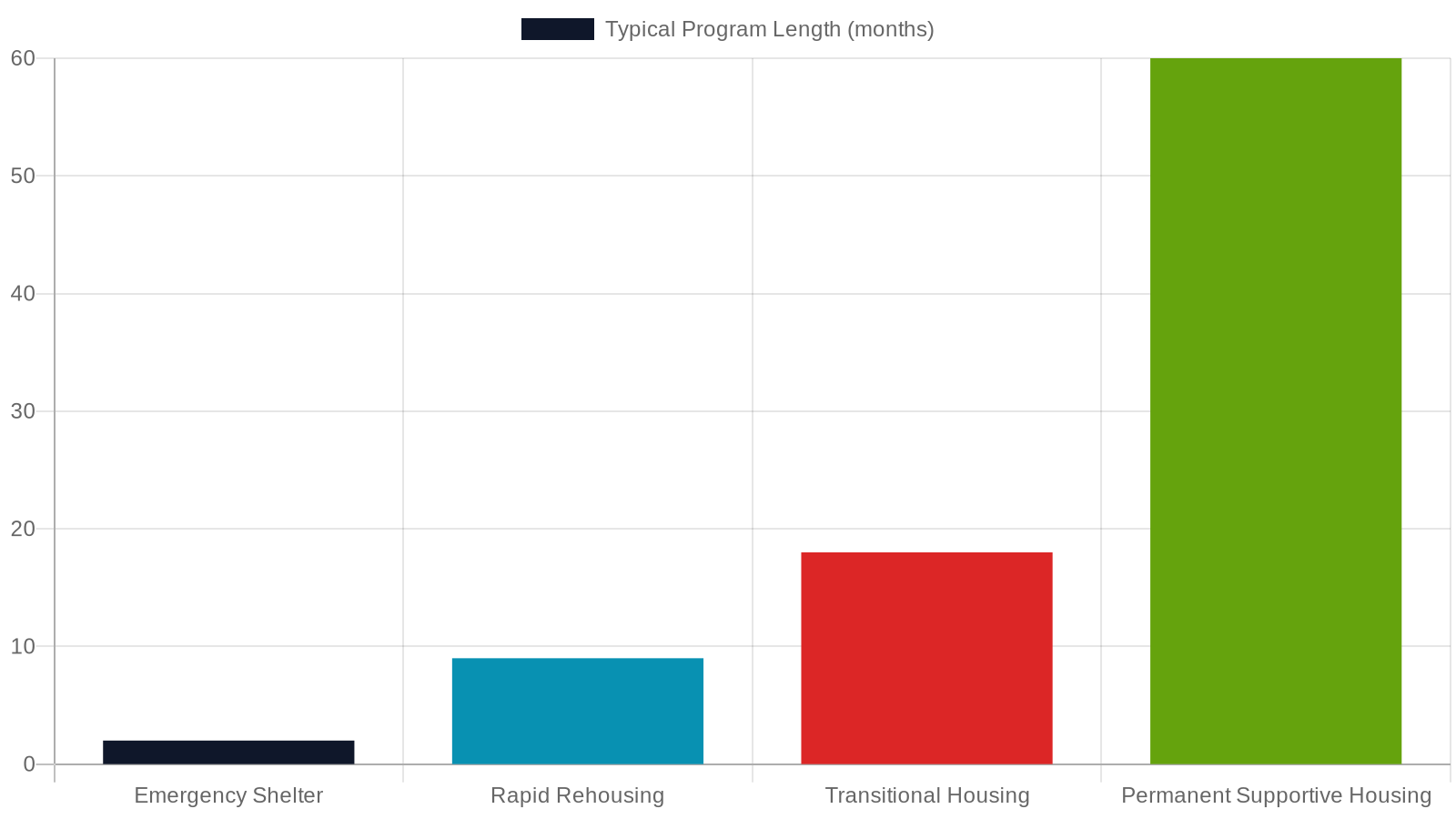
Emergency shelters are the immediate, short-term option — usually 30 to 90 days. They provide a safe place to sleep, meals, and basic case management. In Tennessee, youth-specific emergency shelters exist in Memphis (Door of Hope), Nashville (Oasis Center, Campus for Human Development), Knoxville (KARM Youth), and Chattanooga (Chambliss Center). Rural areas may have fewer options, but 211 can connect you to the nearest available bed. Important: if you are 17 and unaccompanied, ask specifically for a youth shelter — adult shelters may not accept minors, and youth shelters offer different protections.
Rapid Rehousing (RRH)
Rapid Rehousing is one of the most powerful tools in the system for young adults. It provides short-term rental assistance (typically 3 to 12 months) plus case management to help you get into your own apartment quickly — often within 30 days of being matched. You pay a portion of rent based on your income (sometimes as little as $0 to start), and a housing navigator helps you find a landlord willing to work with the program. In Tennessee, RRH programs for youth exist in all seven CoC regions, though waitlists vary.
Transitional Housing and Permanent Supportive Housing
Transitional Housing (TH) programs offer longer stays — typically 12 to 24 months — with structured support: life skills, employment coaching, education assistance, and savings programs. They’re a good fit if you need more time and support before living independently. Permanent Supportive Housing (PSH) combines long-term affordable housing with ongoing services and is reserved for individuals with a disabling condition and a longer history of homelessness. Both programs are accessed through Coordinated Entry — you don’t apply directly, you get matched.
Approximate program durations; actual length varies by CoC region and individual need.
5. Handle the ID and Documents Barrier
Lack of identification is one of the most common barriers young adults face when trying to access housing and employment. The good news: you have more rights than you think, and there are free pathways to getting the documents you need. Don’t let a missing ID stop you from asking for help.
You Have the Right to Access Services Without ID
One of the biggest myths in the housing system is that you need a government-issued photo ID before anyone will help you. That is not true. Under HUD guidelines, CoC-funded programs cannot deny you an assessment or emergency shelter solely because you lack identification. You have the right to be assessed and placed in the queue even without an ID. Tell your case manager or shelter intake worker this directly if they push back.
That said, having an ID does speed up access to housing programs, employment, and benefits — so getting one should be a priority once you’re stable.
How to Get a Tennessee ID for Free
Tennessee offers a free state ID for people experiencing homelessness through the Tennessee Department of Safety and Homeland Security. Here’s how to get one:
Visit any Tennessee Driver Services Center and tell them you are experiencing homelessness
A shelter address or a letter from a service provider can serve as your address of record
If you don’t have a birth certificate, organizations like Matthew 25 (Nashville) and MIFA (Memphis) can help you obtain one at no cost
Social Security cards can be replaced for free at your local Social Security Administration office — bring any ID you have, even a school ID
Many CoC case managers are trained to help with document recovery — ask your housing navigator to walk you through it as part of your housing plan.
6. Know Your Rights as a Young Renter in Tennessee
Knowing your rights as a renter is one of the most powerful tools you have. Tennessee law gives you specific protections — whether you’re in a lease, month-to-month, or even in a rooming house situation. Understanding these rights means you can push back on illegal landlord behavior and protect your housing once you have it.
The Tennessee Uniform Residential Landlord and Tenant Act
Tennessee’s Uniform Residential Landlord and Tenant Act (URLTA) applies in counties with populations over 75,000 — which includes Shelby, Davidson, Knox, Hamilton, and several others. Under URLTA, your landlord must:
Maintain the unit in a habitable condition (working heat, plumbing, no pest infestations)
Give you at least 30 days written notice before raising rent or ending a month-to-month lease
Return your security deposit within 30 days of move-out, with an itemized list of any deductions
Not retaliate against you for reporting code violations
In rural counties not covered by URLTA, common law still protects you from illegal lockouts and harassment. If a landlord changes your locks, removes your belongings, or shuts off utilities to force you out — that is an illegal self-help eviction, and you can call the police and pursue legal action.
Eviction Process and Your Right to a Hearing
In Tennessee, a landlord cannot legally remove you without going through the court system. The process must follow these steps: (1) written notice (14 days for nonpayment of rent, 30 days for lease violations), (2) filing a detainer warrant in General Sessions Court, (3) a court hearing where you have the right to appear and present your case, and (4) a writ of possession issued by the court before any physical removal. You have the right to appear at your eviction hearing — showing up can result in a payment plan, dismissal, or more time to find housing. Tennessee Legal Aid (tals.org) provides free legal help for low-income renters, including young adults.
Tennessee Youth Housing Programs at a Glance
Use this table to quickly compare the four main housing program types available to transition-age youth (ages 17–25) through Tennessee’s Continuum of Care network.
Program Type
Who It’s For
Typical Length
What It Provides
How to Access
Emergency Shelter
Anyone in immediate housing crisis
30–90 days
Safe bed, meals, basic case management
Call 211 or walk in
Rapid Rehousing (RRH)
Youth who can stabilize quickly with short-term help
3–12 months
Rental assistance + housing navigator
Coordinated Entry assessment
Transitional Housing (TH)
Youth needing structured support before independence
12–24 months
Housing + life skills, employment, education coaching
Coordinated Entry assessment
Permanent Supportive Housing (PSH)
Youth with disabling condition + long-term homelessness
Long-term / ongoing
Stable housing + wraparound services
Coordinated Entry — priority match
Section 8 / HCV Voucher
Low-income renters (all ages)
Long-term
Rental subsidy for private-market housing
Apply through local housing authority; waitlist 1–3 years
Chafee / ETV Funds
Youth who aged out of Tennessee foster care (to age 23)
One-time or annual
Up to $5,000 for education and housing costs
Apply through TN Dept. of Children’s Services
7. Stack Your Financial Resources to Afford Housing
Housing is about more than finding a place — it’s about being able to keep it. Stacking multiple financial resources together is how most young adults make it work. You don’t have to earn a lot of money to access these programs; you just have to know they exist and apply.
Benefits and Assistance You May Qualify For
Getting into housing is step one — staying housed requires income and financial support. As a young adult in Tennessee, you may qualify for several programs:
TennCare (Medicaid): Free or low-cost health insurance for adults earning up to 138% of the federal poverty level (~$20,120/year for a single adult in 2024)
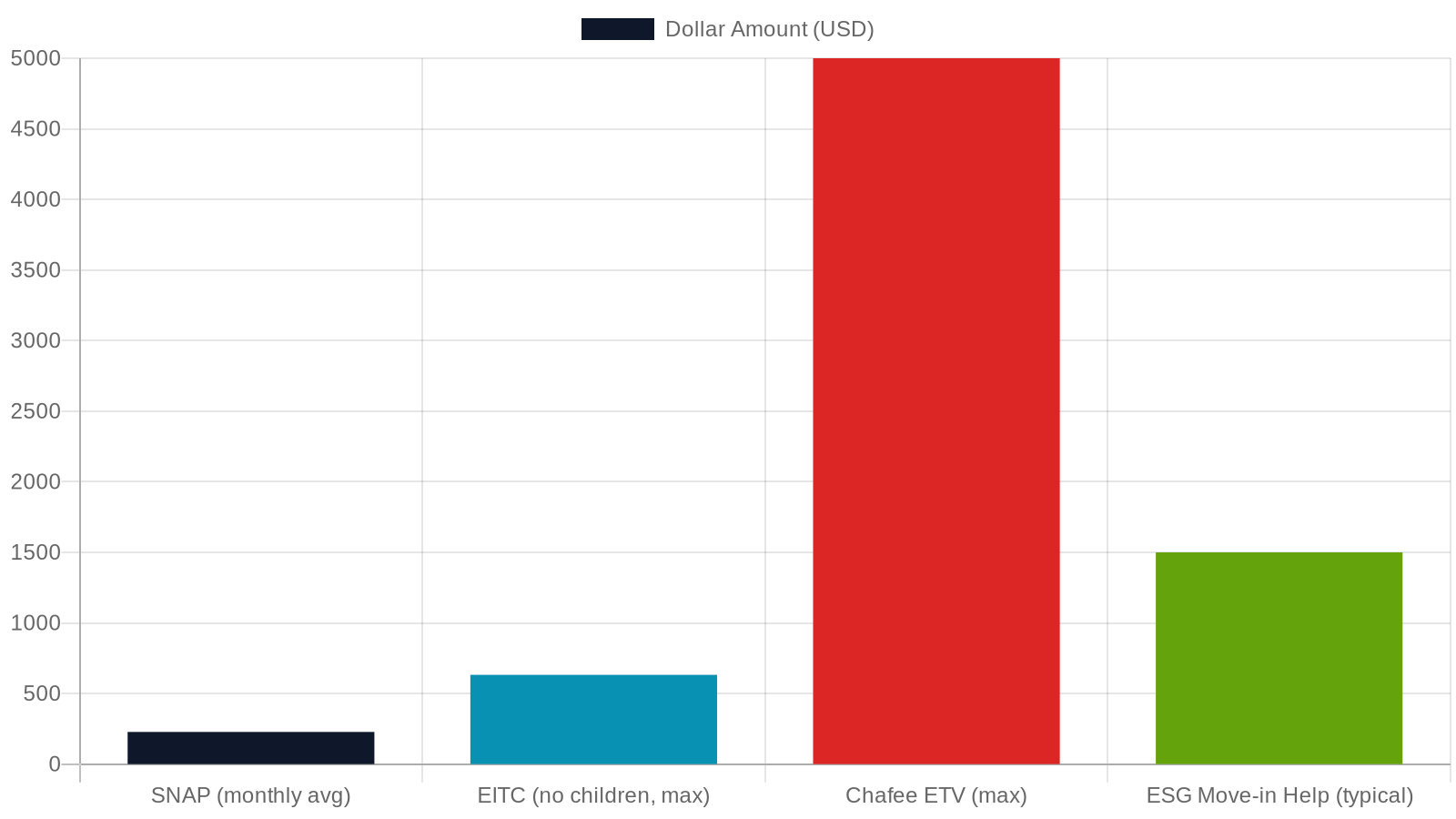
SNAP (Food Stamps): Monthly food assistance — the average Tennessee SNAP benefit in 2023 was approximately $228/month per person
Tennessee Emergency Solutions Grant (ESG): Can cover move-in costs, security deposits, and first/last month’s rent through local CoC providers
Section 8 / Housing Choice Voucher: Long-term rental subsidy — waitlists in Tennessee are often 1 to 3 years, but getting on the list early is worth it
Earned Income Tax Credit (EITC): If you work, even part-time, you may qualify for a federal tax refund of up to $632 (no children, 2024) or more
Youth-Specific Financial Programs
Several programs are specifically designed for transition-age youth:
Independent Living / Chafee Funds: If you aged out of Tennessee foster care, you may be eligible for up to $5,000 in Chafee Education and Training Vouchers (ETVs) for education and housing costs through age 23
Tennessee College of Applied Technology (TCAT): Free tuition for qualifying foster care alumni through the Tennessee Promise Scholarship
Individual Development Accounts (IDAs): Matched savings programs offered through some CoC partners — save $1, get $2 matched, for a down payment or move-in costs
Amounts are approximate and subject to change. Eligibility requirements apply. ESG move-in help varies by CoC region.
8. Navigate the System Without Losing Yourself
The housing system is not designed with young people in mind, and navigating it can feel overwhelming. But knowing a few practical strategies — and knowing that your mental health matters as much as your housing status — can make the difference between getting stuck and getting through.
Dealing With Waitlists and System Delays
The housing system in Tennessee — like everywhere — has waitlists, paperwork delays, and frustrating gaps. Here’s how to stay on top of it without burning out:
Follow up every 2 weeks with your case manager or housing navigator — not to be a nuisance, but because squeaky wheels really do get greased in overloaded systems
Keep a paper or phone log of every call, meeting, and document you submit — dates, names, what was said
Ask for your place on the waitlist in writing — you have the right to know your status
Apply to multiple programs simultaneously — you can be on the waitlist for Rapid Rehousing and Transitional Housing at the same time
Don’t turn down emergency shelter while waiting for longer-term housing — being in shelter often moves you up the priority list
Mental Health and Self-Care While Housing Insecure
Housing instability is one of the most stressful experiences a person can go through. Anxiety, depression, and trauma responses are common — and they’re valid. Tennessee has several free or low-cost mental health resources for young adults:
Crisis Text Line: Text HOME to 741741 — free, 24/7, confidential
Federally Qualified Health Centers (FQHCs): Offer sliding-scale mental health services in every Tennessee county — find yours at findahealthcenter.hrsa.gov
Peer support specialists: Many CoC programs employ people with lived experience of homelessness as peer navigators — ask for one
Taking care of your mental health isn’t separate from finding housing — it’s part of it. You deserve both.
9. Turn Your Experience Into Power: Get Involved With YAAB Tennessee
Getting stable housing is a huge achievement — and if you’ve been through housing instability, you have knowledge and resilience that can help other young people navigate the same system. YAAB Tennessee exists to make sure that young adults with lived experience have a real seat at the table where housing decisions get made.
What YAAB Is and What Members Actually Do
The Youth Action Board (YAAB) of Tennessee is a statewide network of young adults ages 17 to 25 with lived experience of homelessness and housing instability. YAAB members don’t just receive services — they shape them. Members advise local Continuum of Care boards, testify at state legislative hearings, review funding applications, and help design programs that actually work for young people. If you’ve been through the system, you have expertise that no consultant or policy analyst can buy. That expertise is exactly what YAAB is built on.
There are regional YAAB chapters in Memphis/Shelby County, Nashville/Davidson County, Knoxville/Knox County, Chattanooga/Hamilton County, Jackson/West Tennessee, the Upper Cumberland, and Northeast Tennessee — so no matter where you are in the state, there’s a chapter near you.
How to Join and What to Expect
Joining YAAB is free and open to any young adult ages 17 to 25 in Tennessee who has lived experience of homelessness or housing instability. You don’t need to be currently homeless — past experience counts. Here’s what membership looks like:
Monthly meetings (in-person and virtual options available)
Leadership development and public speaking training
Stipends for participation in advocacy activities
Connections to housing, employment, and education resources through YAAB’s partner network
A community of peers who get it — because they’ve been there
Ready to get involved? Apply to join YAAB Tennessee — it takes about five minutes and could change the direction of your life and the lives of young people across the state.
Frequently Asked Questions
Can I get housing help in Tennessee if I'm 17 and not with a parent?
Yes. Unaccompanied youth ages 17 and older can access youth-specific emergency shelters and CoC programs in Tennessee without a parent or guardian. Call 211 and ask specifically for youth shelter options in your area. You cannot be turned away from a CoC assessment solely because of your age or lack of ID.
What is Coordinated Entry and how do I get assessed?
Coordinated Entry is a standardized process used by Tennessee’s Continuum of Care regions to match people to the right housing program. To get assessed, call 211 or contact your local CoC directly and ask for a Coordinated Entry assessment. The assessment is a survey that takes about 20–30 minutes and determines your priority level for available programs.
I'm couch-surfing — do I count as homeless in Tennessee?
Yes. HUD’s definition of homelessness includes ‘doubled-up’ situations where you are staying temporarily with others because you have no housing of your own. This means you are eligible for CoC-funded programs including Rapid Rehousing. Tell your case manager or 211 specialist that you are doubled-up and need housing assistance.
How long does it take to get housing through Rapid Rehousing in Tennessee?
It varies by CoC region and program availability, but Rapid Rehousing is designed to move quickly — many programs aim to get youth into housing within 30 days of being matched. Waitlists exist in some regions. The best way to reduce wait time is to complete your Coordinated Entry assessment immediately and stay in regular contact with your housing navigator.
What if I aged out of foster care in Tennessee — are there extra resources for me?
Yes. Tennessee foster care alumni who aged out of the system may qualify for Chafee Education and Training Vouchers (up to $5,000), extended TennCare coverage through age 26, and priority access to some CoC housing programs. Contact the Tennessee Department of Children’s Services or ask your case manager about Independent Living services.
How do I find my local YAAB chapter in Tennessee?
YAAB Tennessee has regional chapters in Memphis/Shelby County, Nashville/Davidson County, Knoxville/Knox County, Chattanooga/Hamilton County, Jackson/West Tennessee, the Upper Cumberland, and Northeast Tennessee. Visit yaabtn.org/local-yaabs/ to find your nearest chapter and get connected to local members and meetings.