Understanding Youth Homelessness in Tennessee: 10 Things Young Adults Ages 17–25 Need to Know
Quick answer: Youth homelessness in Tennessee affects an estimated 8,000 or more young adults ages 17 to 25 every year, spanning Memphis, Nashville, Knoxville, Chattanooga, Jackson, and every rural region in between. It is caused by a mix of family conflict, aging out of foster care, economic hardship, and discrimination — and it looks very different from adult homelessness. You have legal rights, real resources, and a statewide peer network ready to back you up. This article breaks down the facts, the systems, and the steps you can take right now to find stability and get your voice heard.
1. What Youth Homelessness Actually Looks Like in Tennessee
When most people picture homelessness, they imagine a single adult on a street corner. Youth homelessness — especially for 17-to-25-year-olds — looks completely different, and understanding that difference is the first step to knowing where you stand and what help you can access.
It Is Rarely a Sleeping-Bag-on-a-Sidewalk Situation
Most young people experiencing homelessness in Tennessee are not sleeping under bridges. The most common form is couch surfing — moving from friend to friend, relative to relative, sometimes night by night. Others are staying in cars, motels paid for by someone else, or overcrowded apartments where they have no lease and no stability. Because this kind of homelessness is invisible, it often goes uncounted and underserved.
The U.S. Department of Housing and Urban Development (HUD) calls this unstably housed, and it still qualifies you for many emergency and transitional housing programs. You do not have to be sleeping outside to ask for help.
Hidden Homelessness Is Still Homelessness
Tennessee’s Continuum of Care (CoC) regions conduct an annual Point-in-Time (PIT) Count every January to tally people experiencing homelessness on a single night. In 2023, Tennessee’s combined CoC regions counted more than 9,600 individuals experiencing homelessness — but researchers consistently estimate that young adults ages 17–25 are significantly undercounted because they avoid shelters and official systems.
Studies from Chapin Hall at the University of Chicago estimate that roughly 1 in 10 young adults nationwide experiences some form of homelessness in a given year. Applied to Tennessee’s population of approximately 800,000 young adults in this age range, that suggests tens of thousands are affected annually — far more than any PIT count captures.
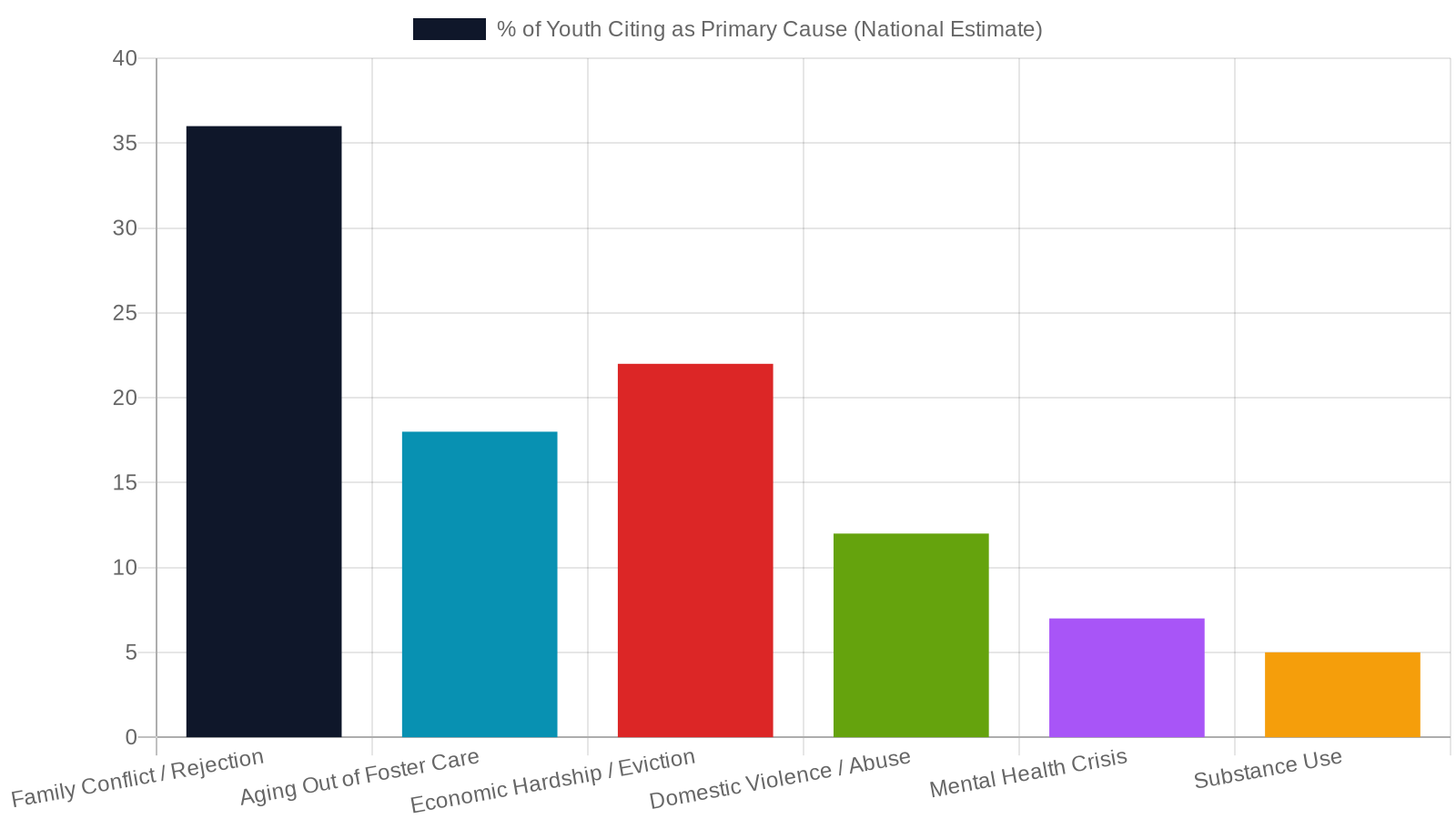
2. The 6 Most Common Causes for Young Adults in Tennessee
Youth homelessness is never just one thing. It is usually a combination of personal, family, and systemic factors colliding at once. Knowing the root causes helps you understand the system — and helps you explain your situation when seeking services.
Family Conflict and Rejection
The single most cited reason young adults become homeless is family conflict — arguments that escalate to being asked to leave, or feeling unsafe at home. For LGBTQ+ youth, family rejection is a leading cause: national data from The Trevor Project shows LGBTQ+ youth are 120% more likely to experience homelessness than their non-LGBTQ+ peers. In Tennessee, where LGBTQ+ protections vary by city, this risk is especially real.
Aging Out of Foster Care
Tennessee’s foster care system serves thousands of young people, but when a youth turns 18 — or 21 if they choose extended foster care — they often leave with limited savings, no housing, and no family safety net. The Tennessee Department of Children’s Services (DCS) reports that roughly 700–900 youth age out of foster care in Tennessee each year. Without transitional support, many face homelessness within months. Programs like Tennessee’s Extended Foster Care (available up to age 21) and the Chafee Foster Care Program exist specifically to bridge this gap.
Economic Hardship, Job Loss, and Eviction
Low wages, sudden job loss, a single unexpected bill, or an eviction can push a young adult out of housing fast. Tennessee has one of the lowest minimum wages in the country — the federal floor of $7.25/hour — and no state-level renter protections beyond the federal baseline. A full-time minimum-wage worker in Tennessee earns roughly $15,080 per year before taxes, well below the income needed to afford a one-bedroom apartment at the statewide fair market rent of approximately $850/month.
Sources: Chapin Hall Voices of Youth Count; National Alliance to End Homelessness. Percentages are national estimates; Tennessee-specific breakdowns vary by region.
3. Tennessee's Continuum of Care: How the System Is Organized
The housing and homelessness system in Tennessee can feel like a maze. But it follows a specific structure — and once you understand that structure, you know exactly which doors to knock on.
What a Continuum of Care (CoC) Is
A Continuum of Care is a regional planning body funded by HUD that coordinates homeless services — from street outreach to permanent housing. Tennessee has nine CoC regions, each covering different counties. The major ones include: Memphis/Shelby County CoC, Nashville/Davidson County CoC, Knoxville/Knox County CoC, Chattanooga/Hamilton County CoC, Jackson/West Tennessee CoC, Upper Cumberland CoC, and Northeast Tennessee CoC. Each CoC receives federal funding and distributes it to local service providers.
Why the CoC Matters to You Personally
The CoC in your region controls which shelters get funded, which rapid rehousing programs exist, and how Coordinated Entry — the system that connects people to housing — works in your area. When you call 211 or walk into a shelter, you are entering the CoC system. Understanding this helps you advocate for yourself: you can ask which programs you qualify for, request a priority assessment, and know that youth-specific programs exist within most Tennessee CoCs. You can also visit YAAB Tennessee’s youth homelessness overview for region-specific guidance.
4. Your Legal Rights as a Young Adult Experiencing Homelessness
You have rights — even when you are unhoused, even when you are under 18, and even when the system feels like it is working against you. Here are the most important ones to know in Tennessee.
The McKinney-Vento Act and What It Covers
The McKinney-Vento Homeless Assistance Act is a federal law that gives students experiencing homelessness the right to enroll in school immediately, stay in their current school even if they move, and receive transportation support. If you are under 22 and still enrolled in K–12, this law protects you in Tennessee. Your school district must have a homeless liaison — a staff member whose job is to help you stay in school no matter what your housing situation looks like.
Consent and Service Rights for 17–25 Year Olds
In Tennessee, you can consent to your own medical care at age 18. Some services — including certain mental health and substance use treatments — allow minors ages 16 and up to consent without a parent. If you are 18 or older, no shelter or service provider can require parental consent to serve you. You also have the right to confidentiality: service providers cannot share your information with family members without your permission. Knowing this matters — many young adults avoid seeking help because they fear their family will be contacted.
LGBTQ+ Protections in Tennessee Shelters
HUD’s Equal Access Rule requires that any shelter receiving federal funding must provide equal access regardless of sexual orientation or gender identity. This means federally funded shelters in Tennessee cannot turn you away or treat you differently because you are LGBTQ+. If you experience discrimination at a shelter, you can file a complaint with HUD’s Office of Fair Housing and Equal Opportunity (FHEO) at 1-800-669-9777.
5. Types of Housing Programs Available to You in Tennessee
Not all housing programs work the same way. Tennessee’s system has a spectrum of options, and knowing which type fits your situation helps you ask for exactly what you need — and understand what to expect.
Emergency Shelter: The First Step
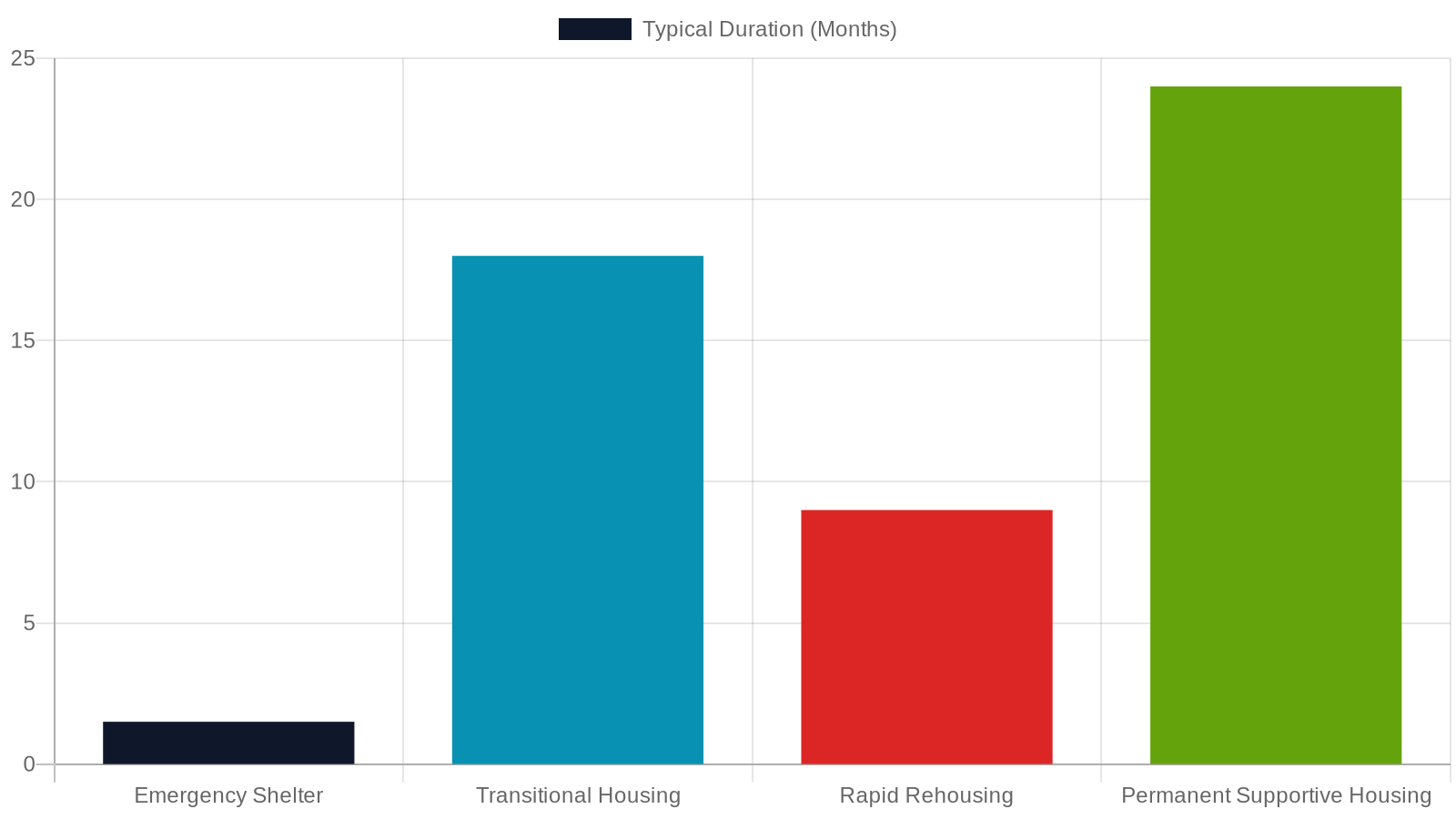
Emergency shelters provide a safe place to sleep, usually for 30 to 90 days, while you work on next steps. Tennessee has youth-specific emergency shelters in Memphis (Door of Hope, Youth Villages), Nashville (Campus for Human Development, Oasis Center), Knoxville (Volunteer Ministry Center, KARM), and Chattanooga (Chambliss Center). Many shelters offer meals, case management, and referrals. Call 211 from anywhere in Tennessee to find the nearest available bed.
Transitional Housing: 12 to 24 Months of Stability
Transitional housing programs give you a place to live for up to 24 months while you work on goals like finishing your GED, getting a job, or saving money. These programs are specifically designed for transition-age youth (17–24) and often include life skills training, financial coaching, and mental health support. Examples in Tennessee include Oasis Center’s transitional housing in Nashville and Youth Villages’ Transitional Living program statewide. Spots are competitive — getting on a waitlist early matters.
Rapid Rehousing and Permanent Supportive Housing
Rapid Rehousing (RRH) programs pay your first month’s rent and security deposit, then provide short-term rental assistance (typically 3–12 months) while you stabilize. Permanent Supportive Housing (PSH) is for young adults with disabilities or chronic homelessness who need longer-term subsidized housing plus on-site services. Both are accessed through your local CoC’s Coordinated Entry system — ask any shelter or 211 operator to connect you to a Coordinated Entry assessment.
Durations are typical ranges; actual program lengths vary by provider and individual plan.
6. Coordinated Entry: How to Actually Get Into the System
Knowing that housing programs exist is one thing. Actually getting connected to them requires understanding a specific process called Coordinated Entry — and knowing how to navigate it confidently.
What Coordinated Entry Is and Why It Matters
Coordinated Entry (CE) is the front door to Tennessee’s housing system. It is a standardized process — required by HUD — that assesses your needs and matches you to the right program. Every CoC region in Tennessee has a CE access point. When you call 211 or walk into a participating shelter or outreach program, a trained staff member will complete a Vulnerability Index – Service Prioritization Decision Assistance Tool (VI-SPDAT) or a youth-specific assessment with you. Your score determines your priority for available housing resources.
Tips for Navigating the Assessment
Be honest during your assessment — the more accurately you describe your situation, the higher your priority score may be. Mention every risk factor: how long you have been unstably housed, any health conditions, safety concerns, and whether you have aged out of foster care. You can bring a peer advocate or case manager with you. If you feel the process was unfair or your score does not reflect your situation, you have the right to request a re-assessment. Document everything — dates, names, and what you were told.
7. Mental Health, Trauma, and Why They Are Part of the Housing Conversation
Housing stability and mental health are not separate issues — they feed each other. You deserve support for both, and Tennessee has resources specifically designed for young adults navigating this intersection.
The Mental Health–Homelessness Connection
Research consistently shows that homelessness and mental health are deeply linked — not because mental illness causes homelessness, but because trauma, instability, and lack of support create or worsen mental health challenges. A 2022 Chapin Hall study found that young adults experiencing homelessness were 3 times more likely to report serious psychological distress than their stably housed peers. In Tennessee, access to mental health services varies widely by region — rural areas like Upper Cumberland and Northeast Tennessee face significant provider shortages.
Free and Low-Cost Mental Health Resources in Tennessee
You do not have to pay out of pocket for mental health support. Options include: Tennessee’s Crisis Line (call or text 988); Open Door Health Center (Nashville, sliding-scale fees); Cherokee Health Systems (East Tennessee, integrated care); Centerstone (statewide, serves uninsured and TennCare clients); and federally qualified health centers (FQHCs) in every region that offer mental health services on a sliding scale. If you have TennCare, behavioral health services are covered — ask your case manager to help you enroll if you are not already on it.
Trauma-Informed Care: What to Expect and Ask For
Trauma-informed care means a provider understands that your past experiences shape how you interact with services — and they will not shame, blame, or re-traumatize you. You have the right to ask any shelter, clinic, or housing program: “Is your staff trained in trauma-informed care?” Good programs will say yes and will show it in how they talk to you, how they handle conflict, and how they involve you in your own plan. If a program makes you feel judged or unsafe, it is okay to seek another option.
Tennessee Youth Housing Programs at a Glance
Not sure which type of program fits your situation? This side-by-side breakdown covers the four main housing options available to young adults ages 17–25 in Tennessee’s Continuum of Care system.
Program Type
Who It’s For
Typical Duration
What It Covers
How to Access
Emergency Shelter
Anyone in immediate housing crisis
30–90 days
Safe bed, meals, basic case management
Call 211 or walk in
Transitional Housing
Youth 17–24 working toward independence
12–24 months
Housing + life skills, job/education support
Coordinated Entry referral
Rapid Rehousing (RRH)
Youth who can sustain housing with short-term help
3–12 months
Move-in costs + short-term rental assistance
Coordinated Entry assessment
Permanent Supportive Housing (PSH)
Youth with disabilities or chronic homelessness
Long-term / ongoing
Subsidized housing + on-site support services
Coordinated Entry, high-priority score
Extended Foster Care (TN)
Youth aging out of foster care, up to age 21
Up to age 21
Housing, case management, education support
Tennessee DCS — request before turning 18
WIOA Youth Services
Low-income youth 16–24 facing barriers
Varies by program
Job training, work experience, support services
Tennessee Career Center / 211
8. Education and Employment: Building Stability Beyond a Roof
A stable place to sleep is the foundation — but education and employment are what build long-term security. Tennessee has more pathways than most young adults realize, and many are specifically designed for people in your situation.
GED and High School Equivalency Pathways in Tennessee
Tennessee offers the HiSET exam (the state’s preferred high school equivalency test) at testing centers across all regions. The exam costs approximately $10.75 per subtest ($53.75 total), but Tennessee’s Adult Education program — funded through the Tennessee Department of Labor and Workforce Development — provides free preparation classes at community colleges, libraries, and workforce development centers statewide. If you are experiencing homelessness, you may qualify for a fee waiver. Call 1-888-212-3368 to find your nearest adult education center.
Workforce Programs for Transition-Age Youth
Tennessee’s American Job Centers (also called Tennessee Career Centers) offer free job search help, resume writing, interview coaching, and access to training funds through the Workforce Innovation and Opportunity Act (WIOA). Youth ages 16–24 who are low-income or face barriers to employment — including homelessness — are a priority population for WIOA youth services, which can cover occupational training, work experience, and supportive services like transportation and childcare. Find your nearest career center at tnworkforce.com or by calling 211.
Tennessee Promise and College Access for Unhoused Students
Tennessee Promise provides two years of tuition-free community or technical college for eligible Tennessee high school graduates. If you experienced homelessness during high school, you may qualify for independent student status on the FAFSA — meaning your parents’ income is not counted, which can significantly increase your financial aid. Tennessee also has campus homeless liaisons at many community colleges who can connect you to emergency housing funds, food pantries, and support services. Ask the financial aid office at your school about emergency assistance grants.
9. Youth Homelessness Across Tennessee's Regions: What's Different Where You Are
Tennessee is not one place — it is a long, diverse state stretching from the Mississippi River to the Appalachian Mountains. The resources available to you depend significantly on where you are, and knowing your region’s landscape helps you navigate it more effectively.
Tennessee’s four largest cities have the most developed youth-specific services — dedicated youth shelters, drop-in centers, and LGBTQ+-affirming programs. Nashville has the Oasis Center, Campus for Human Development, and Room in the Inn. Memphis has Door of Hope and Youth Villages. Knoxville has KARM and the Volunteer Ministry Center. Chattanooga has Chambliss Center for Children and the Chattanooga Room in the Inn. Urban areas also have more active street outreach teams who can connect you to services without requiring you to walk into a shelter.
Rural and Smaller Regions: Jackson, Upper Cumberland, Northeast TN
In rural Tennessee — including West Tennessee, the Upper Cumberland plateau, and the Northeast region — youth-specific services are thinner on the ground. Distances are greater, transportation is limited, and shelter beds are fewer. However, rural CoC regions often have stronger case management relationships and can connect you to statewide resources more personally. Organizations like Frontier Health (Northeast TN) and Plateau Mental Health Center (Upper Cumberland) serve as anchor providers. The 211 network covers all Tennessee counties and is your best first call regardless of where you are.
10. How to Get Involved with YAAB Tennessee and Use Your Voice
Understanding the system is powerful. Helping change it is even more powerful. YAAB Tennessee exists because young adults with lived experience are the most credible, most effective advocates for better youth housing policy — and that means you.
What the Youth Action Board Does
The Youth Action Board (YAAB) of Tennessee is a statewide network of young adults ages 17–25 with lived experience of homelessness and housing instability. YAAB members sit at the table where decisions get made — advising CoC leaders, shaping local policy, and making sure the people who design housing programs actually hear from the people those programs are supposed to serve. This is not a support group. It is a leadership and advocacy platform where your experience becomes expertise.
Local YAABs Across Tennessee
YAAB has regional chapters — called local YAABs — in multiple Tennessee CoC regions, including Memphis/Shelby, Nashville/Davidson, Knoxville/Knox, and others. Each local YAAB meets regularly, connects members to resources, and feeds into statewide advocacy efforts. You do not need to have your housing fully figured out to join. You just need to be between 17 and 25, have lived experience of housing instability, and be willing to show up. Find your local YAAB chapter and see when they meet next.
Why Peer Advocacy Changes the System
Systems change when the people most affected by them have a seat at the table. YAAB members have influenced state-level policy decisions, improved how Coordinated Entry assessments are conducted for youth, and helped design programs that actually work for young adults — not just for the adults who run them. When you join YAAB, you are not just getting support. You are becoming part of the solution for every young person who comes after you. Get involved with YAAB Tennessee and see how your story can shape Tennessee’s future.
Your Next Move: Start Here, Right Now
You have read the facts. You know the system. Now here is what to do with that knowledge — whether you need help today, are working toward stability, or are ready to help change things for the next person who comes through that door.
The Three Calls That Can Change Your Situation Today
If you are in Tennessee and need housing support right now, start with these three steps: 1) Call or text 211 — available 24/7 in all Tennessee counties — to be connected to your nearest shelter, food, or housing resource. 2) Call 988 if you are in a mental health crisis or just need someone to talk to. 3) Visit YAAB Tennessee’s resource directory for a curated list of housing, employment, education, and mental health resources organized by region.
Join the Movement — Your Voice Matters
Whether you are currently unhoused, recently stabilized, or just want to make sure other young people in Tennessee have better options than you did — YAAB Tennessee wants to hear from you. You can apply to join YAAB Tennessee at any time. Membership is open to young adults ages 17–25 across all Tennessee regions. You bring the experience. YAAB brings the platform. Together, we build something better — for Memphis, Nashville, Knoxville, Chattanooga, Jackson, and every corner of this state.
Frequently Asked Questions
Do I have to be sleeping outside to qualify for homeless services in Tennessee?
No. HUD’s definition of homelessness includes people who are couch surfing, staying in motels without a stable lease, living in cars, or in situations where they could be asked to leave at any time. You do not need to be sleeping outside to qualify for shelter, transitional housing, or rapid rehousing programs in Tennessee.
What is the age range for youth homeless services in Tennessee?
Most youth-specific housing and support programs in Tennessee serve young adults ages 17 to 24, which aligns with HUD’s transition-age youth definition. Some programs extend to age 25. Adult shelter systems serve anyone 18 and older, but youth-specific programs offer more tailored support for this age group.
How do I find a youth shelter near me in Tennessee?
Call or text 211 from anywhere in Tennessee — it is free, confidential, and available 24 hours a day, 7 days a week. The 211 operator can tell you which youth shelters have available beds in your area and connect you to Coordinated Entry for longer-term housing options.
Can I get housing help in Tennessee if I aged out of foster care?
Yes. Tennessee offers Extended Foster Care up to age 21, which includes housing support. If you have already aged out, you are a priority population for Coordinated Entry and many transitional housing programs. Ask any shelter or 211 operator specifically about programs for foster care alumni.
What is the Youth Action Board of Tennessee and how do I join?
YAAB Tennessee is a statewide network of young adults ages 17–25 with lived experience of homelessness who advise policymakers and advocate for better youth housing systems across Tennessee’s Continuum of Care regions. You can apply to join at yaabtn.org/join — no experience required, just lived experience and a willingness to show up.
Are there LGBTQ+-friendly homeless services for young adults in Tennessee?
Yes. Any shelter receiving federal HUD funding is legally required to provide equal access regardless of sexual orientation or gender identity under HUD’s Equal Access Rule. Organizations like Oasis Center in Nashville specifically serve LGBTQ+ youth. If you experience discrimination at a shelter, you can file a complaint with HUD’s Office of Fair Housing at 1-800-669-9777.