How Lived Experience Shapes Better Youth Homelessness Policy in Tennessee
Quick answer: Young adults ages 17 to 25 who have personally experienced homelessness or housing instability bring insights that no policy report or academic study can replicate. Across Tennessee — from Memphis to Knoxville, Nashville to Chattanooga — the Youth Action Board (YAAB) channels that lived experience directly into Continuum of Care planning, state legislation, and local program design. The result is policy that actually fits the real lives of transition-age youth: more accessible shelter rules, better connections to employment and education, and funding decisions guided by the people most affected. This article explains exactly how that process works and why it matters.
1. What 'Lived Experience' Actually Means in a Policy Context
The phrase lived experience shows up constantly in housing policy conversations, but it can mean very different things depending on who is using it. In the context of youth homelessness policy in Tennessee, it has a specific and powerful meaning: the direct, personal knowledge that young adults carry from having navigated homelessness themselves. Understanding that definition is the first step to understanding why YAAB exists and why it works.
Beyond a Buzzword: A Working Definition
Lived experience in a policy context means firsthand, personal knowledge of a social condition — in this case, homelessness or housing instability — that shapes how a person understands the problem and its solutions. It is not a credential you earn in a classroom; it is knowledge built through surviving couch-surfing at 18, navigating a shelter intake process at 20, or aging out of foster care with nowhere to go at 21.
Policy researchers sometimes call this experiential expertise to distinguish it from professional or academic expertise. Both matter. But experiential expertise catches things that data dashboards miss — like the fact that a shelter’s 10 p.m. curfew makes it impossible to hold a closing-shift job, or that a program’s ID requirement is a barrier for youth who fled home without documents.
Why It Matters More for Transition-Age Youth
Transition-age youth (TAY) — typically defined as ages 16 to 24 by the U.S. Department of Housing and Urban Development, and 17 to 25 by Tennessee’s YAAB network — face a uniquely narrow window. Policies designed for adults over 25 often don’t account for incomplete education, lack of credit history, or the absence of a family safety net. Policies designed for younger children don’t account for the legal autonomy and self-determination that young adults need and deserve.
According to HUD’s 2023 Annual Homeless Assessment Report, approximately 35,574 unaccompanied youth experienced homelessness on a single night in the United States. Tennessee’s own Point-in-Time counts consistently show that youth make up a disproportionate share of the unsheltered population in urban counties like Shelby, Davidson, and Knox. Without voices from that population in the room, policy defaults to assumptions — and assumptions cost lives.
2. The Scale of Youth Homelessness Across Tennessee
Before examining how lived experience shapes policy, it helps to understand the scale of the problem that policy needs to address. Youth homelessness in Tennessee is not a single, uniform crisis — it looks different in Memphis than it does in Johnson City, and different in Nashville than in rural Fentress County. That geographic and demographic complexity is exactly why top-down, one-size-fits-all policy so often fails young people.
Regional Snapshots: Memphis to Northeast Tennessee
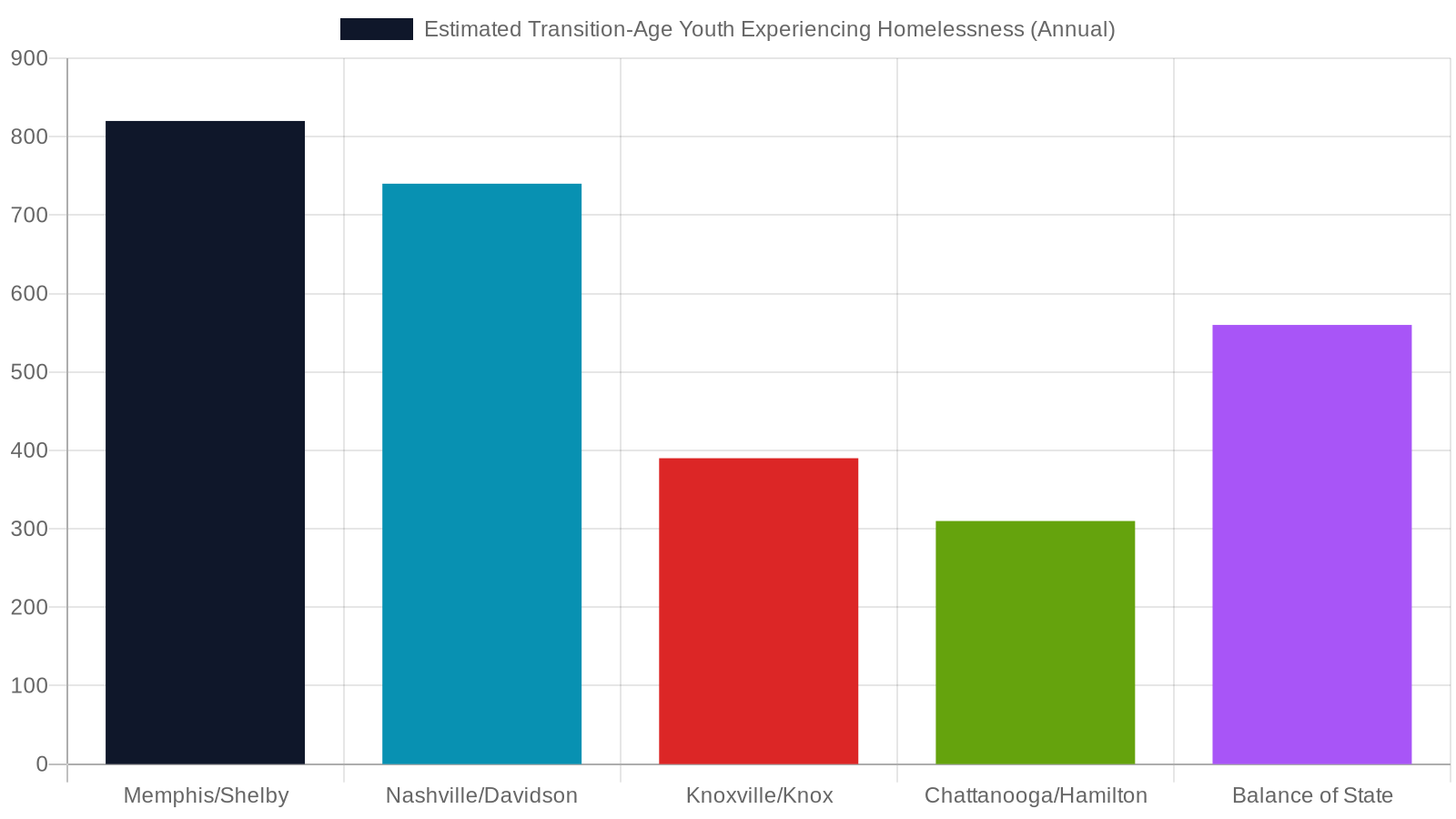
Tennessee’s homelessness response is organized through regional Continuums of Care (CoC) — local planning bodies that coordinate housing and services. The state has multiple CoCs, including Memphis/Shelby County, Nashville/Davidson County, Knoxville/Knox County, Chattanooga/Hamilton County, Balance of State (which covers rural and smaller metro areas including Jackson/West Tennessee, the Upper Cumberland, and Northeast Tennessee).
Each region has its own youth homelessness profile. Memphis, for example, has historically recorded some of the highest rates of youth street homelessness in the Southeast. Nashville’s rapid growth has pushed affordable housing further out of reach, with average one-bedroom rents exceeding $1,400/month as of 2024 — roughly 140% of what a full-time minimum-wage worker earns monthly in Tennessee. Knoxville and Chattanooga face their own pressures from gentrification and limited transitional housing stock.
The Hidden Homelessness Problem: Couch-Surfing and Doubling Up
Official Point-in-Time counts capture people in shelters and on the streets on a single January night, but they systematically undercount hidden homelessness — youth staying temporarily with friends, sleeping in cars, or doubling up in overcrowded apartments. Research from Chapin Hall at the University of Chicago estimates that for every youth counted as homeless in a PIT count, as many as 10 more are experiencing hidden homelessness.
For young adults in Tennessee, hidden homelessness is often the norm, not the exception. A 17-year-old who bounces between relatives’ couches in Jackson or a 22-year-old sleeping in a car in Cookeville rarely shows up in official data — which means policies built only on that data will always fall short. Lived-experience advisors know this reality because they have lived it.
Illustrative regional estimates based on CoC Point-in-Time data and Chapin Hall multiplier methodology. Actual counts vary by year.
3. How Tennessee's Youth Action Board Puts Lived Experience to Work
Understanding the problem is one thing. Changing the systems that perpetuate it is another. Tennessee’s Youth Action Board was built specifically to bridge that gap — to create a durable, structured pathway for lived experience to reach the people and institutions that make decisions about housing, services, and funding for transition-age youth.
Structure: Regional YAABs Connected to a Statewide Network
Tennessee’s YAAB is not a single organization housed in one city — it is a statewide network of regional boards, each rooted in a specific CoC geography. Local YAABs operate in Memphis/Shelby County, Nashville/Davidson County, Knoxville/Knox County, Chattanooga/Hamilton County, and across the Balance of State regions including West Tennessee, the Upper Cumberland, and Northeast Tennessee.
Each regional YAAB is made up of young adults ages 17 to 25 who have personal experience with homelessness or housing instability. Members are not token representatives — they are active advisors who attend CoC planning meetings, review funding applications, and bring peer-informed recommendations to the table. The statewide network connects these regional boards so that a policy insight from a young adult in Cookeville can inform a decision being made in Nashville. You can explore all the local YAAB chapters across Tennessee to find the one closest to you.
What YAAB Members Actually Do Day to Day
YAAB membership is active, not ceremonial. On any given month, a YAAB member might be reviewing a proposed shelter policy change and flagging unintended consequences, presenting testimony to a county commission, co-designing a peer-support program, or training case managers on how to communicate with young adults without being condescending.
Members also conduct peer outreach — connecting unhoused young adults in their communities to resources, because a 20-year-old who has been through the shelter system is often more trusted than a professional outreach worker. This peer-credibility effect is documented in research on harm reduction and youth services: young people are significantly more likely to accept help from someone who has shared their experience.
4. The Continuum of Care: Where Policy Decisions Actually Get Made
To understand how lived experience shapes policy in Tennessee, you need to understand the arena where most of those policy decisions happen: the Continuum of Care. The CoC system is the backbone of the U.S. homeless response, and it is where YAAB members do some of their most consequential work.
What a Continuum of Care Is and Why It Matters
A Continuum of Care (CoC) is a regional planning body funded and overseen by the U.S. Department of Housing and Urban Development. Each CoC is responsible for coordinating the local homeless response system — deciding which programs get HUD funding, setting priorities for who gets housed first, and measuring whether the system is actually working. In Tennessee, CoCs exist at the county and regional level, and they collectively determine how tens of millions of federal dollars flow into housing and services each year.
CoC governance boards typically include nonprofit service providers, local government representatives, healthcare systems, and — increasingly, thanks to advocacy from groups like YAAB — people with lived experience of homelessness. HUD’s CoC Program regulations now explicitly require that people with lived experience be meaningfully involved in CoC governance, a standard that YAAB members help Tennessee’s CoCs meet and exceed.
How YAAB Engages the CoC Process
YAAB members participate in CoC governance in several concrete ways. They serve on CoC committees that review and score funding applications from local service providers — which means a young adult with lived experience has a direct say in which shelter programs, rapid rehousing initiatives, and transitional housing projects receive federal dollars. They also participate in the annual Point-in-Time count, the overnight census of people experiencing homelessness that shapes federal funding allocations.
Perhaps most importantly, YAAB members provide qualitative context that quantitative data cannot capture. When a CoC is deciding whether to fund a new shelter program, a YAAB member can speak to whether that program’s intake requirements are realistic for young adults without IDs, whether its location is accessible by public transit, and whether its rules are compatible with holding a job. That context routinely changes outcomes.
5. Real Policy Changes Driven by Youth Lived Experience
Advocacy is only meaningful if it produces change. Here are concrete examples of how youth lived experience, channeled through YAAB, has shifted policies and practices in Tennessee’s homeless response system. These are not hypothetical wins — they are the kinds of changes that happen when young adults are in the room when decisions get made.
Shelter Rules That Actually Work for Working Youth
One of the most consistent themes in YAAB advocacy across Tennessee is shelter policy reform. Traditional adult shelter models were not designed with working young adults in mind. Strict curfews — often 7 p.m. or 8 p.m. — make it impossible to hold evening or closing-shift jobs. Mandatory group programming scheduled during daytime hours conflicts with school or work. Storage policies that limit belongings to a single bag are incompatible with maintaining work uniforms or school supplies.
YAAB members in multiple Tennessee regions have successfully advocated for flexible curfew waivers for employed youth, extended storage options, and separate youth wings in adult shelters that offer more privacy and safety. These changes sound small, but they are the difference between a shelter that functions as a launchpad and one that functions as a trap.
Coordinated Entry Reforms: Making the Front Door Easier to Open
Coordinated Entry is the standardized process that most CoCs use to assess and prioritize people experiencing homelessness for housing and services. Done well, it creates a fair, consistent pathway to help. Done poorly, it becomes a bureaucratic maze that discourages the most vulnerable people from seeking help at all.
YAAB members across Tennessee have flagged specific Coordinated Entry barriers that disproportionately affect young adults: assessment tools that assume a level of housing history that most 19-year-olds simply don’t have; intake processes that require a permanent address to receive mail (a catch-22 for someone who is homeless); and assessment locations that are inaccessible without a car. Youth-informed reforms have included mobile assessment options, youth-specific assessment tools calibrated to TAY experiences, and peer navigators who help young adults complete the process.
Funding Priorities: Shifting Dollars Toward What Works
YAAB members don’t just advise on program design — they influence funding. In CoC funding competitions, YAAB representatives have advocated for prioritizing rapid rehousing and transitional housing programs specifically designed for transition-age youth over generic adult programs that often fail young people. They have also pushed for funding of peer support specialist positions — roles filled by young adults with lived experience who are paid to help their peers navigate services.
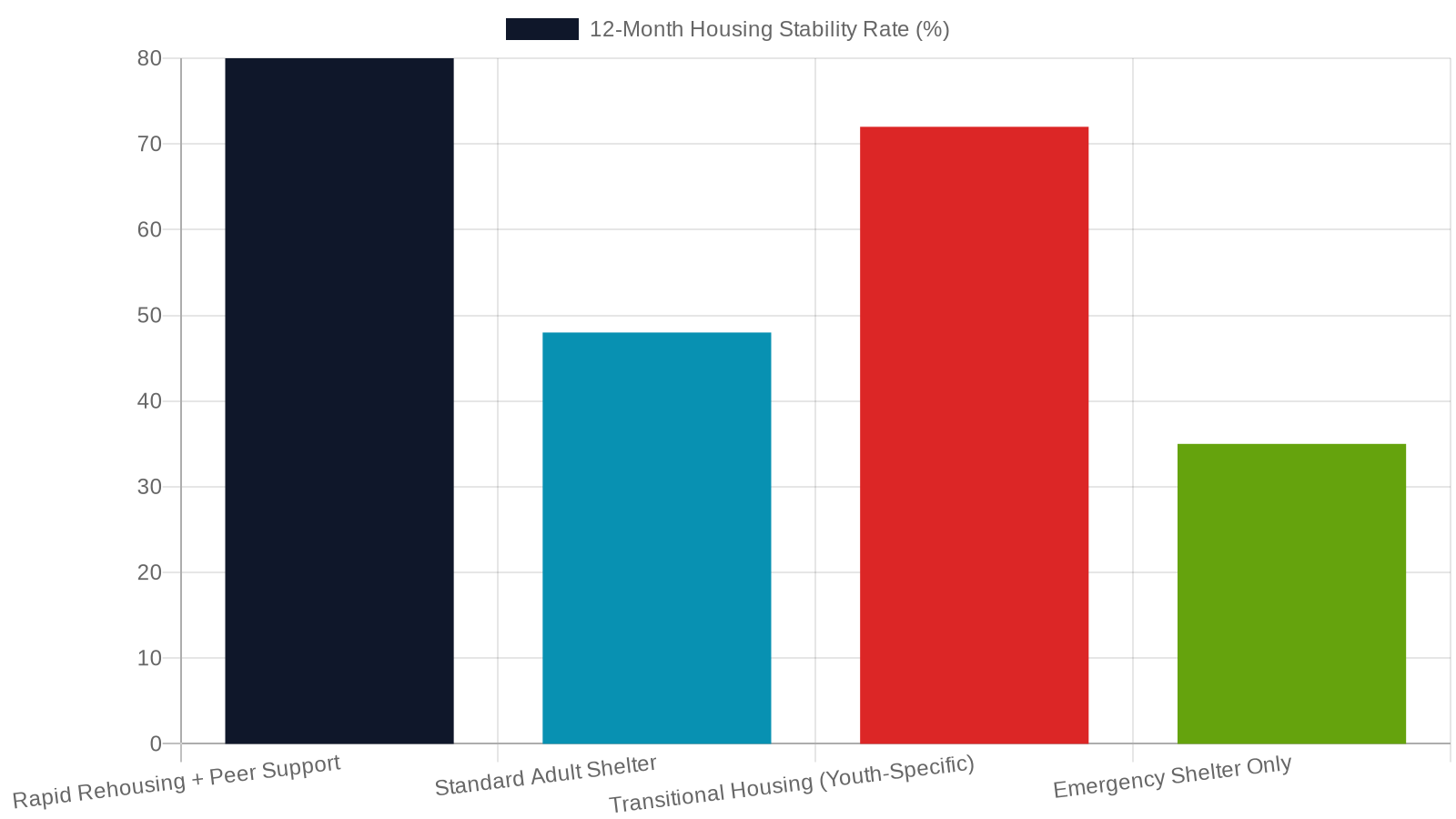
According to the National Alliance to End Homelessness, youth-specific rapid rehousing programs achieve housing stability for approximately 80% of participants within 12 months when combined with peer support. That outcome data, combined with YAAB testimony, has helped shift CoC funding priorities in multiple Tennessee regions toward evidence-based, youth-centered approaches.
Sources: National Alliance to End Homelessness; Chapin Hall Voices of Youth Count. Rates are approximate national averages.
6. The Connection Between Lived Experience and Trauma-Informed Policy
One of the most significant contributions of lived-experience advisors to youth homelessness policy is in the area of trauma-informed practice. The term gets used a lot — sometimes as genuine commitment, sometimes as marketing. Young adults who have navigated these systems know the difference, and their presence in policy spaces helps ensure the difference matters.
What Trauma-Informed Really Means — and What It Doesn't
Trauma-informed care is a framework that recognizes the widespread impact of trauma and integrates that knowledge into policies, procedures, and practices. In the context of youth homelessness, it means designing systems that don’t re-traumatize young people who are already dealing with the aftermath of abuse, neglect, family rejection, or survival on the streets.
But trauma-informed policy is frequently designed by professionals who have studied trauma academically, not by people who have experienced it. The result can be well-intentioned but tone-deaf — programs that use the right vocabulary but still require young adults to repeatedly retell their trauma stories to multiple intake workers, or that prioritize clinical compliance over genuine autonomy. YAAB members are uniquely positioned to identify these gaps because they have sat on the other side of the intake desk.
Youth Voice as a Quality-Control Mechanism
One of the most underappreciated functions of lived-experience advisors is as a quality-control mechanism for trauma-informed claims. When a service provider says their program is trauma-informed, a YAAB member can ask the questions that a funder or government official might not think to ask: Do staff receive ongoing training, or just a one-time orientation? Are young adults ever asked to leave for behaviors that are direct trauma responses? Does the program have a formal grievance process that young adults actually use?
This kind of accountability questioning has led to more rigorous trauma-informed standards in Tennessee CoC funding applications — including requirements for documented staff training hours, youth feedback mechanisms, and annual program reviews that include participant input. The YAAB advocacy work in this space has helped set a higher bar for what trauma-informed actually means in practice.
Effective youth homelessness policy cannot be built on a single, generic portrait of a young person experiencing homelessness. The reality is far more complex — and the complexity matters for policy design. Lived-experience advisors who represent the full spectrum of Tennessee’s transition-age youth are essential for building systems that don’t inadvertently leave the most vulnerable behind.
LGBTQ+ Youth, Foster Care Alumni, and Youth of Color
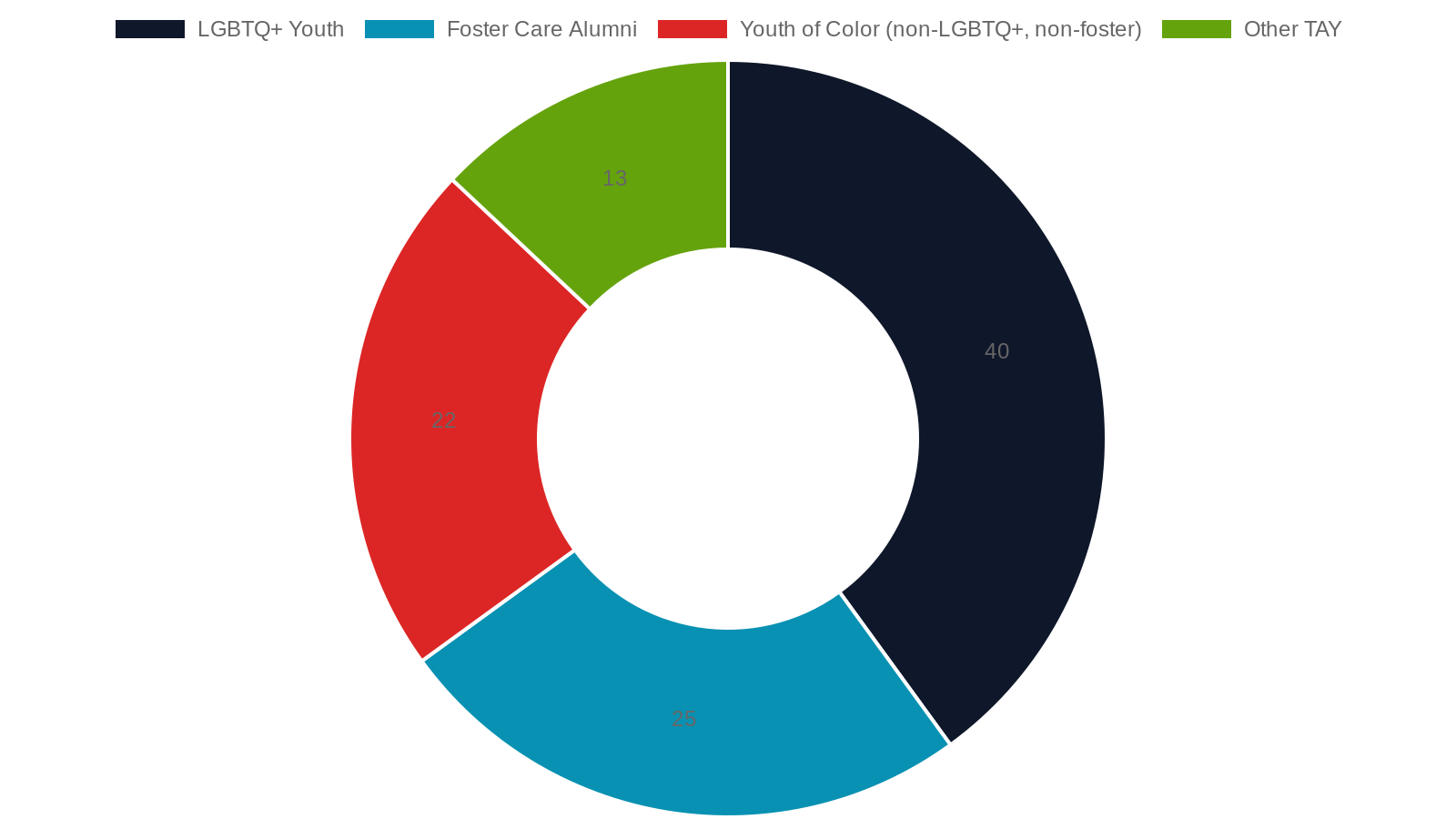
Youth homelessness is not evenly distributed. Research consistently shows that LGBTQ+ youth are 120% more likely to experience homelessness than their non-LGBTQ+ peers, largely due to family rejection. Youth aging out of foster care — a population with significant overlap in Tennessee, where approximately 1,200 young adults age out of state custody each year — face homelessness at rates five to eight times higher than the general youth population. And youth of color, particularly Black youth, are dramatically overrepresented in homeless counts relative to their share of the general population.
Policies that don’t account for these overlapping vulnerabilities will miss the young people who need help most. A shelter that is technically open to all youth but has no LGBTQ+-affirming policies will effectively exclude a significant portion of the youth who most need shelter. A rapid rehousing program that doesn’t account for the credit and rental history barriers facing foster care alumni will fail them at the final step.
How Lived Experience Surfaces Intersectional Gaps
YAAB members who identify as LGBTQ+, who have aged out of foster care, or who are young adults of color bring intersectional perspectives that are essential for catching these policy gaps before they are baked into program design. They can speak to whether a shelter feels safe for a transgender young adult, whether a case management approach accounts for the distrust of government systems that many foster care alumni carry, and whether outreach materials are reaching communities of color in culturally appropriate ways.
This is not about checking demographic boxes — it is about building systems that work for the most marginalized young people, because if a system works for them, it works for everyone. Tennessee’s YAAB actively recruits members who represent the full diversity of the state’s transition-age youth population, including young adults from rural communities where homelessness is often invisible and services are scarce.
Estimates based on True Colors United and Chapin Hall national research. Tennessee figures may vary by region.
8. From Advisory to Legislative: YAAB's Role in State Policy
YAAB’s influence does not stop at the CoC level. Tennessee’s statewide network creates a pathway for youth voices to reach state government — the Tennessee General Assembly, state agencies, and the federal processes that shape how housing dollars flow into communities across the state. Understanding this pipeline helps explain why lived-experience advocacy is not just symbolic: it has measurable policy consequences.
Testifying, Briefing, and Building Relationships with Lawmakers
CoC-level advocacy is powerful, but some of the most important decisions affecting transition-age youth in Tennessee are made at the state level — in the General Assembly, in state agency rulemaking, and in the Governor’s budget process. YAAB members engage at this level too, providing legislative testimony, briefing state agency staff, and building ongoing relationships with lawmakers who may not have direct exposure to youth homelessness in their districts.
Legislative testimony from a young adult who has personally experienced homelessness carries a different weight than testimony from a nonprofit executive or a policy analyst. It is harder to dismiss, harder to abstract, and harder to forget. YAAB members who have testified before Tennessee legislative committees report that lawmakers frequently tell them their testimony was the most impactful part of a hearing — because it made the issue real in a way that statistics alone cannot.
State Plans, HMIS Data, and the Annual Homeless Assessment
Tennessee participates in the federal Homeless Management Information System (HMIS), a statewide database that tracks people experiencing homelessness and the services they receive. HMIS data shapes state and federal funding decisions, program evaluations, and policy priorities. YAAB members have advocated for youth-specific data collection fields in HMIS — including fields that capture hidden homelessness, aging-out status, and LGBTQ+ identity (with appropriate privacy protections) — so that the data driving policy decisions actually reflects the population it is meant to serve.
They have also engaged with Tennessee’s state Consolidated Plan, the five-year housing and community development strategy that governs how federal Community Development Block Grant and HOME funds are spent. Youth input in that process helps ensure that transition-age youth are explicitly named as a priority population, which in turn shapes how local governments allocate housing dollars.
Lived-Experience Engagement: Meaningful vs. Performative — a 6-Point Comparison
Not all youth engagement in policy spaces is equal. Use this framework to assess whether a program, CoC, or service provider is genuinely centering lived experience or simply checking a box.
Dimension
Performative Engagement
Meaningful Engagement
YAAB Standard
Compensation
Gift cards or no pay
Professional stipend rates ($15–$25/hr)
Paid stipends for all members
Decision-Making Power
Advisory only — no vote
Voting seat on governance body
Voting CoC committee seats
Information Access
Summaries provided after decisions
Full documents, same as other members
Full CoC application access
Support Structures
None — attend or don’t
Transportation, childcare, tech support
Transit stipends, virtual options
Accountability
No tracking of youth input outcomes
Documented record of how input influenced decisions
Annual impact reporting
Recruitment
One-time invitation
Ongoing outreach, diverse representation
Active recruitment across all TN regions
Training
One orientation session
Ongoing leadership and policy training
Continuous skill-building curriculum
Feedback Loop
Youth told ‘thank you’
Youth informed of outcomes and next steps
Regular follow-up from YAAB staff
9. What Makes Lived-Experience Engagement Meaningful vs. Performative
There is a real risk that ‘lived experience’ becomes a checkbox rather than a genuine shift in power. Recognizing the difference — and insisting on the real thing — is part of what YAAB members do. It is also something that case managers, CoC partners, and service providers need to understand if they want to build systems that young adults will actually trust and use.
The Difference Between Token Inclusion and Real Power
Not all lived-experience engagement is created equal. Performative engagement puts a young adult in the room but doesn’t give them real decision-making power — they are invited to share their story, thanked warmly, and then the professionals make the actual decisions. Meaningful engagement gives young adults voting seats on governance bodies, pays them for their time, provides the training and support they need to participate fully, and actually changes decisions based on their input.
The distinction matters enormously. Research from the Corporation for Supportive Housing identifies several markers of meaningful youth engagement: compensation at professional rates (not gift cards), decision-making authority rather than advisory-only roles, access to the same information that other decision-makers receive, and accountability mechanisms that track whether youth input actually influenced outcomes. Tennessee’s YAAB network is built around these principles.
Supporting YAAB Members to Participate Fully
Meaningful engagement also requires removing practical barriers to participation. A young adult who is currently experiencing homelessness or housing instability cannot reliably attend a 9 a.m. CoC committee meeting if they don’t have stable housing, reliable transportation, or a phone with a charged battery. YAAB’s operational model accounts for this by providing stipends, transportation support, flexible meeting formats (including virtual options), and peer mentorship from more experienced YAAB alumni.
This support structure is not charity — it is infrastructure. Just as a professional consultant needs a laptop and a reliable internet connection to do their job, a lived-experience advisor needs basic stability to contribute meaningfully. Investing in that infrastructure is what separates a YAAB from a one-time focus group. Learn more about how the program works and apply to join YAAB if you are a young adult ages 17 to 25 in Tennessee.
10. How Case Managers and Service Providers Can Support This Work
Lived-experience policy change doesn’t happen in isolation — it depends on a network of adults who work alongside young people, amplify their voices, and remove barriers to their participation. Case managers, CoC staff, nonprofit directors, and service providers all have a role to play in making sure that YAAB’s work reaches its full potential.
Referring Young Adults to YAAB and Peer Leadership Opportunities
Case managers and service providers are often the first point of contact for young adults experiencing homelessness. They are uniquely positioned to identify young people who have leadership potential and to connect them with YAAB. The referral conversation doesn’t need to be complicated: “You’ve been through a lot, and you clearly understand this system in a way that a lot of people don’t. There’s a group of young adults across Tennessee who are using that knowledge to change things. Would you want to know more?”
That conversation can be life-changing — not just for the young adult, but for the policy landscape. YAAB alumni consistently report that their involvement transformed their relationship to their own experience, shifting it from something that happened to them to something they are actively using to help others. That transformation is itself a powerful housing stability factor, because it builds identity, purpose, and community.
Centering Youth Voice in Program Design and Evaluation
Service providers can also embed lived-experience input into their own program design and evaluation processes, independent of YAAB. This means conducting regular youth advisory sessions with current and former program participants, building feedback mechanisms that are easy to use and actually responded to, and hiring peer support specialists who are compensated at professional rates.
It also means being willing to hear hard feedback. Young adults who have been through a program know exactly where it fails — and they will share that knowledge if they trust that it will be acted on rather than dismissed. Creating that trust requires consistency, transparency, and demonstrated willingness to change. Providers who do this work well report higher program completion rates, better outcomes, and stronger relationships with the communities they serve. Explore the full range of Tennessee youth resources available through the YAAB network to connect young adults with the right support.
11. The Evidence Base: Why Lived Experience Leads to Better Outcomes
Advocates for lived-experience engagement sometimes face skepticism from policymakers who want to see data before changing systems. The good news is that the evidence base has grown substantially over the past decade — and it strongly supports the conclusion that centering youth voice in program and policy design produces measurably better outcomes for young people and more efficient use of public resources.
Research on Peer-Led and Youth-Informed Approaches
The case for lived-experience engagement is not just moral — it is empirical. A growing body of research documents that programs designed with meaningful youth input achieve better outcomes than those designed without it. Chapin Hall’s Voices of Youth Count initiative, the most comprehensive national study of youth homelessness to date, found that youth-informed rapid rehousing programs achieved housing stability rates 15 to 25 percentage points higher than standard adult programs applied to young adults.
Research on peer support specialists — workers with lived experience of homelessness or mental health challenges who support their peers — consistently shows reduced service avoidance, higher engagement rates, and lower rates of return to homelessness. A 2022 study in the Journal of Community Psychology found that young adults were 3.2 times more likely to engage with housing services when initial contact was made by a peer specialist rather than a professional outreach worker.
The Cost Argument: Prevention Is Cheaper Than Crisis Response
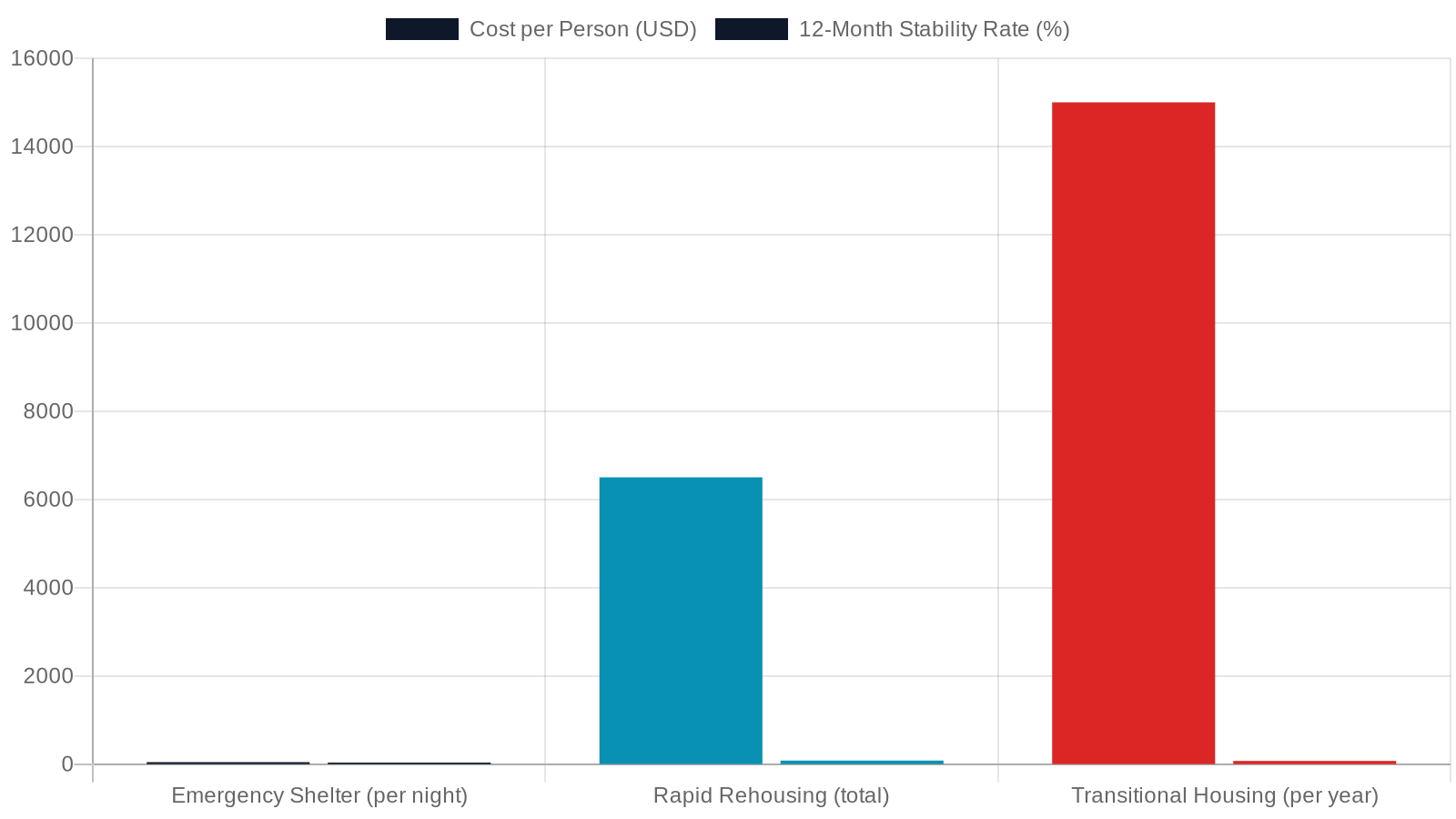
There is also a compelling fiscal argument for lived-experience-informed policy. Emergency shelter costs approximately $35 to $55 per person per night in most Tennessee markets. Rapid rehousing, informed by youth input and delivered with peer support, costs approximately $5,000 to $8,000 per person total — and achieves lasting housing stability for roughly 80% of participants. Transitional housing programs designed with youth input average $12,000 to $18,000 per person per year but produce long-term stability that reduces lifetime system costs dramatically.
When young adults help design programs that actually work, the system spends less money cycling the same people through crisis services repeatedly. That fiscal efficiency argument has proven persuasive with budget-conscious state legislators and county commissioners who might be skeptical of the equity argument alone. Lived experience is not just the right thing — it is the smart thing.
Cost estimates based on Tennessee CoC program data and National Alliance to End Homelessness benchmarks. Stability rates are approximate national averages for youth-specific programs.
Ready to Add Your Voice to Tennessee's Youth Housing Movement?
The work of shaping better youth homelessness policy in Tennessee is not finished — it never is, because systems require constant attention and young people’s needs evolve as housing markets, economies, and social conditions change. But the foundation is real: a statewide network of young adults with lived experience who are actively driving policy change in every corner of Tennessee, from Memphis to Mountain City. Here is how to be part of it.
If You Are a Young Adult with Lived Experience
If you are between 17 and 25 and have experienced homelessness or housing instability anywhere in Tennessee — Memphis, Nashville, Knoxville, Chattanooga, Jackson, the Upper Cumberland, Northeast Tennessee, or anywhere in between — your experience is not just something you survived. It is knowledge that Tennessee’s housing system needs. YAAB is built for you, by people like you.
Joining a local YAAB chapter means being part of a peer community, developing real advocacy and leadership skills, being compensated for your time, and having a genuine seat at the table where decisions about youth housing get made. You don’t need a degree, a perfect housing record, or any prior experience in policy. You need your story and your willingness to use it to make things better for the next young person who comes behind you. Visit yaabtn.org/get-involved to take the first step.
If You Are a Provider, Case Manager, or CoC Partner
If you work in Tennessee’s homeless response system — as a case manager, a shelter director, a CoC coordinator, or a funder — you have a role in making lived-experience engagement real rather than performative. Refer young adults to YAAB. Build youth advisory structures into your own programs. Compensate young people for their expertise. And when YAAB members bring you feedback that is uncomfortable, treat it as the gift it is.
The young adults navigating Tennessee’s housing system right now are not problems to be managed — they are the experts who can help you build something that actually works. The evidence is clear. The moral case is clear. The question is whether the system will meet this moment with the seriousness it deserves. To learn more about partnering with YAAB or to connect with the statewide network, visit yaabtn.org/contact.
Frequently Asked Questions
What is the Youth Action Board of Tennessee and who can join?
The Youth Action Board (YAAB) of Tennessee is a statewide network of young adults ages 17 to 25 who have lived experience of homelessness or housing instability. Members advise local Continuums of Care, state agencies, and legislators on youth housing policy. Any young adult in Tennessee who meets the age and lived-experience criteria can apply to join a local YAAB chapter.
How does lived experience actually change housing policy in Tennessee?
YAAB members participate directly in Continuum of Care governance — reviewing funding applications, scoring shelter programs, and providing testimony to state legislators. Their firsthand knowledge of barriers like shelter curfews, ID requirements, and Coordinated Entry processes has led to concrete policy reforms, including flexible curfew waivers for employed youth, mobile assessment options, and youth-specific rapid rehousing funding priorities.
What is a Continuum of Care and why does it matter for young people experiencing homelessness?
A Continuum of Care (CoC) is a regional planning body funded by HUD that coordinates the local homeless response system, decides which programs receive federal funding, and sets priorities for who gets housed first. In Tennessee, CoCs operate in Memphis/Shelby, Nashville/Davidson, Knoxville/Knox, Chattanooga/Hamilton, and Balance of State regions. CoC decisions directly determine what housing and services are available to transition-age youth in each area.
Why are LGBTQ+ youth and foster care alumni at higher risk of homelessness in Tennessee?
LGBTQ+ youth are approximately 120% more likely to experience homelessness than their non-LGBTQ+ peers, primarily due to family rejection. Youth aging out of foster care — about 1,200 young adults per year in Tennessee — face homelessness at rates five to eight times higher than the general youth population because they exit state custody without the family safety net most young adults rely on. Both groups are priority populations for YAAB advocacy.
Is there a difference between youth homelessness and adult homelessness when it comes to policy?
Yes, significantly. Transition-age youth (17–25) have different legal statuses, shorter housing histories, less credit history, and are more likely to experience hidden homelessness like couch-surfing rather than street homelessness. Policies designed for adults over 25 often fail young people because they don’t account for these differences. Youth-specific programs and youth-informed policy design consistently produce better outcomes for this age group.
How can a case manager or service provider connect a young adult to YAAB in Tennessee?
Case managers can refer young adults ages 17 to 25 with lived experience of homelessness to their regional YAAB chapter by visiting yaabtn.org/local-yaabs or directing them to yaabtn.org/join. The referral conversation is straightforward: let the young adult know that their experience is valuable knowledge, and that YAAB is a paid, supported way to use that knowledge to change systems for the better.