Quick answer: Young adults ages 17 to 25 across Tennessee who have experienced homelessness or housing instability are not just recipients of services — they are active architects of the policies and programs designed to help them. Through the Youth Action Board (YAAB) of Tennessee, transition-age youth in regions from Memphis to Northeast Tennessee sit at decision-making tables, advise Continuum of Care leaders, testify before policymakers, and redesign programs from the inside out. Their lived experience is treated as expertise, and the result is housing policy that actually works for the people it is meant to serve.
What 'Lived Experience' Actually Means in Policy Work

Before we can understand how young adults shape policy, it helps to be clear about what lived experience means — and why it carries weight in rooms where decisions get made. The term is used a lot, but it points to something concrete: the kind of knowledge you can only gain by living through a broken system and surviving it.
More Than a Personal Story
When advocates talk about lived experience, they mean direct, firsthand knowledge of a system — sleeping in a shelter, couch-surfing between relatives, aging out of foster care with nowhere to go, or navigating a housing application while working a minimum-wage job. That knowledge is not anecdotal. It is data that no survey or academic study can fully replicate.
In housing policy circles, lived experience is increasingly recognized as a credential. The U.S. Department of Housing and Urban Development (HUD) now requires Continuums of Care to include people with lived experience of homelessness on their governing boards. Tennessee’s regional CoCs have taken that requirement seriously — and the Youth Action Board is one of the primary vehicles for making it real for transition-age youth.
Why Youth Perspective Is Distinct
Adults who experienced homelessness decades ago bring valuable insight, but the landscape facing a 19-year-old in Tennessee today is different: the gig economy, social media as a survival tool, fentanyl in the drug supply, a post-pandemic rental market where median rents in Nashville rose more than 30% between 2020 and 2023, and a foster care system that legally ends support at age 18 in most circumstances.
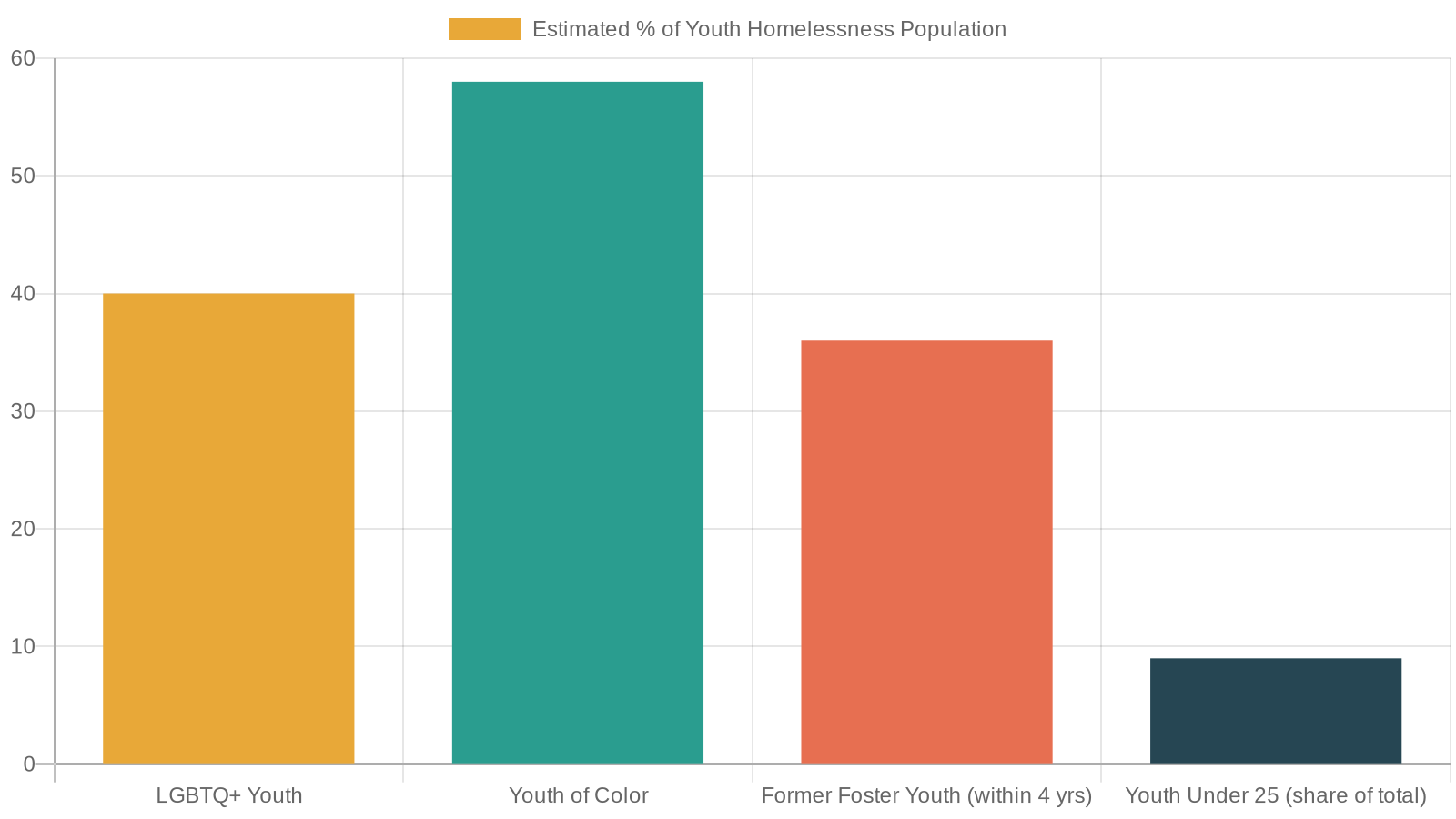
Transition-age youth (TAY) — generally defined as ages 16 to 25 — make up a significant share of the unhoused population. HUD’s 2023 Point-in-Time Count found that youth under 25 represented roughly 9% of all people experiencing homelessness nationally, with disproportionate representation among LGBTQ+ youth and youth of color. Policies written without youth input routinely miss the mark on shelter rules, ID requirements, curfews, and service hours that simply do not fit young people’s realities.
How the Youth Action Board of Tennessee Is Structured

Understanding how YAAB is built helps explain why it is effective. The structure is intentional: local boards embedded in regional Continuums of Care, connected to a statewide network, with young adults holding real seats at real tables — not just advisory roles that get ignored.
A Statewide Network with Regional Roots
YAAB Tennessee is not a single organization in one city — it is a statewide network of local Youth Action Boards embedded in each of Tennessee’s Continuum of Care regions. Those regions include Memphis/Shelby County (TN-500), Nashville/Davidson County (TN-502), Knoxville/Knox County (TN-503), Chattanooga/Hamilton County (TN-504), Jackson and West Tennessee (TN-506), the Upper Cumberland region (TN-507), and Northeast Tennessee (TN-509). Each local YAAB is connected to its regional CoC while also feeding insight upward to state-level conversations.
This structure matters because housing challenges in rural Northeast Tennessee look very different from those in urban Memphis. A young person in Johnson City may face a 45-minute drive to the nearest shelter; a young person in Memphis may face a waitlist measured in months. Having local boards means policy recommendations are grounded in regional reality, not a one-size-fits-all assumption.
Who Can Join and What Members Do
YAAB membership is open to young adults ages 17 to 25 who have personal experience with homelessness or housing instability — including couch-surfing, staying in shelters, living in cars, or aging out of foster care. Members are not volunteers in a traditional sense; they are advisors, advocates, and decision-makers who bring expertise that no hired consultant can replicate.
Day-to-day, YAAB members might review grant applications, give feedback on shelter intake forms, present at CoC planning meetings, testify at the state legislature, participate in Point-in-Time Count planning, or co-design new youth-specific programs. Many members also access support services — housing navigation, employment coaching, education resources — through their regional CoC partners, so participation in YAAB can directly improve a member’s own stability while they help improve the system for everyone else.
The Continuum of Care: Where Policy Actually Gets Made

To understand why YAAB participation matters, you need to understand what a Continuum of Care actually does. CoCs are not just service providers — they are the governing bodies that decide how millions of federal housing dollars get spent in each Tennessee region. Getting a seat at that table is not ceremonial; it is where the real work happens.
What a CoC Is and Why It Controls Resources
A Continuum of Care (CoC) is a regional planning body funded and overseen by HUD that coordinates housing and services for people experiencing homelessness. In Tennessee, there are eight CoC regions. Each CoC controls the allocation of federal McKinney-Vento homeless assistance grants — which in Tennessee total tens of millions of dollars annually — and sets local priorities for who gets served, in what order, and through what programs.
CoC decisions determine whether a region funds more emergency shelter beds or more rapid rehousing vouchers. They determine whether youth-specific housing programs get prioritized. They shape the Coordinated Entry system — the front door through which most people access housing services. If you are a young adult trying to get housed in Tennessee, the decisions made inside your regional CoC affect you directly, whether you know it or not.
How YAAB Members Plug Into CoC Decision-Making
YAAB members participate in CoC governance in several concrete ways. They serve on CoC committees — including those that score and rank funding applications, review program performance data, and set system priorities. They provide feedback on Coordinated Entry policies, which often contain age-based barriers that unintentionally exclude transition-age youth. They participate in the annual Point-in-Time Count, the one-night census of people experiencing homelessness that shapes federal funding formulas.
Critically, YAAB members do not just attend meetings as observers. They speak, vote where eligible, and submit formal written recommendations. When a shelter’s intake policy requires a government-issued ID that a 19-year-old who aged out of foster care may not have, a YAAB member is the person most likely to name that barrier clearly — and to propose a workable fix.
Real Ways Youth Voices Change Policy: 5 Mechanisms That Work

Lived experience does not automatically translate into policy change — it needs structured pathways to do so. YAAB has developed several concrete mechanisms that move youth insight from conversation into actual decisions. Here are five that have proven effective in Tennessee’s regional CoCs.
1. Participatory Policy Review
One of the most direct mechanisms is participatory policy review — giving YAAB members actual policy documents and asking them to identify what works, what creates barriers, and what is missing. This is not a focus group; it is a structured review process where youth feedback is documented, attributed, and tracked through revisions.
For example, shelter intake forms often ask questions about criminal history, substance use, or mental health diagnoses in ways that deter young people from accessing services. A YAAB review can flag specific language, propose alternatives, and follow up to confirm changes were made. This kind of iterative feedback loop is how policy documents shift from being written about young people to being written with them.
2. Legislative Testimony and Advocacy Campaigns
YAAB members testify before Tennessee legislative committees, speak at city council meetings, and participate in advocacy days at the state capitol in Nashville. Personal testimony from a young adult who has lived through the system carries a different weight than statistics alone — and legislators notice.
Advocacy campaigns coordinated through YAAB have addressed issues including extending foster care support beyond age 18, increasing funding for Transitional Living Programs, and reforming policies that make it harder for young adults with prior involvement in the justice system to access housing. When a bill is being debated that affects transition-age youth, having organized, articulate young advocates who can speak from experience is a strategic asset that changes outcomes.
3. Program Co-Design and Feedback Loops
Beyond reviewing existing policies, YAAB members help co-design new programs from the ground up. When a CoC or service provider wants to launch a new rapid rehousing initiative for youth, YAAB members can weigh in on everything from eligibility criteria to case management ratios to what the intake process should feel like for a scared 18-year-old walking in for the first time.
This co-design approach is backed by research. A 2019 study published in the American Journal of Community Psychology found that programs designed with meaningful youth participation showed higher enrollment rates and better housing stability outcomes than those designed without it. The logic is straightforward: when the people a program is designed to serve help design it, it fits better.
The Data Behind Youth Homelessness in Tennessee

Effective advocacy is grounded in evidence. YAAB members do not just share personal stories — they engage with data, help collect it more accurately, and use it to make the case for change. Here is what the numbers say about youth homelessness in Tennessee, and why youth participation in data collection is itself a policy lever.
What the Numbers Tell Us
Tennessee’s 2023 Point-in-Time Count identified approximately 10,000 people experiencing homelessness on a single night statewide, though researchers consistently note that PIT counts undercount youth because young people are more likely to be in hidden situations — couch-surfing, staying with strangers, or sleeping in cars — rather than in shelters where counters can find them.
Among counted youth under 25, the data shows persistent disparities: LGBTQ+ youth are estimated to represent 40% of youth experiencing homelessness nationally despite being roughly 7% of the youth population. Youth of color, particularly Black youth, are significantly overrepresented. Youth who have aged out of foster care are at dramatically elevated risk — studies suggest that within four years of aging out, approximately 36% of former foster youth experience homelessness.
Why Representation in Data Collection Matters
YAAB members participate in Point-in-Time Count planning not just as counters but as strategists. They know where young people actually sleep — which parking lots, which parks, which extended-stay motels, which friend’s couch. Their involvement in PIT planning improves count accuracy, which directly affects how much federal funding Tennessee’s CoCs receive.
Beyond the PIT count, YAAB members advocate for better data collection year-round — pushing for CoC databases (HMIS) to track youth-specific outcomes like educational enrollment, employment, and family reunification, not just housing placement. Better data means better advocacy, and better advocacy means more resources flowing to the young adults who need them most.
Aging Out of Foster Care: A Policy Crisis That YAAB Is Helping Fix

Aging out of foster care is one of the most direct pipelines into youth homelessness in Tennessee. Young adults who have lived this experience bring an irreplaceable perspective to policy conversations — and YAAB has become a key vehicle for turning that perspective into concrete reforms.
What 'Aging Out' Means in Tennessee
In Tennessee, young people in state custody typically age out of foster care at 18, though extended support through the Tennessee Independent Living program is available up to age 21 for those who qualify and opt in. The gap between what is available and what young people actually need is enormous: a 2021 report from the Annie E. Casey Foundation found that fewer than half of eligible youth nationally take advantage of extended care, often because they do not know it exists or because the process to access it is too burdensome.
The result is that thousands of Tennessee young adults leave foster care each year without stable housing, without a support network, and without the financial cushion that most 18-year-olds in housed families take for granted. Many enter homelessness within months. This is not a personal failure — it is a policy failure, and YAAB members who have lived it are uniquely positioned to name it as such.
Policy Changes YAAB Has Pushed For
YAAB members across Tennessee have advocated for several concrete policy improvements related to aging out, including: expanding awareness of extended foster care options so more eligible youth actually use them; streamlining the process for former foster youth to access housing vouchers (including the HUD-VASH equivalent for youth, the Foster Youth to Independence voucher program); and reforming CoC Coordinated Entry systems to recognize that a 19-year-old who aged out of foster care last year should be prioritized for housing resources.
They have also pushed for better coordination between the Tennessee Department of Children’s Services (DCS) and regional CoCs, so that a young person’s transition out of care includes a warm handoff to housing services rather than a cliff edge. These are systemic changes that require sustained advocacy — exactly the kind of long-game work that YAAB is built to do.
Housing Policy Is Connected to Everything Else: Education, Jobs, and Mental Health

One of the most powerful contributions YAAB members make to policy conversations is insisting on a holistic view of what young people need. Housing stability is not just about a roof — it is the prerequisite for everything else. When young adults with lived experience speak in policy rooms, they naturally connect the dots that siloed systems miss.
The Interconnected Web of Stability
Housing policy does not exist in a vacuum. A young adult who does not have a stable address cannot reliably enroll in community college, because many institutions require proof of residency. They cannot hold a job that requires a consistent schedule when they do not know where they will sleep tonight. They cannot engage in mental health treatment when survival is the only priority. Housing is the foundation — and YAAB members understand this from lived experience in a way that shapes how they advocate.
This is why YAAB’s policy work extends beyond shelter beds and rental assistance. Members advocate for housing-first approaches that do not require sobriety or employment as preconditions for getting housed. They push for education liaisons within CoC systems who can help young adults navigate GED programs, FAFSA, and community college enrollment simultaneously with housing navigation. They advocate for employment programs that understand the specific barriers young adults face — lack of work history, lack of professional references, gaps in employment due to housing instability.
Mental Health and Trauma-Informed Policy
Many young adults who have experienced homelessness have also experienced trauma — family rejection, abuse, involvement in the justice system, or the trauma of homelessness itself. YAAB members advocate for trauma-informed care standards across Tennessee’s CoC-funded programs, meaning that staff are trained to understand how trauma affects behavior, communication, and engagement with services.
Practically, this means advocating for shelter rules that do not punish trauma responses, for case management approaches that build trust over time rather than demanding immediate compliance, and for mental health services that are co-located with housing programs so young adults do not have to navigate multiple systems simultaneously. These are not soft preferences — they are evidence-based practices that improve housing retention rates and long-term outcomes.
A Region-by-Region Look at YAAB Across Tennessee

Tennessee is not one place — it is a state of distinct regions with different economies, geographies, and housing markets. YAAB’s regional structure means that policy advocacy is grounded in local reality, not a statewide average that smooths over the differences between Memphis and Mountain City.
Urban Centers: Memphis, Nashville, Knoxville, Chattanooga
Tennessee’s four largest metro areas each have distinct youth homelessness profiles and active local YAABs. Memphis (TN-500) faces some of the state’s highest rates of youth homelessness, compounded by concentrated poverty and limited affordable housing stock. Nashville (TN-502) has seen dramatic rent increases that have pushed more young adults into housing instability even while the city’s economy booms. Knoxville (TN-503) has a significant population of youth aging out of foster care and a growing YAAB presence that has been active in CoC governance. Chattanooga (TN-504) has made strides in youth-specific rapid rehousing, in part because of YAAB advocacy for dedicated youth funding streams.
In each of these cities, local YAAB members have shaped specific local policies — from shelter intake procedures to how Coordinated Entry prioritizes youth — in ways that reflect the particular character of their community.
Rural and Regional Tennessee: Jackson, Upper Cumberland, Northeast TN
Rural youth homelessness is often invisible because it looks different — it is more likely to be hidden in doubled-up living situations, extended-stay motels, or isolated rural areas far from services. Jackson and West Tennessee (TN-506), the Upper Cumberland region (TN-507), and Northeast Tennessee (TN-509) all face the additional challenge of geographic distance: a young adult in a rural county may be an hour or more from the nearest shelter or service provider.
YAAB members in these regions advocate for transportation assistance as a housing policy issue, for remote case management options, and for outreach strategies that reach young people in rural areas who may not know that services exist. Their regional knowledge is irreplaceable — no urban-based policy analyst can design effective rural outreach without input from people who have lived it.
Youth Advisory Models: How YAAB Compares to Other Approaches
Not all forms of youth engagement in housing policy carry the same weight. Here is how YAAB Tennessee's model stacks up against common alternatives across five key dimensions.
Barriers Young Adults Face When Trying to Influence Policy

Honest advocacy work requires acknowledging the obstacles. Young adults with lived experience face real barriers to policy participation — both practical and systemic. Understanding these barriers is the first step to dismantling them, and YAAB’s model is built around reducing them wherever possible.
Practical Barriers: Time, Transportation, and Stability
Participating in policy work is not easy when you are also trying to survive. CoC meetings happen during business hours. Legislative testimony requires travel to Nashville. Reviewing policy documents requires literacy, time, and cognitive bandwidth that is genuinely harder to access when you are worried about where you will sleep. These are not excuses — they are real barriers that YAAB works actively to address by providing stipends for member participation, transportation assistance, flexible meeting formats, and support services that help members stabilize their own situations.
Research on youth civic engagement consistently finds that compensation matters. When young adults with lived experience are paid for their expertise — rather than asked to donate it — participation rates increase, the quality of input improves, and the implicit message is sent that their knowledge has value. YAAB’s model reflects this understanding.
Systemic Barriers: Tokenism and Power Dynamics
Even when young adults get into the room, they can face tokenism — being asked to share their story once for emotional impact and then being talked over when it comes to actual decisions. YAAB’s structure is designed to counter this by building collective power rather than relying on individual testimony. When multiple YAAB members from multiple regions show up with consistent, data-backed recommendations, it is much harder to dismiss them as a single anecdote.
Power dynamics within CoC governance can also be challenging — long-tenured service providers, government officials, and funders hold significant institutional authority. YAAB members receive training in advocacy, public speaking, policy analysis, and meeting facilitation specifically to help them navigate these dynamics with confidence. The goal is not just to have a seat at the table — it is to be effective once seated.
How YAAB Compares to Other Youth Advisory Models

Context matters. Understanding how YAAB compares to other models of youth engagement in policy helps clarify what makes it effective — and what other organizations and CoCs can learn from Tennessee’s approach.
What Makes YAAB Different
Not all youth advisory boards are created equal. Some are purely symbolic — a checkbox that lets agencies claim youth input without actually incorporating it. Others are one-time focus groups rather than ongoing governance structures. YAAB Tennessee is designed to be substantively different: members hold seats on CoC governing bodies, their recommendations are formally documented, and there is accountability for whether feedback is incorporated.
The statewide network model also distinguishes YAAB from isolated local efforts. When a policy issue affects youth across multiple regions — like a state legislative proposal or a HUD regulatory change — YAAB can mobilize coordinated responses from Memphis to Kingsport, amplifying the impact of youth advocacy in ways that a single-city board cannot.
Learning from National Models
Tennessee’s YAAB model draws on and contributes to national best practices in youth engagement in homelessness systems. Organizations like True Colors United and the National Network for Youth have documented what works: paid participation, peer-to-peer support structures, formal governance roles rather than advisory-only positions, and ongoing skill-building that helps members grow as advocates over time.
Tennessee’s regional CoC structure creates a unique opportunity — and a unique challenge — because policy must be shaped at both the regional and state level simultaneously. YAAB’s statewide network is one of the more sophisticated models in the country for navigating that complexity, and its approach is increasingly referenced by other states looking to build similar structures.
How to Get Involved with Your Local YAAB in Tennessee

Reading about policy work is one thing. Being part of it is another. If you are a young adult in Tennessee with lived experience of housing instability, YAAB is a place where that experience becomes power — where you can shape the systems that once shaped you, and help make them better for everyone who comes after you.
Learn more about what YAAB does and how it works, and check out the resources available to transition-age youth across Tennessee — from housing navigation to education support to employment programs.
Who Should Join and What to Expect
If you are between 17 and 25 years old and have personal experience with homelessness or housing instability — including couch-surfing, staying in shelters, living in your car, or aging out of foster care — you are exactly who YAAB is built for. You do not need a resume, a college degree, or any prior advocacy experience. Your experience is the qualification.
New members can expect an onboarding process that includes orientation to how CoCs work, training in advocacy and public speaking, and connection to a peer community of young adults doing similar work across Tennessee. Many members say that joining YAAB was the first time they felt like their experience was treated as an asset rather than a liability — and that shift in perspective is itself transformative.
Finding Your Regional YAAB
Each of Tennessee’s eight CoC regions has its own local YAAB with its own meeting schedule, leadership structure, and current priorities. To find the one closest to you — whether you are in Memphis, Nashville, Knoxville, Chattanooga, Jackson, the Upper Cumberland, or Northeast Tennessee — you can explore all local YAABs on the YAAB Tennessee website and connect directly with the regional coordinator.
If you are a case manager, service provider, or CoC partner looking to connect young adults you work with to YAAB, the same page is the right starting point. Warm referrals from trusted adults are one of the most effective ways to bring new members into the network — and the young adults you refer will be joining a community that is genuinely invested in their growth and stability, not just their stories.
Your Next Move: Join the Work That Changes Tennessee Housing Policy

The most important thing to know about shaping housing policy in Tennessee is this: it is not something that happens to you. It is something you can do. YAAB Tennessee exists to make sure that young adults with lived experience are not just the subject of policy conversations — they are leading them. Visit the YAAB Tennessee website to learn more, find your regional board, and take the first step toward turning your experience into change.
Start Where You Are
You do not have to have everything figured out to start. YAAB members come in at every stage — some are still navigating their own housing situations, some have been stable for a few years and want to give back, some are case managers who want to better understand the youth perspective. The common thread is a belief that the people most affected by a system should have real power to change it.
If you are in Memphis, Nashville, Knoxville, Chattanooga, Jackson, the Upper Cumberland, or Northeast Tennessee, there is a local YAAB near you. If you are somewhere in between, the statewide network can connect you to the closest regional board and help you figure out how to get involved from where you are. Transportation, scheduling, and other practical barriers are things YAAB actively works to address — so do not let logistics be the reason you stay on the sidelines.
The Bigger Picture
Every policy that gets changed, every shelter intake form that gets simplified, every legislative bill that passes because a young adult testified with clarity and courage — that is the work YAAB is doing across Tennessee right now. It is slow, sometimes frustrating, and always worth it. The young adults who shaped the policies that exist today did so because someone before them built a structure that made it possible. You can be part of building that structure for the next generation.
Housing policy in Tennessee will be shaped by someone. The question is whether the people most affected by it will be in the room when it happens. YAAB exists to make sure the answer is yes — and it needs your voice, your experience, and your energy to keep doing that work.
Frequently Asked Questions
What is the Youth Action Board of Tennessee?
The Youth Action Board (YAAB) of Tennessee is a statewide network of young adults ages 17 to 25 with lived experience of homelessness or housing instability. Members advise Continuum of Care leaders, shape housing policy, and connect peers to resources across Tennessee's eight CoC regions.
How do young adults with lived experience actually influence housing policy?
They participate in CoC governance meetings, review and provide feedback on policy documents, testify before state legislators, co-design new programs, and help plan the annual Point-in-Time Count. Their input is formally documented and tracked through policy revisions, giving it real accountability.
Who is eligible to join a local YAAB in Tennessee?
Young adults ages 17 to 25 who have personal experience with homelessness or housing instability — including couch-surfing, shelter stays, living in a vehicle, or aging out of foster care — are eligible. No prior advocacy experience is required; lived experience is the qualification.
What is a Continuum of Care and why does it matter for youth?
A Continuum of Care (CoC) is a regional planning body funded by HUD that coordinates housing and services for people experiencing homelessness. CoCs control the allocation of federal homeless assistance grants and set local priorities for who gets served. Their decisions directly affect every young adult seeking housing support in Tennessee.
What happens to young people when they age out of foster care in Tennessee?
In Tennessee, young people typically age out of foster care at 18, though extended support is available up to age 21 for those who qualify and opt in. Many leave without stable housing, and studies suggest that roughly 36% of former foster youth experience homelessness within four years of aging out. YAAB advocates for policy reforms to close this gap.
How does YAAB support members who are still experiencing housing instability themselves?
YAAB provides stipends for participation, transportation assistance, and flexible meeting formats to reduce practical barriers. Many members also access housing navigation, employment coaching, and education resources through their regional CoC partners while they participate in advocacy work.