Know Your Rights: 9 Things Young Adults Need to Know About Tennessee’s Continuum of Care
Quick answer: Tennessee’s Continuum of Care (CoC) is a federally funded network of housing and support programs that serves young adults ages 17 to 25 who are experiencing homelessness or housing instability. You have real rights inside this system — including the right to be assessed fairly, to appeal decisions, to access services without a parent’s consent, and to participate in shaping the policies that affect you. This guide breaks down nine things every transition-age youth in Tennessee should know so you can navigate the CoC with confidence and get the help you’re entitled to.
1. What the Continuum of Care Actually Is
Before you can know your rights inside the system, you need to understand what the system actually is. The Continuum of Care sounds like bureaucratic jargon — and honestly, it kind of is — but once you break it down, it’s a structure you can use to your advantage. Here’s the plain-language version.
A Federal Framework, a Local Reality
The Continuum of Care (CoC) is a program created by the U.S. Department of Housing and Urban Development (HUD) that funds a coordinated network of housing and services for people experiencing homelessness. In Tennessee, there are seven regional CoC areas: Memphis/Shelby County, Nashville/Davidson County, Knoxville/Knox County, Chattanooga/Hamilton County, Jackson/West Tennessee, the Upper Cumberland region, and Northeast Tennessee. Each region has its own lead agency, its own funded programs, and its own local rules — but all of them must follow federal HUD guidelines.
For you as a young adult, this means the CoC is not one single office you walk into. It’s a web of shelters, rapid rehousing programs, transitional housing, and supportive services that are supposed to work together to get you housed and stable.
Why Transition-Age Youth Are a Priority
HUD specifically recognizes transition-age youth (TAY) — generally ages 16 to 24 — as a priority population. That means CoC-funded programs in Tennessee are required to think about your specific needs when they design services. According to HUD’s 2023 Annual Homeless Assessment Report, approximately 35,574 unaccompanied youth were counted as homeless on a single night across the U.S., and young people ages 18 to 24 made up the largest share of that group. Tennessee’s Point-in-Time counts consistently show hundreds of unaccompanied youth across the state’s seven CoC regions — and advocates believe the true number is far higher because couch-surfing and doubling-up are undercounted.
2. Your Right to a Fair and Unbiased Assessment
One of the most important rights you have in Tennessee’s CoC system is the right to be assessed fairly — without judgment, without discrimination, and without being turned away at the door. Here’s what that means in practice.
What Coordinated Entry Is and How It Works
Every CoC in Tennessee uses a process called Coordinated Entry (sometimes called Coordinated Assessment) to figure out what kind of housing or services you need. Think of it as a standardized intake process — a trained assessor asks you a set of questions about your situation, your history, and your needs, and then uses that information to match you to the right program. In most Tennessee regions, the tool used is called the VI-SPDAT (Vulnerability Index – Service Prioritization Decision Assistance Tool) or a youth-specific version of it.
You have the right to complete this assessment without being turned away because of your age (as long as you’re 17 or older in most regions), your gender identity, your sexual orientation, your race, your immigration status, or your criminal history. Federal fair housing law and HUD’s Equal Access Rule both prohibit discrimination in CoC-funded programs.
What to Do If You Feel the Assessment Was Unfair
If you believe your assessment was conducted unfairly — for example, if an assessor made assumptions about you, rushed through the questions, or scored you in a way that doesn’t reflect your actual situation — you have the right to request a reassessment. Every CoC is required by HUD to have a written grievance and appeals process. Ask the agency that conducted your assessment for their written grievance policy. If they can’t produce one, that’s a red flag you can escalate to the CoC lead agency. Keep a record of dates, names, and what was said.
3. Your Right to Access Services Without Parental Consent
Age can feel like a barrier when you’re trying to get help. But the law — and HUD policy — are on your side more than many programs let on. Here’s what you need to know about accessing services as a minor or a young adult in Tennessee.
Tennessee Law and the Age of Consent for Services
This is one of the most misunderstood rights for young people in Tennessee. Under Tennessee Code Annotated § 37-5-106, a minor who is homeless, runaway, or in need of services may receive certain crisis and shelter services without parental consent. Once you turn 18, you are a legal adult and can access all housing and support services entirely on your own. For youth ages 17 and under, individual programs may have different policies, but no CoC-funded shelter can legally require you to contact an abusive or unsafe parent as a condition of receiving services.
If you are 17 and a program is telling you that you must have a parent’s signature before they will help you, ask to speak with a supervisor and ask specifically which written policy requires that — because HUD’s own guidelines strongly discourage barriers that prevent youth from accessing shelter.
LGBTQ+ Youth and Safe Access
HUD’s Equal Access Rule (24 CFR Part 5) requires all CoC-funded programs to provide equal access regardless of sexual orientation or gender identity. This means a shelter cannot turn you away or place you in an unsafe situation because you are LGBTQ+. You have the right to be housed in a manner consistent with your gender identity. If a program violates this, you can file a complaint directly with HUD’s Office of Fair Housing and Equal Opportunity (FHEO) at 1-800-669-9777. Tennessee also has LGBTQ+-affirming youth shelters, including True Colors United partner organizations in Memphis and Nashville.
4. The Types of Housing Programs You Can Access
The CoC isn’t just one type of help — it’s a layered system of programs designed to meet you where you are. Understanding what’s available means you can ask for the right thing and advocate for yourself when you’re placed on a waiting list or offered something that doesn’t fit your situation.
Emergency Shelter and Diversion
Emergency shelter is the most immediate resource — it’s a safe place to sleep tonight. Tennessee’s CoC regions fund emergency shelters specifically for youth in Memphis, Nashville, Knoxville, Chattanooga, and Jackson. Diversion is a newer strategy that tries to help you avoid shelter altogether by resolving your immediate housing crisis — for example, mediating a conflict with a family member or helping you access short-term rental assistance to stay where you are. Diversion doesn’t mean being turned away from shelter; it means being offered a faster, more stable alternative first.
Rapid Rehousing and Transitional Housing
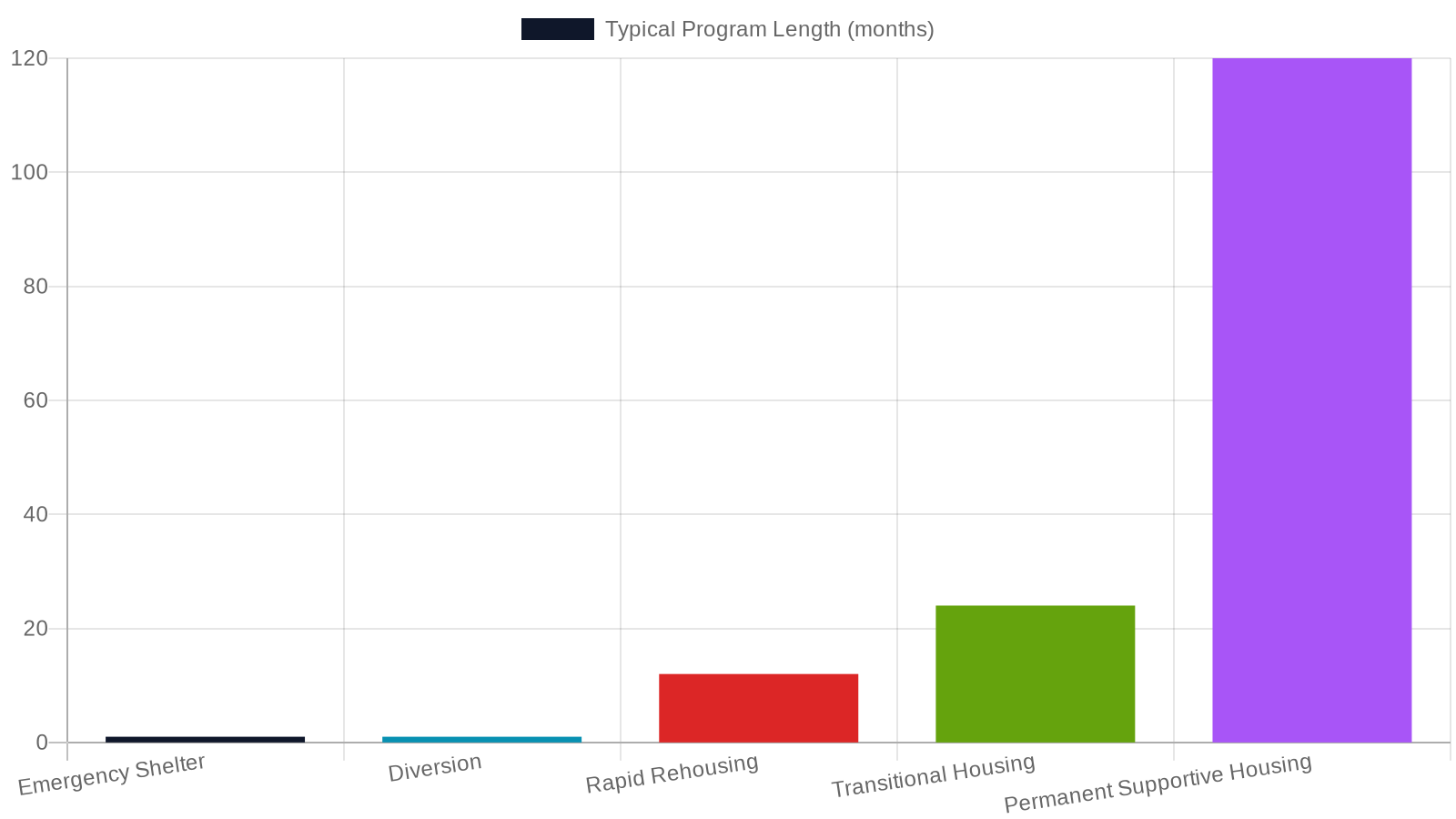
Rapid Rehousing (RRH) is a short-term rental assistance program — typically 3 to 24 months — that helps you get into your own apartment quickly while a case manager supports you in building stability. It’s one of the most effective interventions for transition-age youth. Transitional Housing (TH) programs offer longer-term housing (up to 24 months) with built-in services like life skills training, employment support, and mental health counseling. Both types of programs exist in Tennessee’s CoC regions, though availability varies by location and funding cycles. According to HUD data, rapid rehousing programs nationally achieve housing stability for approximately 80% of participants within 6 months.
Permanent Supportive Housing
Permanent Supportive Housing (PSH) combines long-term affordable housing with voluntary support services. It’s typically prioritized for youth with the highest needs — for example, those with chronic health conditions, disabilities, or very long histories of homelessness. If you’re matched to PSH through Coordinated Entry, you have the right to remain in that housing as long as you meet the lease terms, and you cannot be required to participate in services as a condition of keeping your housing (though services are strongly encouraged and available).
Approximate program durations — actual lengths vary by region and individual need.
5. Your Right to Privacy and Confidentiality
When you enter the CoC system, you share personal information — sometimes very personal information. You have real legal rights around how that information is stored, who can see it, and how it can be used. Don’t let anyone tell you otherwise.
HMIS and Your Data
Every CoC-funded program in Tennessee is required to enter your information into the Homeless Management Information System (HMIS) — a federally mandated database that tracks who is using services and what outcomes they achieve. You have the right to know that your data is being collected. You also have the right to review your own HMIS record and request corrections if something is wrong. Under HUD’s HMIS Data Standards, your personally identifiable information (PII) cannot be shared with law enforcement, immigration authorities, or other non-CoC entities without your written consent — with very limited exceptions.
Confidential Shelters and Domestic Violence
If you are fleeing domestic violence, dating violence, sexual assault, or stalking, you have additional protections under the Violence Against Women Act (VAWA). CoC-funded programs cannot disclose your location to an abuser. Domestic violence shelters that receive CoC funding operate under separate, stricter confidentiality rules — they are not even listed in HMIS in the same way as other shelters. If you are in this situation, ask specifically for a DV-specific shelter or a confidential safe house when you call a CoC hotline.
6. Your Right to Appeal Decisions and File Grievances
Getting denied, terminated, or deprioritized in the CoC system is frustrating — and it happens. But it doesn’t have to be the end of the road. You have a formal right to push back, and here’s how to do it effectively.
When You Can Appeal
You have the right to appeal if you are: denied entry into a CoC-funded program; terminated from a program before you expected to be; given a lower priority score through Coordinated Entry than you believe is accurate; or denied a reasonable accommodation for a disability. Every CoC-funded program is required by HUD to have a written grievance procedure. Ask for it in writing. If the program can’t produce one, contact the CoC lead agency for your region directly.
How to Escalate If a Program Doesn't Respond
If you file a grievance and the program doesn’t respond within a reasonable timeframe (typically 10 to 30 business days depending on the program’s policy), you can escalate to the CoC lead agency for your region. If the lead agency doesn’t resolve it, you can file a complaint with HUD’s Community Planning and Development (CPD) office. For fair housing violations — discrimination based on race, gender identity, sexual orientation, disability, or other protected classes — file directly with HUD’s Office of Fair Housing and Equal Opportunity (FHEO) online at hud.gov/program_offices/fair_housing_equal_opp or by phone at 1-800-669-9777. You can also contact a local legal aid organization — Tennessee has legal aid offices in every major region.
7. Your Rights Around Education and Employment While in the System
Being in the CoC system doesn’t put your education or career on hold — and the law actually gives you extra protections to make sure it doesn’t. Here’s what you’re entitled to on the education and employment front.
The McKinney-Vento Act and School Enrollment
If you are under 21 and enrolled in K–12 education, the McKinney-Vento Homeless Assistance Act gives you the right to immediate school enrollment — even without records, immunization documents, or a permanent address. You cannot be placed in a segregated program just because you are experiencing homelessness. Every Tennessee school district is required to have a McKinney-Vento liaison who can help you enroll and access free transportation. For young adults who have aged out of K–12, Tennessee’s Adult Education program offers free GED preparation and testing at locations across all seven CoC regions.
Employment Rights and Work Permits for Youth
If you are 16 or 17, Tennessee law requires an employment certificate (work permit) from your school before you can work most jobs. If you are not enrolled in school, contact your county’s Department of Education or a McKinney-Vento liaison — they can help you get the documentation you need. Once you turn 18, you can work without a permit. Many CoC-funded transitional housing programs also connect residents with workforce development programs, including Tennessee’s American Job Centers (AJCs), which offer free job training, resume help, and connections to employers. There are AJC locations in Memphis, Nashville, Knoxville, Chattanooga, Jackson, and other cities across the state.
FAFSA and Financial Aid While Experiencing Homelessness
If you are experiencing homelessness or are a youth who has aged out of foster care, you may qualify as an independent student on the FAFSA — meaning you don’t need a parent’s tax information or signature to apply for federal financial aid. A school financial aid officer, a CoC case manager, or a HUD-approved housing counselor can help you document your status. Tennessee also offers the Tennessee Promise and Tennessee Reconnect programs, which provide last-dollar scholarship funding for community college — and both programs have provisions for students experiencing homelessness.
Tennessee CoC Housing Programs at a Glance
Use this table to quickly compare the main types of CoC-funded housing programs available to transition-age youth in Tennessee — what they offer, how long they last, and what to expect.
Program Type
Who It’s For
Typical Length
Key Benefit
Youth-Specific Versions?
Emergency Shelter
Anyone in immediate crisis, 17+
1 night to 90 days
Safe place to sleep tonight
Yes — in Memphis, Nashville, Knoxville, Chattanooga
Diversion
People who may be able to avoid shelter with short-term help
1–30 days
Faster resolution, avoids shelter system
Sometimes — depends on region
Rapid Rehousing (RRH)
Youth who can maintain housing with short-term support
Youth with highest needs, chronic homelessness, or disabilities
Long-term / permanent
Stable housing with voluntary support services
Limited — prioritized by vulnerability score
Host Home / Safe Haven
Youth who need a family-style setting
Varies (often 6–12 months)
Home environment with a vetted host family
Yes — growing model in Nashville and Knoxville
8. How Tennessee's CoC Regions Compare for Youth Services
Tennessee’s seven CoC regions are not identical — they vary in size, funding, and the depth of youth-specific services they offer. Knowing what your region has (and doesn’t have) helps you ask the right questions and push for what you need.
What to Look for in Your Region
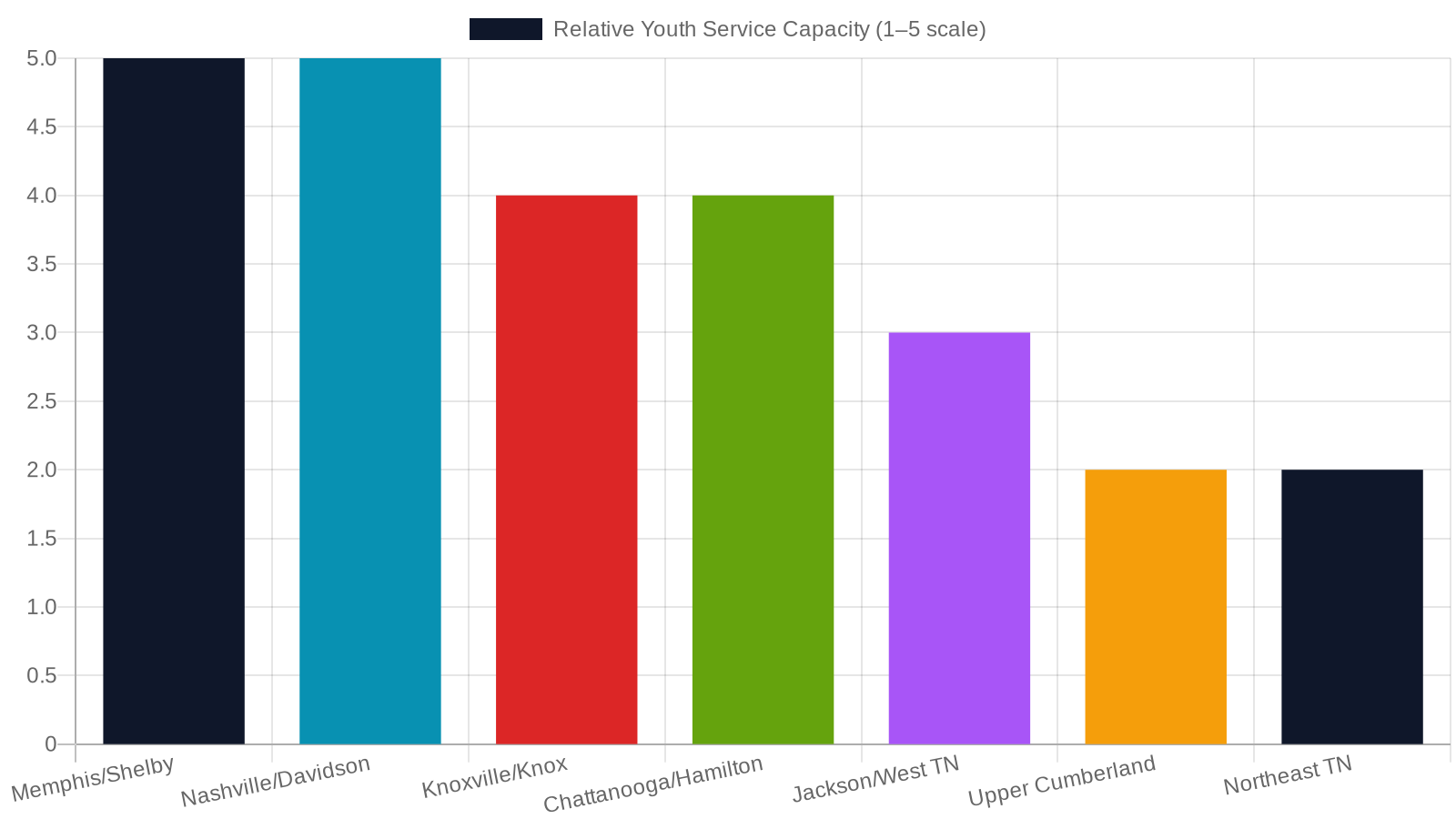
Not all CoC regions in Tennessee have the same level of youth-specific resources. The largest urban CoCs — Memphis/Shelby, Nashville/Davidson, and Knoxville/Knox — generally have the most dedicated youth shelter beds, youth-specific rapid rehousing programs, and drop-in centers. Smaller or more rural regions like Upper Cumberland and Northeast Tennessee may have fewer dedicated youth beds but often have strong community partnerships and case managers who can connect you to regional resources or help you access services in a neighboring CoC area.
When evaluating your options, ask specifically: Do you have a youth-specific program?What is the current wait time?Do you have staff trained in trauma-informed care? These questions signal that you know your rights and help you get better service.
Point-in-Time Count Data Across Tennessee
Tennessee’s annual Point-in-Time (PIT) Count — conducted every January — is the official snapshot of homelessness in each CoC region. In the most recent statewide count, Tennessee recorded over 8,500 people experiencing homelessness on a single night, with youth ages 18 to 24 making up an estimated 12–15% of the unsheltered population. Advocates consistently note that the PIT count undercounts youth because many young people are couch-surfing, staying in motels, or in other situations that don’t look like traditional homelessness. The real number is almost certainly higher — which is why your voice in advocacy matters.
Relative capacity estimate based on number of dedicated youth shelter beds, youth-specific RRH programs, and drop-in services. Not an official HUD ranking.
9. How to Get Involved and Shape the System Yourself
You’re not just a recipient of the CoC system — you’re someone who can change it. Tennessee’s CoC regions are required to include young people with lived experience in their decision-making, and YAAB is the organized vehicle for making that happen statewide. Here’s how to plug in.
What YAAB Members Actually Do
The Youth Action Board (YAAB) of Tennessee is made up of young adults ages 17 to 25 with lived experience of homelessness and housing instability — people who have been through the CoC system and want to make it better for everyone who comes after them. YAAB members attend CoC planning meetings, provide feedback on new programs and policies, testify at the state legislature, and connect their peers to resources. This isn’t volunteer work that looks good on a resume (though it does) — it’s real power. CoC lead agencies are required by HUD to include people with lived experience in their governance structures, which means your voice has a formal seat at the table.
Finding Your Local YAAB in Tennessee
There are local YAAB chapters across Tennessee’s CoC regions. Whether you’re in Memphis, Nashville, Knoxville, Chattanooga, Jackson, the Upper Cumberland, or Northeast Tennessee, there is a local group you can connect with. You don’t need to have all your housing figured out before you join — many members are still navigating their own situations while also helping others. Find your local YAAB chapter and learn how to connect — showing up is the first step, and the community is there to support you.
Advocacy Beyond YAAB
Even if YAAB isn’t the right fit for you right now, there are other ways to use your voice. You can attend your regional CoC’s public meetings — they are open to the public and your comments are on the record. You can contact your Tennessee state legislators about youth homelessness policy. You can share your story (on your own terms, only what you’re comfortable sharing) with journalists, researchers, or policymakers who are working on housing issues. And you can connect other young people to the resources they need — peer-to-peer connection is one of the most powerful tools in the system. Visit YAAB Tennessee’s advocacy page to see current campaigns and ways to plug in.
Your Next Move: Getting Help and Getting Connected in Tennessee
You’ve made it through a lot of information — and that’s the point. The more you know about how Tennessee’s Continuum of Care works, the better equipped you are to get what you need, push back when something isn’t right, and help the people around you do the same. Here’s a quick action plan to get started.
Start Here: Key Contacts Across Tennessee
No matter where you are in Tennessee, your first call should be 211 — Tennessee’s statewide information and referral line, available 24/7. Tell them you are a young adult experiencing housing instability and ask specifically for youth-specific CoC programs in your area. In Memphis, you can also contact MIFA (Metropolitan Inter-Faith Association). In Nashville, reach out to Campus for Human Development or Conexión Américas for bilingual support. In Knoxville, contact Volunteer Ministry Center. In Chattanooga, reach out to the Chattanooga Room in the Inn. These are CoC partner organizations with experience serving transition-age youth.
Use YAAB Tennessee's Resource Hub
YAAB Tennessee has compiled a statewide resource guide specifically for young adults navigating housing instability, education, employment, and mental health. You can explore it at yaabtn.org/resources — it’s organized by region and updated regularly. If you want to take the next step and get involved with a local YAAB chapter, visit yaabtn.org/join to learn how to become a member. You belong in this conversation — and Tennessee’s CoC system is supposed to work for you.
Frequently Asked Questions
Can I access a homeless shelter in Tennessee without my parents' permission if I'm 17?
In most cases, yes. Tennessee Code Annotated § 37-5-106 allows minors who are homeless or in crisis to receive certain services without parental consent. No CoC-funded shelter can require you to contact an abusive or unsafe parent as a condition of receiving help. If a program is blocking you, ask to speak with a supervisor and ask for their written policy.
What is Coordinated Entry and do I have to go through it to get housing?
Coordinated Entry is a standardized assessment process that CoC-funded programs in Tennessee use to match people to the right housing program. Most CoC-funded housing — including rapid rehousing and transitional housing — requires a Coordinated Entry assessment. You have the right to a fair assessment and the right to appeal if you believe your score was inaccurate.
Can a Tennessee shelter turn me away because I'm LGBTQ+?
No. HUD’s Equal Access Rule (24 CFR Part 5) prohibits CoC-funded programs from discriminating based on sexual orientation or gender identity. You have the right to be housed consistent with your gender identity. If a shelter violates this, you can file a complaint with HUD’s Office of Fair Housing and Equal Opportunity at 1-800-669-9777.
Does being homeless affect my ability to apply for college financial aid in Tennessee?
No — it may actually help. If you are experiencing homelessness or have aged out of foster care, you may qualify as an independent student on the FAFSA, meaning you don’t need a parent’s information. Tennessee Promise and Tennessee Reconnect also have provisions for students experiencing homelessness. A financial aid officer or CoC case manager can help you document your status.
What is the Youth Action Board (YAAB) and how do I join in Tennessee?
YAAB Tennessee is a statewide network of young adults ages 17 to 25 with lived experience of homelessness who help shape housing policies and programs across Tennessee’s seven CoC regions. You can find your local chapter and apply to join at yaabtn.org/join. You don’t need to have your housing fully stable before joining.
How do I find out what CoC housing programs are available in my part of Tennessee?
Call 211 — Tennessee’s 24/7 statewide information and referral line — and ask specifically for youth-specific CoC programs in your area. You can also visit yaabtn.org/resources for a regional resource guide maintained by YAAB Tennessee.