Quick answer: The Upper Cumberland region of Tennessee — covering counties like Putnam, White, Overton, and surrounding areas — faces real challenges with youth homelessness among young adults ages 17 to 25. The HART (Homeless Alliance of the Rural Tennessee) Continuum of Care and the Youth Action Board (YAAB) of Tennessee work together in this region to connect transition-age youth to housing, employment, and mental health resources, while giving young people with lived experience a real seat at the table to shape the policies that affect their lives.
1. What Is the Upper Cumberland Region and Why Does It Matter?

To understand why youth advocacy in Upper Cumberland matters so much, it helps to understand the region itself. Upper Cumberland is not a single city — it’s a sprawling, largely rural stretch of middle Tennessee where resources are spread thin and young adults navigating housing instability often have to travel significant distances just to access a shelter bed or a case manager.
The Counties That Make Up Upper Cumberland
The Upper Cumberland region sits in the north-central part of Tennessee and includes roughly 14 counties: Putnam, White, Overton, Fentress, Pickett, Clay, Macon, Jackson, Smith, DeKalb, Van Buren, Warren, Cumberland, and Cannon. Cookeville, the seat of Putnam County, is the region’s largest city and a hub for services, education, and employment.
Despite its natural beauty and tight-knit communities, Upper Cumberland faces a persistent gap in resources for young adults experiencing housing instability. The region is largely rural, which means fewer shelters, fewer public transit options, and longer distances between services — all of which make homelessness harder to escape when you’re 17 to 25 years old.
Rural Homelessness Is Often Invisible
Youth homelessness in rural Tennessee often looks different from what people picture. Instead of sleeping on city sidewalks, young people in Upper Cumberland are more likely to be couch-surfing with friends or extended family, sleeping in cars, or staying in unsafe situations just to have a roof. The U.S. Department of Housing and Urban Development (HUD) estimates that rural youth homelessness is undercounted by as much as 30–40% because these situations are harder to observe and report.
That invisibility has real consequences: fewer resources get allocated, fewer programs get funded, and young people fall through the cracks. Naming the problem — and having young people name it themselves — is the first step to fixing it.
2. What Is HART and How Does It Serve Transition-Age Youth?

HART is the backbone organization that coordinates homeless services across Upper Cumberland’s 14 counties. Understanding how HART works — and how young people can influence it — is essential for anyone who wants to see real change in this region.
HART as a Continuum of Care
HART — the Homeless Alliance of Rural Tennessee — is the HUD-designated Continuum of Care (CoC) for the Upper Cumberland region. A Continuum of Care is a community planning body that coordinates housing and services for people experiencing homelessness. HART brings together nonprofits, government agencies, faith communities, and service providers across the region to plan, fund, and deliver homeless services.
For transition-age youth (TAY) — that’s young adults ages 17 to 25 — the CoC is critical because it controls the flow of federal funding through HUD grants, Emergency Solutions Grants (ESG), and other streams. When HART prioritizes youth in its funding decisions, more beds, more case managers, and more rapid rehousing dollars reach young people in Putnam, White, Overton, and surrounding counties.
Services Available Through the HART CoC
Through HART and its partner agencies, transition-age youth in Upper Cumberland can access a range of services, including:
- Emergency shelter referrals and short-term stays
- Rapid Rehousing — short-term rental assistance paired with case management to help young people move into stable housing quickly
- Coordinated Entry — a standardized process for assessing needs and connecting youth to the right resources without having to re-tell their story at every door
- Street outreach to find young people who aren’t connected to services
- Referrals to employment, education, mental health, and substance use programs
The key word is coordinated. HART’s job is to make sure these services talk to each other so young people don’t get lost in the system.
3. How Youth Homelessness Shows Up in Upper Cumberland's Data

Numbers tell part of the story. Here’s what the data says about youth homelessness in Upper Cumberland — and why the official figures likely undercount the real scope of the problem.
Point-in-Time Count Numbers
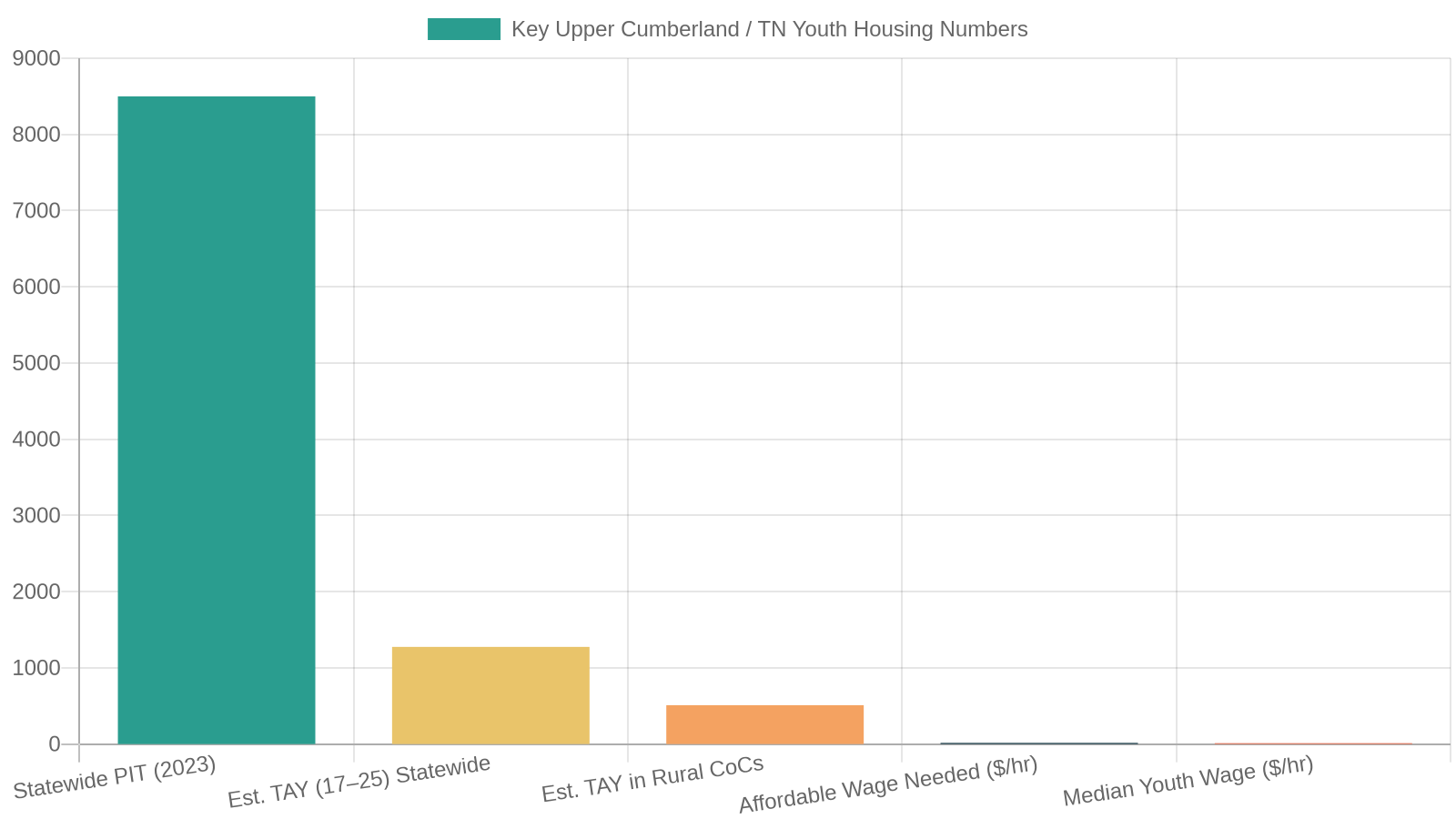
Every January, communities across the U.S. conduct a Point-in-Time (PIT) Count — a one-night snapshot of people experiencing homelessness. In Tennessee, the 2023 statewide PIT Count identified approximately 8,500 individuals experiencing homelessness on a single night, with transition-age youth (17–25) making up an estimated 12–15% of that total — roughly 1,000 to 1,275 young people statewide.
In rural CoCs like HART’s Upper Cumberland region, the PIT Count consistently undercounts youth because couch-surfing and vehicle dwelling are harder to capture. Advocates estimate the real number of youth experiencing housing instability in Upper Cumberland on any given night is 2 to 3 times the official count.
Risk Factors Concentrated in This Region
Several factors make Upper Cumberland young adults particularly vulnerable to housing instability:
- Aging out of foster care: Tennessee has approximately 1,200 young people age out of foster care each year statewide. Without family support or transitional housing, many become homeless within 12 months.
- Limited affordable housing stock: Putnam County’s rental vacancy rate has hovered below 4% in recent years, making it extremely difficult for young adults with limited income to find housing.
- Wage gaps: The median hourly wage for workers under 25 in the Upper Cumberland region is approximately $11–$13/hour, while a modest one-bedroom apartment in Cookeville averages $750–$900/month — requiring an income of roughly $15–$17/hour just to afford rent at the standard 30% threshold.
- Transportation barriers: With no regional public transit system, young people without a car are effectively cut off from jobs, services, and education.
4. What Is the Youth Action Board (YAAB) and Who Can Join?
YAAB is the vehicle through which young people in Upper Cumberland and across Tennessee transform their personal experience into collective power. Here’s what it is, who it’s for, and why it exists.
YAAB's Mission in Plain Language
The Youth Action Board (YAAB) of Tennessee is a statewide network of young adults ages 17 to 25 who have lived experience with homelessness or housing instability. YAAB members don’t just receive services — they shape them. They sit on CoC committees, advise state agencies, testify at legislative hearings, and help design the programs that serve their peers.
The core belief behind YAAB is simple: the people most affected by a problem are the most qualified to help solve it. Young people who have navigated shelter systems, housing applications, and service gaps bring knowledge that no policy report can replicate. YAAB turns that knowledge into power.
Who Is Eligible to Join YAAB?
You can join YAAB if you are:
- Between the ages of 17 and 25
- A current or former resident of Tennessee
- Someone who has personally experienced homelessness, housing instability, or the risk of losing housing — including couch-surfing, staying in a shelter, aging out of foster care, or fleeing an unsafe home
You do not need to currently be experiencing homelessness to join. Many YAAB members are in stable housing now and use their past experience to advocate for others. You also don’t need any prior advocacy or leadership experience — YAAB provides training, mentorship, and support. Your lived experience is your qualification.
5. The 7 Ways YAAB and HART Are Driving Change in Upper Cumberland

YAAB’s impact in the Upper Cumberland region shows up in concrete, specific ways. Here are seven of the most important — and why each one matters for young adults navigating housing instability in this part of Tennessee.
1. Amplifying Youth Voice in CoC Decision-Making
HUD’s CoC program regulations require that people with lived experience of homelessness have a meaningful role in CoC governance. YAAB members in the Upper Cumberland region attend HART meetings, serve on committees, and provide formal input on funding priorities. When a young person who has slept in their car speaks at a CoC board meeting, it changes the conversation in ways that data alone cannot.
2. Identifying Gaps That Service Providers Miss
YAAB members conduct peer outreach and surveys that surface problems the formal system often misses — like the fact that many young people in rural areas won’t go to a shelter because they fear losing their pet, or that intake paperwork written at a college reading level creates a barrier for youth who didn’t finish high school. These insights directly inform how HART and its partners redesign intake processes, shelter rules, and outreach strategies.
3. Connecting Peers to Housing, Jobs, and Education
YAAB members are trusted messengers. A young person who has been through the system can explain Coordinated Entry, rapid rehousing, or a GED program to a peer in a way that feels real — not like a brochure. YAAB members in Upper Cumberland help connect their peers to Tennessee’s network of resources, including Tennessee’s SNAP, Medicaid, and workforce development programs available through the Tennessee Department of Labor and Workforce Development.
6. Advocacy in Action: Policy Wins That Affect Tennessee Youth

Advocacy isn’t just showing up to meetings — it’s changing the rules. Here’s a look at the real policy wins that YAAB members and their allies in the Upper Cumberland region have helped achieve at both the state and local level.
State-Level Advocacy Efforts
YAAB members across Tennessee — including those from the Upper Cumberland region — have engaged in state-level advocacy on issues including:
- Extended foster care: Advocating for Tennessee to strengthen its Extended Foster Care program (available to youth up to age 21) so fewer young people age out into homelessness
- Youth-specific housing funds: Pushing for dedicated state funding streams for transitional housing and rapid rehousing programs that serve 17–25-year-olds
- Medicaid continuity: Ensuring young adults who age out of the foster care system maintain TennCare (Tennessee Medicaid) coverage without gaps
These aren’t abstract policy debates — they’re decisions that directly determine whether a 19-year-old in Cookeville has a safe place to sleep tonight.
Local CoC Policy Wins in Upper Cumberland
At the local level, youth advocates working with HART have pushed for changes like:
- Lowering the minimum age for shelter access in some programs from 18 to 17
- Adding youth-specific questions to the Coordinated Entry assessment tool so that young people’s unique needs (like educational goals, family reunification, and safety from trafficking) are captured
- Establishing a youth advisory subcommittee within the HART CoC structure so that youth voice is built into governance — not just invited as a guest
Every one of these wins started with a young person raising their hand and saying: this isn’t working for us.
7. Resources Available to Youth in Upper Cumberland Right Now

Knowing what’s available is the first step to accessing it. Here’s a practical rundown of the resources that exist right now for young adults in the Upper Cumberland region — whether you’re in crisis tonight or planning your next move.
Emergency and Transitional Housing Options
If you’re a young adult in Upper Cumberland experiencing a housing crisis right now, here are starting points:
- Call 211: Tennessee’s 211 helpline connects callers to local emergency shelter, food, and utility assistance 24/7. It’s free and confidential.
- HART Coordinated Entry: Contact HART’s Coordinated Entry access point to be assessed for shelter, rapid rehousing, or transitional housing programs. Coordinated Entry is designed to be a no wrong door system — you can enter from multiple points.
- Youth-specific programs: Some HART partner agencies operate programs specifically for transition-age youth, including transitional living programs (TLPs) that provide housing plus life skills support for up to 24 months.
Education, Employment, and Financial Resources
Stable housing is the foundation, but young people also need pathways to income and education. In Upper Cumberland, options include:
- Tennessee College of Applied Technology (TCAT) Cookeville: Affordable short-term certificate programs in trades, healthcare, and technology — many with financial aid available
- Tennessee Promise and Tennessee Reconnect: Free community college programs for eligible young adults — Tennessee Reconnect specifically serves adults 18 and older returning to education
- American Job Centers: Tennessee Career Centers in Cookeville offer free job search help, resume assistance, and workforce training referrals
- SNAP and TennCare: Young adults experiencing homelessness often qualify for food assistance and Medicaid — a case manager or 211 can help you apply
Upper Cumberland Youth Housing Resources at a Glance
Use this quick-reference table to compare the main programs and supports available to transition-age youth (17–25) in the Upper Cumberland region of Tennessee.
8. Mental Health and Trauma-Informed Support for Transition-Age Youth

Housing stability and mental health are deeply connected. Young people navigating homelessness often carry significant trauma — and healing that trauma is part of what makes stable housing last. Here’s what mental health support looks like in Upper Cumberland.
Why Mental Health Is Inseparable from Housing Stability
Research consistently shows that trauma and mental health challenges are both a cause and a consequence of youth homelessness. A 2022 study published in the Journal of Adolescent Health found that approximately 50–70% of homeless youth report at least one diagnosable mental health condition, compared to about 20% of housed youth. In rural areas like Upper Cumberland, access to mental health care is even more limited — Tennessee ranks among the bottom 10 states for mental health provider availability in rural counties.
This is why YAAB and HART partners advocate for trauma-informed care — an approach that recognizes the impact of trauma on behavior, avoids re-traumatization, and builds trust before demanding compliance.
Mental Health Resources in Upper Cumberland
Young adults in Upper Cumberland can access mental health support through:
- Plateau Mental Health Center: The community mental health center serving Putnam, White, Overton, and surrounding counties — offers sliding-scale fees and accepts TennCare
- Tennessee’s Crisis Line: Call or text 988 (the Suicide and Crisis Lifeline) for immediate mental health support, 24/7
- Federally Qualified Health Centers (FQHCs): Several FQHCs in the region offer integrated behavioral health services alongside primary care, often at low or no cost
- Peer support specialists: Some HART partner agencies employ peer support specialists — people with their own lived experience of mental health challenges who provide non-clinical support and connection
9. Aging Out of Foster Care in Upper Cumberland: What You Need to Know

For young people aging out of the foster care system in Upper Cumberland, the transition to adulthood can feel like stepping off a cliff. But there are rights, resources, and people who want to help — and YAAB is one of them.
The Foster Care Cliff in Tennessee
In Tennessee, young people in foster care can remain in Extended Foster Care until age 21 if they meet certain conditions — enrolled in school, working, or participating in a program to remove barriers to employment. But many youth don’t know this option exists, or they age out at 18 without a plan. Nationally, 1 in 5 youth who age out of foster care will experience homelessness within two years of leaving care, according to the National Foster Youth Institute.
In rural regions like Upper Cumberland, the risk is compounded by distance from services and a smaller network of supportive adults. YAAB advocates specifically for stronger outreach to youth approaching age 18 in foster care so they know their options before they’re on their own.
Rights and Supports for Foster Care Alumni
If you’ve aged out of foster care in Tennessee, you have access to specific supports:
- TennCare until age 26: Tennessee expanded Medicaid coverage for foster care alumni — you may qualify for free health insurance until your 26th birthday regardless of income
- Education and Training Vouchers (ETVs): Up to $5,000 per year in federal funding for education and training expenses for youth who aged out of foster care
- Chafee Independent Living Program: Funds for life skills training, housing, and support services for current and former foster youth
- Tennessee’s Independent Living program: Connects youth to case management, housing assistance, and life skills support through the Tennessee Department of Children’s Services (DCS)
10. How to Get Involved with YAAB in the Upper Cumberland Region

The most powerful thing you can do — whether you’re a young person with lived experience or someone who supports transition-age youth — is get connected. Here’s how YAAB membership works in Upper Cumberland and how to take your first step.
What YAAB Membership Actually Looks Like
Joining YAAB doesn’t mean you have to move to Nashville or attend meetings every week. YAAB is a statewide network with regional chapters that meet locally and virtually. As a member, you might:
- Attend monthly regional meetings (in person or via video call)
- Participate in advocacy training and leadership development workshops
- Share your story (only if and when you choose) with policymakers, CoC partners, or the media
- Help design surveys, outreach materials, or program feedback tools
- Connect your peers to resources and services
YAAB members are compensated for their time through stipends, gift cards, or other supports — because your time and expertise have value, and YAAB recognizes that.
Taking the First Step
The easiest first step is to reach out. You can learn more about the Upper Cumberland (TN-506) YAAB chapter — including how to connect with the regional coordinator, when meetings happen, and what current members are working on. You can also apply to join YAAB statewide if you’re ready to get involved. There’s no perfect background required — just a willingness to show up and use what you’ve been through to make things better for the next person.
If you’re a case manager, CoC partner, or service provider who works with transition-age youth in Upper Cumberland, you can support YAAB by referring young people, attending CoC meetings where youth voice is centered, and advocating within your own organization for youth-informed practices.
Your Next Move: Connect, Advocate, and Be Heard in Tennessee

Youth homelessness in Upper Cumberland is a solvable problem — but only if the people most affected have a real voice in the solutions. YAAB Tennessee exists to make that happen, one region at a time. Here’s how to stay connected and keep moving forward.
Resources to Bookmark Right Now
Whether you’re in Cookeville, Crossville, Sparta, or anywhere else in Upper Cumberland, these links are worth saving:
- YAAB’s statewide resource directory — housing, employment, mental health, and more
- Understanding youth homelessness in Tennessee — facts, context, and how the system works
- The Upper Cumberland (TN-506) YAAB chapter page — your direct connection to local advocacy and peer community
You don’t have to navigate this alone. YAAB exists because young people in Tennessee decided their experience was worth more than a case file number — and they were right. If you’re between 17 and 25 and you’ve been through housing instability in Upper Cumberland or anywhere in Tennessee, there’s a place for you in this movement.
For Service Providers and CoC Partners
If you work in the HART CoC or support transition-age youth in Upper Cumberland professionally, YAAB needs your partnership. Centering youth voice isn’t just good ethics — it’s increasingly a HUD requirement for CoC funding. You can support YAAB by:
- Referring eligible young adults to your regional YAAB coordinator
- Including YAAB members on your agency’s advisory committees
- Advocating within HART for dedicated youth funding streams and youth-specific Coordinated Entry pathways
- Adopting trauma-informed, youth-centered practices in your intake and service delivery
Real change in Upper Cumberland’s youth homelessness landscape will come from young people and system partners working together — and that partnership starts with showing up.
Frequently Asked Questions
What is the Upper Cumberland HART Continuum of Care in Tennessee?
HART — the Homeless Alliance of Rural Tennessee — is the HUD-designated Continuum of Care for the Upper Cumberland region, covering approximately 14 counties including Putnam, White, and Overton. It coordinates homeless services, manages federal funding, and connects people experiencing homelessness to shelter, rapid rehousing, and support programs.
How can a young adult ages 17 to 25 join YAAB in Upper Cumberland Tennessee?
You can join the Upper Cumberland (TN-506) YAAB chapter by visiting yaabtn.org/local-yaabs/tn-506/ to connect with the regional coordinator and learn about upcoming meetings. Eligibility requires being ages 17–25 with lived experience of homelessness or housing instability in Tennessee. No prior advocacy experience is needed.
What resources are available for homeless youth in Cookeville or Upper Cumberland Tennessee?
Young adults in Upper Cumberland can call 211 to reach HART's Coordinated Entry system, which connects them to emergency shelter, rapid rehousing, and case management. Additional resources include Plateau Mental Health Center, Tennessee Career Centers, TCAT Cookeville, and YAAB Tennessee for peer advocacy and leadership.
What happens to foster youth who age out of care in Tennessee?
Tennessee offers Extended Foster Care until age 21 for youth who meet certain conditions like being enrolled in school or working. Foster care alumni also qualify for TennCare until age 26, Education and Training Vouchers up to $5,000 per year, and Chafee Independent Living Program supports. YAAB advocates for stronger outreach so youth know these options before they turn 18.
Is youth homelessness different in rural Tennessee than in cities?
Yes. Rural youth homelessness in areas like Upper Cumberland is often invisible — young people are more likely to couch-surf, sleep in vehicles, or stay in unsafe situations rather than use shelters. HUD estimates rural youth homelessness is undercounted by 30–40%, and barriers like lack of transportation and fewer services make it harder to escape housing instability.
Does YAAB pay its members for their time?
Yes. YAAB recognizes that young people's lived experience and time have real value. Members are typically compensated through stipends, gift cards, or other supports for their participation in meetings, advocacy activities, and leadership development. Compensation structures may vary by region and activity.