Quick answer: The Youth Action Board (YAAB) of Tennessee is a statewide network of young adults ages 17 to 25 with lived experience of homelessness or housing instability. YAAB members gain real leadership training, public speaking practice, policy advocacy experience, and peer connections across Tennessee's eight Continuum of Care regions — from Memphis to Northeast TN. Membership is free, open to eligible young adults statewide, and gives you a genuine seat at the table where housing decisions get made. If you want your story to drive change, YAAB is where that starts.
What Is YAAB and Who Can Join?

Before diving into what YAAB membership does for you, it helps to understand exactly what YAAB is and whether you qualify. The short answer: if you are a young adult in Tennessee between 17 and 25 who has experienced housing instability in any form, YAAB was built for you. Membership is free, peer-driven, and rooted in the belief that your experience is a source of expertise — not something to be ashamed of.
A Peer-Led Network Built on Lived Experience
YAAB — the Youth Action Board of Tennessee — is not a program that happens to young people. It is a movement led by young people. Every member is a young adult between the ages of 17 and 25 who has personally experienced homelessness or housing instability, whether that means couch-surfing, staying in a shelter, aging out of foster care, or any other form of housing insecurity.
That lived experience is not a barrier to joining — it is the qualification. YAAB was built on the principle that the people most affected by a broken system are best positioned to fix it. Members bring firsthand knowledge that no policy expert, researcher, or government official can replicate.
Tennessee's Eight Continuum of Care Regions
YAAB operates across all of Tennessee’s Continuum of Care (CoC) regions, meaning there is likely a local YAAB chapter near you regardless of where you live in the state. The eight regions include:
- TN-500 — Memphis/Shelby County
- TN-501 — Nashville/Davidson County
- TN-502 — Knoxville/Knox County
- TN-503 — Chattanooga/Hamilton County
- TN-504 — Jackson/West Tennessee
- TN-506 — Upper Cumberland
- TN-507 — Northeast Tennessee
- TN-509 — Balance of State
Each local YAAB functions as its own peer-led group while connecting to the statewide network, giving members both local community and statewide influence.
The Real Leadership Skills You Build as a YAAB Member

YAAB membership is not a title — it is a training ground. The skills members build are concrete, transferable, and resume-worthy. From the first meeting onward, members are practicing skills that employers, colleges, and community organizations actively seek. Here is a closer look at the core competencies YAAB develops.
Public Speaking and Testimony Training
One of the most tangible skills YAAB members develop is the ability to speak confidently in public — especially in formal settings like city council chambers, state legislative hearings, and Continuum of Care planning meetings. Many members arrive with powerful stories but no framework for sharing them effectively in policy spaces.
YAAB provides structured coaching on how to deliver testimony: how to stay within a two-to-three minute window, how to connect personal experience to a specific policy ask, and how to remain composed under pressure. Members who have gone through this training report feeling significantly more confident in professional and civic settings long after their YAAB tenure.
Facilitation, Meeting Leadership, and Group Dynamics
YAAB meetings are not lecture-style — they are facilitated by members themselves. That means learning how to run an agenda, manage group discussion, synthesize different viewpoints, and move a room toward a decision. These are the same skills valued in every professional environment, from nonprofit management to corporate team leadership.
Members rotate facilitation responsibilities, which means every person gets hands-on practice — not just the loudest voices in the room. Over time, this builds a cohort of young adults who know how to lead collaboratively rather than hierarchically.
Research, Data Literacy, and Policy Analysis
YAAB members are expected to engage with real data — HUD point-in-time counts, local CoC reports, state housing budgets, and federal policy proposals. Training sessions walk members through how to read these documents, identify what the numbers mean for their communities, and translate data into plain-language talking points for advocates and lawmakers.
This data literacy is a career-building skill. Young adults who can read a federal housing report and explain its implications are valuable to nonprofits, government agencies, research organizations, and advocacy groups across Tennessee and beyond.
How YAAB Members Actually Influence Housing Policy

The word ‘influence’ can feel abstract. In YAAB’s case, it is measurable and real. Members are embedded in the decision-making structures that govern housing resources across Tennessee — from local shelter policies to statewide funding allocations. Here is how that influence actually works in practice.
Advising Continuum of Care Decision-Makers
Each of Tennessee’s eight Continuum of Care regions is responsible for coordinating homeless services and allocating federal HUD funding in its area. YAAB members sit in these planning processes — not as observers, but as advisors with a formal voice. When a CoC is deciding how to prioritize housing resources, which populations to serve first, or how to design a new program, YAAB members are at the table providing input that shapes those decisions.
This is not symbolic participation. CoC leadership is required by HUD to demonstrate meaningful engagement with people who have lived experience of homelessness, and YAAB fulfills that role with substance and accountability.
State-Level Advocacy and Legislative Engagement
Beyond local CoC work, YAAB members engage at the state level — meeting with Tennessee legislators, participating in state housing task forces, and contributing to reports that inform statewide policy. Members have traveled to Nashville to testify before committees, met with staff from the Tennessee Housing Development Agency (THDA), and contributed to conversations about Rapid Rehousing, Transitional Housing, and youth-specific funding streams.
When a bill affecting transition-age youth moves through the General Assembly, YAAB members are positioned to respond quickly — submitting written testimony, coordinating peer voices, and making sure lawmakers hear directly from the people their decisions will affect.
Program Design and Community Feedback Loops
YAAB members also influence policy from the ground up by shaping how programs are designed and delivered. Service providers, shelters, and housing agencies across Tennessee regularly consult YAAB members to review intake processes, evaluate program effectiveness, and identify gaps that data alone cannot reveal.
For example, a shelter might ask YAAB members to review its intake paperwork for language that feels stigmatizing, or a housing program might ask members to help design a peer-support component. This program-level input has a direct effect on the day-to-day experience of thousands of young adults across Tennessee.
YAAB Across Tennessee: Regional Chapters at a Glance

Tennessee is a geographically and demographically diverse state, and YAAB reflects that diversity. Whether you are in a major metro area or a rural county, there is a YAAB chapter designed to connect you with peers and policy opportunities relevant to your community. Understanding the regional structure helps you find your closest entry point.
Urban Chapters: Memphis, Nashville, Knoxville, and Chattanooga
Tennessee’s four largest metro areas each have active YAAB chapters embedded in their local CoC structures. In Memphis (TN-500), Nashville (TN-501), Knoxville (TN-502), and Chattanooga (TN-503), members engage with some of the state’s largest homeless service systems, highest youth homeless counts, and most complex policy environments.
Urban chapters often have more frequent meeting schedules, more access to in-person advocacy events, and stronger connections to local media and elected officials. If you live in or near one of these cities, your local YAAB chapter is likely the most active entry point into the network. You can explore each chapter at yaabtn.org/local-yaabs.
Rural and Regional Chapters: Jackson, Upper Cumberland, Northeast TN, and Balance of State
YAAB’s reach extends well beyond Tennessee’s urban centers. Chapters in Jackson/West Tennessee (TN-504), the Upper Cumberland (TN-506), Northeast Tennessee (TN-507), and the Balance of State region (TN-509) serve young adults in rural and small-town contexts where housing instability can look very different — fewer shelters, longer distances to services, and less visible homelessness that is often hidden in motels or doubled-up households.
Rural YAAB members bring a perspective that is chronically underrepresented in statewide housing conversations. Their participation ensures that policy solutions are not designed exclusively around urban realities, making the whole system more effective for everyone.
What Membership Looks Like Day to Day

Joining YAAB is a commitment, but it is designed to fit the real lives of young adults who are often managing multiple challenges at once. Here is an honest look at what participation actually involves — the time, the structure, and the tangible benefits that come with it.
Meetings, Stipends, and Time Commitment
YAAB membership is structured to be accessible to young adults who are managing work, school, housing searches, and other real-life demands. Most local chapters meet monthly, with additional opportunities for statewide convenings, advocacy events, and training sessions throughout the year. Meetings typically last one to two hours and may be held in person, virtually, or in a hybrid format depending on the region.
Importantly, many YAAB members receive stipends for their participation — recognizing that their time and expertise have real value. Stipend structures vary by region and funding availability, so check with your local chapter for current details. This is one of the ways YAAB actively works to remove financial barriers to civic participation.
Training, Retreats, and Statewide Convenings
Beyond regular meetings, YAAB members have access to leadership development trainings, skill-building workshops, and statewide convenings where members from all eight regions come together. These events are opportunities to build relationships with peers across Tennessee, learn from national housing policy experts, and develop a broader understanding of how homelessness systems work at the federal level.
Past convenings have included training on HUD policy, trauma-informed advocacy, media and communications skills, and financial literacy. These are not passive learning experiences — members are expected to bring what they learn back to their local chapters and apply it in real advocacy work.
Peer Connection and Mutual Support
Perhaps the most underrated benefit of YAAB membership is the community it creates. Many young adults who join YAAB describe it as the first place they felt genuinely understood — surrounded by peers who have navigated similar systems and who do not require explanation or justification for their experiences.
This peer connection is not just emotionally meaningful; it is practically valuable. Members share information about housing resources, job opportunities, education pathways, and support services. The YAAB network functions as an informal but powerful mutual aid system across Tennessee.
The Connection Between Lived Experience and Better Policy

One of YAAB’s core operating principles is that lived experience is not just valid in policy spaces — it is irreplaceable. But translating personal experience into policy impact requires a specific set of skills and frameworks. YAAB provides both, and the results are measurable.
Why Lived Experience Is a Policy Asset, Not a Liability
There is a persistent misconception in policy spaces that lived experience is too personal, too emotional, or too anecdotal to be useful in formal decision-making. YAAB rejects that framing entirely — and so does an increasing body of research on participatory policy design.
Studies on Continuum of Care effectiveness consistently show that programs co-designed with people who have experienced homelessness have higher rates of housing retention, better service engagement, and fewer barriers to access. The 2022 HUD Continuum of Care Program interim rule explicitly strengthened requirements for lived experience participation in CoC governance — a recognition at the federal level that this input is not optional; it is essential.
How YAAB Translates Stories Into Systemic Change
YAAB provides members with a structured framework for translating personal experience into policy language without stripping away its power. Members learn to identify the systemic factor behind a personal story — the policy gap, funding shortfall, or program design flaw that created the problem — and to articulate a specific, actionable ask that addresses it.
For example, a member’s experience of losing housing because a shelter had a curfew that conflicted with their work schedule becomes a policy recommendation for flexible shelter hours. A member’s experience of aging out of foster care with no housing plan becomes advocacy for extended foster care support to age 21 or beyond. Personal stories, properly framed, are the most persuasive tool in any advocate’s toolkit.
Education and Career Pathways YAAB Opens Up

YAAB membership does more than build civic skills — it opens doors. The experience, connections, and credentials members gain through YAAB have direct applications in education and career advancement, particularly for young adults navigating systems that have not always worked in their favor.
Resume-Building Experience That Employers Recognize
YAAB membership generates real, verifiable professional experience. Members can list roles such as Youth Policy Advisor, Community Advocate, or CoC Advisory Board Member on a resume — and back those titles up with concrete accomplishments like testimony delivered, programs reviewed, or reports contributed to. For young adults who may have gaps in traditional employment history, this kind of civic leadership experience is a powerful differentiator.
Employers in the nonprofit sector, government agencies, social work fields, and community development organizations actively seek candidates with policy engagement experience. YAAB membership signals initiative, communication skills, and familiarity with systems that many applicants in their 20s simply do not have.
Connections to Education, Training, and Scholarship Opportunities
YAAB’s network extends into the educational landscape as well. Members gain connections to college access programs, GED pathways, vocational training opportunities, and scholarships specifically designed for young adults who have experienced homelessness or foster care involvement. Organizations like the Tennessee Student Assistance Corporation (TSAC) offer the Tennessee Promise and Tennessee Reconnect programs, and YAAB staff can help members navigate eligibility and application processes.
Beyond formal education, YAAB training sessions themselves function as professional development — covering topics like data analysis, public policy, communications, and nonprofit management that are directly applicable to career advancement.
Pathways Into the Housing and Social Services Sector
Many YAAB alumni go on to work directly in the housing and social services sector — as case managers, housing navigators, outreach workers, policy analysts, and program directors. The combination of lived experience and professional training that YAAB provides is exactly what these roles require, and YAAB’s network of CoC partners across Tennessee creates direct pathways to employment opportunities.
Some members have parlayed their YAAB experience into internships, AmeriCorps positions, and full-time roles at organizations they first encountered through YAAB advocacy work. The board is, in a very real sense, a career launchpad as well as a civic one.
Youth Homelessness in Tennessee: The Numbers Behind the Need

Understanding the scale of youth homelessness in Tennessee is essential context for understanding why YAAB exists and why its work matters. These are not abstract statistics — they represent the real experiences of young adults across the state, many of whom are YAAB members or potential members.
What the Point-in-Time Count Tells Us
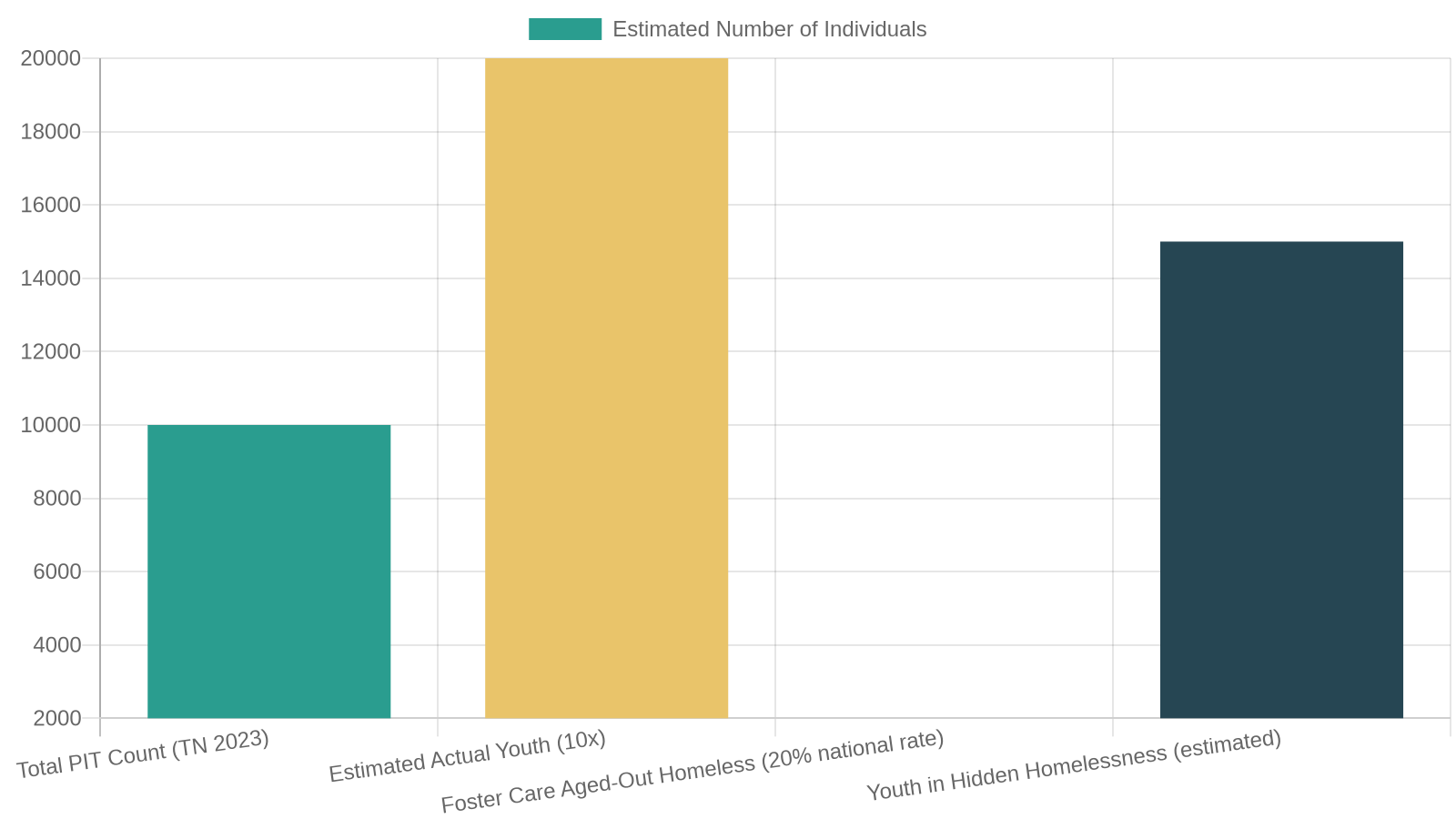
Each January, HUD requires every Continuum of Care to conduct a Point-in-Time (PIT) count — a single-night census of people experiencing homelessness in their region. Tennessee’s 2023 PIT count identified approximately 10,000 individuals experiencing homelessness statewide on a given night, with transition-age youth (ages 18–24) representing a significant and consistently undercounted portion of that total.
The PIT count is widely acknowledged to undercount youth homelessness because young people are more likely to be in hidden situations — staying with friends, in cars, or in motels — rather than in shelters where they are easier to count. Estimates from the True Colors United organization suggest the actual number of youth experiencing homelessness in any given year may be 10 times higher than a single-night count captures.
Foster Care, Aging Out, and the Housing Gap
Young adults who age out of Tennessee’s foster care system face a particularly acute housing risk. Nationally, approximately 20% of youth who age out of foster care experience homelessness within two years of leaving the system, according to the National Foster Youth Institute. In Tennessee, young people can age out of foster care as early as 18, often with limited savings, no established credit history, and no family safety net to fall back on.
Tennessee has made some progress through extended foster care provisions and programs like the Chafee Foster Care Program for Successful Transition to Adulthood, but gaps remain significant — particularly in rural regions where transitional housing options are scarce. YAAB members who have aged out of foster care bring this perspective directly into CoC planning conversations, helping to close the gap between policy intent and lived reality.
YAAB vs. Other Youth Engagement Options: How They Compare
Not all youth engagement programs offer the same level of real-world impact, compensation, or career value. Here is how YAAB stacks up against common alternatives for transition-age youth in Tennessee.
How YAAB Compares to Other Youth Engagement Opportunities

If you are weighing YAAB against other ways to get involved in your community or build your resume, it helps to understand what makes YAAB distinctive. Not all youth engagement programs are created equal — and YAAB’s structure, scope, and authority set it apart in meaningful ways.
What Sets YAAB Apart From Traditional Volunteer Programs
Many organizations offer volunteer opportunities for young adults, but most of those programs position young people as helpers rather than leaders. YAAB is fundamentally different: members are not volunteering for a system — they are shaping it. The decision-making authority that YAAB members hold within CoC structures is real, not ceremonial.
Traditional volunteer programs also rarely provide the structured skill-building, stipend compensation, or professional network access that YAAB offers. For young adults who need their time to generate tangible returns — whether financial, professional, or educational — YAAB is a significantly more valuable investment than a standard volunteer role.
YAAB vs. Youth Advisory Boards at Other Organizations
Youth advisory boards exist at many nonprofits and government agencies, but they vary enormously in how much actual influence members have. Some are purely consultative with no binding authority; others meet infrequently and have limited access to decision-makers. YAAB’s integration into the federally mandated CoC governance structure gives it a level of formal authority that most youth advisory boards simply do not have.
Additionally, YAAB’s statewide network means members are not siloed in a single organization’s ecosystem. They are connected to peers, providers, and policymakers across eight regions of Tennessee — a breadth of network that is rare for any youth engagement program, let alone one specifically designed for young adults with housing instability experience.
Resources YAAB Connects You to Beyond Membership

YAAB is not just a leadership program — it is a gateway to a broader ecosystem of support. Members gain access to resources, referrals, and connections that can make a real difference in their own lives while they are working to improve the system for everyone else. Here is a look at what that ecosystem includes.
Housing, Shelter, and Rapid Rehousing Connections
YAAB membership puts you in direct contact with the organizations and programs that provide housing assistance to transition-age youth across Tennessee. Members learn how to navigate the Coordinated Entry system — the process by which homeless services are allocated in each CoC region — and can connect peers to resources including emergency shelter, transitional housing, Rapid Rehousing programs, and Permanent Supportive Housing.
Knowing how these systems work from the inside is itself a form of power. YAAB members often become informal housing navigators in their own communities, helping peers access resources they would not have found on their own. You can explore statewide resources at yaabtn.org/resources.
Mental Health, Benefits Navigation, and Peer Support
Housing instability rarely exists in isolation — it intersects with mental health challenges, substance use, involvement with the justice system, and gaps in public benefits. YAAB’s network includes connections to mental health services, TennCare enrollment support, SNAP and other benefits navigation, and peer support specialists who have their own lived experience of these systems.
Members also gain access to trauma-informed advocacy training, which helps them understand and articulate the connection between systemic failures and individual outcomes — a framework that is valuable both personally and professionally.
How to Get Involved With YAAB in Tennessee

Ready to turn your experience into impact? Getting involved with YAAB is more straightforward than you might expect. Here is everything you need to know to take that first step — from eligibility to making your first contact with a local chapter.
When you are ready, join YAAB Tennessee today and add your voice to a statewide movement of young adults who are changing the systems that affect all of us. Your lived experience is your credential — and it is exactly what Tennessee’s housing policy conversations need.
Eligibility and the Application Process
To join YAAB, you must be between the ages of 17 and 25 and have lived experience of homelessness or housing instability. There is no income threshold, no documentation requirement, and no background check that disqualifies you. YAAB is explicitly designed to be accessible to young adults who have faced barriers in other systems.
The application process varies slightly by region, but generally involves a brief intake conversation with a local YAAB coordinator or CoC partner. This is not an interview in the traditional sense — it is a chance to learn more about the chapter, ask questions, and share a bit about your experience and interests. Most applicants are welcomed into their local chapter within a few weeks of first contact.
Finding Your Local Chapter and Making First Contact
The easiest way to get started is to visit yaabtn.org/local-yaabs and find the chapter for your region. Each chapter page includes contact information for local coordinators who can answer questions and walk you through next steps. If you are unsure which region you fall into, the statewide YAAB team can help you figure it out.
You can also reach out through the statewide YAAB website, attend a public CoC meeting in your area, or connect through a case manager or service provider who is already part of the CoC network. Many young adults first hear about YAAB through a shelter, transitional housing program, or outreach worker — so if you are already connected to services, ask your provider about YAAB.
Your Voice Belongs in This Room: Take the Next Step

Tennessee’s housing system affects hundreds of thousands of young adults — and the decisions that shape it are made in rooms where your voice deserves to be heard. YAAB exists to make sure it is. Whether you are in Memphis, Knoxville, Chattanooga, Jackson, or anywhere else across the state, there is a chapter ready to welcome you, train you, and amplify what you already know.
The most important thing you can do right now is take one step: reach out to your local chapter, attend a meeting, or simply learn more. Your experience is not a burden — it is a blueprint for better policy. And YAAB is the place where blueprints become reality.
What Happens After You Join
Once you connect with your local YAAB chapter, you will be onboarded into the group’s meeting schedule, introduced to other members, and matched with any available training or orientation resources. Most chapters pair new members with a peer mentor — someone who has been in YAAB longer and can help you navigate the network, understand the CoC structure, and find your footing in advocacy spaces.
From there, your level of involvement is largely up to you. Some members attend monthly meetings and contribute feedback on local programs. Others step into more active roles — facilitating meetings, delivering testimony, attending statewide convenings, or representing their region in state-level policy conversations. YAAB meets you where you are and grows with you.
Spread the Word: Invite a Peer
One of the most powerful things a YAAB member can do is bring someone else in. If you know a young adult in Tennessee who is experiencing housing instability and who has something to say about how the system should work, tell them about YAAB. The network grows stronger with every new voice, and the more diverse the membership — in terms of geography, background, and experience — the more effective YAAB’s advocacy becomes.
You can share the YAAB About page with peers, post about it on social media, or simply have a conversation. Word of mouth from trusted peers is how most young adults find YAAB in the first place — and it is how the movement keeps growing across Tennessee.
Frequently Asked Questions
How old do you have to be to join YAAB Tennessee?
You must be between 17 and 25 years old to join YAAB Tennessee. The program is specifically designed for transition-age youth, so once you turn 26 you would age out of membership, though alumni often stay connected to the network.
Do I have to have been homeless to join YAAB?
Yes — YAAB membership requires lived experience of homelessness or housing instability. This includes a wide range of situations: staying in a shelter, couch-surfing, living in a car or motel, doubling up with others due to economic hardship, or aging out of foster care without stable housing. You do not need to have stayed in a formal shelter to qualify.
Does YAAB pay members for their time?
Many YAAB chapters offer stipends to members in recognition of their time and expertise. Stipend availability and amounts vary by region and funding, so contact your local chapter for current details. YAAB is committed to removing financial barriers to participation.
What is a Continuum of Care and why does it matter for YAAB?
A Continuum of Care (CoC) is a regional planning body that coordinates homeless services and allocates federal HUD funding in its area. Tennessee has eight CoC regions. YAAB members are embedded in these CoC structures as formal advisors, which means their input directly influences how housing resources are distributed and how programs are designed across the state.
Can I join YAAB if I am aging out of foster care?
Absolutely. Young adults aging out of Tennessee's foster care system are explicitly welcomed in YAAB. The transition out of foster care is one of the leading pathways into housing instability for young adults, and YAAB actively seeks members with this experience to ensure their perspective shapes statewide policy.
How do I find my local YAAB chapter in Tennessee?
Visit yaabtn.org/local-yaabs to find the chapter for your region. Tennessee has eight CoC regions — including Memphis, Nashville, Knoxville, Chattanooga, Jackson, Upper Cumberland, Northeast TN, and the Balance of State — each with its own local YAAB chapter and contact information.