Quick answer: Youth homelessness and adult homelessness share a name but are fundamentally different experiences with different causes, different risks, and different solutions. Young people ages 17 to 25 are more likely to become homeless because of family rejection, aging out of foster care, or abuse — not the chronic economic factors that drive most adult homelessness. Youth hide their situation more, face unique legal barriers, and need age-specific services like transitional housing and education support. In Tennessee, the Youth Action Board (YAAB) works statewide to make sure programs actually fit the realities young adults face.
Why the Distinction Matters in the First Place

Before diving into the specific differences, it helps to understand why this distinction matters at all. Homelessness policy in the United States was largely built around the experiences of adult men — the people most visible in street counts and emergency shelters. Young adults, especially those ages 17 to 25, have a fundamentally different relationship with housing instability, and treating their situation as a smaller version of adult homelessness leads to programs that miss the mark.
One Label, Two Very Different Realities
When most people picture homelessness, they picture an older adult sleeping on a city sidewalk. That image shapes policy, funding, and shelter design — and it leaves young people out. The truth is that youth homelessness and adult homelessness are distinct phenomena with different root causes, different risk factors, and different pathways out. Lumping them together means young adults often end up in systems built for someone else’s experience.
In the United States, an estimated 4.2 million young people ages 13 to 25 experience homelessness in a given year, according to research by Chapin Hall at the University of Chicago (2017). Many of them are invisible — couch-surfing, staying in cars, or doubling up with friends rather than sleeping in shelters. That invisibility is itself one of the biggest differences from adult homelessness.
Why Tennessee Needs Youth-Specific Thinking
Tennessee’s eight Continuum of Care (CoC) regions — stretching from Memphis and Shelby County in the west to Northeast Tennessee in the east — each count and serve homeless populations differently. Without a youth-specific lens, transition-age young adults ages 17 to 25 can fall through the cracks between child welfare systems and adult services. That gap is exactly why the Youth Action Board (YAAB) of Tennessee exists: to make sure the people designing those systems have heard from the young adults living inside them.
1. The Root Causes Are Completely Different

Understanding why someone becomes homeless is the first step toward actually helping them. And the causes of youth homelessness diverge sharply from the causes of adult homelessness — which means the solutions have to diverge too.
What Drives Adult Homelessness
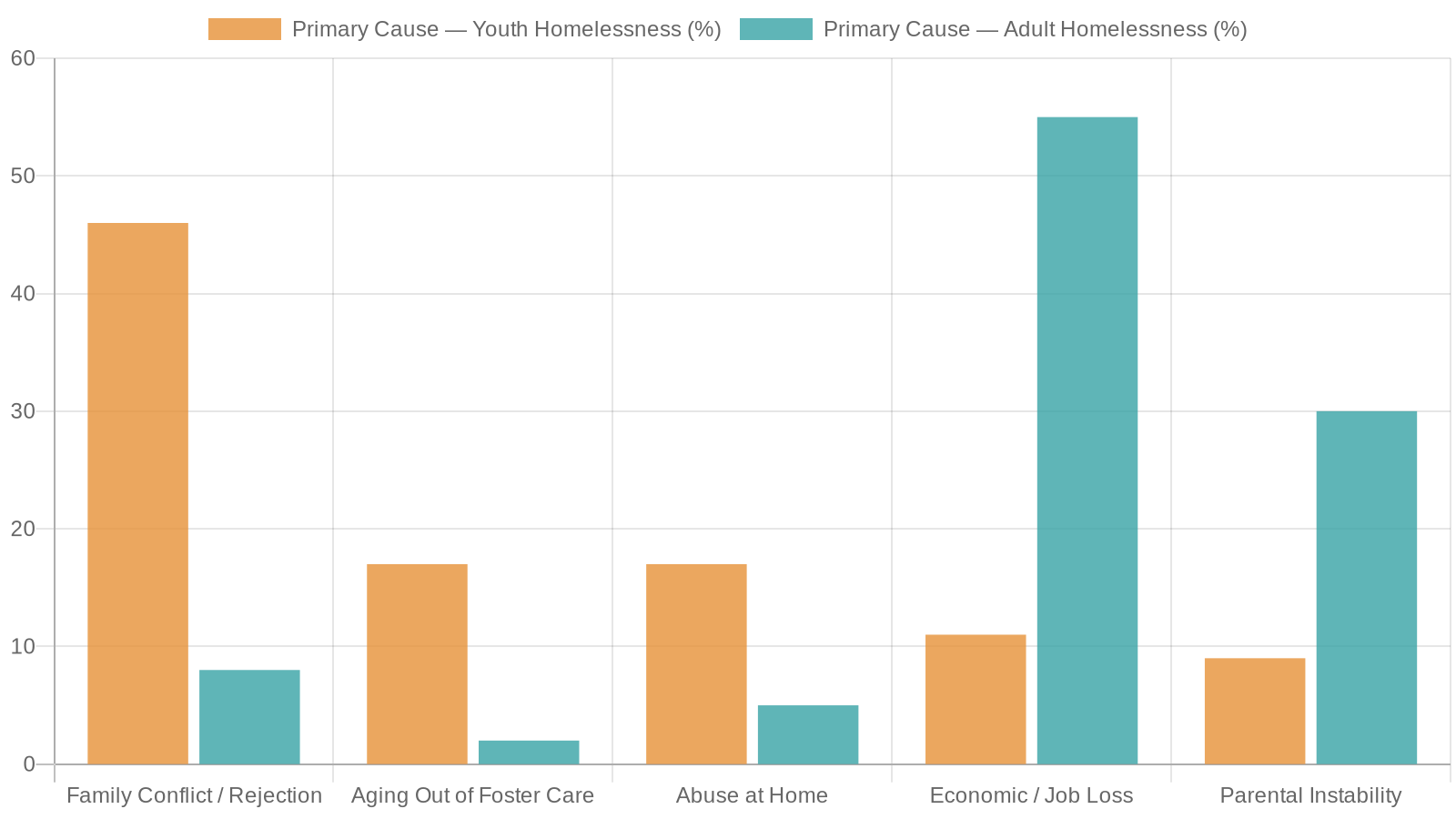
Adult homelessness is most often linked to economic shocks, chronic health conditions, and long-term housing market failures. A 55-year-old who loses their job after a factory closure, develops a disability, or faces a medical crisis that wipes out savings is a common profile. Substance use disorders and untreated mental illness also play significant roles, but they usually develop over years and interact with a longer life history of housing instability.
The National Alliance to End Homelessness notes that among adults, job loss and inability to pay rent are the top self-reported triggers — economic causes that respond to economic solutions like rental assistance and employment programs.
What Drives Youth Homelessness
For young people, the picture looks very different. The top causes of youth homelessness include:
- Family conflict and rejection — including LGBTQ+ youth rejected by parents (who make up an estimated 40% of homeless youth despite being about 7% of the general youth population)
- Aging out of foster care — in Tennessee, young people can age out of state custody at 18 with limited housing supports
- Physical, emotional, or sexual abuse at home
- Parental substance use or incarceration
- Pregnancy or parenting at a young age without family support
Notice that most of these causes are relational, not purely economic. A young person doesn’t become homeless because the rent went up — they become homeless because the place they were supposed to call home stopped being safe.
2. How Young People Experience Homelessness Looks Different

The form that homelessness takes for young people is often invisible to the systems designed to count and serve it. That invisibility has real consequences — it means fewer resources, less funding, and programs that don’t reach the people who need them most.
Hidden Homelessness and 'Couch-Surfing'
Adults experiencing homelessness are more likely to use emergency shelters or sleep in places visible to street outreach workers. Young adults are far more likely to engage in what researchers call hidden homelessness — staying on a friend’s couch for a few nights, sleeping in a car, or bouncing between relatives. This is sometimes called couch-surfing, and it is one of the most common forms of youth housing instability in Tennessee.
Hidden homelessness is real homelessness. The U.S. Department of Housing and Urban Development (HUD) defines homelessness to include people living in places not meant for human habitation and those in emergency or transitional housing — but the annual Point-in-Time count often misses couch-surfers entirely, leading to a significant undercount of young people.
Why Youth Avoid Shelters
Many adult shelters are not safe or appropriate spaces for young adults. Common reasons youth avoid them include:
- Fear of older adults with substance use or mental health crises
- Rules that separate couples or young parents from their children
- Curfews that conflict with work or school schedules
- Lack of privacy and personal safety
- Stigma — many young people don’t identify as ‘homeless’ even when they technically are
This avoidance isn’t irrational. It reflects a real mismatch between what adult shelters offer and what transition-age youth actually need.
3. The Legal Landscape Is Completely Different for Young Adults
The legal system treats young people differently — sometimes protectively, sometimes as an obstacle. Understanding where those differences lie can mean the difference between accessing a resource and being turned away from it.
Age-Based Barriers to Services
Adults experiencing homelessness can generally access emergency shelters, apply for housing vouchers, and sign leases on their own. Young adults — especially those under 18 — face a tangle of legal barriers. In Tennessee, minors cannot sign a lease without a parent or guardian, which means a 17-year-old fleeing an unsafe home has almost no legal pathway to stable housing without adult involvement.
Even for those 18 to 21, barriers remain. Many landlords won’t rent to applicants without rental history or a co-signer. Young adults who have been in foster care or juvenile justice systems may have gaps in their records that make background checks a barrier. And young parents face additional hurdles around custody documentation and family shelter eligibility.
Emancipation, McKinney-Vento, and Your Rights
There are legal protections specifically designed for young people. The McKinney-Vento Homeless Assistance Act guarantees that students experiencing homelessness have the right to enroll in school immediately, even without documentation, and to receive transportation support. This applies to young adults in K–12 and, in some cases, community college settings.
Tennessee also allows for judicial emancipation for minors who can demonstrate financial self-sufficiency — though this process requires a lawyer and isn’t accessible to everyone. Knowing these rights exists is the first step toward using them. YAAB members across Tennessee work to make sure young adults know what protections they’re entitled to.
4. The Risks Young People Face Are Unique and More Acute

The risks associated with youth homelessness are not simply adult risks scaled down. Some are unique to young people, and some are more severe precisely because they occur during a formative period of life.
Exploitation, Trafficking, and Survival Sex
Young people without stable housing are at dramatically elevated risk of exploitation. Research consistently shows that youth experiencing homelessness are among the most at-risk populations for human trafficking. Traffickers specifically target young people who are isolated, hungry, and desperate for shelter — offering what looks like safety in exchange for something far more dangerous.
Survival sex — exchanging sex for a place to sleep, food, or money — is a reality for a significant portion of homeless youth. This is not a moral failing; it is a survival strategy in the absence of safe alternatives. Addressing it requires safe, non-judgmental housing options, not criminalization.
Developmental Risks During a Critical Window
Ages 17 to 25 are a critical developmental window. The brain is still forming, identity is being established, and the foundations of adult life — education, employment history, credit, social networks — are being built. Housing instability during this period doesn’t just cause immediate harm; it disrupts development in ways that can compound over a lifetime.
Young people who experience homelessness during this window are more likely to drop out of school, experience long-term unemployment, develop mental health conditions, and cycle back into homelessness as adults. Early, youth-specific intervention during this window has an outsized return on investment — both for the individual and for Tennessee communities.
5. How Homelessness Is Counted — and Why Youth Get Undercounted

You can’t fund what you can’t see. The way homelessness is counted has a direct impact on how much money flows to services — and young people have historically been invisible in those counts.
The Point-in-Time Count and Its Limits
Every January, communities across the country conduct a Point-in-Time (PIT) count — a single-night census of people experiencing homelessness. This count drives federal funding allocations through HUD. The problem? It is designed to find people in shelters and on streets, not young people sleeping on couches or in cars.
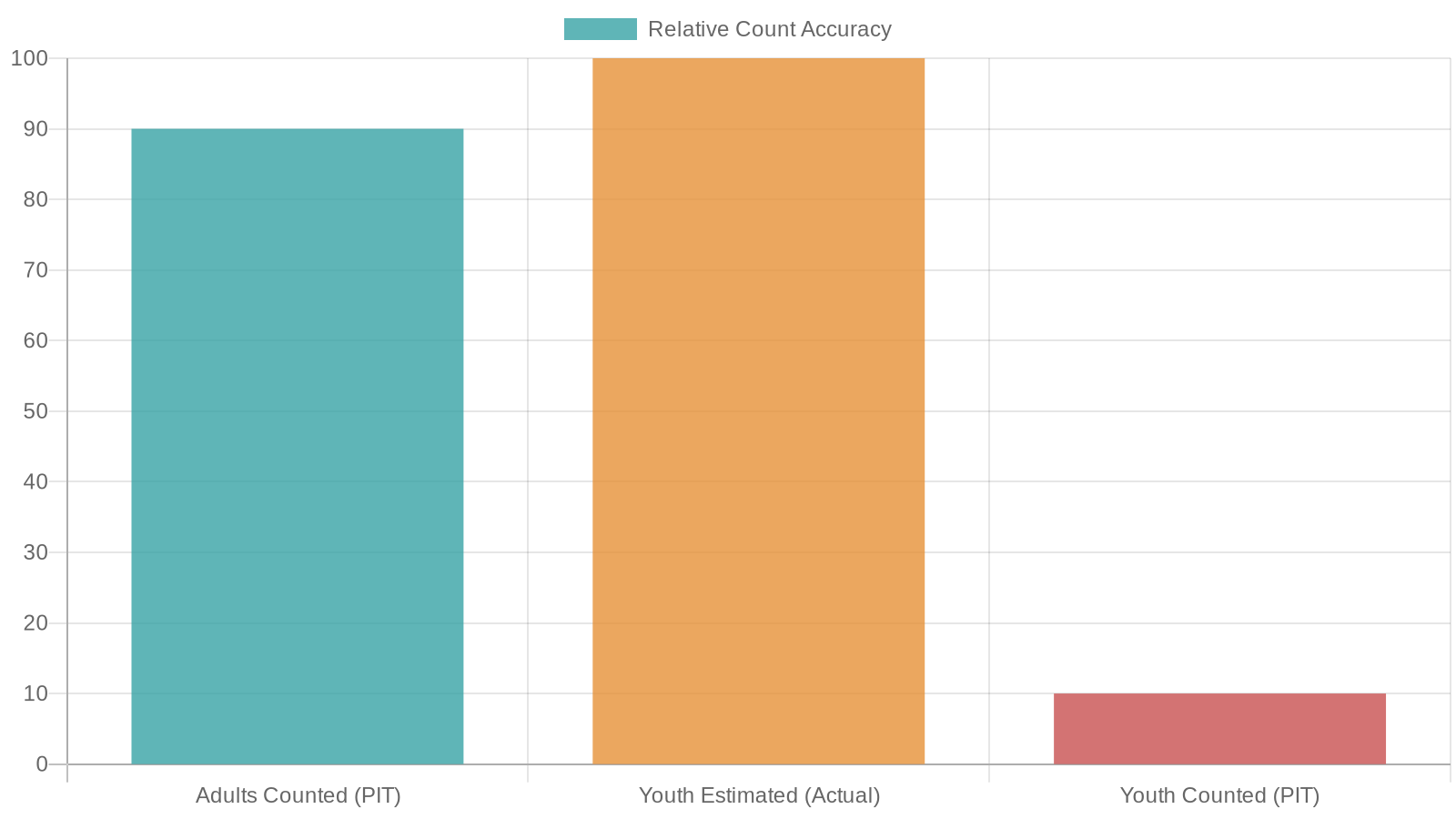
In Tennessee’s 2023 PIT count, the total number of people counted statewide was approximately 8,500. But researchers estimate that youth homelessness is undercounted by a factor of 10 to 1 compared to adult homelessness, because the methods used simply don’t reach hidden homeless youth. That means Tennessee’s true number of young adults experiencing housing instability is almost certainly far higher than official counts suggest.
Youth-Specific Counting Methods
Some Tennessee CoC regions have begun implementing youth-specific count methodologies, including surveys at schools, drop-in centers, and online outreach. These methods consistently find more young people than traditional street counts. YAAB members in regions like Memphis/Shelby County (TN-500), Nashville/Davidson (TN-501), and Knoxville/Knox County (TN-502) have been involved in designing and conducting these more accurate counts — because young adults with lived experience know where their peers are hiding.
6. The Solutions That Work Are Different Too
Effective solutions for youth homelessness don’t just need to be bigger — they need to be different. The evidence is clear that age-appropriate, trauma-informed, and youth-led approaches produce better outcomes than simply adding young people to adult systems.
Why Adult Shelter Models Often Fail Youth
Emergency shelters designed for adults prioritize immediate safety and basic needs — a bed, a meal, a locker. These are important, but they don’t address the specific needs of a 19-year-old who needs help finishing their GED, managing trauma from family rejection, or figuring out how to get their first apartment without rental history. Adult shelters also often have age restrictions that exclude 17-year-olds, leaving the youngest and most vulnerable transition-age youth with nowhere to go.
Rapid Rehousing — a model that moves people quickly from homelessness into permanent housing with short-term rental assistance — works well for many adults. For youth, it often needs to be paired with longer-term supports like case management, life skills coaching, and education assistance, because young adults may not yet have the income stability or practical skills to sustain housing independently.
What Actually Works for Young Adults
Evidence-based approaches for youth homelessness include:
- Host Home programs — vetted community volunteers provide safe temporary housing in a home setting
- Transitional Living Programs (TLPs) — longer-term (up to 24 months) supported housing with life skills and education components
- Permanent Supportive Housing — for youth with the highest needs, combining housing with ongoing services
- Family reunification services — when safe and desired, helping young people repair relationships that led to homelessness
- Drop-in centers — low-barrier spaces where youth can access services without committing to a shelter
Tennessee’s CoC regions are at different stages of implementing these models. YAAB members across the state advocate for expanding youth-specific options in every region.
Youth vs. Adult Homelessness: 10-Point Comparison at a Glance
This side-by-side comparison summarizes the key differences between youth and adult homelessness across the dimensions that matter most for policy, services, and advocacy.
7. Mental Health and Trauma Show Up Differently
Mental health is inseparable from housing stability for young adults. But the way trauma and mental health challenges show up in youth homelessness — and the kinds of support that actually help — differ meaningfully from the adult experience.
Trauma at a Formative Age
Adults experiencing homelessness often have long histories of trauma, but that trauma occurred over decades. For young adults, the trauma may be recent, acute, and still actively unfolding. A 20-year-old who was kicked out of their home at 17 has been living with that wound for three years — during the same years they were supposed to be building the skills and confidence to launch into adulthood.
Research shows that more than 50% of youth experiencing homelessness meet criteria for at least one mental health disorder, most commonly depression, anxiety, and PTSD. But many are reluctant to seek help because of stigma, past bad experiences with systems, or simply not knowing where to go.
The LGBTQ+ Youth Mental Health Crisis
LGBTQ+ young people are dramatically overrepresented in the homeless youth population — estimated at 40% of homeless youth nationally, despite representing a much smaller share of the overall youth population. For many, homelessness began with family rejection related to their identity. This means that mental health support for homeless youth must be explicitly LGBTQ+-affirming — not just tolerant, but actively welcoming.
In Tennessee, YAAB members have advocated for service providers to adopt affirming practices and to train staff on the specific needs of LGBTQ+ youth. This isn’t a niche issue — it’s central to serving the homeless youth population effectively.
8. Young People Have Power — and YAAB Proves It

The final — and most important — difference between youth and adult homelessness is this: young people are not passive recipients of services. They are advocates, leaders, and experts. The systems that serve them work better when young adults are in the room helping design them.
Lived Experience as Expertise
One of the most important differences between youth and adult homelessness is also one of the most hopeful: young people with lived experience of homelessness are uniquely positioned to fix it. They know which shelter rules don’t make sense. They know why their peers avoid services. They know what a drop-in center needs to feel safe. That knowledge is expertise — and it belongs at the policy table.
The Youth Action Board of Tennessee is built on exactly this premise. YAAB members ages 17 to 25 advise local and state leaders, participate in Continuum of Care governance, and drive advocacy campaigns across all eight Tennessee CoC regions. This isn’t charity — it’s democracy working the way it should.
How to Get Involved with Your Local YAAB
If you’re a young adult in Tennessee ages 17 to 25 with lived experience of homelessness or housing instability, your voice matters and YAAB wants to hear it. Local YAABs are active in regions including:
- Memphis/Shelby County (TN-500)
- Nashville/Davidson County (TN-501)
- Knoxville/Knox County (TN-502)
- Chattanooga/Hamilton County (TN-503)
- Jackson/West Tennessee (TN-504)
- Upper Cumberland (TN-506)
- Northeast Tennessee (TN-507)
- TN-509 region
You don’t need a resume or a perfect story. You just need to show up. Find your local YAAB chapter and connect with peers who are already doing this work.
Tennessee's CoC Regions: A Snapshot of Youth Housing Landscape

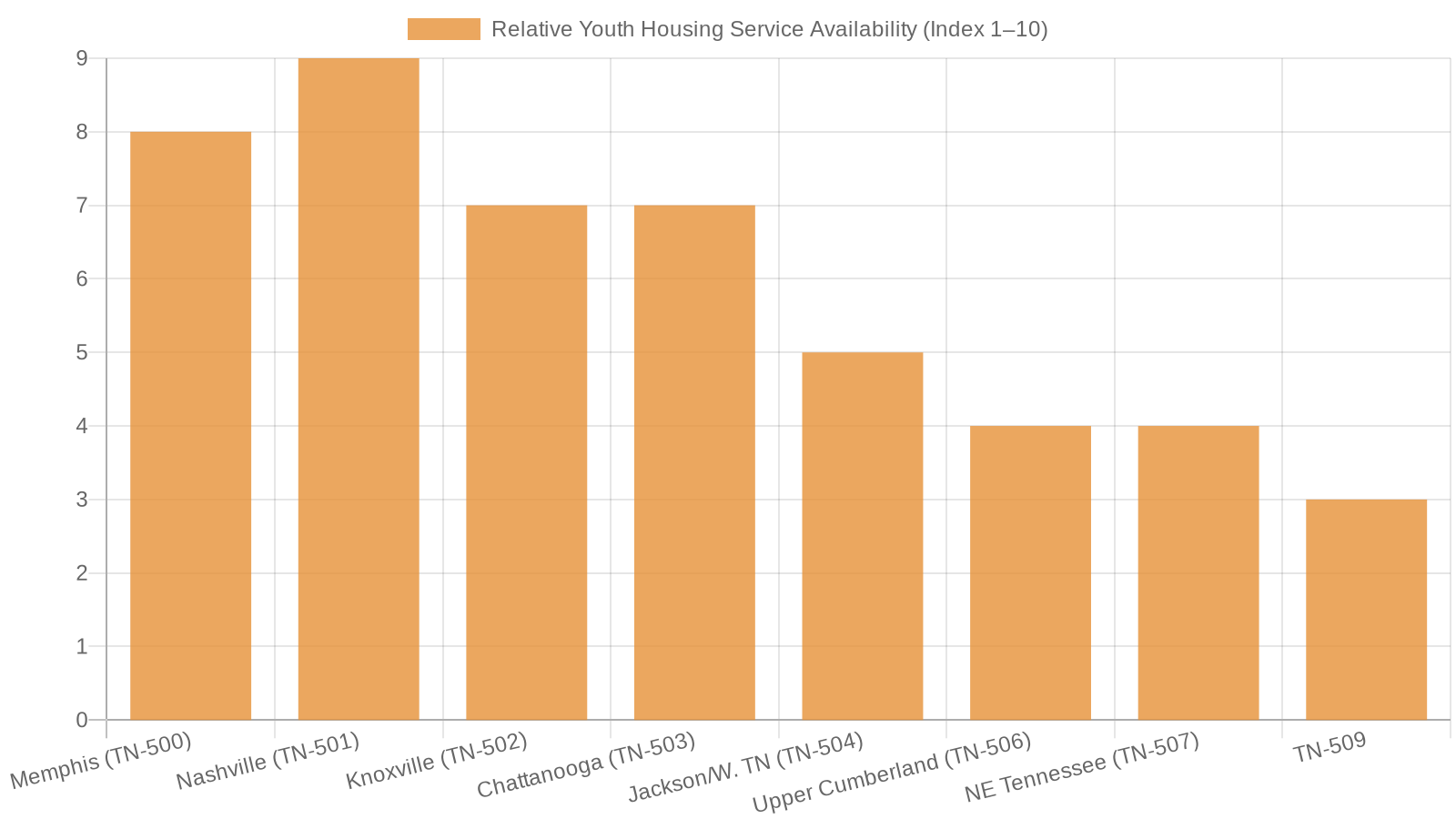
Tennessee’s statewide picture of youth homelessness is shaped by eight distinct Continuum of Care regions, each with its own housing market, service landscape, and community strengths. Knowing your region helps you find the right resources and the right people to connect with.
Regional Variation Matters
Tennessee is not one homogeneous place. The housing challenges facing a 19-year-old in Memphis look different from those facing a peer in rural Northeast Tennessee. Urban regions like Nashville (TN-501) and Memphis (TN-500) have more shelter beds and services but also higher rents and longer waitlists. Rural regions often have fewer formal services but stronger informal community networks — and longer distances to reach any services that do exist.
Understanding these regional differences is why YAAB operates at the local CoC level, not just statewide. Each local YAAB can identify what’s missing in their specific community and advocate for solutions that actually fit.
What the Data Shows Across Tennessee
Based on available HUD CoC data and Tennessee’s annual homeless counts:
- Tennessee counted approximately 8,500 people experiencing homelessness on a single night in 2023
- Youth (under 25) represented approximately 15–20% of sheltered homeless individuals in Tennessee’s larger CoCs
- Unsheltered youth are significantly undercounted, meaning the real percentage is likely higher
- Tennessee has seen a roughly 12% increase in youth homelessness counts over the past five years, driven partly by better counting methods and partly by real increases
These numbers represent real young people — classmates, neighbors, peers — who deserve systems built for their actual needs.
Ready to Learn More and Take Action?

Understanding the difference between youth and adult homelessness isn’t just an academic exercise — it’s the foundation for building better systems, better policies, and better outcomes for young adults across Tennessee. Whether you’re a young person navigating housing instability yourself, a peer who wants to get involved in advocacy, or a professional working in this space, the knowledge in this article is a starting point, not a finish line.
Start with Understanding, Then Move to Action
If this article has raised more questions than it answered — that’s a good thing. The difference between youth and adult homelessness is a topic that deserves deep attention, and there’s always more to learn. A great next step is to explore YAAB Tennessee’s full guide to understanding youth homelessness, which goes deeper on definitions, data, and the specific ways housing instability affects transition-age young adults across the state.
If you’re a young adult in Tennessee who’s been through housing instability yourself, know that your experience is valid, your perspective is valuable, and there are people who want to hear from you. Learn more about what YAAB is and how it works — you might find a community that’s been waiting for you.
For Case Managers and Service Providers
If you’re a case manager, CoC partner, or service provider reading this, the most important takeaway is this: young adults need youth-specific services, not adult services with a lower age limit. That means trauma-informed, LGBTQ+-affirming, peer-driven, and developmentally appropriate approaches. It means counting youth accurately, funding youth-specific programs, and — critically — including young adults with lived experience in every planning table you sit at.
YAAB Tennessee is a resource for providers as much as for young adults themselves. Check out the YAAB resources page for tools, data, and ways to partner with young adult advocates in your region. Together, Tennessee can build systems that actually work for the young people who need them most.
Frequently Asked Questions
What is the difference between youth homelessness and adult homelessness?
Youth homelessness (ages 17–25) is primarily caused by family rejection, abuse, and aging out of foster care, while adult homelessness is more often driven by economic shocks and chronic health conditions. Young people are also more likely to experience 'hidden' homelessness like couch-surfing, face unique legal barriers, and need age-specific services rather than adult shelter systems.
Why are LGBTQ+ youth overrepresented in homeless youth populations?
LGBTQ+ youth make up an estimated 40% of homeless youth nationally, largely because family rejection related to sexual orientation or gender identity is one of the leading causes of youth homelessness. Many LGBTQ+ young people are forced to leave home or flee unsafe situations, making affirming housing and services especially critical.
What is the Youth Action Board (YAAB) of Tennessee?
YAAB Tennessee is a statewide network of young adults ages 17 to 25 with lived experience of homelessness who advise policymakers, drive advocacy, and help shape housing programs across Tennessee's eight Continuum of Care regions. Members connect their peers to housing, education, employment, and support services.
How can a young adult in Tennessee get help if they're experiencing homelessness?
Young adults in Tennessee can connect with their local Continuum of Care region for shelter referrals, transitional housing, and support services. YAAB Tennessee also connects young people to peer advocates and regional resources. Starting with your local YAAB chapter is a good first step to find people who understand your experience.
What is 'couch-surfing' and does it count as homelessness?
Couch-surfing means temporarily staying at someone else's home — a friend's, family member's, or acquaintance's — without a stable place of your own. Yes, it counts as homelessness under federal definitions. It is one of the most common forms of youth housing instability and is often missed in official homeless counts.
Why do young people avoid adult homeless shelters?
Young adults often avoid adult shelters because they can feel unsafe, have rules that don't fit their schedules (like strict curfews that conflict with work or school), lack privacy, and are designed for older adults with different needs. Many young people also don't identify as 'homeless' even when they technically are, making outreach and youth-specific spaces especially important.