Finishing School: 9 GED and Education Pathways for Young Adults in Tennessee
Quick answer: If you’re a young adult in Tennessee between 17 and 25 and you haven’t finished high school, you have more options than you might think. The HiSET exam (Tennessee’s version of the GED) is free for qualifying residents, adult education centers are in every county, and community colleges offer bridge programs that let you earn a credential and college credit at the same time. Trade and apprenticeship programs, online learning, and HOPE Scholarship pathways are also open to you — even if you’ve experienced homelessness or housing instability. This guide breaks down every major option, what it costs, and how to take the first step.
Why Education Still Matters When You're Just Trying to Survive
When you’re dealing with housing instability, education can feel like a luxury. But across Tennessee, thousands of young adults ages 17 to 25 are proving every day that finishing school and finding stable housing aren’t competing goals — they’re connected ones. Understanding your options is the first step toward making both happen.
The Real Link Between a Credential and Stable Housing
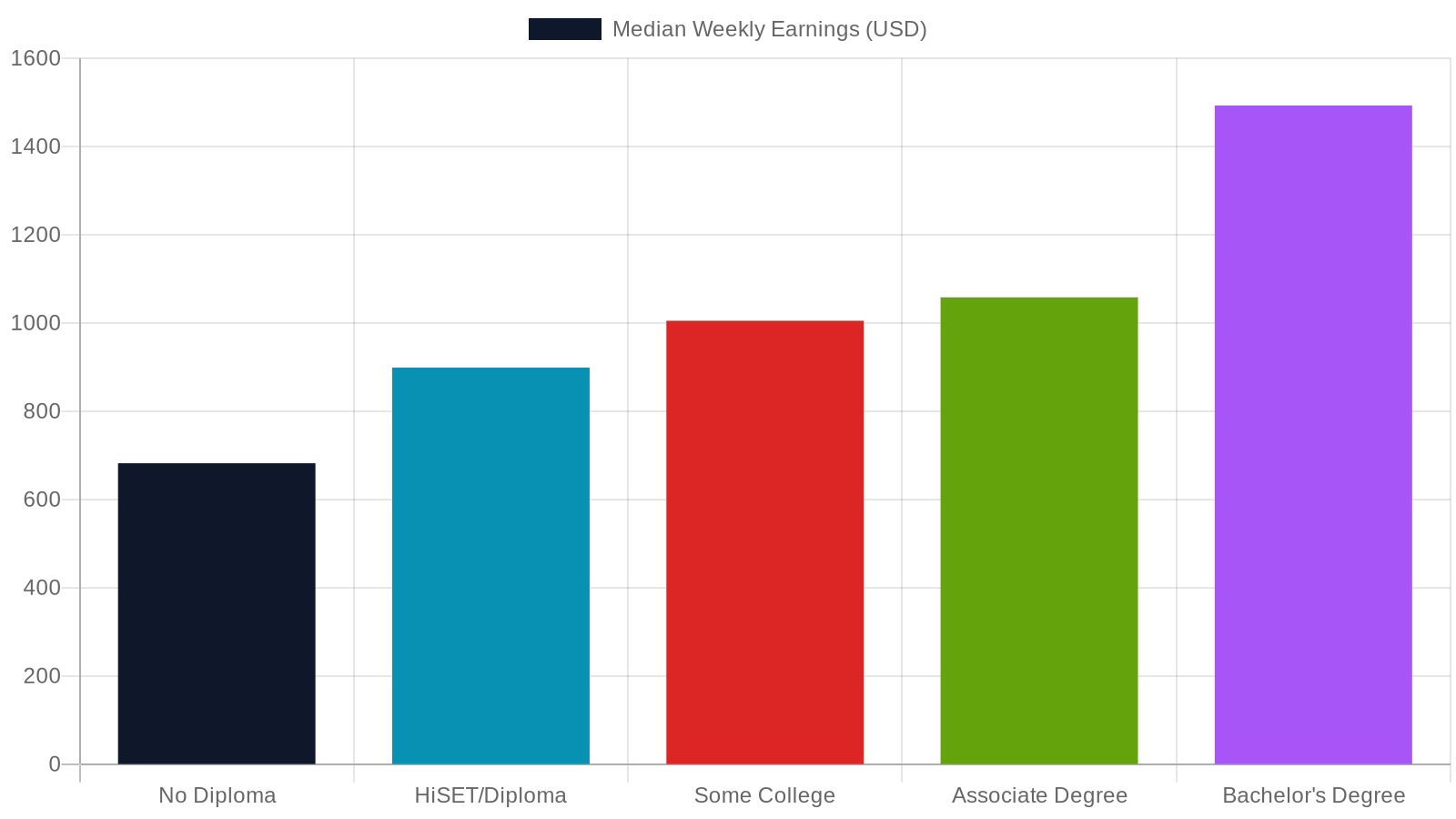
It might feel backwards to think about school when you’re worried about where you’ll sleep tonight. But research consistently shows that a high school equivalency credential is one of the most powerful levers for long-term housing stability. According to the U.S. Bureau of Labor Statistics, workers without a high school diploma earn a median of $682 per week, compared to $899 per week for those with a diploma or equivalency — a difference of more than $11,000 per year. Over a career, that gap is life-changing.
In Tennessee, a HiSET credential (the state’s official high school equivalency exam) is the key that unlocks HOPE Scholarship eligibility, community college enrollment, most trade apprenticeships, and thousands of jobs that list ‘high school diploma or equivalent’ as a minimum requirement.
You Are Not Behind — You Are Right on Time
Transition-age youth who have experienced homelessness, foster care, or housing instability are disproportionately likely to have gaps in their schooling — and that is a system failure, not a personal one. Tennessee’s adult education system is specifically designed to meet people where they are, at any age between 17 and 64. There is no deadline. Whether you left school at 16 or 24, the pathway back is open. YAAB members across Tennessee have walked these same roads and come out the other side with credentials, college credits, and careers — and they’re here to show you it’s possible.
1. The HiSET Exam — Tennessee's High School Equivalency Test
The HiSET is the single most direct route to a high school equivalency credential in Tennessee. It’s recognized by every Tennessee employer, college, and military branch — and with fee waivers available, cost doesn’t have to be a barrier.
What the HiSET Is and How It Works
Tennessee uses the HiSET exam (not the GED) as its official high school equivalency credential. The HiSET is a five-subject test covering Literacy/Reading, Writing, Mathematics, Science, and Social Studies. Each subject is scored on a scale of 1–20, and you need a minimum score of 8 on each subtest and a total score of at least 45 to pass. You can take one subtest at a time, so you don’t have to tackle everything at once.
Tests are offered at approved testing centers throughout Tennessee, including many adult education centers, community colleges, and workforce development offices. You can find your nearest site at hiset.ets.org or by contacting your local Tennessee College of Applied Technology (TCAT).
Cost and Fee Waivers for Tennessee Residents
Each HiSET subtest costs $10.75 when taken at a paper-based testing site, or $15.00 at a computer-based site — making the full five-subtest battery between $53.75 and $75.00. However, Tennessee’s adult education program offers fee waivers for qualifying low-income residents, which can bring your out-of-pocket cost to $0. To access a waiver, enroll in a Tennessee Adult Education program through your local community college or workforce board — your adult education instructor can submit the waiver on your behalf. If you’re experiencing homelessness or housing instability, you almost certainly qualify.
How to Prepare Without a Classroom
You don’t need to sit in a traditional classroom to prepare for the HiSET. Free prep resources include:
Khan Academy (khanacademy.org) — free math, science, and reading practice at every level
GED.com prep materials — many overlap with HiSET content
Tennessee Adult Education’s free online portal — available through enrolled students
Public library study rooms — Memphis-Shelby, Nashville, Knoxville, and Chattanooga public libraries all offer free Wi-Fi and quiet study space
Most adult education centers also offer flexible evening and weekend classes designed around work schedules.
Earning a HiSET/diploma adds roughly $217/week over no credential — more than $11,000 per year.
2. Tennessee Adult Education — Free Classes in Every County
Tennessee Adult Education is the backbone of the state’s high school equivalency system. It’s free, it’s statewide, and it’s designed for people who have gaps in their education history — including young adults who’ve experienced homelessness, foster care, or housing instability. Here’s what you need to know.
What Adult Education Centers Offer
Tennessee Adult Education (TAE) is a statewide network of free learning programs available at community colleges, TCATs, and community-based sites in all 95 counties. Programs include:
Adult Basic Education (ABE) — foundational reading, writing, and math for anyone below a 9th-grade level
Adult Secondary Education (ASE) — high school-level prep leading directly to the HiSET exam
English Language Acquisition (ELA) — for students whose first language is not English
Integrated Education and Training (IET) — combines basic skills instruction with workforce training so you earn a credential and a job skill at the same time
Classes are free, and most sites offer morning, afternoon, and evening options.
How to Enroll — Even Without a Permanent Address
One of the most common fears among young adults experiencing homelessness is that you need a permanent address to enroll in school. You do not. Tennessee Adult Education programs are required to serve students experiencing homelessness under the federal McKinney-Vento Homeless Assistance Act, which extends to young adults in adult education settings. You can use a shelter address, a case manager’s address, or a P.O. box. Bring whatever ID you have — even an expired ID or a birth certificate is usually enough to get started. If you have no ID at all, staff can often help you navigate the Tennessee ID voucher process.
3. Tennessee Colleges of Applied Technology (TCATs) — Trade Skills That Pay
Not every path to financial stability runs through a four-year university. Tennessee’s TCAT system is one of the best-kept secrets in workforce development — fast, affordable, and directly connected to employers who are actively hiring. If you want to earn a living wage within a year or two, a TCAT program might be your fastest route.
What TCATs Are and Who They're For
Tennessee has 27 TCAT campuses spread across the state, from Memphis to Elizabethton. TCATs offer short-term, hands-on training programs in fields like welding, HVAC, electrical technology, automotive service, cosmetology, healthcare, and information technology. Most programs run between 9 and 24 months, and graduates earn industry-recognized certificates and diplomas — not four-year degrees. That means you can be working in a skilled trade within a year or two.
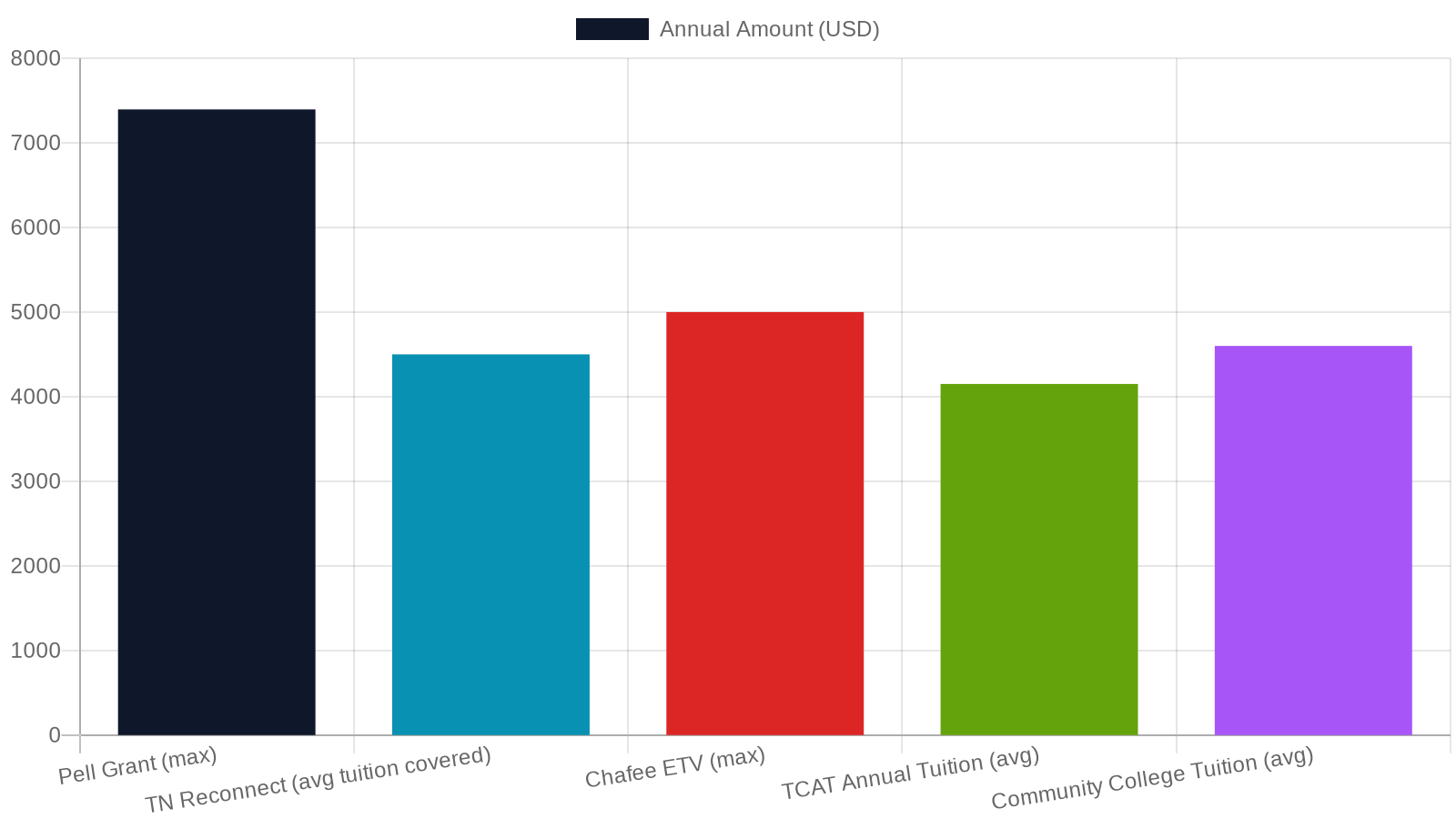
Tuition at TCATs is among the lowest in the nation. The average annual tuition is approximately $3,800–$4,500, and most students qualify for federal Pell Grants that cover all or most of that cost.
Tennessee Reconnect — Free Tuition for Adults Without a Degree
Tennessee Reconnect is a state grant program that covers tuition and mandatory fees at TCATs for adults who don’t already have a college degree. If you’re 18 or older and haven’t completed a postsecondary credential, Tennessee Reconnect can make TCAT essentially free after federal Pell Grant funds are applied. To apply, complete the Free Application for Federal Student Aid (FAFSA) at studentaid.gov and then apply for Tennessee Reconnect through the Tennessee Student Assistance Corporation (TSAC) at tnreconnect.gov. Applications open each spring for the following academic year.
Top TCAT Programs by Earning Potential in Tennessee
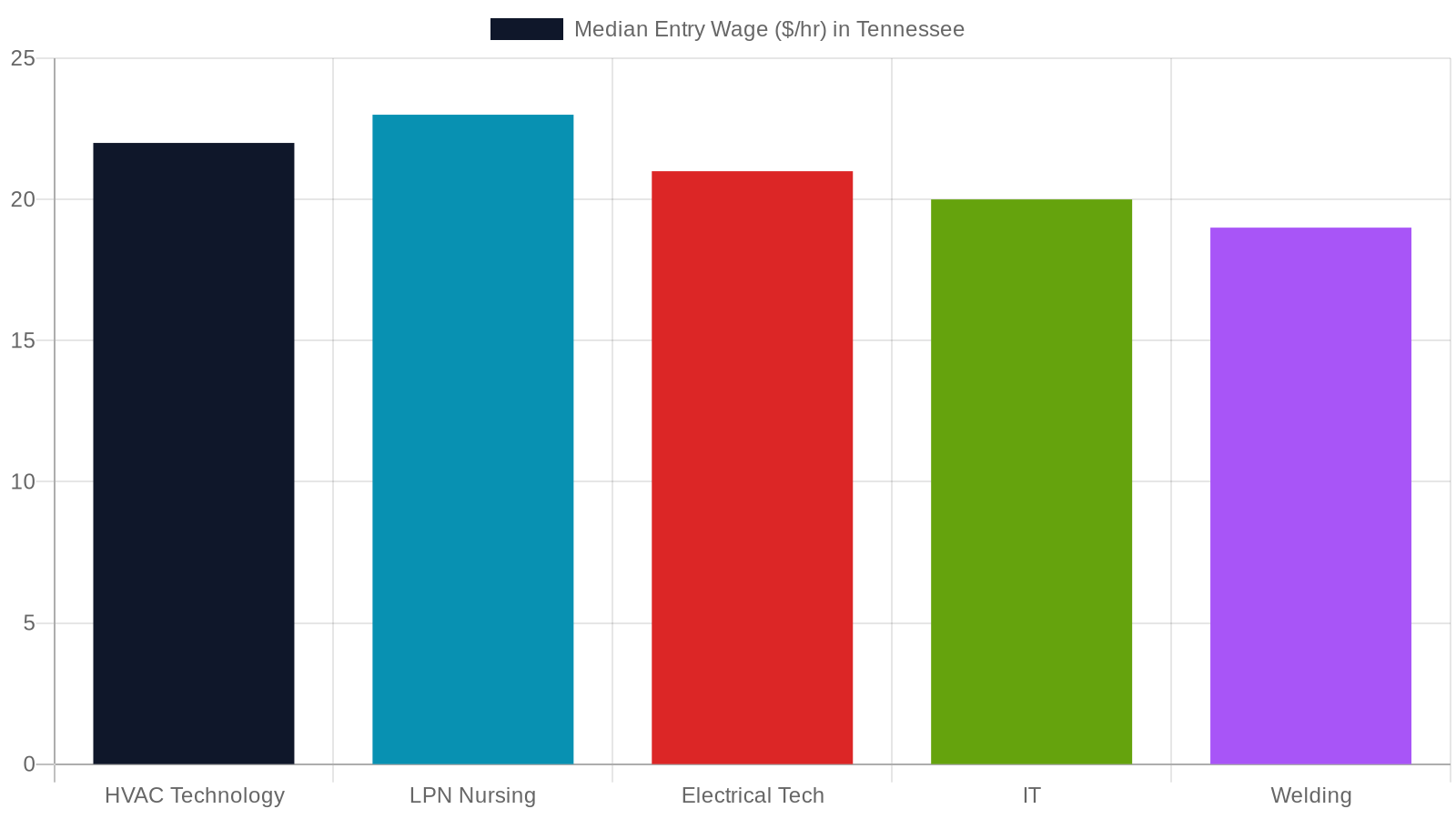
Choosing a program that leads to a living wage matters. Here are some of the strongest TCAT pathways by median starting wage in Tennessee:
HVAC Technology — median entry wage ~$22/hr
Electrical Technology — median entry wage ~$21/hr
Welding Technology — median entry wage ~$19/hr
Healthcare — Practical Nursing (LPN) — median entry wage ~$23/hr
Information Technology — median entry wage ~$20/hr
All of these exceed Tennessee’s median hourly wage of approximately $18.50 for workers without a bachelor’s degree, according to the Tennessee Department of Labor and Workforce Development.
All five programs exceed Tennessee’s ~$18.50/hr median for workers without a bachelor’s degree.
4. Community College Pathways — Earn Credits While You Build
Community college is often the most flexible and affordable bridge between a HiSET credential and a full career or bachelor’s degree. Tennessee’s community college system spans every major region of the state and offers programs designed specifically for adult learners who are balancing work, housing challenges, and school at the same time.
Tennessee Promise and Tennessee Reconnect for Community College
Tennessee has two major free-college programs that apply to community colleges. Tennessee Promise covers last-dollar tuition and fees at Tennessee community colleges and TCATs for students who enroll within 16 months of high school graduation (or HiSET completion). Tennessee Reconnect covers the same costs for adults 18 and older who don’t already have a degree. Both programs are administered by TSAC and require FAFSA completion. If you’ve recently earned your HiSET, you may qualify for Tennessee Promise — ask your adult education instructor or a TSAC advisor to confirm your eligibility window.
Bridge Programs and Co-Enrollment
Many Tennessee community colleges offer bridge programs that let students who are still completing their HiSET prep take college-level coursework simultaneously. Nashville State Community College, Southwest Tennessee Community College (Memphis), Pellissippi State (Knoxville), Chattanooga State, and Jackson State Community College all have dedicated adult learner support offices. These offices can connect you with tutoring, emergency financial assistance, childcare referrals, and housing navigation — services that recognize you’re managing more than just academics.
Associate Degrees That Lead to Four-Year Transfers
An Associate of Arts or Associate of Science from a Tennessee community college transfers directly into the Tennessee Board of Regents university system under the Tennessee Transfer Pathway agreement. That means you can complete your first two years of a bachelor’s degree at low cost, then transfer to a university like Austin Peay, East Tennessee State, Middle Tennessee State, Tennessee State, Tennessee Tech, or the University of Memphis. The average annual tuition at a Tennessee community college is approximately $4,600 before grants — often fully covered by Pell and Reconnect combined.
5. Online Learning — Flexible Education When Life Isn't Predictable
When your housing situation is unstable, a fixed class schedule can feel impossible. Online learning gives you the flexibility to study at 11pm in a shelter common room or early morning before a shift. The key is knowing which platforms are genuinely free and which require payment — and knowing where to access reliable internet in your city.
Free and Low-Cost Online Platforms That Actually Work
Online learning isn’t just for people with fast Wi-Fi and a quiet apartment. Tennessee’s public libraries — including the Memphis Public Library system, Nashville Public Library, Knox County Public Library, and Chattanooga Public Library — offer free Wi-Fi, computer access, and in some cases, free hotspot lending programs. With reliable internet access, these platforms are genuinely useful:
Khan Academy — completely free, covers HiSET prep through college-level math and science
Coursera and edX — offer free audit access to university courses; certificates cost money but auditing is free
LinkedIn Learning — free with a library card in many Tennessee counties
Tennessee’s Virtual Library (TSVL) — free to all Tennessee residents, includes thousands of academic resources
Western Governors University — Accredited Online Degrees
Western Governors University (WGU) is a fully accredited, nonprofit online university that is particularly popular among working adults and those with non-traditional backgrounds. WGU’s competency-based model means you can move faster through subjects you already know, potentially cutting tuition costs significantly. Annual tuition is approximately $7,300–$8,200 depending on program — and WGU accepts Pell Grants, Tennessee Reconnect, and other federal aid. WGU has a specific partnership with the Tennessee Department of Human Services and has served many former foster youth and transition-age young adults in the state.
6. Registered Apprenticeships — Get Paid While You Learn
Apprenticeships are one of the most underused education pathways for young adults — and one of the best. You earn real money from the start, you don’t take on student loan debt, and you graduate with both a credential and years of documented work experience. In Tennessee, apprenticeship programs are growing fast across the skilled trades and beyond.
How Apprenticeships Work in Tennessee
A registered apprenticeship is a formal, employer-sponsored training program in which you earn a wage from day one while learning a skilled trade. In Tennessee, apprenticeships are registered through the U.S. Department of Labor and the Tennessee Department of Labor and Workforce Development. Programs typically last 1 to 5 years and combine on-the-job training with related technical instruction. Upon completion, you earn a nationally recognized Certificate of Completion of Apprenticeship — a credential respected by employers across the country.
Tennessee has active apprenticeship programs in construction, manufacturing, healthcare, IT, and public utilities. The Tennessee Apprenticeship Initiative has been expanding rapidly, with more than 4,500 active apprentices statewide as of 2023.
Finding an Apprenticeship as a Young Adult
The best starting points for finding a registered apprenticeship in Tennessee are:
apprenticeship.gov — the federal database of all registered programs, searchable by occupation and zip code
Tennessee’s Jobs4TN.gov — the state workforce portal, which lists apprenticeship openings alongside regular jobs
Local union halls — the International Brotherhood of Electrical Workers (IBEW), United Brotherhood of Carpenters, and Plumbers/Pipefitters unions all run apprenticeship programs in Memphis, Nashville, Knoxville, and Chattanooga
Tennessee Workforce Development Boards — each of the state’s 10 local workforce areas has an American Job Center that can connect you to apprenticeship sponsors
A HiSET or high school diploma is required for most apprenticeship programs, which is another reason getting that credential first pays off.
Tennessee Education Pathways at a Glance — 9-Option Comparison
Every pathway has different costs, timelines, and outcomes. Use this table to find the option that fits your situation right now.
Pathway
Time to Complete
Typical Cost (After Aid)
Key Credential
Best For
HiSET Exam
3–12 months prep
$0–$75 (waivers available)
TN High School Equivalency
Anyone without a diploma; required for most other pathways
Tennessee Adult Education
Ongoing / self-paced
Free
HiSET prep + workforce skills
Anyone needing foundational skills or HiSET prep
TCAT Program
9–24 months
$0–$2,000 (Reconnect + Pell)
TCAT Diploma / Certificate
Young adults wanting skilled trades without a 4-year degree
Community College (AA/AS)
2 years full-time
$0–$1,500/yr (Reconnect + Pell)
Associate Degree
Young adults planning to transfer to a university
Tennessee Reconnect
Ongoing (covers tuition)
Free tuition/fees
Stackable credential
Adults 18+ without a postsecondary degree
Online Learning (Khan, WGU)
Self-paced / 2–4 years
$0–$8,200/yr
Varies (certificate to degree)
Young adults with unstable schedules needing flexibility
Registered Apprenticeship
1–5 years
$0 (earn while you learn)
DOL Certificate of Completion
Young adults who want to earn a wage from day one
Chafee ETV Scholarship
Up to age 23 (or 26 in TN)
Up to $5,000/yr supplement
Supplements other credentials
Youth who aged out of Tennessee foster care
HOPE / Tennessee Promise
2–4 years
$0 tuition/fees (last dollar)
Associate or Bachelor’s Degree
Recent HiSET completers within 16 months of credential
7. Financial Aid, Scholarships, and Emergency Funds for Tennessee Youth
Money is one of the biggest barriers to education for young adults experiencing housing instability — but there is more financial support available than most people realize. The key is knowing which programs exist, how to apply, and how your housing situation may actually increase your eligibility for aid.
FAFSA — The First Step for Almost Every Aid Program
The Free Application for Federal Student Aid (FAFSA) is the gateway to Pell Grants, Tennessee Reconnect, Tennessee Promise, and most institutional scholarships. You can complete it at studentaid.gov. If you’re an unaccompanied homeless youth or a youth aging out of foster care, you have special status on the FAFSA that makes you an independent student — meaning your parents’ income is not counted, which typically maximizes your aid eligibility. The maximum federal Pell Grant for the 2024–25 award year is $7,395. Many Tennessee young adults experiencing homelessness qualify for the full amount.
Scholarships Specifically for Foster Youth and Homeless Youth in Tennessee
Several scholarships are specifically designed for young adults who’ve experienced foster care or homelessness:
Tennessee Education Lottery Scholarship (TELS) / HOPE Scholarship — requires a 3.0 GPA or 21 ACT, but the General Assembly Merit Scholarship component has lower thresholds
Tennessee Chafee Education and Training Voucher (ETV) — up to $5,000/year for youth who aged out of foster care, for education or training expenses. Contact Tennessee DCS at tn.gov/dcs
Orphan Foundation of America / Think of Us — national scholarships open to Tennessee foster youth
Local Community Foundations — the Community Foundation of Greater Memphis, Community Foundation of Middle Tennessee, and East Tennessee Foundation all offer scholarships for low-income young adults
Emergency Aid Funds on Campus
Most Tennessee community colleges and universities have emergency aid funds that can cover unexpected costs — a car repair that threatens your ability to get to class, a gap in rent, or a utility shutoff. These funds are typically small ($200–$1,500) but can be the difference between staying enrolled and dropping out. Ask for the Dean of Students office or the Financial Aid office at your institution and specifically ask about emergency aid, basic needs grants, or student emergency funds. You should not have to justify your situation in detail — a brief explanation is usually enough.
Pell Grant + Tennessee Reconnect can fully cover TCAT or community college tuition for many qualifying young adults.
8. Navigating Education While Experiencing Homelessness — Your Rights
Knowing your rights as a student experiencing homelessness can remove barriers before they stop you. Federal law gives you specific protections around enrollment, documentation, and privacy — and understanding them means you can advocate for yourself when institutions put up unnecessary roadblocks. For more on your rights and available support, visit the YAAB Tennessee resources page for a curated list of Tennessee-specific tools and organizations.
McKinney-Vento Rights for Young Adults
The McKinney-Vento Homeless Assistance Act is a federal law that protects the educational rights of people experiencing homelessness. While it’s most often discussed in the context of K–12 students, its protections extend to young adults in adult education programs and, in some interpretations, to transition-age youth in community college settings. Under McKinney-Vento, you have the right to:
Enroll in school immediately, even without typical documentation
Remain enrolled at your school of origin even if you move
Receive transportation assistance in some cases
Access the same programs and services as other students
If you’re enrolling in a Tennessee Adult Education program and face barriers due to lack of documentation or address, specifically mention McKinney-Vento to the enrollment staff.
FERPA and Your Privacy as a Student
Once you’re enrolled in any postsecondary institution, your educational records are protected under the Family Educational Rights and Privacy Act (FERPA). This means your school cannot share your enrollment status, grades, or financial aid information with your parents, former foster family, or anyone else without your written consent — regardless of your age. This is especially important for young adults who may have complicated family situations or who are trying to maintain privacy about their housing situation. You have the right to review your own records and to request corrections if something is wrong.
9. Regional Education Resources Across Tennessee's CoC Areas
Tennessee’s education resources are not evenly distributed, but every region of the state has pathways available. Knowing what’s closest to you — and who to call — makes all the difference. Here’s a quick regional breakdown across Tennessee’s Continuum of Care areas.
Memphis/Shelby County and West Tennessee
Memphis is home to Southwest Tennessee Community College, which has a robust adult education and workforce development division, and TCAT Memphis, one of the largest TCAT campuses in the state. The Memphis Public Library system offers free computer access, Wi-Fi, and hotspot lending. The Memphis Literacy Council provides free tutoring and HiSET prep. For young adults in Jackson and West Tennessee, Jackson State Community College and TCAT Jackson are the primary resources, and the West Tennessee Legal Services office can help with documentation barriers.
Nashville/Davidson, Chattanooga/Hamilton, and Middle Tennessee
Nashville has one of the strongest adult education ecosystems in the state. Nashville State Community College runs a dedicated adult education program with evening and weekend options. TCAT Nashville offers programs in healthcare, IT, and skilled trades. The Nashville Adult Literacy Council provides free tutoring. In Chattanooga, Chattanooga State Community College and TCAT Chattanooga serve Hamilton County and surrounding areas. The Chattanooga Public Library’s 4th Floor is a nationally recognized free maker and learning space. For the Upper Cumberland region, Tennessee Tech University’s Cookeville campus and TCAT Crossville are key access points.
Knoxville/Knox and Northeast Tennessee
East Tennessee is served by Pellissippi State Community College (Knoxville), which has a strong adult learner support program, and TCAT Knoxville. The Knox County Public Library offers free Wi-Fi and study space across multiple branches. In Northeast Tennessee, Northeast State Community College (Blountville) and TCAT Elizabethton serve the Tri-Cities area. East Tennessee State University (ETSU) in Johnson City has an office of financial aid specifically experienced with foster youth and independent student status. The Mountain Alliance organization in Boone, NC (serving the TN border region) also provides education navigation for young adults.
Ready to Take Your Next Step? YAAB Tennessee Is Here
You’ve read through nine real pathways to education and credentials in Tennessee. Now the question is: which one fits your life right now? There’s no single right answer — and you don’t have to figure it out alone. YAAB Tennessee exists specifically to support young adults ages 17 to 25 across every region of the state who are building their futures while navigating housing instability. Whether you’re in Memphis, Nashville, Knoxville, Chattanooga, Jackson, the Upper Cumberland, or Northeast Tennessee, there are people in your corner. Reach out, show up, and take the next step — on your terms, at your pace.
Connect With a Local YAAB Near You
The Youth Action Board of Tennessee has members in Memphis/Shelby, Nashville/Davidson, Knoxville/Knox, Chattanooga/Hamilton, Jackson/West TN, Upper Cumberland, and Northeast Tennessee who have navigated these exact education pathways — and who want to help you do the same. YAAB isn’t a service provider that will hand you a pamphlet. It’s a peer network of young adults who get it, because they’ve lived it. You can find your local YAAB chapter and connect with members in your region who can share what worked for them and point you toward the right resources.
Get Involved, Not Just Served
If you’ve already started your education journey — or even if you’re just thinking about it — YAAB wants to hear your story. Young adults with lived experience of homelessness and housing instability are the most powerful advocates for better education policies in Tennessee. When you get involved with YAAB, you’re not just accessing support — you’re helping shape the systems that will affect the next generation of young adults across the state. That’s real leadership, and it looks good on a resume, a college application, and in your own sense of who you are.
Frequently Asked Questions
Can I get my GED for free in Tennessee?
Tennessee uses the HiSET exam rather than the GED brand, but the process is similar. Each subtest costs $10.75–$15.00, but fee waivers are available through Tennessee Adult Education programs for qualifying low-income residents — bringing your cost to $0. Enroll in a local adult education program and ask your instructor about the waiver process.
Do I need a permanent address to enroll in school in Tennessee?
No. Under the federal McKinney-Vento Homeless Assistance Act, schools and adult education programs cannot deny enrollment because you lack a permanent address. You can use a shelter address, a case manager’s address, or a P.O. box. Bring whatever ID you have — staff can often help with the rest.
What is Tennessee Reconnect and how do I apply?
Tennessee Reconnect is a state grant that covers tuition and mandatory fees at Tennessee community colleges and TCATs for adults 18 and older who don’t already have a college degree. Complete the FAFSA at studentaid.gov, then apply through the Tennessee Student Assistance Corporation at tnreconnect.gov. Applications open each spring.
What education help is available specifically for young adults aging out of foster care in Tennessee?
Youth who aged out of Tennessee foster care can access the Chafee Education and Training Voucher (ETV), which provides up to $5,000 per year for education or training expenses through age 23 (or 26 in some cases). Contact the Tennessee Department of Children’s Services (tn.gov/dcs) to apply. You also qualify as an independent student on the FAFSA, which typically maximizes your Pell Grant eligibility.
How long does it take to get a HiSET credential in Tennessee?
It depends on your starting point. Some people prepare and pass all five subtests within 3–6 months; others take 6–12 months or longer. Tennessee Adult Education programs let you move at your own pace, and you can take one subtest at a time. There is no deadline — you can start at any point between ages 17 and 64.
How do I find my local YAAB chapter in Tennessee?
YAAB Tennessee has chapters in Memphis/Shelby, Nashville/Davidson, Knoxville/Knox, Chattanooga/Hamilton, Jackson/West TN, Upper Cumberland, and Northeast Tennessee. Visit yaabtn.org/local-yaabs to find the chapter closest to you and connect with peer members who can share local education and housing resources.