Quick answer: Youth homelessness in Tennessee is driven by a combination of systemic failures and personal crises — including family conflict, aging out of foster care, economic hardship, housing unaffordability, mental health challenges, substance use, LGBTQ+ rejection, domestic violence, involvement in the justice system, and a lack of affordable housing supply. No single cause stands alone; most young people experience several of these at once. Understanding the real roots of the problem is the first step toward fixing it — and young people with lived experience are leading that work across Tennessee every day.
Why Understanding the Causes Actually Matters

Before we can solve youth homelessness in Tennessee, we have to understand what actually causes it. Too often, conversations about homelessness focus on the surface — someone sleeping outside — without asking why they ended up there. The causes are layered, interconnected, and deeply rooted in both individual circumstances and the systems young people move through every day. This article breaks down the 10 most significant root causes, backed by data, so that young adults, advocates, and service providers across Tennessee can see the full picture.
The Numbers Behind Youth Homelessness in Tennessee
On any given night, thousands of young adults ages 17 to 25 across Tennessee are sleeping in shelters, cars, motels, or on friends’ couches — or completely unsheltered. According to the U.S. Department of Housing and Urban Development (HUD), Tennessee’s Continuum of Care regions collectively counted over 1,200 unaccompanied youth in the 2023 Point-in-Time Count, and advocates widely acknowledge that number undercounts the real total because many young people avoid shelters entirely.
- Memphis/Shelby County (TN-500) and Nashville/Davidson County (TN-501) account for the largest shares of counted youth homelessness in the state.
- Young adults ages 18 to 24 make up roughly 13% of all people experiencing homelessness nationally, yet they are among the least-served populations.
- Youth of color, LGBTQ+ youth, and youth aging out of foster care are dramatically overrepresented.
Why 'Cause' Is Not the Same as 'Fault'
One of the most important things to understand is that the causes of youth homelessness are almost never about personal failure. They are about systems — housing markets, child welfare, schools, healthcare — that were not built with young people in mind, especially young people who are already navigating instability. Framing homelessness as a personal moral failure ignores the data and, more importantly, ignores the lived reality of the young adults who experience it. The Youth Action Board of Tennessee (YAAB) is built on the belief that the people closest to the problem are closest to the solution.
1. Family Conflict and Rejection at Home

Family is supposed to be a safety net. For many young adults in Tennessee, it becomes the source of the crisis instead. Understanding how and why family conflict pushes young people out of their homes — and why some groups face this at far higher rates — is essential to building better responses.
When Home Is the Source of the Crisis
Family conflict is consistently cited as the number one immediate trigger of youth homelessness nationally. A 2017 study by Chapin Hall at the University of Chicago found that young adults who had experienced family conflict were 3 times more likely to experience homelessness than their peers. In Tennessee, this plays out in cities like Memphis, Knoxville, and Chattanooga every day — a young person is told to leave, or conditions at home become so unsafe or hostile that leaving feels like the only option.
Family conflict covers a wide range of situations: physical or emotional abuse, conflict over relationships or life choices, overcrowding, a parent’s substance use, or simply a family that has run out of resources and space. The important thing to understand is that the young person is rarely the cause of the conflict — they are navigating a situation that was already broken before they arrived at a shelter door.
LGBTQ+ Youth and Family Rejection
LGBTQ+ youth face a specific and devastating form of family conflict: rejection based on their identity. Research from the Williams Institute at UCLA found that 40% of homeless youth identify as LGBTQ+, despite making up only about 7% of the general youth population. In Tennessee, where LGBTQ+ youth may face additional layers of stigma in some communities, family rejection can be swift and severe. A young person who comes out to their family may find themselves without a home within days. This is not a personal failing — it is a crisis created by rejection, and it demands affirming, identity-safe shelter and services in response.
2. Aging Out of Foster Care Without a Safety Net

For young people in Tennessee’s foster care system, turning 18 can feel less like a birthday and more like a deadline. The abrupt end of system support — without a family to fall back on — is one of the most predictable pathways into homelessness for transition-age youth across the state.
What 'Aging Out' Actually Means
In Tennessee, young people in foster care typically age out of the system at 18 — though extended foster care through the Tennessee Independent Living program can provide some support up to age 21. But for many youth, the transition is abrupt. One day the system is responsible for your housing, healthcare, and basic needs. The next, you are expected to be fully self-sufficient. Without family support, savings, or a stable housing plan, this transition is a direct pipeline into homelessness.
Nationally, one in five youth who age out of foster care will experience homelessness within two years of leaving care (National Foster Youth Institute). Tennessee’s foster care system serves thousands of young people annually, and the gap between aging out and stable adulthood is one of the most predictable — and preventable — causes of youth homelessness in the state.
What Tennessee Is Doing — and What's Still Missing
Tennessee has programs like Transitional Living Programs (TLPs) and Rapid Re-Housing for Youth that are specifically designed to bridge this gap. The Chafee Foster Care Program for Successful Transition to Adulthood provides federal funding for independent living services. But capacity is limited, and many young people who need these services never access them — either because they don’t know they exist, because they don’t meet narrow eligibility criteria, or because the programs in their region are full. YAAB members across Tennessee have firsthand experience navigating — and falling through the cracks of — these systems.
3. The Unaffordability of Housing in Tennessee
Even when a young adult in Tennessee wants to find stable housing, the market may simply be out of reach. Rising rents, stagnant wages, and a severe shortage of affordable units create a structural barrier that affects young adults across Memphis, Nashville, Knoxville, Chattanooga, and every region in between.
Rents Are Rising Faster Than Young Adults Can Earn
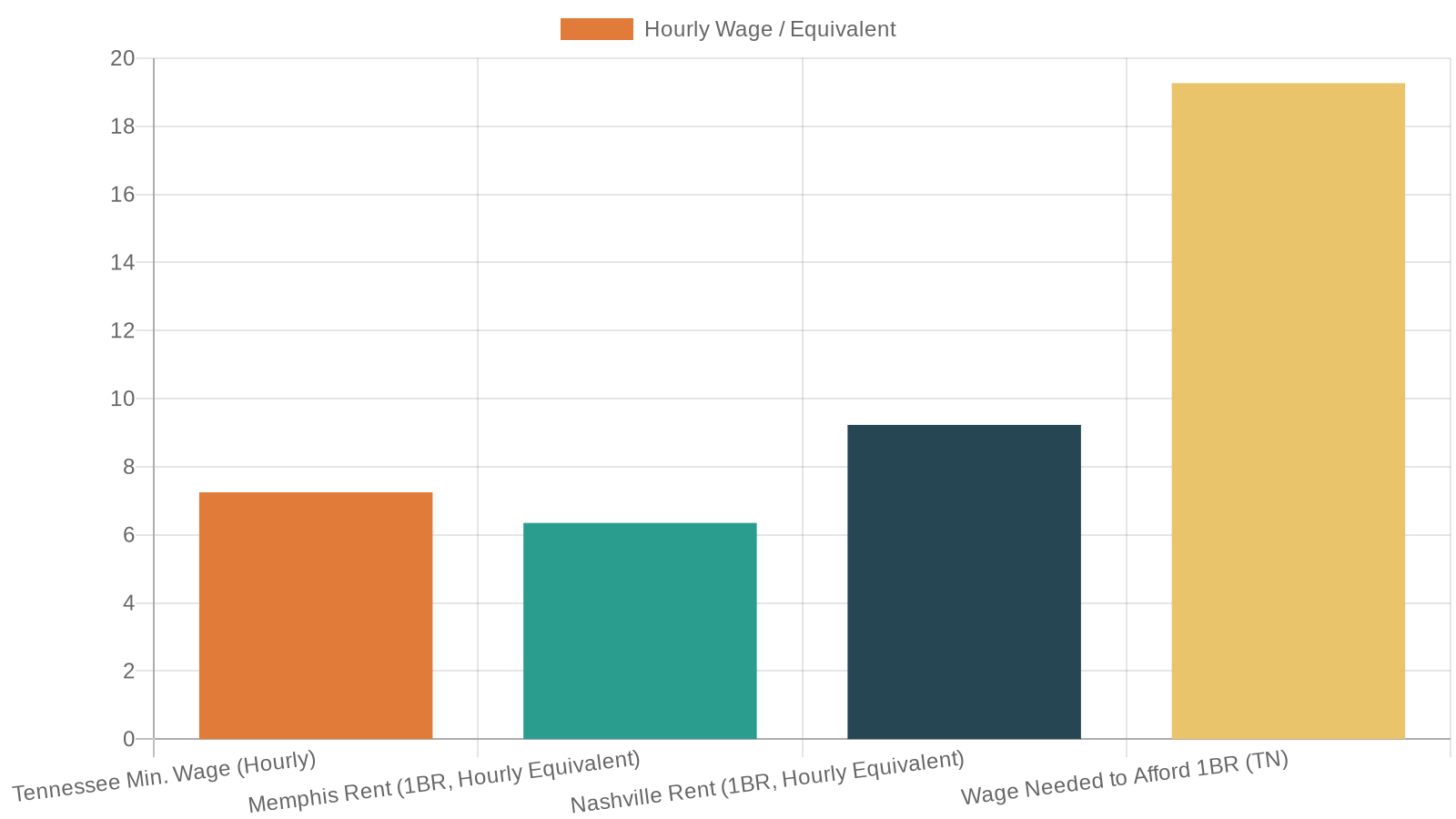
Tennessee has seen some of the fastest rent increases in the country over the past five years. According to Zillow’s 2023 data, median rent in Nashville exceeded $1,600/month for a one-bedroom apartment, and Memphis was not far behind at around $1,100/month. For a young adult working a minimum-wage job in Tennessee — which sits at the federal floor of $7.25/hour — affording even a modest apartment is mathematically impossible without multiple jobs or roommates.
The National Low Income Housing Coalition’s 2023 Out of Reach report found that a Tennessee renter needs to earn at least $19.27/hour to afford a modest one-bedroom apartment without spending more than 30% of their income on housing. That is nearly three times the state minimum wage.
The Shortage of Affordable Units
It is not just about wages — it is also about supply. Tennessee has a shortage of over 100,000 affordable rental units for extremely low-income renters, according to the National Low Income Housing Coalition. When affordable units do exist, they are often in poor condition, located far from jobs and transit, or have long waitlists. For a young adult who needs housing now, a two-year waitlist for a subsidized unit is not a solution. This structural shortage is a root cause of homelessness that no amount of individual effort can overcome without systemic change.
4. Mental Health Challenges and Limited Access to Care

Mental health is one of the most misunderstood factors in youth homelessness. It is not that young people with mental health challenges are incapable of stability — it is that the systems around them often fail to provide the support they need before a crisis becomes a catastrophe.
The Bidirectional Relationship Between Mental Health and Homelessness
Mental health challenges and homelessness have a complex, bidirectional relationship — each can cause or worsen the other. Young adults experiencing anxiety, depression, PTSD, or other mental health conditions may struggle to maintain employment or relationships, making housing instability more likely. At the same time, the trauma of homelessness itself creates or deepens mental health challenges. A 2019 study found that over 50% of homeless youth meet criteria for at least one mental health disorder.
In Tennessee, access to mental health care for young adults is severely limited, especially in rural regions like Upper Cumberland and Northeast Tennessee. Long wait times, lack of insurance, and a shortage of providers who specialize in trauma-informed care for young adults all create gaps that push vulnerable youth closer to the edge of homelessness.
Trauma Is a Root Cause, Not a Character Flaw
Many young adults experiencing homelessness have histories of childhood trauma — abuse, neglect, domestic violence, community violence, or the loss of a caregiver. Adverse Childhood Experiences (ACEs) are strongly correlated with housing instability in adulthood. Tennessee’s ACE data shows that a significant portion of the state’s young adult population has experienced four or more ACEs, which dramatically increases risk for a range of negative outcomes including homelessness. Addressing mental health is not separate from addressing homelessness — it is central to it.
5. Substance Use and the Cycle It Creates

Substance use and homelessness are deeply intertwined in Tennessee, but not in the way most people assume. Understanding the direction of the relationship — and the barriers to treatment — is essential for building responses that actually work for young adults.
Substance Use as Coping, Not Cause
Substance use is often listed as a cause of youth homelessness, but the relationship is more nuanced. For many young adults, substance use begins as a coping mechanism for trauma, mental health challenges, or the stress of housing instability itself. Once someone is unhoused, substance use can escalate because of the environment — exposure to others who use, the need to cope with the dangers of street life, and a lack of access to healthier alternatives. It becomes a cycle that is very difficult to break without stable housing and wraparound support.
Tennessee has been significantly impacted by the opioid epidemic, which has affected young adults across all regions of the state. Programs that use a Housing First approach — providing stable housing before requiring sobriety — have shown strong outcomes for this population because stability is a prerequisite for recovery, not the other way around.
Barriers to Treatment for Young Adults
Even when a young adult in Tennessee wants help with substance use, the path to treatment is full of barriers: lack of insurance, waitlists for residential programs, programs that are not designed for young adults, and geographic distance from services in rural areas. In some Tennessee counties, there is no youth-specific substance use treatment program at all. This gap means that young adults who are struggling often have nowhere to turn until a crisis forces intervention — by which point they may already be homeless.
6. Economic Hardship, Unemployment, and Low Wages

Economic hardship is both a cause and a consequence of youth homelessness. For young adults in Tennessee, the math of survival — wages versus rent — often simply does not add up, and the job market presents barriers that are specific to their age and circumstances.
When Work Isn't Enough to Cover Rent
Many young adults experiencing homelessness in Tennessee are working — or want to be. The problem is that entry-level wages in Tennessee simply do not cover the cost of housing. A young adult earning $10/hour working 35 hours a week brings home roughly $1,400/month before taxes. After taxes, transportation, food, and phone, there is often nothing left for rent. This is especially true in cities like Nashville and Memphis, where the cost of living has risen sharply while wages have not kept pace.
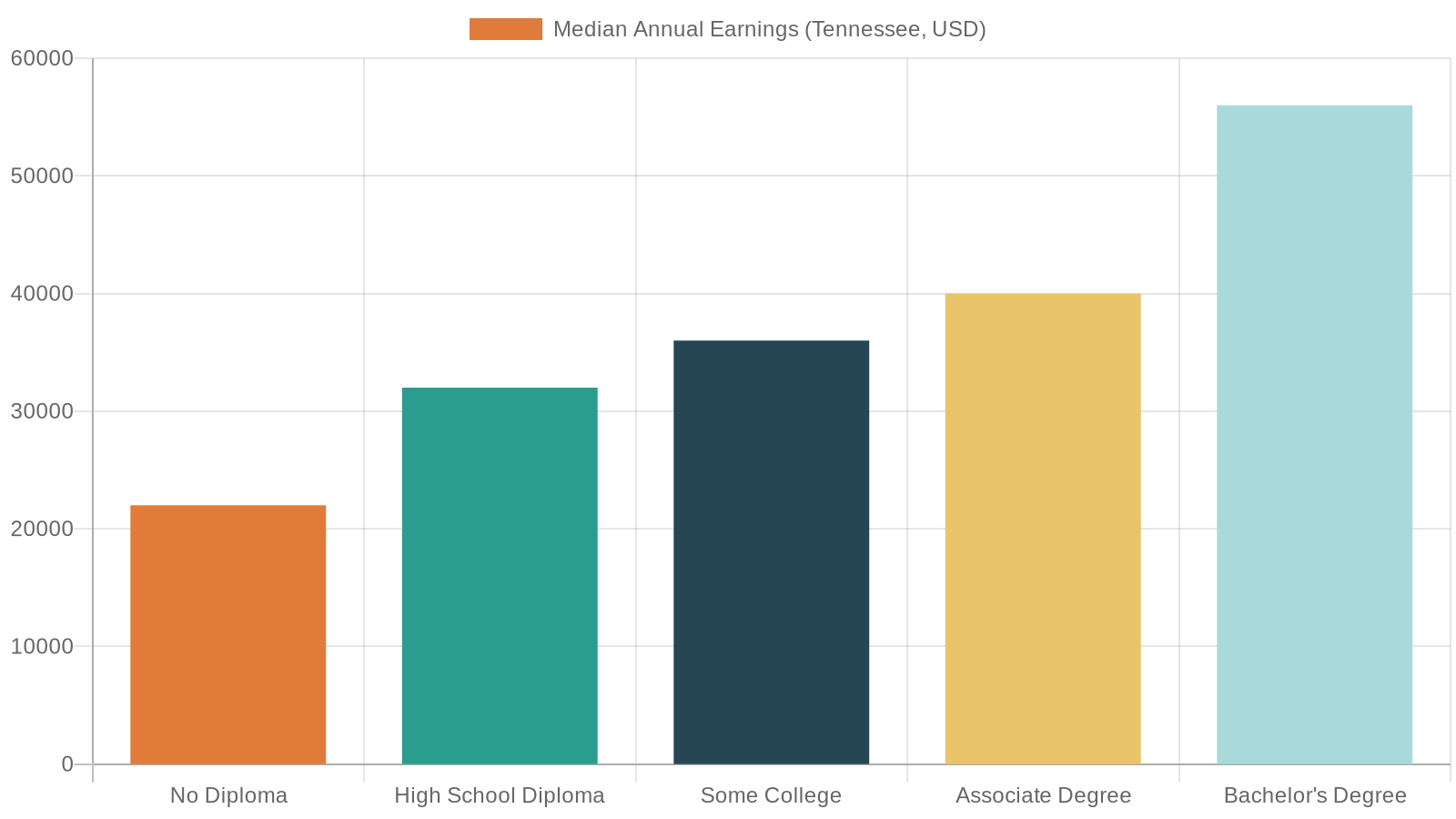
Youth unemployment rates are also consistently higher than the general population. Young adults without a high school diploma or GED face even steeper barriers — in Tennessee, workers without a diploma earn a median of $10,000 less per year than those with one, according to U.S. Census data.
Barriers Specific to Young Adults in the Job Market
Young adults face unique employment barriers: no work history, no professional references, no transportation, no childcare (for young parents), and sometimes a criminal record from juvenile or adult court. Employers often require experience that young adults have not had the chance to gain. Workforce development programs in Tennessee — including those funded through the Workforce Innovation and Opportunity Act (WIOA) — exist specifically to address these gaps, but many young adults do not know about them or cannot access them without stable housing and transportation first.
7. Domestic Violence and Unsafe Home Environments

For many young adults in Tennessee, homelessness is not a failure — it is an act of survival. Leaving a violent or unsafe home environment is often the safest decision a young person can make, even when it means having nowhere to go. The system’s job is to make sure ‘nowhere’ is never the only option.
Fleeing Violence Is Not a Choice — It's Survival
Domestic violence is a leading cause of homelessness for young women in Tennessee, and it also affects young men and nonbinary youth. When a young adult is in a relationship that becomes abusive — or when they are fleeing violence from a family member — leaving that environment often means leaving their only housing. Domestic violence shelters in Tennessee are frequently at capacity, and many have age restrictions or rules that make them inaccessible to young adults, especially those under 18.
The Tennessee Coalition to End Domestic and Sexual Violence reports that domestic violence hotlines in the state receive tens of thousands of calls annually. For young adults, the overlap between intimate partner violence and homelessness is significant — and the solutions require both safety planning and immediate housing access.
Unsafe Home Conditions Beyond Violence
Unsafe home environments are not limited to physical violence. Young adults may leave — or be pushed out of — homes where there is severe neglect, untreated parental mental illness, active substance use that creates danger, or extreme poverty that makes the home uninhabitable. These are not situations where the young person is being dramatic or making a bad choice. They are situations where staying would be more dangerous than leaving. Recognizing this is essential for service providers and community members who may otherwise judge a young person for not staying with family.
8. Involvement in the Justice System

The justice system and the housing system are deeply connected for many young adults in Tennessee. A record that follows a young person from their teens into their twenties can make stable housing nearly impossible to find — even when that person is doing everything right.
How a Record Creates a Housing Barrier
A criminal record — even a minor one from juvenile court — can close doors to housing, employment, and education for years. Many landlords in Tennessee conduct background checks and automatically reject applicants with any criminal history. Public housing authorities can deny applications based on certain convictions. This means that a young adult who has served their time and is trying to rebuild their life may find themselves locked out of the very resources they need to stay stable.
Young adults who have been incarcerated are 10 times more likely to experience homelessness than those who have not, according to research from the Prison Policy Initiative. In Tennessee, where incarceration rates are above the national average, this pipeline from justice involvement to homelessness affects a significant number of transition-age youth.
The Intersection of Youth Justice and Foster Care
Many young adults in the justice system were also in the foster care system — a phenomenon sometimes called the ‘foster care to prison pipeline.’ Young people who have experienced instability in care are more likely to have contact with the justice system, and that contact then creates additional barriers to housing and employment. Breaking this cycle requires upstream intervention — better support in foster care, diversion programs, and record expungement pathways for young adults who committed offenses as minors or young adults.
Root Causes of Youth Homelessness: At a Glance
Each of the 10 root causes of youth homelessness in Tennessee has different characteristics, affected populations, and prevention levers. Use this table to see them side by side.
9. Lack of Education and Early School Disconnection

Education is one of the most powerful pathways out of poverty and housing instability — but housing instability is also one of the most powerful barriers to education. For young adults in Tennessee, breaking this cycle requires both academic support and stable housing at the same time.
Dropping Out and Housing Instability Feed Each Other
Education and housing stability are deeply connected. Young adults who drop out of high school face significantly lower earning potential, which makes stable housing harder to afford. But the relationship also runs in the other direction: housing instability makes it extremely difficult to stay in school. Frequent moves mean changing schools, losing credits, and losing connections to teachers and counselors who might have helped. A young adult who is sleeping in a car or couch-surfing is not going to prioritize homework — they are focused on survival.
Tennessee’s high school graduation rate has improved in recent years, reaching approximately 90% in 2022, but that number masks significant disparities by race, income, and geography. In some Memphis and rural Tennessee zip codes, dropout rates remain much higher. Young adults who left school early often need GED pathways, adult education programs, or vocational training to access better employment — and those programs are not always easy to find or access.
McKinney-Vento and School Stability Rights
Young adults who are still in high school and experiencing homelessness have specific rights under the McKinney-Vento Homeless Assistance Act, including the right to remain enrolled in their school of origin, receive transportation, and access immediate enrollment without documents. Tennessee’s Department of Education has a McKinney-Vento coordinator, and every school district is required to have a homeless liaison. However, awareness of these rights among young people themselves is often low — which is exactly the kind of gap that YAAB members work to close through peer education and advocacy.
10. Systemic Gaps in Youth-Specific Services

Even when individual causes are addressed, systemic gaps in youth-specific services mean that many young adults in Tennessee fall through the cracks. The absence of coordinated, youth-centered systems is itself a cause of homelessness — and fixing it requires young people to have a seat at the table where those systems are designed.
The 'Too Old / Too Young' Problem
Transition-age youth often fall into a frustrating gap in the service system: too old for child welfare services, too young or too inexperienced to navigate adult systems. Adult homeless shelters can be unsafe or inappropriate for young adults, especially those who have experienced trauma. Youth-specific shelters and transitional housing programs exist in Tennessee’s major cities, but capacity is severely limited. In many rural counties, there are no youth-specific housing programs at all.
Tennessee’s Continuum of Care regions — including TN-500 (Memphis), TN-501 (Nashville), TN-502 (Knoxville), TN-503 (Chattanooga), TN-504 (Jackson/West TN), TN-506 (Upper Cumberland), TN-507 (Northeast TN), and TN-509 (Knox/Blount) — each have different levels of youth-specific capacity, and the gaps between regions are significant.
Coordination Gaps Between Systems
Even when services exist, they often do not talk to each other. A young adult leaving foster care may not be connected to housing services. A young adult leaving a juvenile detention facility may not have a housing plan. A young adult who drops out of school may lose their connection to a counselor who knew their situation. These coordination failures are systemic — they are not the fault of any individual caseworker, but they are the result of systems that were designed in silos. YAAB members across Tennessee advocate specifically for better coordination, data sharing, and youth-informed system design to close these gaps.
How These Causes Connect: Seeing the Full Picture

The ten causes outlined in this article do not operate in isolation. They form a web of interconnected factors that push young adults in Tennessee toward homelessness — and understanding how they connect is the key to building responses that actually work. Learn more about the full landscape of youth homelessness in Tennessee and what’s being done to address it at every level.
Intersectionality: When Multiple Causes Stack
Very few young adults experience homelessness because of a single cause. More often, it is a combination: a young person ages out of foster care (cause 2), cannot afford rent on a minimum-wage job (causes 3 and 6), has untreated PTSD from childhood trauma (cause 4), and lives in a county with no youth-specific shelter (cause 10). Each factor compounds the others, and the result is a crisis that feels impossible to escape without coordinated, sustained support.
This is why YAAB’s approach — centering the voices of young people with lived experience — is so important. Young adults who have navigated multiple systems simultaneously understand the intersections in ways that no policy document can fully capture. Their insights are not just valuable; they are essential.
Prevention Is Possible — and Young People Are Leading It
Understanding the root causes of youth homelessness is not just an academic exercise. It is the foundation for prevention. When we know that family conflict is the leading trigger, we can invest in family mediation and host home programs. When we know that aging out of foster care is a pipeline into homelessness, we can push for extended care and better transition planning. When we know that LGBTQ+ youth are overrepresented, we can fund affirming shelters and services. Every cause identified in this article has a corresponding prevention strategy — and young adults across Tennessee are advocating for those strategies right now through YAAB’s statewide advocacy work.
Ready to Get Involved? Here's Your Next Move

Understanding the causes of youth homelessness in Tennessee is the first step. The second step is doing something about it. Whether you are a young adult looking for support, a peer who wants to advocate, or a service provider looking to better serve transition-age youth, there are concrete ways to get involved — and YAAB is at the center of that work across the state.
Connect With Your Regional YAAB
If you are a young adult ages 17 to 25 in Tennessee — whether you have lived experience of homelessness or you just want to make a difference — there is a place for you in the Youth Action Board. YAAB has regional chapters across Tennessee’s Continuum of Care regions: find your local YAAB and connect with peers who are already doing this work in Memphis, Nashville, Knoxville, Chattanooga, Jackson, the Upper Cumberland, and Northeast Tennessee. You do not need to have all the answers. You just need to show up.
Resources for Young Adults Experiencing Housing Instability Right Now
If you or someone you know is experiencing homelessness or housing instability in Tennessee right now, here are immediate steps:
- Call 211 — Tennessee’s statewide resource hotline connects you to local shelter, food, and housing assistance 24/7.
- Contact your local Continuum of Care — Each region has a coordinated entry system for housing services. Ask about youth-specific programs.
- Know your McKinney-Vento rights — If you are still in high school, contact your school’s homeless liaison immediately.
- Visit YAAB’s resources page — for a curated list of housing, employment, education, and mental health resources for young adults across Tennessee.
You are not alone, and this is not your fault. Tennessee has young adults who have been where you are — and they are working every day to make the path forward clearer for everyone who comes after them.
Frequently Asked Questions
What is the most common cause of youth homelessness in Tennessee?
Family conflict and rejection — including LGBTQ+ youth being kicked out by their families — is consistently identified as the leading immediate trigger of youth homelessness in Tennessee and nationally. It is rarely about a single event; it is usually the result of long-standing instability at home.
How many youth are experiencing homelessness in Tennessee?
Tennessee's 2023 Point-in-Time Count identified over 1,200 unaccompanied youth experiencing homelessness, but advocates believe the true number is significantly higher because many young people avoid shelters and are not counted. Memphis and Nashville have the highest concentrations of counted youth homelessness in the state.
Why are LGBTQ+ youth overrepresented in youth homelessness?
LGBTQ+ youth make up an estimated 40% of homeless youth despite being roughly 7% of the general youth population. The primary driver is family rejection following a young person coming out. In Tennessee, this is compounded in some communities by additional layers of stigma and a shortage of LGBTQ+-affirming shelter and service options.
What happens to Tennessee youth when they age out of foster care?
In Tennessee, young people typically age out of foster care at 18, though extended support is available up to 21 through the Independent Living program. Without family support or a housing plan, many face homelessness quickly — nationally, one in five youth who age out of foster care experience homelessness within two years of leaving the system.
What rights do homeless youth have in Tennessee schools?
Under the federal McKinney-Vento Homeless Assistance Act, youth experiencing homelessness have the right to remain enrolled in their school of origin, receive free transportation, and enroll immediately without documents. Every Tennessee school district is required to have a homeless liaison who can help students access these rights.
How can a young adult in Tennessee get involved with the Youth Action Board?
Young adults ages 17 to 25 across Tennessee can connect with their regional YAAB chapter — there are chapters covering Memphis, Nashville, Knoxville, Chattanooga, Jackson, Upper Cumberland, and Northeast Tennessee. No prior experience or expertise is required — just a willingness to show up and share your perspective. Visit yaabtn.org/local-yaabs/ to find your region.