Quick answer: Youth-led policy advocacy means young adults ages 17 to 25 who have experienced homelessness or housing instability use their real-life knowledge to shape the laws, programs, and funding decisions that affect them. In Tennessee, the Youth Action Board (YAAB) is the statewide network that makes this happen — connecting young people in Memphis, Nashville, Knoxville, Chattanooga, and beyond to local Continuum of Care leaders, state legislators, and service providers. YAAB members don't just receive services; they design them, critique them, and fight to make them better.
1. What 'Youth-Led Policy Advocacy' Actually Means

Before we can talk about how youth-led advocacy works in Tennessee, it helps to break down what the phrase actually means — because it gets used a lot, and not always accurately. Youth-led policy advocacy is a specific, structured practice where young people with direct experience of homelessness or housing instability take an active role in designing, critiquing, and improving the systems meant to serve them. It is not a focus group. It is not a photo opportunity. It is real power-sharing.
Policy Advocacy vs. Charity: A Critical Difference
Charity gives someone a meal. Policy advocacy changes the system so fewer people go hungry in the first place. Youth-led policy advocacy takes that one step further: it insists that the young people most affected by a broken system are the ones best qualified to fix it.
When a 20-year-old who aged out of foster care in Memphis sits at a table with Shelby County’s Continuum of Care board and explains exactly why the current rapid-rehousing waitlist process fails youth — that’s advocacy. When that same person drafts a recommendation that gets adopted into the county’s housing plan, that’s policy change.
- Advocacy = speaking up, educating decision-makers, and pushing for change
- Policy = the rules, funding formulas, and program designs that govern how services work
- Youth-led = young people with lived experience drive the agenda, not just participate in it
Why 'Lived Experience' Is a Credential, Not a Liability
In traditional policy spaces, professional degrees open doors. In youth-led advocacy, lived experience is the credential. A young adult who has navigated a shelter intake process, been turned away from transitional housing because of a background check, or lost a job because they had no stable address knows things that no policy report can fully capture.
Research consistently backs this up. According to the U.S. Interagency Council on Homelessness, programs co-designed with people who have experienced homelessness are significantly more likely to be used and trusted by the communities they serve. Tennessee’s YAAB model is built on exactly this principle: the people closest to the problem are closest to the solution.
2. The Scale of Youth Homelessness in Tennessee

Good advocacy starts with understanding the problem at scale. Tennessee’s youth homelessness crisis is real, measurable, and unevenly distributed across the state’s eight Continuum of Care (CoC) regions. Knowing the numbers — and knowing their limits — is essential for any young person who wants to walk into a policy conversation with credibility.
Point-in-Time Count Data Across Tennessee's Regions
Every January, communities across the country conduct a Point-in-Time (PIT) count — a single-night snapshot of people experiencing homelessness. Tennessee’s 2023 PIT count identified approximately 8,200 people experiencing homelessness statewide, with transition-age youth (ages 18–24) making up a disproportionate share of the unsheltered population.
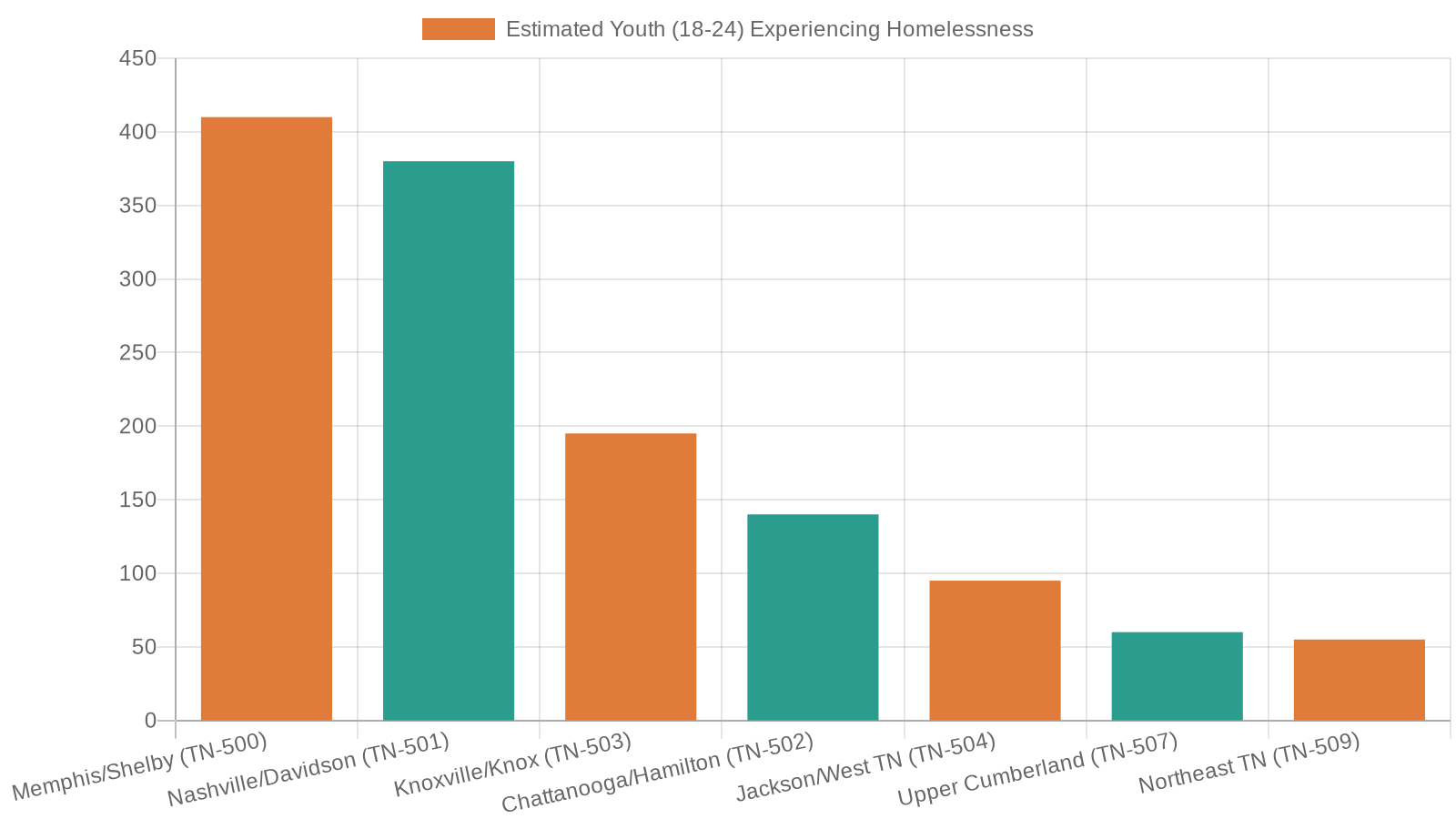
The numbers vary significantly by region. Shelby County (Memphis) and Davidson County (Nashville) consistently record the highest raw counts, but rural regions like Upper Cumberland and Northeast Tennessee often have fewer shelter options, meaning youth there are more likely to be couch-surfing or living in cars — situations that are harder to count and easier to ignore.
- Memphis/Shelby (TN-500): Largest urban count in the state
- Nashville/Davidson (TN-501): Rapid population growth has tightened the affordable housing market severely
- Knoxville/Knox (TN-503): Significant youth population near the University of Tennessee corridor
- Rural regions: Chronic undercount due to hidden homelessness (couch-surfing, doubled-up households)
Who Is Most at Risk Among Transition-Age Youth?
Not all transition-age youth face the same level of risk. Research from True Colors United and the Williams Institute identifies several groups with sharply elevated rates of homelessness:
- Youth aging out of foster care: In Tennessee, roughly 700–900 young people age out of the foster care system each year. Without a family safety net, many experience homelessness within 12–18 months of aging out.
- LGBTQ+ youth: National data shows LGBTQ+ youth are 120% more likely to experience homelessness than their peers, often due to family rejection.
- Young adults of color: Structural inequities mean Black and Indigenous youth are overrepresented in homeless counts nationwide and in Tennessee.
- Youth with justice system involvement: A prior record can block access to housing programs, creating a direct pipeline from incarceration to the streets.
Understanding who is most affected is the first step toward designing advocacy that actually reaches the people who need it most.
3. What Is the Continuum of Care — and Why Does It Matter to You?

If you’ve ever tried to access housing services in Tennessee, you’ve probably encountered the Continuum of Care system — even if nobody called it that. Understanding how CoCs work is foundational to understanding why youth-led advocacy matters and where young people can have the most impact.
How the CoC System Works
A Continuum of Care (CoC) is a regional planning body funded by the U.S. Department of Housing and Urban Development (HUD). Each CoC is responsible for coordinating homeless services, allocating federal funding, and setting local priorities for who gets housed first and how. Tennessee has eight CoC regions, each with its own board, data systems, and funding competitions.
CoC boards make decisions that directly affect young people: Which shelter gets funded? Does the region prioritize families or single adults? Are youth-specific programs included in the annual funding application? These are not abstract bureaucratic questions — they determine whether a 19-year-old in Chattanooga has a safe place to sleep tonight.
The Youth Action Board's Role Inside the CoC
YAAB was created specifically to give transition-age youth a formal, ongoing voice inside each CoC region. YAAB members attend CoC meetings, review funding applications, and provide feedback on whether proposed programs actually match what young people need. This is called meaningful youth engagement — and HUD has increasingly required it as a condition of federal funding.
In practical terms, this means a YAAB member in Nashville might review a proposed rapid-rehousing program and flag that its income requirements are too strict for youth who are just entering the workforce. That feedback can change the program before it launches — saving time, money, and lives. You can learn more about each regional YAAB at the YAAB local chapters page.
4. How YAAB Tennessee Structures Youth-Led Advocacy

YAAB Tennessee isn’t a single organization with a single office — it’s a living network of young leaders spread across the state. Understanding how it’s structured helps you figure out where you fit and how your voice can travel from your neighborhood all the way to the state capitol.
The Statewide Network and Regional Chapters
YAAB Tennessee operates as a statewide network with local chapters embedded in each CoC region. Each regional YAAB — from TN-500 in Memphis to TN-509 in Northeast Tennessee — has its own members, meeting schedule, and local priorities. The statewide network connects these chapters, shares resources, and amplifies regional voices at the state level.
This structure matters because homelessness looks different in Memphis than it does in Johnson City. A one-size-fits-all policy rarely works. By having regional chapters, YAAB ensures that the specific barriers young people face in each part of Tennessee are heard by the people making decisions in that region.
What YAAB Members Actually Do Day-to-Day
Being a YAAB member is not just showing up to meetings. Members engage in a range of activities depending on their region and interests:
- Attending CoC board meetings and providing formal public comment
- Reviewing grant applications to ensure youth-specific needs are included
- Conducting peer outreach to connect other young people to housing and support resources
- Participating in legislative advocacy — including testifying before Tennessee General Assembly committees
- Co-designing programs with service providers so that new initiatives actually work for youth
- Training service providers on trauma-informed, youth-centered approaches
Members are compensated for their time — because advocacy is work, and YAAB respects that.
5. The 5 Core Issues YAAB Members Advocate For

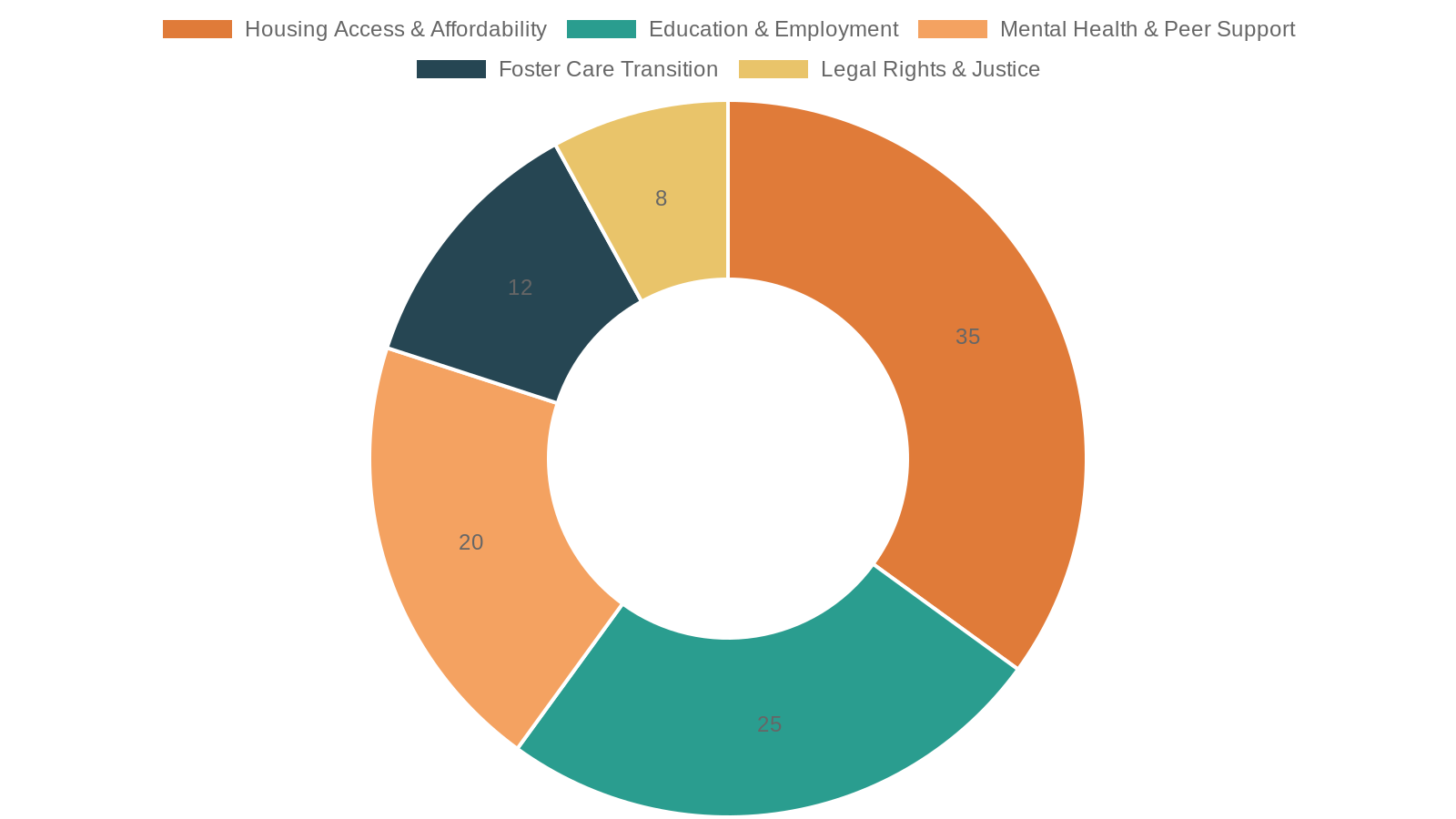
Youth-led advocacy isn’t scattered — it’s focused on the specific, interconnected issues that keep young people from achieving stability. YAAB members across Tennessee’s eight regions have identified five core areas where policy change can make the biggest difference in the shortest time.
Housing Access and Affordability
The most urgent issue is also the most obvious: young people need safe, affordable places to live. YAAB members advocate for youth-specific housing programs — including transitional housing, rapid rehousing, and permanent supportive housing — that don’t require a credit history, a co-signer, or a background check that disqualifies someone for a decade-old charge. Tennessee’s fair market rent for a one-bedroom apartment in Nashville exceeded $1,200/month in 2024, making it nearly impossible for a young adult earning minimum wage ($7.25/hour in Tennessee) to afford housing without assistance.
Education, Employment, and Financial Stability
Stable housing and economic stability are inseparable. YAAB members push for policies that connect youth to GED programs, workforce training, and jobs that pay living wages. They also advocate for financial literacy resources — things like bank account access, credit-building programs, and help navigating student financial aid — that many young adults never received because they didn’t have stable family support.
Key advocacy wins in this area include pushing CoC partners to fund employment case managers specifically for transition-age youth and advocating for Tennessee’s Workforce Innovation and Opportunity Act (WIOA) funds to be more accessible to youth experiencing homelessness.
Mental Health, Trauma, and Peer Support
Experiencing homelessness is traumatic. So is aging out of foster care, fleeing an unsafe home, or surviving on the streets. YAAB members advocate for trauma-informed care across all service systems — meaning that every caseworker, shelter staff member, and program coordinator understands how trauma affects behavior and responds with patience rather than punishment.
Peer support is a particularly powerful tool. Young people are more likely to trust and engage with someone who has been through similar experiences. YAAB members advocate for paid peer specialist positions within shelters, housing programs, and mental health agencies across Tennessee.
6. Aging Out of Foster Care: A Pipeline to Homelessness

For thousands of young people in Tennessee, the foster care system is supposed to be a safety net. But when that net drops them at 18 — or 21 — without stable housing, a job, or a support system, the result is often homelessness. This is one of the most urgent issues YAAB members across the state are fighting to change.
What Happens When the System Lets Go
In Tennessee, young people in foster care can receive extended services until age 21 through the Tennessee Department of Children’s Services (DCS) Extended Foster Care program. But many youth don’t know this option exists, are pressured to leave early, or age out before they’ve built the skills and connections needed to live independently.
National data from Chapin Hall’s Voices of Youth Count study found that 1 in 3 young people who age out of foster care will experience homelessness within two years. In Tennessee, advocates estimate that between 30–40% of youth experiencing homelessness have a foster care history. That’s not a coincidence — it’s a system failure that YAAB members are actively working to change.
Policy Changes YAAB Advocates for Foster Youth
YAAB members who have aged out of foster care bring unique authority to this conversation. Their advocacy priorities in this area include:
- Raising the age of extended foster care to 23 or 25, aligning with brain development research
- Requiring transition planning to start at age 14, not 17, so youth have years — not months — to prepare
- Eliminating policies that penalize youth for having a job or savings while in foster care
- Expanding Chafee Independent Living funds so more youth can access housing deposits, vocational training, and life skills support
- Creating youth-friendly housing priority pathways within CoC Coordinated Entry systems so former foster youth aren’t competing on equal footing with adults who have had years to accumulate resources
7. Knowing Your Rights as a Young Person Experiencing Homelessness

One of the most powerful things advocacy can do is make sure young people know what they’re already entitled to. Too often, rights go unclaimed simply because no one explained them. Here’s what every transition-age youth in Tennessee should know about their legal protections — and what YAAB members are pushing to strengthen.
Federal Protections You Should Know
Young people experiencing homelessness have legal rights that many service providers don’t always explain clearly. Key federal protections include:
- McKinney-Vento Homeless Assistance Act: Guarantees K-12 students experiencing homelessness the right to immediate school enrollment, transportation, and academic support. If you are 17 and still in high school, this applies to you.
- HEARTH Act: Requires CoC programs to serve unaccompanied youth and to track youth-specific data.
- LGBTQ+ Equal Access Rule: HUD-funded shelters cannot discriminate based on sexual orientation or gender identity. If you’ve been turned away from a shelter in Tennessee for being LGBTQ+, that may be a civil rights violation.
- FERPA: Your educational records are private, even if you are homeless or in foster care.
Tennessee-Specific Rights and Protections
At the state level, Tennessee has several policies that affect transition-age youth:
- Minor Consent Laws: In Tennessee, youth ages 16 and older can consent to certain mental health and substance use treatment without parental permission.
- Extended Foster Care: Youth in Tennessee foster care can voluntarily remain in care until age 21 under the Fostering Connections Act. You must opt in — ask your DCS worker before your 18th birthday.
- Tenant Rights: Even if you are under 18 and have signed a lease (which requires a co-signer in most cases), you have basic tenant rights under Tennessee landlord-tenant law, including the right to a habitable unit and proper notice before eviction.
For a full list of resources and rights information, visit the YAAB Tennessee resources page.
Youth-Led Advocacy vs. Traditional Advocacy: How They Compare
Understanding the difference between youth-led and traditional advocacy models helps clarify why YAAB's approach produces better outcomes for transition-age youth in Tennessee.
8. What Makes Youth-Led Advocacy Different From Traditional Advocacy

Youth-led advocacy isn’t just advocacy with young people in the room. It’s a fundamentally different model of how change happens — one that centers the expertise of lived experience over professional credentials. Understanding what makes it different helps explain why it works, and why YAAB’s model is worth paying attention to.
The Problem With 'Nothing About Us Without Us' Being Ignored
The phrase “nothing about us without us” has been a rallying cry in disability rights and homeless advocacy for decades. But in practice, many organizations still treat youth as subjects to be served rather than leaders to be followed. Traditional advocacy often means adults with professional credentials speaking on behalf of young people — with the best intentions, but without the lived knowledge that makes policy actually work.
Youth-led advocacy flips this. It means young people set the agenda, define the problems, and propose the solutions. Adults and professionals become supporters of that process, not directors of it. This isn’t just more ethical — it’s more effective. Programs designed with youth input have higher engagement rates, lower dropout rates, and better outcomes across housing, education, and employment domains.
Barriers Young Advocates Face — and How YAAB Addresses Them
Youth-led advocacy faces real structural barriers that traditional advocacy doesn’t:
- Transportation: Getting to a CoC meeting across town is hard without a car or transit access. YAAB provides stipends and transportation support.
- Time and stability: It’s hard to advocate when you’re focused on survival. YAAB compensates members for their time so advocacy doesn’t compete with basic needs.
- Credibility gatekeeping: Decision-makers sometimes dismiss young people’s input as anecdotal. YAAB trains members in data literacy and public speaking so they can present their experience alongside research.
- Trauma and burnout: Repeatedly sharing painful experiences in policy spaces is exhausting. YAAB builds in peer support, wellness check-ins, and the option to step back without losing your place in the community.
9. Real Impact: What Youth Advocacy Has Changed in Tennessee

It’s easy to be skeptical about whether advocacy actually changes anything. So let’s talk about what YAAB members across Tennessee have actually accomplished — because the wins are real, even when they don’t make headlines.
Policy and Program Wins Driven by YAAB Members
Youth-led advocacy in Tennessee has produced concrete, measurable changes. YAAB members have:
- Successfully advocated for youth-specific set-asides in multiple CoC funding competitions, ensuring that a portion of HUD dollars is reserved for programs serving transition-age youth
- Contributed to the development of youth-specific Coordinated Entry pathways in several regions, reducing the time it takes for young people to be connected to housing
- Provided testimony that influenced Tennessee General Assembly discussions on extended foster care and housing funding
- Partnered with service providers to redesign intake forms and shelter rules that were unintentionally hostile to youth — for example, removing policies that banned guests, which isolated young people from their support networks
The Ripple Effect: Peer-to-Peer Impact
Beyond formal policy wins, YAAB members create change through peer connection. When a young person in Knoxville who has been through the shelter system helps a peer navigate the same process, that’s advocacy in action. When a YAAB member in Jackson trains shelter staff on how to talk to youth without triggering trauma responses, that changes the day-to-day experience of every young person who walks through that door.
This peer-to-peer impact is harder to quantify than a policy win, but it may be equally important. Research from the National Alliance to End Homelessness shows that peer outreach workers are significantly more effective at engaging people who are unsheltered than traditional outreach approaches. YAAB members are living proof of this principle.
10. How to Get Involved With Youth-Led Advocacy in Tennessee

Everything in this article points toward one question: what do you do next? Whether you’re a young person who has experienced homelessness, a peer who wants to support others, or a case manager looking to connect clients to leadership opportunities — there’s a place for you in Tennessee’s youth-led advocacy movement. Here’s how to find it.
Joining Your Regional YAAB
If you are between 17 and 25 and have experienced homelessness or housing instability, you are eligible to join your regional YAAB. Each chapter has its own onboarding process, meeting schedule, and set of active projects. Here’s where to start:
- Memphis/Shelby (TN-500): TN-500 YAAB chapter
- Nashville/Davidson (TN-501): TN-501 YAAB chapter
- Knoxville/Knox (TN-503): Contact through the statewide network
- Chattanooga/Hamilton (TN-502): Contact through the statewide network
- All regions: Start at the YAAB Tennessee join page and someone will connect you to your local chapter
You don’t need experience in policy or advocacy. You need your story, your perspective, and the willingness to show up.
Ways to Engage Beyond Membership
Not ready to join a chapter yet? There are other ways to engage with youth-led advocacy in Tennessee:
- Attend a public CoC meeting in your region — they are open to the public and your presence matters
- Share your story with a YAAB member or case manager who can anonymize it and use it to inform policy discussions
- Follow YAAB on social media and amplify advocacy campaigns during key legislative moments
- Connect your peers to resources and information — peer-to-peer outreach is one of the most powerful forms of advocacy
Ready to take the next step? Explore the full range of YAAB Tennessee’s advocacy work and current campaigns to find where your energy fits best.
Frequently Asked Questions
What is youth-led policy advocacy for homeless youth in Tennessee?
Youth-led policy advocacy means young adults ages 17 to 25 who have experienced homelessness or housing instability use their lived knowledge to shape the laws, programs, and funding decisions that affect them. In Tennessee, the Youth Action Board (YAAB) is the statewide network that organizes this advocacy across all eight Continuum of Care regions.
How do I join a YAAB chapter in Tennessee?
If you are between 17 and 25 and have experienced homelessness or housing instability, you can join your regional YAAB chapter. Start at yaabtn.org/join and you'll be connected to the chapter in your area. No prior advocacy experience is required — your lived experience is your qualification.
What is a Continuum of Care and how does it affect young people?
A Continuum of Care (CoC) is a HUD-funded regional planning body that coordinates homeless services and allocates federal housing funds. CoC boards decide which programs get funded and how services are prioritized. YAAB members participate in CoC meetings to make sure transition-age youth needs are included in those decisions.
Do YAAB members get paid for their advocacy work?
Yes. YAAB recognizes that advocacy is work and compensates members with stipends for their time. This is a core part of YAAB's model — making sure that participation in advocacy doesn't compete with meeting basic needs like food, transportation, or rent.
What rights do homeless youth have in Tennessee?
Homeless youth in Tennessee have several important protections, including the right to immediate school enrollment under the McKinney-Vento Act, the right to remain in foster care until age 21 under Tennessee's Extended Foster Care program, and protections against discrimination in HUD-funded shelters based on sexual orientation or gender identity. Visit yaabtn.org/resources for a full overview.
How does aging out of foster care connect to youth homelessness in Tennessee?
Approximately 700–900 young people age out of Tennessee's foster care system each year. Without a family safety net, many experience homelessness within 12–18 months of aging out. YAAB members who have aged out of foster care advocate for stronger transition planning, extended care options, and youth-priority housing pathways to break this cycle.