Quick answer: Lived experience youth advisory boards — like the Youth Action Board (YAAB) of Tennessee — put young adults ages 17 to 25 who have faced homelessness or housing instability directly in the room where housing decisions get made. In Jackson and across West Tennessee's Continuum of Care region (TN-507), YAAB members advise local leaders, review programs, and connect peers to real resources. Their firsthand knowledge makes housing systems more effective, more equitable, and more likely to actually work for the young people who need them most.
What Is a Lived Experience Youth Advisory Board?

Before diving into the seven specific ways a lived experience advisory board shapes housing programs in Jackson, Tennessee, it helps to understand exactly what these boards are — and why they exist in the first place. The concept is straightforward but powerful: the people most directly affected by a system are often the most qualified to improve it.
Defining 'Lived Experience' in the Housing Context
Lived experience means you have personally navigated homelessness, housing instability, couch-surfing, aging out of foster care, or a similar crisis — not just read about it. In the housing policy world, that firsthand knowledge is increasingly recognized as a form of expertise that no degree or training can fully replicate.
When a young adult who has slept in a shelter, fought to keep their apartment, or aged out of foster care at 18 sits on an advisory board, they bring insight that changes the questions being asked — and the solutions being proposed. They know which shelter rules feel punishing, which application forms are confusing, and which services actually show up when you need them.
How Advisory Boards Differ from Traditional Committees
Traditional housing committees are often made up of administrators, funders, and service providers. Advisory boards with lived experience members flip that dynamic. Young adults are not just consulted as an afterthought — they are decision-influencing partners who review program designs, flag gaps, and advocate for policy changes before those policies are finalized.
- Traditional committees: professionals advising other professionals
- Lived experience boards: people most affected by a system helping to redesign it
- YAAB model: peer-to-peer leadership with formal advisory power inside Tennessee’s Continuum of Care structure
The National Shift Toward Youth Voice in Housing Policy
The U.S. Department of Housing and Urban Development (HUD) now requires Continuums of Care to meaningfully engage youth with lived experience in their planning processes. As of 2023, HUD’s Youth Homelessness System Improvement guidance explicitly calls for youth advisory structures with real decision-making influence — not token participation. Tennessee’s YAAB network was built to meet and exceed that standard, giving young adults in every region, including Jackson and West Tennessee, a formal seat at the table.
1. Mapping the Real Landscape of Youth Homelessness in Jackson, TN

You can’t fix a problem you don’t fully understand. One of the first and most important contributions a lived experience youth advisory board makes is helping local housing planners see the true scope and texture of youth homelessness in Jackson and the surrounding West Tennessee region — not just what shows up in official counts.
What the Numbers Tell Us About West Tennessee
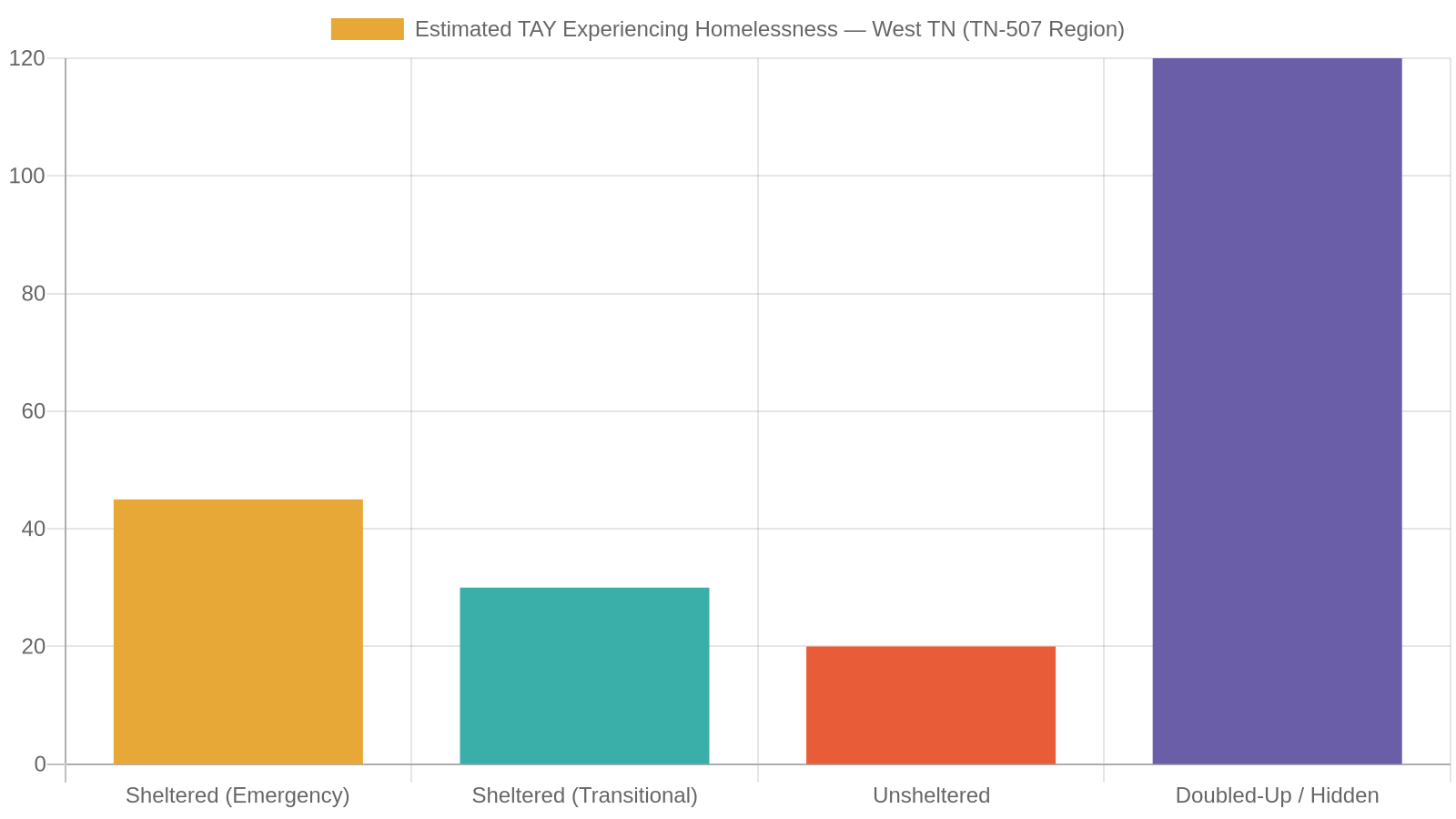
Jackson sits in Madison County, the hub of West Tennessee’s Continuum of Care region (TN-507). During the 2023 Point-in-Time (PIT) count — an annual snapshot of homelessness conducted every January — Tennessee counted hundreds of transition-age youth (ages 18–24) experiencing homelessness on a single night. West Tennessee’s rural and semi-rural geography means many young people experiencing housing instability are invisible to official counts: doubling up with family, sleeping in cars, or couch-surfing in ways that don’t show up in shelter data.
YAAB members in the TN-507 region know this reality personally. They help local CoC planners understand that the PIT count is a floor, not a ceiling, when it comes to understanding youth need.
Why Local Knowledge Outperforms Statewide Averages
Statewide data from the Tennessee Interagency Council on Homelessness (TICH) is useful, but it can mask hyper-local realities. In Jackson, factors like limited public transit, a shortage of affordable one-bedroom units (vacancy rates for units under $700/month have hovered near 2–3% in recent years), and gaps in mental health services create a specific landscape that a Nashville-based planner might not fully grasp.
Lived experience board members from Jackson can say: “The bus doesn’t run after 7 p.m., so that job training program across town is effectively inaccessible.” That kind of ground-level intelligence reshapes program design in ways that spreadsheets cannot.
2. Reviewing Housing Programs Before They Launch

Designing a housing program without input from the people it’s meant to serve is like designing a shoe without measuring anyone’s foot. YAAB members in the TN-507 region participate in formal program reviews — examining eligibility criteria, intake processes, and program rules to identify what works and what creates unnecessary barriers for young adults.
Catching Barriers Before They Become Policy
Housing programs often include eligibility rules, documentation requirements, or behavioral expectations that seem neutral on paper but create real barriers for young adults. Common examples include:
- Requiring a government-issued ID that many youth aging out of foster care don’t have
- Mandating sobriety as a condition of entry into transitional housing, which can exclude youth who need harm-reduction support
- Setting income minimums that disqualify youth who are between jobs or in part-time work
YAAB members review these program designs and flag barriers before they are baked into grant applications or service contracts. That early intervention saves programs from launching with built-in exclusions.
The 'Nothing About Us Without Us' Standard
The phrase “nothing about us without us” originated in disability rights advocacy and has become a guiding principle for lived experience advisory work. For youth housing programs in Jackson, it means that any new shelter, rapid rehousing initiative, or transitional housing program should be reviewed by young adults who have used similar services — before it goes live.
In practice, this looks like YAAB members sitting in on CoC planning meetings, completing structured program reviews, and submitting written feedback that is formally documented in grant applications. HUD now asks CoCs to demonstrate this engagement, making YAAB participation not just ethical but strategically necessary for local funding.
3. Advocating for Policy Changes at the Local and State Level

Advisory boards that stop at advising miss half the picture. YAAB members in Jackson and across West Tennessee are also advocates — people who take what they learn in planning meetings and carry it into public forums, legislative hearings, and community conversations where housing policy actually gets written.
From Jackson City Hall to the Tennessee Capitol
YAAB members don’t just advise behind closed doors — they advocate publicly. In Tennessee, that means showing up at city council meetings in Jackson, testifying before county commissions in Madison County, and traveling to Nashville to speak with state legislators about bills that affect transition-age youth. When a young adult with lived experience testifies about what it felt like to age out of foster care with nowhere to go, it lands differently than a policy brief.
Recent advocacy priorities for Tennessee’s YAAB network have included expanding Medicaid coverage for youth aging out of foster care, increasing state investment in transitional housing, and pushing for stronger tenant protections for young renters.
How Advocacy Connects to Housing Funding
Policy advocacy has direct financial consequences. When YAAB members help make the case for increased housing investment, they are influencing how federal and state dollars flow into communities like Jackson. Tennessee receives millions in annual HUD funding through the Continuum of Care program — in the 2023 grant cycle, Tennessee CoCs collectively received over $30 million in HUD CoC Program funding. How that money is allocated, and which populations are prioritized, is shaped in part by the advocacy work that lived experience boards do year-round.
4. Connecting Peers to Housing Resources in the TN-507 Region

One of the most immediate and tangible ways YAAB members make a difference is by acting as bridges — connecting peers who are struggling with housing to the programs and services that can help them. In Jackson and West Tennessee, knowing what exists and how to access it can be the difference between staying housed and ending up on the street.
Peer Navigation: Why It Works
Research consistently shows that young adults are more likely to engage with services when they are introduced by a peer — someone who has been through a similar experience — rather than a professional they’ve just met. A 2021 study published in the Journal of Adolescent Health found that peer-delivered services for homeless youth significantly increased engagement rates compared to traditional outreach models.
YAAB members in the TN-507 region serve as informal peer navigators — connecting friends, classmates, and community members to emergency shelter, rapid rehousing programs, and support services in Jackson and surrounding counties. That word-of-mouth network reaches young people who would never walk into a service office on their own.
Key Housing Resources Available in Jackson and West Tennessee
Young adults in the Jackson area can access several housing-related resources, including:
- Emergency shelter: Local shelters in Jackson that accept transition-age youth, including some with low-barrier entry policies
- Rapid Rehousing (RRH): Short-term rental assistance and case management to help young adults move quickly from homelessness into stable housing
- Transitional Housing: Longer-term supported housing (typically 18–24 months) with life skills programming
- Tennessee’s Coordinated Entry System: A standardized intake process that connects youth to the right level of housing support based on their needs
- PATH (Projects for Assistance in Transition from Homelessness): Outreach and mental health services for youth experiencing homelessness
YAAB members help peers understand how to access these systems — including how to navigate the Coordinated Entry process, which can feel confusing without a guide.
5. Shaping How Services Address Race, Gender, and Identity

Effective housing programs don’t treat all young adults as identical. YAAB members — who reflect the real diversity of Tennessee’s transition-age youth population — help ensure that programs are designed to work for everyone, not just the easiest-to-serve. That means centering conversations about race, gender identity, sexual orientation, and disability in program design from the start.
Disproportionate Impact on Black Youth and LGBTQ+ Young Adults
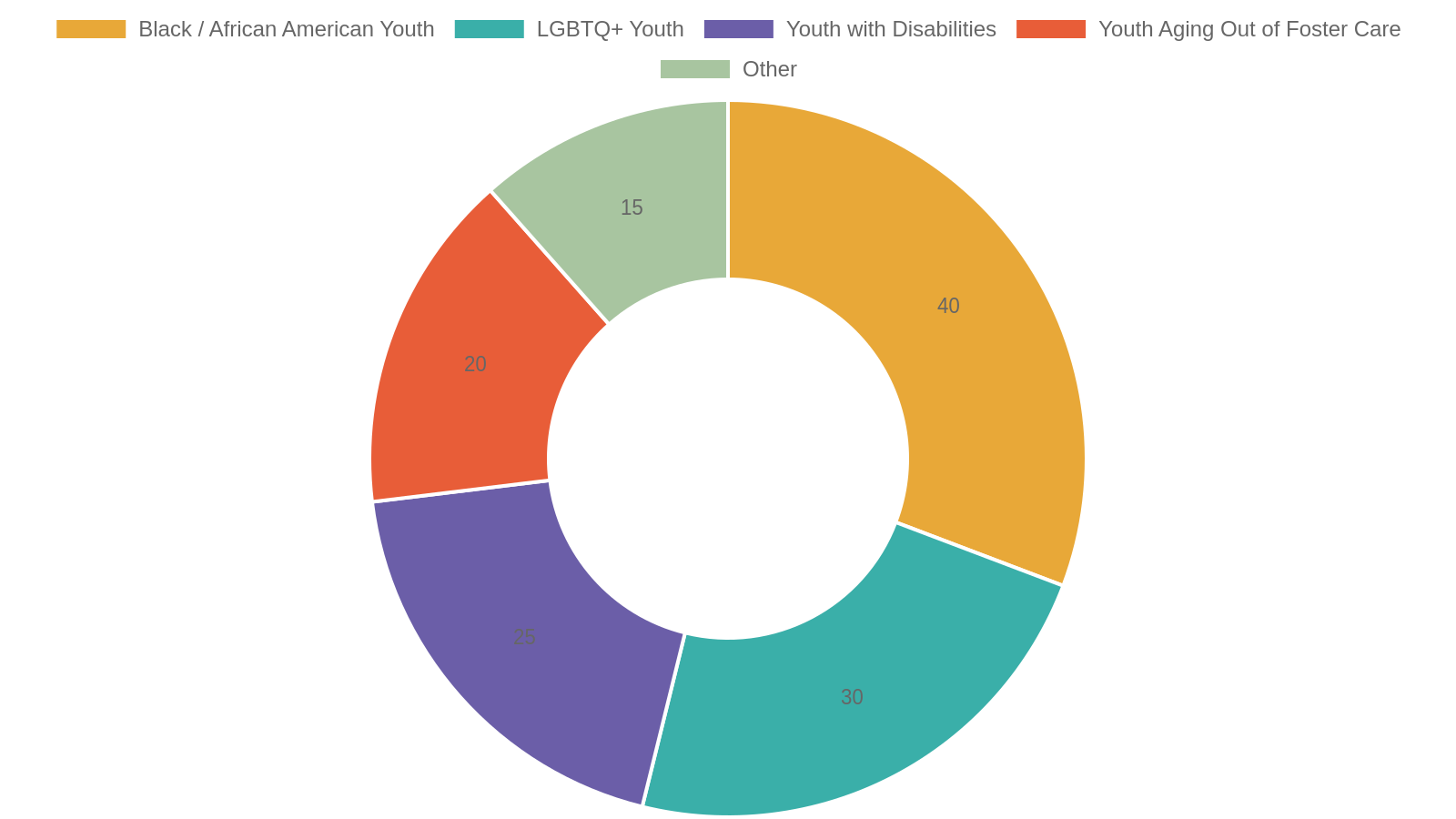
Youth homelessness is not evenly distributed. Nationally, Black youth are overrepresented in the homeless population at roughly 40% of all homeless youth despite being approximately 14% of the general youth population. LGBTQ+ youth face similarly stark disparities — estimates suggest they make up 20–40% of all homeless youth nationally, often because family rejection follows coming out.
In Jackson and West Tennessee, these national patterns play out locally. YAAB members who belong to these communities bring irreplaceable perspective on which program rules, shelter environments, and service approaches feel safe — and which feel hostile or exclusionary — for Black youth and LGBTQ+ young adults.
Building Culturally Responsive Programs
A shelter that doesn’t feel safe for a young Black man or a transgender teenager will not be used, no matter how many beds it has. Lived experience board members help programs think through:
- Staff training on anti-racism and LGBTQ+ inclusion
- Gender-affirming shelter policies (e.g., room assignments based on gender identity)
- Culturally responsive case management that doesn’t assume a one-size-fits-all path to stability
- Trauma-informed practices that recognize the cumulative impact of racism, family rejection, and housing instability
These are not abstract DEI checkboxes — they are practical design decisions that determine whether a young person walks through the door and stays.
6. Holding Programs Accountable After They Launch

Getting a housing program funded and launched is only the beginning. The harder work is making sure it actually delivers results for the young adults it’s meant to serve. YAAB members play a critical role in ongoing program evaluation — not as critics, but as informed partners who want programs to succeed.
Beyond the Ribbon-Cutting: Ongoing Program Evaluation
A program that looks good on paper can fail in practice. YAAB members don’t disappear after a program launches — they continue to gather feedback from peers who are using the services, identify problems as they emerge, and bring that information back to CoC planners and program administrators.
This ongoing accountability function is especially important for rapid rehousing programs, where the quality of case management and the speed of housing placement can vary dramatically. YAAB members in TN-507 can flag when a program is taking too long to place youth, when case managers are hard to reach, or when landlord relationships are breaking down — before those problems become crises.
Using Data to Drive Improvement
Tennessee’s CoC regions use the Homeless Management Information System (HMIS) to track outcomes for people experiencing homelessness. YAAB members are increasingly being trained to read and interpret HMIS data — understanding metrics like average length of time from program entry to housing placement, return-to-homelessness rates, and program exit destinations.
When a YAAB member can say, “Our rapid rehousing program is averaging 94 days to placement, but the national benchmark is 30 days — what’s causing the delay?” — that is a powerful accountability question that drives real improvement. Nationally, effective rapid rehousing programs aim to house participants within 30 days of program entry; programs exceeding 60 days are flagged for review.
How Lived Experience Advisory Boards Compare to Traditional Housing Committees
Not all advisory structures are created equal. Here's how a lived experience youth advisory board like YAAB stacks up against traditional housing committee models across five key dimensions.
7. Building Leadership Skills and Pathways for YAAB Members Themselves

The benefits of a lived experience youth advisory board flow in both directions. Yes, YAAB members improve housing programs for their peers — but the experience of serving on a board also transforms the members themselves. Participation in YAAB is a leadership development pathway for young adults who have often been told their experiences are liabilities rather than assets.
What YAAB Membership Offers Young Adults
Joining a YAAB isn’t just about giving back — it’s also about gaining real skills and opportunities. Members across Tennessee’s regional boards develop:
- Public speaking and testimony skills through advocacy training and legislative visits
- Policy literacy — understanding how HUD funding works, what a Continuum of Care does, and how local housing decisions get made
- Professional networking with CoC leaders, nonprofit directors, and government officials
- Stipends and compensation for their time, recognizing that their expertise has real value
- Resume-building experience that opens doors in social services, public policy, and community organizing careers
Healing Through Leadership
For many YAAB members, the experience of being heard — of having their knowledge treated as valuable rather than shameful — is itself part of healing from the trauma of homelessness. Research on post-traumatic growth suggests that finding meaning and purpose in difficult experiences is one of the most powerful pathways to long-term wellbeing.
When a 20-year-old from Jackson who spent time in a shelter at 17 is now advising the county on how to improve that shelter — that is not just good policy. That is a young person reclaiming their story and their power. YAAB creates the conditions for that transformation to happen at scale, across every region of Tennessee.
How the TN-507 YAAB Fits into Tennessee's Statewide Network

Understanding the TN-507 YAAB requires understanding the larger network it belongs to. Tennessee’s Youth Action Board isn’t a single organization — it’s a statewide network of regional chapters, each rooted in its local Continuum of Care and connected to the others through shared training, advocacy priorities, and peer support.
Tennessee's Nine Continuum of Care Regions
Tennessee is divided into nine Continuum of Care regions, each with its own local planning body responsible for coordinating homeless services and allocating HUD funding. The TN-507 region covers West Tennessee, with Jackson as its hub. Other major regions include TN-500 (Memphis/Shelby County), TN-501 (Nashville/Davidson County), TN-502 (Knoxville/Knox County), and TN-506 (Chattanooga/Hamilton County).
Each region has — or is building — a local YAAB chapter that feeds into the statewide YAAB network. This structure means that young adults in Jackson are not isolated: they are connected to peers in Memphis, Nashville, Knoxville, and beyond, sharing strategies and amplifying each other’s advocacy.
What Makes TN-507 Unique
West Tennessee’s rural character, limited public transportation, and geographic spread across multiple counties make the TN-507 region distinct from the urban CoC regions in Memphis and Nashville. Youth homelessness here is more likely to be hidden — doubling up, couch-surfing, or living in unstable situations that don’t trigger official counts — and less likely to involve street homelessness.
The TN-507 YAAB chapter works within that specific context, advocating for solutions that fit West Tennessee’s reality: mobile outreach, rural transportation solutions, and housing programs that don’t require youth to travel long distances to access services. You can learn more about the TN-507 region and how to get involved at the TN-507 local YAAB page — including upcoming meetings, contact information, and ways to connect with the regional board.
What Case Managers and CoC Partners Need to Know

YAAB isn’t just for young adults who want to get involved — it’s also a critical resource for the professionals and organizations working alongside transition-age youth in Jackson and West Tennessee. Understanding how to work with a lived experience advisory board, rather than simply around it, makes programs stronger and more fundable.
How to Meaningfully Engage YAAB in Your Work
If you are a case manager, CoC coordinator, or service provider in the Jackson area, here is how to engage the TN-507 YAAB in ways that are genuine rather than performative:
- Invite early, not late: Bring YAAB members into program design conversations before decisions are made, not after
- Compensate their time: Stipends, gift cards, or other compensation signal that you value their expertise as much as any consultant’s
- Share data and outcomes: Don’t just ask for input — share what happened as a result of their recommendations
- Create psychological safety: Ensure that sharing critical feedback won’t result in retaliation or loss of services for YAAB members who are also clients
HUD Requirements and CoC Compliance
HUD’s Youth Homelessness System Improvement (YHSI) framework and the CoC Program Interim Rule both emphasize meaningful youth engagement. CoCs that fail to demonstrate genuine youth participation risk losing competitive advantage in annual grant competitions. The 2022 HUD CoC Notice of Funding Opportunity (NOFO) awarded additional scoring points to CoCs that could document youth advisory board participation in their planning processes.
For TN-507 and other Tennessee CoCs, a functioning, well-supported YAAB chapter is not just the right thing to do — it is increasingly a funding requirement. Explore the full range of YAAB’s statewide work and advocacy priorities at yaabtn.org/advocacy.
Ready to Get Involved with the TN-507 YAAB in Jackson?

Everything covered in this article points toward one practical question: what can you do next? Whether you are a young adult in Jackson with lived experience of housing instability, a case manager looking to strengthen your CoC’s youth engagement, or a peer who wants to turn their experience into advocacy — there is a place for you in Tennessee’s YAAB network.
Who Can Join and What to Expect
If you are between the ages of 17 and 25 and have lived experience of homelessness or housing instability in West Tennessee, you are exactly who the TN-507 YAAB was built for. You don’t need a resume, a degree, or any prior advocacy experience. You need your story, your perspective, and a willingness to show up.
What membership typically looks like:
- Regular meetings (in-person and/or virtual) with your regional YAAB chapter
- Training on housing policy, advocacy skills, and how the CoC system works
- Opportunities to attend local CoC meetings, city council sessions, and statewide convenings
- Compensation for your time and participation
- A peer community of young adults across Tennessee who get what you’ve been through
Your Next Step Starts Here
You don’t have to figure out housing, advocacy, or your next move alone. The TN-507 YAAB chapter in West Tennessee is a community of young adults who have been where you are and are using that experience to make things better — for themselves and for everyone who comes after them.
Whether you want to get involved in advocacy, connect with housing resources, or simply find out what YAAB is about, the best first step is to reach out. You can also explore the full network of local YAAB chapters across Tennessee to find the chapter closest to you, or learn more about the statewide mission at yaabtn.org/about-yaab.
Your lived experience is not a liability. It is your qualification. And Tennessee needs your voice in the room.
Frequently Asked Questions
What is the Youth Action Board (YAAB) in Jackson, Tennessee?
The Youth Action Board (YAAB) in Jackson, Tennessee is the TN-507 regional chapter of Tennessee's statewide YAAB network. It is made up of young adults ages 17 to 25 with lived experience of homelessness or housing instability who advise local Continuum of Care planners, review housing programs, and connect peers to resources in West Tennessee.
How do I join the YAAB in West Tennessee or Jackson?
If you are between 17 and 25 years old and have lived experience of homelessness or housing instability in West Tennessee, you can reach out to the TN-507 YAAB chapter through yaabtn.org/local-yaabs/tn-507/. No prior experience or credentials are required — your lived experience is your qualification.
What housing resources are available for young adults in Jackson, TN?
Young adults in Jackson can access emergency shelter, rapid rehousing programs with short-term rental assistance, transitional housing with life skills support, and the Tennessee Coordinated Entry System, which matches youth to the right level of housing help. YAAB members can help you navigate these options as peer guides.
Why does HUD require youth lived experience in Continuum of Care planning?
HUD's Youth Homelessness System Improvement guidance and CoC Program rules require meaningful youth engagement because programs designed without input from the people they serve tend to have more barriers and lower effectiveness. CoCs that document youth advisory board participation also receive competitive scoring advantages in annual grant applications.
What is the TN-507 Continuum of Care region?
TN-507 is the Continuum of Care region covering West Tennessee, with Jackson as its hub. It coordinates homeless services, allocates HUD funding, and plans housing programs for the region. The local YAAB chapter operates within TN-507 to ensure young adults with lived experience have a voice in those decisions.
Can I join YAAB if I am currently experiencing homelessness?
Yes. YAAB is specifically designed to include young adults who are currently experiencing or have recently experienced homelessness or housing instability. Members receive stipends for their participation, and the board works to ensure that involvement doesn't create barriers for people who are still navigating housing challenges.