Quick answer: Tennessee's Youth Action Board (YAAB) is organized into eight regional chapters — called Continuum of Care (CoC) regions — that together cover every county in the state. Whether you live in Memphis, Nashville, Knoxville, Chattanooga, Jackson, the Upper Cumberland, Northeast Tennessee, or rural West Tennessee, there is a local YAAB working for young adults ages 17 to 25 who have experienced homelessness or housing instability. Each chapter advises local leaders, connects peers to resources, and welcomes new members who want to turn their lived experience into real change.
What Is the Tennessee Youth Action Board — and Why Does It Exist?

Before you can find your local chapter, it helps to understand what YAAB actually is and how it’s structured across Tennessee. This section gives you the foundation so the regional breakdown that follows makes complete sense.
Lived Experience as a Superpower
The Tennessee Youth Action Board (YAAB) was built on a simple but powerful idea: the people closest to a problem are also closest to the solution. YAAB is a statewide network of young adults ages 17 to 25 who have personally experienced homelessness or housing instability. Members don’t just receive services — they shape them. They sit at tables with city councils, Continuum of Care boards, and state agencies to make sure that policies actually reflect what young people need.
- YAAB members advise local and state leaders on housing, employment, education, and mental health policy.
- They connect peers to real resources — shelters, rapid rehousing programs, GED pathways, job training.
- They advocate for systemic change so fewer young Tennesseans face homelessness in the first place.
The Continuum of Care Framework
Tennessee’s homelessness response is organized through Continuums of Care (CoC) — federally recognized regional networks that coordinate housing and services. HUD assigns each CoC a code (like TN-500 or TN-507), and YAAB mirrors that structure so that every chapter is plugged directly into the decision-making bodies that control local funding and programming. There are eight active YAAB chapters in Tennessee, one for each CoC region. Understanding which CoC covers your county tells you exactly which YAAB chapter is your home base.
How Tennessee Is Divided into 8 YAAB Regions

Tennessee doesn’t have one single YAAB — it has eight, each rooted in a specific geographic region. Here’s how the state is carved up and why that structure works in your favor.
Eight CoC Codes, Eight Local Chapters
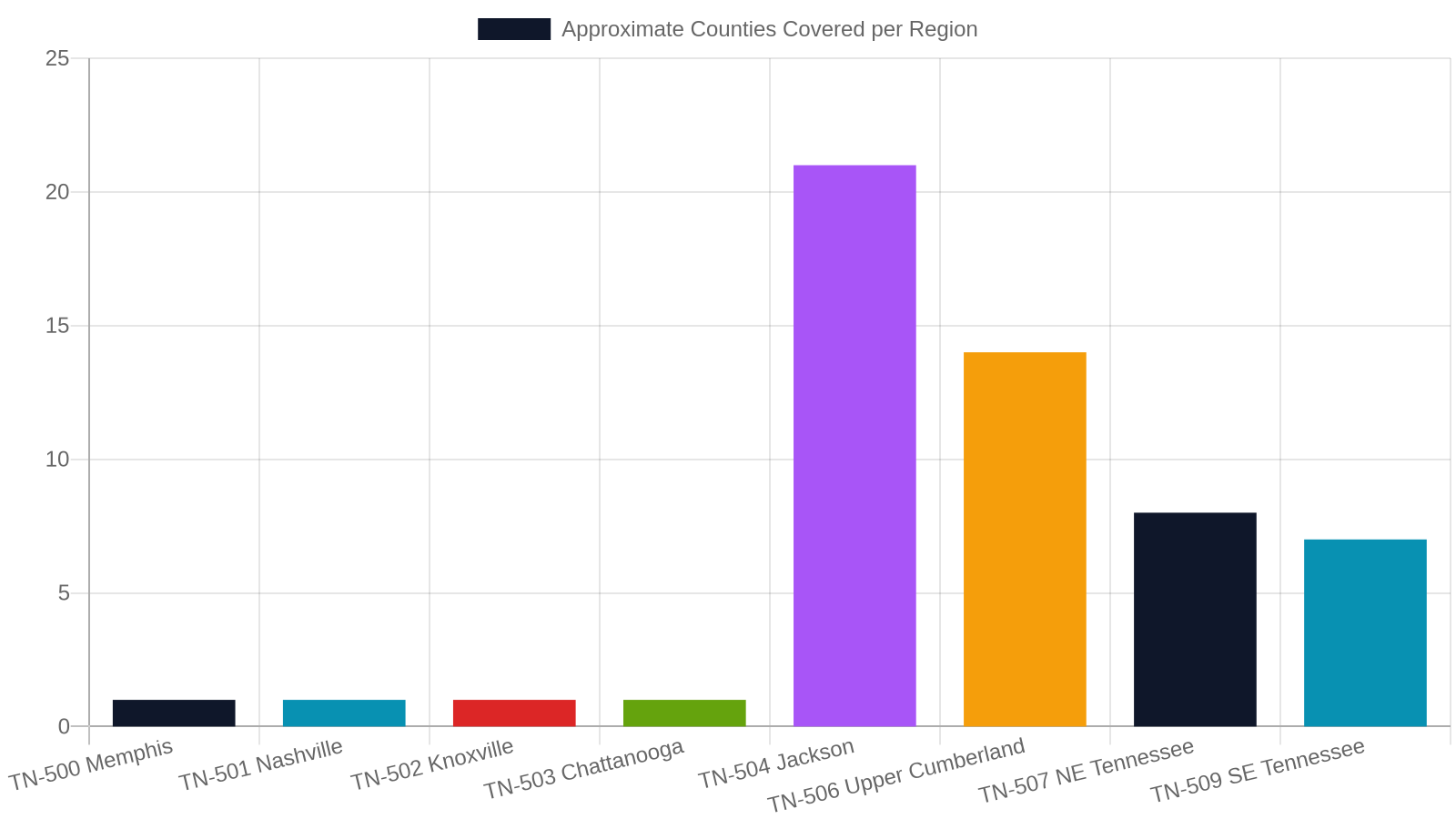
Tennessee has eight Continuum of Care regions, each with its own YAAB chapter. The CoC codes run from TN-500 through TN-509 (with some numbers retired or consolidated over time). Each chapter is independent in its day-to-day work but connected to the statewide YAAB network for shared advocacy, training, and resources. Here’s the quick map:
- TN-500 — Memphis / Shelby County
- TN-501 — Nashville / Davidson County
- TN-502 — Knoxville / Knox County
- TN-503 — Chattanooga / Hamilton County
- TN-504 — Jackson / West Tennessee
- TN-506 — Upper Cumberland
- TN-507 — Northeast Tennessee
- TN-509 — Southeast Tennessee
Why Region Boundaries Matter for You
Your county determines which CoC — and therefore which YAAB chapter — you belong to. This matters for a few practical reasons:
- Funding: Rapid rehousing, transitional housing, and emergency shelter grants flow through your local CoC. Your YAAB chapter advocates for how that money gets spent.
- Programs: Each region has different service providers, youth shelters, and employment programs. Your local YAAB knows exactly what’s available near you.
- Advocacy: Local YAAB members attend CoC board meetings in your region, so your voice reaches the right decision-makers.
If you live near a county line or have recently moved, it’s worth checking both neighboring chapters — you may be able to connect with whichever one is most accessible to you.
TN-500: Memphis and Shelby County YAAB

Memphis is home to Tennessee’s most populous county and one of the state’s most active YAAB chapters. Here’s what young adults in Shelby County need to know.
Who This Chapter Serves
The TN-500 YAAB chapter is based in Memphis and Shelby County — Tennessee’s largest city by population, with approximately 929,000 residents as of 2023. Memphis consistently records some of the highest rates of youth homelessness in the state, making this chapter one of the most active. If you live in Memphis, Germantown, Bartlett, Collierville, Millington, or anywhere else in Shelby County, TN-500 is your chapter.
- Works closely with Memphis’ local CoC, which coordinates dozens of housing and service providers.
- Focuses heavily on youth aging out of foster care — Shelby County has one of Tennessee’s largest foster care populations.
- Partners with organizations like Memphis Area Legal Services and local rapid rehousing programs.
Getting Connected in Memphis
If you’re in Memphis and want to connect with YAAB or find local resources, the TN-500 chapter is your starting point. Members meet regularly to discuss local policy, share resources, and support each other. You don’t need to have all the answers — you just need to show up. Visit the TN-500 chapter page for current meeting info and contact details.
TN-501: Nashville and Davidson County YAAB

As Tennessee’s capital and its fastest-growing city, Nashville presents both opportunity and challenge for young adults navigating housing instability. The TN-501 YAAB chapter is at the center of that fight.
Who This Chapter Serves
The TN-501 YAAB chapter covers Nashville and Davidson County, Tennessee’s state capital and fastest-growing major city. Nashville’s rapid growth has driven up rents dramatically — the median one-bedroom apartment in Nashville hit approximately $1,450/month in 2024, putting stable housing out of reach for many young adults earning minimum wage. TN-501 YAAB members work directly with Metro Nashville’s CoC and advocate for affordable housing solutions that don’t leave transition-age youth behind.
- Engages with Metro Nashville’s Office of Homeless Services and the CoC board.
- Focuses on rapid rehousing, transitional housing, and host home programs for youth.
- Connects members to Nashville’s robust network of workforce development and GED programs.
Getting Connected in Nashville
If you live in Nashville, Antioch, Madison, Hermitage, or anywhere in Davidson County, TN-501 is your chapter. Nashville also has strong connections to neighboring counties like Williamson, Rutherford, and Wilson — if you’re in those areas, check with TN-501 first, as some regional services extend beyond Davidson County lines. Find current meeting times and contact info on the TN-501 chapter page.
TN-502 and TN-503: Knoxville and Chattanooga YAABs

East and Southeast Tennessee have two dedicated YAAB chapters — one rooted in Knoxville’s university city energy and one in Chattanooga’s river city momentum. Both are actively working to make sure young adults have a seat at the table.
TN-502: Knoxville and Knox County
The TN-502 YAAB chapter serves Knoxville and Knox County in East Tennessee. Knoxville is home to the University of Tennessee and a growing tech and healthcare economy, but youth homelessness remains a real challenge — especially for young adults aging out of foster care who don’t have family support networks. TN-502 members work with the Knoxville-Knox County CoC, which coordinates providers like Volunteer Ministry Center and KARM (Knox Area Rescue Ministries).
- Advocates for youth-specific housing units and host home programs in the Knoxville area.
- Connects peers to education pathways, including Pellissippi State’s programs for students experiencing homelessness.
- Meets regularly with CoC leadership to ensure youth voices are heard in funding decisions.
Visit the TN-502 chapter page for details on getting involved in Knoxville.
TN-503: Chattanooga and Hamilton County
The TN-503 YAAB chapter covers Chattanooga and Hamilton County in Southeast Tennessee. Chattanooga has invested heavily in downtown revitalization and tech infrastructure, but those gains haven’t always reached young adults in housing crisis. TN-503 members engage with the Chattanooga Regional Homeless Coalition and push for youth-centered solutions in a city where the youth homeless count has fluctuated significantly year over year.
- Focuses on connecting young adults to Chattanooga’s growing job market in manufacturing, logistics, and healthcare.
- Advocates for longer-term transitional housing options for youth ages 18 to 24.
- Collaborates with Hamilton County schools’ McKinney-Vento liaisons to support youth still in school.
TN-504: Jackson and the Greater West Tennessee YAAB

West Tennessee outside of Memphis is a vast, mostly rural region where youth homelessness often goes unseen. The TN-504 YAAB chapter is the voice for young adults across this wide stretch of the state.
A Large Region with Unique Rural Challenges
The TN-504 YAAB chapter is one of the most geographically expansive in the state, covering Jackson and a wide swath of West Tennessee counties beyond Shelby. This region includes cities like Jackson, Martin, Union City, and Dyersburg, as well as dozens of smaller rural communities. Rural youth homelessness is often invisible — young people couch-surf, double up with relatives, or sleep in cars rather than accessing shelters that may be an hour’s drive away.
- TN-504 YAAB members understand the unique barriers of rural housing instability: limited public transit, fewer shelter beds, and sparse service provider networks.
- The chapter advocates for mobile outreach, virtual services, and rural-specific housing solutions.
- Jackson serves as the regional hub, with connections to providers like RIFA (Relief, Inc., Food, and Advocacy) and local community action agencies.
Counties Covered in TN-504
TN-504 is a multi-county region. Key counties include Madison, Chester, Crockett, Dyer, Gibson, Hardeman, Haywood, Henderson, Henry, Lake, Lauderdale, McNairy, Obion, Tipton, and Weakley, among others. If you live in West Tennessee outside of Shelby County, TN-504 is almost certainly your chapter. Because the region is large, YAAB members here often connect virtually as well as in person — making it accessible even if you’re far from Jackson. Check the TN-504 chapter page for current contact info.
TN-506 and TN-507: Upper Cumberland and Northeast Tennessee YAABs

Two YAAB chapters serve the highlands and rural communities of Middle-to-East Tennessee and the Appalachian Northeast — regions where lived experience of housing instability looks different from urban Tennessee but is no less real.
TN-506: The Upper Cumberland Region
The TN-506 YAAB chapter serves the Upper Cumberland — a region of rolling hills, small cities, and tight-knit communities in Middle-to-East Tennessee. The regional hub is Cookeville, home to Tennessee Tech University. Counties in this region include Putnam, Cumberland, DeKalb, Fentress, Jackson, Macon, Overton, Pickett, Smith, Van Buren, Warren, and White. Like TN-504, this is a largely rural region where housing instability can be hard to spot from the outside but very real for young adults living it.
- TN-506 members advocate within the Upper Cumberland CoC for youth-specific housing resources.
- The chapter connects peers to workforce development programs tied to the region’s healthcare and manufacturing sectors.
- Virtual participation options make it possible to engage even from the most remote corners of the region.
TN-507: Northeast Tennessee
The TN-507 YAAB chapter covers Northeast Tennessee — the Tri-Cities area and surrounding counties. This region includes Johnson City, Kingsport, Bristol, and counties like Sullivan, Washington, Carter, Unicoi, Greene, Hawkins, and Hancock. Northeast Tennessee has a distinct Appalachian character, and housing instability here is often tied to economic challenges in communities that have seen manufacturing decline over decades. TN-507 YAAB members work with the Northeast Tennessee CoC to advocate for solutions that fit the region’s specific needs — including rural outreach, substance use recovery-friendly housing, and youth employment pathways. Visit the TN-507 chapter page to connect with peers in the Tri-Cities area.
TN-509: Southeast Tennessee YAAB

Southeast Tennessee’s YAAB chapter is growing — and that means there’s real opportunity for young adults in this region to help shape what it becomes.
Who This Chapter Serves
The TN-509 YAAB chapter covers Southeast Tennessee — the counties surrounding and adjacent to Hamilton County (Chattanooga) that fall outside TN-503’s single-county focus. This region includes counties such as Bradley, McMinn, Meigs, Monroe, Polk, Rhea, and Sequatchie. Cities like Cleveland and Athens serve as local anchors. Southeast Tennessee blends suburban, small-city, and rural character, and young adults here often face a gap between urban services (concentrated in Chattanooga) and the communities where they actually live.
- TN-509 advocates for regional equity — making sure that rural Southeast Tennessee youth aren’t overlooked in favor of larger urban centers.
- Members connect peers to Bradley County and McMinn County service providers, community action agencies, and workforce boards.
- The chapter works to build local capacity so that young adults don’t have to travel to Chattanooga for basic support.
Getting Connected in Southeast Tennessee
If you’re in Bradley, McMinn, or any of the surrounding Southeast Tennessee counties, TN-509 is your chapter. Because this region is newer in its YAAB development, it’s also a place where your involvement can have an outsized impact — helping to build something from the ground up. Find current contact information and meeting details on the TN-509 chapter page.
Tennessee YAAB Chapters at a Glance
Use this table to quickly identify your regional YAAB chapter, the counties it covers, its primary hub city, and the key focus areas for that region.
What Happens at a Local YAAB Chapter — and What to Expect

Joining a YAAB chapter isn’t just about attending meetings — it’s about becoming part of a movement. Here’s what you can realistically expect when you get involved with your local chapter.
Meetings, Advocacy, and Peer Support
Every local YAAB chapter operates a little differently based on its region’s needs and capacity, but most chapters share a common rhythm. Members typically meet monthly or bi-monthly — sometimes in person, sometimes virtually, often both. Meetings aren’t lectures; they’re peer-led conversations where members share what’s happening in their community, identify gaps in services, and plan advocacy actions. You might:
- Review local CoC data and give feedback on how funding should be prioritized.
- Prepare testimony for a city council or CoC board meeting.
- Help design a survey to understand what young adults in your region actually need.
- Connect a peer to a housing program or emergency resource.
Leadership Development and Real Skills
YAAB isn’t just about advocacy — it’s about building your own skills and future. Members gain experience in public speaking, policy analysis, community organizing, and professional networking. Many YAAB alumni have gone on to careers in social work, public policy, nonprofit leadership, and community health. Some chapters offer stipends or honoraria for members’ time, recognizing that your participation has real value. You’re not volunteering your trauma — you’re contributing your expertise.
- Public speaking and testimony training
- Resume and professional development support
- Connections to internships, scholarships, and employment opportunities
- A network of peers and mentors across Tennessee
How Each YAAB Chapter Connects to Tennessee's Bigger Picture
Your local YAAB chapter isn’t operating in isolation — it’s part of a statewide network that shapes real funding decisions and policy outcomes for young adults across Tennessee.
The Statewide Network and HUD Funding
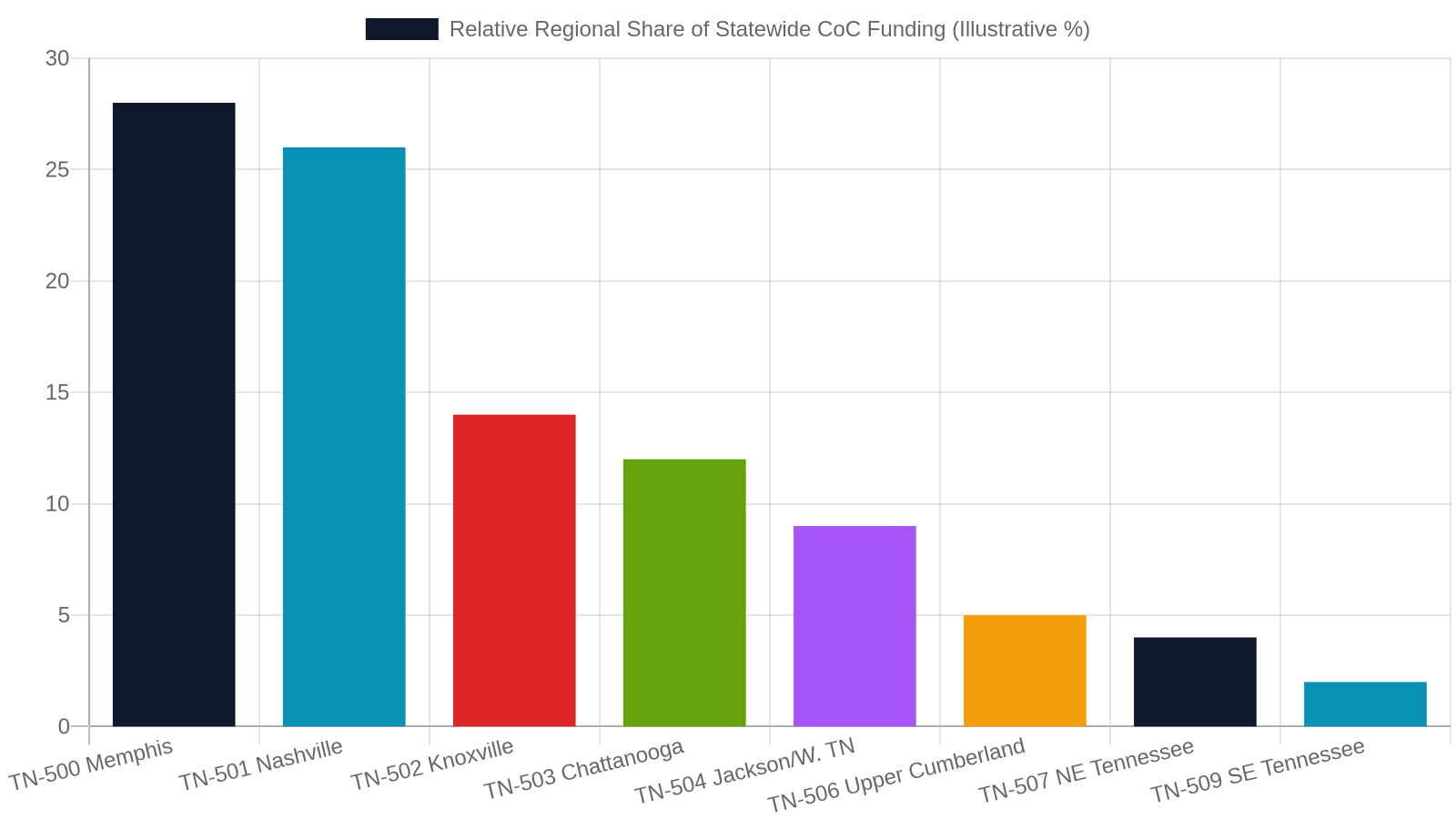
Each local YAAB chapter feeds into the statewide YAAB network, which in turn connects to HUD’s Continuum of Care program — the federal framework that funds most of Tennessee’s homelessness response. In 2023, HUD awarded Tennessee CoCs approximately $28 million in CoC Program grants to fund housing and services across the state. YAAB members influence how a portion of that money is prioritized for transition-age youth (ages 18 to 24 in HUD’s definition, 17 to 25 in YAAB’s broader scope).
- YAAB members participate in Point-in-Time (PIT) counts — the annual census of people experiencing homelessness — which directly affects funding allocations.
- They review CoC applications and provide youth-perspective feedback before submissions go to HUD.
- Statewide YAAB convenings bring all eight chapters together to align on shared priorities and amplify Tennessee’s youth voice nationally.
Youth Homelessness Data in Tennessee
According to the most recent available Point-in-Time count data, Tennessee counted over 8,000 people experiencing homelessness on a single night in January 2023 — and young adults ages 18 to 24 represented a significant share of that number, with many more experiencing hidden homelessness (couch-surfing, doubling up, staying in motels) that the PIT count doesn’t fully capture. YAAB exists precisely because data alone doesn’t tell the full story — lived experience does. To learn more about the scope of youth homelessness in Tennessee, visit YAAB’s youth homelessness overview.
Resources Available Through Your Local YAAB Chapter

One of the most practical things your local YAAB chapter does is act as a bridge — connecting young adults to the housing, education, employment, and financial resources that exist in your region but can be hard to find on your own.
Housing and Emergency Support
Your local YAAB chapter can connect you — or help you connect a peer — to housing resources specific to your region. These may include:
- Emergency shelters with youth-specific beds or policies
- Rapid Rehousing programs that pay deposits and short-term rent while you stabilize
- Transitional housing for young adults ages 18 to 24, typically 12 to 24 months of supported housing
- Host home programs that match young adults with vetted community hosts for short-term stays
- Youth-specific HUD-VASH for young veterans experiencing homelessness
Availability varies by region — rural chapters like TN-504, TN-506, and TN-507 often have fewer shelter beds but strong connections to rapid rehousing and community-based support.
Education, Employment, and Financial Resources
Housing is the foundation, but YAAB chapters also connect members and peers to a broader set of resources:
- GED and HiSET programs — most Tennessee community colleges offer free or low-cost pathways
- TN Promise and TN Reconnect — free community college for eligible Tennessee residents
- American Job Centers — free workforce services including resume help, job training, and placement, available in every region
- Financial literacy workshops — budgeting, banking, and credit-building programs offered through local nonprofits and community action agencies
- Benefits navigation — help understanding TennCare, SNAP, and other public benefits you may be entitled to
For a broader list of statewide resources, explore the YAAB resources page.
Find Your Chapter and Take Your Next Step

You’ve found the map — now it’s time to take the first step. Whether you’re a young adult ready to get involved, a peer looking for resources, or a provider wanting to build a better system, your local YAAB chapter is the right place to start.
How to Locate and Join Your Local YAAB
Finding your chapter is straightforward. The best starting point is the YAAB Tennessee local chapters page, where you can browse all eight regional chapters, find contact information, and learn about upcoming meetings and events. Here’s a simple process to get started:
- Identify your county. If you’re not sure which region it falls in, the local chapters page will help you figure it out.
- Visit your chapter’s page. Each chapter has its own page with current contact info and meeting details.
- Reach out. Send a message, attend a meeting, or show up to a community event — there’s no formal application to join.
- Show up as you are. You don’t need to have your life together to be a YAAB member. Your experience — whatever it looks like — is exactly what makes you valuable.
For Case Managers and Service Providers
If you’re a case manager, CoC partner, or service provider reading this: YAAB chapters across Tennessee are eager to partner with organizations that genuinely want youth input. The most effective partnerships treat YAAB members as consultants and collaborators, not just program participants. Consider inviting your local YAAB chapter to review program materials, join planning committees, or co-facilitate peer outreach. You can learn more about YAAB’s advocacy work and partnership opportunities at the YAAB advocacy page. Together, we build systems that actually work for the young people they’re meant to serve — across every corner of Tennessee.
Frequently Asked Questions
How do I know which YAAB chapter covers my county in Tennessee?
Your YAAB chapter is determined by your county's Continuum of Care (CoC) region. The easiest way to find out is to visit yaabtn.org/local-yaabs/ and browse the eight regional chapters. Each chapter page lists the counties it serves. If you're near a county line, you can reach out to both neighboring chapters.
Do I have to be currently homeless to join a YAAB chapter?
No. YAAB welcomes young adults ages 17 to 25 who have any lived experience of homelessness or housing instability — past or present. If you've ever couch-surfed, stayed in a shelter, doubled up with family, or experienced housing insecurity in any form, your experience is relevant and valued.
Is there an age limit to join the Youth Action Board in Tennessee?
YAAB serves transition-age youth ages 17 to 25. If you're within that age range and have lived experience of homelessness or housing instability, you're eligible to get involved with your local chapter.
What if I live in a rural Tennessee county far from the nearest city?
Rural young adults are exactly who YAAB chapters like TN-504, TN-506, TN-507, and TN-509 are built for. Many chapters offer virtual meeting options so you can participate without needing transportation to a city. Reach out to your regional chapter to ask about remote participation.
Can case managers or service providers refer young adults to YAAB?
Absolutely. Case managers and CoC partners are encouraged to connect transition-age youth to their local YAAB chapter. YAAB is also open to partnership and collaboration with service providers who want genuine youth input in their programs and policies.
Does joining YAAB help with finding housing or other services?
YAAB chapters can connect you to local housing resources, rapid rehousing programs, education pathways, and employment support. While YAAB itself is an advocacy and leadership network rather than a direct service provider, members and staff are deeply connected to the local resource landscape and can help you navigate it.