Quick answer: The Youth Action Board (YAAB) Central Tennessee region — known as TN-503 and covering the Nashville/Davidson County Continuum of Care — is open to any young adult ages 17 to 25 who has lived experience with homelessness or housing instability. To join, you connect with the local YAAB, attend an orientation, share your story on your own terms, and begin showing up to meetings and advocacy events. Membership is free, flexible, and built around your schedule. You gain leadership skills, a peer network, and a real seat at the table where Tennessee housing decisions get made.
1. What Is YAAB and Why Central Tennessee Needs Your Voice

Before you fill out a single form, it helps to understand exactly what you are signing up for — and why your perspective is not just welcome but genuinely necessary. YAAB Central Tennessee is part of a statewide movement that treats young adults with lived experience as experts, not recipients. This section breaks down what YAAB is, what TN-503 covers, and why the region needs more members right now.
YAAB in Plain Language
The Youth Action Board (YAAB) of Tennessee is a statewide network of young adults — ages 17 to 25 — who have personally experienced homelessness or housing instability. Instead of just being talked about in policy rooms, YAAB members are in those rooms, advising Continuum of Care (CoC) leaders, shaping programs, and making sure that the people closest to the problem are closest to the solution.
YAAB is not a support group and it is not a case-management program. It is a leadership and advocacy body. You bring your lived experience; YAAB gives you the platform, training, and community to turn that experience into policy change.
Why Central Tennessee (TN-503) Matters
Central Tennessee’s CoC — officially designated TN-503 — covers the Nashville/Davidson County metro area, one of the fastest-growing regions in the country. Between 2018 and 2023, Nashville’s overall population grew by roughly 11%, but youth homelessness remained stubbornly persistent, with Point-in-Time counts consistently identifying hundreds of unsheltered transition-age youth each January.
Rapid growth means rising rents, tighter shelter capacity, and more young adults falling through the cracks. TN-503’s YAAB chapter exists specifically to make sure that Central Tennessee’s housing and service systems hear from the young people those systems are supposed to serve — before decisions get finalized, not after.
2. Who Is Eligible to Join YAAB TN-503

One of the most common questions young adults ask is: “Do I actually qualify?” The eligibility bar for YAAB TN-503 is designed to be as inclusive as possible. Here is a clear breakdown of who can join, including some pathways people often overlook.
The Core Age and Experience Requirements
Eligibility for YAAB Central Tennessee is intentionally broad so that as many young people as possible can participate. The two core requirements are:
- Age: You must be between 17 and 25 years old at the time you join.
- Lived experience: You must have personal experience with homelessness or housing instability — this includes couch-surfing, staying in a shelter, living in a car, doubling up with family because you had nowhere else to go, or aging out of foster care into uncertain housing.
You do not need to be currently homeless. Many YAAB members are in stable housing now and use that stability as a foundation to give back and advocate for peers still in crisis.
Foster Care, Aging Out, and Other Pathways
Young adults who aged out of Tennessee’s foster care system at 18 (or extended foster care at 21) are especially encouraged to join. Research consistently shows that youth who age out of foster care face homelessness rates 3 to 5 times higher than their peers within the first two years of leaving care. YAAB recognizes this overlap and actively centers the foster-care-to-homelessness pipeline in its advocacy work.
Other pathways that qualify as lived experience include: fleeing an unsafe home environment, being asked to leave by a family member, experiencing domestic or intimate-partner violence that disrupted housing, or losing housing due to a gap in income or benefits. If you are unsure whether your experience qualifies, reach out — the answer is almost always yes.
What Does NOT Disqualify You
A common worry is that a criminal record, an incomplete education, or current mental health challenges will keep you out. They will not. YAAB is explicitly designed for young adults navigating real-world barriers. You do not need a GED or diploma to join. You do not need a permanent address. You do not need prior leadership or advocacy experience. YAAB provides training, mentorship, and support so you can build those skills inside the organization.
3. Understanding the TN-503 Continuum of Care Region

To get the most out of YAAB membership, it helps to understand the system you will be influencing. The Continuum of Care is the engine behind most local homeless services funding, and YAAB’s role inside that system is more powerful than most young people realize when they first join.
What a Continuum of Care Actually Does
A Continuum of Care (CoC) is a regional planning body funded by the U.S. Department of Housing and Urban Development (HUD) that coordinates housing and services for people experiencing homelessness. Each CoC receives federal grants, sets local priorities, and decides which programs get funded. In practical terms, the CoC is where the money and the decisions live.
TN-503 is Nashville’s CoC. It brings together nonprofits, city agencies, healthcare providers, schools, and — thanks to YAAB — young adults with lived experience. When YAAB members show up to TN-503 meetings, they are sitting at the same table as the people who control millions of dollars in housing funding.
The Geographic Footprint of TN-503
TN-503 primarily covers Davidson County and the greater Nashville metropolitan area. If you are living in Nashville or the surrounding communities and you are 17 to 25 with housing instability experience, TN-503’s YAAB chapter is your local entry point into the statewide YAAB network.
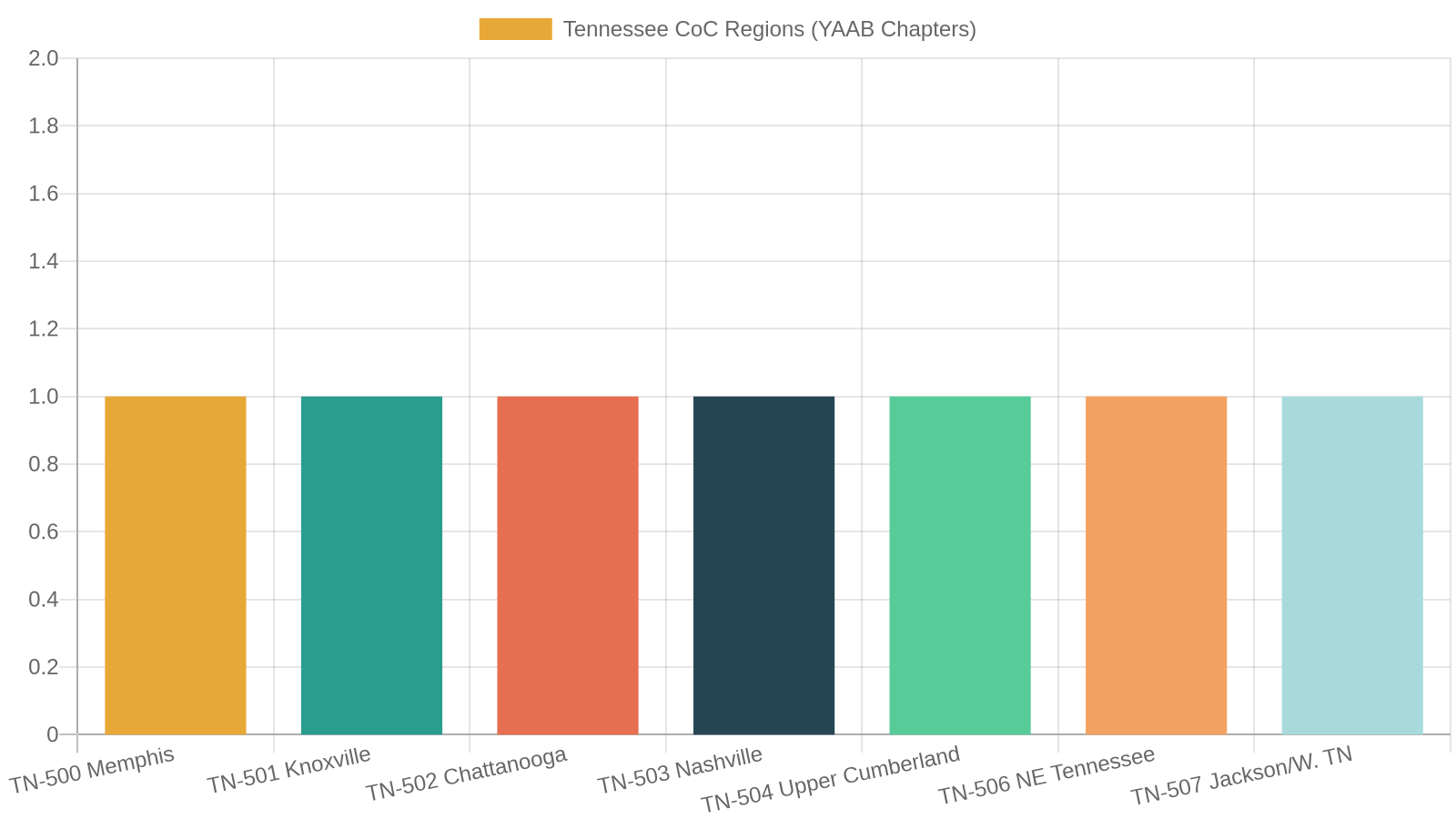
Tennessee has multiple CoC regions. If you are based in Memphis, you would connect with TN-500. Knoxville falls under TN-501. Chattanooga is TN-502. The Upper Cumberland region is TN-504. Each region has its own YAAB chapter. But this guide focuses specifically on Central Tennessee / TN-503 — Nashville’s region — because that is where this chapter’s membership, meetings, and advocacy work are centered.
4. The 8 Steps to Joining YAAB Central Tennessee

The process of joining YAAB TN-503 is straightforward, but knowing each step in advance makes it easier to take the first one. Here is the full eight-step pathway from first contact to active membership — broken into three phases so you can see the whole picture at once.
Steps 1–3: Connect, Confirm, and Learn the Basics
- Step 1 — Visit the TN-503 page. Start at the YAAB Central Tennessee (TN-503) page to find current contact information, meeting schedules, and any open membership calls. This is your official starting point.
- Step 2 — Reach out directly. Send a message through the site’s contact form or email the regional coordinator listed on the TN-503 page. Introduce yourself briefly — your name, age, and that you are interested in joining. You do not need to share your full story at this stage.
- Step 3 — Attend a welcome or orientation session. Most YAAB chapters hold periodic orientations for new members. These sessions run roughly 60 to 90 minutes and cover what YAAB does, how meetings work, and what you can expect as a member. Orientations are low-pressure and judgment-free.
Steps 4–6: Show Up, Share (on Your Terms), and Get Trained
- Step 4 — Attend your first regular meeting. YAAB TN-503 holds regular member meetings — check the current schedule on the TN-503 page or the YAAB statewide events calendar. Your first meeting is about listening, meeting people, and getting a feel for the group. You are not expected to lead anything.
- Step 5 — Share your story on your own terms. YAAB values lived experience, but you are never required to disclose more than you are comfortable with. Many members share their experiences gradually over weeks or months as trust builds. Your story is yours — you decide what to share, when, and with whom.
- Step 6 — Complete any onboarding or training offered. YAAB provides leadership development training, advocacy skill-building, and education on housing policy. These trainings are free and often come with stipends or other supports to help cover your time and transportation costs.
Steps 7–8: Engage in Advocacy and Grow Your Role
- Step 7 — Participate in advocacy activities. This might mean attending a CoC planning meeting, testifying at a city council hearing, joining a statewide YAAB convening in Nashville, or contributing to a report on youth housing needs. You choose the level of involvement that fits your life right now.
- Step 8 — Grow into leadership. Long-term members can take on roles as regional representatives, serve on CoC committees, or help recruit and mentor newer members. There is no fixed timeline — you grow at your own pace. Some members move into paid advocacy or policy roles through connections made inside YAAB.
5. What YAAB Membership Actually Looks Like Day to Day

Joining sounds great in theory — but what does being a YAAB member actually feel like week to week? This section gives you an honest, practical picture of the time commitment, the structure of meetings, and what you get out of your participation beyond the work itself.
Meetings, Frequency, and Format
YAAB TN-503 members typically meet once or twice a month, with additional optional events like advocacy days, trainings, or statewide convenings. Meetings are held in accessible community locations in the Nashville area and, when possible, are also available virtually so members without reliable transportation can still participate.
A typical meeting runs about 90 minutes and might include: updates on local CoC decisions, a skill-building segment (public speaking, policy reading, budgeting), peer check-ins, and planning for upcoming advocacy actions. Meetings are facilitated by members, not by outside adults — the peer-led structure is intentional.
Stipends, Supports, and What You Get Back
YAAB recognizes that your time has real value. Many YAAB chapters, including TN-503, offer stipends or gift cards for participating in meetings, trainings, and advocacy events. Specific amounts vary by funding cycle, but stipends are a core part of YAAB’s model — the organization believes that young adults with lived experience should be compensated for their expertise, not asked to volunteer indefinitely.
Beyond stipends, members gain access to: leadership development certificates, references and professional connections for employment or education applications, peer support from others who get it, and a direct line to housing resources and service providers through the CoC network.
The Commitment Level: Flexible, Not All-or-Nothing
Life at 17 to 25 is unpredictable — especially when you are navigating housing instability, employment, school, or family responsibilities. YAAB is built with that reality in mind. There is no strict attendance policy that will kick you out for missing meetings. Members are encouraged to show up consistently, but the organization understands that stability takes time to build.
If you go through a hard stretch and need to step back, you can re-engage when you are ready. YAAB is a community, not a contract.
6. The Real Impact YAAB Members Have Made in Tennessee

It is fair to ask: does any of this actually change anything? The answer, backed by YAAB’s track record across Tennessee’s CoC regions, is yes. Here are concrete examples of the kind of impact that young adult members have driven — and why that impact is only possible because of people like you getting involved.
Policy Wins Driven by Youth Voice
YAAB members across Tennessee have contributed to tangible policy outcomes. Youth-informed advocacy has helped shape how CoC regions prioritize rapid rehousing and transitional housing for young adults — two of the most effective interventions for transition-age youth homelessness according to HUD research. In Tennessee, YAAB members have presented at statewide homeless planning meetings, contributed to annual Point-in-Time count strategies, and helped draft youth-specific recommendations that were incorporated into regional CoC plans.
These are not symbolic gestures. When a CoC updates its written plan to include youth-specific priorities, that language directly affects which programs receive federal funding the following year.
Peer-to-Peer Connection as a Resource
Beyond formal policy, YAAB members serve as informal connectors — helping peers navigate systems that can feel overwhelming from the outside. A member who went through the process of applying for emergency housing assistance can walk a friend through the same process in plain language. A member who found a GED program can share that resource directly. This peer-to-peer knowledge transfer is one of the most undervalued parts of what YAAB does, and it happens organically through the relationships members build inside the organization.
Studies on peer support models in housing services consistently show that young adults are more likely to engage with resources when they hear about them from someone their own age with similar experience — not from a pamphlet or a case manager they just met.
7. How TN-503 Fits Into the Statewide YAAB Network

Joining TN-503 does not mean you are limited to Nashville. As a YAAB member, you automatically become part of a statewide network that spans every major region of Tennessee. Here is how the regional structure works and what that broader connection means for your membership.
Tennessee's CoC Regions at a Glance
Tennessee is divided into multiple HUD-recognized Continuum of Care regions, each with its own YAAB chapter. Understanding where TN-503 sits in that statewide picture helps you see how your local work connects to a larger movement:
- TN-500: Memphis/Shelby County
- TN-501: Knoxville/Knox County
- TN-502: Chattanooga/Hamilton County
- TN-503: Nashville/Davidson County (Central Tennessee — this guide)
- TN-504: Upper Cumberland region
- TN-506: Northeast Tennessee
- TN-507: Jackson/West Tennessee
- TN-509: Additional regional coverage
Each chapter operates locally but shares resources, training, and advocacy strategies through the statewide YAAB network.
Statewide Convenings and Cross-Region Collaboration
Several times a year, YAAB chapters from across Tennessee come together for statewide convenings — multi-day gatherings where members share what is working in their regions, receive advanced leadership training, and coordinate on advocacy campaigns that require a unified statewide voice.
For TN-503 members, these convenings are an opportunity to meet peers from Memphis, Knoxville, Chattanooga, and rural Tennessee — young adults who share your experience but are navigating different local systems. The cross-pollination of ideas that happens at these events is one of the most energizing parts of YAAB membership, according to long-term members.
YAAB TN-503 vs. Other Youth Program Types: What Makes Each Unique
Not every program serves the same purpose. Use this table to understand where YAAB fits relative to other types of support available to young adults in Central Tennessee.
8. Resources Available to You as a YAAB TN-503 Member

Membership in YAAB TN-503 is not just about what you give — it is also about what you gain access to. Here is a practical breakdown of the resources and supports that flow through the YAAB network to its members in Central Tennessee.
Housing and Emergency Support Connections
YAAB membership gives you a warm connection to the CoC network — meaning you are not navigating the housing system alone. Through TN-503’s relationships with Nashville-area service providers, members can get connected to:
- Emergency shelter referrals for young adults in immediate crisis
- Rapid rehousing programs that provide short-term rental assistance and case management
- Transitional housing options designed specifically for young adults ages 18 to 24
- Permanent supportive housing pathways for those with longer-term barriers
These connections are not guaranteed placements — housing resources in Nashville are limited — but YAAB members have a peer network and CoC relationships that can help them navigate waitlists and eligibility requirements more effectively than going it alone.
Education, Employment, and Financial Literacy Supports
Housing stability is the foundation, but YAAB’s resource network extends further. Members are regularly connected to:
- GED and adult education programs in the Nashville area, including those with flexible scheduling for working young adults
- Workforce development programs that provide job training, resume support, and employer connections
- Financial literacy workshops covering budgeting, banking, credit building, and avoiding predatory lending
- Benefits navigation help to understand TennCare, SNAP, and other programs you may qualify for
For a broader look at statewide resources, the YAAB Tennessee resources page is regularly updated with housing, education, employment, and mental health supports across all regions.
Mental Health and Peer Support
Experiencing homelessness or housing instability takes a real toll on mental health. YAAB does not pretend otherwise. The peer-led structure of YAAB meetings creates a built-in support system — you are surrounded by people who understand your experience without needing an explanation. Additionally, YAAB’s CoC connections can help link members to community mental health centers, trauma-informed counseling services, and crisis support lines available to young adults in the Nashville area.
You do not have to have everything figured out before you join. Many members say that YAAB itself became a stabilizing force in their lives — not because it solved every problem, but because it gave them community, purpose, and a reason to keep showing up.
9. Common Concerns About Joining — Answered Honestly

It is completely normal to have hesitations before joining something new — especially an advocacy organization that asks you to show up and use your voice. Here are the most common concerns young adults raise before joining YAAB TN-503, answered directly and without sugarcoating.
"I'm Not a Good Public Speaker"
You do not need to be. Public speaking is a skill YAAB helps you build over time — it is not a prerequisite. Many members start by listening, then contribute to small group discussions, then gradually take on more visible roles as their confidence grows. YAAB provides public speaking training specifically because most people are not born comfortable at a microphone. The goal is to help you get there, not to screen you out because you are not already there.
"I'm Worried About My Privacy"
YAAB takes member privacy seriously. You are never required to share identifying details about your housing history in public settings. When members do share their stories — at a CoC meeting, in a report, or at a public hearing — they do so voluntarily, with support, and often with the option to remain anonymous or use a first name only. The organization has protocols around consent and story-sharing that are explained clearly during orientation.
"I Don't Know Anything About Policy"
That is exactly the right place to start. YAAB provides training on how the Continuum of Care works, how HUD funding decisions are made, and how young adults can effectively influence both. You do not need a policy background — you need your lived experience and the willingness to learn. The policy knowledge comes through participation. Many YAAB members who started with zero policy background have gone on to present at state-level housing forums and contribute to published reports on youth homelessness in Tennessee.
For more background on the issue itself, the YAAB guide to understanding youth homelessness is a great starting point before your first meeting.
10. How YAAB Compares to Other Youth Programs in Central Tennessee

If you are weighing YAAB against other programs or opportunities available to young adults in Nashville, it helps to understand what makes YAAB structurally different — not better or worse than other resources, but genuinely distinct in what it offers and what it asks of you.
YAAB vs. Traditional Youth Services
Most youth-serving programs in Nashville are designed to deliver services to young adults — case management, shelter beds, job training, counseling. These programs are valuable and YAAB does not compete with them. The difference is that YAAB is not a service delivery program. It is a leadership and advocacy body where young adults are the decision-makers, not the recipients.
In traditional programs, a young adult might receive housing assistance. In YAAB, a young adult helps decide what housing assistance programs exist, how they are designed, and who they prioritize. Both roles matter — but YAAB fills a gap that almost no other program in Central Tennessee addresses.
The Unique Value of Lived-Experience Leadership
Research on housing policy consistently shows that programs designed with input from people who have used those programs perform better than programs designed without that input. A 2021 analysis of youth homelessness interventions found that youth-informed program design was associated with higher engagement rates, lower dropout from services, and better long-term housing outcomes compared to programs designed solely by adult professionals.
YAAB operationalizes this principle at the CoC level. When TN-503 makes decisions about how to allocate housing resources, YAAB members are in the room. That is a structural advantage that no other youth program in Central Tennessee currently provides.
11. Your Next Move: Join YAAB Central Tennessee Today

You have made it through the full guide — which means you are more prepared than most people who join YAAB. Here is how to turn that preparation into action, starting today, in Central Tennessee.
Three Things You Can Do Right Now
- 1. Visit the TN-503 page. Head to the YAAB Central Tennessee (TN-503) membership page to find the current contact, meeting schedule, and how to reach your regional coordinator. This is the single most important first step.
- 2. Explore the full YAAB network. If you know peers in other parts of Tennessee who could benefit from YAAB, point them to the full list of local YAAB chapters — every region from Memphis to Northeast Tennessee has a chapter ready to welcome new members.
- 3. Read up on the issue. The more you understand about youth homelessness in Tennessee before your first meeting, the more confident you will feel walking in. The YAAB site has plain-language explainers, advocacy resources, and project updates that will give you solid context.
You Already Have What It Takes
YAAB TN-503 does not need you to be polished, credentialed, or certain about your future. It needs you to be real — to show up with your experience, your perspective, and your willingness to work alongside peers who are navigating the same systems you have navigated.
Central Tennessee’s housing crisis will not be solved by people who have only read about it. It will be solved — or at least meaningfully improved — by people who have lived it and who refuse to let that experience go to waste. That is you. YAAB TN-503 is ready when you are.
Questions before you reach out? The YAAB About page covers the organization’s history, structure, and values in depth — a good five-minute read before your first contact.
Frequently Asked Questions
How old do I have to be to join YAAB Central Tennessee?
You must be between 17 and 25 years old at the time you join YAAB TN-503. There is no lower age cutoff below 17 for this program, and members who turn 26 while active are typically supported in transitioning out of the membership role gracefully.
Do I have to be currently homeless to join YAAB TN-503?
No. You need lived experience of homelessness or housing instability at some point in your life — but you do not need to be in crisis right now. Many YAAB members are in stable housing and use that stability as a foundation to advocate for peers who are still navigating the system.
Does YAAB pay members for their time?
Many YAAB chapters, including TN-503, offer stipends or gift cards for participating in meetings, trainings, and advocacy events. The specific amounts vary by funding cycle. YAAB's model is built on the belief that young adults with lived experience should be compensated for their expertise.
What if I aged out of foster care — can I still join?
Absolutely, and you are especially encouraged to join. Youth who age out of Tennessee's foster care system face homelessness rates three to five times higher than their peers, and YAAB actively centers the foster-care-to-homelessness pipeline in its advocacy work. Your experience is directly relevant to what YAAB does.
How much time does YAAB membership require each month?
Most members spend four to six hours per month on YAAB activities — typically one or two meetings of about 90 minutes each, plus optional advocacy events and trainings. YAAB is designed to be flexible for young adults managing school, work, and other responsibilities.
I live outside Nashville — is TN-503 still the right YAAB chapter for me?
TN-503 covers the Nashville/Davidson County area. If you are based in Memphis, Knoxville, Chattanooga, or another part of Tennessee, there is a YAAB chapter in your region. Visit the YAAB local chapters page at yaabtn.org/local-yaabs/ to find the chapter closest to where you live.