Quick answer: Homeless and housing-unstable young adults in Nashville — and across Tennessee — have real power to change the laws and programs that affect their lives. Through the Youth Action Board (YAAB) of Tennessee, transition-age youth ages 17 to 25 can learn how the legislative process works, testify before committees, meet with lawmakers, and push for policy wins on housing, shelter funding, and youth services. This guide walks you through eight concrete steps to get started, from understanding your rights to joining a regional YAAB and showing up at the Tennessee General Assembly.
1. Understand What Youth Legislative Advocacy Actually Means

Before you can change a law, you need to understand what legislative advocacy is — and why young adults with lived experience of homelessness are the most powerful voices in the room. This section breaks down the basics so you can walk into any meeting at the Tennessee General Assembly or Nashville Metro Council with confidence.
Advocacy vs. Charity: Know the Difference
Charity gives someone a meal. Advocacy changes the policy that caused hunger in the first place. Legislative advocacy means going directly to the people who write laws — state representatives, senators, city council members — and telling them what needs to change based on your lived experience. For young adults facing homelessness in Nashville and across Tennessee, that difference is everything.
- Charity = short-term relief (a shelter bed, a food box)
- Advocacy = long-term change (more shelter beds funded in the state budget, a new rapid-rehousing program)
- Legislative advocacy = using the law-making process as the tool for that change
You don’t need a law degree. You need your story, your facts, and a clear ask.
Why Transition-Age Youth (17–25) Have a Unique Voice
Transition-age youth — young adults between 17 and 25 — are one of the fastest-growing segments of the unhoused population in Tennessee. According to the 2023 Point-in-Time Count, youth under 25 represented approximately 18% of all people experiencing homelessness in Tennessee’s Continuum of Care regions. Yet this age group is often left out of the policy conversations that shape their lives.
Lawmakers hear from nonprofit executives and agency directors every day. What they rarely hear is a 20-year-old from Nashville/Davidson County who aged out of foster care and navigated the shelter system firsthand. That perspective is irreplaceable — and it moves votes in ways that data alone cannot.
2. Know the Tennessee Legislative Landscape

Effective advocacy means knowing who has the power to make the change you want. In Tennessee, that power is split between the state General Assembly in Nashville and local governing bodies like Metro Council. Here’s a plain-language breakdown of how the system works — and where young advocates can plug in.
How the Tennessee General Assembly Works
Tennessee’s state legislature is called the General Assembly. It has two chambers:
- Senate: 33 members, 4-year terms, meets in Nashville at the State Capitol
- House of Representatives: 99 members, 2-year terms
The legislative session typically runs from January through April or May each year. Bills that affect housing, shelter funding, youth services, and the state budget are introduced, debated in committee, and voted on during this window. Missing the session means waiting another full year — which is why knowing the calendar matters.
Key committees for youth housing advocates include the Health and Human Services Committee and the Finance, Ways and Means Committee, which controls the state budget.
Nashville/Davidson County: Metro Council and Local Power
In Nashville, local advocacy happens at Metro Council, which has 40 members representing districts across Davidson County. Metro Council controls the city’s budget, zoning decisions, and local ordinances — all of which directly affect where shelters can be built, how much funding goes to youth services, and what protections exist for unhoused residents.
Nashville also has a Mayor’s Office and a dedicated Office of Homeless Services, which coordinates with the Continuum of Care (CoC) for Nashville/Davidson County. Understanding which level of government controls which resource helps you target your advocacy precisely instead of shouting into the void.
- State level: shelter funding formulas, foster care exit policies, Medicaid/TennCare access
- Metro/city level: zoning for shelters, local rapid-rehousing dollars, encampment policies
3. Learn the Key Issues Affecting Homeless Youth in Tennessee

You can’t advocate effectively without knowing what you’re fighting for. These are the top policy pressure points that directly affect homeless and housing-unstable young adults in Nashville and across Tennessee — the issues most likely to come up in a legislative meeting, a committee hearing, or a Metro Council session.
Housing and Shelter Funding Gaps
Tennessee’s Continuum of Care regions consistently report that youth-specific shelter beds are severely underfunded. In the 2023 Point-in-Time Count, Tennessee recorded over 8,500 people experiencing homelessness on a single night — and youth-specific beds covered only a fraction of the need. Nashville alone has seen a 23% increase in youth homelessness since 2019, driven by rising rents, a lack of affordable housing, and limited transitional housing options for young adults aging out of systems.
Key funding streams advocates push for include: Tennessee Housing Development Agency (THDA) grants, HUD Emergency Solutions Grants (ESG), and state General Fund appropriations for youth shelters.
Aging Out of Foster Care: The Policy Gap at 18
In Tennessee, young people in foster care can access extended support through Tennessee’s Extended Foster Care program up to age 21 — but many don’t know it exists or face barriers to enrollment. Without extended care, youth who age out at 18 face an immediate housing cliff: one day they have a placement, the next they don’t.
Legislative priorities for this group include:
- Expanding awareness and enrollment in extended foster care
- Increasing the Chafee Education and Training Voucher (ETV) amount, currently capped at $5,000/year federally
- Creating a state-funded bridge housing program for youth exiting foster care at 18
- Removing documentation barriers (birth certificates, IDs) that block access to housing applications
Criminalization of Homelessness
Several Tennessee cities have ordinances that effectively criminalize sleeping outside, camping in public spaces, or panhandling. For young adults with no safe indoor option, these laws create a cycle: citation → court date → missed court → warrant → arrest → record → harder to get housing. In 2023, Tennessee passed SB 1610, which created new restrictions on public camping. Youth advocates have pushed back by documenting the impact on transition-age youth and proposing alternative investments in shelter capacity instead of enforcement.
Understanding current law — and knowing which bills are moving through committee — is a core skill for any youth legislative advocate in Nashville.
4. Find and Join Your Regional YAAB

You don’t have to figure out advocacy alone. The Youth Action Board of Tennessee has already built the structure — regional chapters, statewide connections, and a track record of policy wins. Here’s how to find your local chapter and plug in, whether you’re in Nashville, Memphis, Knoxville, or anywhere in between.
What Is YAAB Tennessee?
The Youth Action Board (YAAB) of Tennessee is a statewide network of young adults ages 17 to 25 with lived experience of homelessness and housing instability. YAAB members advise local and state leaders, drive advocacy campaigns, and connect peers to housing, education, employment, and support services across Tennessee’s Continuum of Care regions.
YAAB is not a service provider — it’s a youth-led advocacy body. That means the people setting the agenda are young adults who have been through the system, not administrators looking down at it. If you want your voice to actually shape policy, YAAB is the structure that makes that possible.
Learn more about the mission and history at the YAAB Tennessee About page.
Tennessee's Eight CoC Regions and Local YAABs
Tennessee is divided into eight Continuum of Care (CoC) regions, each with its own local YAAB chapter. No matter where you are in the state, there’s a regional board that represents your community:
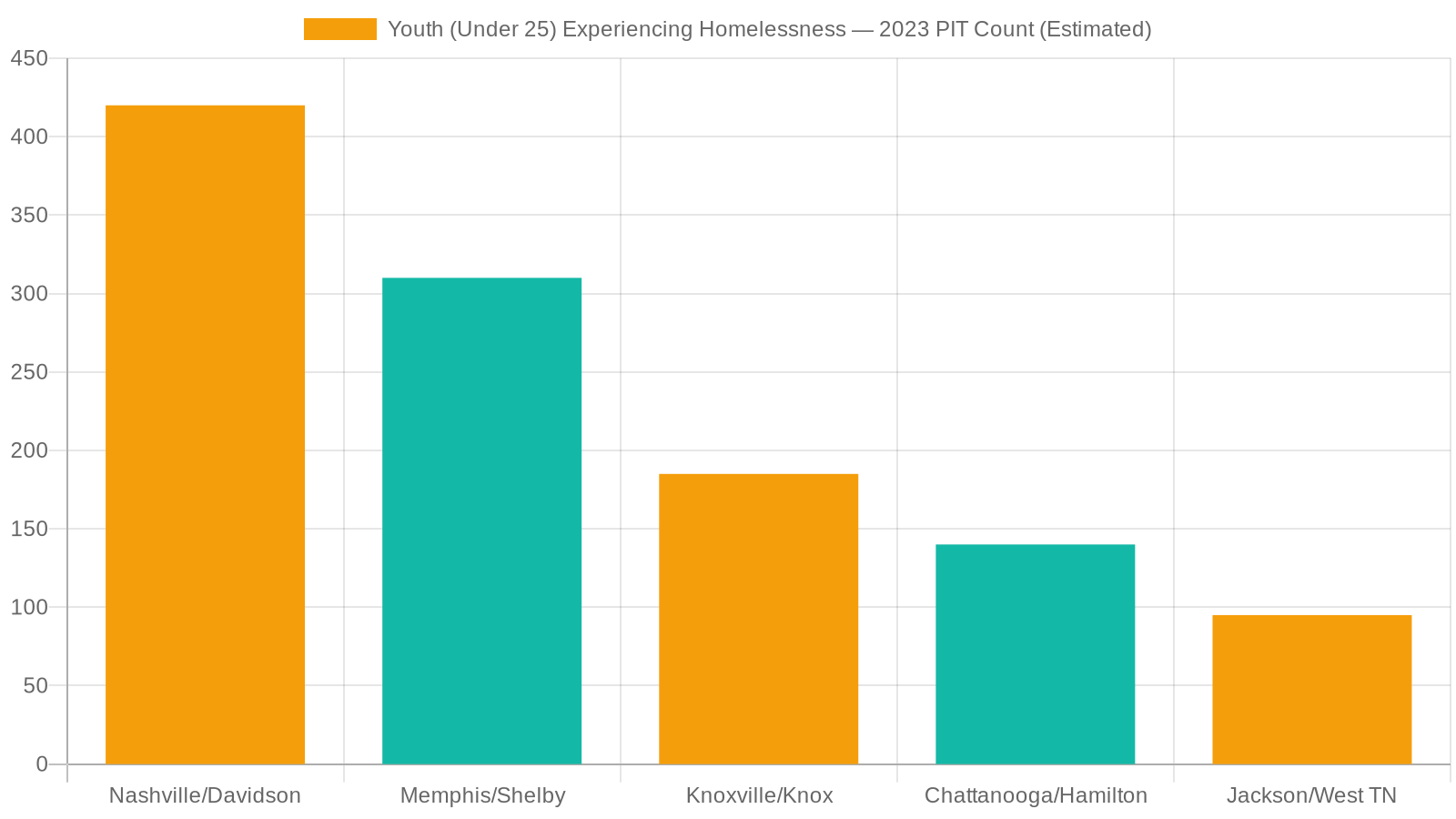
- TN-500 (Nashville/Davidson): Nashville YAAB
- TN-501 (Memphis/Shelby): Memphis YAAB
- TN-502 (Knoxville/Knox): Knoxville YAAB
- TN-503 (Chattanooga/Hamilton): Chattanooga YAAB
- TN-504 (Jackson/West TN): Jackson YAAB
- TN-506, TN-507, TN-509: Upper Cumberland, Northeast TN, and additional regional chapters
Each local YAAB meets regularly, takes on local advocacy projects, and sends representatives to statewide convenings. Joining your regional chapter is the fastest way to go from interested to involved.
5. Build Your Advocacy Story Without Reliving Trauma

Your lived experience is your most powerful advocacy tool — but sharing it publicly requires preparation and boundaries. This section walks you through how to build a testimony that is honest, strategic, and protective of your own wellbeing. You get to decide what you share and how.
The Power of a Personal Testimony
Lawmakers hear statistics every day. What they remember is a person. A well-crafted personal testimony — two to four minutes, delivered calmly and clearly — can shift a committee vote more than a 50-page policy brief. The goal is not to make people feel sorry for you. The goal is to make them understand what a specific policy failure looked like in real life, and what a specific policy fix would have changed.
A strong testimony has three parts:
- Who you are (briefly — name, age, city, connection to the issue)
- What happened (one concrete moment that shows the policy gap)
- Your ask (one specific thing you want the lawmaker to do)
You are not obligated to share anything you’re not comfortable sharing. Your story belongs to you.
Trauma-Informed Storytelling: Protecting Yourself
Advocacy spaces can sometimes pressure young people to share more than is healthy. Here are ground rules to protect yourself:
- You choose what to share. You can make a powerful point without disclosing your full history.
- Practice first. Run your testimony by a YAAB peer or staff member before delivering it publicly. Hearing yourself say it out loud in a safe space reduces the emotional charge.
- Name the policy, not just the pain. Anchor your story to a specific system failure (e.g., “I aged out of foster care at 18 with no housing plan”) rather than personal details that aren’t relevant to the ask.
- Debrief afterward. Plan something grounding for after a testimony — a meal with a friend, a walk, a call with someone you trust.
YAAB chapters provide peer support and coaching to help members prepare testimonies in a way that feels empowering, not extractive.
6. Navigate a Legislative Meeting or Hearing

Walking into the Tennessee State Capitol or a Nashville Metro Council chamber for the first time can feel intimidating. It doesn’t have to. Here’s a practical, step-by-step breakdown of what to expect before, during, and after a legislative meeting — so you can show up prepared and be taken seriously.
Before the Meeting: Research and Prepare
Walking into a legislative meeting unprepared is like showing up to a job interview without knowing the company. Before any meeting with a lawmaker or committee appearance, do this:
- Look up your representative: Use the Tennessee General Assembly website (capitol.tn.gov) to find your state senator and house member by zip code.
- Read their recent votes: Have they supported or opposed housing-related bills? Knowing their record helps you frame your ask.
- Prepare a one-pager: A single-page fact sheet with your ask, two or three supporting data points, and your contact information. Lawmakers keep these. Paragraphs of text get recycled.
- Know the bill number: If you’re testifying on a specific bill, know its number (e.g., HB 1234 / SB 5678) and the committee it’s in.
During and After: Etiquette, Follow-Up, and Persistence
Legislative advocacy is a relationship, not a single event. Here’s how to show up professionally and keep the door open:
- Arrive early. Committee hearings fill up. Signing up to testify is usually first-come, first-served.
- Be specific and brief. You typically get 2–3 minutes to testify. Use all of it, but don’t go over. Committees can cut you off.
- Thank them — even if you disagree. Saying “thank you for your time” costs nothing and keeps the relationship open for the next ask.
- Follow up within 48 hours. Send a brief email: your name, the bill you testified on, your ask, and a thank-you. Include your one-pager as an attachment.
- Track your contacts. Keep a simple spreadsheet of who you’ve met, what you asked for, and what they said. Advocacy is cumulative — lawmakers remember the people who keep showing up.
7. Use Digital Tools and Social Media for Advocacy

In-person testimony is powerful — but digital tools multiply your reach and let you advocate between legislative sessions. Here’s how to use online platforms strategically to amplify youth voices on housing policy in Nashville and across Tennessee, without burning out or sacrificing your privacy.
Online Tools That Amplify Your Voice
Legislative advocacy doesn’t only happen in person. Digital tools let you reach lawmakers, mobilize peers, and build public pressure between sessions:
- VoterVoice / Action Network: These platforms let advocacy organizations send pre-written emails or call scripts to constituents, making it easy to flood a lawmaker’s inbox before a key vote.
- capitol.tn.gov: Track bill status, find committee schedules, and look up contact information for every state legislator.
- Change.org / Care2: Online petitions can demonstrate public support for a policy ask — useful as a supplement to direct lobbying, not a replacement.
- Email campaigns: A coordinated email campaign from 50 constituents in a single district gets noticed. Quality beats quantity — personalized emails outperform form letters.
Social Media Strategy for Youth Advocates
Social media is where public narrative gets shaped — and young advocates are often better at it than the lobbyists they’re up against. Effective tactics include:
- Tag your legislators: When you post about a bill or issue, tag the relevant senator or representative. Public accountability matters.
- Use consistent hashtags: Coordinate with your YAAB chapter on shared hashtags so your posts aggregate and build momentum (e.g., #YouthVoicesTN, #HousingJusticeTN).
- Share data visually: A simple graphic showing youth homelessness numbers in Nashville gets more engagement than a paragraph of text.
- Go live at the Capitol: Short live videos from committee hearings or lobby days humanize the advocacy process and recruit new members to YAAB.
- Protect your privacy: You decide how much of your personal story to share publicly. Use a first-name-only policy if you prefer.
State vs. Local vs. Federal: Where Each Advocacy Target Lives
Youth homelessness policy is shaped at multiple levels of government. Knowing which level controls which resource helps you target your advocacy precisely and avoid wasted effort.
8. Measure Impact and Celebrate Wins

Advocacy is a long game — but wins happen, and they’re worth celebrating. Tracking your impact keeps your chapter motivated, demonstrates value to funders and CoC partners, and shows the next generation of young advocates that change is possible. Here’s how to measure what you’re doing and honor what you’ve already accomplished.
How to Track Policy Progress
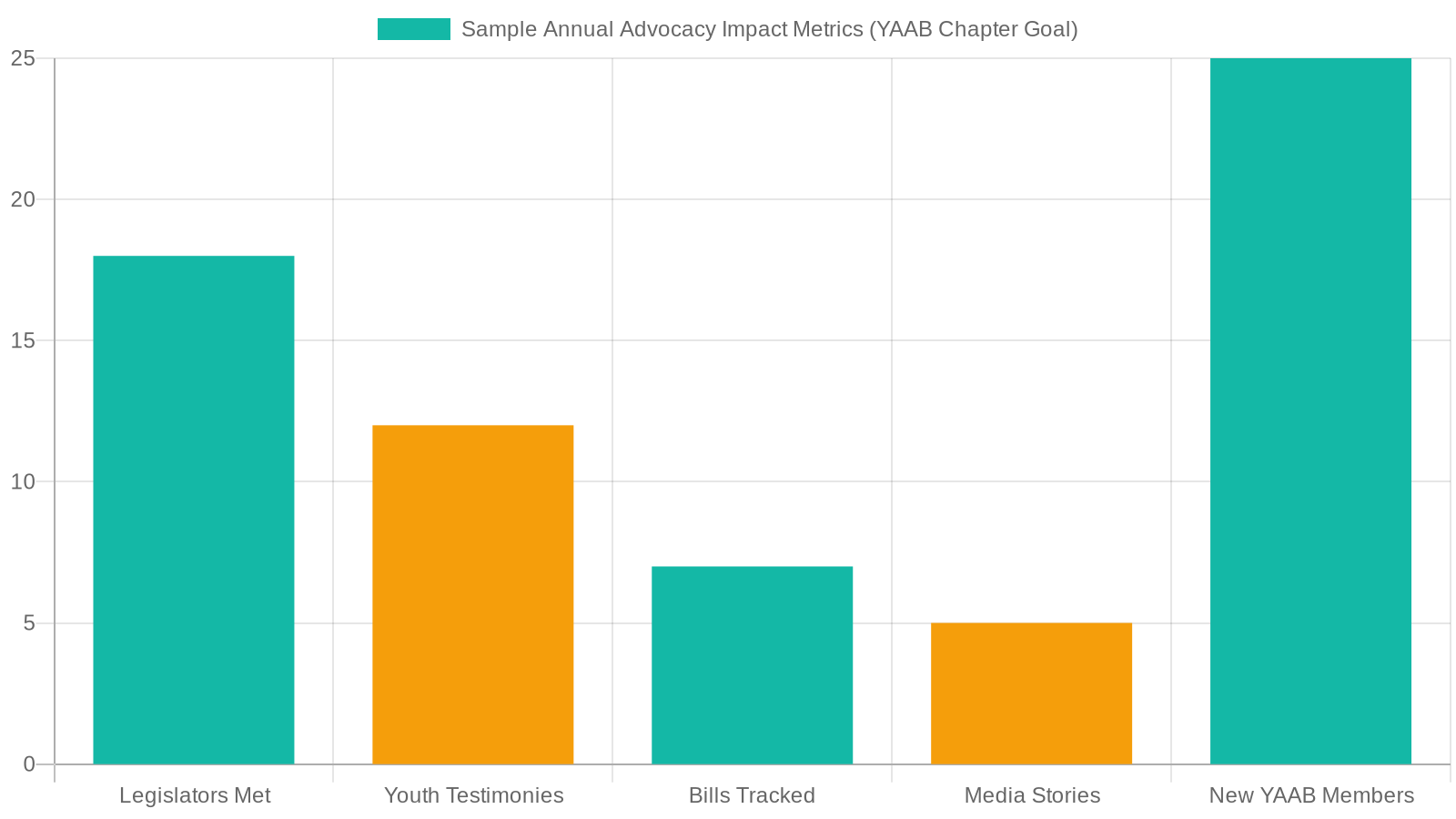
Advocacy can feel like pushing against a wall — until the wall moves. Tracking progress keeps you motivated and helps you report back to your community. Useful metrics include:
- Bill status: Did the bill you supported pass committee? Get a floor vote? Become law?
- Budget line items: Was funding for youth shelters increased in the state budget? By how much?
- Meetings secured: How many legislators did your YAAB chapter meet with this session?
- Testimonies delivered: How many youth members testified at the General Assembly or Metro Council?
- Media coverage: Did your advocacy generate news stories that shifted the public narrative?
YAAB chapters document these wins in annual impact reports, which also serve as evidence of youth engagement when applying for grants and CoC funding.
Real Wins: What Youth Advocacy Has Already Changed in Tennessee
Youth-led advocacy in Tennessee has produced real, documented policy wins. Examples include:
- YAAB members contributed to the expansion of Tennessee’s Extended Foster Care program, ensuring more youth could access support past age 18.
- Youth advocates in Nashville helped shape the priorities of the Davidson County CoC’s annual HUD funding application, resulting in increased youth-specific rapid-rehousing slots.
- YAAB testimony at the General Assembly contributed to legislative awareness of the gap between foster care exit and housing stability — laying groundwork for future bridge housing legislation.
These wins didn’t happen overnight. They happened because young adults showed up, told their stories, built relationships with lawmakers, and kept coming back. That’s the model — and it works.
Resources Every Young Advocate in Tennessee Should Know

Good advocacy is informed advocacy. Before you walk into a legislative meeting, it helps to know what resources already exist, what gaps remain, and where young adults can turn for help right now. Here’s a curated list of Tennessee-specific tools, organizations, and databases every young advocate should bookmark.
Tennessee-Specific Housing and Legal Resources
Knowing your rights and knowing where to get help are both forms of power. Key resources for young adults in Nashville and across Tennessee include:
- Tennessee Legal Aid (TALS): Free civil legal services for low-income Tennesseans, including housing and benefits issues. Multiple offices statewide.
- Tennessee Housing Development Agency (THDA): Administers state and federal housing funds, including Emergency Solutions Grants and HOME funds. thda.org
- 2-1-1 Tennessee: Dial 2-1-1 or text your zip code to 898-211 for local shelter, food, and service referrals anywhere in the state.
- Tennessee Voices for Children: Advocacy organization focused on children’s mental health — a coalition partner for youth housing advocates.
- HUD Youth Homelessness Demonstration Program (YHDP): Federal initiative that has funded youth-specific housing programs in Nashville and other Tennessee CoC regions.
YAAB Tennessee's Own Resource Hub
YAAB Tennessee maintains a curated resource library specifically for transition-age youth and the providers who support them. You can find housing guides, advocacy toolkits, and regional service directories at the YAAB Tennessee Resources page. For a deeper dive into the data and context behind youth homelessness in Tennessee, the Understanding Youth Homelessness page is a strong starting point for anyone preparing to advocate.
These resources are designed for young adults — not just professionals — and are updated regularly as programs and funding change.
Ready to Make Your Voice Heard in Nashville?

You’ve read the guide. You know the landscape, the issues, the tools, and the structure. Now it’s time to act. Whether you’re in Nashville, Knoxville, Chattanooga, or anywhere across Tennessee, the Youth Action Board is ready to support your first step into legislative advocacy — and every step after that.
Your First Three Moves This Week
You don’t have to wait until the next legislative session to get started. Here are three concrete actions you can take in the next seven days:
- Find your regional YAAB: Visit the YAAB Tennessee Local Chapters page and identify the chapter that covers your county. Reach out and ask about the next meeting.
- Learn one bill that affects you: Go to capitol.tn.gov and search for current bills related to housing, shelter, or foster care. Read the summary. You now know more than most people in the room.
- Draft your one-pager: Write down your name, your connection to the issue, one policy ask, and two supporting facts. You now have the foundation of a legislative testimony.
Every policy change in Tennessee that has benefited homeless young adults started with someone deciding their voice mattered. Yours does too.
Get Involved With YAAB Advocacy Statewide
YAAB Tennessee’s advocacy work spans all eight Continuum of Care regions — from Nashville/Davidson to Memphis/Shelby to the Upper Cumberland and Northeast Tennessee. Whether you want to testify at the General Assembly, join a local policy committee, or help shape the CoC’s annual HUD funding priorities, there’s a role for you.
Explore current campaigns, upcoming lobby days, and ways to get involved at the YAAB Tennessee Advocacy page. This is where statewide campaigns are coordinated, where you can find advocacy toolkits, and where your regional chapter connects to the bigger picture. Check the YAAB Events Calendar for upcoming lobby days, trainings, and regional meetings near you.
You’ve lived through the system. Now you can change it.
Frequently Asked Questions
How do I get involved in youth advocacy for homeless young adults in Nashville?
The fastest way is to join your regional Youth Action Board (YAAB) chapter. For Nashville and Davidson County, that's the TN-500 YAAB. Visit yaabtn.org/local-yaabs to find your chapter, reach out about the next meeting, and start connecting with peers who are already doing this work.
Do I need to be currently homeless to join YAAB Tennessee?
No. YAAB Tennessee is open to young adults ages 17 to 25 who have lived experience of homelessness or housing instability — meaning you may be currently housed but have experienced homelessness in the past. Lived experience is the qualification, not current housing status.
What age do you have to be to testify at the Tennessee General Assembly?
There is no minimum age requirement to testify at a Tennessee General Assembly committee hearing. Any member of the public can sign up to testify. YAAB members as young as 17 have testified at the Capitol in Nashville.
What is the Continuum of Care and why does it matter for youth homelessness?
A Continuum of Care (CoC) is a regional planning body that coordinates housing and services for people experiencing homelessness and applies for HUD funding on behalf of local programs. Tennessee has eight CoC regions. The CoC determines which programs get funded and how many youth-specific beds are available in your area — which is why YAAB's advisory role within each CoC is so important.
What happens to young people who age out of foster care in Tennessee?
In Tennessee, youth can remain in foster care and access extended support through age 21 under the Extended Foster Care program, but enrollment is not automatic. Youth who exit at 18 without a housing plan face an immediate risk of homelessness. YAAB advocates push for stronger bridge housing programs and better outreach to ensure youth know their options before they age out.
How can service providers and case managers support youth legislative advocacy?
Service providers can support youth advocacy by connecting clients to their regional YAAB chapter, helping youth prepare testimonies in a trauma-informed way, attending lobby days alongside youth members, and sharing data about service gaps with legislators. The goal is to amplify youth voices — not speak for them.